Tag Archives: sentencing commission

U.S. Sentencing Commission’s In A Hurry to Get Things Done – Update for March 27, 2023

We post news and comment on federal criminal justice issues, focused primarily on trial and post-conviction matters, legislative initiatives, and sentencing issues.

SENTENCING COMMISSION ROCKET DOCKET

rocket190620Showing that a federal prisoner has an ‘extraordinary and compelling’ reason for grant of compassionate release is critical to getting a sentence reduction grant under 18 USC § 3582(c)(1)(A). That statute also requires that any grant be consistent with “applicable policy statements” of the U.S. Sentencing Commission.

This is where it’s been sticky. The USSC has one policy statement (USSG § 1B1.13) addressing compassionate release, adopted well before the compassionate release statute was changed by the First Step Act. The same month Congress passed First Step (December 2018), the USSC lost its quorum as multiple members’ terms expired. President Trump nominated some new members a few months later, but the Senate did not approve them. That condition lasted until last spring, when President Biden nominated a complete slate of new members.

USSC2300327Without a quorum, the USSC could not modify § 1B1.13 to account for the changes that First Step made in the § 3582(c)(1)(A). Almost all courts responded by holding that the old § 1B1.13 was no longer an “applicable policy statement” and thus didn’t bind the courts. In a way, that was liberating to the people filing compassionate release motions, because courts were freed from § 1B1.13’s restrictive definition of what constituted “extraordinary and compelling” reasons.

But without a USSC policy statement moderating district court responses, compassionate release grants since 2019 have been characterized by wide disparity. In Oregon, for instance, about 62% of compassionate release filings have been granted. In the Middle District of Georgia, on the other hand, only about 1.5% have been granted.

The new USSC said last its top priority was to amend § 1B1.13, and in January, the Commission issued a draft § 1B1.13 for public comment that contained some very prisoner-friendly proposals and options. The proposed change was part of an extensive set of draft Guidelines amendments that spanned more than a hundred pages of text. The public comment period ended two weeks ago, with over 1,600 pages of comments filed on the compassionate release proposal alone.

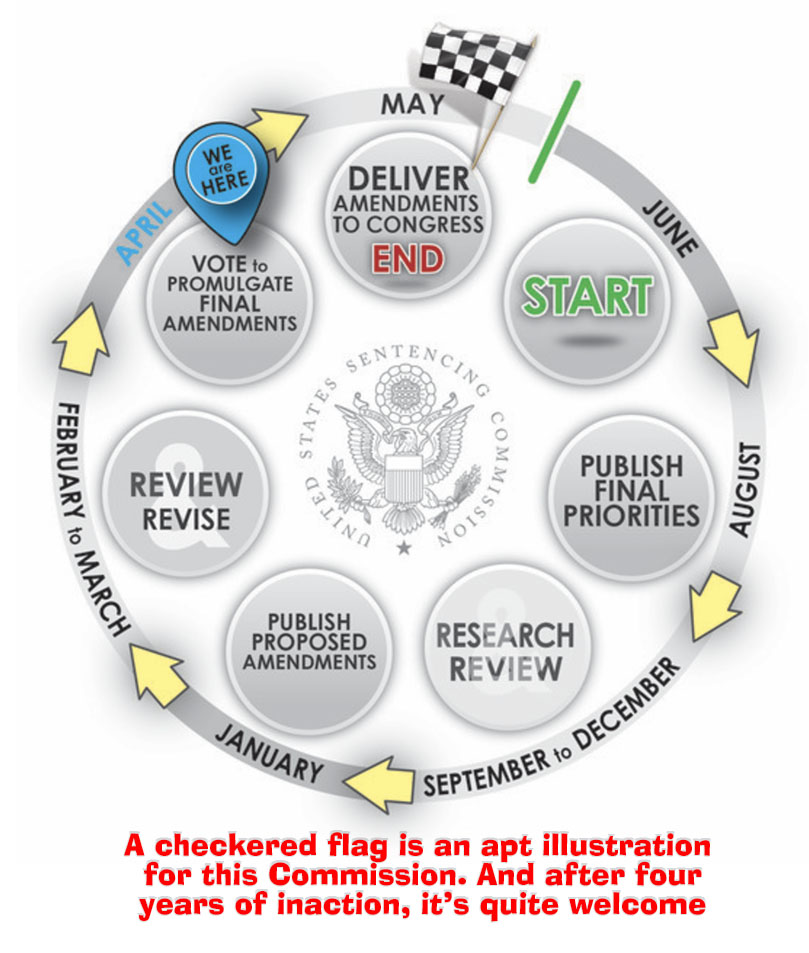
The USSC usually rolls out its proposal Guidelines amendments by May 1st. Under 28 USC § 994(p), the amendments go to Congress, which then has 180 days to reject them. If Congress does nothing (which is almost always the case), the changes become effective.

Iminahurry230327But this new USSC is in a hurry to get things done. Last week, the Commission announced an April 5 meeting at which the final § 1B1.13 (and all of the other draft proposed amendments) will be adopted.

If the amendment package goes to Congress that same day, they could become effective as early as Monday, Oct 2nd.

USSC, Public Meeting – April 5, 2023 (March 24, 2023)

– Thomas L. Root

DOJ Called Out On Two-Faced Acquitted Conduct Position – Update for March 13, 2023

We post news and comment on federal criminal justice issues, focused primarily on trial and post-conviction matters, legislative initiatives, and sentencing issues.

DOJ SPEAKS WITH FORKED TONGUE

In late January, the Department of Justice got the Supreme Court to place a hold on four petitions for certiorari that, if granted, would have the Court decide whether acquitted conduct can be used in sentencing. DOJ pulled this off by promising SCOTUS that the proposed Guidelines amendments were going to fix the problem.

Then, DOJ showed up at the Sentencing Commission to tell it that it lacked the power to make the acquitted conduct change. Last week, the Supreme Court petitioner cried foul.

Acquitted conduct sentencing is a district court’s use of conduct a jury had acquitted a defendant of in setting Guidelines and deciding whether to depart from those Guidelines in sentencing a defendant.

Real-life example: Last week, the 7th Circuit upheld Phillip Robinson’s sentence. Phil was charged with a drug distribution conspiracy and an 18 USC § 924(c) for using a gun during a drug transaction. The jury convicted him of the drug conspiracy but acquitted him on the § 924(c). At sentencing, the district court pumped up Phil’s Guidelines for possessing a gun “in connection with the cocaine conspiracy.” The Circuit said that under the Supreme Court’s 1997 United States v. Watts decision, using the acquitted conduct to enhance Phil’s sentence is fine.

The petitions in front of SCOTUS, led by McClinton v United States, argue that sentencing defendants based on conduct a jury acquitted them of violates the 6th Amendment. The Supremes have relisted McClinton multiple times (“relisting” meaning the justices have considered the petitions at their weekly conference and then deferred a decision to the next conference, a “relist” meaning that the petition have substantial support).

On January 12th, the Sentencing Commission rolled out its draft proposed Guidelines amendments for public comment. One of them would ban the use of acquitted conduct in setting Guidelines levels. If adopted, the change would mean that Phil’s Guidelines would be set based only on the coke conspiracy without reference to the gun.

nothingtosee230313In response, DOJ told the Supreme Court that “[t]his Court’s intervention” was not “necessary to address” the widespread problem of acquitted-conduct sentencing because “the Sentencing Commission could promulgate guidelines to preclude such reliance.”

A few weeks later, DOJ told the Sentencing Commission that it could not amend the Guidelines to curtail the use of acquitted conduct at federal sentencing. DOJ argued that USSC lacked the power to adopt the amendment. The proposal “would be a significant departure from long-standing sentencing practice” because the Supreme Court “has continued to affirm [in Watts] that there are no limitations on the information concerning a defendant’s background, character, and conduct that courts may consider in determining an appropriate sentence.”

McClinton has fired back that DOJ’s “expansive reading of Watts” in front of the Sentencing Commission “is deeply at odds with the far more limited understanding the government has presented to this Court… And contrary to its assurances to this Court, DOJ now contends that the Sentencing Commission lacks authority to promulgate amendments addressing the practice.”

two-faced230313Reuters said last week that DOJ’s position on this issue “does not square with agency leadership and President Joe Biden’s forceful commitments to addressing racism in the justice system and reducing mass incarceration.”

True, but what is more notable is that DOJ can tell the Supreme Court to deny McClinton review because the USSC is going to fix the acquitted conduct problem while at the same time telling USSC that it is not allowed to fix the problem. The government has prosecuted people for less duplicity than that.

Letter of DOJ to Supreme Court, Case No 21-1557, January 18, 2023)

United States v. Robinson, Case No 22-1472, 2023 USAppLEXIS 5625 (7th Cir, March 9, 2023)

Supplemental Brief of Dayonta McClinton, Case No 21-1557 (Supreme Ct, March 7, 2023)

United States v. Watts, 519 US 148 (1997)

Reuters, U.S. Justice Dept takes a hard line on sentencing reform (March 7, 2023)

Sentencing Law and Policy, DOJ testimony to Sentencing Commission on acquitted conduct sentencing generates notable responses (March 8, 2023)

– Thomas L. Root
Did DOJ Sandbag McClinton Cert Petition? – Update for February 21, 2023

We post news and comment on federal criminal justice issues, focused primarily on trial and post-conviction matters, legislative initiatives, and sentencing issues.

A COUPLE OF SCOTUS RELISTS COME UP TODAY

relist230221Last week, I reported that the Supreme Court would again take up McClinton v. United States – a case on using acquitted conduct at sentencing – at last Friday’s conference. We won’t know the conference’s outcome until today at 9:30 am EST, but last week, SCOTUSblog.com had an interesting spin on the repeated McClinton relistings.

John Elwood, one of Dayonta McClinton’s lawyers and a regular SCOTUSblog contributor, wrote that McClinton and four other cases raising the same issue “are just sitting there on the court’s docket… [A]s near as we can tell, the court appears to be holding those cases to see whether the US Sentencing Commission acts on a pending proposal to place restrictions on federal courts’ consideration of acquitted conduct at sentencing.”

How come? It seems the Solicitor General wrote to the Court in January, alerting it to the Commission’s acquitted conduct proposal and implying that the Guidelines change would solve the problem, making the grant of McClinton’s constitutional challenge to acquitted conduct superfluous.

inaction230221Dayonta McClinton has argued that the USSC proposal is “woefully inadequate to resolve the issue, but it still may explain the court’s inaction,” Elwood wrote. “Things may become clearer down the road.”

Another new relist, Davis v. United States, raises a fascinating 28 USC § 2255 question: Quartavious Davis got 159 years for a string of armed Hobbs Act robberies. His two co-defendants signed plea deals and got about a tenth of that time. Quart argues his attorney was ineffective by not negotiating the same kind of plea agreement with the government. His district court denied the post-conviction petition, holding that Quart could not prove that he would have gotten a plea deal if his lawyer had advocated for one.

Quart contends it should be enough to show that similarly-situated co-defendants got plea deals, which – he argues – suggests there is no reason the government would not have given him the same benefit. The 11th Circuit disagreed, holding that he could not show prejudice absent making some showing that the government had offered him a plea deal.

catch22-230221The petition raises the Catch-22 that informs a lot of § 2255 post-conviction arguments. Under the case that shaped modern federal habeas corpus claims directed at the constitutionality of federal convictions and sentences – Strickland v. Washington – in order to make a prima facie showing that a movant is entitled to a hearing, the prisoner has to show his or her lawyer goofed, and that but for the goof, there is a reasonable probability that the goof affected the outcome.

Here, Quart has argued that probability favors his claim that the government would have made a plea offer: after all, his two co-defendants – whose culpability was little different than his own – got plea deals. Unsurprising, inasmuch as 94% of federal prosecutions end in plea deals. But the government argues that he could not prove that the government would have made an offer, so he should be denied the very hearing that he needs to prove the government would have made an offer.

Catch-22. To be entitled to a hearing that could prove an element of his claim, the movant must prove the element.

We’ll see whether the Supreme Court is interested in a case that could sharpen the definition of “reasonable probability” as used in Strickland.

McClinton v. United States, Case No. 21-1557 (certiorari filed March 15, 2022)

Davis v. United States, Case No. 22-5364 (certiorari filed August 8, 2022)

Strickland v. Washington, 466 U.S. 668 (1984)

SCOTUSblog.com, Plea bargaining and a high-profile separation-of-powers case (February 15, 2023)

JDSupra, Sentencing Guidelines Amendment Would Preclude Acquitted Conduct from Being Used at Sentencing (January 30, 2023)

– Thomas L. Root

New Day Dawning for Compassionate Release? – Update for January 17, 2023

We post news and comment on federal criminal justice issues, focused primarily on trial and post-conviction matters, legislative initiatives, and sentencing issues.

SENTENCING COMMISSION ISSUES DRAFT COMPASSIONATE RELEASE AMENDMENTS

USSCvanwinkle230117For the first time in five years, the U.S. Sentencing Commission last week issued draft Guidelines amendments that – after public comment and a 6-month Congressional review period – will become effective in November.

The USSC’s draft amendments cover everything from the drug safety valve to extra points off for defendants with a zero criminal history score to tougher guideline numbers for gun straw purchasers. But these draft changes are of lesser interest to prisoners because nothing the Commission changes in the guidelines is retroactive unless the USSC goes through a separate amendment process to make it so.

The last time that happened was the “drug-minus-two” change in 2014. Whether any of the sentencing changes the USSC issued in draft form last week will ever make the retroactivity cut is not yet clear.

The compassionate release policy statement that the USSC rolled out, however, will have applicability for people already serving a sentence. The Guidelines applied at sentencing have been advisory for the past 18 years, but the Commission’s compassionate release policy, USSG § 1B1.13, is not: under 18 USC § 3582(c)(1)(A) – the  “compassionate release” provision of the sentencing statute – a district court must ensure any sentence reduction decision “is consistent with applicable policy statements issued by the Sentencing Commission.”
compassionlimit230117The existing compassionate release policy was written before the First Step Act passed, for an era in which only the Bureau of Prisons could bring a compassionate release motion on behalf of an inmate. Since First Step passed, most (but not all) circuit courts have ruled that § 1B1.13 is not binding because it had not been amended to include First Step changes. While that freed district courts to grant compassionate release in circumstances other than the few listed in the old § 1B1.13, it wasn’t all good.

“Commission data have indicated that in recent years — over the COVID-19 pandemic and without a Commission quorum — the district courts have granted compassionate release at varying rates,” US District Court Judge Carlton W. Reeves, Commission chairman, said at last week’s USSC meeting. “It is my sincere hope that our work… brings greater clarity to the federal courts and more uniform application of compassionate release across the country.”

According to the USSC, people in Oregon had a 62% chance of getting a compassionate release grant. People in the Middle District of Georgia had a 1.5% chance. Giving federal judges the freedom to define for themselves what justifies a sentence reduction is a great thing when it frees the jurists from unreasonably strict limitations. It’s not so great when defendants with similar histories and offenses are treated dramatically differently due to an accident of geography.

The draft § 1B1.13 amendments propose additions to circumstances justifying compassionate release that include “medical conditions that require long-term or specialized medical care, without which the defendant is at risk of serious deterioration in health or death, that are not being provided in a timely or adequate manner; risk of being affected by a disease outbreak in prison for which the defendant is at increased risk of suffering severe medical complications or death; the incapacitation of the defendant’s parent when the defendant would be the only available caregiver; the defendant has been the victim of sexual assault or physical committed by a BOP employee or contractor; or “the defendant is serving a sentence that is inequitable in light of changes in the law.”

compassion160208The proposal also suggests a “catch-all” provision that “the defendant presents an extraordinary and compelling reason other than, or in combination with” the other circumstances the Commission has proposed for the beefed-up  § 1B1.13

The USSC draft proposals also include a provision to amend § 1B1.3 the “relevant conduct’ provision that tends to run up sentencing ranges, “to add a new subsection (c) providing that acquitted conduct shall not be considered relevant conduct for purposes of determining the guideline range unless the conduct was admitted by the defendant during a guilty plea colloquy or was found by the trier of fact beyond a reasonable doubt to establish, in whole or in part, the instant offense of conviction.” As noted, no one at this point knows whether this might become retroactive in the future.

Reuters, U.S. panel proposes limiting sentencing of defendants for acquitted conduct (January 12, 2023)

USSC, US Sentencing Commission Seeks Comment on Proposed Revisions to Compassionate Release, Increase in Firearms Penalties (January 12, 2023)

USSC, Proposed Amendments to the Sentencing Guidelines (Preliminary) (January 12, 2023)

Sentencing Law and Policy, US Sentencing Commissions publishes proposed guideline amendments and issues for comment (January 12, 2023)

– Thomas L. Root
Four Years After First Step Passes, USSC to Roll Out Draft Compassionate Release Policy – Update for January 12, 2023

We post news and comment on federal criminal justice issues, focused primarily on trial and post-conviction matters, legislative initiatives, and sentencing issues.

SENTENCING COMMISSION TO PUBLISH FIRST DRAFT PROPOSED GUIDELINES AMENDMENTS TODAY

USSC170511The U.S. Sentencing Commission will adopt its first set of draft proposed amendments to the Federal Sentencing Guidelines in five years when it meets today.

The Commission’s meeting, which starts at 1 p.m. Eastern time,  will be live-streamed.

Last October, the Commission announced that its top priority is amending USSG § 1B1.13, the policy statement on compassionate release.

The compassionate release statute, 18 U.S.C. § 3582(c)(1)(A), requires judges to only grant compassionate releases that are “consistent with applicable policy statements issued by the Sentencing Commission.” However, § 1B1.13 was written when only the BOP could bring compassionate release motions. The compassionate release statute was changed by the First Step Act, passed four years ago at the same time the Sentencing Commission lost its quorum,

Most (but not all) Circuits have since ruled that § 1B1.13 was written for a compassionate release regime that no longer exists and thus is not binding on district courts until it is amended.

Other changes that may be issued in draft form include changes in the drug Guideline (USSG § 2D1.1) due to First Step’s lowering of mandatory drug minimums, resolving circuit conflicts over whether the government may withhold a motion for a third acceptance of responsibility point because a defendant had moved to suppress evidence before entering a guilty plea, and amendments to the Guidelines career offender chapter that would provide an alternative to the “categorical approach” in determining whether an offense is a “crime of violence” or a “controlled substance offense.”

The draft the Commission will issue Thursday will be open for public comment for a period of time, and then a slate of proposed amendments will be adopted by May 1.  Under 28 U.S.C. § 994(p), the proposed amendments become effective November 1st unless Congress blocks them.

U.S. Sentencing Commission, Public Meeting – January 12, 2023 (January 3, 2023)

US Sentencing Commission, Commission Sets Policy Priorities (October 28, 2023)

– Thomas L. Root

Sentencing Commission Rolls Up Its Sleeves – Update for November 3, 2022

We post news and comment on federal criminal justice issues, focused primarily on trial and post-conviction matters, legislative initiatives, and sentencing issues.

USSC SETS GUIDELINE AMENDMENT PRIORITIES

The U.S. Sentencing Commission held its first meeting in 46 months last Friday, voting in a 20-minute session to adopt priorities for the Guidelines amendment cycle that ends Nov 1, 2023.

USSC170511The USSC lost its quorum due to term expirations of multiple members in December 2018, just as the First Step Act was signed into law. That meant the commission was unable to revise the Guidelines just as First Step changes required modifications that would have prevented conflicting judicial interpretations, especially in the application of 18 USC § 3582(c)(1)(A) sentence reduction motions, commonly called “compassionate release” motions.

The compassionate release statute requires judges to consult USSG § 1B1.13, Guidelines policy on granting compassionate releases, but § 1B1.13 was written for a time when only the Bureau of Prisons could bring compassionate release motions. Most but not all Circuits have ruled that § 1B1.13 is not binding on district courts until it is amended, but the 11th has ruled that it is binding, the 8th has studiously avoided deciding the question, and others – such as the  3rd, 6th and 7th – have held that district judges cannot consider First Step Act changes in sentencing law that would result in much lower sentences when deciding compassionate release motions.

U.S. District Judge Carlton Reeves (S.D. Mississippi), chairman of the Commission, said implementing the First Step Act through revisions to the federal sentencing guidelines would be the USSC’s “top focus.”

Other changes in the Guidelines, such as to the drug tables, could result from First Step’s lowering of drug mandatory minimums.

responsibility221103Additional priorities for the coming year include resolving circuit conflicts over whether the government may withhold a motion for a third acceptance-of-responsibility point just because a defendant moved to suppress evidence before pleading guilty and whether an offense must involve a substance actually controlled by the Controlled Substances Act to qualify as a “controlled substance offense,”

The USSC will also consider amendments to the Guidelines career offender chapter that would provide an alternative to the “categorical approach” in determining whether an offense is a “crime of violence” or a “controlled substance offense.

First Step also made changes to the “safety valve,” which relieves certain drug trafficking offenders from statutory mandatory minimum penalties, by expanding eligibility to some defendants with more than one criminal history point. A USSC press release says the Commission “intends to issue amendments to § 5C1.2 to recognize the revised statutory criteria and consider changes to the 2-level reduction in the drug trafficking guideline currently tied to the statutory safety valve.”

marijuana220412The only addition to the Commission’s previously-published list of proposed priorities that came out of the meeting was consideration of possible amendments on whether, and to what extent, people’s criminal history for marijuana possession can be used against them in sentencing.

The cannabis item was added and adopted after President Joe Biden issued a mass marijuana pardon proclamation.

The Commission’s priorities only guide what it will be working on for the Nov 2023 amendment cycle. Expect amendment proposals by late January, followed by a public comment period, and final amendments by May 1. After that, the Senate has 6 months to reject any of the amendments (a very rare occurrence). Amendments not rejected will become effective Nov 1, 2023.

Reuters, Newly-reconstituted U.S. sentencing panel finalizes reform priorities (October 28, 2022)

US Sentencing Commission, Final Priorities for Amendment Cycle (October 5, 2022)

US Sentencing Commission, Commission Sets Policy Priorities (October 28, 2022)

Marijuana Moment, Federal Commission Considers Changes To How Past Marijuana Convictions Can Affect Sentencing For New Crimes (October 28, 2022)

– Thomas L. Root

D.C. Circuit Creates More “Compassionate Release” Circuit Confusion – Update for October 26, 2022

We post news and comment on federal criminal justice issues, focused primarily on trial and post-conviction matters, legislative initiatives, and sentencing issues.

DC CIRCUIT HOLDS THAT CHANGES IN THE LAW CANNOT SUPPORT COMPASSIONATE RELEASE

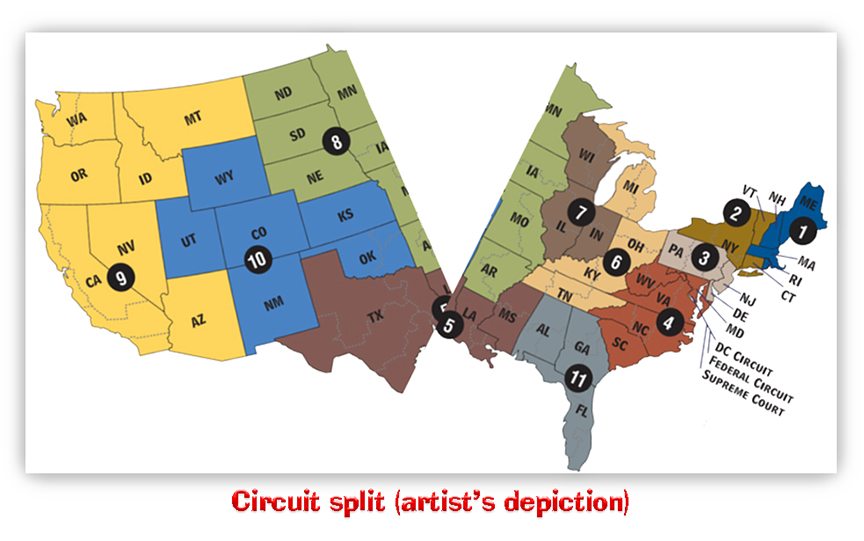
circuitsplit220516The US Court of Appeals for the District of Columbia Circuit has deepened the circuit split on compassionate release, joining three other circuits in holding that a prisoner cannot use the fact he or she is serving a sentence that could not be imposed today as “extraordinary and compelling” reason for an 18 USC § 3582(c)(1)(A)(i) compassionate release.

In 2016, Curtis Jenkins was caught by D.C. police with drugs and a gun. He got bonded out of jail, but a short time later he was caught by D.C. police again with drugs and a gun. Curtis thus faced two 18 USC § 924(c) counts (for carrying a gun during drug trafficking) and a 15-year Armed Career Criminal Act count (18 USC § 924(e)), not to mention qualifying as a “career offender” under the Sentencing Guidelines (which dramatically jacks up the sentencing range).

Factor all of that into the mix, Curtis was looking at a minimum 45-year sentence. He did the wise thing, agreeing to a plea deal that carried a Guidelines range of 23-27 years. Despite that range – still a substantial chunk of time – The parties agreed to recommend only 12 years to the sentencing judge.

From there, things got even better. Curtis walked out of sentencing with eight years. For the math-challenged among us, good lawyering had cut Curtis’s sentence exposure by about 82%.

It looked like a great deal at the time, but after a few years, Curtis thought it had all turned to dust later.

First, in 2018, the First Step Act changed § 924(c) so that the 25-year add-on sentence required by law for the second § 924(c) violation would only apply if the second offense came after a first conviction. If that had been the law when Curtis was convicted, his 45-year mandatory minimum sentence would have been only 30 years.

May you rest in peace, Betty... stealing America's hearts did not make you ACCA-qualified.
May you rest in peace, Betty… stealing America’s hearts did not make you ACCA-qualified.

Second, things changed for Curtis’s ACCA conviction. If a felon was caught with a gun back when Curtis was nabbed, he or she faced a zero-to-ten-year sentence. But if the defendant had three prior convictions for violent crimes or drug offenses, the sentence was a minimum 15 years. Two of Curtis’s predicate offenses qualifying him for the ACCA were for assault with a weapon. D.C. law at the time permitted conviction for that offense even when the assault was committed “recklessly.” But in 2021, the Supreme Court ruled in Borden v. United States that any crime that could be committed recklessly was not a “crime of violence” for ACCA purposes. If that had been the law when Curtis was convicted, his 30-year mandatory minimum sentence exposure would have dropped to only 10 years.

Third, the Court of Appeals held in United States v. Winstead that drug offenses relied on to qualify someone as a Guidelines career offender could not count when they were mere attempts. Curtis’s drug priors were for attempted drug distribution, meaning that the high sentencing range that applied because he was a Guidelines “career offender” would have been out, too.

Like that, all of the very good reasons Curtis once had for taking a 12-year deal disappeared like Halloween candy on trick-or-treat night. He moved for a sentence reduction, arguing that if he had made a deal based on the sentence exposure he would have faced if he were sentenced today, it would have been a lot lower.

emptybowl221027The district court denied Curtis’s
motion, holding that changes in the law were not the kind of “extraordinary and compelling” reasons for sentence reduction listed in USSG § 1B1.13, the Guidelines policy statement covering compassionate release motions. That statement does not bind the court, the judge ruled, but he nonetheless referred to it for “guidance.”

The district court said the First Step Act, Winstead, and Borden were irrelevant, because the compassionate-release statute does not permit courts to reexamine the lawfulness or fairness of a sentence as originally imposed.

Two weeks ago, the DC Circuit upheld the district court’s denial. “We agree with the 3rd, 7th, and 8th Circuits,” the appellate panel wrote. “To begin, there is nothing remotely extraordinary about statutes applying only prospectively. In fact, there is a strong presumption against statutory retroactivity, which is ‘deeply rooted in our jurisprudence’ and ‘embodies a legal doctrine older than our Republic’… [The Supreme Court has held that] in federal sentencing the ordinary practice is to apply new lower penalties to defendants not yet sentenced, while withholding that change from defendants already sentenced. And what “the Supreme Court views as the ‘ordinary practice’ cannot also be an ‘extraordinary … reason’ to deviate from that practice.”

extraordinary221027But other Circuits – including the 2nd, 4th, 5th, 9th and 10th – do consider such changes to be among the “extraordinary and compelling reasons” for sentence reduction that will drive a compassionate release motion. The Circuit split just exacerbated by Curtis’s D.C. Circuit decision will most likely be fixed not by the Supreme Court but rather by the newly-reconstituted Sentencing Commission.

The Commission, which just announced having received over 8,000 public comments on its announcement of proposed priorities – has its first public meeting set for this coming Friday. The Commission is expected to adopt its priorities for the coming year, the first of which is likely to be to amend § 1B1.13 to bring some predictability to compassionate release cases.

When that happens, § 1B1.13 will again be binding on the courts, and we can expect a little uniformity to be injected into what is now a chaotic compassionate release system.

United States v. Jenkins, Case No. 21-3089, 2022 U.S.App. LEXIS 28198 (D.C. Cir., Oct. 11, 2022)

U.S. Sentencing Commission, Public Meeting, October 28, 2022

U.S. Sentencing Commission, Public Comments on Priorities (October 23, 2022)

– Thomas L. Root

Batting Cleanup for LISA… – Update for June 17, 2022

wahoo220617We post news and comment on federal criminal justice issues, focused primarily on trial and post-conviction matters, legislative initiatives, and sentencing issues.

Today, we’re cleaning up the week with some odds and ends left over from the week before…

Judiciary Committee Grills Sentencing Committee Nominees: President Biden’s seven nominees to the U.S. Sentencing Commission promised at a Senate hearing last week to prioritize implementing the First Step Act by amending the Guidelines, something the Commission had been unable to do since losing its quorum just as the 2018 law passed.

U.S. District Judge Carlton Reeves (S.D. Miss), nominated to be chairman of the USSC, told the Judiciary Committee that the Commission would also address what he called “troubling” divisions that emerged among courts on sentencing issues during the years it lacked a quorum.

Four Democrat and three Republican picks have been nominated to join the seven-member commission.

Senior U.S. District Judge Charles Breyer (N.D. Cal.), the lone remaining member of USSC, has complained that the Commission’s inability to update its compassionate release policy (USSC § 1B1.13) in light of First Step has resulted in inconsistent decisions across the nation on compassionate release amid the COVID-19 pandemic.

“Today, we take an important step to remedy that problem,” said Judiciary Committee chairman Sen Richard Durbin (D-IL).

Sen Marsha Blackburn (R-TN) jumped on one Democratic nominee, former U.S. District Judge John Gleeson. Gleeson, one of the most thoughtful and creative sentencing judges during his time on the E.D.N.Y. bench, has been a critic of mandatory minimum drug sentences.

“How can you possibly say that more lenient sentencing and reduced penalties for convicted criminals is the answer to our crime problems?” Blackburn complained. Gleeson, now a partner at a Wall Street law firm, responded that as a judge he tried only to show the impact mandatory sentences have on “the individualized sentencing that our system contemplates.”

pissfire220617Meanwhile, former federal defender Laura Mate, a director of the Federal Defenders’ Sentencing Resource Counsel Project, refused demands by Sen Josh Hawley (R-MO) to renounce a detailed 61-page letter to the Sentencing Commission she had co-signed in 2013. The letter had criticized mandatory minimums, especially for some child pornography offenses, with a detailed, well-reasoned argument.

Mate was pilloried by at least one YouTuber for politely dodging Hawley’s question, but given what I know of the good Senator from the Show-Me State, I would resist agreeing with him that the sun rises in the east, because he would end our exchange accusing me of causing dawn to arrive too early.

Republican USSC nominees include Claire McCusker Murray, a Justice Department official during the Trump era; Candice Wong, a federal prosecutor in Washington, D.C., and U.S. District Judge Claria Horn Boom of Kentucky.

The hearing suggests that the Senate will act soon on restoring a functional Sentencing Commission. However, as Ohio State University law professor Doug Berman observed in his Sentencing Law and Policy blog, “it is still unclear exactly when there will be a committee vote and then a full Senate vote on these nominees. I am hopeful these votes might take place this summer, but I should know better than to make any predictions about the pace of work by Congress.”

Senate Judiciary Committee, Hearing (June 8, 2022)

Reuters, Biden’s sentencing panel noms vow to implement criminal justice reform law (June 8, 2022)

Sentencing Law and Policy, Senate conducts hearing for nominees for US Sentencing Commission (June 8, 2022)

Federal Defenders, Letter to Sentencing Commission (July 15, 2013)

rockingchair220617Last Week Makes Mike Long for Retirement:  BOP Director Carvajal is probably giddy at the prospect that his replacement is finally waiting in the wings. 

Besides the USP Thomson investigation being announced last week, the BOP suffered some embarrassing press last week:

•  A Miami TV station reported on a CO’s claim that drones were being used to smuggle contraband into FDC Miami;

•  A Colorado paper reported that the BOP was paying $300,000 in damages to an ADX Florence inmate with Type 1 diabetes who alleged in a lawsuit that he had been denied adequate amounts of insulin;

•  A San Francisco area TV station reported that a former FCI Dublin inmate – who early on told BOP authorities about what has turned into a major sex abuse scandal featuring the arrest of a former warden and four other staffers – says she was punished in retaliation for calling out the staff abuse. “I will never tell another inmate that they should go to report anything to anyone higher up,” the former prisoner told KTVU. “Because all that’s going to happen is it’s going to make their life worse.”; and

•  A former correctional officer at the Federal Medical Center in Lexington, Kentucky, was sentenced to more than 11 years after pleading guilty to sexual abuse of inmates.

Finally, in February, Carvajal told a Congressional committee that the “common criticism” that the BOP is understaffed was a “narrative [that] is routinely misrepresented without reference to the factual data.” Two weeks ago, he told BOP staff in an agency-wide memo that “staffing levels are currently trending downward nationwide.”

Last week, Government Executive reported that the declines have happened in the last four months and that the employees who have quit cite “lack of training and lack of connection to the institution as reasons for their leaving the bureau within the first few years of service.”

Mike must be thinking that the old rocking chair is looking pretty good right now.

WQAD-TV, Justice Department Inspector General launches investigation into USP Thomson (June 9, 2022)

WTVJ, Inmates Attempted to Smuggle Contraband Using Drones, Correctional Officer Says (June 8, 2022)

Colorado Sun, Bureau of Prisons to pay $300,000 to settle lawsuit after diabetic prisoner was allegedly deprived of insulin at Supermax facility (June 7, 2022)

KTVU, Woman who reported Dublin prison sexual abuse claims she was target of retaliation (June 10, 2022)

Government Executive, Federal Prisons Are Losing Staff. The Bureau’s Director Would Like to Fix That By October (June 6, 2022)

– Thomas L. Root

Compassionate Release Numbers Show Gross Disparities – Update for May 17, 2022

We post news and comment on federal criminal justice issues, focused primarily on trial and post-conviction matters, legislative initiatives, and sentencing issues.

COMPASSIONATE RELEASE AIN’T WHAT IT USED TO BE

funwithnumbers170511A Sentencing Commission report issued last week chronicled a slow but consistent slide in the rate of compassionate release motions being granted by district courts, even while highlighting how inconsistencies among federal courts are resulting in gross sentence disparities.

The First Step Act granted the right to prisoners to file their own motions for sentence reduction under 18 U.S.C. § 3582(c)(1)(A)(i). For the 30 years prior to that, only the Bureau of Prisons was permitted to file on behalf of the prisoner, and – unsurprisingly – the BOP was greatly disinclined to ask any court to let any of its wards go home early.

In the year following First Step’s passage, around 450 compassionate release motions were filed. But in April 2020, with onset of the COVID-19 pandemic, the numbers skyrocketed. Nearly as many compassionate release motions were filed in April 2020 (436) as in all of the 15 prior months. By July 2020, over 1,500 a month were being submitted.

Everyone was scared. But as COVID became more common, the monthly numbers declined. In September 2020, 1,363 were filed, with 19% granted. A year later (September 2021), 456 motions were filed with 11% granted.

The report highlights striking variations in grant rates among the 94 federal districts. Oregon repudiates its nickname of The Land of Hard Cases, remaining the best place, statistically, to file. Of 144 motions, 63% have been granted. The back of the pack includes Western North Carolina (only 3.4% of 534 granted), Eastern Texas (2.0% of 349 granted) and Southern Georgia (2.0% of 248 granted). The average grant rate since the First Step Act permitted the filing of compassionate release motions by inmates themselves is 17.2% out of 3,867 motions.

oregon220517Ohio State University law professor Doug Berman noted in his Sentencing Law and Policy blog that “the District of Maryland — with a total of 211 sentencing reduction motions granted (though “only” a grant rate of 32.7% with 646 motions) — granted more of these motions than all the courts of the Fifth Circuit!” The 5th Circuit has the lower grant rate (9.3% of the 2,197 total brought) of all the circuits.

Not surprisingly, the longer one has been in prison, the better the chances for compassionate release. People with sentences over 20 years had a 26.2% grant rate, compared to a 3.8% grant rate for people with a sentence of 24 months or fewer. But here’s a strange inversion: people with lowest criminal history had a 30.0% grant rate, while those with a moderate history only had a 12% grant rate. But inmates with the worst history had a grant rate of 29.2%, almost as good as those with no prior convictions.

But the most beneficial information in the Report is the list of reasons that compassionate release motions were denied. Courts found that 18 USC § 3553(a) sentencing factors and the need to protect the public required denial in 33.1% of all compassionate release motions. Behind that were the movants’ failure to show they were at risk from COVID factors or a serious medical condition (26.4%), followed by failure to exhaust administrative remedies (17.9%). These amounted to nine out of ten reasons for denial (the courts failed to list reasons in 10% of the cases).

dice161221If it provides no other benefit, the Report suggests that compassionate release – far from being the relief First Step Act intended – has become an enormous geographical crapshoot, and a driver of sentence disparity.

US Sentencing Commission, Compassionate Release Data Report – Fiscal Years 2020 to 2021 (May 8, 2022)

Sentencing Law and Policy, US Sentencing Commission releases latest detailed “Compassionate Release Data Report” (May 9, 2022)

– Thomas L. Root

President Packs USSC With Some Good Picks – Update for May 12, 2022

We post news and comment on federal criminal justice issues, focused primarily on trial and post-conviction matters, legislative initiatives, and sentencing issues.

SENTENCING COMMISSION DROUGHT IS LIFTING

noquorum191016President Biden yesterday nominated a bipartisan slate of seven candidates to serve as commissioners on the U.S. Sentencing Commission. If confirmed, the nominees will revitalize the USSC, giving it its first quorum in almost four years.

The list includes U.S. District Judge Carlton W. Reeves (Southern District of Mississippi). If confirmed by the Senate, he will be the first black jurist to chair the 33-year-old commission’s history.

By statute, the Commission must be bipartisan and consist of at least three federal judges and no more than four members of each political party.

Biden’s planned nominees include three active judges and four attorneys. Of those nominees, two have experience as public defenders. Nominees also include

• Laura Mate, a former assistant federal public defender in the Western District of Washington, serves as Sentencing Resource Counsel for the Federal Public and Community Defenders in Arizona;

• Judge Luis Felipe Restrepo, appointed by President Obama to serve on the US Court of Appeals for the Third Circuit and a former assistant federal public defender in the Eastern District of Pennsylvania;

• Claire McCusker Murray, formerly principal deputy associate attorney general in the Dept. of Justice during the Trump Administration;

• Judge Claria Horn Boom, appointed by President Trump to the U.S. District Courts for both the Eastern and Western Districts of Kentucky;

• Former U.S. District Judge John Gleeson (EDNY), a partner at Debevoise and Plimpton LLP, who enjoys close to rock-star status as a forward-thinking sentence reformer;

• Candice Wong, Assistant United States Attorney and Chief of the Violence Reduction and Trafficking Offenses Section in the United States Attorney’s Office for the District of Columbia.

USSC170511The Sentencing Commission has lacked a full slate of commissioners for the entirety of the Trump Administration, and has not had a quorum since the First Step Act passed in December 2018. That is why no guideline has been amended since the November 2018 amendments went into force.

Trump nominated four commissioners in August 2020, two of whom – Judges Restrepo and Boom – were renominated yesterday. Their nominations expired when the Senate did not act on them prior to the end of the 116th Congress in January 2021.

The Commission has a stack of work waiting for its attention, chief among the issues being compassionate release. Last November, the sole remaining member of the Commission at the time, Senior Judge Charles Breyer (N.D. Cal.) complained to Reuters that the lack of quorum meant the Commission could not provide guidance on how to implement compassionate release, creating a “vacuum” in which judges inconsistently decide whether inmates under the measure can secure a sentence reduction under 18 USC § 3582(c)(1)(A)(i) amid the COVID-19 pandemic.

“Some people were granted compassionate release for reasons that other judges found insufficient,” he said. “There was no standard. That’s a problem when you try to implement a policy on a nationwide basis.” The Commission’s outdated Guideline 1B1.13, ignored by most circuits but used as a bludgeon by others, was perhaps the primary mischief-maker, but with no quorum, the USSC has been powerless to fix things.

Don’t expect immediate miracles. The Commission normally works on a 12-month cycle, with proposed topics for amendments to the Sentencing Guidelines issued late in the year, followed by the actual amendments early in the following year, and a final slate of amendments by May 1. Under the law, the amendments take effect on November 1, unless Congress votes to veto one or all of them.

This means that the most anyone can hope for would be amendments to take effect on November 1, 2023.

progress220512Still, the slate of new commissioners would be the most defendant-friendly bunch to ever run the USSC. Ohio State University law professor Doug Berman wrote in his Sentencing Law and Policy blog yesterday, “Because these selections have surely been made in consultation with Senate leadership, I am reasonably hopeful that hearings and a confirmation of these nominees could proceed swiftly. (But that may be wishful thinking, as was my thinking that these needed nominees would come a lot sooner.) There is lots of work ahead for these nominees (and lots of blog posts to follow about them and their likely agenda), but for now I will be content with just a ‘Huzzah!’”

He’s right.  Its progress, however slow in coming.

Bloomberg Law, Biden Names Seven to Restock US Sentencing Commission (May 11, 2022)

The White House, President Biden Nominates Bipartisan Slate for the United States Sentencing Commission (May 11, 2022)

The White House, President Donald J. Trump Announces Intent to Nominate and Appoint Individuals to Key Administration Posts (August 12, 2021)

Reuters, U.S. sentencing panel’s last member Breyer urges Biden to revive commission (November 11, 2021)

Sentencing Law and Policy, Prez Biden finally announces a full slate of nominees to the US Sentencing Commission (May 11, 2022)

– Thomas L. Root