Tag Archives: career offender

Sentencing Commission Builds Us Up, Disappoints Again – Update for April 20, 2026

We post news and comment on federal criminal justice issues, focused primarily on trial and post-conviction matters, legislative initiatives, and sentencing issues.

BRINGING FORTH A MOUSE

The US Sentencing Commission held its long-anticipated April meeting last Thursday, taking up weighty proposals to reduce the methamphetamine purity guidelines and to bring some sense to the career offender label.

It brought forth a mouse.

No changes in meth, no changes in career offender status…. Everything that was adopted passed quickly and unanimously. Everything that was abandoned disappeared without comment, like one of those old-time Kremlin photos where the image of a newly-disfavored apparatchik was crudely cut out of an official photo.

Writing in the Sentencing Matters substack, Jonathan Wroblewski (a 35-year veteran of the Dept of Justice and long-time ex officio member of the Sentencing Commission) summed up last week’s meeting:

With expectations high, the Commission’s 2024–25 and 2025–26 amendment years ended in April 2025 and again last Thursday with short, opaque public meetings — genuinely unbecoming given the importance of the issues at stake and the extensive process leading up to them. The Commission voted on some of the published amendment proposals but not on others. It offered no explanation for the consequential choices it made and the actions it took. It was a profound disappointment in transparent policymaking.

As has become its habit, the Commission held a short and seemingly scripted meeting in which nothing was discussed, nothing was debated, and nothing was explained. Like the backlog of guidelines for which retroactivity was proposed in 2024 and 2025 – only to die without further mention – the guideline amendments that were rejected simply disappeared.

The proposed amendments that made it through the Commission’s process include

  • addition of new paths for offenders to get credit for presentence rehabilitative efforts.
  • increased emphasis on the availability of sentences eligible for probation, home confinement and split sentences.
  • restructuring of the loss table for economic crimes to account for inflation over the past decade.
  • elimination of the sophisticated means enhancement, and
  • a new enhancement to account for the non-economic harm suffered by victims of economic crimes.

The only drug guideline change to be adopted was a boost in fentanyl-related sentencing levels, adopted to implement the HALT Fentanyl Act of 2025 (HR 27). Apparently, for all of the options proposed to moderate the meth guidelines, the Commission decided to do nothing. I say “apparently” because, as usual, the USSC provided no explanation why some proposals did not make the cut.

The abandonment of the “career offender” proposal is troubling. The Sentencing Reform Act of 1984 directs the Commission to ensure that “career offenders” receive sentences near the statutory maximum. The Commission’s definition of what constitutes a career offender, however, has caught many defendants in the net whose criminal histories do not suggest “career criminal” by any stretch of the imagination.

The change in the “career offender” guidelines would have abandoned the current “categorical approach” to what prior convictions were crimes of violence or drug offenses, substituting instead a list of federal and state crimes that apply. Burglary would no longer apply, felonies of any kind for which the defendant served less than 90 days would not apply, and defendants would have a chance to show that some crimes of violence should not count because their conduct was completely nonviolent.

Forget that change.

Last December, the Commission asked for public comment on options to change the methamphetamine guidelines. One proposal is to simply eliminate the Guidelines distinction among a meth mixture, meth (actual), and high-purity ice. All meth would be scored the same. An alternative option would be to keep the distinctions in the current meth Guidelines but offer reductions for people who had minor roles, who qualified for the 18 USC § 3553(f) safety valve, or who were involved only because of family relationships or duress.

Forget that change, too.

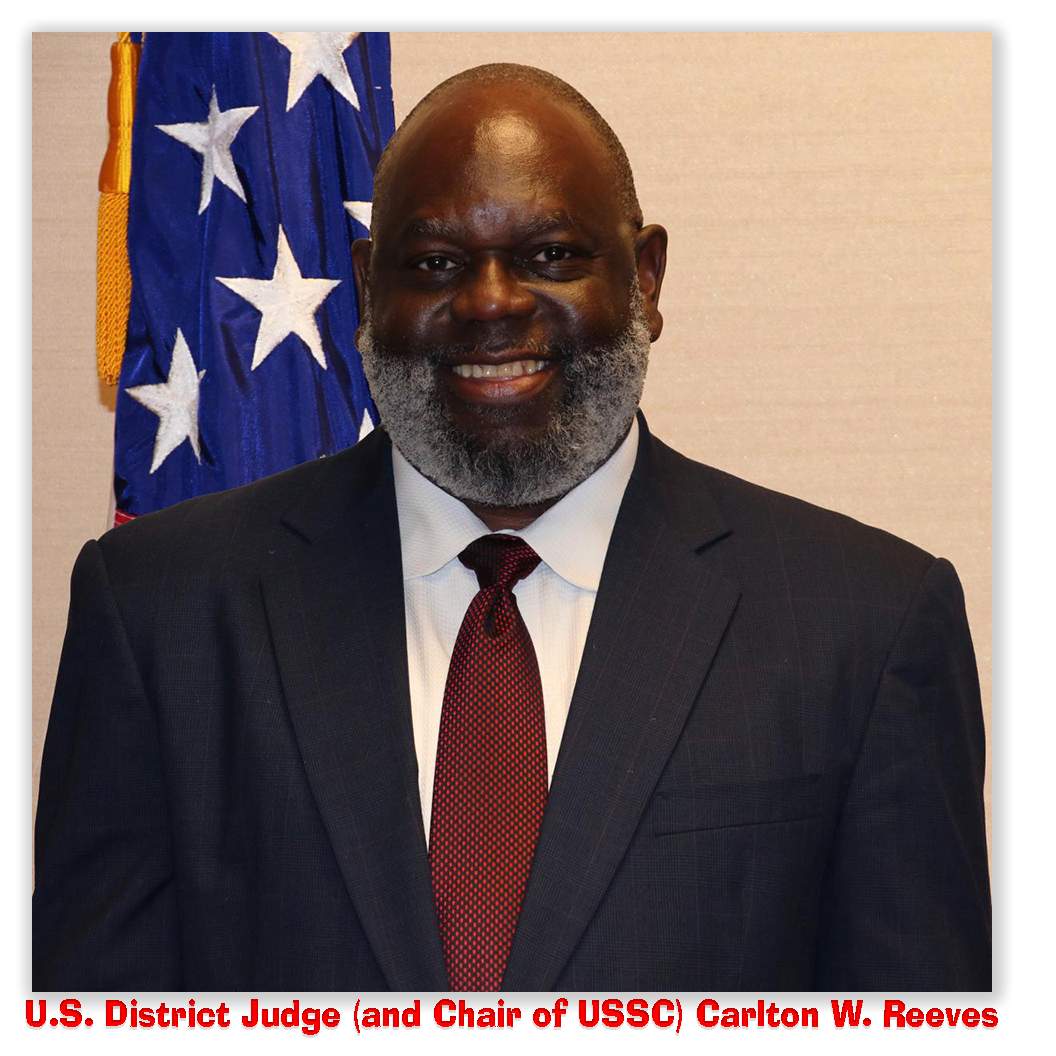
The commission, chaired by U.S. District Judge Carlton Reeves (SD Mississippi), currently has five voting members, with two empty seats. During President Trump’s first term, the Commission lost its quorum. Trump appointed people so far outside the mainstream – such as Eastern District of Virginia US District Judge Henry “Hang “Em High” Hudson – that even a Republican-controlled Senate wouldn’t confirm them. The upshot was that the Commission went five years without being able to amend the Guidelines until President Biden appointed new members.

Ohio State University law professor Doug Berman, writing in his Sentencing Law and Policy blog, said, “In the end, though, the amendments voted on today are more fairly described as modest rather than major. I am generally inclined to want to celebrate the ‘less is more’ character of today’s amendment. And yet, with the Commission’s very future a bit uncertain given current and possible future Commissioner vacancies…”

Professor Wroblewski asks the thoughtful question: “So, as we pass the end of the 2026 statutory guideline amendment window and head to the end of the terms of two more of President Biden’s commissioners, what are we left with?”

The nutshell answer? Lost opportunities.

USSC, Reader-Friendly Proposed Sentencing Amendments (April 16, 2026)

Sentencing Matters, The Failure of President Biden’s Sentencing Commission (April 20, 2026)

Law 360, Sentencing Commission Votes To Enact Modest Reform Agenda (April 16, 2026)

National Law Journal, ‘No Longer One Size Fits All’: Tweaks to U.S. Sentencing Guidelines May Ease White-Collar Penalties, Cut Litigation (April 17, 2026)

HR 27, HALT Fentanyl Act of 2025

Sentencing Law and Policy, After lots of major proposals, US Sentencing Commission adopts some modest guideline reforms (April 16, 2026)

~ Thomas L. Root

Sentencing Commission to Adopt Proposed Amendments On Thursday – Update for April 14, 2026

We post news and comment on federal criminal justice issues, focused primarily on trial and post-conviction matters, legislative initiatives, and sentencing issues.

HERE COME THE NEW GUIDELINES

The US Sentencing Commission has set a meeting for Thursday, April 16, to adopt proposed amendments for the coming amendment cycle.

The Sentencing Reform Act requires that any proposed Guidelines amendments be sent to Congress by May 1. The Commission typically adopts its slate of amendments in April. Congress then has 6 months to vote down any amendment it doesn’t like. If Congress does nothing (which it has done all but once in the SRA’s 36-year history), the amendments will become effective on Nov 1.

For many prisoners, the most important proposed change would be the options to modify the methamphetamine guidelines. One proposal (Option 1) is to simply eliminate the Guidelines distinction among a meth mixture, meth (actual), and high-purity ice. All meth would be scored the same.

An alternative option (Option 2) would be to keep the distinctions in the current meth Guidelines but offer reductions for people who had minor roles, who qualified for the 18 USC § 3553(f) safety valve, or who were involved only because of family relationships or duress.

For theft and economic crimes, the Commission rolled out a proposal to raise the loss tables (which drive the offense level) by an average of 40%, both to simplify application and to adjust for inflation (which was done last 11 years ago).

In a separate proposal, the USSC seeks comment on a proposal to “simplify” the USSG § 2B1.1 loss table by reducing it from 16 levels to 7, with jumps of 4 points for each level. Additionally, the Commission suggests a new USSG § 2B1.1 enhancement to reflect noneconomic harm to victims, such as physical, psychological harm, emotional, and reputational damage, or invasion of privacy.

More interesting is a USSC request for comment on redefinition of the “sophisticated means” enhancement set out in § 2B1.1(b)(10). Currently, “sophisticated means” is widely applied by courts to virtually any economic offense more complex than stealing from a Salvation Army kettle. The Commission seeks to return the “sophisticated means” enhancement to what was originally intended, “committing or concealing an offense with a greater level of complexity than typical for an offense of that nature” and provide further guidance for courts to use when determining whether conduct fits the definition.

Also up for consideration are proposals to expand the sentencing ranges that should be eligible for probation, home confinement, and “split sentences” (half in prison, half on home confinement). More significant are proposed changes in the Guidelines governing whether someone is considered a “career offender,” a label that dramatically increases the advisory sentencing range a defendant faces. The Sentencing Reform Act of 1984 directs the Commission to ensure that “career offenders” receive sentences near the statutory maximum. The Commission’s definition of what constitutes a career offender, however, has caught many defendants in the net whose criminal histories do not suggest “career criminal” by any stretch of the imagination.

None of the proposed amendments will apply to people already sentenced unless the Commission holds a separate proceeding to decide whether retroactivity should apply to any of the amendments.  The Commission has asked for comment on retroactivity in this amendment cycle, but while several amendments have been proposed for retroactivity since 2024, no decision has been made. The Commission has said that it wants to examine the procedure it employs to determine retroactivity, but so far, it’s been like the weather – everyone talks about it but no one does anything about it.

US Sentencing Commission, Public Notice of Meeting

~ Thomas L. Root

USSC Proposes Refinements on ‘Career Offender’ – Update for January 30, 2026

We post news and comment on federal criminal justice issues, focused primarily on trial and post-conviction matters, legislative initiatives, and sentencing issues.

SENTENCING COMMISSION FLOATS PROBATION, CAREER OFFENDER PROPOSALS

In a rare second round of proposals for amending the federal Sentencing Guidelines, the US Sentencing Commission today published three sets of options to perhaps add to the proposed amendments that will be sent to Congress on or before May 1st.

These proposals are in addition to several issued last month, and – if adopted – represent a substantial change toward judicial flexibility as well as a commonsense approach to what some think has become a tendency to label far too many defendants as “career offenders,” a designation that has a major inflationary effect on sentencing ranges.

Today’s proposals focus on substantially expanding the sentencing ranges that should be eligible for probation, home confinement, and “spilt sentences” (half in  prison, half on home confinement).  Currently, a defendant who has a sentencing range that starts at more than 12 months is presumptively doing it all in prison. More than six months takes probation off the table. The Commission proposes to dramatically increase the sentencing ranges for which judges may consider probation and split sentences, with the probation zone expanding to up to the 87-108 month stratum for people with no prior criminal history (and more modest expansions for those having criminal history).

More significant are proposed changes in the Guidelines that govern whether someone is considered a “career offender.” The Sentencing Reform Act of 1984 directs the Commission to ensure that “career offenders” receive sentences near the statutory maximum. The Commission’s definition of what constitutes a career offender, however, has caught many defendants in the net whose criminal histories do not suggest “career criminal” by any stretch of the imagination.

Under the current Guidelines, two minor state burglaries 14 years ago for which Donny Defendant served 60 days – with a spotless record since – would nevertheless qualify Donny as a career offender if he got convicted of buying a pound of pot to divide up and sell to friends.  His Guideline sentencing range – 8 to 14 months – would shoot up to 210-262 months because of those 14-year old state burglaries.

The long-awaited change in the “career offender” guidelines would abandon the current “categorical approach” to what prior convictions were crimes of violence or drug offenses, substituting instead a list of federal and state crimes that apply. Burglary would no longer apply, felonies of any kind for which the defendant served less than 90 days would not apply, and defendants would have a chance to show that some crimes of violence should not count because their conduct was completely nonviolent.

There are many options contained in the USSC’s latest proposal.  For instance, the Commission asks people to comment on whether the cutoff for not counting minor felonies should be a sentence of 30, 60 or 90 days.  The proposal also includes changes to address conflicts among federal circuits on aspects of the Guidelines and changes to

As with most USSC proposals, the document is lengthy, 56 pages of explanation and granular strikeouts and additions, as well as modifications to the human trafficking Guidelines “to provide enhanced penalties that better reflect the harms of certain human smuggling offenses.”

The proposals are out for public comment until March 18, 2026,

US Sentencing Commission, Public Hearing (January 30, 2026)

US Sentencing Commission, Proposed Amendments to the Sentencing Guidelines (Preliminary) (January 30, 2026)

~ Thomas L. Root

Lawyers Can Be Wrong But Still Be Good, 7th Says – Update for October 2, 2025

We post news and comment on federal criminal justice issues, focused primarily on trial and post-conviction matters, legislative initiatives, and sentencing issues.

WRONG DOESN’T MEAN INEFFECTIVE, 7TH CIRCUIT SAYS

Otis Elion pleaded guilty to distributing meth in 2017. The district court held that he qualified as a Guidelines Chapter 4B “career offender.” Otis’s attorney did not object, because after researching whether his prior convictions qualified as predicate offenses for career offender, she concluded that challenging that sentencing enhancement would fail.

In his 28 USC § 2255 petition, Otis argued his lawyer provided ineffective assistance under Strickland v. Washington by not challenging his “career offender” status. The district court agreed that he was prejudiced because he really didn’t qualify as a “career offender,” but that his lawyer – although wrong – was not ineffective.

With several prior drug convictions, Otis may have been a “career offender” under USSG § 4B1.1(a). The drug convictions might have been considered to be “controlled substance offenses, “defined as federal or state offenses that “prohibits the manufacture, import, export, distribution, or dispensing of a controlled substance (or a counterfeit substance)” or possession with intent to engage in those actions, punishable by imprisonment for a term exceeding one year.”

One of Otis’s priors was a 2006 federal conviction for distribution of crack cocaine. Before that was a 2000 conviction for delivery of a look-alike substance. The oldest was a 1999 conviction for delivery of a look-alike substance within 1,000 feet of public housing property. The Presentence Report concluded that those convictions qualified Otis for career offender.

His attorney reached the same conclusion, so she did not object to the application of the enhancement at Otis’s sentencing. Instead, she argued Otis ‘s health and life circumstances justified a mitigated sentence. The district court sentenced Otis as a “career offender” to 167 months.

To Otis, neither his 1999 nor his 2000 state convictions was controlled substance offense because look-alike substances made the Illinois statute broader than the Guidelines, and his lawyer’s failure to make that argument violated his 6thAmendment right to effective assistance of counsel. Using the modified categorical approach, the court agreed the Illinois use of “look-alike” substance made it different from the Guideline’s use of counterfeit substance.

Otis’s attorney had wrongly concluded that “counterfeit” and “look-alike” were a categorical match. But the 7th Circuit said last week that a defense attorney does not need to forecast changes in the law. “Failure to object to an issue that is not settled law within the circuit is not unreasonable by defense counsel… A defense attorney’s choice not to make a potentially meritorious argument is not automatically deficient performance, even if it stems solely from a legal error.” 

Strickland holds that the “proper measure of attorney performance remains simply reasonableness under prevailing professional norms,” the 7th said. Strickland necessarily permits mistakes that are reasonable. Only when the defense attorney’s error is so appalling that he can no longer be considered “counsel” for his client is his performance deemed deficient… The giving of legal advice that later is proven to be incorrect, therefore, does not necessarily fall below the objective standard of reasonableness.

If an attorney declines to make an argument that no court has accepted and no other attorney has made, yet which later succeeds, it is doubtful the attorney’s omission was unreasonable under prevailing norms of practice. Otis’s lawyer did the necessary work, the 7th observed. “She researched the categorical approach arguments, found the applicable caselaw, and analogized that precedent to Otis’s case. When the caselaw provided no answer, she used statutory interpretation and relied on her extensive experience. She just reached a different conclusion than the Circuit did —a  conclusion on which reasonable minds could disagree.”

Elion v. United States, Case No. 24-3014, 2025 U.S. App. LEXIS 24770 (7th Cir. September 24, 2025)

~ Thomas L. Root

Assault With a Deadly Weapon Is Not Violent under Guidelines, 9th Holds – Update for September 9, 2024

We post news and comment on federal criminal justice issues, focused primarily on trial and post-conviction matters, legislative initiatives, and sentencing issues.

9TH HOLDS CALIFORNIA ASSAULT WITH DEADLY WEAPON IS NOT A GUIDELINES VIOLENT CRIME

The Sentencing Commission is required by 28 USC § 994(h) to include provisions in the Guidelines to ensure that people with more than one prior conviction for crimes of violence or drug trafficking are sentenced “at or near the maximum term authorized” by statute. To carry out that mandate, the Commission created the career offender provision in Chapter 4B of the Guidelines.

Jesus Gomez was sentenced to 188 months for a drug distribution offense, being found to be a Guidelines career offender because of a prior conviction for assault with a deadly weapon (ADW) under California Penal Code § 245(a)(1).

Last week, the 9th Circuit vacated his sentence, holding that its prior decisions that California ADW was a crime of violence “are clearly irreconcilable with the Supreme Court’s ruling in Borden v. United States.

violence181008In Borden, the Supreme Court held that the mens rea requirement of USSG § 4B1.1 stems from the language requiring that force be used “against the person… of another.” A defendant acts recklessly when he “consciously disregards a substantial and unjustifiable risk.” But the phrase “against another” demands that the defendant “direct his action… at another individual.” Because reckless conduct is not aimed “in that prescribed manner,” the Borden court ruled, it does not satisfy the elements clause of 4B1.1.

California state courts have previously recognized that the ADW statute does not require an intent to cause harm but instead only requires an intent to do the act that results in harm. The Gomez court ruled that the ADW’s “intentional act” requirement does not equate to the “intent to harm” or “purpose” mens rea required for a Guidelines crime of violence.

Jesus, whose non-career offender Guidelines are 130-162 months, will go back for resentencing.

United States v. Gomez, Case No. 23-435, 2024 U.S.App. LEXIS 22457 (9th Cir. Sep 4, 2024)

Borden v. United States, 593 US 420 (2021)

– Thomas L. Root

5th Circuit Endorses District Court Discretion on Compassionate Release Motions – Update for July 18, 2024

We post news and comment on federal criminal justice issues, focused primarily on trial and post-conviction matters, legislative initiatives, and sentencing issues.

5TH CIRCUIT DERAILS DOJ EFFORT TO DELEGITIMIZE GUIDELINES

ratchet211108I suppose it is unsurprising that the Dept of Justice sees appropriate judicial discretion as a ratchet. It’s fine if a judge employs his or her flexibility to tighten the screws on a defendant, but any attempt to fashion a remedy that seeks to ameliorate harsh sentences that could not be imposed today is seen by the denizens of the US Attorney’s offices as a threat to the republic.

After the First Step Act permitted prisoners to bring so-called compassionate release motions – petitioning courts under 18 USC § 3582(c)(1)(A) to reduce sentences for extraordinary and compelling reasons – courts labored for almost five years to pound square-peg Sentencing Guideline 1B1.13 into the new round hole of defendant-initiated compassionate release motions. The old version of 1B1.13, written back in the day when only the Federal Bureau of Prisons could initiate a compassionate release request, was minimally relevant to the new regime. However, the Sentencing Commission lost its quorum a mere 11 days after First Step was signed into law, and could not promulgate a new § 1B1.13 for prisoner-brought motions.

Nearly all courts of appeal rejected DOJ demands that the old § 1B1.13 be slavishly applied to compassionate release motions, holding that commentary for motions brought by the BOP was inapplicable to motions brought by defendants and that what constituted extraordinary and compelling reasons for compassionate release motions was left to the broad discretion of district courts, limited only by the statute’s directive that rehabilitation alone was an insufficient basis for a sentence reduction.

In the absence of a guiding Sentencing Commission policy statement, appellate courts split on whether district courts could consider non-retroactive changes in the law in deciding whether extraordinary and compelling reasons existed for compassionate release. Such was a major concern. First Step changed mandatory minimum sentences for a number of drug offenses and clarified a drafting blunder in 18 USC § 924(c) – which imposes mandatory consecutive sentences for using or carrying a gun in a drug offense or crime of violence – but did not make those changes retroactive.

In some circuits, prisoners with draconian 50-year-plus sentences for 924(c) offenses that today would carry 15 years could get relief. In other places, appellate courts ruled that such reductions were impermissible because old § 1B1.13 did not permit it.

draconian170725That was the state of things until last November, when the reconstituted Sentencing Commission’s rewritten 1B1.13 became effective. The new 1B1.13 provided ample guidance as to what a district court must consider to be “extraordinary and compelling” reasons for grant of a 3582(c)(1)(A) motion, including

[i]f a defendant received an unusually long sentence and has served at least 10 years of the term of imprisonment, a change in the law (other than an amendment to the Guidelines Manual that has not been made retroactive) may be considered in determining whether the defendant presents an extraordinary and compelling reason, but only where such change would produce a gross disparity between the sentence being served and the sentence likely to be imposed at the time the motion is filed, and after full consideration of the defendant’s individualized circumstances.

The USSC also added a “catch-all,” authorizing district courts to consider as extraordinary and compelling reasons “any other circumstance or combination of circumstances that, when considered by themselves or together with any of the reasons [listed in 1B1.13] are similar in gravity…”

The DOJ immediately mounted a nationwide attack on the new 1B1.13, arguing (among other things) that allowing the consideration of changes in the law that made the old sentences disparately long exceeded the Commission’s legal authority and supplanted Congress’s legislative role by permitting the revision of sentences that Congress did not wish to make retroactive.

This full-throated attack on the new 1B1.13, which Congress had six months to reject but chose not to, finally got to an appellate court.

careeroffender22062Joel Jean was locked up in 2009 for a cocaine distribution crime and a § 924(c) offense. He had three prior state drug convictions, and as a result, he was classified as a Guidelines “career offender,” which came with a recommended sentencing range of 352-425 months. The district court gave him a break, sentencing him to 292 months’ imprisonment.

In the years following Joel’s conviction, a series of Supreme Court and 5th Circuit cases redefined what could be considered a qualifying offense for the “career offender” enhancement. Those held that some of Joel’s Texas convictions no longer qualified to make him a “career offender.” As a result, “it is undisputed that if he were to be sentenced today, Joel would not be classified as a career offender under § 4B1.1.”

Joel filed a compassionate release motion, arguing that non-retroactive changes in the law would result in a substantially shorter sentence today if he were sentenced today and that his post-sentencing conduct and rehabilitation weighed in favor of compassionate release.

To be sure, Joel’s rehabilitation efforts – good conduct, successful programming, and comportment that resulted in laudatory letters from BOP staff – were exceptional. The district court was impressed, granting Joel’s motion and resentencing him to time served. The government, however, was dissatisfied with the decade-length pound of flesh it had gotten from Joel. It appealed, arguing that the district court could not consider non-retroactive changes in the law and that Joel should return to prison.

Last week, the 5th Circuit rejected the government’s position, holding that a sentencing court has the “discretion to hold that non-retroactive changes in the law, when combined with extraordinary rehabilitation, amount to extraordinary and compelling reasons warranting compassionate release.”

The Circuit ruled that “there is no textual basis [in statute] for creating a categorical bar against district courts considering non-retroactive changes in the law as one factor” nor did appellate precedent or 1B1.13 prohibit including such factors in a compassionate release calculus.

In Concepcion v. United States, the 5th observed, the Supreme Court held that

Federal courts historically have exercised this broad discretion to consider all relevant information at an initial sentencing hearing, consistent with their responsibility to sentence the whole person before them. That discretion also carries forward to later proceedings that may modify an original sentence. Such discretion is bounded only when Congress or the Constitution expressly limits the type of information a district court may consider in modifying a sentence… [T]he Concepcion Court concluded that nothing limits a district court’s discretion except when expressly set forth by Congress in a statute or by the Constitution. And in the case of the FSA, though the Court noted that “Congress is not shy about placing such limits where it deems them appropriate,” Congress had not expressly limited district courts to considering only certain factors there.

The Circuit noted that Congress “has never wholly excluded the consideration of any factors. Instead, it appropriately affords district courts the discretion to consider a combination of ‘any’ factors particular to the case at hand, limited only by the proscription that “rehabilitation alone was insufficient… [but] did not prohibit district courts from considering rehabilitation in conjunction with other factors.”

discretion220629

Congress adopted § 3582(c)(1)(A) due to the “need for a ‘safety valve’ with respect to situations in which a defendant’s circumstances had changed such that the length of continued incarceration no longer remained equitable,” the Court ruled: “It is within a district court’s sound discretion to hold that non-retroactive changes in the law, in conjunction with other factors such as extraordinary rehabilitation, sufficiently support a motion for compassionate release. To be clear, it is also within a district court’s sound discretion to hold, after fulsome review, that the same do not warrant compassionate release. For this court to hold otherwise would be to limit the discretion of the district courts, contrary to Supreme Court precedent and Congressional intent. We decline the United States’ invitation to impose such a limitation.”

United States v. Jean, Case No. 23-40463, 2024 U.S. App. LEXIS 17274 (5th Cir. July 15, 2024)

Concepcion v United States, 597 US 481 (2022)

– Thomas L. Root

4th Says District Court Must Consider All Grounds for Sentence Reduction – Update for April 26, 2024

We post news and comment on federal criminal justice issues, focused primarily on trial and post-conviction matters, legislative initiatives, and sentencing issues.

4TH ISSUES EXPANSIVE COMPASSIONATE RELEASE DECISION

compassion240426Antonio Davis was in the 8th year of a 210-month sentence drug conspiracy sentence when COVID hit. He filed for an 18 USC § 3582(c)(1)(A) sentence reduction (compassionate release) for medical reasons and because he should no longer be a career offender inasmuch as one of his predicate offenses was no longer considered a crime of violence.

The district court denied Antonio’s motion because his medical condition wasn’t that bad and he had gotten vaccinated. The district court rejected Antonio’s career offender argument, finding that the issue should be raised in a 28 USC § 2255 motion. And even if Antonio had shown extraordinary and compelling reasons for relief, the court held that his release would not be justified under the 18 USC § 3553(a) sentencing factors because he had only done half of his sentence and 210 months was needed to address the seriousness of his crimes and the risk of recidivism.

Last week, the 4th Circuit reversed, holding that the district court wrongly failed to consider whether Antonio’s career-offender status claim was an extraordinary and compelling reason for release. “Years after Davis was sentenced,” the 4th said, “this Court held that a 21 USC § 846 [drug] conspiracy conviction… is not categorically a “controlled substance offense” for purposes of the career offender guidelines… If Davis were sentenced after that decision, he would no longer be designated a career offender…”

compassion160124In addition, the Circuit said, Antonio presented a second intervening change in law that would further reduce his sentence. Guidelines Amendment 782, added in 2014, retroactively lowered the base offense level for Antonio’s § 846 conviction by two points, but because he was a career offender, he was not eligible for the reduction. “Today,” the 4th said, “Davis would not be sentenced as a career offender [and he would be] eligible for the retroactive two-point reduction…”

If Antonio “were sentenced today,” the Circuit said, “his guidelines range would be 92 to 115 months—about half of his 210-month sentence.” Citing the Supreme Court’s 2022 Concepcion v. United States decision, the 4th said, “Concepcion’s broad reasoning permits federal judges to think expansively about what constitute ‘extraordinary and compelling reasons’ for release, absent specific congressional limitations. And the Sentencing Commission’s latest guidance goes a long way to resolve any remaining questions of congressional intent not answered by the Supreme Court’s decision.”

The 4th concluded that “the district court abused its discretion by declining to address Davis’s change-in-law and rehabilitation arguments in its “extraordinary and compelling reasons” analysis. We also find that, given the mitigation evidence Davis supplied, the substantial changes in law between the original sentencing and today, and the potentially gross sentencing disparity created by those changes, the district court’s explanation of the § 3553(a) factors is insufficient.”

United States v. Davis, Case No. 21-7325, 2024 U.S. App. LEXIS 9399 (4th Cir, Apr 18, 2024)

The Short Rocket – Update for January 27, 2023

rocket190620We post news and comment on federal criminal justice issues, focused primarily on trial and post-conviction matters, legislative initiatives, and sentencing issues.

Today, the short rocket – decisions from around the federal circuits…

SOME CASE SHORTS

Timing is Everything: In 2015, Benny Hall pled guilty to conspiracy to commit Hobbs Act robbery and using a gun in a crime of violence, (an 18 U.S.C. § 924(c) offense). After the Supreme Court decided in United States v. Davis that conspiracy to commit a crime of violence was not itself a crime of violence that supported a § 924(c) conviction for using a gun in a crime of violence, Benny filed a 28 U.S.C. §2255 post-conviction motion asking that the § 924(c) be thrown out.

corso170112The government convinced the district court that Benny’s § 924(c) conviction didn’t depend only on the conspiracy, but also on his admissions in open court that established that he had actually attempted to commit the robbery.

‘Gotcha!’ the government cried.

‘Not so fast!’ the 2nd Circuit replied last week. Last summer, the  Supreme Court ruled in United States v. Taylor that an attempted Hobbs Act robbery is not a crime of violence. The Circuit threw out § 924(c) conviction and the mandatory 10-year add-on sentence it represented.

Hall v. United States, Case No 17-1513, 2023 U.S.App. LEXIS 1256 (2d Cir., January 19, 2023)
rocket190620

11th Holds Drug Conspiracy Can’t Lead to Guidelines ‘Career Offender’: Brandon Dupree was convicted of a 21 U.S.C. § 846 drug conspiracy, and was hammered at sentencing as a Guidelines “career offender” (which dramatically increased the advisory sentencing range). An 11th Circuit panel rejected Brandon’s argument that an inchoate offense (that is, a mere plan to commit a crime) does not qualify as a “controlled substance offense” for purposes of the Guidelines ‘career offender’ enhancement.

brandon230127Last week, the full Circuit sitting en banc said, ‘Let’s go, Brandon,’ and reversed his ‘career offender’ sentence. The 11th ruled that “application of the enhancement turns on whether the ‘instant offense of conviction’ is ‘a controlled substance offense’ [under USSG] 4B1.1(a)… The plain text of 4B1.2(b) unambiguously excludes inchoate crimes. Dupree must be resentenced without application of the career offender enhancement.”

United States v. Dupree, Case No 19-13776, 2023 U.S.App. LEXIS 1183 (11th Cir., January 18, 2023)
rocket190620

Channeling Your Inner Habeas: People are always asking why they can’t point out in their 18 U.S.C. § 3582(c)(1)(A) compassionate release motions that their sentences were wrongly calculated, that their lawyers were ineffective imbeciles, that something was very wrong with how they were convicted.

reallawyer170216Mike Escajeda was convicted of selling drugs and carrying a gun. After losing his direct appeal, Mike filed a compassionate release motion, arguing that the “extraordinary and compelling reasons” required by an 18 U.S.C. § 3582(c)(1)(A) compassionate release motion were that (1) his sentence exceeded the statutory maximum and (2) he received ineffective assistance of counsel. He even admitted in his motion that he had filed for compassionate release because he figured that he could not win relief under § 2255.

Last week, the 5th Circuit ruled that the habeas-channeling rule prevented Mike from raising 2255-type issues in a compassionate release motion. The Circuit said, “Congress provided specific avenues for post-conviction relief that permit prisoners to challenge the legality of their confinement in federal court… The Supreme Court has repeatedly held that by codifying these specific provisions, Congress required prisoners to bring their legality-of-custody challenges under [28 USC 2241, 2244, 2254, and 2255], and prohibited prisoners from bringing such claims under other, more-general statutes like 42 U.S.C. § 1983.

[A] prisoner cannot use § 3582(c) to challenge the legality or the duration of his sentence,” the 5th held. “Such arguments can, and hence must, be raised under [the habeas statutes]… Because Escajeda’s claims would have been cognizable under § 2255, they are not cognizable under § 3582(c).”

United States v. Escajeda, Case No 21-50870, 2023 U.S.App. LEXIS 1041 (5th Cir., January 17, 2023)
rocket190620

DOJ SORNA Rule Blocked: The U.S. District Court for Central District of California last week issued a preliminary injunction blocking the Dept of Justice’s new Sex Offender Registration and Notification Act rule because it violated due process and the 1st Amendment.

injunction230127The rule requires people who had been convicted of a sex crime to register as sex offenders in their state, even if the sex crime convictions have been expunged and the people are not allowed by the state to register. Because plaintiff John Doe could not register, the DOJ’s rule said that he could be prosecuted at any time, and he would have been forced to prove that registration was impossible — “an affirmative defense,” Doe’s lawyer said, “that turns the presumption of innocence on its head.

The court ruled that it was likely an unconstitutional violation of due process to require anyone to affirmatively prove his innocence when he had never been convicted.

Preliminary injunction, ECF 55, Doe v. DOJ, Case No 5:22-cv-855 (CD Cal., Jan 13, 2023)

Reason, A Federal Judge Says the DOJ’s Sex Offender Registration Rules Violate Due Process by Requiring the Impossible (January 19, 2023)

Thomas L. Root

Sentencing Commission Rolls Up Its Sleeves – Update for November 3, 2022

We post news and comment on federal criminal justice issues, focused primarily on trial and post-conviction matters, legislative initiatives, and sentencing issues.

USSC SETS GUIDELINE AMENDMENT PRIORITIES

The U.S. Sentencing Commission held its first meeting in 46 months last Friday, voting in a 20-minute session to adopt priorities for the Guidelines amendment cycle that ends Nov 1, 2023.

USSC170511The USSC lost its quorum due to term expirations of multiple members in December 2018, just as the First Step Act was signed into law. That meant the commission was unable to revise the Guidelines just as First Step changes required modifications that would have prevented conflicting judicial interpretations, especially in the application of 18 USC § 3582(c)(1)(A) sentence reduction motions, commonly called “compassionate release” motions.

The compassionate release statute requires judges to consult USSG § 1B1.13, Guidelines policy on granting compassionate releases, but § 1B1.13 was written for a time when only the Bureau of Prisons could bring compassionate release motions. Most but not all Circuits have ruled that § 1B1.13 is not binding on district courts until it is amended, but the 11th has ruled that it is binding, the 8th has studiously avoided deciding the question, and others – such as the  3rd, 6th and 7th – have held that district judges cannot consider First Step Act changes in sentencing law that would result in much lower sentences when deciding compassionate release motions.

U.S. District Judge Carlton Reeves (S.D. Mississippi), chairman of the Commission, said implementing the First Step Act through revisions to the federal sentencing guidelines would be the USSC’s “top focus.”

Other changes in the Guidelines, such as to the drug tables, could result from First Step’s lowering of drug mandatory minimums.

responsibility221103Additional priorities for the coming year include resolving circuit conflicts over whether the government may withhold a motion for a third acceptance-of-responsibility point just because a defendant moved to suppress evidence before pleading guilty and whether an offense must involve a substance actually controlled by the Controlled Substances Act to qualify as a “controlled substance offense,”

The USSC will also consider amendments to the Guidelines career offender chapter that would provide an alternative to the “categorical approach” in determining whether an offense is a “crime of violence” or a “controlled substance offense.

First Step also made changes to the “safety valve,” which relieves certain drug trafficking offenders from statutory mandatory minimum penalties, by expanding eligibility to some defendants with more than one criminal history point. A USSC press release says the Commission “intends to issue amendments to § 5C1.2 to recognize the revised statutory criteria and consider changes to the 2-level reduction in the drug trafficking guideline currently tied to the statutory safety valve.”

marijuana220412The only addition to the Commission’s previously-published list of proposed priorities that came out of the meeting was consideration of possible amendments on whether, and to what extent, people’s criminal history for marijuana possession can be used against them in sentencing.

The cannabis item was added and adopted after President Joe Biden issued a mass marijuana pardon proclamation.

The Commission’s priorities only guide what it will be working on for the Nov 2023 amendment cycle. Expect amendment proposals by late January, followed by a public comment period, and final amendments by May 1. After that, the Senate has 6 months to reject any of the amendments (a very rare occurrence). Amendments not rejected will become effective Nov 1, 2023.

Reuters, Newly-reconstituted U.S. sentencing panel finalizes reform priorities (October 28, 2022)

US Sentencing Commission, Final Priorities for Amendment Cycle (October 5, 2022)

US Sentencing Commission, Commission Sets Policy Priorities (October 28, 2022)

Marijuana Moment, Federal Commission Considers Changes To How Past Marijuana Convictions Can Affect Sentencing For New Crimes (October 28, 2022)

– Thomas L. Root

“What Is It Exactly That You Want?” Courts Ask Defendants – Update for August 3, 2021

We post news and comment on federal criminal justice issues, focused primarily on trial and post-conviction matters, legislative initiatives, and sentencing issues.

FUTILITY

futility180705Two decisions last week should serve as cautionary tales for people seeking a sentence break from the courts, without really being able to explain to the courts why they are seeking the break they want.

In the 7th Circuit, Mike Millis filed a 28 USC § 2241 petition for writ of habeas corpus, arguing that his career-offender Guidelines enhancement (USSG § 4B1.1) should not have been applied in his case. As a result of his 1994 crime spree, Mike was convicted of several robbery counts, which included two 18 USC § 924(c) counts for using a gun. The § 924(c) counts, of course, were stacked. When the dust settled, Mike’s sentencing range began at 562 months.

That was too much for his judge, who departed downward to a still-shocking 410 months.

In the intervening 26 years, Mike filed and lost a 28 USC § 2255 motion in his Eastern District of Kentucky home. But well after that, the 6th Circuit held in a different case that one of the prior convictions relied on to make Mike a Guidelines career offender – an Ohio aggravated assault conviction – could not be used as a basis for career offender. Because the change in the law did not open the door to a new § 2255 motion. But Mike relied on the § 2255(e) “saving clause,” which lets prisoners use a § 2241 motion where the § 2255 would be “inadequate or ineffective to test the legality of his detention.”

Last week, the 7th Circuit shot him down. One of the standards for being able to use the 28 USC § 2255(e) saving clause, the Circuit said, is that the prior conviction or sentence has to constitute a miscarriage of justice. Here, Mike’s sentence range had started at 567 months. But if he had not been a career offender, the Circuit said, his 410-month sentence would still have fallen within what his non-career sentencing range would have been.

miscarriage-of-justiceBecause of that, the sentence – although the career offender status was wrong – was not a miscarriage of justice. This made the § 2255(e) saving clause unavailable to Mike.

So what was Mike’s point? I am guessing that he was looking to get rid of the career-offender label, because he is or will soon seek to get his second § 924(c) conviction cut from 300 months to 60 months, which is all he could have gotten under the law since passage of the First Step Act made clear that the 300-month mandatory sentence only applies after a prior conviction for a § 924(c) offense. Knocking 240 months off his sentence would let Mike out after having only served 260-some months (21 years) in prison.

Talk about soft on crime!

Meanwhile, over in the 8th Circuit, Brett Corrigan got a mandatory-minimum sentence of 60 months in prison, based on quantity of drugs involved in his case. At sentencing, his district court gave him a 2-level enhancement under USSG § 2D1.1(b)(1) for possessing a dangerous weapon, which gave him an advisory sentencing range of 60 to 71 months in prison. The judge gave him 60 months, the bottom of the range, (which, incidentally, was his mandatory minimum sentence).

softoncrime190307That did not stop Brett, who appealed the 2-level enhancement to the Court of Appeals. Last week the 8th Circuit denied him any relief. “Nothing we do here will affect Corrigan’s sentence, meaning that we lack the ability to provide any effectual relief.,” the Circuit said. “Win or lose, it makes no difference—his sentence will remain 60 months because of the mandatory minimum. In jurisdictional terms, Corrigan lacks a cognizable interest in the outcome, which means that there is no longer a live case or controversy under Article III.”

So why bother appealing? I suspect what Brett was fighting for was to get the 2-level gun enhancement lifted, because the enhancement made him ineligible to take the Bureau of Prison’s Residential Drug Abuse Program. The RDAP would entitle him to another 12 months off his sentence under 18 USC § 3621(e)(2)(B), meaning that Brett very much had something at stake here. It’s just that the courts generally seem not to appreciate the adverse effects that enhancements like that – which often get added on the flimsiest of evidence – have on a defendant’s prison term.

Millis v. Segal, Case No. 20-1520, 2021 U.S. App. LEXIS 22349 (7th Cir., July 28, 2021)

United States v. Corrigan, Case No. 20-1682, 2021 U.S. App. LEXIS 22166 (8th Cir., July 27, 2021)

– Thomas L. Root