Tag Archives: sentencing commission

Sentencing Commission Builds Us Up, Disappoints Again – Update for April 20, 2026

We post news and comment on federal criminal justice issues, focused primarily on trial and post-conviction matters, legislative initiatives, and sentencing issues.

BRINGING FORTH A MOUSE

The US Sentencing Commission held its long-anticipated April meeting last Thursday, taking up weighty proposals to reduce the methamphetamine purity guidelines and to bring some sense to the career offender label.

It brought forth a mouse.

No changes in meth, no changes in career offender status…. Everything that was adopted passed quickly and unanimously. Everything that was abandoned disappeared without comment, like one of those old-time Kremlin photos where the image of a newly-disfavored apparatchik was crudely cut out of an official photo.

Writing in the Sentencing Matters substack, Jonathan Wroblewski (a 35-year veteran of the Dept of Justice and long-time ex officio member of the Sentencing Commission) summed up last week’s meeting:

With expectations high, the Commission’s 2024–25 and 2025–26 amendment years ended in April 2025 and again last Thursday with short, opaque public meetings — genuinely unbecoming given the importance of the issues at stake and the extensive process leading up to them. The Commission voted on some of the published amendment proposals but not on others. It offered no explanation for the consequential choices it made and the actions it took. It was a profound disappointment in transparent policymaking.

As has become its habit, the Commission held a short and seemingly scripted meeting in which nothing was discussed, nothing was debated, and nothing was explained. Like the backlog of guidelines for which retroactivity was proposed in 2024 and 2025 – only to die without further mention – the guideline amendments that were rejected simply disappeared.

The proposed amendments that made it through the Commission’s process include

  • addition of new paths for offenders to get credit for presentence rehabilitative efforts.
  • increased emphasis on the availability of sentences eligible for probation, home confinement and split sentences.
  • restructuring of the loss table for economic crimes to account for inflation over the past decade.
  • elimination of the sophisticated means enhancement, and
  • a new enhancement to account for the non-economic harm suffered by victims of economic crimes.

The only drug guideline change to be adopted was a boost in fentanyl-related sentencing levels, adopted to implement the HALT Fentanyl Act of 2025 (HR 27). Apparently, for all of the options proposed to moderate the meth guidelines, the Commission decided to do nothing. I say “apparently” because, as usual, the USSC provided no explanation why some proposals did not make the cut.

The abandonment of the “career offender” proposal is troubling. The Sentencing Reform Act of 1984 directs the Commission to ensure that “career offenders” receive sentences near the statutory maximum. The Commission’s definition of what constitutes a career offender, however, has caught many defendants in the net whose criminal histories do not suggest “career criminal” by any stretch of the imagination.

The change in the “career offender” guidelines would have abandoned the current “categorical approach” to what prior convictions were crimes of violence or drug offenses, substituting instead a list of federal and state crimes that apply. Burglary would no longer apply, felonies of any kind for which the defendant served less than 90 days would not apply, and defendants would have a chance to show that some crimes of violence should not count because their conduct was completely nonviolent.

Forget that change.

Last December, the Commission asked for public comment on options to change the methamphetamine guidelines. One proposal is to simply eliminate the Guidelines distinction among a meth mixture, meth (actual), and high-purity ice. All meth would be scored the same. An alternative option would be to keep the distinctions in the current meth Guidelines but offer reductions for people who had minor roles, who qualified for the 18 USC § 3553(f) safety valve, or who were involved only because of family relationships or duress.

Forget that change, too.

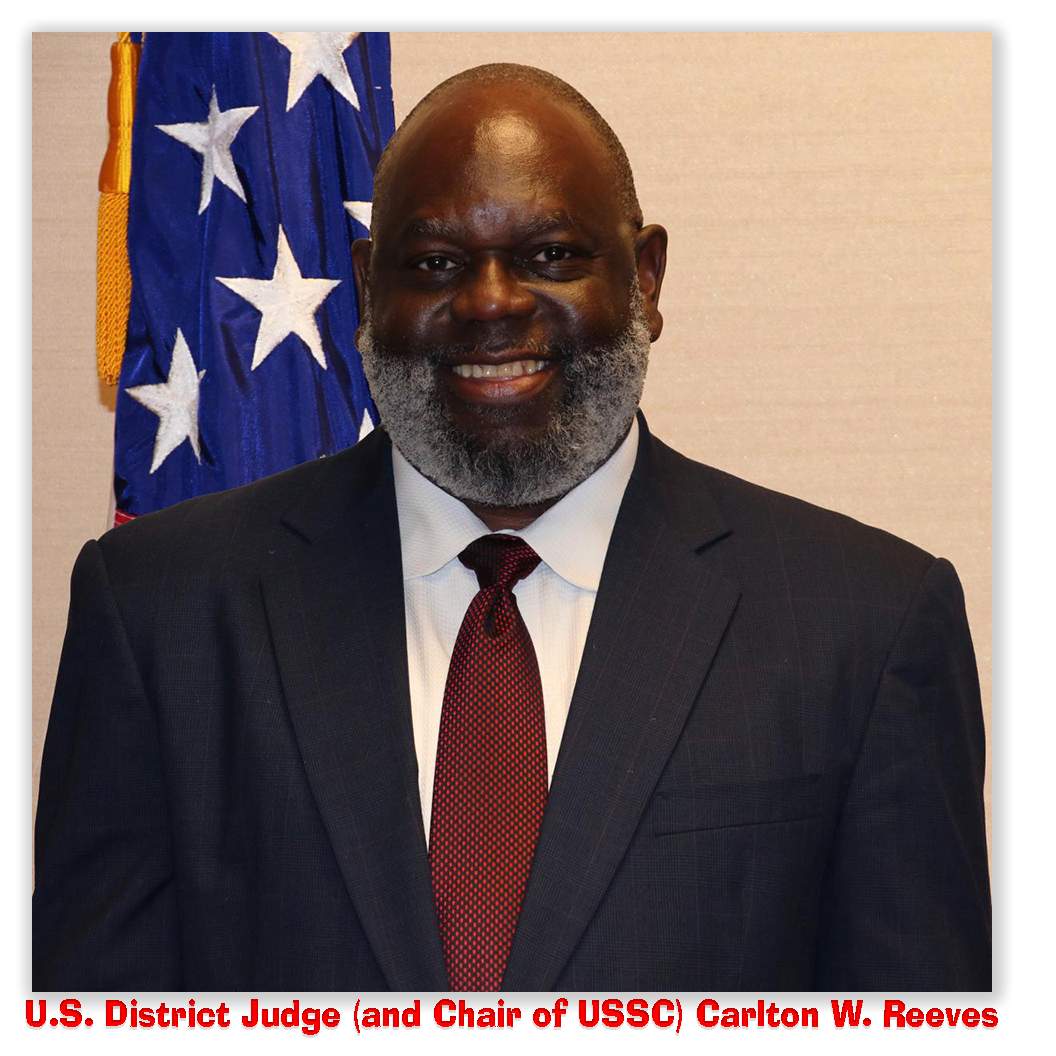
The commission, chaired by U.S. District Judge Carlton Reeves (SD Mississippi), currently has five voting members, with two empty seats. During President Trump’s first term, the Commission lost its quorum. Trump appointed people so far outside the mainstream – such as Eastern District of Virginia US District Judge Henry “Hang “Em High” Hudson – that even a Republican-controlled Senate wouldn’t confirm them. The upshot was that the Commission went five years without being able to amend the Guidelines until President Biden appointed new members.

Ohio State University law professor Doug Berman, writing in his Sentencing Law and Policy blog, said, “In the end, though, the amendments voted on today are more fairly described as modest rather than major. I am generally inclined to want to celebrate the ‘less is more’ character of today’s amendment. And yet, with the Commission’s very future a bit uncertain given current and possible future Commissioner vacancies…”

Professor Wroblewski asks the thoughtful question: “So, as we pass the end of the 2026 statutory guideline amendment window and head to the end of the terms of two more of President Biden’s commissioners, what are we left with?”

The nutshell answer? Lost opportunities.

USSC, Reader-Friendly Proposed Sentencing Amendments (April 16, 2026)

Sentencing Matters, The Failure of President Biden’s Sentencing Commission (April 20, 2026)

Law 360, Sentencing Commission Votes To Enact Modest Reform Agenda (April 16, 2026)

National Law Journal, ‘No Longer One Size Fits All’: Tweaks to U.S. Sentencing Guidelines May Ease White-Collar Penalties, Cut Litigation (April 17, 2026)

HR 27, HALT Fentanyl Act of 2025

Sentencing Law and Policy, After lots of major proposals, US Sentencing Commission adopts some modest guideline reforms (April 16, 2026)

~ Thomas L. Root

Sentencing Commission to Adopt Proposed Amendments On Thursday – Update for April 14, 2026

We post news and comment on federal criminal justice issues, focused primarily on trial and post-conviction matters, legislative initiatives, and sentencing issues.

HERE COME THE NEW GUIDELINES

The US Sentencing Commission has set a meeting for Thursday, April 16, to adopt proposed amendments for the coming amendment cycle.

The Sentencing Reform Act requires that any proposed Guidelines amendments be sent to Congress by May 1. The Commission typically adopts its slate of amendments in April. Congress then has 6 months to vote down any amendment it doesn’t like. If Congress does nothing (which it has done all but once in the SRA’s 36-year history), the amendments will become effective on Nov 1.

For many prisoners, the most important proposed change would be the options to modify the methamphetamine guidelines. One proposal (Option 1) is to simply eliminate the Guidelines distinction among a meth mixture, meth (actual), and high-purity ice. All meth would be scored the same.

An alternative option (Option 2) would be to keep the distinctions in the current meth Guidelines but offer reductions for people who had minor roles, who qualified for the 18 USC § 3553(f) safety valve, or who were involved only because of family relationships or duress.

For theft and economic crimes, the Commission rolled out a proposal to raise the loss tables (which drive the offense level) by an average of 40%, both to simplify application and to adjust for inflation (which was done last 11 years ago).

In a separate proposal, the USSC seeks comment on a proposal to “simplify” the USSG § 2B1.1 loss table by reducing it from 16 levels to 7, with jumps of 4 points for each level. Additionally, the Commission suggests a new USSG § 2B1.1 enhancement to reflect noneconomic harm to victims, such as physical, psychological harm, emotional, and reputational damage, or invasion of privacy.

More interesting is a USSC request for comment on redefinition of the “sophisticated means” enhancement set out in § 2B1.1(b)(10). Currently, “sophisticated means” is widely applied by courts to virtually any economic offense more complex than stealing from a Salvation Army kettle. The Commission seeks to return the “sophisticated means” enhancement to what was originally intended, “committing or concealing an offense with a greater level of complexity than typical for an offense of that nature” and provide further guidance for courts to use when determining whether conduct fits the definition.

Also up for consideration are proposals to expand the sentencing ranges that should be eligible for probation, home confinement, and “split sentences” (half in prison, half on home confinement). More significant are proposed changes in the Guidelines governing whether someone is considered a “career offender,” a label that dramatically increases the advisory sentencing range a defendant faces. The Sentencing Reform Act of 1984 directs the Commission to ensure that “career offenders” receive sentences near the statutory maximum. The Commission’s definition of what constitutes a career offender, however, has caught many defendants in the net whose criminal histories do not suggest “career criminal” by any stretch of the imagination.

None of the proposed amendments will apply to people already sentenced unless the Commission holds a separate proceeding to decide whether retroactivity should apply to any of the amendments.  The Commission has asked for comment on retroactivity in this amendment cycle, but while several amendments have been proposed for retroactivity since 2024, no decision has been made. The Commission has said that it wants to examine the procedure it employs to determine retroactivity, but so far, it’s been like the weather – everyone talks about it but no one does anything about it.

US Sentencing Commission, Public Notice of Meeting

~ Thomas L. Root

‘Random Compassion’ Wasting A Resource, Former DOJ Official Says – Update for March 27, 2026

We post news and comment on federal criminal justice issues, focused primarily on trial and post-conviction matters, legislative initiatives, and sentencing issues.

COMPASSIONATE RELEASE NEEDS SERIOUS STUDY

Jonathan Wroblewski, a former ex officio member of the US Sentencing Commission, director of Harvard Law School’s Semester in Washington Program, and longtime federal prosecutor and defense attorney, wrote in a Substack column last week that the disparities and under-utilization of compassionate release require comprehensive review by the Sentencing Commission.

Professor Mark Osler wrote a few months ago that President Trump’s use of the pardon power is like a driver who uses a “classic Jag to knock down an old house by slamming it into a wall again and again and again as a crowd gathers, aghast. It is a terrible use of a beautiful machine.”

Wroblewski suggests that compassionate release has similarly always been a beautiful machine, even as it was practiced for more than 30 years following the enactment of the Sentencing Reform Act. Its misuse prior to the First Step Act lay in the Bureau of Prisons’ chary use of the authority. Now, the misuse lies in its inconsistent implementation even as it has morphed into something much more than just a means to send dying prisoners’ home. Wroblewski writes that now, compassionate release serves a broader function,

with the Sentencing Commission authorizing sentence reductions for those suffering from a serious physical or medical condition or a serious functional or cognitive impairment, or experiencing deteriorating physical or mental health because of the aging process. Sentence reductions are authorized for the old, for those with acute challenging circumstances, victims of abuse, and those serving an unusually long sentence that would today be different on account of a change in the law. There’s even a catch-all provision for other circumstances that are “similar in gravity” to those articulated in the Guidelines. Interestingly, there’s nothing about penitence or contrition.

But compassionate release is used seldomly and inconsistently. The BOP is holding than 10,000 people aged 61 or older. The National Council on Aging reports that almost all adults in the United States age 65 or older have at least one chronic medical condition, 40% are obese, and significant numbers have COPD, diabetes, or cancer. Of course, many studies report that older adults in prison are significantly more likely to experience serious medical conditions or disabilities, with cognitive impairments, for example, being twice as prevalent compared to their peers living in community settings. There are undoubtedly many hundreds, if not thousands of federal prisoners who are, as described in the Commission’s policy statement on compassionate release, “suffering from a serious physical or medical condition, a serious functional or cognitive impairment, or experiencing deteriorating physical or mental health because of the aging process that substantially diminishes the ability of the defendant to provide self-care . . .

About one person dies in BOP custody each day. The BOP admit that deaths are due to “cancer,” “pulmonary,” “cardiac,” “blunt trauma,” “hanging,” and “drug overdose.” There almost certainly are dozens — or hundreds — of BOP prisoners “suffering from a terminal illness,” Wroblewski wrote, such as “metastatic solid-tumor cancer, amyotrophic lateral sclerosis (ALS), end-stage organ disease, and advanced dementia,” as described by the Commission in its compassionate release policy.

Data show that the longer someone is in BOP custody, the more likely it is that they will be granted compassionate release. The primary reason given by judges for granting compassionate release is rehabilitation, although the Sentencing Commission reports that “[i]n all cases where the court gave rehabilitation as a reason for the granted motion, the court also gave one or more other reasons.”

Subject to a Supreme Court decision in a pending case, thousands of BOP prisoners with long sentences will also be subject to the “changes in law” provision of compassionate release, although the precise number is impossible to calculate. Many will experience changes in family circumstances during their years of incarceration.

Wroblewski wrote that from the data, “I would expect a couple of thousand compassionate release motions would meet the Commission standards each year (an educated guess, really).” Yet Sentencing Commission data for FY 2024 show only about 2,700 inmates filed for compassionate release and of those, only 391 of the motions were granted:

But when you look just a little deeper, the data are quite troubling. They show tremendous disparities in the application of compassionate release, strongly suggesting that compassionate release is not being implemented with the certainty and fairness in meeting the purposes of sentencing required by the Sentencing Reform Act. The disparities evident from the Commission data ought to be studied further by the Commission to determine whether they are indeed unwarranted and whether further adjustments need to be made to compassionate release policy.

Wroblewski noted substantial disparities in compassionate release grants. While the Middle and Southern Districts of Florida processed 11% of the total motions filed nationwide, they only had 4% of the total number of defendants sentenced nationwide that year. Eight districts that sentenced 4.5% all defendants reported zero compassionate release motions filed. These districts collectively sentenced 2,818 defendants in FY 2024 or about 4.5% of the total.

The rate at which motions are granted varies dramatically across the country as well. “Among the districts that reported more than 20 motions filed in FY 2025,” Wroblewski wrote, “the grant rate varied from zero to 56%. In the District of Maryland, for example, judges granted 31 pct of the 95 compassionate release motions filed there, while judges in the Northern District of Ohio granted just 2.5% of the 80 motions filed, and judges in the Eastern District of Wisconsin granted zero motions of the 35 filed there.”

Although the longer a prisoner has been locked up, the greater the chance a compassionate release motion will be granted, the number of motions filed by long-serving prisoners is relatively few. And while the BOP must be asked to bring the compassionate release motion before the prisoner files it himself or herself, the BOP moved for compassionate release only 19 times during the year (out of over 2,700 filed).

Wroblewski argued, “Given the number of elderly, the number of deaths in the Bureau of Prisons, the number of long sentences being served, it seems virtually impossible that the Bureau of Prisons is applying the compassionate release statute consistently as the Commission intended.”

Substack, What’s Really Going on with Compassionate Release? (March 19, 2026)

~ Thomas L. Root

Retroactivity Lurks In USSC Proposed Amendments – Update for February 2, 2026

We post news and comment on federal criminal justice issues, focused primarily on trial and post-conviction matters, legislative initiatives, and sentencing issues.

SLEEPER

Back in 2024, the Sentencing Commission proposed a slate of four proposed Guidelines changes to be retroactive. However, at the USSC’s August 2024 meeting, the retroactivity for the four Guideline changes — covering acquitted conduct, gun enhancements, 18 USC § 922(g)/drug/18 § USC 924(c) joint convictions, and a beneficial change in the drug Guidelines — did not go forward because of philosophical differences in how to approach retroactivity.

US District Judge Carlton Reeves, chairman of the Commission, said, “Many have called for the Commission to identify clear principles that will guide its approach to retroactivity. After deep deliberation, we have decided to heed those calls. For that reason, we will not be voting on retroactivity today.”

Last year, the Commission considered whether 2025 changes in mitigating roles, drug offense, robbery and the definition of physical restraint should be made retroactive. Again, no decision was made.

Buried deep in the USSC’s 2026 request for public comment on proposed Guidelines amendments is a “sleeper” request for “public comment regarding whether, pursuant to 18 USC § 3582(c)(2) and 28 USC § 994(u), any proposed amendment published in this notice should be included… as an amendment that may be applied retroactively to previously sentenced defendants.” The Commission asks that public comment address all of the factors listed in USSG § 1B1.10: (1) the purpose of the amendment, (2) the magnitude of the change in the guideline range made by the amendment, and (3) the difficulty of applying the amendment retroactively to determine an amended guideline range under § 1B1.10(b)

Public comment is due February 10, 2026.

Unfortunately, the request does not solicit public comment on the Commission’s underlying approach to retroactivity, and thus, the current proceeding is unlikely to resolve the retroactivity backlog any time soon.

Sentencing Guidelines for U.S. Courts, 90 FR 59660, 59661 (December 19, 2025)

Epstein Becker Green, Recalibrating Economic Crime Sentencing: The U.S. Sentencing Commission’s Proposed Reforms to Section 2B1.1 and What They Mean for the Defense Bar (January 29, 2026)

~ Thomas L. Root

USSC Proposes Refinements on ‘Career Offender’ – Update for January 30, 2026

We post news and comment on federal criminal justice issues, focused primarily on trial and post-conviction matters, legislative initiatives, and sentencing issues.

SENTENCING COMMISSION FLOATS PROBATION, CAREER OFFENDER PROPOSALS

In a rare second round of proposals for amending the federal Sentencing Guidelines, the US Sentencing Commission today published three sets of options to perhaps add to the proposed amendments that will be sent to Congress on or before May 1st.

These proposals are in addition to several issued last month, and – if adopted – represent a substantial change toward judicial flexibility as well as a commonsense approach to what some think has become a tendency to label far too many defendants as “career offenders,” a designation that has a major inflationary effect on sentencing ranges.

Today’s proposals focus on substantially expanding the sentencing ranges that should be eligible for probation, home confinement, and “spilt sentences” (half in  prison, half on home confinement).  Currently, a defendant who has a sentencing range that starts at more than 12 months is presumptively doing it all in prison. More than six months takes probation off the table. The Commission proposes to dramatically increase the sentencing ranges for which judges may consider probation and split sentences, with the probation zone expanding to up to the 87-108 month stratum for people with no prior criminal history (and more modest expansions for those having criminal history).

More significant are proposed changes in the Guidelines that govern whether someone is considered a “career offender.” The Sentencing Reform Act of 1984 directs the Commission to ensure that “career offenders” receive sentences near the statutory maximum. The Commission’s definition of what constitutes a career offender, however, has caught many defendants in the net whose criminal histories do not suggest “career criminal” by any stretch of the imagination.

Under the current Guidelines, two minor state burglaries 14 years ago for which Donny Defendant served 60 days – with a spotless record since – would nevertheless qualify Donny as a career offender if he got convicted of buying a pound of pot to divide up and sell to friends.  His Guideline sentencing range – 8 to 14 months – would shoot up to 210-262 months because of those 14-year old state burglaries.

The long-awaited change in the “career offender” guidelines would abandon the current “categorical approach” to what prior convictions were crimes of violence or drug offenses, substituting instead a list of federal and state crimes that apply. Burglary would no longer apply, felonies of any kind for which the defendant served less than 90 days would not apply, and defendants would have a chance to show that some crimes of violence should not count because their conduct was completely nonviolent.

There are many options contained in the USSC’s latest proposal.  For instance, the Commission asks people to comment on whether the cutoff for not counting minor felonies should be a sentence of 30, 60 or 90 days.  The proposal also includes changes to address conflicts among federal circuits on aspects of the Guidelines and changes to

As with most USSC proposals, the document is lengthy, 56 pages of explanation and granular strikeouts and additions, as well as modifications to the human trafficking Guidelines “to provide enhanced penalties that better reflect the harms of certain human smuggling offenses.”

The proposals are out for public comment until March 18, 2026,

US Sentencing Commission, Public Hearing (January 30, 2026)

US Sentencing Commission, Proposed Amendments to the Sentencing Guidelines (Preliminary) (January 30, 2026)

~ Thomas L. Root

USSC May Be Looking At More Proposed Amendments – Update for January 27, 2026

We post news and comment on federal criminal justice issues, focused primarily on trial and post-conviction matters, legislative initiatives, and sentencing issues.

SENTENCING COMMISSION MAY ADD MORE PROPOSED GUIDELINE CHANGES THIS WEEK

Last month, the US Sentencing Commission announced a slate of Guideline changes it may want to pose to Congress on May 1. The announcement came almost a month earlier than its customary January rollout of proposed amendments.

Last week, the USSC announced a meeting this coming Friday (January 30, 2026) with an agenda that includes “possible vote to publish proposed guideline amendments.”

A second round of possible amendments is unprecedented in my memory (which stretches back nearly to the dawn of the Commission 37 years ago). Writing in Sentencing Law and Policy, Ohio State University law professor Douglas Berman expressed a theory for the surprise announcement: “I am not at all sure what to expect from the next set of proposed amendments from the Commission. But I am pretty sure that all the proposed guideline amendment activity this cycle is prompted, at least in part, by the real possibility that the USSC could lose its quorum at the end of 2026 and may not be able to make guideline amendments for perhaps some time after this amendment cycle. Interesting times.”

USSC, Public Notice of January 30, 2026, Meeting

Sentencing Law and Policy, US Sentencing Commission notices public meeting for publishing more proposed guideline amendments (January 22, 2026)

~ Thomas L. Root

Sentencing Commission Finally Tackles Meth Guidelines – Update for December 16, 2025

We post news and comment on federal criminal justice issues, focused primarily on trial and post-conviction matters, legislative initiatives, and sentencing issues.

LISAStatHeader2small.jpg

SENTENCING COMMISSION PROPOSES LONG-AWAITED METH GUIDELINES AMENDMENT

There was a time when the US Sentencing Commission held a work meeting in January during which it would sort through ideas for the coming November’s amendments, adopting some options for public comment. After a few months of written comments and public sessions, the USSC would roll out the proposed amendments just in time for its May 1 deadline to get the package to Congress.

Under USSC Chairman Carlton W. Reeves, a US District Judge from the Southern District of Mississippi, the schedule seems to have been accelerated. That’s not a bad thing. But at the same time, the meetings these days seem much shorter and bereft of any meaningful discussion. I’ve seen speed dating encounters last longer.

Last Friday, in a 25-minute session, the Commission adopted for public comment a 194-page proposal to amend guidelines in nine areas. For prisoners, the most important of these to prisoners would be the options to change the methamphetamine guidelines. One proposal (Option 1) is to simply eliminate the Guidelines distinction among a meth mixture, meth (actual), and high-purity ice. All meth would be scored the same.

An alternative option (Option 2) would be to keep the distinctions in the current meth Guidelines but offer reductions for people who had minor roles, who qualified for the 18 USC § 3553(f) safety valve, or who were involved only because of family relationships or duress.

For theft and economic crimes, the Commission wants public comment on a proposal to raise the loss tables (which drive the offense level) by an average of 40%, both to simplify application and to adjust for inflation (which was done last 11 years and a lot of price hikes ago – up about 31% since 2016, according to one cost-of-living calculator).

In a separate proposal, the USSC seeks comment on a proposal to “simplify” the USSG § 2B1.1 loss table by reducing it from 16 levels to 7, with jumps of 4 points for each level. Additionally, the Commission suggests a new § 2B1.1 enhancement to reflect noneconomic harm to victims, such as physical, psychological harm, emotional, and reputational damage, or invasion of privacy.

More interesting is a USSC request for comment on redefinition of the “sophisticated means” enhancement. Currently, “sophisticated means” is widely applied by courts to virtually any economic offense more complex than stealing a Salvation Army kettle. The Commission seeks to return the “sophisticated means” enhancement to what was originally intended, “committing or concealing an offense with a greater level of complexity than typical for an offense of that nature” and provide further guidance for courts to use when determining whether conduct fits the definition.

Finally, the USSC has suggested a post-offense rehabilitation adjustment when a defendant shows pre-sentencing positive behavior or rehabilitation, such as voluntary efforts at rehabilitation or attempts to make things right with the victims.

No one already sentenced should get hopes up yet. None of the proposals has been suggested to be retroactive. That decision usually only comes after the proposed amendments are adopted in April. The Commission has a pending study on how to decide retroactivity, and a number of proposals for retroactivity of specific changes are bottled up awaiting the results of the retroactivity policy review.

Public comment closes February 10, 2026. Comments may be submitted through the USSC portal or in writing to U.S. Sentencing Commission, One Columbus Circle, NE, Suite 2-500, Washington, DC 20002-8002, Attn: Public Affairs – Proposed Amendments.

USSC Public Meeting (December 12, 2025)

USSC, Proposed Amendments to the Sentencing Guidelines (Preliminary) (December 12, 2025)

~ Thomas  L. Root

USSC To Propose 2026 Guidelines Amendments Next Week – Update for December 5, 2025

We post news and comment on federal criminal justice issues, focused primarily on trial and post-conviction matters, legislative initiatives, and sentencing issues.

SENTENCING COMMISSION SETS DECEMBER MEETING ON 2026 AMENDMENTS

The United States Sentencing Commission announced last Monday that it would hold a public meeting on Friday, December 12, 2025, at which it is likely to vote to publish some proposed guideline amendments.

Policy priorities – which may or may not be reflected in proposed amendments – include revisiting the penalty structure in the USSG § 2D1.1 drug guidelines, including issues of methamphetamine purity. They also suggest the possible restructuring the § 2B1.1 theft/fraud guidelines “to ensure the guidelines appropriately reflect the culpability of the individual and the harm to the victim, including (A) reassessing the role of actual loss, intended loss, and gain; (B) considering whether the loss table in § 2B1.1 should be revised to simplify application or to adjust for inflation,” as well as role in the offense and victim impact.

US Sentencing Commission, Public Meeting set for December 12, 2025 (November 24, 2025)

US Sentencing Commission, Final Priorities for Amendment Cycle (90 FR 39263, August 14, 2025)

~ Thomas L. Root

A New November… Same Old Laws – Update for November 3, 2025

We post news and comment on federal criminal justice issues, focused primarily on trial and post-conviction matters, legislative initiatives, and sentencing issues.

NOVEMBER 1ST IS HERE… SO WHAT?

Quick quiz: What new laws benefitting inmates became effective on November 1st?

If you said ‘none,’ you win. Any other guess means you lose. If you said the ‘65% law went into effect,’ go to the back of the class.

In a few weeks, I will have been writing this newsletter every week for 10 years. And for the past 10 years, I have been waging a lonely campaign to stamp out the never-ending myth that Congress just passed (or is about to pass) a law that says that some or all federal offenders will only have to serve 65% of their sentences.

So I again repeat myself. There is NO 65% bill, 65% law or 65% anything. There is NO proposal to cut federal sentences so that everyone will only serve 65% of his or her time. There is NO bill, law, NO directive from Trump, and NO anything else that will give inmates extra time off because things were so bad during COVID.

Nothing. Nada. Zilch. Bupkis.

The genesis of the pernicious 65% rumor is a longing for the bad old days of parole, where federal prisoners served between one-third and two-thirds of their sentences. People seem to think that if parole – abolished in the Sentencing Reform Act of 1985 – only came back, that means that prisoners would only serve two-thirds of their current Sentencing Guidelines sentences. But back then, there were no Guidelines sentences. Courts would just hand out statutory sentences of 5 years, 10 years, 20 years, or whatever. The U.S. Parole Commission would then apply its own guidelines to determine where – between one-third and two-thirds of that time – you’d actually be locked up.

So that meant on a sentence with a statutory range of zero to five years, the court would usually give you five years. You would serve between 20 months and 40 months, but you wouldn’t know how long you’d serve until you finally had your parole hearing (in front of a board of non-judges who were notoriously pro-prosecution).

The Sentencing Guidelines moved that analysis to the front of the sentencing process and applied standards that were much more detailed and subject to due process protections.  The parole hearing process was opaque and – while it could be challenged with a 28 USC § 2241 habeas petition – was nearly bulletproof. I have seen both systems, and for all of its shortcomings, the Sentencing Guidelines are better for prisoners by an order of magnitude.

The 65% rumor gained legs because the late Rep. Sheila Jackson-Lee (D-TX) introduced a bill in every Congress since 2003 (except for the 116th in 2019) to increase 18 USC § 3624(b) good time from 15% to 35% for nonviolent offenders. None of those bills ever collected a single co-sponsor, had a committee hearing, or came up for a vote.

Congresswoman Jackson Lee died in June 2024 of pancreatic cancer. Her last effort at a 65%-type law was the Federal Prison Bureau Nonviolent Offender Relief Act of 2023 (H.R. 54), which called for nonviolent offenders who were at least 45 years old and had zero criminal history points and no incident reports to serve only 50% of their sentences. This bill, like her prior efforts, failed.

There is NO legislation pending in Congress – a legislative body unable to even keep the government open – that provides any sentencing relief for federal prisoners. I predict that there is no stomach in this Republican-controlled Congress to entertain any such legislation. If there were, President Trump – who has been pushing the trope that America is overrun with crime – is unlikely to sign it.

However, the 2025 Guidelines amendments did become effective on November 1st. The most significant is that for the first time in 37 years, departures have been eliminated (except for substantial assistance to the government, its own category with three decades of precedent on its frequent application). Another, a new drug amendment, expands the use of the mitigating role adjustment and caps the drug quantity table for such people at a maximum of 32. Another change encourages courts to impose supervised release only on people needing such structure and asks courts to terminate such supervised release early.

The supervised release change will benefit anyone subject to current or future supervised release. None of the other changes, however, is retroactive.

US Sentencing Commission, Amendments in Brief (October 31, 2025)

~ Thomas L. Root

Of Fraud and Weed – Update for August 22, 2025

We post news and comment on federal criminal justice issues, focused primarily on trial and post-conviction matters, legislative initiatives, and sentencing issues.

Summer is ending with back-to-school, football, and cooler days upon us. In commemoration of a short summer, I am condensing a surprising amount of news from last week into ‘shorts’.


LEGISLATIVE ‘SHORTS’

Easing Up on Fraud Guidelines? Law360 reported last week on the U.S. Sentencing Commission interest in modifying the 2B1.1 theft/fraud guidelines.

The USSC said it will consider Guideline reforms to the outsized role of loss calculation in driving the Guidelines advisory sentencing range, one of several priorities the agency has marked for closer examination.

The examination includes a reassessment of the role of actual loss, intended loss and gain in guidelines calculation, and whether the fraud guidelines as they stand “appropriately reflect the culpability of a defendant and harm to victims.”

Also on the table are whether to adjust the applicable loss guidelines for inflation and adjust for the role the defendant played in the crime, including minor roles and those who abuse positions of trust.

Law360, Sentencing Commission Plans To Reassess Fraud Guidelines(August 7, 2025)

More on Rescheduling Marijuana: After telling donors earlier this month that he was considering rescheduling marijuana, President Trump said at an August 11th press conference, “We’re looking at reclassification, and we’ll make a determination over, I’d say, the next few weeks,” The Hill reported.

The Biden administration had sought to reschedule cannabis from Schedule I to the lesser Schedule III but left the process unfinished. The move would bring negligible changes in criminal justice reform but may pave the way for legislative or guidelines reform.

The Hill reported that Adam Smith, executive director of the Marijuana Policy Project, said the Biden rescheduling effort stalled due to a resistant DEA.

The Dept of Health and Human Services recommended in 2023 that marijuana be reclassified as a Schedule III drug, one that has a “moderate to low potential for physical and psychological dependence.”

The Hill, Trump signals push to finish Biden’s marijuana reform (August 15, 2025)

The Hill, Trump admin may reclassify marijuana: Would that make it legal in the US? (August 12, 2025)

~ Thomas L. Root