All posts by lisa-legalinfo

Guideline Amendments Adopted in Contentious USSG Love-fest – Update for April 6, 2023

We post news and comment on federal criminal justice issues, focused primarily on trial and post-conviction matters, legislative initiatives, and sentencing issues.

SENTENCING COMMISSION ADOPTS AMENDMENTS

USSC170511The U.S. Sentencing Commission yesterday adopted proposed amendments to the Federal Sentencing Guidelines for the first time in five years, with the new “compassionate release” guidelines consuming much of the meeting and generating sharp (but collegial) disagreement.

The “compassionate release” Guideline, USSG § 1B1.13, was approved on a 4-3 vote. It updates and expands the criteria for what can qualify as “extraordinary and compelling reasons” to grant compassionate release – the language in 18 USC § 3582(c)(1)(A) – and it will give judges both more discretion and more guidance to determine when a sentence reduction is warranted.

The new categories that could make an inmate eligible for compassionate release include

• if the prisoner is suffering from a medical condition that requires long-term or specialized medical care not being provided by the BOP and without which he or she is at risk of serious deterioration in health or death.

• if the prisoner is housed at a prison affected or at imminent risk of being affected by (an ongoing outbreak of infectious disease or an ongoing public health emergency declared by the appropriate federal, state, or local authority, and due to personal health risk factors and custodial status, he or she is at increased risk of suffering “severe medical complications or death as a result of exposure” to the outbreak.

• if the prisoner’s parent is incapacitated and the prisoner would be the only available caregiver.

• if the prisoner establishes that similar family circumstances exist involving any other immediate family member or someone whose relationship with the prisoner is similar in kind to that of an immediate family member when the prisoner would be the only available caregiver.

• if the prisoner becomes the victim of sexual assault by a corrections officer.

• if a prisoner received an unusually long sentence and has served at least 10 years of the term of imprisonment, changes in the law (other than to the Guidelines) may be considered in determining whether an extraordinary and compelling reason exists, but only where such change would produce a gross disparity between the sentence being served and the sentence likely to be imposed at the time the motion is filed.

The amendments also provide that while rehabilitation is not, by itself, an extraordinary and compelling reason, it may be considered in combination with other circumstances.

compassion160208Three of the seven-member Commission disagreed sharply with the “unusually long sentence” amendment. Commissioner Candice C. Wong said, “Today’s amendment allows compassionate release to be the vehicle for applying retroactively the very reductions that Congress has said by statute should not apply retroactively.”

Commissioner Claira Boom Horn, who is a sitting US District Court Judge in Kentucky, observed that “nothing in the First Step Act – literally nothing, not text, not legislative history – indicates any intention on Congress’s part to expand the substantive criteria for granting compassionate release, much less to fundamentally change the nature of compassionate release to encompass for the first time factors other than the defendant’s personal or family circumstances. The Supreme Court tells us that Congress does not hide elephants in mouseholes and it did not do so here.”

Commissioner Claire McCusker Murray said, “The seismic expansion of compassionate release promulgated today not only saddles judges with the task of interpreting a free will catch-all but also ensures a flood of motions, a flood that will then repeat anytime there is a nonretroactive change in the law. For the past several years, while the Commission lacked a quorum to implement the First Step Act, the country has experienced a natural experiment in what happens when judges have no operative guidance as to the criteria they should apply in deciding release motions. The result has been widespread disparities. In Fiscal Year 2022, for example, the most generous circuit granted 35% of compassionate release motions, the most cautious granted only 2.5%. The disparities within circuits and even within courthouses were often just as stark. We fear that with today’s dramatic vague and ultimately unlawful expansion of compassionate release that we… will expect far more of the same.”

Commissioner John Gleeson, a retired US District Court judge and Wall Street law firm partner, disagreed: “[The amendment’s] common sense guidance is fully consistent with separation of powers principles, our authority as the Sentencing Commission, and with the First Step Act. Most importantly, it will ensure that § 3582(c)(1)(A) of Title 18 of the United States Code serves one of the purposes Congress explicitly intended it to serve when that law is enacted almost 40 years ago: to provide a needed transparent judicial second look at unusually long sentences that in fairness should be reduced.”

noteasycongress221212Congress may veto one or more of the Guidelines proposals between now and November 1, 2023. That has only once before, when Congress voted down a guideline lessening the crack/cocaine disparity in 2005. Congress is pretty busy, and both the Senate and House are pretty evenly split politically, but the extent of the disagreement at the Commission gives cause for concern. If Congress does veto, it is unclear whether would focus solely on the “unusually long sentence” subsection of new § 1B1.13, or whether the entire amended Guideline would be jettisoned.

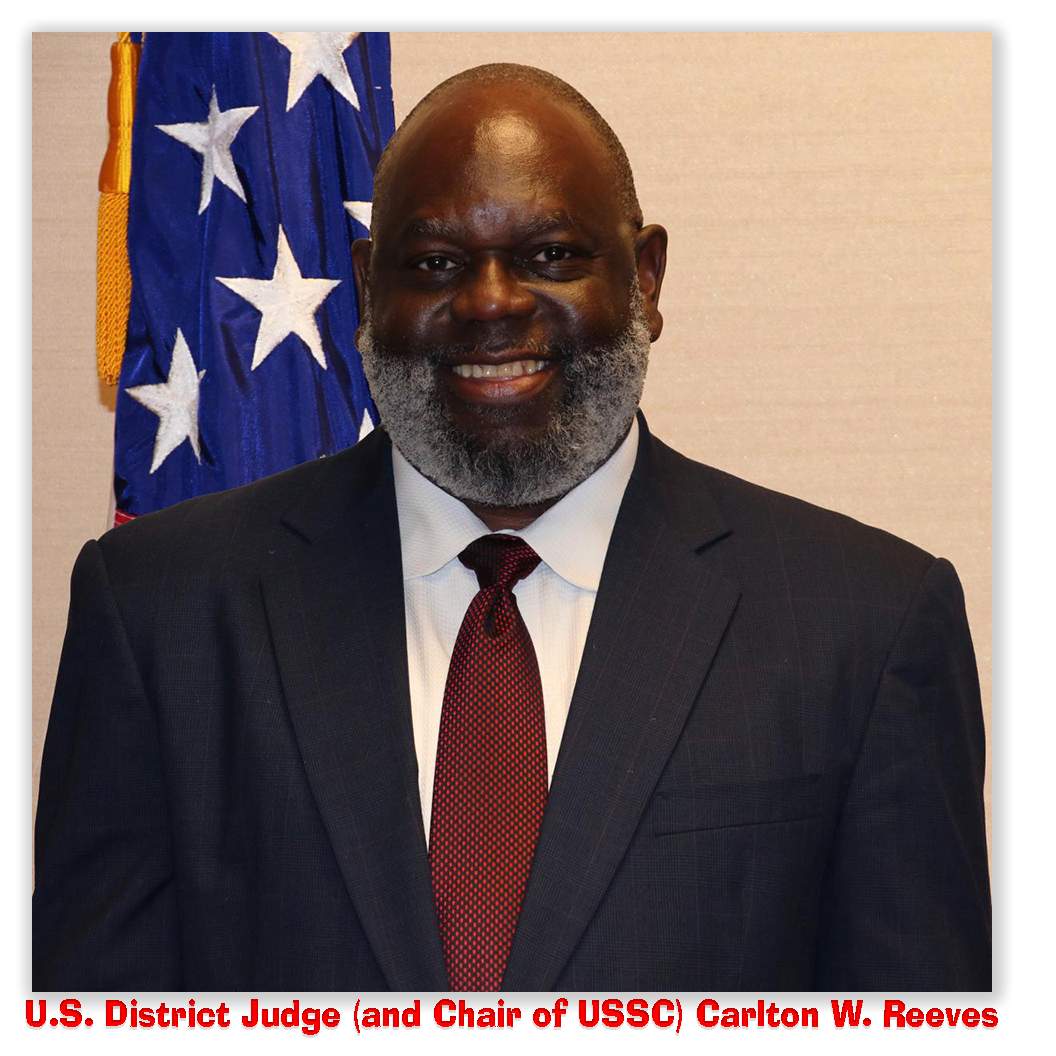
In other action, the Commission had been considering an amendment that prohibited courts from imposing longer sentences based on alleged crimes of which a defendant had been acquitted. Commission Chairman Carleton Reeves, a federal district judge from the Southern District of Mississippi, said the Commission needs more time before making a final determination on the issue.

Reuters reported that Michael P. Heiskell, President-Elect of the National Association of Criminal Defense Lawyers, said he was disappointed by the delay. “Permitting people to be sentenced based on conduct for which a jury has acquitted them is fundamentally unfair because it eviscerates the constitutional right to trial and disrespects the jury’s role,” he said in a statement.

However, the Commission’s delay may rejuvenate the McClinton v. United States petition for certiorari, which the Supreme Court has been sitting on at the suggestion of the Dept of Justice, awaiting Sentencing Commission action on acquitted conduct. A Supreme Court decision that use of acquitted conduct in sentencing is unconstitutional would benefit many more people than would a prospective Guidelines change.

The USSC also adopted a criminal history amendment that eliminates “status points” (sometimes called “recency points”) – additional criminal history points assessed if the defendant committed the current crime within two years of release for a prior crime – and grants a 2-level downward adjustment to a defendant’s offense level if he or she had zero criminal history points and met other criteria.

The Commission also approved an amendment to criminal history commentary advising judges to treat prior marijuana possession offenses more leniently in the criminal history calculus, making downward adjustments for offenses now seen as lawful by many states.

The proposal doesn’t seek to remove marijuana convictions as a criminal history factor entirely, but it would revise commentary within the guidelines to “include sentences resulting from possession of marihuana offenses as an example of when a downward departure from the defendant’s criminal history may be warranted,” according to a synopsis.

usscretro230406None of the Guidelines changes is retroactive without specific Commission determination that they should be. The USSC yesterday issued a notice that it will consider, pursuant to 18 USC § 3582(c)(2) and 28 USC § 994(u), whether Guidelines changes on “status points” and the “zero criminal history points” adjustment should be retroactive, and ask for public comment on the matter.

Although the Guidelines amendments do not become effective until November, most federal circuits have declared that – while the current § 1B1.13 is not binding on district courts because it is pre-First Step – courts should consider it to express the opinion of an agency expert in sentencing. The amended § 1B1.13 has every bit of the authority that the current non-binding § 1B1.13 has, and it has the additional benefit of being evidence of current Sentencing Commission thought.

USSC, Adopted Amendments (Effective November 1, 2023) (April 5, 2023)

USSC, Issue For Comment On Retroactivity Of Criminal History Amendment (April 5, 2023)

Reuters, U.S. panel votes to expand compassionate release for prisoners (April 5, 2023)

Marijuana Moment, Federal Sentencing Commission Approves New Marijuana Guidelines For Judges To Treat Past Convictions More Leniently (April 5, 2023)

– Thomas L. Root

Pollyanna Sees Great Future For EQUAL Act – Update for April 5, 2023

We post news and comment on federal criminal justice issues, focused primarily on trial and post-conviction matters, legislative initiatives, and sentencing issues.

HANDICAPPING CRIMINAL JUSTICE REFORM

pollyanna230405There’s not been much good news lately coming from Washington about reform of federal criminal laws, making a Washington Post piece last week noteworthy (if a bit too optimistic).

The Post admitted that the 117th Congress “in this tense partisan atmosphere” is likely to produce anything “along the lines of the First Step Act… some lawmakers and outside advocates say there are still opportunities to pass more limited legislation to make the criminal justice system less punitive.”

Partisan? Really?

The article cited the EQUAL Act (introduced in February in the Senate as S.524 and the House as H.R. 1062) to eliminate the disparity in federal sentencing for trafficking crack and cocaine. The bill passed the House on an overwhelming bipartisan vote in 2021 but was never brought to a vote in the Senate. It also noted the bipartisan task force formed last month to push legislation easing barriers to prisoners reentering society.

The EQUAL Act has broad support. Just last week, the conservative Americans for Tax Relief wrote Congress supporting the two bills, saying that “the sentencing disparity that currently exists between crack and powdered cocaine… has needlessly imposed sentences 100 times longer for possession of crack cocaine than the powdered counterpart, and despite some reform a large difference remains.”

“There’s a ton of Republicans that just want to do the right thing,” David Trone (D-MD) said last Tuesday. “And there’s a minority of Republicans who live on the rhetoric of, ‘Let’s stop everything.’”

Jason Pye, who lobbied for First Step at the conservative FreedomWorks group, said reform legislation might start moving once House Republicans tire of passing bills that stand no chance of clearing the Democratic-controlled Senate. “As far as I’m concerned, this is one of the few areas where there is not only bipartisan consensus, but support [from across the Republican] conference to do something,” the Post quoted Pye as saying.

However, besides being tragedies in their own right, events such as last week’s school shooting in Nashville hobble criminal justice reform efforts, especially in making First Step changes to 18 USC § 924(c) retroactive. Some Democrats want more than incremental progress on remaking the criminal justice system, especially after Monday’s school shooting in Nashville that left six dead.

gun160718Rep Jamie Raskin (D-MD) worked as a state senator on legislation eliminating state-law drug mandatory minimums and abolishing the death penalty. “I’m very open to that,” Raskin told the Post. “The problem is that we are in the midst of a nationwide gun violence crisis where we are losing tens of thousands of people every year, and we need real action there.”

Raskin, who served on the House Jan. 6 committee, also criticized Republicans for bemoaning the conditions of the D.C. jail holding those charged with attacking the Capitol. Rep Marjorie Taylor Greene(R-Ga.) led a visit to the jail last Friday.

But Armstrong and some conservative criminal justice advocates said they thought Republicans’ concerns about the Jan. 6 defendants might spur interest in the bills they’re working to pass. Armstrong, for instance, is working on a bill that would require federal prosecutors to certify that they’ve provided defendants with all exculpatory evidence before judgments are entered against them.

“That would be good for the Jan. 6 defendants, but it would [also] be good for every criminal defendant in federal court,” Armstrong said.

“When you have these highly charged political issues, I think the good side is, we may be calling attention to issues I’ve really cared about for a long time, and I get a new audience that may not have necessarily cared about them before,” Armstrong added.

Highly charged, indeed. Writing in Ringside at the Reckoning, William G. Otis (a former AUSA and DEA advisor) blasted the EQUAL Act: “The Post is hiding the ball by saying that the bill would just “eliminate the disparity” in sentencing between crack and powder cocaine. How exactly would it do that? … The answer, you will have guessed, is not to bring the penalties for each more nearly together, but solely to lower crack penalties.’

Otis, whom President Trump nominated to the Sentencing Commission but (thankfully) was never confirmed by the Senate, wrote that “lowering of penalties for a dangerous drug is exactly what the country needs ‘for its safety’ after two consecutive years in which, for the first time in our history, America suffered more than 100,000 drug overdose deaths — a critical fact nowhere to be found in the Post’s story.’

In fact, nothing is sacred anymore. The New York Times reported last week that Florida governor Ron DeSantis “see[s] the signature criminal-justice law enacted by Mr. Trump in 2018 as an area of weakness with his base, and Mr. DeSantis has indicated that he would highlight it when the two men tussle for the Republican nomination, according to three people with knowledge of Mr. DeSantis’s thinking. That law, known as the First Step Act, reduced the sentences for thousands of prisoners.”

optimism230405A perfect storm of people and events that coalesced to result in First Step – a senior White House official in the conservative Trump Administration whose father had done federal time, a liberal black justice activist who bucked criticism from the left to work with people seen as racist, a bill that disappointed the right for going too far and the left for not going far enough –  is not on the horizon right now. The film The First Step, a 90-minute documentary about the role Jones played in lobbying for prison reform, started streaming yesterday on Amazon Prime and Vudu, describes the improbable personalities and pressures that brought about passage of First Step, and reminds us that “it is important to work for bipartisanship if you want to get anything meaningful done in Congress,” according to San Diego Jewish World.

With crime once again becoming a political football, the odds of a Second Step Act don’t look good.

Washington Post, Is there any chance for criminal justice reform bills? Surprisingly, yes (March 29, 2023)

Americans for Tax Reform, ATR Supports the EQUAL Act (March 29, 2023) 

Ringside at the Reckoning, When the Washington Post Touts “Criminal Justice Reform”… (March 29, 2023)

The New York Times, DeSantis Burnishes Tough-on-Crime Image to Run in ’24 and Take on Trump (March 29, 2023)

San Diego Jewish World, ‘The First Step’ Tells How Prison and Sentencing Reform Were Won (April 3, 2023)

– Thomas L. Root

Congress Moves Up End of CARES Act – Update for April 3, 2023

We post news and comment on federal criminal justice issues, focused primarily on trial and post-conviction matters, legislative initiatives, and sentencing issues.

CARES ACT END NEARER THAN WE THOUGHT

Under Congressional pressure, in late January, President Joe Biden announced he would end the national COVID emergency on May 11th. Last week, the Senate made it clear to Biden that the emergency will end when Congress – not Joe – says it does.

endisnear230403In February, the House voted 229-197 to terminate the COVID-19 pandemic national emergency order immediately. Last week, the Senate agreed by a 68-23 vote that the emergency, which Biden extended in January, should end.

An Administration spokesman told Roll Call that “the President strongly opposes H.J. Res. 7, and the administration is planning to wind down the COVID national emergency and public health emergency on May 11….” However, “if this bill comes to [Biden’s] desk… he will sign it.”

Had the emergency expired on May 11, the Bureau of Prisons’ CARES Act authority to place prisoners in home confinement would have ended 30 days later, or on June 10. But with the emergency to expire as soon as today, BOP home confinement authority could end as early as Wednesday, May 3.

BOP CARES Act authority lasts during the “covered emergency period,” which the Act defines as “the period beginning on the date on which the President declared a national emergency under the National Emergencies Act… and ending on the date that is 30 days after the date on which the national emergency declaration terminates.”

The BOP previously promised not to slow CARES Act home confinement placement as the covered emergency period expired. However, there seems to be a marked increase in unexplained denials by Regional Residential Managers, many apparently resulting from the BOP’s current policy of soliciting the opinion of the same US Attorney responsible for convicting the prisoner to begin with.

CARESEnd230131Writing in Forbes, Walter Pavlo said a prisoner told him that the BOP “is responding to inmates completely contrary to how they’ve responded to you.” Pavlo notes that “for all of the CARES Act successes, a review of the program, which will ultimately occur, will assess the equity with which the BOP used its authority. Many prisoners who were approved for CARES Act have told me that they received a denial but no real explanation for that denial. Others, with the support of a case manager and warden, were denied by Central Office, most likely from interference from prosecutors who have a renewed interest in keeping prisoners in institutions for as long as possible.”

The time for a post-mortem will come soon enough, perhaps as soon as 30 days from now. For now, Congress has succeeded in advancing the timetable by maybe 40 days.

The New Testament quotes Jesus as telling Judas, “What thou doest, do quickly.”  Good advice for anyone still in the CARES Act pipeline.

Roll Call, Senate votes to overturn COVID-19 national emergency order (March 29, 2023)

The Hill, Biden declines to veto GOP-led measure to end COVID-19 emergency March 29, 2023)

Forbes, End Of CARES Act Home Confinement Is Near For Many Federal Prisoners (March 29, 2023)

– Thomas L. Root

A Mea Culpa and A Chocolate Bunny – Update for March 31, 2023

We post news and comment on federal criminal justice issues, focused primarily on trial and post-conviction matters, legislative initiatives, and sentencing issues.

EASTER BUNNY DROPS OFF ROTTEN EGGS FOR ME, BUT IT’S THE BOP’S RESPONSE THAT REALLY SMELLS

rotteneggs230331In LISA’s February 28th installment, The Easter Bunny’s Working for the BOP, I noted a New York Times report about the Federal Bureau of Prison’s promise, in the wake of sexual abuse of female inmates by BOP staff at FCI Dublin (California) and elsewhere, to favorably consider bringing sentence reduction motions for victimized inmates.

In one of the first tests of that promise, the Times reported the BOP general counsel denied a compassionate release application filed by a middle-aged female inmate who claimed the sexual abuse she suffered from BOP personnel justified the grant of a sentence reduction.

The Times said that BOP officials familiar with the case privately admitted that they did not dispute her allegations and thought her release would not pose a public safety threat.

Somehow, I made it less than clear that the BOP thought the inmate would not pose a danger to the public. In fact, I dropped the word “not” from the reports, making it seem that the BOP saw her as a danger.

(Don’t bother to look at the old post. I fixed it).

gutenberg230331Back in journalism school (around the time Gutenberg invented the press), I learned that when a defendant was acquitted, one should always write that he or she was “found innocent.” Literally, a jury does not find a defendant innocent, but rather “not guilty.” However, the imprecision was deemed acceptable, because to use the more accurate “not guilty” ran the risk that the word “not” might be dropped in error, opening the newspaper to a libel suit.

I always thought that the risk of that was pretty slim. Now I know better, and I am chagrinned at the error.

I’m embarrassed, but not as much as the BOP should be. What the BOP’s decision on this inmate means is that it had absolutely no reason for denying the inmate’s request that it bring a compassionate release motion on her behalf, except for the BOP’s belief that while she suffered at the hands of BOP employees, her suffering just wasn’t bad enough for the BOP to acknowledge.

So exactly how bad does the abuse have to be before the BOP figures some atonement is called for?

Incidentally, last week former FCI Dublin Warden Ray Garcia was sentenced to 70 months on multiple counts of sexual abuse of female inmates, and Jose Viera, a CO at MDC Los Angeles, got 120 months in federal prison for deprivation of rights under color of law arising from his sexual abuse of a female detainee. BOP Director Colette Peters said last Thursday that “to the victims and all negatively impacted by these offenses, be assured, we will continue our commitment to rooting out this criminal behavior and holding those who violate their oath accountable.”

chocobunny230330The BOP has an interest in locking up employees who sexually abuse inmates. Notably, Director Peters mentioned nothing about any BOP concern for the impact of that conduct on the victims.  After all they’re just inmates.  Or, to use Ms. Peters’s expression, “adults in custody.”

I regret my error in the original story, and I owe the inmate the best pickings from my Easter basket (if I get one). Sadly, if I could give her no more than a couple of jelly beans and a chocolate bunny, it would still be more than she can expect from the BOP.

The New York Times, Justice Dept Struggles to Carry Out Early Release Program for Abused Inmates (February 22, 2023)

DOJ, Former Bureau of Prisons Corrections Officer Sentenced to 10 Years in Federal Prison for Sexually Assaulting Inmate in Los Angeles Jail (March 20, 2023)

BOP, Statement regarding the sentencing of Ray J. Garcia (March 23, 2023)

– Thomas L. Root

10th Says ‘No Flogging’ Supervised Release Violators – March 30, 2023

We post news and comment on federal criminal justice issues, focused primarily on trial and post-conviction matters, legislative initiatives, and sentencing issues.

‘YOU MUST BE PUNISHED!’

punishment230330My daughter Leslie spent a year as a Fulbright Scholar teaching in Vladivostok, Russia (back in the days when Russia still held promise as a member in good standing of the benevolent world order). One evening, she was struck by a car whose driver jumped a red light.

It was the kind of automotive negligence that happens the world over, and the driver and his wife were appalled and chagrinned by the mishap, even bundling her into the car and driving her to an emergency room (she suffered a broken leg but nothing worse). Still, the next day, as Leslie lay recuperating in the hospital, her Russian friends urged her to file a police report.

Leslie resisted, because it was a cinch that the driver’s insurance – if he had any – would not begin to pay for the treatment she would need back in the USA (she had to fly home for about six weeks for the reconstruction that her knee required). She hardly saw the point in the paperwork a police report would require. But her Russian friends insisted, arguing, “He must be punished!”

Alas, the societal demand for retribution is hardly limited to Putin’s paradise, as the 10th Circuit reminded us last week.

After Donald Joe Booker, Jr. repeatedly violated the terms of his supervised release, the district court revoked his supervision and sentenced him to 24 months in prison, the maximum time he could get under the statute.

badtrack230330To be sure, Donnie was 87 miles of bad track: While on supervised release after serving his sentence for being a felon in possession of a gun, Donnie was caught for speeding, driving without a license or insurance, and refusing to submit to sobriety testing. He tested positive for amphetamine or methamphetamine use on four separate occasions (and had some meth in his pocket when he was arrested on the revocation warrant), left the Eastern District of Oklahoma without permission on three occasions, failed to tell his probation officer about contacts with law enforcement on three occasions, and failed to appear for drug testing on five separate occasions.

When he was sentenced on the supervised release violation, the district court complained that Donnie “has shown repeated disregard for rules and condition of his supervised release. He has continued to commit new law violations and he has illegally possessed controlled substances, which he acknowledges. He has on multiple occasions failed to report to his law enforcement contact as required by the conditions of his supervision and he has also traveled outside the district of supervision without permission of his probation officer. Based upon these factors, a sentence outside the advisory guideline range is necessary to serve as an adequate deterrent to this defendant as well as others, promote respect for the law, and provide just punishment for the offense, and provide protection for the public.”

Last week, the 10th Circuit vacated Donnie’s sentence.

Badlaw200804Hard cases make bad law. The catch is that when sentencing someone for a criminal offense, the judge must consider the sentencing factors listed in 18 USC § 3553(a), which is a weighty list that includes just punishment for the offense, the need to protect the public, deterrence and the promoting respect for the law.

When sentencing someone who screwed up and violated their supervised release – a term which is imposed to run after release from imprisonment – the district court is required to consider only some of the § 3553(a) sentencing factors, not all of them. Under 18 USC § 3583(e), which governs revocation of supervised release , the court must sentence “after considering the factors set forth in section 3553(a)(1), (a)(2)(B), (a)(2)(C), (a)(2)(D), (a)(4), (a)(5), (a)(6), and (a)(7).”

“Notably absent from this list,” the 10th noted, “is § 3553(a)(2)(A), which directs courts to consider… the need for the sentence imposed… to reflect the seriousness of the offense, to promote respect for the law, and to provide just punishment for the offense.”

The Circuit held that “section 3553(a)(2)(A) represents ‘retribution,’ one of the ‘four purposes of sentencing’ that courts must consider when fashioning a sentence during the initial sentencing process.” Here, the district court justified Donnie’s 24-month… “in part as ‘necessary to serve as an adequate deterrent to this defendant as well as others, promote respect for the law, and provide just punishment for the offense, and provide protection for the public.’ By referencing the need to ‘promote respect for the law, and provide just punishment for the offense,’ the district court quoted from § 3553(a)(2)(A), the omitted factor.”

Two weeks ago, the Congressional Research Service issued one of its “Legal Sidebar” reports on supervised release sentencing, in which it noted a deep circuit split on whether retribution may play a role in sentencing on revocation of supervised release. “On one side of the divide,” the report stated, “the U.S. Courts of Appeals for the First, Second, Third, Sixth, and Seventh Circuits have held that federal courts may consider retribution in making revocation decisions. On the other side, the Fourth, Fifth, and Ninth Circuits have concluded that courts either may not consider retribution in these decisions at all or may consider it only to a limited degree.”

To the “nays” you can now add the 10th Circuit.

angels170726We’re not just counting angels on the head of a pin, either. Writing in his Sentencing Law and Policy blog, Ohio State University law professor Doug Berman observed that “given U.S. Sentencing Commission data showing over 20,000 supervised release violation hearings taking place every year, there are on average nearly 100 federal defendants at least potentially impacted by this jurisprudential divide every single day in federal courts. SCOTUS really should resolve this matter sooner rather than later if we think some semblance of equal justice is of importance in our federal criminal sentencing systems.

United States v. Booker, Case No. 22-7000, 2023 U.S. App. LEXIS 7312 (10th Cir. March 28, 2023)

Congressional Research Service, Can Retribution Justify the Revocation of Supervised Release? Courts Disagree (March 13, 2023)

Sentencing Law and Policy, Tenth Circuit deepens split over considering retribution in revocation of federal supervised release (March 29, 2023)

– Thomas L. Root
DOJ Confirms: BOP COVID Numbers Were Wacky – Update for March 29, 2023

We post news and comment on federal criminal justice issues, focused primarily on trial and post-conviction matters, legislative initiatives, and sentencing issues.

IG REPORT ON BOP COVID RESPONSE FINDS NUMBERS WERE JUST AS FUNNY AS EVERYONE SAID THEY WERE

numbers180327The Dept of Justice Office of Inspector General released a report last week on the BOP’s COVID response, containing little of any surprise to those who lived through it (especially when it came to the Bureau’s incomplete and misleading daily COVID data).

A common complaint by the media (including this blog) during the pandemic related to the BOP’s manipulation of COVID numbers to make the pandemic look less pervasive in the prison system. The BOP reported on the total number of inmates who had tested positive for COVID at a given institution and system-wide, but sometimes the number actually fell from day to day. It turned out the BOP would deduct from the total inmates who had been released, as though their COVID cases never counted because they had never been there.

Complaints at the time that the BOP was cooking the books fell on deaf ears. But now, the IG has placed its seal of disapproval on the BOP’s voodoo medical accounting:

[BOP COVID] active case counts do not include inmates or staff who recovered or died, and the recovered case counts do not include inmates or staff who die, inmates who have subsequently been released from BOP custody, or staff who have left BOP employment. These omissions mean that the BOP’s publicly posted data does not represent the full extent of cumulative COVID-19 cases among inmates and staff over the course of the pandemic. Further, the BOP website does not mention that the staff and inmate recovery data presented excludes inmates who left BOP custody or staff who left BOP employment, which could lead stakeholders to draw incorrect conclusions about the BOP’s data.

crazynumbers200519The IG noted that “similar issues exist with the BOP’s publicly posted data on testing, which also includes only inmates currently in BOP custody” and which omitted many local tests. BOP vaccination data was also flawed: “BOP does not publish data that allows stakeholders to see the proportion of vaccinated individuals at any of the facilities, as the published data displays only the cumulative number of BOP-administered vaccinations completed at each facility.”

In fact, this blog noted that the BOP’s misleading cumulative numbers had some facilities showing that well more than 100% of the inmate population had been vaccinated. The IG dryly observed that such reporting “could lead stakeholders to draw incorrect conclusions.”

No kidding.

The Inspector General also criticized the BOP’s opaque communications on CARES Act home confinement. The Report “observed that the BOP’s communication with the public regarding home confinement only restated the criteria in the Attorney General’s memoranda without clarifying them in plainer language or describing how the BOP was interpreting or implementing the criteria. For example, while the BOP provided a Frequently Asked Questions section on home confinement on its public website during the pandemic, the section did not mention the additional time-served criteria the BOP was using to determine eligibility for home confinement. Clearly stating to the public how and why the BOP was implementing and prioritizing its expanded home confinement authorities could have helped the BOP be more transparent with inmates and other stakeholders at a time of high stress and uncertainty.”

DOJ Inspector General, Capstone Review of the Federal Bureau of Prisons’ Response to the Coronavirus Disease 2019 Pandemic (March 20, 2023)

Govt Executive, Here’s How the Prisons Agency Fared During the Pandemic (March 21, 2023)

– Thomas L. Root

U.S. Sentencing Commission’s In A Hurry to Get Things Done – Update for March 27, 2023

We post news and comment on federal criminal justice issues, focused primarily on trial and post-conviction matters, legislative initiatives, and sentencing issues.

SENTENCING COMMISSION ROCKET DOCKET

rocket190620Showing that a federal prisoner has an ‘extraordinary and compelling’ reason for grant of compassionate release is critical to getting a sentence reduction grant under 18 USC § 3582(c)(1)(A). That statute also requires that any grant be consistent with “applicable policy statements” of the U.S. Sentencing Commission.

This is where it’s been sticky. The USSC has one policy statement (USSG § 1B1.13) addressing compassionate release, adopted well before the compassionate release statute was changed by the First Step Act. The same month Congress passed First Step (December 2018), the USSC lost its quorum as multiple members’ terms expired. President Trump nominated some new members a few months later, but the Senate did not approve them. That condition lasted until last spring, when President Biden nominated a complete slate of new members.

USSC2300327Without a quorum, the USSC could not modify § 1B1.13 to account for the changes that First Step made in the § 3582(c)(1)(A). Almost all courts responded by holding that the old § 1B1.13 was no longer an “applicable policy statement” and thus didn’t bind the courts. In a way, that was liberating to the people filing compassionate release motions, because courts were freed from § 1B1.13’s restrictive definition of what constituted “extraordinary and compelling” reasons.

But without a USSC policy statement moderating district court responses, compassionate release grants since 2019 have been characterized by wide disparity. In Oregon, for instance, about 62% of compassionate release filings have been granted. In the Middle District of Georgia, on the other hand, only about 1.5% have been granted.

The new USSC said last its top priority was to amend § 1B1.13, and in January, the Commission issued a draft § 1B1.13 for public comment that contained some very prisoner-friendly proposals and options. The proposed change was part of an extensive set of draft Guidelines amendments that spanned more than a hundred pages of text. The public comment period ended two weeks ago, with over 1,600 pages of comments filed on the compassionate release proposal alone.

The USSC usually rolls out its proposal Guidelines amendments by May 1st. Under 28 USC § 994(p), the amendments go to Congress, which then has 180 days to reject them. If Congress does nothing (which is almost always the case), the changes become effective.

Iminahurry230327But this new USSC is in a hurry to get things done. Last week, the Commission announced an April 5 meeting at which the final § 1B1.13 (and all of the other draft proposed amendments) will be adopted.

If the amendment package goes to Congress that same day, they could become effective as early as Monday, Oct 2nd.

USSC, Public Meeting – April 5, 2023 (March 24, 2023)

– Thomas L. Root
DOJ Seeks Expedited Certiorari on Rahimi – Update for March 23, 2023

We post news and comment on federal criminal justice issues, focused primarily on trial and post-conviction matters, legislative initiatives, and sentencing issues.

DOJ SEEKS CERTIORARI ON 5TH CIRCUIT RAHIMI DECISION

bad driver230323You may recall Zack Rahimi, a man who responded to the all-too-common embarrassment of having his credit card declined in the usual way. After being unable to use plastic to pay for his Whataburger Patty Melt (ranked as the chain’s best sandwich, by the way), Zack understandably drew his handgun and opened fire on houses, police cars, and pretty much anything else in front of the muzzle of his pistol. He even shot at bad drivers (something we’ve all had the urge to do from time to time).

At the time, Zack was subject to a civil protection order for having stalked an ex-girlfriend. After the locals got done charging him for felony hangry-ness, the Feds weighed in, charging him with possessing a firearm while being subject to a domestic violence protection order, a violation of 18 USC § 922(g)(8). But in the wake of the Supreme Court’s decision last June in N.Y. State Rifle & Pistol Ass’n, Inc. v. Bruen, the 5th Circuit ruled that prohibiting people from possessing guns because of domestic violence protection orders violates the 2nd Amendment. The Circuit said:

The question presented in this case is not whether prohibiting the possession of firearms by someone subject to a domestic violence restraining order is a laudable policy goal,” the Circuit said. “The question is whether 18 U.S.C. § 922(g)(8), a specific statute that does so, is constitutional under the 2nd Amendment of the Constitution. In the light of N.Y. State Rifle & Pistol Ass’n, Inc. v. Bruen… it is not.

stalking230323The government has now filed a petition for writ of certiorari with the Supreme Court, and has done so quickly. The government could have sought en banc review, asking the entire 26-judge court to consider the issue. Instead, the government explained in its petition for writ of cert, due to “the significant disruptive consequences of the Fifth Circuit’s decision, the government is filing this petition for a writ of certiorari on a highly expedited schedule — a little more than two weeks after the issuance of the Fifth Circuit’s final amended opinion — in order to allow the Court to consider the petition before it recesses for the summer.”

The government argues in its petition that the appellate decision “overlooked the strong historical evidence supporting the general principle that the government may disarm dangerous individuals… Although courts interpreting the 2nd Amendment must consider text, history, and tradition, they should not focus on whether the law at issue has ‘a historical twin,’” the government contends “To the contrary, this Court emphasized that ‘even if a modern-day regulation is not a dead ringer for historical precursors, it still may be analogous enough to pass constitutional muster.’”

doitnow160817Writing in his Sentencing Law and Policy blog, Ohio State University law professor Doug Berman wonders whether the Supreme Court will be amenable to the government’s request to “take up the case on an expedited basis even before there is a direct circuit split.” He suggests that “expedited” may have a more glacial meeting at the high court: “I suspect the Justices will get back to these Second Amendment matters pretty soon. But ‘pretty soon’ in Supreme Court timelines does not really mean ‘soon’…”

There have been District Court decisions elsewhere that have relied on Bruen to gut § 922(g) limitations on gun possession by people under indictment, possession of guns with obliterated serial numbers, and possession of guns by marijuana users.  In the 3rd Circuit, the appeals court is examining whether the § 922(g) proscription on gun possession by people with felony convictions can survive Bruen.  And on Monday, a U.S. District Court in the Central District of California struck down the state’s Unsafe Handgun Act – which required all handguns sold in the state to have three features which not a single handgun in the world has – as unconstitutional under Bruen.

Perhaps the legal tsunami of attacks on § 922 alone – even absent a circuit split – will force SCOTUS’s hand and bring us another gun decision sooner rather than later.

United States v. Rahimi, Case No. 21-11001, — F.4th —, 2023 U.S. App. LEXIS 5114 (5th Cir., March 2, 2023) (amended opinion)

Petition for Writ of CertiorariUnited States v. Rahimi, Case No. 22-915 (Supreme Court, filed March 17, 2023)

N.Y. State Rifle & Pistol Ass’n, Inc. v. Bruen, — U.S. —, 142 S. Ct. 2111, 213 L. Ed. 2d 387  (2022)

The Hill, DOJ asks SCOTUS to review ruling that overturned firearm ban for those with domestic violence restraining orders (March 18, 2023)

Sentencing Law and Policy, With DOJ asking, will SCOTUS quickly take up a post-Bruen case on gun possession by thoe subject to DV orders? (March 20, 2023)

Boland v. Bonta, Case No. SACV 22-01421-CJC (March 20, 2023)

Thomas L. Root

7th’s Lack of Compassion is Disturbing – Update for March 21, 2023

We post news and comment on federal criminal justice issues, focused primarily on trial and post-conviction matters, legislative initiatives, and sentencing issues.

7TH CIRCUIT ISSUES DOUBLE-BARRELED COMPASSIONATE RELEASE DENIALS

Nuthin Times Nuthin May Be More Than Nuthin’: Stanley Vaughn, who is doing consecutive 240- and 262-month sentences, moved for compassionate release because of COVID-19 and his record of programming. He also argued that due to decisions issued since his conviction, he could not receive nearly as high a sentence if he was convicted today.

vadercompassion230321Last week, the 7th Circuit affirmed a district court denial of his compassionate release motion. Holding that “COVID-19 has been a fact of life for more than three years,” the 7th observed that “for prisoners who have received a vaccine, the risk of serious complications should they develop a breakthrough infection is modest. Vaughn has not provided or pointed to any medical data suggesting that his combination of conditions puts him at serious risk should he develop a breakthrough infection.”

Stan’s argument about completing classes left the appeals court equally unimpressed: “Taking classes while incarcerated is common rather than extraordinary. If data showed that completion of particular classes reliably put prisoners on the path to a law-abiding life, that might satisfy the statutory requirement, but Vaughn has not supplied any information along these lines.”

The Circuit may as well demand that Vaughn prove that the sun will rise in the east tomorrow.  From Congressional findings underpinning the First Step Act to the most current Dept of Justice reports on the effectiveness of the Act, evidence shows that the more evidence-based recidivism reduction classes a prisoner completes and the lower his or her recidivism score, the less likely he or she is to return to prison.

FSATable230320

After reducing Stan’s programming achievements to an asterisk,  the Circuit ruled that his career offender classification and not a statutory minimum drove the 262-month sentence. Stan’s reliance on United States v. Ruth, was misplaced, the Circuit said., and does not affect the career-offender calculation. “At all events,” the 7th noted, “we have held that Ruth does not justify compassionate release as an indirect means to achieve retroactive application of that decision.”

An interesting aspect of the ruling is the Circuit’s endorsement that individual reasons may be aggregated to meet the “extraordinary and compelling” standard for compassionate release: “If we conceive of ‘extraordinary and compelling reasons’ as those differentiating one prisoner’s situation from 99% of other prisoners, it is easy to see how Circumstance X could be true of only 10% of prisoners, Circumstance Y of 10%, and Circumstance Z of 10% – each insufficient to meet the threshold, but if they are independent then collectively enough to place the applicant among only 0.1% of all federal prisoners… Our point… is that no matter how the threshold is defined, a combination of factors may move any given prisoner past it, even if one factor alone does not.”

Despite this holding, the Circuit concluded that however you stacked Stan’s reasons, they fell short.

Legal Error Is Neither Extraordinary Nor Compelling: Leonard Williams filed for compassionate release because a district court treated him as having a prior conviction for unlawful drug delivery, which increased his minimum sentence to 10 years. But United States v. Ruth held that his conviction for delivery of cocaine in Illinois does not satisfy the criteria of a “serious drug felony” under 21 USC § 841(b)(1)(B), meaning his sentence was longer than the law required.

Last week, the 7th Circuit said ‘so what?’

extraordinaryerror230321“As we put it in Von Vader,” the 7th said, “the sort of ‘extraordinary and compelling’ circumstance that § 3582(c)(1) addresses is some new fact about an inmate’s health or family status, or an equivalent post-conviction development, not a purely legal contention for which statutes specify other avenues of relief—avenues with distinct requirements, such as the time limits in § 2255(f) or the need for a declaration by the Sentencing Commission that a revision to a Guideline applies retroactively… There’s nothing ‘extraordinary’ about a legal error by a district court (or a court of appeals), and the law provides methods other than compassionate release for dealing with claims of legal error.”

United States v. Vaughn, Case No. 22-2427, 2023 U.S.App. LEXIS 6171 (7th Cir., March 15, 2023)

United States v. Williams, Case No. 22-1981, 2023 U.S.App. LEXIS 5877 (7th Cir., March 13, 2023)

– Thomas L. Root

With CARES Act Almost Over, BOP Streamlines Process – Update for March 20, 2023

We post news and comment on federal criminal justice issues, focused primarily on trial and post-conviction matters, legislative initiatives, and sentencing issues.

BOP STEPS ON THE GAS IN CARES ACT’S FINAL DAYS

CARESEnd230131President Biden will end the COVID-19 national emergency on May 11, 2023. The immediate effect for the Federal Bureau of Prisons is that the agency will lose its authorization to place prisoners in extended Coronavirus Aid, Relief, and Economic Security (“CARES“) Act,  home confinement 30 days later.

Among the myriad of federal responses mandated by the bloated CARES Act, a $2.2 trillion response to COVID-19 that runs some 324 pages in Volume 134 of the United States Statutes, the BOP was given authority in § 12003(b)(2) to “lengthen the maximum amount of time for which the Director is authorized to place a prisoner in home confinement under the first sentence of section 3624(c)(2) of title 18, United States Code, as the Director determines appropriate.” Practically speaking, this gave the BOP the right to place prisoners on home confinement indefinitely, despite the old 18 USC 3624(c)(2) limitation of 10% of the sentence up to a maximum of six months.

The CARES Act authority continues during what § 12003(a)(2) calls the “covered emergency period.” This period ends “on the date that is 30 days after the date on which the national emergency declaration terminates.” In other words, with the national emergency ending on May 11, the “covered emergency period” ends on Saturday, June 10th.

As the BOP’s CARES Act authority sunsets, some have speculated the Bureau would slow the transfer of prisoners to home confinement. But writing in Forbes last week, Walter Pavlo reported that the BOP’s Office of Public Affairs told him, “The Bureau of Prisons (BOP) has not made efforts to slow CARES Act home confinement placements as the end of the CARES Act approaches. We have issued no guidance regarding this matter.” Pavlo called that “welcome news to prisoners who meet the eligibility requirements for CARES Act placement.”

caresbear230124Hard evidence the BOP is pushing CARES Act release arrived last week with the report of an internal BOP memorandum dated March 9 that relaxed prior BOP policy on CARES Act approvals. The BOP has established criteria for CARES Act placement, including serving a minimum portion of one’s sentence, prior disciplinary reports, and history of violence. When a prisoner did not meet all of the conditions, he or she could still be recommended by the institution for home confinement, but the referral had to be approved by a BOP Central Office Home Confinement Committee.

One of the HCC’s practices was to solicit comment from the US Attorney’s Office that had prosecuted the inmate. Pavlo noted that “in many cases, prosecutors did oppose rather than just defer to the BOP, who know best how to house prisoners in its care.”

Up to now, those prisoners denied CARES Act placement by the HCC have been required to go back to Central Office later even when they met all CARES Act criteria. Pavlo said, “This usually led to the same opposition and denial.” But the March 9 memo ends the endless cycle of HCC approval. It says, “Effective with the issuance of this memo, referrals for home confinement placement no longer need to be submitted to the HCC if the inmate now meets all established criteria.” Now, if the inmate meets all BOP criteria, referrals for CARES Act will now be sent directly to the appropriate Residential Reentry Management Office . The RRM “will retain the final authority based on the referral and availability of community resources,” the memo says.

noplacelikehome200518Pavlo writes that “[m]any are also hoping that the DOJ extends the 30 days after the end of CARES Act to something that takes into consideration the success of the program and the conditions of prison.” Unfortunately, the hopes of those who are looking for a magical extension are misplaced. Because the BOP’s authority to place people in home confinement is limited by statute, any extension of a CARES Act-style home confinement will have to come from Congress.

Writing last week in his Sentencing Law and Policy blog, Ohio State law professor Doug Berman said, “Though it makes sense to wind down the pandemic-driven authority to transfer certain persons from federal prison to home confinement, Congress and the US Sentencing Commission and the Justice Department should carefully study the apparent success of this CARES Act program and consider ways to give BOP broader authority in non-pandemic times to move low-risk prisoners into home confinement.”

BOP, Home Confinement Criteria and Guidance (Addendum) (March 9, 2023)

Forbes, Bureau Of Prisons Sees End Of Cares Act Home Confinement, Some Prisoners Will Be Left Behind (March 14, 2023)

Sentencing Law and Policy, With pandemic legally winding down, should Congress build in CARES Act success to greatly expand BOP home confinement authority? (March 15, 2023)

– Thomas L. Root