
We post news and comment on federal criminal justice issues, focused primarily on trial and post-conviction matters, legislative initiatives, and sentencing issues.

WE’RE OUTTA HERE
One week a year, we take a break from the newsletter. That will be next week, while we are abused by our grandkids on vacation. THERE WILL BE NO NEWSLETTER ON AUGUST 10, 2026. We will be back on August 17th.
THE ORANGUTANS SPEAK?
A little more than a month ago, the Supreme Court ruled that appeal and collateral attack waivers contained in plea agreements were not rigid but instead should be found to be “unenforceable when it would result in a miscarriage of justice — meaning, when it would leave in place the kind of egregious sentencing error that would bring the judicial system into disrepute.”
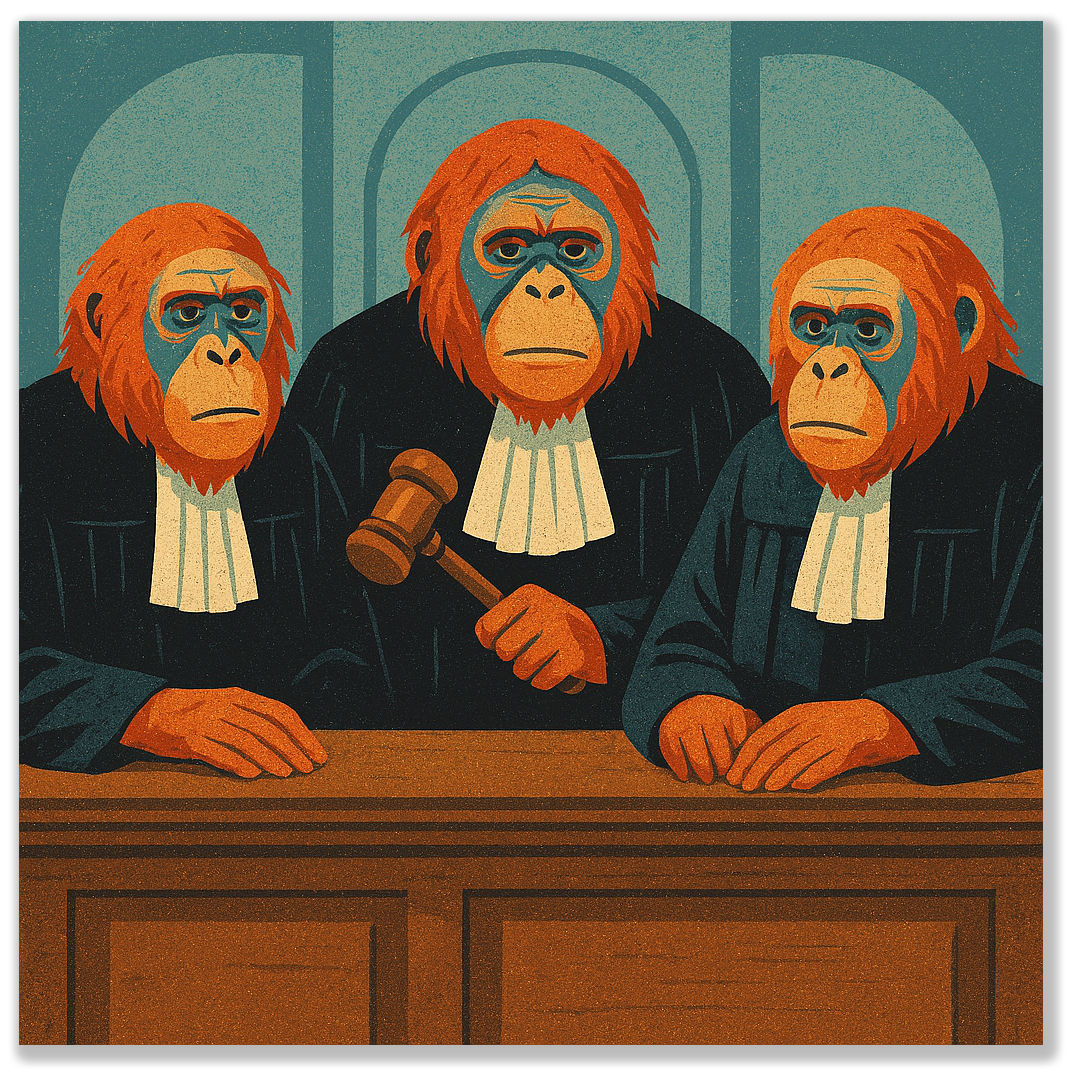 The decision, Hunter v. United States, reversed a 5th Circuit policy that refused to set aside waivers for any error whatsoever. SCOTUS held that the error in the sentencing must be obvious, not one that a judge could reasonably make.” The high court ruled that “[t]he point of the miscarriage-of-justice limit… is to offer a safety valve for extreme cases—a way out of waiver when the system’s integrity is at stake.”
The Court further explained the types of situations that would qualify for the miscarriage-of-justice exception:
A defendant may appeal a sentence exceeding what the relevant statute allows—most commonly, a term of years above the maximum prescribed. Second, a defendant may appeal a sentence infected with a blatant constitutional error, such as when a judge takes account of a constitutionally impermissible factor (like race) or imposes a constitutionally infirm condition of supervised release (like barring a defendant from becoming pregnant). And third, a defendant may appeal if his sentence was imposed without some minimum of civilized procedure, as in, yes, the [trial by] twelve orangutans case—or less extravagantly, one in which the judge refused to hold a hearing consonant with basic principles of law.
SCOTUS said other more “uncertain or ordinary” errors would not override an appeal waiver. It observed that “mistakes” in “the detailed calculation of a Sentencing Guidelines range and the mandatory consideration of multiple sentencing factors” are “unfortunate but inevitable… and cannot cancel an appeal waiver.”
In the Hunter case, defendant Munson – convicted of a white-collar offense – was ordered to get mental health therapy while on supervised release and to take whatever medication his mental health provider told him to take. Munson was uninterested in downing the drugs some psychiatric doc ordered. He did not appeal his sentence but rather the mental health condition in his supervised release, making a 5th Amendment argument that he couldn’t be told to dope himself up by the court.
The Supreme Court did not settle the matter for Munson. It just told the 5th Circuit that it couldn’t automatically reject the appeal without testing the waiver provision against a miscarriage of justice standard.
Last week, the 5th Circuit applied the new standard but unsurprisingly found against Munson once again. The Circuit held that a court order that a defendant be doped up against his will is normal and acceptable, because “there is a nexus between the Medication Condition and the government’s interests in promoting Hunter’s health and reducing his likelihood of re-offending.” Plus, he could always appeal to the District Court if a “dispute” arose about Hunter’s taking particular medication, and “the probation officer can’t resolve the dispute,” and, anyway, the meds will be prescribed by a physician who, the Court assumes, will not “prescribe mental health medication against Hunter’s medical interest.”
 Additionally, the Medication Condition “does not rise to the level of ‘egregious” constitutional error that would ‘bring the judicial system into disrepute’ because the same condition has been “broadly imposed” by federal district courts “as a ‘stock’ special condition” of supervised release.” Finally, the condition is nothing like the Hunter opinion’s examples of race-based or gender-based terms that would be “blatantly unconstitutional.” Such errors would “stem from extreme animus or prejudice,” the Circuit said, “which are never appropriate considerations in sentencing. In contrast, there is no suggestion here that the district court imposed the Medication Condition for such invidious purposes.”
No one expected the 5th to roll over after the SCOTUS Hunter opinion slapped down its “waivers-are-bulletproof” policy. However, its quick and dubious defense of a district court’s decision to practice psychiatric medicine on a white-collar defendant – complete with anodyne justifications that could fit any case – suggests that SCOTUS has a lot more oversight to apply to appeals waiver enforcement.
United States v. Hunter, Case No 24-20211, 2026 U.S. App. LEXIS 22637 (5th Cir. July 29, 2026)
~ Thomas L. Root