Going Back to the Well – Update for September 24, 2021

We post news and comment on federal criminal justice issues, focused primarily on trial and post-conviction matters, legislative initiatives, and sentencing issues.

PROCEDURAL BOOTSTRAPPING

well210924Back to the Well Once Too Often: Federal prisoners who lose their 28 USC § 2255 motions sometimes resort to filing motions to set aside the § 2255 judgment under Federal Rule of Civil Procedure 60(b), as a clever means of getting around seeking permission for a second or successive § 2255 under 28 USC § 2244. It seldom works.

A few fun facts: First, although a post-conviction motion under 28 USC § 2255 challenges a criminal conviction or sentence, the § 2255 proceeding itself is considered to be a civil action. That is how a movant even has the option to employ Fed.R.Civ.P. 60(b), or any other Federal Rule of Civil Procedure, for that matter. Second, Rule 60(b) – which governs motions to set aside the judgment – is usable after a final judgment is rendered, although that some time constraints and designated bases for invoking the Rule that are beyond today’s discussion. Third, the Anti-Terrorism and Effective Death Penalty Act – known as the AEDPA – puts severe restrictions on prisoners bringing more than a single § 2255 motion without meeting some pretty high standards (a new retroactive rule of constitutional law or some killer new evidence) and getting advance approval from a United States Court of Appeals under 28 USC § 2244. These restrictions can run headlong into a Rule 60(b) motion.

Desmond Rouse and several co-defendants were convicted based on what they called “outdated, false, misleading, and inaccurate” forensic medical evidence, testimony that had since been recanted, and juror racism. Having failed to win their § 2255 motions, they filed a motion to set aside the § 2255 judgment under Rule 60(b), arguing that a “new rule” announced in Peña-Rodriguez v Colorado would now let them “investigate whether their convictions were based upon overt [juror] racism,” and the witness recantations showed they were actually innocent.

Last week, the 8th Circuit rejected the Rule 60(b) motion as a second-or-successive § 2255 motion.

aedpa210504The Circuit held that newly discovered evidence in support of a claim previously denied and a subsequent change in substantive law “fall squarely within the class of Rule 60(b) claims to which the Supreme Court applied § 2244(b) restrictions in Gonzalez v. Crosby back in 2005. The requirement in § 2244(b)(3) that courts of appeals first certify compliance with § 2244(b)(2) before a district court can accept a motion for second or successive relief applies to Rule 60(b)(6) motions that include second or successive claims. Our prior denial of authorization did not sanction Appellants’ repackaging of their claims in Rule 60(b)(6) motions to the district court. The motions are improper attempts to circumvent the procedural requirements of AEDPA.”

Back to the Well is Just Fine: In the 7th Circuit, however, a prisoner who filed reconsideration on denial of his First Step Act Section 404 motion chalked up a procedural win. Within the 14 days allowed for filing a notice of appeal after his district court denied him a sentence reduction, William Hible filed a motion asking the district judge to reconsider his denial. The judge denied the motion, and Bill filed his notice of appeal, again within 14 days of the denial. The government argued the notice was late, because a motion for reconsideration doesn’t stop the appeal deadline from running.

Last week, the 7th Circuit agreed with Bill. The 7th observed that while the Federal Rules of Criminal Procedure lack any parallel to the Federal Rules of Civil Procedure 59, the Supreme Court “has held repeatedly that motions to reconsider in criminal cases extend the time for appeal. But under the Sentencing Reform Act of 1984, only Criminal Rules 35 and 36 offer any prospect of modification by the district judge. Rule 36 is limited to the correction of clerical errors. Under Federal Rule of Appellate Procedure 4(b)(5), a motion under Rule 35 does not affect the time for appeal.

 timewaits210924The government argued these rules govern sentence reduction proceedings, but the 7th disagreed. The Circuit said the First Step Act authorizes reduction of a sentence long after the time allowed by Rule 35. Thus, “the First Step Act’s authorization to reduce a prisoner’s sentence is external to Rule 35,” so the provision in Rule 4(b)(5) about the effect of Rule 35 motions does not apply here. A reconsideration motion in a 404 proceeding thus stops the running of the time to appeal, and Hible’s notice of appeal was timely.

Rouse v. United States, Case No. 20-2007, 2021 U.S. App. LEXIS 27795 (8th Cir., September 16, 2021)

United States v. Hible, Case No. 20-1824, 2021 U.S. App. LEXIS 27548 (7th Cir., September 14, 2021)

– Thomas L. Root

Clemency Tips – Update for September 23, 2021

We post news and comment on federal criminal justice issues, focused primarily on trial and post-conviction matters, legislative initiatives, and sentencing issues.

YOU’RE STILL LOCKED UP – SHOULD YOU FILE FOR CLEMENCY?

writing160425On Monday, I wrote about the Biden clemency initiative. And I have gotten questions about it, principally this one: What should you do if you’re not in the cohort of 1,000 people on CARES Act home confinement that Joe purportedly has asked to submit a clemency request?

Write one anyway. Like the lottery people say, you can’t win if you don’t buy a ticket. The commutation forms and instructions are available online. You probably should get your application in the hopper anyway, doing your best to show that you’re non-violent, show rehabilitation during your incarceration, and explain why your situation is similar to the 1,000 prisoners invited to file or otherwise praiseworthy.

Some pointers:

A commutation petition is not the time to say this...
A commutation petition is not the time to say this…

(1) No one cares about your innocence: Explaining that you’re actually innocent or that you were convicted by bad lawyering, corrupt courts, or cheating prosecutors is a bad idea. No one in the Administration wants to hear that, even if it happens to be so. The commutation process wants to hear about your remorse and rehabilitation, not about how you may have been done wrong. Clemency is an act of executive grace, completely discretionary and utterly unreviewable. Imagine that you have a gun with only one bullet. This shot absolutely has to count. Whining about your judge or lawyer fires your one bullet right into your foot.

(2) Truth counts:  Maybe the “gun with one bullet” analogy isn’t such a good one. You want to demonstrate that Gandhi has nothing on you when it comes to non-violence, but don’t sugar-coat things. If you were a hot-blooded young gun in your past, admit that and explain how you’ve aged out of it, found a spiritual path, whatever. But be truthful about your history. Glossing over prior conduct figuring that no one in Washington will examine your past in too much detail is not a winning strategy. Betting on the other side being lazy or incompetent is no plan.

(3) Reach for the possible, not the ideal. You want a pardon. Of course you do. Everyone would love to have his or her federal crime wiped off the books. But, if history is a guide, pardons are for celebrities – political or otherwise – or, if you’re a little guy, for people with decades-old offenses and a history since conviction that should make them Time’s Person of the Year. You want a pardon, sure. But that ain’t gonna happen. File for a commutation, which does not forgive your crime, but says that you’ve been punished enough and should have the rest of your sentence commuted.

So how should you write your petition? Attorney Brandon Sample has posted tips on writing clemency petitions at clemency.com. (Brandon’s site contains a lot of good information, and invites you to contact him – which is not to say that hiring Brandon or another attorney who knows the process is a bad idea: it’s a very good idea, especially if you have a decent shot at getting some traction from the Biden initiative).  

Speaking of lawyers, Margaret Colgate Love – who was U.S. Pardon Attorney during the George H.W. Bush and Bill Clinton administrations – has written a lot on clemency and is available for hire as well.

There are other effective legal advocates out there, too. I have just mentioned two whose work for which I have respect.

obtaining-clemencyWhile not attorneys for hire, the people at Amy Povah’s Can-Do Foundation – focused on clemency for non-violent drug offenders –have posted some tips on applying for clemency or (and this is important) getting friends or family to write in support. Some of Can-Do’s information is a little dated, having been written during the Wild West days of Trump clemency, but there are nuggets of good advice on the website.

Finally, while its focus is slightly different (or perhaps larger than just clemency), Attorney Brittany Barnett’s Buried Alive project has worked on some high-profile commutation as part of its work on drug life-without-parole sentences. Alice Marie Johnson, one of President Trump’s most deserving commutations (and later, pardons), was represented by Barnett.

Dept. of Justice Pardon Attorney website

Brandon Sample, Clemency Resources

Margaret Colgate Love, Clemency Resources

Can-Do Foundation, Clemency Resources

Buried Alive Project

– Thomas L. Root

BOP, COVID, Vaccine and Rumors – Update for September 21, 2021

We post news and comment on federal criminal justice issues, focused primarily on trial and post-conviction matters, legislative initiatives, and sentencing issues.

COVID’S GRIP

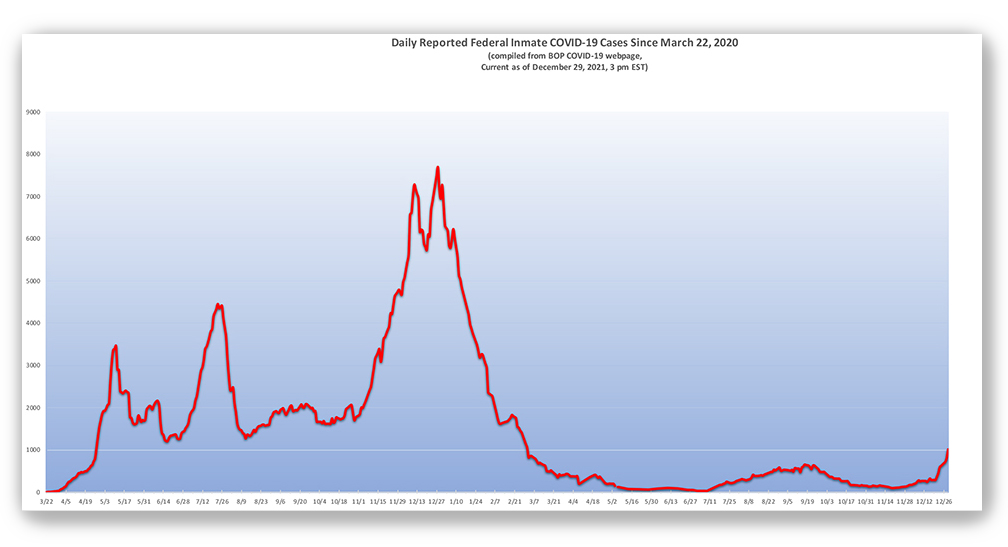
coviddelta210730Despite the BOP’s best efforts to quickly declare COVID-suffering inmates to be “recovered” – which the agency insists is done in conformance with Centers for Disease Control and Prevention guidelines – the numbers continue to creep upward. As of yesterday, the BOP reported 627 inmates (up 13%) with COVID. The agency reported four more inmate deaths than a week ago. Staff numbers were holding at 562, down one from a week ago.

The BOP phenomenon of inmates dying of COVID weeks or months after “recovery” was noted last week by the Beaumont Enterprise. That is hardly surprising. Even if the BOP is carefully determining that “recovered” inmates have no symptoms 10 days after a positive COVID test – and a number of inmate reports suggest that the agency’s approach to “recovered” is fairly slapdash – that does not mean the inmate is “recovered.” Guidance released last week by the CDC states that this means simply that “isolation and precautions can be discontinued 10 days after symptom onset and after resolution of fever for at least 24 hours, without the use of fever-reducing medications, and with improvement of other symptoms.”

As many prisoners have found out, COVID may be a long-haul thing. A CDC study released last week reported that one in three people who survived COVID-19 may suffer from long COVID. The study found that 35% of survey responders reported at least one ongoing symptom of COVID-19 two months after the initial positive test. Fatigue was reported by 17% of those long COVID patients; difficulty breathing and loss of taste or smell were reported by 13%; and muscle or joint pain was reported by 11%.

COVIDvaccine201221As of last Friday, 61.6% of BOP inmates had been vaccinated. Staff vaccinations still lag at 54.0%, up only 4/10th of a point since last week. That may be changing, however. The Safer Federal Workforce Task Force last week set November 22 as the deadline for federal employees to get fully vaccinated under President Biden’s new mandate. By and large, the staff will either get vaxxed or quit (bad news for an already-understaffed BOP).

However, 24 Republican state attorneys general warned the Biden administration last week that their states would sue to block the federal employee mandate if the plan is not abandoned.

Forbes last week noted that the pandemic had not particularly influenced federal criminal sentences. It noted that in Fiscal Year 2020, federal judges cited the Covid-19 pandemic as a basis for lower sentences in just over just 2.5% of all cases at most. Forbes cited SDNY Judge J. Paul Oetken’s observation that time served during the pandemic is “essentially the equivalent of either time and a half or two times what would ordinarily be served,” and SDNY Judge Paul A. Engelmayer’s statement that “prison is supposed to be punishment, but it is not supposed to be trauma.”

unicorn210921That being the case, there is no truth to the rumor, reported regularly by inmate emails, that anyone – Biden, Congress, or even the shuttered Sentencing Commission – is considering an across-the-board sentence reduction for federal inmates because of the pandemic. You can expect that if that happens, President Biden will personally ride up to BOP headquarters on a pink unicorn to deliver the happy news.

Beaumont Enterprise, Second senior, COVID recovered federal inmate dies in Beaumont (September 15, 2021)

Los Angeles Times, 1 in 3 COVID-19 patients suffer from long COVID, a CDC study of Long Beach residents finds (September 16, 2021)

CDC, Ending Isolation and Precautions for People with COVID-19: Interim Guidance (September 14, 2021)

CDC, Post-Acute Sequelae of SARS-CoV-2 Infection Among Adults Aged ≥18 Years — Long Beach, California, April 1–December 10, 2020 (September 17, 2021)

Government Executive, Coronavirus Roundup: A November 22 Deadline for Feds to Get Vaccinated; Booster Shot Clashes (September 14, 2021)

Columbus Dispatch, Ohio and 23 other state attorneys general tell Biden to drop vaccine mandate or be sued (September 17, 2021)

Forbes, The U.S. Sentencing Commission’s Inadequate Response To Covid-19 (September 17, 2021)

– Thomas L. Root

Biden Proposes Clemency Lite – Update for September 20, 2021

We post news and comment on federal criminal justice issues, focused primarily on trial and post-conviction matters, legislative initiatives, and sentencing issues.

ADMINISTRATION TROTS OUT COMMUTATION PLAN THAT IS OPAQUE AND TINY

clemencypitch180716President Biden’s administration last week announced something that looks like a clemency plan, only much smaller. Last Monday, White House spokesman Andrew Bates said the Administration “will start the clemency process with a review of non-violent drug offenders on CARES Act home confinement with four years or less to serve.”

Those who have been invited to apply fall into a specific category: drug offenders released to CARES Act home confinement who have four years or less on their sentences. Neither the White House nor the Dept of Justice would say how many people have been asked to submit commutation applications or whether it would be expanding the universe of prisoners who would be considered.

However, according to news reports, about 1,000 home confinees – about 25% of the people on CARES Act home confinement – are included in the batch the White House wants to review. Weldon Angelos, who was pardoned for a marijuana conviction by President Donald Trump last year and works with the current administration on criminal justice reform, told Marijuana Moment that about 1,000 people were asked to report to their designated halfway houses to fill out the clemency form in recent days.

Udi Ofer, the ACLU’s deputy national political director, said he was troubled by the possibility that the White House was cleaving off CARES Act recipients into those deserving commutation and those who didn’t, arguing that the Bureau of Prisons, in originally releasing inmates under the CARES Act, had already made a determination between those who posed a threat of violence and those who didn’t.

clemency170206“We are worried that the White House is viewing this issue too narrowly and unnecessarily restricting the category of people being asked to apply for clemency,” Ofer told Politico.

Others disagree that then BOP’s decisions on home confinement – which have largely been delegated to 122-odd executive officers at BOP facilities – are a consistent or reliable indicator of who should get clemency. “It’s not clear how the Bureau of Prisons chose people for this home confinement program, which raises the question of whether it’s fair to give a special benefit to these folks not available to those who have filed clemency petitions sometimes years ago and have been patiently waiting,” said former DOJ Pardon Attorney Margaret Love.

Biden’s limited clemency plan appears not to be enough for some lawmakers. Last Friday, 28 House Democrats called on Biden to commute the sentences of all 4,000 CARES Act home confinees, as well to establish a review board for pending clemency petitions.

“We urge you to use your authority as President to immediately commute the sentences of the 4,000 people who, under the [CARES Act], are currently on home confinement and at risk of being sent back to federal prison, and further, to create an independent clemency board to review the more than 15,000 pending clemency petitions,” the letter, spearheaded by Reps. Cori Bush (Missouri), Bonnie Watson Coleman (New Jersey), Pramila Jayapal (Washington), and David Trone (Maryland), said.

The President had announced in May that he would tackle clemency in 2022.

noplacelikehome200518A BOP spokesperson told The Hill last week that the agency is focused on the “expanded criteria for home confinement and taking steps to ensure individualized review of more inmates who might be transferred… The BOP and the [Department of Health and Human Services] continue to explore all potential authorities that could be exercised after the end of the pandemic to help address this issue.”

Politico, Biden starts clemency process for inmates released due to Covid conditions (September 13, 2021)

CNN, Administration to start clemency process for some federal inmates on home confinement due to Covid conditions (September 13, 2021)

Marijuana Moment, Biden Administration Asks Prisoners with Certain Federal Drug Convictions to Apply for Clemency (September 13, 2021)

The Hill, Democrats urge Biden to commute sentences of 4K people on home confinement (September 17, 2021)

– Thomas L. Root

There Ain’t No Easter Bunny… – Update for September 16, 2021

We post news and comment on federal criminal justice issues, focused primarily on trial and post-conviction matters, legislative initiatives, and sentencing issues.

HOW’S THAT 65% BILL DOING?

After answering yet another email about the mythical 65% bill – legislation that purportedly would reduce everyone’s sentence to 65% of what the court imposed – I thought I would lead with this sad news:

There is no Santa Claus. There is no Easter Bunny. And there is no 65% Bill.

easterbunny210916While Congresswoman Sheila Jackson Lee (D-Texas) has introduced such a bill in a number of previous sessions of Congress since 2001, there is no such bill in the hopper now. When she did introduce it, the bill never even got a committee hearing. If it did exist, it wouldn’t get one now. A 65% bill would stand a chance of passage approaching zero.

In sum, the so-called 65% bill is like a pink unicorn: fun to imagine, but not real. And neither is the rumor that everyone will get a sentence cut because of COVID.

So what is real? First, a letter sent last week by 25 state attorneys general to House and Senate leadership, urging an expansion of Section 404 of the First Step Act to include people sentenced under 21 USC § 841(b)(1)(C). You recall that in Terry v. United States last June, the Supreme Court held that Section 404 did not qualify pre-2010 crack sentences for sentence reduction. The state attorneys general want legislation to change that.

Second, a lot of criticism of the President over the CARES Act. Writing in the Washington Examiner last week, Matt Schlapp – chairman of the American Conservative Union – argued that Congress should act to ensure that CARES Act home confinees stay at home after the pandemic ends. He wrote, “As a former influential senator and Judiciary Committee chairman, President Joe Biden is at least partially responsible for the explosive growth of our federal prison population. His legislative record is riddled with bills he supported, and sometimes wrote, that filled BOP cells and encouraged states to do the same. Indeed, there are thousands of Americans still serving draconian sentences authorized by some of then-Sen. Biden’s bills.”

chart210624Meanwhile, a piece in the Deseret News made the conservative argument for the EQUAL Act, which would retroactively make crack cocaine sentencing levels equal to those of powder cocaine: The EQUAL Act already passed through the U.S. House Judiciary Committee with a vote of 36-5, garnering support from both sides of the aisle. It faces another battle to pass through the rest of Congress, and Utah’s delegation should be there to vote in support. The debate over crack versus powder cocaine has no basis in science, in rationality, or in ethics. Because of this, many individuals have been needlessly imprisoned for far too long in comparison to the crime committed. Congress should pass the EQUAL Act to ensure these penalties are equalized and fairness is restored to criminal sentencing.”C

So when will Congress get to any criminal justice reform measures? No one knows. Only a few bills have been voted out of committee in the Senate – the COVID-19 Safer Detention Act, the First Step Implementation Act of 2021, and the Prohibiting Punishment of Acquitted Conduct Act. In the House, the EQUAL Act is the only criminal justice bill voted out of committee. No floor votes have been scheduled for any bills. With infrastructure and the $3.5 trillion spending bills taking center stage in Congress, it is unlikely that criminal justice reform will get any attention until next year.

Letter to Sens Charles Schumer and Mitch McConnell (September 2, 2021)

Washington Examiner, Biden promised to address over-incarceration. He’s blowing his opportunity (September 8, 2021)

Deseret News, Conservatives should support sentencing reform for crack cocaine (September 8, 2021)

– Thomas L. Root

Too Early, Too Late – Update for September 15, 2021

We post news and comment on federal criminal justice issues, focused primarily on trial and post-conviction matters, legislative initiatives, and sentencing issues.

TIMING IS EVERYTHING

timewaits200325Two decisions last week remind us that timing is key.

Julio Cardenas filed a 28 USC § 2255 motion arguing that his defense attorney had rendered ineffective assistance to him. In fact, he had no idea how ineffective counsel had been (and was continuing to be).

Julio lost his direct appeal, and the Supreme Court then denied certiorari. Julio filed for Supreme Court rehearing, and that was denied, too.

Fast forward a year. Julio’s attorney filed his § 2255 motion, but did so a year after denial of Supreme Court rehearing. But courts have uniformly held that the deadline for filing a § 2255 motion is really a year after the Supreme Court first denies certiorari, not a year after the later date when it denies rehearing whether its earlier denial of cert was correct. As a result, Julio’s § 2255 was filed 47 days past the date it was due under 28 USC § 2255(f)(1).

Julio asked his district court to accept it anyway under a doctrine called equitable tolling. A prisoner is entitled to equitable tolling only if he shows (1) that he has been pursuing his rights diligently, and (2) that some extraordinary circumstance stood in his way and prevented timely filing. Equitable tolling is warranted only in “rare and exceptional circumstances,” as the courts like to say.

Last week, the 5th Circuit said Julio didn’t have such circumstances here. The 5th said Julio’s counsel simply messed up. His lawyer admitted he now knew that a “petition for rehearing on a denial of certiorari on direct appeal does not toll the AEDPA time limit. All I can say in my defense is the concept is so counterintuitive that it did not even occur to me to check or research the question.”

The Circuit said Julio’s lawyer’s mistake was “precisely the kind of case that does not warrant equitable tolling…”

worm210913Timing also played a role in a second 5th Circuit decision last week. Leondus Garrigan filed an 18 USC § 3582(c)(1)(A) compassionate release motion, but he sent his request to the warden two weeks after filing the motion in district court. After his court denied the compassionate release motion, Leo filed a motion for reconsideration, pointing out that his administrative remedies were now exhausted, and the court could rule on the motion.

The district court denied the reconsideration, and last week, the 5th agreed: 

The primary basis on which Lionel justified reconsideration,” the Circuit ruled, “was a purported ‘manifest error of law.’ But there was no legal error in the underlying judgment. Because he filed his motion in the district court before the warden received his request, he failed to exhaust his administrative remedies. To be sure, after Garrigan’s first motion was denied without prejudice, he successfully exhausted. But it is irrelevant that he achieved exhaustion in the intervening period between the denial and his motion for reconsideration – he was required to properly exhaust before filing the motion. The district court did not have discretion to excuse his failure to do so.

United States v. Garrett, Case No 20-61083, 2021 U.S. App. LEXIS 27214 (5th Cir., Sept. 9, 2021)

United States v. Cardenas, Case No 18-40790, 2021 U.S. App. LEXIS 26910 (5th Cir., Sept. 7, 2021)

– Thomas L. Root

Biden Plans to Commute Some Drug Defendants, Vax BOP Staff – Update for September 14, 2021

We post news and comment on federal criminal justice issues, focused primarily on trial and post-conviction matters, legislative initiatives, and sentencing issues.

SO WHAT HAPPENS NOW?

The morning after President Biden announced an executive order that all federal employees would get the COVID vaccine, the Bureau of Prisons numbers were stubbornly high. The number of sick inmates was up 5% from a week ago, standing at 553 (the highest count since March 15). More ominously, the number of sick staff jumped 12% to 563, nearly equal to the number of sick inmates, and the highest since April 20. COVID is present at 112 of 122 institutions, and the death toll notched up to at least 267 inmates.

deadcovid210914What remains puzzling is the BOP’s testing. The agency said it tested 127 people last week, a very low number of tests for the number of inmate cases the BOP is reporting.

Meanwhile, the number of vaccinated inmates hit the 60% mark, while the staff percentage barely moved, from 53.39% to 53.62%.

The staff number should change. On Thursday, Biden signed an Executive Order that, among other things, “require[s] COVID-19 vaccination for all Federal employees, subject to such exceptions as required by law.” The exceptions are for medical and religious reasons only, and (I already received one email asking this) the Order does not exempt BOP employees. Biden ordered each Federal agency to implement a program to require COVID-19 vaccination for all Federal employees and directed the Safer Federal Workforce Task Force to issue guidance within 7 days of the date of this order on agency implementation of this requirement for all agencies covered by this order.

The BOP announced two more COVID-19 deaths, one on September 4th at FCI Bennettsville and another from last November at FCI Talladega. The Talladega death was of a 29-year old who had contracted COVID on August 5, 2020, but who was declared “recovered” 12 days later.

At the 43-minute mark of last Friday morning’s White House press briefing, Press Secretary Jen Psaki had an exchange with an unidentified reporter:

Q: Jen, I’m hearing that the Bureau of Prisons issued a memo today telling approximately about 1,000 drug offenders how to apply for clemency. Have you — do you have anything on that?

MS. PSAKI: I would certainly point you to the Department of Justice. I would say that the President has been clear about his openness to using clemency powers, but I don’t — I wouldn’t say that’s an assessment of decisions made — and certainly targeting those toward nonviolent drug offenders. But I’d point you to the Department of Justice for any further details.

The riddle was solved yesterday when POLITICO reported that the Biden administration has begun asking people on CARES Act home confinement inmates to “formally submit commutation applications, criminal justice reform advocates and one inmate herself tell POLITICO.”

clemencyjack161229“Those who have been asked for the applications fall into a specific category,’ POLITICO reported, “drug offenders released to home under the pandemic relief bill known as the CARES Act with four years or less on their sentences. Neither the White House nor the Department of Justice clarified how many individuals have been asked for commutation applications or whether it would be expanding the universe of those it reached out to beyond that subset. But it did confirm that the president was beginning to take action.”

Business Insider published a piece on Saturday noting that “the Biden administration is considering granting commutations to those under home confinement who have federal drug charges and have less than four years left in their sentences. If enacted, that decision would only affect about 2,000 out of the 4,000 people currently under home confinement. To those that don’t fit the criteria, the administration will force them back to federal prison. For these individuals, the decision could be devastating to the progress they’ve made since emerging from behind bars. Sending [inmates] back to prison and hampering [their] progress would have the opposite effect of what our justice system purports to achieve.”

White House, Executive Order on Requiring Coronavirus Disease 2019 Vaccination for Federal Employees (September 9, 2021)

BOP, Inmate Death at FCI Talladega (September 10, 2021)

White House, Press Briefing by Press Secretary Jen Psaki (September 10, 2021)

Politico, Biden starts clemency process for inmates released due to Covid conditions (September 13, 2021)

Business Insider, Thousands of people who were released from prison due to the pandemic are now thriving with their families. But if Biden doesn’t act now, they will be cruelly sent back. (September 11, 2021)

– Thomas L. Root

Nothing Extraordinary about a 312-Year Robbery Sentence, 3rd Circuit Says – Update for September 8, 2021

We post news and comment on federal criminal justice issues, focused primarily on trial and post-conviction matters, legislative initiatives, and sentencing issues.

A LARGELY UGLY COMPASSIONATE RELEASE DECISION FROM THE THIRD CIRCUIT

guns200304The 3rd Circuit last week joined eight other federal circuits in holding that an inmate-filed compassionate release motion is not limited by the Sentencing Guidelines § 1B1.13 policy statement. That was the good news, the only good news.

Eric Andrews is serving a 312-year sentence for a string of armed robberies, with almost all of that time due to stacked 18 USC § 924(c) convictions. If he had been sentenced after passage of the First Step Act, his § 924(c) sentences would have amounted to 91 years, still impressive but possibly a survivable sentence. But because the First Step changes were not retroactive, Rick’s only course was to file a compassionate release motion under 18 USC § 3582(c)(1)(A)(i) arguing that his excessive sentence length and the First Step Act changes were the “extraordinary and compelling reasons” supporting grant of the motion.

The district court denied Rick, and last week, the 3rd Circuit agreed.

The appeals court held that “the duration of a lawfully imposed sentence does not create an extraordinary or compelling circumstance… Considering the length of a statutorily mandated sentence as a reason for modifying a sentence would infringe on Congress’s authority to set penalties.”

41475-Forever-Is-A-Long-TimeLikewise, the 3rd ruled, a nonretroactive change to mandatory minimums “cannot be a basis for compassionate release. In passing the First Step Act, Congress specifically decided that the changes to the 924(c) mandatory minimums would not apply to people who had already been sentenced.” Applying rules of statutory construction to the First Step Act, the Circuit said, “we will not construe Congress’s nonretroactivity directive as simultaneously creating an extraordinary and compelling reason for early release. Such an interpretation would sow conflict within the statute… We join the 6th and 7th Circuits in reaching this conclusion.”

Ohio State University law professor Doug Berman, writing in his Sentencing Law and Policy blog, makes a telling point:

The very first sentence of the Andrews ruling has a Kafka-esque “only in America” quality to it: “Eric Andrews is serving a 312-year sentence for committing a series of armed robberies when he was nineteen.” That a person at age 19 can get a 312-year sentence for a series of robberies strikes me as quite extraordinary and quite compelling, but the district court did not see matters that way. Specifically, as described by the panel opinion, the district court decided that “the duration of Andrews’s sentence and the nonretroactive changes to mandatory minimums could not be extraordinary and compelling as a matter of law.” Of course, there is no statutory text enacted by Congress that sets forth this “as a matter of law.” But the Third Circuit panel here blesses the extra-textual notion that courts can and should invent some new categorical exclusions “as a matter of law” regarding what might qualify as extraordinary and compelling.

noquorum191016The Second, Fourth, Fifth, Ninth and Tenth Circuits have held the contrary to this opinion, which perhaps puts some wind in Thomas Bryant’s pending petition to the Supreme Court for review of the 11th Circuit’s denial of his compassionate release motion. That petition is ripe for decision at the end of this month at the Supreme Court’s “long conference.” Of course, a reconstituted Sentencing Commission could solve this circuit split by rewriting USSG § 1B1.13, but that would require that the Sentencing Commission first be repopulated with new members. President Biden has thus far shown no more interest than did his predecessor in appointing new members. By December, the Commission will have been without a quorum for three years.

United States v. Andrews, Case No 20-2768, 2021 US App LEXIS 26089 (3d Cir. August 30, 2021)

Sentencing Law and Policy, Third Circuit invents some extra-textual limits on what might permit a sentence reduction under 3582(c)(1)(A) (August 30, 2021)

– Thomas L. Root

President Said to be Considering CARES Act Partial Clemency – Update for September 7, 2021

We post news and comment on federal criminal justice issues, focused primarily on trial and post-conviction matters, legislative initiatives, and sentencing issues.

BIDEN MAY (FINALLY) BE TAKING BABY STEPS ON CLEMENCY

The New York Times reported last week that President Biden is considering using his clemency powers – which he has not exercised in his first seven months in office – to commute the sentences of nonviolent drug offenders with fewer than four years left to serve. The contemplated intervention would not apply to those now in home confinement with longer sentences left, or those who committed other types of crimes, Biden administration sources told the Times.

The notion of clemency for some inmates is just one of several ideas being examined in the executive branch and Congress, the Times said. Others include a broader use of 18 USC § 3582(c)(1)(A)(i) “compassionate release” or 34 USC § 60541, the elderly offender home detention program, or even a law – such as the Safer Detention Act (S.312) – to allow some inmates to stay in home confinement after the pandemic.

The CARES Act permits inmates who are sent to home confinement under Section 12003(b) to remain at home until the pandemic public health emergency ends. The Times says, “That will not be soon: With the Delta variant spurring a surge in cases, the public health emergency is not expected to end before next year at the earliest.”

clemencyjack161229On August 10, Biden Press Secretary Jen Psaki said Biden was “exploring multiple avenues to provide relief to nonviolent drug offenders, including through the use of his clemency power.” The Times reported officials have confirmed that the Justice Department “will soon begin requesting clemency petitions for drug offenders who have less than four years left on their sentence, which will then be reviewed by its pardon office.” The officials said a focus on nonviolent drug offenders “dovetail[s] with Mr. Biden’s area of comfort on matters of criminal justice reform.”

Whether Biden is leaning toward commuting the sentences of drug offenders to home confinement, reducing sentence length to bring them down to the normal window 10%-or-six-month window for 18 USC 3624(c)(2) end-of-sentence home confinement, or some mix of the two, is not yet clear.

The Times reported that DOJ is still studying options that could keep non-drug offenders from being forced back into prison.

Meanwhile, criminal justice reform groups are keeping up pressure on the President. FAMM and the American Civil Liberties Union are mounting a six-figure ad campaign to pressure Biden to keep the CARES Act prisoners at home. The TV ads feature Juan Rodriguez, a federal prisoner sent home in July after doing eight of 14 years for a drug conviction. “I’m going to try to make the best out of every day I have out here,” Mr. Rodriguez says in the ad featuring him with his family and working a new job. “President Biden, please don’t separate me from my family.”

angel210907The ACLU has argued that fewer than 1% of prisoners put on home confinement had violated the terms of their release, and it was time for Biden to follow through on lowering the incarceration rate and size of the federal prison population that he campaigned on as a presidential candidate. So far, only five people sent home during the pandemic have been returned to prison for new criminal conduct.

USA Today has reported that over two dozen small business owners who have CARES Act home confinees are also asking Biden to grant clemency to prisoners. Some say losing employees to prison during a national labor shortage would not only be detrimental to their businesses, but would also keep their companies from growing.

Ohio State law professor Doug Berman complained in his Sentencing Law and Policy blog that when Biden was campaigning, he promised to “’take bold action to reduce our prison population’. But the federal prison population… has grown by over 4000 persons according to BOP numbers, from 151,646 total inmates on January 21, 2021, to 155,730 total inmates on August 26, 2021. To date, I cannot really think of any actions (let alone bold ones) that Prez Biden has taken to reduce the federal prison population. Talk of some clemency action is heartening, but just a start. And whatever clemency efforts are made, they should extend beyond just a limited group who are already home.”

The New York Times, White House Weighs Clemency to Keep Some Drug Offenders Confined at Home (August 30, 2021)

Washington Times, ACLU pressures Biden to keep convicts on home confinement out of prison due to pandemic (August 27, 2021)

USA Today, Businesses that hired inmates who were allowed to serve time at home during COVID push for clemency (August 26, 2021)

CBS News, Inmates on home confinement could be sent back to prison after the pandemic: “Why make us go back and do it again?” (September 3, 2021)

Sentencing Law and Policy, Prez Biden reportedly considering, for home confinement cohort, clemency only for “nonviolent drug offenders with less than four years” left on sentence (August 30, 2021)

– Thomas L. Root

Compassionate Release Gets Uglier – Update for September 3, 2021

We post news and comment on federal criminal justice issues, focused primarily on trial and post-conviction matters, legislative initiatives, and sentencing issues.

THE UNSTRUCTURED AND ARBITRARY WORLD OF COMPASSIONATE RELEASE, IN WHICH DISCRETION ONLY WORKS ONE WAY…

Someday, legal scholars may look back on COVID-era compassionate releases granted under 18 USC § 3582(c)(1)(A)(i) as having introduced more disparity and inconsistency in sentencing than any event in federal criminal law.

chaos210903A Sentencing Commission study last month tallied compassionate releases by district, released last month, reported that 22.3% of the 12,885 compassionate release motions filed in 2020 were granted. But if you filed one, your chances were not one out of 4.5, Instead, if your case came from the District of Oregon, your chances of a grant were 69.8%. If, however, your case came from the Western District of North Carolina, your chances were a lousy 1.5%.

There is no federal court district in the country with a poorer track record for compassionate release than Western District of North Carolina. During 2020, Western District judges heard 337 compassionate release motions. The judges denied all but five. By comparison, the Eastern District of North Carolina approved release in 25% of its 224 compassionate-release requests. The Middle District of North Carolina had an approval rate of 6.2%, granting 10 of 162 requests.

(The U.S. Virgin Islands had a 0% approval rate, but that court heard just six requests, the report says. By contrast, the Western District of North Carolina handled the sixth-highest number of compassionate release cases in the country last year.)

“The numbers are jarring,” one defense attorney said. “Your geography remains one of the most relevant factors in determining the sentence you receive or the severity of the punishment. In a country that guarantees equal protection under the law, I think that should raise some constitutional questions.”

That’s because appellate courts afford district judges a lot of discretion in deciding compassionate release motions, and – from time to time – confound things by issuing questionable decisions that tie up their district courts in procedural knots.

Case in Point #1: Take Jessica Ward, for example. She is around a third of a way through a 200-month drug sentence, and sought compassionate release in the Northern District of Texas due to chronic kidney failure. The government’s opposition argued that she did not meet Section 1B1.13 of the Sentencing Guidelines, in that the BOP was adequately managing COVID, but neither mentioned her kidney disease nor argued that 18 USC § 3553(a) sentencing factors should be relied on to deny her compassionate release motion.

The district court denied her motion because she did not meet USSG 1B1.13 and because § 3553(a) factors did not support a reduction. Jenny appealed.

crystalball210903Last week, the 5th Circuit denied her appeal. It agreed that the district court was wrong to rely on USSG 1B1.13, because that Guideline does not apply when a prisoner files a compassionate release motion herself. But while the Government made no mention of the § 3553(a) factors, the Circuit “gives deference to the district court’s determination… We see no reason to hold that the Government’s failure to make arguments about the factors cancels the court’s statutory obligation to consider them.”

The 5th said the burden falls on the defendant to convince the court to grant compassionate release after considering the § 3553(a) factors. If the defendant fails to convince the district court to exercise its discretion, then the court may deny the motion, assuming it considers the § 3553(a) factors, for reasons the government may have never argued. 

Lesson: Not only does a compassionate release movant have to address the arguments raised by the government, but he or she should address arguments that the court might raise on its own in the ultimate denial. The prudent defense attorney should thus have both a LEXIS/Westlaw account and a crystal ball.

Case in Point #2: Consider Ron Hunter, a one-time drug trafficking organization hitman convicted 21 years ago of murdering a 23-year-old woman outside a nightclub. As we like to say, Ron has kind of a tough fact pattern to argue… So tough that his sentencing judge sentenced him to life in prison.

Twenty-one years later, a different judge granted Ron’s motion for compassionate release. Based upon the fact that Ron did not get the benefit of the non-retroactive United States v. Booker ruling that Guidelines are not mandatory, on certain facts that existed at sentencing, and Ron’s rehabilitation efforts (which were far from perfect), the district court held the factors amounted to the “extraordinary and compelling reasons” required by 18 USC § 3582(c)(1)(A)(i).

compassion210903Should be no problem. right? After all, don’t circuits “give[] deference to the district court’s determination,” like the 5th Circuit said in Jessica Ward’s case? Makes sense, doesn’t it? But it turns out that it’s not necessarily so.

Last Monday, the Sixth Circuit reversed Ron’s compassionate release, holding that his new district judge abused his discretion.

The Sixth Circuit had already ruled last June in United States v. Jarvis that a “non-retroactive changes in the law [can]not serve as the ‘extraordinary and compelling reason’ required for a sentence reduction,” a holding at odds with most other circuits that have considered the issue. That meant that going in to oral argument, Ron was in trouble, because one of the grounds relied on his district court was that Booker would permit a sentence imposed today to vary from the Guidelines.

Now, the Sixth has built on the Jarvis blunder, ruling that “facts that existed when the defendant was sentenced cannot later be construed as “extraordinary and compelling” justifications for a sentence reduction.”

As Ohio State University law prof Doug Berman observed in his Sentencing Law and Policy blog, this holding “seems especially problematic and an especially misguided policy invention.” After all, the Sentencing Commission – which was given the duty by Congress to “describe what should be considered extraordinary and compelling reasons for sentence reduction” – held in Note 2 to Guideline 1B1.13, that

For purposes of this policy statement, an extraordinary and compelling reason extraordinary and compelling reasons need not have been unforeseen at the time of sentencing in order to warrant a reduction in the term of imprisonment. Therefore, the fact that an extraordinary and compelling reason reasonably could have been known or anticipated by the sentencing court does not preclude consideration for a reduction under this policy statement.

So while the Sentencing Commission has said facts known at sentencing can nevertheless be “extraordinary and compelling,” the Sixth Circuit says they cannot. It may well be that the Circuit was just put off at the idea of a hitman doing life going home after serving less time than a porn downloader. But there are ways to force the conclusion the judges wanted to see without pronouncing such a transparently wrong interpretation of the statute.

Lesson: Discretion is a rachet, in which the district court has free rein to deny but substantial restraint to grant, compassionate release.

Raleigh, North Carolina, News & Observer, Inmates seeking release from COVID-hit prisons have next to no chance in this NC district (August 27, 2021)

Ward v. United States, Case No 20-10836, 2021 U.S.App. LEXIS 25808 (5th Cir. Aug. 26, 2021)

United States v. Hunter, Case No. 21-1275, 2021 U.S. App. LEXIS 26115 (6th Cir. Aug. 30, 2021)

Sentencing Law and Policy, Sixth Circuit invents another extra-textual limit on what can permit a sentence reduction under 3582(c)(1)(A), including one in contradiction of USSC guidelines (August 30, 2021)

– Thomas L. Root