All posts by lisa-legalinfo

No Deference to Flawed BOP Time Credits Rule – Update for October 30, 2023

We post news and comment on federal criminal justice issues, focused primarily on trial and post-conviction matters, legislative initiatives, and sentencing issues.

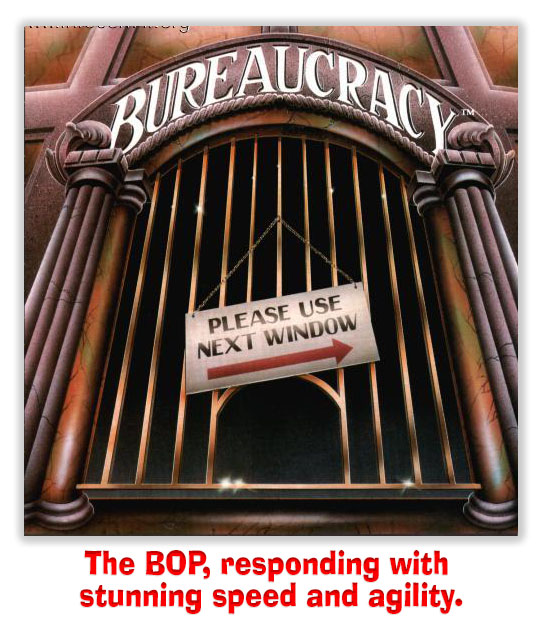
BOP SMACKED BY CHEVRON BUT STANDS TOUGH ON DENYING FSA BENEFIT

chevron230508Writing in Forbes last week, Walter Pavlo flagged a First Step Act credit benefit that the Bureau of Prisons has been denying to prisoners except where courts order otherwise. With the Supreme Court primed this term to rein in the Chevron deference doctrine – the judicial rule that courts defer to federal agencies’ interpretation of the statutes they administer – the BOP’s denial of FSA credits until an inmate reaches his or her assigned institution is an excellent case of how even Chevron can ban some BOP overreaching.

The FSA provides that a prisoner “who successfully completes evidence-based recidivism reduction programming or productive activities, shall earn time credits” according to a set schedule. Under 18 USC 3632(d)(4)(B), otherwise-eligible prisoners cannot earn FSA credits during official detention before the prisoner’s sentence commences under 18 USC 3585(a).” Section 3585(a) says a “term of imprisonment commences on the date the prisoner is received in custody awaiting transportation to, or arrives voluntarily to commence service of sentence at, the official detention facility at which the sentence is to be served.”

But the BOP puts its own gloss on the statute, directing in 28 CFR 523.42(a) that “an eligible inmate begins earning FSA Time Credits after the inmate’s term of imprisonment commences (the date the inmate arrives or voluntarily surrenders at the designated Bureau facility where the sentence will be served).”

Any prisoner who has spent weeks or months between sentencing and final delivery to his or her designated institution can see that the BOP rule can create months of FSA credit dead time.

Ash Patel filed a petition for habeas corpus seeking FSA credit from his sentencing in September 2020 until he finally reached his designated institution on the other side of the country in April 2023. The BOP argued his FSA credits only started in April 2023, stripping him of 2.5 years of earnings. The agency cited 28 CFR 523.42(a) and urged the Court to apply Chevron deference, accepting its interpretation of when FSA credits start.

ambiguity161130The Court didn’t buy it. “Because Section 523.42(a) sets a timeline that conflicts with an unambiguous statute, it is not entitled to Chevron deference and the Court must give effect to the statutory text,” the judge wrote, citing Huihui v. Derr where the court held that while the prisoner was not eligible “before her sentence commenced, [] under 18 USC 3632(d)(4)(B)(ii), her ineligibility ended the moment she was sentenced… because FDC had already received her in custody.”

Pavlo cites Yufenyuy v. Warden FCI Berlin, perhaps the first decision to refuse to give Chevron deference to the BOP’s incorrect 28 CFR 523.42(a) rule. He rightly complains that perhaps thousands of other prisoners ‘who were sentenced and have months of time in transit getting to their final designated facility… are currently not getting those credits.” Pavlo notes that “prisoners who have a disagreement with the BOP have access to an administrative remedy process to air their grievances. However, those in the chain of command at the BOP who would review those grievances have no authority within the BOP to award these credits as it deviates from the BOP’s own Program Statement, which remains unchanged… Currently, the only solution is for every prisoner who has this situation is to exhaust the administrative remedy process, something that could take 6-9 months, and go to court to find a judge who agrees with [Yufenyuy], which could take months more.”

Exhaustion170327Not necessarily. The Huihui v. Derr Court excused exhaustion because “further pursuit would be a futile gesture because… there is an error in [the BOPs] understanding of when Petitioner can begin earning credits under 18 USC 3632(d)(4)(B) and 3632(a)… The Court thus concludes that any further administrative review would not preclude the need for judicial review. The Court thus excuses Petitioner’s failure to exhaust her administrative remedies.”

Forbes, Bureau of Prisons’ Dilemma On First Step Act Credits (October 27, 2023)

Patel v. Barron, Case No C23-937, 2023 U.S. Dist. LEXIS 174601 (WD Wash., September 28, 2023)

Huihui v. Derr, Case No 22-00541, 2023 U.S. Dist. LEXIS 106532 (D. Hawaii, June 20, 2023)

Yufenyuy v. Warden FCI Berlin, No. 22-CV-443, 2023 U.S. Dist. LEXIS 40186 (D.NH, March7, 2023)

– Thomas L. Root
Five Years Later, BOP Still Doesn’t Have First Step Act Right – Update For October 27, 2023

We post news and comment on federal criminal justice issues, focused primarily on trial and post-conviction matters, legislative initiatives, and sentencing issues.

FIVE YEARS SHOULD BE LONG ENOUGH TO GET FIRST STEP ACT RIGHT

firststepB180814The First Step Act, including its innovative system for granting credits to inmates who complete programs designed to reduce recidivism, is 5 years old in less than two months. But it took three years of fits and starts before the Bureau of Prisons pretty much had a final set of rules for administering FSA credits (after a proposal that was as miserly as the final rule was generous hanging around for a year of comments).

Now, almost two years later, the BOP is still muddled in trying to launch a computer program of forward-looking calculation for FSA credits that predicts when a prisoner will leave BOP custody for halfway house or home confinement (HH/HC). The agency still lacks a comprehensive list of what types of inmate employment or education constitutes “productive activities,” which are supposed to continue a prisoner’s earning of FSA credits. And the BOP continues to deny HH/HC placement because it lacks resources, despite First Step’s requirement that inmates be placed to the full extent of their FSA credits.

Writing in Forbes last week, Walter Pavlo observed that “prisoners, mostly minimum and low security, who are eligible for these credits have done their best to try to participate in programs but many complain of a lack of classes, mostly due to the challenges the BOP is having in hiring people. However, beyond that, the BOP has been liberal in accepting that the BOP does not have the staff to fulfill the demand for classes and credits are being given anyway, mostly for participating in productive activities, like jobs. This misses the primary mission of programming meant to have a lasting, positive influence on prisoners after they leave the institution.

“Now,” Pavlo said, “nearly two years since the Federal Register’s Final Rule in January 2022, the BOP still has no reliable calculator to determine the number of FSA credits a prisoner will earn during a prison term… One of the last remaining issues is for the BOP to have a forward-looking calculation for FSA credits that predicts when a prisoner will leave BOP custody. It sounds easy, but the BOP’s current computer program can only assess credits after they are earned each month, and it usually takes a full month after they are earned for them to post. The result is that each month, prisoners’ families look at BOP.gov to see if there are indeed new credits and if the amount they are expecting matches what is expected. This moving date is important because it can also determine when prisoners can leave prison for home confinement or halfway house. The result, prisoners are staying in institutions, institutions that are understaffed, for days, weeks and months beyond when they could be released to home confinement or halfway houses. This is defeating one of the other initiatives of the First Step Act and that was to get more people out of decaying BOP facilities and into another form of confinement that is far less expensive.”

Sen. Richard Durbin (D-Illinois)

First Step is important to Congress. When BOP Director Colette Peters appeared for a Senate Judiciary Committee oversight hearing chaired by Senator Richard Durbin (D-IL) last month, “her answer failed to address the continued shortcomings of the implementation,” Pavlo said. “There are thousands of prisoners, many minimum security, who are stuck in prison because of a lack of a computer program that simply calculates forward-looking FSA credits…This computer program was actually alluded to in declarations the BOP submitted to federal courts in 2022 stating that it would be implemented ‘soon.’ Over a year since those declarations, there is still no program to accurately calculate when a prisoner will leave an institution.”

The BOP is facing a substantial halfway house bed shortage as well. There is also the issue of insufficient halfway house space. Unlike HH/HC placement for prisoners without FSA credits, 18 USC 3624(g)(2) does not give the BOP discretion. Subsection 3624(g)(2) says that if a prisoner is eligible (has FSA credits not already applied to a year off of the sentence), he or she “shall be placed in prerelease custody as follows,” describing halfway house or home confinement. There’s nothing hortatory about it. The BOP is required to put the prisoner in HH/HC. Excuses not accepted.

halfway161117Pavlo argued that “the only way to address this situation is to implement a task force to move prisoners through the system and catch up from the failures of the past few years. Systemic challenges of shortages of staff and augmentation which takes away staff like case managers from their jobs, cause continued problems. The BOP needs to get caught up, move prisoners along and develop reliable systems that will assure that the FSA is implemented as the law requires. While the BOP has made great strides, these last challenges of full implementation can be achieved by focusing a concerted effort on three issues; fixing the calculator, assessing the prisoners who will soon be going home as a result of that computer fix, and expanding halfway house capacity to handle them.”

Forbes, Time For A Bureau Of Prisons Task Force To Implement The First Step Act (October 16, 2023)

– Thomas L. Root

‘You Agreed to an Unconstitutional Conviction,’ 2nd Circuit Says – Update for October 26, 2023

We post news and comment on federal criminal justice issues, focused primarily on trial and post-conviction matters, legislative initiatives, and sentencing issues.

‘WAIVING’ JUSTICE GOODBYE

plea161116Resolving criminal cases by a plea deal is more than merely common. In the federal system, 98% of all cases end in a plea agreement where the defendant agrees to plead to one or more counts in exchange for the government usually agreeing to do not much at all. Sure, the defendant usually gets a 2-3 level reduction under § 3E1.1 of the Sentencing Guidelines for “acceptance of responsibility” by pleading guilty.

But often enough, the Government’s concessions are illusory while the defendant’s obligations become onerous.  One of the unexploded mines in the agreement is the waiver.  A defendant will waive the right to appeal the conviction or sentence and to bring a collateral attack on the conviction under 28 USC § 2255.

Such a waiver probably doesn’t seem that unfair, at least where waiving the right to appeal is concerned.  A plea agreement, after all, is supposed to end litigation. But what happens when the conviction to which a defendant agrees proves down the road to be unconstitutional?

hobbsact200218That happened to Derek Cook. Derek (like a number of co-petitioners in his case) pled guilty to conspiracy to commit Hobbs Act robbery – 18 USC § 1951(a) – and using a firearm in furtherance of a crime of violence – 18 USC § 924(c). In exchange for the government’s promise not to bring any more criminal charges, Derek agreed to waive a number of rights, including the right to collaterally attack the convictions and sentences under 28 USC § 2255.

But after the Supreme Court held in the 2015 Johnson v. United States case that the residual clause of the Armed Career Criminal Act was unconstitutionally vague, Derek filed a § 2255 motion in which he correctly argued that his conspiracy charge could no longer be a defined as a crime of violence supporting a § 924(c) conviction. The district court sat on the petition until SCOTUS agreed, definitively holding that, constitutionally, conspiracy could not be the basis for a § 924(c) in the 2019 United States v. Davis decision.

After that, the district court conceded that Derek’s conviction for using a firearm in furtherance of a crime of violence was unconstitutional. But that didn’t matter, the Court said, because Derek had waived his entitlement to a conviction that was constitutional by signing a plea agreement containing his commitment not to file a § 2255 motion.

Last week, the 2nd Circuit agreed. The Circuit wrote that “while we have not yet considered the precise question of whether collateral-attack waivers are enforceable in the wake of Johnson and Davis, we have made clear that such waivers are generally enforceable in the face of evolving judicial precedent… [T]he possibility of a favorable change in the law after a plea is simply one of the risks that accompanies pleas and plea agreements. This principle follows from the fact that plea agreements, like all contracts, allocate risk between the parties – and we are not free to disturb the bargain the parties strike.

pleadeal180104“The enforceability of a collateral-attack waiver,” the 2nd held, “turns on whether the petitioner’s plea was knowing and voluntary, not the nature of any subsequent legal developments… Petitioners counter that they have a due process right not to be convicted of a non-existent offense. But the question is not whether Petitioners have a right not to be convicted of a non-existent offense. It is whether Petitioners have a right to bring a collateral attack when, in exchange for valid consideration, they executed binding plea agreements admitting their criminal conduct and waiving their ability to challenge the resulting convictions. And on that score, our precedent is clear that ignorance of future rights is unavoidable and not a basis for avoiding a plea agreement.”

Cook v. United States, Case Nos. 16-4107 et al, 2023 U.S.App. LEXIS 27383 (2d Cir., October 16, 2023)

– Thomas L. Root
More Rumors – How Many Can You Identify as True? – Update for October 24, 2023

We post news and comment on federal criminal justice issues, focused primarily on trial and post-conviction matters, legislative initiatives, and sentencing issues.

RUMORS II – TAKE OUR INMATE.COM RUMOR QUIZ

In prison, “inmate.com” is an information site of almost mythical status. It’s omniscient, omnipresent, omnivorous, and almost always, always wrong.

Unsurprisingly, there really is an inmate.com, although it bears no resemblance to the ethereal website of legend.

legend231023On November 1, the Guidelines amendments proposed last April will become effective. Under 28 USC § 994(p), amendments proposed by May 1 must become effective by November 1 unless Congress votes otherwise. Congress has not done so, and with the House in turmoil and no apparent Senate interest in stopping the amendments, the amendments will be effective in eight days.

Somehow, in the 35 years we’ve had the Sentencing Guidelines, the date of “November 1” has taken on a mystical, legendary quality. This year’s no different, as my email inbox continues to be stuffed with questions about what may happen ten days from now.

trueorfalse231024Take our true-or-false test to see how current you are on the latest November 1st rumors now being featured on  Inmate.com (the mythical one, not the penpal site):


(1) True or false: On November 1, the meth guidelines will be lowered by doing away with the “ice” enhancement.

FALSE. A district judge in SD Mississippi refused a few months ago to enhance for meth purity. It happens that this Judge is also Chairman of the Sentencing Commission, but nothing has been proposed on meth, let alone passed.

(2) True or false: On November 1, a new law will go into effect making 18 USC 924(c) prisoners eligible for FSA credits.

FALSE. The only way for 924(c) people to get FSA credits would be for Congress to amend the First Step Act. There is no proposal in front of either the House or the Senate to do that.

(3) True or false: On November 1, Congress is going to do away with the crime of conspiracy.

FALSE. Such a proposal, if anyone were daft enough to propose it, would never even make it to a committee hearing.

(4) True or false: On November 1, Biden is going to give all federal prisoners a year off of their sentences because of how miserable it was to be locked up for COVID.

FALSE. No one has even suggested such a thing, let alone seriously proposed it.

(5) True or false: On November 1, the new 65% law is going into effect.

FALSE. There ain’t no 65% law, never has been a 65% law, and probably never will be a 65% law.

(6) True or False:  On November 1, the Time Reduction Fairy will appear to magically commute your sentence to ‘time served.’

FALSE, but no more false than all the other November 1 rumors.

timereductionfairy231003Do you detect a trend here? This year, more happens on the 1st of November than All Saint’s Day… but not much. A couple of Guideline amendments go into effect and become retroactive. That’s good. Another one – compassionate release – will help a lot of people. But nothing will come out of Congress, nothing from the White House, very little from the BOP, and just the predictable annual amendment list from the Sentencing Commission.

And thus it will ever be.

– Thomas L. Root

Is DOJ Gunning for New Compassionate Release Guideline? Some Suspect So – Update for October 23, 2023

We post news and comment on federal criminal justice issues, focused primarily on trial and post-conviction matters, legislative initiatives, and sentencing issues.

RUMORS: WILL DEPT OF JUSTICE GO AFTER NEW COMPASSIONATE RELEASE GUIDELINE?

Ohio State University law professor Doug Berman wrote last week in his Sentencing Law and Policy blog that he has “heard talk that, notwithstanding the text of § 994(t), the Justice Department is planning to contest the new [compassionate release] guideline once it becomes effective on November 1.”

rumor231023Prof Berman does not cite his sources, but his credentials as among the premier federal sentencing law experts in the nation suggest that his report should be taken seriously. The Dept of Justice was adamantly opposed to the new USSG § 1B1.13(b)(6) – which directs that if a defendant has served at least 10 years of an unusually long sentence, a change in the law (other than a non-retroactive Guideline amendment) “may be considered in determining whether the defendant presents an extraordinary and compelling reason, but only where such change would produce a gross disparity between the sentence being served and the sentence likely to be imposed at the time the motion is filed, and after full consideration of the defendant’s individualized circumstances.” In fact, subsection (b)(6) was the cause of the Sentencing Commission’s extended debate and 4-3 vote split on approving 1B1.13.

Any DOJ litigation attack on 1B1.13 makes little sense. Congress has decreed in 28 USC 994(t) that the Sentencing Commission “shall describe what should be considered extraordinary and compelling reasons for sentence reduction, including the criteria to be applied and a list of specific examples.” What’s more, Congress has built a veto mechanism into the Guidelines, giving legislators 180 days to reject what the USSC does before it becomes effective. It would be tough to argue that § 994(t) and the fact that Congress let the new 1B1.13 go into effect didn’t mean that any DOJ effort to convince a court to invalidate the new Guideline is doomed to failure.

The rumor may be stoked by a USA Today article last week that warned that “new Sentencing Commission guidelines will give [prisoners] a chance for compassionate release. But DOJ threatens to stand in the way.” The authors wrote that

mercy161107[t]he Sentencing Commission’s commonsense expansion of compassionate release makes us hopeful that our federal criminal system can carve out a little space for redemption, mercy and a recognition that we don’t always get it right the first time around. Unfortunately, even with the promise of and need for the commission’s new guidance, the future of compassionate release is uncertain. The Department of Justice has objected to the commission’s recognition that legal changes resulting in an unjust sentence can qualify as an extraordinary and compelling reason justifying relief.

The article cites the DOJ’s spirited opposition to what became 1B1.13(b)(6) – the “change in the law” provision” – of the compassionate release Guideline. But nothing in the DOJ’s opposition comments, which it was perfectly entitled to file, suggests that the government will try to get the amendment set aside judicially.

The USA Today article argued that

the commission’s ‘unusually long sentences’ provision is good policy. Far from a get-out-of-jail-free card, as some have suggested, it is instead a narrow recognition that a sentence imposed decades ago may, upon review today, be longer than necessary. The provision applies in limited instances where, among other things, the person has served at least 10 years in prison and there is a ‘gross disparity’ between their sentence and the one likely to be imposed today. Even then, an individual still must demonstrate that they will not pose a danger to the community and that their individualized circumstances weigh in favor of a sentence reduction….

Bottom line: I doubt that DOJ plans any omnibus attack on 1B1.13(b)(6). Rather, I suspect that the USA Today authors are extrapolating from the Department’s negative comments during the Guidelines amendment process.  Nevertheless, no one’s gone broke yet betting that the DOJ will not be both creative and vigorous in fighting to keep people locked up in order to honor a draconian but lawful sentence.

If Professor Berman seems a little alarmist to you, recall Sen. Barry Goldwater’s famous observation that “extremism in the defense of liberty is no vice. Moderation in the pursuit of justice is no virtue.” For now, I stand with the Professor.

gleesonB160314In other Sentencing Commission news, President Joe Biden last week nominated current federal judge Claria Boom Horn (who sits in both the Eastern and Western Districts of Kentucky) and retired federal judge John Gleeson to full 6-year terms on the Commission. Both of them – who were filling one-year interim terms on the USSC – are intelligent and thoughtful commissioners. I see Judge Gleeson – author of what came to be known as the “Holloway motion” when he used his legal and persuasive authority to correct a grossly unjust sentence – to be a little better rounded on sentencing policy.

That being said, one only has to remember former Commissioner Judge Danny Reeves, Bill Otis and Judge Henry Hudson to realize that the weakest commissioner on the USSC now (and I do not mean to imply that the weakest commission is either Judge Horn or Judge Gleeson) stands far above the ones President Trump favored but was unsuccessful in placing on the Commission.

Sentencing Law and Policy, Urging the Justice Department to respect the US Sentencing Commission’s new guidelines for compassionate release (October 18, 2023)

USA Today, First Step Act advanced prison reform, but hundreds are still serving unjust sentences (October 18, 2023)

White House, President Biden Names Fortieth Round of Judicial Nominees and Announces Nominees for U.S. Attorney, U.S. Marshal, and the U.S. Sentencing Commission (October 18, 2023)

– Thomas L. Root

Von Vader’s Back Raising Compassionate Release Issue at SCOTUS – Update for October 21, 2023

We post news and comment on federal criminal justice issues, focused primarily on trial and post-conviction matters, legislative initiatives, and sentencing issues.

CERT PETITION TAKES AIM AT COMPASSIONATE RELEASE CIRCUIT SPLIT

vader231020Last winter, I wrote about Wolfgang Von Vader, who had both a 2000 conviction in the Western District of Wisconsin for distributing meth (a “career offender” 270-month sentence) and a 2012 federal conviction in Kansas for possessing heroin in prison (a 120-month consecutive sentence).

Wolfgang applied for 18 USC § 3582(c)(1)(A) compassionate release in both Kansas and Wisconsin. The Wisconsin case, dismissed for lack of jurisdiction, was reversed by the 7th Circuit and remanded last winter. In the Kansas case, however, his compassionate release motion was denied outright.

Wolfgang’s case should have been resentenced because of Johnson v. United States and Mathis v. United States, but when a multi-agency task force reviewed cases of prisoners qualifying for a 28 USC § 2255 motion to get him the lower sentence, Wolfgang got skipped. It was an accident. As his petition for cert put it, “extraordinary and compelling” describes his circumstances.

oops170417The 10th Circuit, however, held that the district court could not consider the change in the law brought about by Johnson and Mathis in determining whether “extraordinary and compelling reasons” warranted a sentence reduction. Such reasons, the Circuit reasoned, are limited only to “new facts about an inmate’s health or family status, or an equivalent post-conviction development” and that any “legal contention” is categorically outside of § 3582(c)(1)(A)’s scope.

Wolfgang has filed for Supreme Court review, with his petition filed by a partner in the Supreme Court/appellate practice group at McDermott Will and Emery, a 1,400-lawyer global firm. In his petition, Wolfgang noted that the 10th’s holding is at odds with other circuits on an issue on which the 7th Circuit has specifically asked the Supremes to hear.

scotus161130The effectiveness of the amended Guideline 1B1.13 in a little less than two weeks will help a lot of people, but it will not resolve whether a judge can consider a change in the law that makes a prisoner innocent of the offense or, at least, the sentence. With the Supreme Court slamming the door on using 28 USC § 2241 petitions to address changes in statutory interpretation (Jones v. Hendrix last June), the Von Vader cert question is an important one to a lot of people.

Von Vader v. United States, Case No 23-354 (petition for certiorari filed September 29, 2023)

– Thomas L. Root

First Step’s Coming Birthday Reason for Hagiography – Update for October 19, 2023

We post news and comment on federal criminal justice issues, focused primarily on trial and post-conviction matters, legislative initiatives, and sentencing issues.

FIRST STEP ACT TURNS FIVE YEARS OLD

Cake201130The anniversary is still 63 days away, but a couple of early hagiographic articles on the First Step Act’s 5th birthday are already being posted.

The Crime Report said last week that First Step “now allows federal inmates to significantly reduce their actual penal custody time. That fits into the primary goal of The Act, which is to reduce recidivism among nonviolent offenders through greater emphasis on rehabilitation in the Bureau of Prisons.”

The philanthropy Arnold Ventures interviewed Colleen P. Eren, Ph.D., author of a new book, Reform Nation: The First Step Act and the Movement to End Mass Incarceration. She noted that “33,000 people have been released from federal prison so far under the First Step Act, according to FAMM. The recidivism rate for those people is 12.4% compared to a rate of around 43% for others exiting federal prison. The First Step Act made President Obama’s Fair Sentencing Act of 2010 retroactive, resulting in the release of around 4,000 people who were sitting in prison under the 1987 crack cocaine sentencing disparity. It also made it easier to get compassionate release, and a total of 4,500 people have been released under that change.”

compromise180614First Step was far from perfect, but Dr. Eren says that’s more of a feature than a bug. “The First Step Act is an example of people not letting the perfect be the enemy of the good. There were differences to negotiate between conservative reformists and progressive reformists. Conservatives think that the incarceration system went too far but that it’s not fundamentally flawed… Left-leaning organizations refused to give their support until sentencing reform was included, which was significant… The left had to accept the PATTERN risk assessment – They said it was racist, reinforced existing disparities, and didn’t go far enough toward ending mass incarceration. It was a classic reform-versus-revolution tension.”

Five years into the Act, the BOP has yet to work out properly accounting for FSA credits and placing prisoners with credits in halfway house and home confinement appropriately. But as frustrating as the implementation of First Step has been, life before the Act passed was much bleaker.

The Crime Report, The First Step Act: A Five-Year Review and the Path Forward (October 10, 2023)

Arnold Ventures, Historic Bipartisan Justice Reform Turns Five (October 6, 2023)

Colleen Eren, Reform Nation: The First Step Act and the Movement to End Mass Incarceration (Stanford Univ Press, Sep 2023)

– Thomas L. Root

7th Circuit Limits Court’s Dive Into Prisoner’s Pockets – Update for October 17, 2023

We post news and comment on federal criminal justice issues, focused primarily on trial and post-conviction matters, legislative initiatives, and sentencing issues.

HOW MUCH IS TOO MUCH FOR IFP?

The right of access to the courts is not forfeited by indigent people (including prisoners), a constitutional imperative for the past 75 years or so. The Prison Litigation Reform Act tried the limit that right by hobbling would-be litigants, due to what politicians perceived to be abuses of the federal courts by prisoners with grievances,

broke191011One provision requires prisoners to pay filing fees upfront unless they can prove poverty. If they are successful, prisoners may proceed in forma pauperis (IFP), but the courts extract the filing fees from their prison commissary accounts at a set rate.  An indigent who is not a prisoner is not subject to this limitation.

To gain IFP status, and thus to avoid prepaying a $405 U.S. District Court filing fee, prisoners must – among other things – file an affidavit including a printout of their inmate trust accounts (commissary account) showing how much they collected and spent for the past 6 months.

But how much can you have in the account before you’re too rich to be poor? Jordan Whitaker, an Illinois prisoner, found that out last week. He wanted to appeal the loss of a federal suit against his state prison. His IFP filing showed his commissary account had $575, more than enough to cover the $505 filing fee, on the day his notice of appeal was filed, so the district court denied his request and told him to pay.

Last week, a 7th Circuit judge reversed the district court, holding that “the district court did not adequately consider the balance the Prison Litigation Reform Act (PLRA) struck between the need to collect fees and a prisoner’s discretionary use of his funds.”

IFP status is an exception to the normal rule in federal court that parties must prepay fees when filing litigation. But if a prisoner shows he or she is indigent, the PLRA requires the court to collect 20% of the prisoner’s average monthly deposits or balances in the past six months (whichever is higher) and then collect the remainder of the fees in installments based on 20% of the prisoner’s monthly income until the full debt is paid.

pooremptypockets231017Here, the 7th said, “drawing the line for in forma pauperis eligibility at the mere ability to pay the full filing fee fails to respect Congress’s compromise. Worse, it can lead to odd results that Congress likely did not intend. For example, such a rule creates a sharp welfare cliff: a prisoner with a consistent monthly income of $504 that he spent in full would need to pay only $100.80, but a prisoner like Whitaker with a balance of a few dollars more would need to pay almost everything he has, regardless of his income… A court may well have discretion to find a prisoner ineligible short of the point where the outcome of the statutory formula exceeds the full fee, but Whitaker’s income and assets are nowhere close to that limit…Whitaker should be permitted to prepay the prescribed portion of the fee with the rest to be collected from his future income, as Congress envisioned.”

Whitaker v. Dempsey, Case No 23-1086, 2023 U.S. App. LEXIS 26851 (7th Cir. Oct 10, 2023)

– Thomas L. Root

PACER Users Closer To Pot Of Money – Update for October 16, 2023

We post news and comment on federal criminal justice issues, focused primarily on trial and post-conviction matters, legislative initiatives, and sentencing issues.

PACER SUIT HEADS FOR FINISH LINE

pacer231016Many families of federal prisoners have become familiar with PACER, the federal courts’ portal to filings, orders, opinions and case dockets. The system, officially “Public Access to Court Electronic Records,” lets lawyers and the public alike obtain documents that once could only be gotten by visiting the U.S. Courthouse and convincing a clerk to pull from the files.

PACER’s 10¢-a-page charge (with a max of $3.00 per document no matter how many pages) – billed every 90 days to your credit card – seems like one of the real bargains left in this country to someone (like me), who used to trudge to courts all too often for the time-consuming task of checking paper dockets. Now, a few keystrokes and less than the cost of a cup of coffee get me more than I could ever retrieve from the clerk’s office. (Of course, being able to pull a record from a District Court in Anchorage, Alaska, from an office 3,000 miles away in Cleveland, Ohio, for $3.00 and five minutes of time is unparalleled convenience easily worth ten times the price).

Still, I grump every quarter when a PACER bill for a few hundred dollars arrives in my email inbox.  I pay it, and most of the time, I wish state courts uniformly offered the same convenience for the same price.

coffee210521But not everyone is satisfied. Lawyers for some PACER users were in front of a  federal judge in Washington, DC, last week asking approval of a $125 million settlement in a class action lawsuit that accused the federal courts of overcharging the public for PACER electronic court records system documents. The deal includes $23.8 million for the plaintiffs’ attorney fees.

The lawsuit, brought in 2016, alleged that the statute establishing PACER limited the amount charged to users to only enough to run the system. Instead, over the years, the courts let “mission creep” into PACER, using the collected fees to fund other programs as well. In 2020, the US Court of Appeals for the Federal Circuit ruled that 28 USC § 1913 limited “PACER fees to the amount needed to cover expenses incurred in services providing public access to federal court electronic docketing information.”

money170419Last year, the government created the $125 million common fund to provide up to $350 per class member who paid PACER fees from 2010 through 2018. Those who paid over $350 during that time would receive their pro rata share of anything left. The deadline for making a claim to share in the settlement passed several months ago.

A bill to make PACER free (S.2614Open Courts Act of 2021) passed out of the Senate Judiciary Committee late last year but died when the 117th Congress expired on January 2nd of this year.

Nat’l Law Journal, ‘Extraordinary Achievement’: Lawyers Ask Judge to OK $125M PACER Fees Settlement (October 12, 2023)

Nat’l Veterans Legal Services Program v. United States, 968 F.3d 1340 (Fed. Cir. 2020)

PACER Fees Class Action

S.2614 – Open Courts Act of 2021

– Thomas L. Root

Gunfight Brewing at the SCOTUS Corral – Update for October 13, 2023

We post news and comment on federal criminal justice issues, focused primarily on trial and post-conviction matters, legislative initiatives, and sentencing issues.

RAHIMI TEEING UP TO BE GUN POLICY DEBATE

United States v. Rahimi, the fast-track Supreme Court review of a 5th Circuit gun case, passed a filing deadline last week with no fewer than 60 separate amicus briefs on both sides of the debate.

lotsofguns231013In Rahimi, the 5th declared the 18 USC 922(g)(8) prohibition on people with domestic protection orders possessing guns to be unconstitutional under New York State Rifle & Pistol Ass’n v. Bruen.

Dozens of the briefs argue that the Circuit was right. One such example was an amicus filing by the California Public Defenders Association:

The State of California aggressively criminalizes the possession of firearms. We have seen that this disproportionately affects people of color, particularly Black people. Since New York State Rifle & Pistol Association, Inc. v. Bruen, we have litigated hundreds of motions seeking to bring California’s expansive gun regulations in line with the Second Amendment. And we have found the difference between punishment and freedom often depends on how our courts interpret “law-abiding responsible citizens.” We have also seen our clients in California face criminal prosecution for violating civil disarmament orders that sweep far beyond domestic violence.

As to the particular statute at issue in this case, 18 USC § 922(g)(8), we acknowledge the need to protect people from domestic violence. Many of our clients are themselves victims of domestic violence. But we also have first-hand experience fighting the rote issuance of civil protective orders that deny our clients their Second Amendment rights and lead to unjust, unequal criminal prosecutions.

Rahimi is set for oral argument on November 7, 2023.

The Department of Justice’s sense that Rahimi may be its decisive battle on the Second Amendment was reflected in last week’s filing of a petition for writ of certiorari in Range v. Attorney General. The Solicitor General wrote:

The decision below — which held an Act of Congress unconstitutional, conflicts with decisions of other courts of appeals, and has important practical consequences— would ordinarily warrant this Court’s review. See, e.g., Iancu v. Brunetti, 139 S. Ct. 2294, 2298 (2019) (noting that this Court’s “usual” approach is to grant review “when a lower court has invalidated a federal statute”). But the Court has already granted review in Rahimi to decide the constitutionality of 18 USC § 922(g)(8), the statute that disarms individuals who are subject to domestic-violence protective orders… The Court should therefore hold this petition for a writ of certiorari until it decides Rahimi… This case substantially overlaps with Rahimi. Both cases concern Congress’s authority to prohibit a category of individuals from possessing firearms. In each case, the government argues that the Second Amendment allows Congress to disarm individuals who are not law-abiding, responsible citizens.

2dAmendment231013This is palpable nonsense. Even if a low-grade conviction 25 years before (Range was convicted of a misdemeanor, but one carrying a maximum sentence of more than a year in prison, thus disqualifying him from having a gun under 922(g)(1)) can bar firearms possession consistent with the 2nd Amendment, Rahimi has little to do with barring someone who is not a “law-abiding, responsible citizen[]” from possessing guns or ammo. For example, in Ohio the testimony of the victim alone is enough to meet the simple “preponderance of the evidence” standard needed for a civil protection order. While a lesser standard such as this makes perfect sense where an order is intended to protect life and safety, to claim that the words on one aggrieved domestic partner establishes that someone is not a “law-abiding, responsible citizen[]” who can be stripped of 2nd Amendment rights demonstrates the weakness of the government’s “take-no-prisoners” approach to gun rights litigation.

In that vein, I note that last week the government also filed a petition for writ of certiorari in United States v. Daniels, a 5th Circuit decision from last August holding that 18 USC 922(g)(3) – which prohibits users of unlawful controlled substances from gun possession – was unconstitutional. Employing the same argument (indeed, the same language) it used in the Range petition, the government asked that Daniels be held pending the outcome of Rahimi.

United States v. Rahimi, Case No. 22-915

Amicus Brief of Alameda County Defenders Assn and California Public Defenders Assn (filed October 3, 2023)

United States v. Range, Case No. 23-374 (Petition for writ of certiorari filed October 5, 2023)

United States v. Daniels, Case No. 23-376 (Petition for writ of certiorari filed October 5, 2023)

– Thomas L. Root