All posts by lisa-legalinfo

Three First Step Reform Retread Bills Introduced – Update for April 24, 2023

We post news and comment on federal criminal justice issues, focused primarily on trial and post-conviction matters, legislative initiatives, and sentencing issues.

DÉJÀ VU ALL OVER AGAIN

deja171017Senate Majority Whip Richard Durbin (D-IL), chairman of the Judiciary Committee, and Sen. Charles Grassley (R-IA) last Wednesday reintroduced three of the biggest criminal justice of the last Congress, reform bills that made it out of Senate committee but never got voted on in 2021-2022.

Yogi Berra might say, “It’s déjà vu all over again.”

Durbin and Grassley sponsored First Step five years ago. Now, they have reintroduced the First Step Implementation Act (FSIA) (S. 1251) and Safer Detention Act (S.1248) – both of which were approved by the Committee in 2021 but did not pass the Senate the last Congress – as well as rolled out the Terry Technical Correction Act (S. 1247).

The FSIA would allow courts to apply First Step sentencing reform provisions to reduce sentences imposed prior to First Step’s December 2018 enactment and broaden the drug safety valve (18 USC § 3553(f)) to allow courts to sentence below a mandatory minimum for nonviolent controlled substance offenses, if the court finds the defendant’s criminal history over-represents the seriousness of the defendant’s criminal record and the likelihood of recidivism.

The Safer Detention Act of 2023 would reform the Elderly Home Detention Pilot Program (34 USC § 60541(g)(5)) by clarifying that the time served required for the Program should be calculated based on an inmate’s net sentence – including reductions for good conduct time credits; lowering eligibility to include nonviolent offenders who have served at least 50% (instead of 66.7%) of their terms; and making D.C. Code offenders in BOP custody eligible for the Elderly Home Detention Pilot Program. The bill would also make federal prisoners sentenced before November 1, 1987 eligible for compassionate release.

jordan230425The Terry Technical Corrections Act (S. 1247) broadens the scope of crack cocaine offenders who are eligible for a retroactive sentencing reduction under the First Step Act of 2018. The First Step Act authorized sentencing reductions for crack cocaine offenders convicted and sentenced before the Fair Sentencing Act became effective, as long as their conduct triggered a mandatory minimum sentence. This bill extends eligibility for the retroactive sentencing reduction to all crack cocaine offenders sentenced before the Fair Sentencing Act became effective, including low-level offenders whose conduct did not trigger a mandatory minimum sentence.

Remember that this same trio of modest proposals did not pass even when the Democrats ran the House, the Senate and the White House. Now, the Republicans run the House, with Rep. Jim Jordan (R-OH) chairing a House Judiciary Committee more interested in attacking Democrats for being soft on crime and hard on former President Trump than it is in addressing criminal justice reform.

Writing in his Sentencing Law and Policy blog last Thursday, Ohio State University law prof Doug Berman said, “For a wide variety of reasons, I am not at all hopeful that any form of federal sentencing reform will be enacted in the current Congress. But I was still pleased to learn… that a pair of notable Senators are still seeking to advance some notable (previously stalled) sentencing bills.”

underthesun230424

Kohelet was an old and wise guy when he reputedly wrote the Book of Ecclesiastes. If he were still writing, it would be about these three bills.  Nothing new under the sun, indeed, as will probably be the fate of these three – demise in December 2024, just as the last three died at the end of 2022. At that time, we will be writing of the FSIASafer Detention Act and Terry Technical Correction Act, “Vanity of vanities! All is futile! What profit hath a man for all his toil, in which he toils under the sun?”

Reintroduction of the three measures last week came as The Crime Report complained that “after four years, the impact of the First Step Act has been mixed… In March 2022 that there were 208,000 inmates in federal prisons and jails. But only 5,000 inmates… have been released through one or more provisions of the FSA.”

The Crime Report concluded

The sheer number of reforms in the FSA that are the antithesis to the Nixon-era ‘lock-‘em-up-and-throw-away-the-key’ penal philosophy of both the Bureau of Prisons and the US Sentencing Commission make it exceedingly difficult to have the promise of the FSA fulfilled. The very magnitude of the law and its stated objectives, which include reducing recidivism and improving conditions in federal prisons, has resulted in less than what was initially promised by the supporters of FSA.

First Step Implementation Act (S.1251)

Safer Detention Act of 2023 (S.1248)

Terry Technical Corrections Act (S.1247)

Sentencing Law and Policy, Senators Durbin and Grassley introduce again set of First Step follow-up bills (April 20, 2023)

The Crime Report, The Promises Of Federal Criminal Justice Reform: Shortcomings of the First Step Act (April 17, 2023)

– Thomas L. Root

Guidelines Criminal History Changes To Benefit Some – Update for April 21, 2023

We post news and comment on federal criminal justice issues, focused primarily on trial and post-conviction matters, legislative initiatives, and sentencing issues.

EXPLAINER: CRIMINAL HISTORY RETROACTIVITY

explain230420I don’t usually write this kind of thing, but I am getting a lot of questions about the possibly retroactive changes in the criminal history Guidelines.

Earlier this month, the United States Sentencing Commission proposed two Sentencing Guidelines changes benefitting people at both ends of the criminal history spectrum.  Because these changes might become retroactive, many prisoners wonder what might be in it for them.  So here goes:

A sentencing range for a Federal defendant is determined on a table found in Section 5 of the Sentencing Guidelines. A defendant’s offense level – specific to the offense of conviction and usually fortified with several enhancements for leadership, weapon, sophisticated planning and the like – is calculated.  Then, the court takes a dive into the defendant’s criminal history, assigning points to prior offenses depending on severity, status at the time of the offense, and the like.

Those two rankings are applied to the Sentencing Table, with the Total Offense Level being the ordinant and the Criminal History Category (from I to VI) being the abscissa.

zeropoints230420When Zero is Hero: Anyone with zero or one criminal history points falls in Criminal History I. But believing someone who absolutely no prior criminal history points is a special breed of virgin, the Commission has proposed USSG § 4C1.1. This Guideline would provide a 2-level decrease in the Total Offense Level for people with zero points.

Caution: the draft has more holes than a prairie dog village. The two-level decrease would only apply when the defendant did

(1) not receive any criminal history points;

(2) not receive a terrorism adjustment under 3A1.4;

(3) not use violence or threats of violence in the offense;

(4) not commit an offense resulting in death or serious bodily injury, or a sex offense;

(5) not personally cause substantial financial hardship;

(6) not possess of a gun or other dangerous weapon, or get someone else to do so);

(7) not commit an offense involving individual rights, a hate crime, or serious human rights offense); or

(8) not receive a USSG § 3B1.1 role adjustment and was not engaged in a 21 USC § 848 continuing criminal enterprise.

As an example, a defendant with no criminal history points who was convicted of selling a pound of cocaine might have a Total Offense Level of 22.  As a Criminal History Category I, she would have an advisory sentencing range of 41-51 months.  But if she had been a cheerleader and churchgoer before her unfortunate descent into drug-dealing – with zero prior criminal history points – her Total Offense Level would fall by two.  Her sentencing range would then be 33-41 months, not exactly probation, but eight months less is eight months less.

lesson230420Status Seekers:  The status point change is easier. Currently, § 4A1.1(d) of the Guidelines currently adds two criminal history points “if the defendant committed the instant offense while under any criminal justice sentence, including probation, parole, supervised release, imprisonment, work release, or escape status.”

Makes sense. Prison is supposed to teach inmates a lesson, which is (among othert things) ‘don’t break the law‘. Hitting recently-released people with extra status points because they didn’t read the memo (the one that said ‘go forth and break the law no more’). Nevertheless, the Commission has found that its research showed the status points have no effect

Now, the Guidelines will only add a single point if a defendant committed the instant offense while under any criminal justice sentence – including probation, parole, supervised release, imprisonment, work release, or escape status – and already has seven criminal history points before the status point is added.

retro160110Going Retro: The USSC has sought comment on whether it should make the key parts of its new criminal history amendment “available for retroactive application.” If it becomes retroactive and Congress does not veto the change, people who were “crim zeros” or who had status points could file for benefit probably starting in early 2024.

Just note that unless application of the Guidelines change reduces a defendant;s Guidelines sentencing range, he or she can get no benefit from it. Read up on Guideline § 1B1.10 for how this works.

USSC, Amendments to the Sentencing Guidelines (Preliminary) (April 5, 2023)

Sentencing Law and Policy, Highlighting US Sentencing Commission’s significant amendments to federal guidelines’ criminal history rules (April 9, 2023)

– Thomas L. Root

Prisoners Not Alone in Hating BOP – Update for April 20, 2023

We post news and comment on federal criminal justice issues, focused primarily on trial and post-conviction matters, legislative initiatives, and sentencing issues.

TAKE THIS JOB AND SHOVE IT

Last year, the Partnership for Public Service ranked the Federal Bureau of Prisons as 431st out of 432 federal agency subcomponents in its 2021 Best Places to Work in the Federal Government Rankings survey.

BOPBestplace230420This year, things got worse. In the Partnership’s 17th annual rankings, the BOP ranked dead last out of the 432 agency subcomponents for calendar year 2022.

The 2022 rankings include 506 federal agencies and agency subcomponents. Rating categories are broken into 17 large agencies, 27 midsize agencies, 30 small agencies and 432 subcomponents.

The BOP’s rankings fell in subcategories for effective leadership, teamwork, pay, recognition, and performance both of agency and work unit.

Federal Times, Social Security Administration ranks as worst federal workplace (April 12, 2023)

Partnership for Public Service, 2022 Best Places to Work in the Federal Rankings (April 11, 2023)

– Thomas L. Root

Rely on USSC Guidance… Or Not, 7th Circuit Says – Update for April 18, 2023

We post news and comment on federal criminal justice issues, focused primarily on trial and post-conviction matters, legislative initiatives, and sentencing issues.

THAT WAS THEN, THIS IS NOW

Remember when the 7th Circuit ruled that old Guideline 1B1.13 – that rather rigidly defined what constituted an “extraordinary and compelling” reason for sentence reduction under 18 USC § 3582(c)(1)(A)did not apply to inmate-filed compassionate release  motions?

The Circuit ruled in the 2020 United States v. Gunn decision that while 1B1.13 did not apply, the result was not a “sort of Wild West in court, with every district judge having an idiosyncratic release policy.” This was because “the substantive aspects of the Sentencing Commission’s analysis in 1B1.13 and its Application Notes provide a working definition of ‘extraordinary and compelling reasons’… the Commission’s analysis can guide discretion without being conclusive.”

wildwest230418Well, apparently, it guides until it doesn’t guide. And “doesn’t” happened last week, when the 7th ruled that a prisoner’s “unconstitutionally-imposed mandatory life sentence” from a 2001 case cannot be a part of the “extraordinary and compelling” reasons for a compassionate release despite the fact that a week before the opinion was issued, the Commission formally proposed amending 1B1.13 to include harsh sentences that no longer could be imposed due to a change in the law.

Suddenly, the Commission’s analysis provides no meaningful guidance to the Circuit at all:

The USSC is in the process of studying the issue, and recently it has proposed defining ‘extraordinary and compelling reasons’ to include circumstances in which ‘[t]he defendant is serving a sentence that is inequitable in light of changes in the law.’ But this effort is still at an early stage—so early that we see no value in speculating on what such a change would mean. Until the Commission definitively says otherwise, we will not deviate from our current understanding. We therefore affirm the judgment of the district court.

The opinion cited the draft USSC proposal from January and not the Commission’s April 5th action released eight days before the Circuit’s opinion was handed down. A reasonable observer could conclude that “the Commission [has] definitively [said] otherwise” at this point:

[T]he proposed amendment would add a new category (“Unusually Long Sentences”) providing that if a defendant received an unusually long sentence and has served at least 10 years of the term of imprisonment, a change in the law (other than an amendment to the Guidelines Manual that has not been made retroactive) may be considered in determining whether the defendant presents an extraordinary and compelling reason, but only where such change would produce a gross disparity between the sentence being served and the sentence likely to be imposed at the time the motion is filed, and after full consideration of the defendant’s individualized circumstances.

One can only hope that the prisoner’s attorney seeks rehearing of a decision that reflects much more sloppiness than one should expect from an appellate court.

United States v. Williams, Case No. 22-1212, 2023 U.S. App. LEXIS 8826 (7th Cir., April 13, 2023)

United States v. Gunn, 980 F.3d 1178 (7th Cir. 2020)

U.S. Sentencing Commission, Amendments to the Sentencing Guidelines (Preliminary) (April 5, 2023)

– Thomas L. Root

Too Good To Be True? It’s Probably AI – Update for April 17, 2023

We post news and comment on federal criminal justice issues, focused primarily on trial and post-conviction matters, legislative initiatives, and sentencing issues.

A CAUTIONARY TALE

You’ve probably heard of artificial intelligence programs – such as ChatGPT – doing all sorts of great things. While inmates can’t get it on their Bureau of Prisons-sold tablets, they might decide to have friends on the street use it for some high-powered legal research.

Last week, I was wrestling with a tough habeas corpus issue. Even with a LEXIS subscription, I wasn’t finding much on the topic. A friend interested in the issue sent me an email with two Federal Reporter 3d case citations that were exactly on point.

AIphony230417I was excited and at the same time embarrassed I had not found those cases in my research. I looked up both cases to read the whole opinions, but the citations led nowhere. So I searched the respective circuits by case name but could find nothing.

I contacted my friend for help. He checked the citations himself, and then sheepishly reported to me that they indeed did not exist. He had used Chat GPT to research the issue but had not independently verified the results.

crazy200306Computer scientists call it ‘hallucinating’. Apparently, when an AI program cannot find the answer someone is seeking, it can make things up. That’s what happened here.

So, a caution: If you run some AI legal research, you may find some really good information. But check every case citation to be sure the case exists and says what the AI is telling you it says.

– Thomas L. Root

Maybe Guns and Drugs Do Mix – Update for April 14, 2023

We post news and comment on federal criminal justice issues, focused primarily on trial and post-conviction matters, legislative initiatives, and sentencing issues.

GUNS, DRUGS AND ROCK AND ROLL

Last summer’s Supreme Court decision in New York State Rifle & Pistol Ass’n v. Bruen continues to reverberate.

Last week, a second federal district court ruled that 18 USC § 922(g)(3) – which bans people who consume unlawful controlled substances from possessing guns or ammo – is unconstitutional. The court held that the same legal principle also applies to the sale and transfer of guns to such people.

Smoke enough, and you might see this... but it wouldn't violate § 922(g)
Smoke enough, and you might see this… but it wouldn’t violate § 922(g)

Bruen held that a court must “determine whether ‘the Second Amendment’s plain text covers an individual’s conduct,’” If it does, Constitution “presumptively protects that conduct.” Then, in order to regulate the conduct, the Government “must justify its regulation by demonstrating that it is consistent with the Nation’s historical tradition of firearm regulation,” pointing to “historical precedent from before, during, and even after the founding” of the country that “evinces a comparable tradition of regulation.”

Applying Bruen, courts have found that § 922(g) bans on possession of guns by people subject to domestic protection orders and by people unlawfully using controlled substances violate the Second Amendment. Currently, a Third Circuit en banc court is wrestling with whether the Second Amendment bars the Government from prohibiting the possession of firearms by an individual convicted of the felony of submitting a false application for food stamps over 25 years ago. The Dept of Justice has appealed decisions that the § 922(g)(3) ban on drug users possessing guns is unconstitutional in the 10th Circuit. A group of marijuana users seeking the right to possess guns have appealed an adverse ruling in the 11th Circuit.

In last week’s decision, the U.S. District Court for the Western District of Texas threw out charges that Paola Connelly had violated both 18 USC § 922(g)(3) by possessing a gun as an admitted pot smoker and 18 USC § 922(d)(3) by transferring a gun to her husband, an alleged cokehead.

potscooby180713Neither Paola nor her hubby had been proven to be unlawful drug users. But in the pretrial motion decision, Judge Kathleen Cardone said it didn’t matter if they had been: “[E]ven if Connelly and her husband used controlled substances to the extent alleged by the Government, the Court would find § 922(g)(3) and (d)(3) unconstitutional… Connelly’s alleged drug use more resembles private drinking than public drunkenness, casting doubt on the idea that history supports criminalizing or disarming her for this behavior,” Cardone writes. “And more generally, nothing in § 922(g)(3) limits its applicability to public dangers or active intoxication, putting it out of step with colonial-era attitudes.”

The Judge was clearly troubled that unlike prohibitions on felons possessing guns, § 922(g)(3) does not provide for any pre-deprivation process. The Government need not conduct a hearing or make any offer of proof before it deems someone an “unlawful user” of controlled substances and proceeds to bludgeon the unfortunate stoner with a § 922(g)(3) felony. Citing a prior Western District of Oklahoma case, Judge Cardone complained that “this lack of process makes § 922(g)(3) an ‘outlier in our legal tradition.’”

For “the millions of individuals who use marijuana in states that have legalized the practice,” the Judge observed, “§ 922(g)(3) categorically prevents them from owning a firearm without a hearing or any preliminary showing from the Government. They must choose to either stop their marijuana use, forgo possession of a firearm, or continue both practices and face up to fifteen years in federal prison.”

America’s historical tradition of disarming “unlawful” individuals, the Court held, “appears to mainly involve disarming those convicted of serious crimes after they have been afforded criminal process.” This tradition makes § 922(g)(3) unconstitutional.

Notably, Judge Cardone quoted a 2019 dissent that Supreme Court Justice Amy Coney Barrett wrote as a judge on the U.S. Court of Appeals for the 7th Circuit. Barrett argued that the federal ban on gun possession by people with nonviolent felony records sweeps too broadly. In making that case, she took it for granted that a nonviolent misdemeanor is not enough to justify depriving someone of his Second Amendment rights.

marijuana160818Reason observed, “The Biden administration continues to argue that forbidding cannabis consumers to own guns is like telling people not to carry guns when they’re drunk. The Justice Department, meanwhile, is appealing Wyrick’s decision, and it can be expected to appeal Cardone’s as well… For those keeping partisan score, it is notable that all three of these judges were appointed by Republican presidents: Cardone by George W. Bush, Wyrick and Winsor by Donald Trump. Their disagreement seems to reflect evolving conservative views of marijuana as well as the impact of Bruen.

Look for plenty more judicial rock-and-roll on gun issues.

United States v. Connelly, Case No EP-22-CR-229(2)-KC, 2023 U.S. Dist. LEXIS 62495 (W.D. Tex. Apr. 6, 2023)

United States v. Harrison, Case No CR-22-00328-PRW, 2023 U.S. Dist. LEXIS 18397, (W.D. Okla. Feb. 3, 2023)

Kanter v. Barr, 919 F.3d 437 (7th Cir. 2019) (Barrett, J., dissenting)

Reason, Another Federal Judge Rejects the DOJ’s Argument That Cannabis Consumers Have No Second Amendment Rights (April 11, 2023)

– Thomas L. Root

If You Like Your Home Confinement, You Can Keep Your Home Confinement – Update for April 11, 2023

We post news and comment on federal criminal justice issues, focused primarily on trial and post-conviction matters, legislative initiatives, and sentencing issues.

CARES ACT UPDATE

Last Friday, I reported on the Dept of Justice’s final rule delegating to the Bureau of Prisons the authority to determine whichtprisoners on home confinement under the CARES Act will remain there and which prisoners will return to a secure facility.

dontcomeback230411A few updates: First, BOP Director Colette Peters has instructed Residential Reentry Managers “that any individual placed on home confinement under the CARES Act will remain on home confinement under the CARES Act for the remainder of their sentence, provided that they are compliant with the rules and regulations of community placement.” A BOP press release said, “While individuals who have successfully adjusted to home confinement should not be returned to secure custody, the Bureau, and its Residential Reentry Centers, will move swiftly in response to any individual on home confinement who poses a public-safety threat to the community.”

The problem with such BOP memos – as those familiar with the Bureau’s moving-target CARES Act eligibility memos know – is they are subject to change without notice. Still, its a bit heartening.

Speaking of the CARES Act, I reported last week that both the House and Senate had passed H.J.Res. 7, bringing an immediate end to the national COVID emergency, and thus moving the end of BOP CARES Act home confinement up from June 10th to early May.

President Joe Biden, while not happy with the Congressional action, said he would not veto it.

time161229The clock is now ticking. The measure got to the President’s desk last Wednesday. He signed it last night (Monday, April 10th).

Thus, the BOP’s CARES Act placement authority will end on May 10th..

Office of the Attorney General, Department of Justice, Home Confinement Under the Coronavirus Aid, Relief, and Economic Security (CARES) Act (88 FR 19830, April 4, 2023)

BOP, Home Confinement Under the CARES Act (April 5, 2023)

H.J.Res. 7, Congress.gov (April 11, 2023)

Politico, Biden signs bill ending Covid-19 national emergency (April 10, 2023)

– Thomas L. Root

DOJ Kicks Post-CARES Act Can Down the Road (A Little) – Update for April 7, 2023

We post news and comment on federal criminal justice issues, focused primarily on trial and post-conviction matters, legislative initiatives, and sentencing issues.

BOP FOX SHOULD GUARD HOME CONFINEMENT HENHOUSE, DOJ SAYS

fox230131Remember when the Trump Administration made that minute-to-midnight announcement that the end of CARES Act home confinement would mean that all those prisoners placed at home would have to return to prison?

Thankfully, the flawed Dept of Justice Office of Legal Counsel opinion was later withdrawn by the Biden Administration. But when a new OLC opinion supplanted the old, the reversal wasn’t total. Rather, DOJ said that some might return, but that would be governed by rules yet to be promulgated.

(Explainer: Under the March 2020 CARES Act, Congress gave the Director of the Federal Bureau of Prisons the authority to send inmates to home confinement at any time, despite the 6-month/10% limitation on home confinement set by 18 USC § 3624(c). The conditions set by the legislation were only two: (1) the national emergency declared because of COVID-19 had to be in effect, and (2) the Attorney General had to determine that COVID-19 was materially affecting BOP operations.)

As an old Administrative Procedure Act hand, I was relieved. “Rules” suggested regulations written after a classic 5 USC § 553 notice-and-comment formal rulemaking. Everyone could argue the merits and demerits of whatever standards were proposed, and the Bureau of Prisons would subsequently be compelled under the Accardi doctrine to follow the rules (something the BOP too often ignores where its own informal rules, policies and program statements are involved).

Last Tuesday, the rulemaking announced last June ended with a detailed report and a new subpart to the BOP’s delegation rule, 28 CFR §0.96.  The new rule, which will affect slightly more than 3,400 people (because the agency is still sending people to CARES Act home confinement for another month), adds a subpart (u), which, alas, contains no substantive limitation on the BOP’s discretion. That, we are promised, is to come.

can230407The can just got kicked down the road.

DOJ says the final rule, reduced to its essence, provides that “the [DOJ] and the [BOP] will work together to develop guidance to explain objective criteria the Bureau will use to make individualized determinations as to whether any inmate placed in home confinement under the CARES Act should be returned to secure custody. Providing the Bureau with discretion to determine whether any inmate placed in home confinement under the CARES Act should return to secure custody will bolster the Bureau’s ability to efficiently manage its resources and nimbly address changing circumstances in the community, in relation to the needs and profiles of individual inmates.”

The BOP? Nimble? If that’s the case, Joe Biden can compete against Simone Biles.

nimble230407Still, DOJ’s report acknowledges that “under typical circumstances, inmates who have made the transition to home confinement would not be returned to a secure facility absent a disciplinary reason. This is because the typical purpose of home confinement is to allow inmates to readjust to life in the community. Removal from the community of those already making progress in home confinement would frustrate this goal, and the widespread return of prisoners to secure custody without a disciplinary reason would be unprecedented and out of step with the reentry-specific goals of home confinement, as mentioned throughout this final rule.”

(My emphasis, not the report’s).

Reuters interpreted the report as directing that “[t]he BOP will still be able to impose ‘proportional and escalating sanctions,’ including a return to prison, on inmates who commit infractions.”  But the report does not exactly say that, and the contents of the report itself do not limit the BOP’s management of CARES Act home confinees at all.  Any such limitations are coming – if at all – in subsequent policy memos and program statements.

Two sets of fun facts are contained in the DOJ report adopting the rule. First, as Ohio State University law professor Doug Berman noted in his Sentencing Law and Policy blog, between March 26, 2020, and January 23, 2023, the BOP placed 52,561 inmates in home confinement. As of January 23, there were 5,597 inmates in home confinement, and 3,434 of those were CARES Act people.

The second has to do with money. Contrary to the oft-repeated inmate trope that the BOP makes money by keeping inmates locked up (something that only be believed if you simultaneously pay your Flat Earth Society dues), keeping people in prison is expensive. The DOJ noted:

Moneyspigot200220Supervision of inmates in home confinement is also significantly less costly for the Bureau than housing inmates in secure custody. In Fiscal Year (“FY”) 2019, the cost of incarceration fee (“COIF”) for a Federal inmate in a Federal facility was $107.85 per day; in FY 2020, it was $120.59 per day. In contrast, according to the Bureau, an inmate in home confinement costs an average of $55.26 per day—less than half the cost of an inmate in secure custody in FY 2020.

Only the government could manage to spend $55.00 a day to keep someone in their own house eating their own food and paying their own bills. Anyone wonder how we have a national debt of over $31 trillion?

Office of the Attorney General, Department of Justice,
Home Confinement Under the Coronavirus Aid, Relief, and Economic Security (CARES) Act (88 FR 19830, April 4, 2023)

Sentencing Law and Policy, Justice Department formally gives BOP discretion to decide who moved to home confinement during pandemic will be returned to federal prison (April 4, 2023)

Reuters, US rule to allow some inmates to stay home after COVID emergency lifts (April 4, 2023)

– Thomas L. Root

Guideline Amendments Adopted in Contentious USSG Love-fest – Update for April 6, 2023

We post news and comment on federal criminal justice issues, focused primarily on trial and post-conviction matters, legislative initiatives, and sentencing issues.

SENTENCING COMMISSION ADOPTS AMENDMENTS

USSC170511The U.S. Sentencing Commission yesterday adopted proposed amendments to the Federal Sentencing Guidelines for the first time in five years, with the new “compassionate release” guidelines consuming much of the meeting and generating sharp (but collegial) disagreement.

The “compassionate release” Guideline, USSG § 1B1.13, was approved on a 4-3 vote. It updates and expands the criteria for what can qualify as “extraordinary and compelling reasons” to grant compassionate release – the language in 18 USC § 3582(c)(1)(A) – and it will give judges both more discretion and more guidance to determine when a sentence reduction is warranted.

The new categories that could make an inmate eligible for compassionate release include

• if the prisoner is suffering from a medical condition that requires long-term or specialized medical care not being provided by the BOP and without which he or she is at risk of serious deterioration in health or death.

• if the prisoner is housed at a prison affected or at imminent risk of being affected by (an ongoing outbreak of infectious disease or an ongoing public health emergency declared by the appropriate federal, state, or local authority, and due to personal health risk factors and custodial status, he or she is at increased risk of suffering “severe medical complications or death as a result of exposure” to the outbreak.

• if the prisoner’s parent is incapacitated and the prisoner would be the only available caregiver.

• if the prisoner establishes that similar family circumstances exist involving any other immediate family member or someone whose relationship with the prisoner is similar in kind to that of an immediate family member when the prisoner would be the only available caregiver.

• if the prisoner becomes the victim of sexual assault by a corrections officer.

• if a prisoner received an unusually long sentence and has served at least 10 years of the term of imprisonment, changes in the law (other than to the Guidelines) may be considered in determining whether an extraordinary and compelling reason exists, but only where such change would produce a gross disparity between the sentence being served and the sentence likely to be imposed at the time the motion is filed.

The amendments also provide that while rehabilitation is not, by itself, an extraordinary and compelling reason, it may be considered in combination with other circumstances.

compassion160208Three of the seven-member Commission disagreed sharply with the “unusually long sentence” amendment. Commissioner Candice C. Wong said, “Today’s amendment allows compassionate release to be the vehicle for applying retroactively the very reductions that Congress has said by statute should not apply retroactively.”

Commissioner Claira Boom Horn, who is a sitting US District Court Judge in Kentucky, observed that “nothing in the First Step Act – literally nothing, not text, not legislative history – indicates any intention on Congress’s part to expand the substantive criteria for granting compassionate release, much less to fundamentally change the nature of compassionate release to encompass for the first time factors other than the defendant’s personal or family circumstances. The Supreme Court tells us that Congress does not hide elephants in mouseholes and it did not do so here.”

Commissioner Claire McCusker Murray said, “The seismic expansion of compassionate release promulgated today not only saddles judges with the task of interpreting a free will catch-all but also ensures a flood of motions, a flood that will then repeat anytime there is a nonretroactive change in the law. For the past several years, while the Commission lacked a quorum to implement the First Step Act, the country has experienced a natural experiment in what happens when judges have no operative guidance as to the criteria they should apply in deciding release motions. The result has been widespread disparities. In Fiscal Year 2022, for example, the most generous circuit granted 35% of compassionate release motions, the most cautious granted only 2.5%. The disparities within circuits and even within courthouses were often just as stark. We fear that with today’s dramatic vague and ultimately unlawful expansion of compassionate release that we… will expect far more of the same.”

Commissioner John Gleeson, a retired US District Court judge and Wall Street law firm partner, disagreed: “[The amendment’s] common sense guidance is fully consistent with separation of powers principles, our authority as the Sentencing Commission, and with the First Step Act. Most importantly, it will ensure that § 3582(c)(1)(A) of Title 18 of the United States Code serves one of the purposes Congress explicitly intended it to serve when that law is enacted almost 40 years ago: to provide a needed transparent judicial second look at unusually long sentences that in fairness should be reduced.”

noteasycongress221212Congress may veto one or more of the Guidelines proposals between now and November 1, 2023. That has only once before, when Congress voted down a guideline lessening the crack/cocaine disparity in 2005. Congress is pretty busy, and both the Senate and House are pretty evenly split politically, but the extent of the disagreement at the Commission gives cause for concern. If Congress does veto, it is unclear whether would focus solely on the “unusually long sentence” subsection of new § 1B1.13, or whether the entire amended Guideline would be jettisoned.

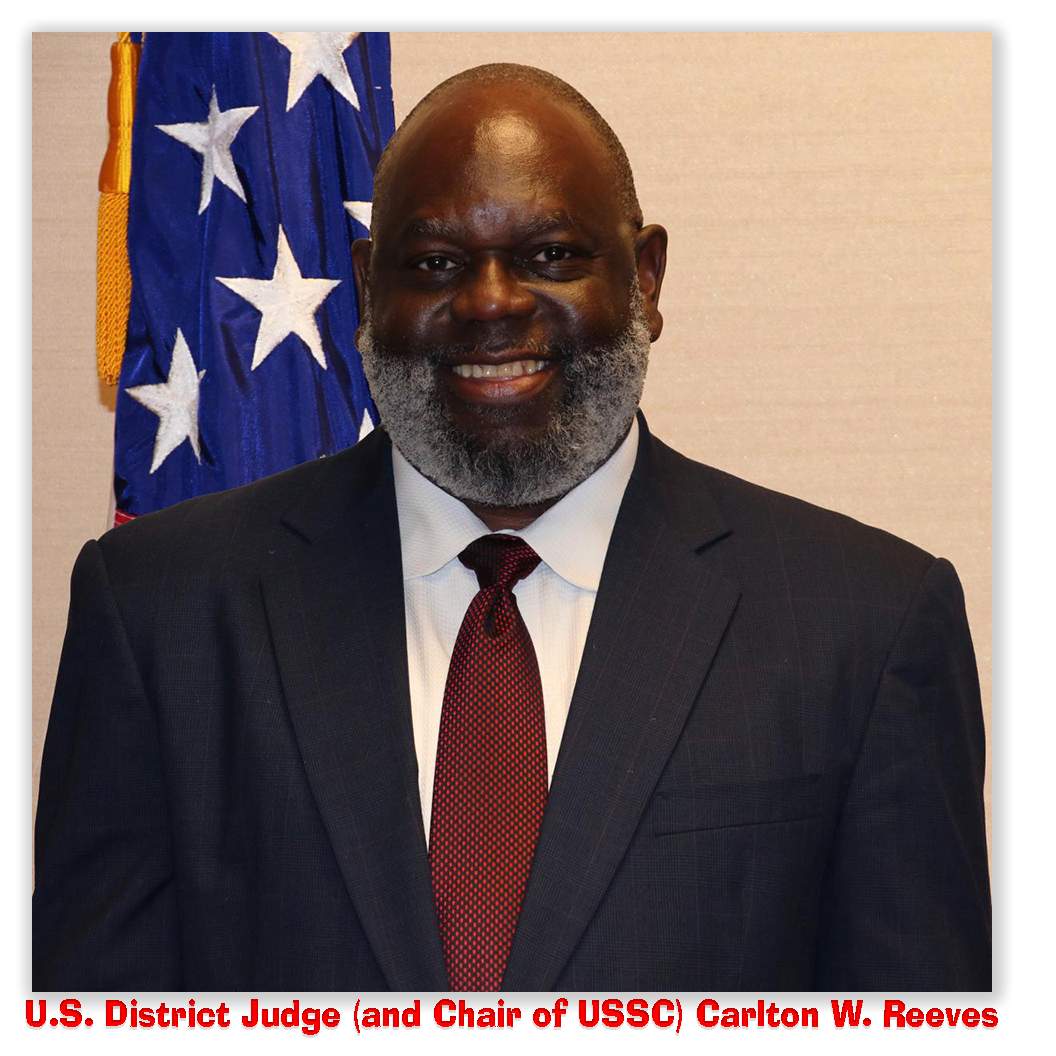
In other action, the Commission had been considering an amendment that prohibited courts from imposing longer sentences based on alleged crimes of which a defendant had been acquitted. Commission Chairman Carleton Reeves, a federal district judge from the Southern District of Mississippi, said the Commission needs more time before making a final determination on the issue.

Reuters reported that Michael P. Heiskell, President-Elect of the National Association of Criminal Defense Lawyers, said he was disappointed by the delay. “Permitting people to be sentenced based on conduct for which a jury has acquitted them is fundamentally unfair because it eviscerates the constitutional right to trial and disrespects the jury’s role,” he said in a statement.

However, the Commission’s delay may rejuvenate the McClinton v. United States petition for certiorari, which the Supreme Court has been sitting on at the suggestion of the Dept of Justice, awaiting Sentencing Commission action on acquitted conduct. A Supreme Court decision that use of acquitted conduct in sentencing is unconstitutional would benefit many more people than would a prospective Guidelines change.

The USSC also adopted a criminal history amendment that eliminates “status points” (sometimes called “recency points”) – additional criminal history points assessed if the defendant committed the current crime within two years of release for a prior crime – and grants a 2-level downward adjustment to a defendant’s offense level if he or she had zero criminal history points and met other criteria.

The Commission also approved an amendment to criminal history commentary advising judges to treat prior marijuana possession offenses more leniently in the criminal history calculus, making downward adjustments for offenses now seen as lawful by many states.

The proposal doesn’t seek to remove marijuana convictions as a criminal history factor entirely, but it would revise commentary within the guidelines to “include sentences resulting from possession of marihuana offenses as an example of when a downward departure from the defendant’s criminal history may be warranted,” according to a synopsis.

usscretro230406None of the Guidelines changes is retroactive without specific Commission determination that they should be. The USSC yesterday issued a notice that it will consider, pursuant to 18 USC § 3582(c)(2) and 28 USC § 994(u), whether Guidelines changes on “status points” and the “zero criminal history points” adjustment should be retroactive, and ask for public comment on the matter.

Although the Guidelines amendments do not become effective until November, most federal circuits have declared that – while the current § 1B1.13 is not binding on district courts because it is pre-First Step – courts should consider it to express the opinion of an agency expert in sentencing. The amended § 1B1.13 has every bit of the authority that the current non-binding § 1B1.13 has, and it has the additional benefit of being evidence of current Sentencing Commission thought.

USSC, Adopted Amendments (Effective November 1, 2023) (April 5, 2023)

USSC, Issue For Comment On Retroactivity Of Criminal History Amendment (April 5, 2023)

Reuters, U.S. panel votes to expand compassionate release for prisoners (April 5, 2023)

Marijuana Moment, Federal Sentencing Commission Approves New Marijuana Guidelines For Judges To Treat Past Convictions More Leniently (April 5, 2023)

– Thomas L. Root

Pollyanna Sees Great Future For EQUAL Act – Update for April 5, 2023

We post news and comment on federal criminal justice issues, focused primarily on trial and post-conviction matters, legislative initiatives, and sentencing issues.

HANDICAPPING CRIMINAL JUSTICE REFORM

pollyanna230405There’s not been much good news lately coming from Washington about reform of federal criminal laws, making a Washington Post piece last week noteworthy (if a bit too optimistic).

The Post admitted that the 117th Congress “in this tense partisan atmosphere” is likely to produce anything “along the lines of the First Step Act… some lawmakers and outside advocates say there are still opportunities to pass more limited legislation to make the criminal justice system less punitive.”

Partisan? Really?

The article cited the EQUAL Act (introduced in February in the Senate as S.524 and the House as H.R. 1062) to eliminate the disparity in federal sentencing for trafficking crack and cocaine. The bill passed the House on an overwhelming bipartisan vote in 2021 but was never brought to a vote in the Senate. It also noted the bipartisan task force formed last month to push legislation easing barriers to prisoners reentering society.

The EQUAL Act has broad support. Just last week, the conservative Americans for Tax Relief wrote Congress supporting the two bills, saying that “the sentencing disparity that currently exists between crack and powdered cocaine… has needlessly imposed sentences 100 times longer for possession of crack cocaine than the powdered counterpart, and despite some reform a large difference remains.”

“There’s a ton of Republicans that just want to do the right thing,” David Trone (D-MD) said last Tuesday. “And there’s a minority of Republicans who live on the rhetoric of, ‘Let’s stop everything.’”

Jason Pye, who lobbied for First Step at the conservative FreedomWorks group, said reform legislation might start moving once House Republicans tire of passing bills that stand no chance of clearing the Democratic-controlled Senate. “As far as I’m concerned, this is one of the few areas where there is not only bipartisan consensus, but support [from across the Republican] conference to do something,” the Post quoted Pye as saying.

However, besides being tragedies in their own right, events such as last week’s school shooting in Nashville hobble criminal justice reform efforts, especially in making First Step changes to 18 USC § 924(c) retroactive. Some Democrats want more than incremental progress on remaking the criminal justice system, especially after Monday’s school shooting in Nashville that left six dead.

gun160718Rep Jamie Raskin (D-MD) worked as a state senator on legislation eliminating state-law drug mandatory minimums and abolishing the death penalty. “I’m very open to that,” Raskin told the Post. “The problem is that we are in the midst of a nationwide gun violence crisis where we are losing tens of thousands of people every year, and we need real action there.”

Raskin, who served on the House Jan. 6 committee, also criticized Republicans for bemoaning the conditions of the D.C. jail holding those charged with attacking the Capitol. Rep Marjorie Taylor Greene(R-Ga.) led a visit to the jail last Friday.

But Armstrong and some conservative criminal justice advocates said they thought Republicans’ concerns about the Jan. 6 defendants might spur interest in the bills they’re working to pass. Armstrong, for instance, is working on a bill that would require federal prosecutors to certify that they’ve provided defendants with all exculpatory evidence before judgments are entered against them.

“That would be good for the Jan. 6 defendants, but it would [also] be good for every criminal defendant in federal court,” Armstrong said.

“When you have these highly charged political issues, I think the good side is, we may be calling attention to issues I’ve really cared about for a long time, and I get a new audience that may not have necessarily cared about them before,” Armstrong added.

Highly charged, indeed. Writing in Ringside at the Reckoning, William G. Otis (a former AUSA and DEA advisor) blasted the EQUAL Act: “The Post is hiding the ball by saying that the bill would just “eliminate the disparity” in sentencing between crack and powder cocaine. How exactly would it do that? … The answer, you will have guessed, is not to bring the penalties for each more nearly together, but solely to lower crack penalties.’

Otis, whom President Trump nominated to the Sentencing Commission but (thankfully) was never confirmed by the Senate, wrote that “lowering of penalties for a dangerous drug is exactly what the country needs ‘for its safety’ after two consecutive years in which, for the first time in our history, America suffered more than 100,000 drug overdose deaths — a critical fact nowhere to be found in the Post’s story.’

In fact, nothing is sacred anymore. The New York Times reported last week that Florida governor Ron DeSantis “see[s] the signature criminal-justice law enacted by Mr. Trump in 2018 as an area of weakness with his base, and Mr. DeSantis has indicated that he would highlight it when the two men tussle for the Republican nomination, according to three people with knowledge of Mr. DeSantis’s thinking. That law, known as the First Step Act, reduced the sentences for thousands of prisoners.”

optimism230405A perfect storm of people and events that coalesced to result in First Step – a senior White House official in the conservative Trump Administration whose father had done federal time, a liberal black justice activist who bucked criticism from the left to work with people seen as racist, a bill that disappointed the right for going too far and the left for not going far enough –  is not on the horizon right now. The film The First Step, a 90-minute documentary about the role Jones played in lobbying for prison reform, started streaming yesterday on Amazon Prime and Vudu, describes the improbable personalities and pressures that brought about passage of First Step, and reminds us that “it is important to work for bipartisanship if you want to get anything meaningful done in Congress,” according to San Diego Jewish World.

With crime once again becoming a political football, the odds of a Second Step Act don’t look good.

Washington Post, Is there any chance for criminal justice reform bills? Surprisingly, yes (March 29, 2023)

Americans for Tax Reform, ATR Supports the EQUAL Act (March 29, 2023) 

Ringside at the Reckoning, When the Washington Post Touts “Criminal Justice Reform”… (March 29, 2023)

The New York Times, DeSantis Burnishes Tough-on-Crime Image to Run in ’24 and Take on Trump (March 29, 2023)

San Diego Jewish World, ‘The First Step’ Tells How Prison and Sentencing Reform Were Won (April 3, 2023)

– Thomas L. Root