We post news and comment on federal criminal justice issues, focused primarily on trial and post-conviction matters, legislative initiatives, and sentencing issues.

LAST WEEK AT THE SUPREME COURT
 Maxwell v. Dinis (formerly Maxwell v. Thomas): A few months ago, I reported on petitioner William Maxwell’s claim in the Supreme Court that he should be allowed to challenge the BOP’s refusal to place him in prerelease custody by applying his First Step Act time credits in a petition for habeas corpus under 28 USC § 2241. (The 5th Circuit ruled otherwise, holding that habeas “is not the proper vehicle” for such a claim, which instead should be brought in “a civil rights suit under Bivens”).
Since then, the Government has informed SCOTUS that it “agrees with petitioner that that holding is incorrect and has therefore filed a brief supporting vacatur of the judgment below.” Last week, the Court granted the Government’s request for divided argument, a procedure that lets the Solicitor General use part of Bill’s argument time to make its own arguments in favor of his position.
The Court has appointed a private attorney to advocate for the side that the Government would usually argue. An argument date has not yet been set.
Maxwell v. Dinis, Case No. 25-5930 (divided argument granted, October 13, 2026)
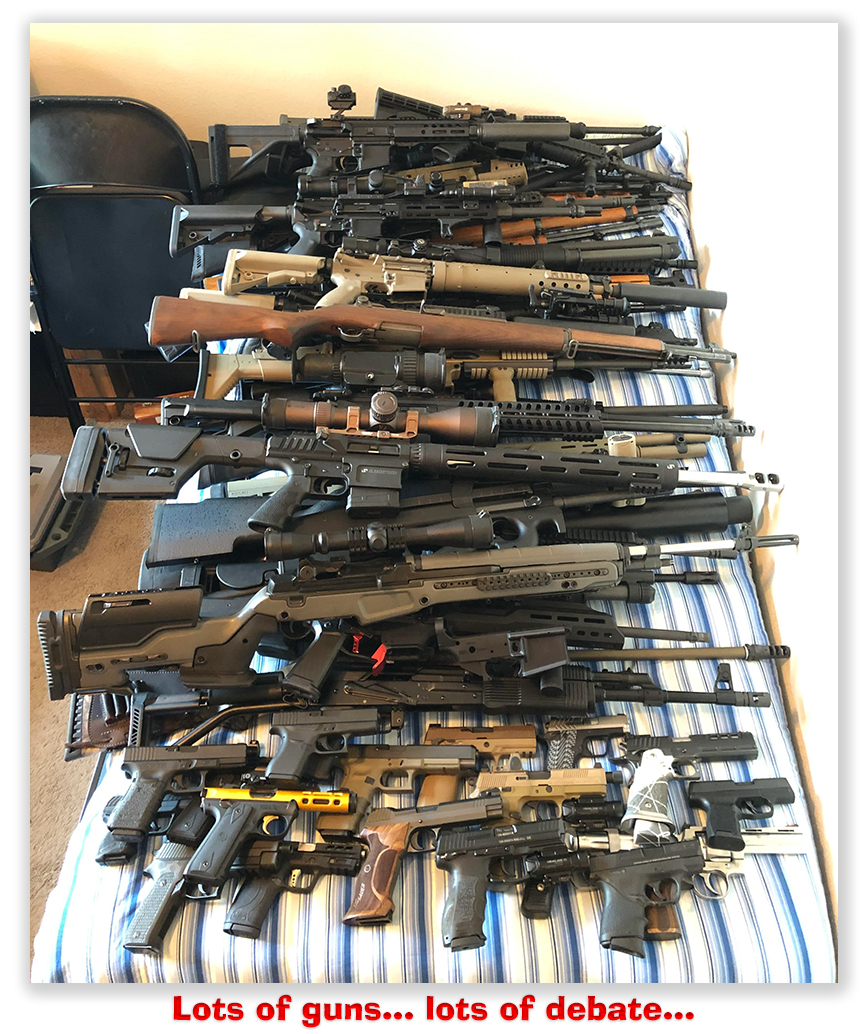
Beaird v. United States: Beaird asks whether a sentencing court must defer to the sentencing Guidelines commentary. The precise issue is whether the enhancement for having a gun with a “large capacity” magazine must follow the Guideline commentary defining such a magazine as being 15 rounds or more.
 At oral argument last week, the Supreme Court seemed disinclined to tinker with the 33-year-old Stinson v. United States holding that Guidelines commentary that “interprets or explains a guideline is authoritative unless it violates the Constitution or a federal statute, or is inconsistent with, or a plainly erroneous reading of, that guideline.” This is despite the fact that there is a substantial argument that the 2019 Kisor v. Wilkie holding – that limited the rule that courts defer to agency interpretation of its own ambiguous regulations – pretty much undid the Stinson holding.
Only Justice Neil Gorsuch seemed open to revisiting Stinson and Kisor in light of the 2025 Loper Bright holding that invalidated the rule that courts had to defer to how agencies interpreted statutes and rules. SCOTUSBlog reported that “none of the other justices seemed particularly interested in adopting such a position.”
This is another case where the Government sided with the petitioner, arguing with Beaird that, principally because the guidelines are now advisory, Stinson–style deference to the commentary should no longer apply. As the oral argument suggested, the fact that both parties argue for one position is no guarantee that the Supremes will roll over and accept it.
SCOTUSBlog, Court unlikely to alter deference to sentencing guidelines commentary (October 16, 2026)
Beaird v. United States, Case No. 25-5343 (argued October 13, 2026)
Berry v. United States: As anyone who ever filed a post-conviction 28 USC § 2255 motion knows, a district court denial is not appealable unless the appellate court grants a certificate of appealability (COA). A COA should be a low bar – a holding that the issue presented is reasonably debatable by judges or otherwise significant enough to let the movant continue with an appeal.
As the National Association of Criminal Defense Attorneys puts it, a COA is thus “the gateway to both appointment of counsel and an appeal on the merits—and by extension to a meaningful appellate process that can develop well-reasoned circuit splits on difficult legal questions.”
 Corey Berry lost his § 2255 motion, and then filed an application for COA pointing out that the 11th Circuit’s holding that he had to prove his sentence did not rely on the elements clause of 18 USC § 924(c) was contrary to the holdings of seven other circuits. Thus, he said, the issue was clearly debatable. The 11th disagreed, denying his COA.
Last week, the Supreme Court granted review, focusing on whether a COA should be granted when the issue the petitioner seeks to raise on appeal has been resolved against him by binding circuit precedent but has been decided in his favor by another circuit.
It’s been a decade since SCOTUS last decided a COA case (Buck v. Davis). A new decision that balances granting COAs of merit with appellate court efficiency is long overdue.
Berry v. United States, Case No. 25-7026 (cert. granted, October 13, 2026)
~ Thomas L. Root