An “AIC” Would Get More Prison Time For Doing What the BOP and ACA Did – Update for December 21, 2023

We post news and comment on federal criminal justice issues, focused primarily on trial and post-conviction matters, legislative initiatives, and sentencing issues.

INSPECTOR GENERAL UNMASKS BOP-ACA INSPECTION SCAM

Adults in Custody (that’s “prisoners” in normal-speak and so far, the new label is about all the progress BOP Director Colette Peters has made in 17 months at the helm) are fortunate that the institutions in which they’re housed are regularly audited by the American Correctional Association to ensure that they continue to meet that organization’s uncompromising high standards.

badcheck231221Of course. And the check’s in the mail, too…

A report issued by the Dept of Justice Inspector General last month found that instead of providing an independent evaluation of Federal Bureau of Prisons facilities, the ACA “instead relied on the prisons’ own internal reports during reaccreditation reviews.” In other words, as the DOJ put it, “it appears the BOP is, in effect, paying ACA to affirm the BOP’s own findings.”

The BOP awarded a $2.75 million contract to the ACA in 2018 to obtain accreditation and reaccreditation for BOP facilities. Five years into the agreement, the DOJ audit was intended to evaluate “the value the BOP receives through ACA accreditation for its prisons” and “how the BOP uses ACA’s accreditation to improve BOP standards for health, safety, and security of inmates and staff; and (3) the BOP’s contract administration and ACA’s performance and compliance with terms, conditions, laws, and regulations applicable to the contract.

nothingtosee230313The IG’s report found that “[a]lthough the contract requires ACA to perform its accreditation and reaccreditation in accordance with ACA’s policies, manuals, and procedures, current BOP and ACA officials… agreed that ACA would only perform independent reviews of BOP facilities as provided for in ACA policy during initial accreditation. For reaccreditation reviews, which was most of ACA’s work under the contract, the BOP and ACA agreed that ACA would rely on the BOP’s internal program review reports. As a result, it appears the BOP is, in effect, paying ACA to affirm the BOP’s own findings.”

The auditors also wrote they “did not identify instances where the BOP used ACA’s accreditation process to improve BOP standards for health, safety, and security of inmates and staff.” Of course not. If the BOP did a self-audit that the ACA signed off on, why bother to improve? Remember that only three months ago, NPR reported that the BOP claimed on its website that its medical centers were accredited by the Joint Commission, which accredits the vast majority of US hospitals, when in fact the certification had lapsed two years before.

NPR’s investigation – showing that federal prisoners die from treatable conditions that the BOP does not diagnose or treat in a timely way – was behind a call last week from Sens Richard Durbin (D-IL) and Charles Grassley (R-IA) for better BOP healthcare.

drquack191111“It is deeply upsetting that families are mourning the loss of their loved ones because they were not afforded the proper medical care they deserved while incarcerated,” Durbin, who is chairman of the Senate Judiciary Committee, told NPR. “BOP must immediately prioritize correcting the ineffective, harmful standards and procedures used to determine when an incarcerated person will be seen by medical professionals.”

Grassley, also a member of the Judiciary Committee, agreed. “BOP needs to be held responsible for this failure and take action to raise its standards.”

In response, a BOP spokesperson told NPR the Bureau “‘appreciates the Senators’ focus on this important issue’ and is committed to continue working with them on oversight.”

DOJ Office of Inspector General, Audit of the Federal Bureau of Prisons’ Contract Awarded to the American Correctional Association (November 16, 2023)

Lincoln, Nebraska, Journal-Star, Federal audit blasts nonprofit responsible for accrediting Nebraska’s prisons (December 10, 2023)

NPR, Lawmakers push for federal prison oversight after reports of inadequate medical care (December 12, 2023)

– Thomas L. Root

Supremes Will Review Four More Criminal Cases – Update for December 19, 2023

We post news and comment on federal criminal justice issues, focused primarily on trial and post-conviction matters, legislative initiatives, and sentencing issues.

SUPREME COURT ENDS YEAR WITH CRIMINAL-CASE CERTIORARI BLOWOUT

In what was probably its last certiorari grant order for 2023, the Supreme Court issued probably added four criminal cases last week.

blowout231219The highest profile case is Fischer v. United States, which arises from a defendant convicted of obstruction of Congress for the January 6th Capitol riot. He was convicted of an 18 USC § 1512(c) offense, which prohibits corruptly obstructing, influencing, or impeding “any official proceeding.” The district court dismissed the § 1512(c) charge, holding that Congress only intended it to apply to evidence tampering that obstructs an official proceeding. The D.C. Circuit Court of Appeals reversed that decision in a 2-1 opinion, ruling that “[u]nder the most natural reading of the statute,” the law “applies to all forms of corrupt obstruction of an official proceeding, other than the conduct that is already covered by” the evidence-tampering language of § 1512(b). One judge dissented that the government’s interpretation of the statute would render it “both improbably broad and unconstitutional in many of its applications.”

SCOTUS also will review a 9th Circuit ruling in favor of Danny Lee Jones, sentenced to death for two murders. A federal district court in Arizona rejected Jones’s claims that his lawyer had provided inadequate assistance, but the 9th reversed that decision, upholding its position in an order denying an en banc rehearing with ten judges dissenting.

The issue is how evidence not presented by a defense attorney because of failure to investigate should be weighed in determining Strickland v. Washington prejudice in a post-conviction proceeding. Although the issue relates to an Arizona death penalty case, the outcome could provide the first new ruling on Strickland prejudice in well over a decade.

goodpros170330In Chiaverini v. City of Napoleon, the high court will consider whether a claim for malicious prosecution can proceed for a baseless criminal charge, even if there was probable cause for prosecutors to bring other criminal charges. In Snyder v. United States, the Supremes will consider whether the federal bribery statute – 18 USC § 666(a)(1)(B) – makes it a crime to accept “gratuities” — that is, payment for something a government official has already done, without any prior agreement to take those actions in exchange for payment.

The Court will rule on the cases by the end of its current term on June 30, 2024.

Sentencing Law and Policy, Four criminal cases of note in latest SCOTUS cert grants (December 13, 2023)

Fischer v. United States, Case No. 23-5572 (certiorari granted December 13, 2023)

Thornell v. Jones, Case No. 22-982 (certiorari granted December 13, 2023)

Chiaverini v. Napoleon, Case No. 23-50 (certiorari granted December 13, 2023)

Snyder v. United States, Case No. 23-108 (certiorari granted December 13, 2023)

– Thomas L. Root

Sentencing Commission Proposes Acquitted Conduct Sentencing Change – Update for December 18, 2023

We post news and comment on federal criminal justice issues, focused primarily on trial and post-conviction matters, legislative initiatives, and sentencing issues.

MOVING RIGHT ALONG…

USSC170511Last Thursday the U.S. Sentencing Commission acted with uncharacteristic alacrity, adopting proposed amendments for the 2024 amendment cycle about a month earlier than has been typical over the past 30 years.

The Commission proposes seven changes in Guideline policy in a 755-page release, the most anticipated of which is the use of acquitted conduct at sentencing.

The Commission proposes adopting one of three acquitted conduct options:

Option 1 would amend § 1B1.3, the “relevant conduct” Guideline, to provide that acquitted conduct is not relevant conduct for determining the guideline range. It would define “acquitted conduct” as conduct constituting an element of a charge of which the defendant has been acquitted by the court, except for conduct establishing the instant offense that was “found by the trier of fact beyond a reasonable doubt.”

Option 2 would amend the § 1B1.3 Commentary to provide that a downward departure may be warranted if the use of acquitted conduct has a “disproportionate impact” on the guideline range.

Option 3 would amend USSG § 6A1.3 (which addresses the standard of proof required to resolve Guidelines disputes) to provide that while a “preponderance of the evidence” standard generally is sufficient, acquitted conduct should not be considered unless it is established by clear and convincing evidence.

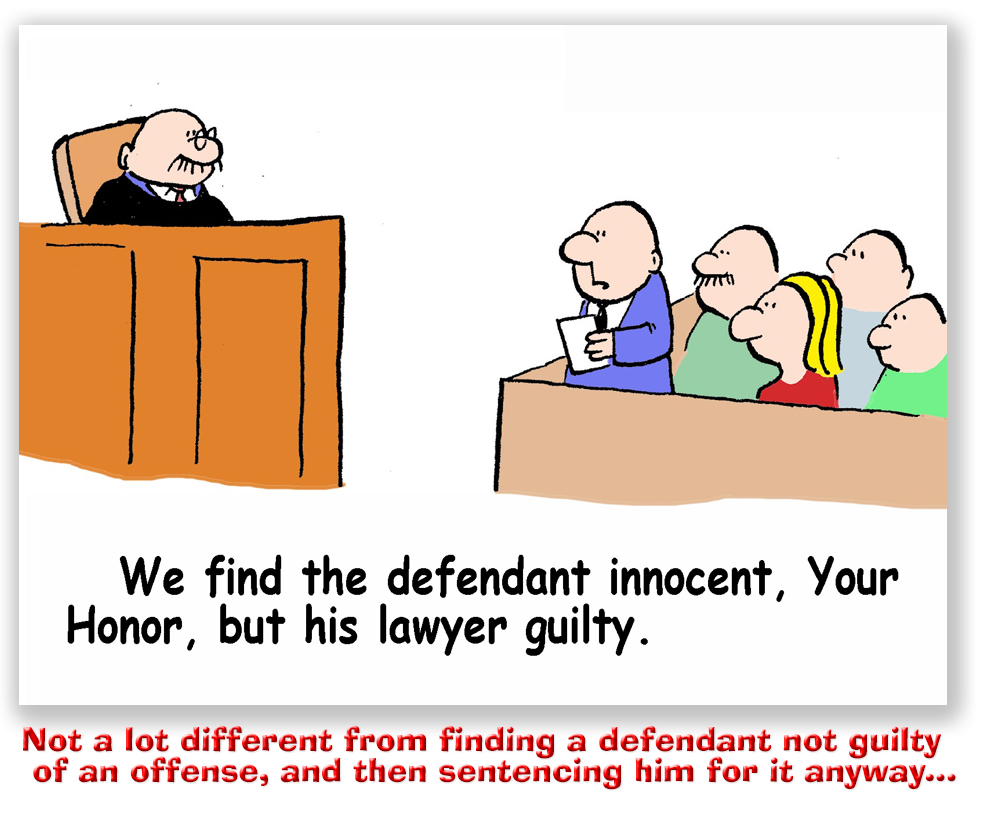
acquitted230106The Supreme Court last June denied 13 petitions for writ of certiorari related to use of acquitted conduct in sentencing. Four Justices felt the Commission should first address the issue. US District Judge Carlton W. Reeves, chairman of the USSC, said, “When the Supreme Court tells us to address an issue, the Commission listens… [A]ll options are on the table.”

The USSC proposal also addresses counting juvenile convictions for criminal history. The Commission proposed changes that would limit the impact of those convictions on criminal history scoring and expand consideration of a defendant’s youth at sentencing.

One piece of bad news is the Commission’s proposal to undo the effects of the 2019 Supreme Court Kisor v. Willkie decision. A year ago, the 3rd Circuit relied on Kisor in United States v. Banks to hold that the loss enhancement under USSG § 2B1.1(b)(1) includes only what was actually lost. The Circuit reasoned that the word “intended” appears only in the 2B1.1 commentary and not in the Guideline itself, and thus “the loss enhancement in the Guideline’s application notes impermissibly expands the word ‘loss’ to include both intended loss and actual loss.”

Sentencing for “intended loss” is the fraud equivalent of “ghost dope“:  Often, “intended loss” is what the government says it is, and that figure shoots the Guidelines sentencing range to the moon.

Banks sparked a debate on how much deference to give the Sentencing Commission’s interpretation of its own Guidelines. The 3rd said the USSC lacked authority to use its commentary – which is not subject to Congressional approval before adoption – to expand the meaning of “loss” to include what was intended but did not happen.

loss210312The USSC now intends to short-circuit the Kisor v. Willkie debate (and to kneecap the Banks decision) by moving “intended loss” from the commentary into the text of 2B1.1. Because that amendment will be subject to a possible (but improbable) veto by Congress veto, the Kisor v. Willkie problem with 2B1.1 will melt as fast as snowflakes on a hot stove.

The USSC drew its proposed amendment from policy priorities adopted last August. Not making the final cut were policy priorities on career offender (and not for the first time) and methamphetamine.

The proposed amendments will be open for public comment period until February 22, 2024. A public hearing will occur after that. Final proposed amendments will be sent to Congress by May 1 to become effective next November 1, 2024.

USSC, Proposed Amendments to the Sentencing Guidelines (Preliminary) (December 14, 2023)

USSC, US Sentencing Commission seeks comment on proposals addressing the impact of acquitted conduct, youthful convictions, and other issues (December 14, 2023)

USSC, Public Hearing (December 14, 2023)

USSC, Federal Register Notice of Final 2023-2024 Priorities (August 24, 2023)

United States v. Banks, 55 F.4th 246 (3d Cir. 2022)

Bloomberg Law, Wall Street Fraudsters Rush to Cut Prison Terms With New Ruling (November 1, 2023)

– Thomas L. Root

Whose Motion Did You Just Deny, Judge? – Update for December 15, 2023

We post news and comment on federal criminal justice issues, focused primarily on trial and post-conviction matters, legislative initiatives, and sentencing issues.

I NEVER SAID THAT

Neversaidthat231215Ever feel like the court was reading something other than your motion when it denied you relief?

Robin Sims filed for compassionate release under 18 USC § 3582(c)(1)(A), arguing that COVID had wrecked his health and the Federal Bureau of Prisons was not giving him adequate care. The government agreed that at least one of Robin’s chronic medical conditions was an “extraordinary and compelling” reason for a compassionate release, but it opposed Robin’s motion because the 18 USC § 3553(a) sentencing factors failed to support letting Robin out at this time.

The district court, however, released an opinion smacking of alternate reality. It first held that Robin’s argument for release “due to the increased risk of contracting COVID and changes in the law arguments [did] not amount to an extraordinary and compelling reason warranting a sentence reduction.” The court also noted the government’s opposition claim that there were no extraordinary and compelling reasons for granting compassionate release. Finally, the district court concluded, the § 3553(a) factors weighed against grant. The court denied the compassionate release on those bases.

twooutofthree231214Last week the 9th Circuit reversed the district court denial, holding that “the government and the district court misread Sims’s pro se motion.”

The district court and government were unforgivably sloppy. First, the government summarized Robin’s argument as being that “extraordinary and compelling reasons exist because the coronavirus (COVID-19) places him at risk if he remains in the custody of BOP.”

Robin never said that. Rather, he argued that he was experiencing ongoing medical complications because of the COVID he had had. He challenged the adequacy of the BOP medical care. Robin relied on these reasons, in addition to intervening changes in the law, to show extraordinary and compelling reasons in support of a reduced sentence.

The 9th also ruled that the district court’s order misstated the government’s position by mistakenly saying that the government opposed Robin’s motion because he had failed to show extraordinary and compelling reasons.  The government had said just the opposite.

mistake170417Doesn’t matter, the government told the 9th Circuit. The district court errors were harmless, the government contended, because the judge had also found that the § 3553(a) factors disfavored Robin’s motion. The Circuit disagreed. “[M]otions for compassionate release require an individualized inquiry,” the Circuit held, and “here, we see no indication that the district court considered Sims’s argument that his health and medical care needs were ‘extraordinary and compelling,’ or that it reviewed the medical records [he] submitted in support of his motion.

The case now goes back to the district court to consider the 18 USC § 3553 factors in light of the extraordinary and compelling reasons Robin had shown.

United States v. Sims, Case No 22-3430, 2023 U.S.App. LEXIS 32310 (8th Cir., December 7, 2023)

– Thomas L. Root

A Few More Short Takes – Update for December 14, 2023

We post news and comment on federal criminal justice issues, focused primarily on trial and post-conviction matters, legislative initiatives, and sentencing issues.

SPIRIT OF THE SEASON

The Romans had a saying, “De mortuis nil nisi bonum dicendum est,” or – as my sainted Latin teacher Emily Bernges would have translated, “Of the dead, nothing but good shall be said.”

This sentiment is enshrined in federal law as the “abatement ad initio” doctrine, which holds that a trial conviction is vacated when a defendant dies before he or she can exhaust the direct appeal process. The doctrine is followed by every federal court in the country.

In a Scrooge-worthy appeal in the 1st Circuit, however, the government argued last week that the Circuit should “break new ground by holding that a defendant’s conviction outlasts his death and does not get wiped away just because he died before his appeal could be heard,” according to Reuters.

grinch151213Former biotech chief executive Frank Reynolds was convicted of securities fraud in 2020 and sentenced to 84 months. He died a year ago with his appeal still pending. In its argument, the government admitted that every appellate circuit in America would vacate Frank’s conviction, but it argued that those courts’ opinions should not matter. Vacating the conviction and “restitution order when a defendant dies while his or her direct appeal is pending would flout [a] clear Congressional directive,” the government contends, that when a defendant subject to a restitution order dies “the individual’s estate will be held responsible for any unpaid balance of the restitution amount” under 18 USC § 3613(b).

At oral argument, one skeptical judge told the government that it needed “a pretty good argument to upset an apple cart that is going uniformly across the country without any sign of being a big problem.” Another member of the panel noted that the DOJ could always bring a civil case against a defendant’s estate for restitution.

United States v. Reynolds, Case No 20-1268 (1st Cir, argued Dec 4, 2023)

Reuters, Convictions should outlive defendants’ deaths, US tells appeals court (December 4, 2023)

CONSERVATIVE SUPPORT FOR CARES ACT HOME CONFINEES

The Senate has yet to take up S.J.Res. 47, the Republican effort to force 3,000 CARES Act home confinees back to prison. Last week, officials of the Conservative Political Action Coalition and the Faith and Freedom Coalition – wrote in The Hill that “the CARES Acts home confinement provision slowed the virus, saved millions of taxpayer dollars, and maintained public safety. By all measures, it has been a success.”

recidivism231214
The authors challenged Republican arguments that CARES Act prisoners were committing new crimes and terrorizing communities. “Of the people moved to home confinement, 521 were returned to custody. This equates to a 4 percent recidivism rate, less than one-tenth of the BOP average. But looking at the numbers more closely, the CARES Act recidivism rate is much more impressive than that. Of the 521 returned to prison, 296 were sent back for positive drug or alcohol tests, 90 for leaving their homes, and 113 for technical violations. That means that only 22 people were re-incarcerated for committing new crimes.”

The recidivism rate for new crimes works out to 0.2%, about 1/200th of the BOP average.

The Hill, There’s no reason to send these 3,000 people in home confinement back to federal prison (December 3, 2023)

S.J.Res. 47, A joint resolution providing for congressional disapproval under… the rule submitted by the Department of Justice relating to “Office of the Attorney General; Home Confinement Under the Coronavirus Aid, Relief, and Economic Security (CARES) Act

JOBS FOR ALL!

A bipartisan group of Representatives last week introduced the BOP Direct-Hire Authority Act, H.R. ____ (no bill number yet) intended to alleviate BOP staffing shortages by letting the agency hire personnel directly instead of the standard federal employment process that goes through the federal Office of Personnel Management and takes up to six months.

understaffed220929Reps Glenn Grothman (R-WI) and Matt Cartwright (D-PA) are spearheading the effort to try to turn around staffing losses of 20% in the last 7 years. The bill is supported by 11 co-sponsors and the Council of Prison Locals C-33, the largest nationwide BOP employees union. union for BOP employees nationwide.

The bill would provide direct-hire authority for a BOP facility until it reaches a level of 96% staffing level.

H.R. ___(no bill number yet), BOP Direct Hire Authority Act

Press release, Grothman, Cartwright Introduce Bipartisan Bill to Address Staffing Shortage in Bureau of Prisons (December 6, 2023)

– Thomas L. Root

A Couple of Short Takes – Update for December 12, 2023

We post news and comment on federal criminal justice issues, focused primarily on trial and post-conviction matters, legislative initiatives, and sentencing issues.

LONELY, I’M MR. LONELY…

Democratic senators introduced legislation last Tuesday that would largely ban the Federal Bureau of Prisons from using solitary confinement.

solitary170721The End Solitary Confinement Act, a companion to a bill, H.R. 4972, introduced last July, would prevent inmates and detainees from being segregated alone for more than four hours to de-escalate emergency situations and, even then, require staff members to meet with them at least once an hour.

Similar to the House bill, the Senate version entitles incarcerated people to at least 14 hours of daily time out of their cells, including access to seven hours of programming meant to address topics such as mental health, substance abuse and violence prevention.

The Senate legislation was introduced by Senators Elizabeth Warren and Ed Markey, both D-MA; Bernie Sanders, I-VT; and Peter Welch, D-VT.

S.____ [no number yet], End Solitary Confinement Act

H.R. 4972, End Solitary Confinement Act

NBC, Bill to ‘end solitary confinement’ in federal institutions introduced in Senate (December 5, 2023)

VOTING IN PRISON

Rep. Ayanna Pressley (D-MA) and Sen Peter Welch (D-VT) introduced bills in their respective chambers last week that, if passed, would grant people the right to vote in federal elections while in prison.

vote160726The Inclusive Democracy Act is unlikely to advance in the divided Congress, where Republicans narrowly control the House of Representatives and Democrats control the Senate.

The lawmakers acknowledged the headwinds to the legislation, their concession that passage in this Congress is very unlikely.

Reuters, Democratic lawmakers unveil bill to give people in US prisons right to vote (December 6, 2023)

HR 4852, The Inclusive Democracy Act

– Thomas L. Root

Government Seeks to Bushwhack Disparate-Sentence Compassionate Release Guideline – Update for December 11, 2023

We post news and comment on federal criminal justice issues, focused primarily on trial and post-conviction matters, legislative initiatives, and sentencing issues.

TIGER TRIES TO EAT ITS YOUNG

Traditionally, the Department of Justice defends federal statutes and regulations from constitutional attack. In fact, DOJ’s role as watchdog over the sanctity of its statutes and rules is so established that the Federal Rules of Civil Procedure require a private litigant to serve the Attorney General in a lawsuit against another private party if the litigant is claiming that any federal statute is unconstitutional.

tigers231211I have seen cases in the past where the government conceded that the application of a statute was unconstitutional – but usually after the Supreme Court has found the statute itself to violate the Constitution. Good examples abound, such as United States v. Brown, a 2nd Circuit summary order noting that where “the underlying crime of violence was a racketeering conspiracy… [t]he Government concedes that the Supreme Court’s recent decision in United States v. Davis… requires vacatur of those counts of conviction [under 18 USC 924(c)]”).

But I don’t recall a case where the government has mounted a defense based on the argument that the federal agency rule applicable to the private party’s claim was void as contrary to federal statute. Until now.

To channel Rodney Dangerfield, this is a case of a tiger eating its young.

The new USSG § 1B1.13(b)(6) – the Guideline that sets out binding Sentencing Commission policy on 18 USC § 3582(c)(1)(A) “compassionate release” sentencing reductions – holds that where a prisoner has

an unusually long sentence and has served at least 10 years of the term of imprisonment, a change in the law… may be considered in determining whether the defendant presents an extraordinary and compelling reason, but only where such change would produce a gross disparity between the sentence being served and the sentence likely to be imposed at the time the motion is filed…

You may recall that when this provision was adopted by the Commission last April, it generated vigorous debate and passed on a whisker-thin 4-3 vote.

retro160110Now, in United States v. Brand, a compassionate release case in the Northern District of Florida, the government has opposed a prisoner’s request for relief from a sentence of stacked 18 USC § 924(c) convictions by arguing that USSG § 1B1.13(b)(6) is an unconstitutional expansion of Sentencing Commission authority because it effectively makes nonretroactive changes in the law retroactive. The thrust of the government’s defense is that Congress did not make changes in 18 USC § 924(c) retroactive when it passed the First Step Act five years ago, that this was a deliberate choice made by Congress, and that the Sentencing Commission’s decision to define the sentence disparity resulting from people sentenced before First Step have dramatically higher stacked 924(c) sentences than people sentenced after First Step as “extraordinary and compelling” is unlawful: “Although Congress has delegated broad authority to the Sentencing Commission, subsection (b)(6) is contrary to the text, structure, and purpose of 18 U.S.C. § 3582(c)(1)(A) and 28 U.S.C. § 994(a), and is therefore invalid.”

I think the argument is strained. Besides trying essentially to engraft Administrative Procedure Act standards (see 5 USC § 706, for instance) onto a judicial agency that is not subject to the APA, I think that the biggest hole in the government’s argument is that – unlike other agency rules – under 28 USC § 994(p), Guideline amendments (and an explanation of why they are being proposed) must be submitted to Congress 180 days before effectiveness to give Congress a chance to modify or disapprove the amendments. Congress’s right to modify or disapprove makes it tough to argue, as the government does, that the Commission’s reading of the compassionate release statute “exceeds the gap left by Congress.” If Congress had thought the new § 1B1.13(b)(6) was overreaching, outside the Commission’s authority, or contrary to the non-retroactivity of First Step, it had six months to say so.

The government relies on Mayo Foundation for Med. Educ. & Research v. United States, but in that case, the court notes that “the ultimate question is whether Congress would have intended, and expected, courts to treat [the regulation] as within, or outside, its delegation to the agency of ‘gap-filling’ authority.” Here, I think, the existence of the six-month review period and Congress’s election not to modify or veto during that period is more than ample evidence of Congress’s intent.

lincolnfool161125But the real danger in Brand is this: The court denied the prisoner appointment of counsel right about the time the government lodged its novel constitutional claim that Federal Rule of Civil Procedure 5.1 requires a party contesting the constitutionality of a federal statute to serve the Attorney General of the United States with notice of the action. Under 28 USC § 2403(a), a court ruling on such a challenge is required to do the same. Upon receiving notice, the Attorney General has a right to intervene as a party in the case and present evidence. Both of these requirements suggest that the government has a compelling interest in defending the sanctity of its rules and statutes.

So what happens when the Attorney General himself contests the lawfulness of a federal regulation, especially where it is a quasi-statute as is a sentencing guideline? Expecting a pro se prisoner to competently defend the lawfulness of a federal rule against the government puts a lot of weight on the shoulders of the inmate. What is more, it is almost certain to result in steamrolling the government’s position into the final order, resulting in the making of a bad ruling out of an unbalanced contest.

Sentencing Commission guideline 1B1.13(b)(6) has the tacit approval of Congress. If any compassionate release defense calls for the appointment of counsel, defending the lawfulness of a properly adopted guideline does.

United States v. Brown, 797 Fed.Appx 52, 54 (2d Cir. 2019)

United States v. Davis, 588 U.S. —, 139 S.Ct. 2319, 204 L.Ed.2d 757 (2019)

Gvt Response to Motion for Compassionate Release (ECF 108), United States v. Brand, Case 8:11-cr-380 (N.D.Fl., filed November 17, 2023)

Mayo Foundation for Med. Educ. & Research v. United States, 562 US 44 (2011)

– Thomas L. Root

District Court’s Detailed Compassionate Release Decision Is a Treat – Update for December 8, 2023

We post news and comment on federal criminal justice issues, focused primarily on trial and post-conviction matters, legislative initiatives, and sentencing issues.

THE HOPEFUL FUTURE OF COMPASSIONATE RELEASE

From the 11th Circuit last week – traditionally, the place where motions for compassionate release went to die – comes a detailed, thoughtful order granting release to a prisoner serving a life sentence for drug distribution.

cocaine170511Bill Vanholten was about 12 years into a life sentence for trafficking cocaine, a sentence he got because he had two prior convictions for selling two dime bags of marijuana, about $20.00 worth, to two undercover cops when he was 19 years old in 1994. In January 2012, Bill was charged with possessing 10 kilograms of cocaine. At the time, a defendant charged with that quantity of cocaine who had two prior drug felonies would get a mandatory life sentence if the government filed what is known as a 21 USC § 851 enhancement with the court.

The government has traditionally used 851 enhancements as a bludgeon to force defendants to cooperate. If the defendant won’t snitch, the government files the 851 and rachets up the minimum sentence dramatically. Bill wouldn’t budge, refusing to identify his source for the coke, so the government filed the 851 notice of two prior drug felonies, a 2006 federal coke charge and one of the “dime bag” offenses. Those two priors mandated a life-without-parole sentence, which, the court said unhappily, it was required to impose.

Six years later, the First Step Act modified the list of prior offenses qualifying for 851 enhancements and lowered the mandatory minimums. After First Step, the “dime bag” offense would not count as a serious drug offense for a 21 USC § 851 enhancement. On top of that, the mandatory minimum sentence for a single 851 enhancement prior dropped to 15 years. If Bill had been sentenced after First Step passed, his court would have only been required to sentence him to 15 years.

compassion160124The First Step Act also permitted defendants to file sentence reduction motions – so-called compassionate release requests – under 18 USC § 3582(c)(1)(A). Before the Act, only the Federal Bureau of Prisons could bring such a request on an inmate’s behalf, an event as rare as a snow flurry on July 4th. All that stood in the way was the Sentencing Commission’s guideline on compassionate release, USSG § 1B1.13. That guideline, written prior to First Step, narrowly circumscribed what “extraordinary and compelling” reason could justify sentencing reduction and required that any reduction be “consistent” with applicable Sentencing Commission policy.

Section 1B1.13 could have been updated by the Sentencing Commission in 2019, but the Commission lost its quorum through the expiration of commissioner terms only a few days after the First Step Act passed.

Most federal circuits recognized the obvious, that the creaking 1B1.13 relic – written long before First Step was even dreamed of – was Commission policy but not “applicable” Commission policy. Only two of the 12 federal circuits remained mired in the past, not permitting any reason for compassionate release not specifically written into the guideline. Bill’s Circuit was one of them.

Four years later, the Sentencing Commission regained a quorum and immediately set to amending 1B1.13. The amendment became effective on November 1, 2023.

sarcodiosis23128In 2022, Bill moved for compassionate release, citing his sarcodiosis, a chronic condition characterized by inflammation in the lungs and other organs, as justification. His court-appointed an attorney to help Bill, who added an argument that the change in the law provided an independent reason for compassionate release. Bill’s lawyer asked the court to sit on the motion until the new 1B1.13 became effective. When it did, the government agreed that Bill’s medical condition established “extraordinary and compelling” reasons warranting release both alone and combined with other factors.

Last week, the court reduced Bill’s life sentence to time served (which, considering Bill’s accumulated good time, now equals 15 years.

The district court’s decision is a model of careful scholarship and proper application of the new 1B1.13. The court relies on Sentencing Commission studies to hold that Bill’s sentence

is an outlier among drug trafficking offenders… Federal prosecutors do not uniformly seek § 851 enhancements, so sentences for offenders like him vary considerably… Some judicial districts see § 851 notices filed for as many as 75% of eligible drug trafficking defendants whereas other districts do not see them filed at all. Since most offenders confronted with an enhanced sentence cooperate, a little less than 4% of eligible defendants ultimately face an enhanced penalty at sentencing… Those in the 4% receive prison terms roughly ten years longer than the average sentence for similar offenders who evaded the enhanced penalty, and twelve years longer than the average for eligible offenders against whom the notice was never filed.

The court candidly admitted that Bill “received one of these unusually long sentences as a de facto punishment for not cooperating.” While the court acknowledged that Bill’s sentence could not be completely compared with a 13-year sentence a cooperator with a similar record had received (because Bill did not cooperate and thus did not receive credit for doing so), it noted nonetheless that the differences between the defendants “do not wholly account for the more than twenty-year disparity between a thirteen-year prison term and life behind bars.”

lock200601The court observed that Bill “received a sentence at least twenty years longer than the fifteen-year minimum Congress now deems warranted for offenders like him. He had a criminal history category of II, comprised entirely of nonviolent offenses, which would warrant nothing close to a life sentence under the guidelines. Whatever ‘significant period of incarceration’ this Court may have settled on at the original sentencing, had it any discretion back then, would not have come within twenty years of Mr. Vanholten’s remaining life expectancy. A difference of a generation between the actual sentence and the sentence Mr. Vanholten would likely receive today no doubt makes for a gross disparity.”

Similarly, the court cited medical studies establishing that sarcodiosis fit the new 1B1.13(b)(1)(B) “extraordinary and compelling” reason that a defendant (1) is suffering from a serious physical or medical condition that (2) substantially diminishes the ability of the defendant to provide self-care within the environment of a correctional facility and (3) from which he is not expected to recover. “Though he is not at death’s door,” the court ruled, Bill’s “medical records show that his sarcoidosis is both chronic and persistent, hurting his lungs and pulmonary function. He is unlikely to recover from it. According to the opinion of medical experts, Mr. Vanholten’s morbidity puts him at a heightened risk of a sudden and serious cardiac event, and a decreased life expectancy,” citing medical journals. At the same time, the court relied on Bill’s records showing infrequent consultation with specialists and noted that the Dept. of Justice “makes no secret that the BOP’s chronic medical staffing shortage has made its ability to deliver healthcare a challenge.”

MerryChristmasBill231208The court released Bill, effective a week from today. Beyond the happy ending for a badly over-sentenced defendant, the court has given prisoners an early Christmas gift, a roadmap for effectively negotiating compassionate release under the new 1B1.13.

United States v. Vanholten, Case No. 3:12-cr-96 (M.D. Fla. Dec. 1, 2023), 2023 U.S. Dist. LEXIS 213764

U.S. Sentencing Commission, Application and Impact of 21 U.S.C. § 851: Enhanced Penalties for Federal Drug Trafficking Offenders (2018)

– Thomas L. Root

You’ve Got Mail – Update for December 7, 2023

We post news and comment on federal criminal justice issues, focused primarily on trial and post-conviction matters, legislative initiatives, and sentencing issues.

BOP MAIL SCANNING BILL INTRODUCED IN THE HOUSE

Legislation introduced by Representative Don Bacon (R-NE) proposes new procedures for handling mail in order to disrupt the flow of drugs into BOP facilities. It requires the agency to adopt a program to electronically scan all incoming inmate mail, give inmates an electronic copy of their mail within 24 hours of its reception, and deliver the original mail within 30 days if it’s drug-free.

youvegotmail231207The Interdiction of Fentanyl in Postal Mail at Federal Prisons Act, H.R, 5266, is based on a 2020 BOP interdiction pilot project that scanned inmate mail and “reduced the number of synthetic drug introductions via general postal mail to effectively zero over the pilot project period,” The Hill reported.

H.R. 5266 is an improvement over the old system, The Hill said, because while the pilot program destroyed the physical mail after scanning, “the proposed bill protects the right of incarcerated people to receive physical mail… Taking away the tactile experience of touching a handwritten letter, or smelling perfume on an envelope would likely have a negative impact on prisoner well-being, which can increase recidivism and antisocial behavior.”

It remains to be seen whether prisoners whose mail delivery is delayed while understaffed facilities scan all incoming letters and documents agree.

HR 5266, Interdiction of Fentanyl in Postal Mail at Federal Prisons Act

The Hill, A new bill will guard against lethal letters in US prisons (November 19, 2023)

– Thomas L. Root

Fun With Numbers – Update for December 6, 2023

We post news and comment on federal criminal justice issues, focused primarily on trial and post-conviction matters, legislative initiatives, and sentencing issues.

PRISON BY THE NUMBERS

The First Step Act requires the Dept of Justice’s Bureau of Justice Statistics to report data from the Federal Bureau of Prisons annually.

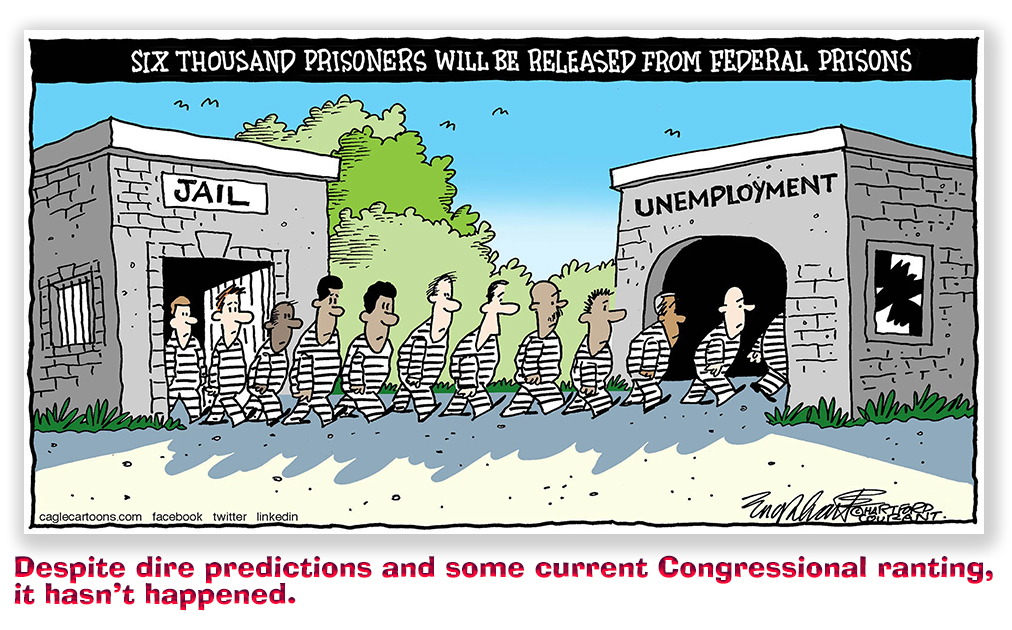
numbers160704The 2023 report issued last week includes stats running the gamut from yawn-inducing to fascinating. Of most significance, despite all of the drawdowns implicitly promised by First Step (retroactive crack cocaine sentencing, compassionate releases, and FSA credits), mass incarceration proceeds apace. The BOP population increased about one percent – from 156,542 at the end of 2021 to 158,637 at the end of 2022 – and is now at 157,811.

You’d think all of those early releases would have made a dent in the federal prison population. You’d be wrong.

Other facts:

•   The BOP admitted almost 44,873 new prisoners in 2022, a 6% change from 2021.

•   The BOP released 42,948 prisoners in 2022, a 9% change from 2021.

•   The BOP’s population exceeded rated capacity by 6.9%.

•   About 5% of BOP prisoners – 8,627 –are military veterans.

•  In 2022, the BOP released about 10,100 prisoners early because of FSA credits.

•   Just over 15% of BOP prisoners are non-U.S. citizens, about the same as 2020 and 2021.

• In 2022, BOP prisoners were found to have committed 80,490 prohibited acts, slightly more than one for every two prisoners.

• There were 10,177 instances of prisoners placed in special housing units in 2022, a 10% increase from 2021.

• There were 965 instances of prisoners assaulting staff. Two percent (19) of these assaults resulted in serious injuries, and only 12 were prosecuted.

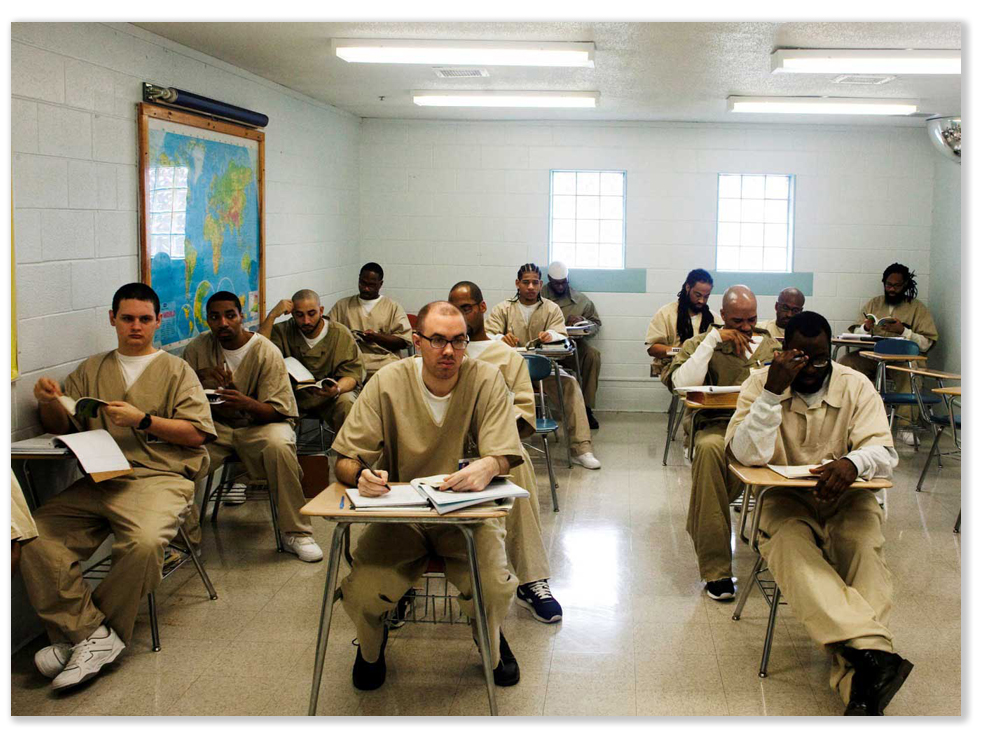
• About 70% of BOP prisoners had high school diplomas or GEDs prior to admission to prison (110,531), and an additional 3,543 (2.2%) earned their GEDs while locked up.

education180205•   In 2022, 13.2% of federal prisoners (20,880) participated in a nonresidential substance use disorder treatment program, while 7.6% (12,035) participated in RDAP.

•   PATTERN, the BOP’s recidivism risk tool, classified 54% of prisoners as minimum or low risk for recidivism, 27% as high risk for recidivism, and 19% as medium risk. Females were more likely than males to be minimum than low (81% vs 52%). Black (61%) and American Indian prisoners (59%) were more likely to be medium or high risk than white (36%) and Asian (27%).

BJS, Prisoners in 2022 – Statistical Tables (November 30, 2023)

– Thomas L. Root