All posts by lisa-legalinfo

If You Want to Go Home, Die Faster – Update for May 16, 2019

We post news and comment on federal criminal justice issues, focused primarily on trial and post-conviction matters, legislative initiatives, and sentencing issues.

CAN’T TEACH AN OLD DOG NEW TRICKS

die190513The Bureau of Prisons has been notorious for refusing to make sentence reduction recommendations to courts because dying inmates seemed to be in pretty good health, and surely able to finish their sentences, no matter what doctors might say. The First Step Act tried to remedy the BOP’s convenient myopia by letting inmates file for sentence reductions with district courts if the BOP refused to do so for them.

You’ll be glad to know that the government remains just as oblivious to medical reality and insensitive to impending death as ever. When Steve Brittner’s BOP doc told him that his Stage IV brain tumor was bad enough to withdraw further treatment and sign him up for hospice care, Steve filed for an 18 USC § 3582(c) sentence reduction so he could die at home.

The government opposed the reduction, arguing Steve did not have a terminal illness within the meaning of the guidelines because his medical records “do not indicate that the tumor has metastasized.” Plus, the government contended, Steve could not show “extraordinary and compelling” circumstances because his medical records did not indicate an inability to care for himself.

Last week, Steve’s district court swept aside the government’s opposition and said Steve could die at home. First, the court said, the Guidelines on sentence reduction do not require that Steve show that his tumor has metastasized for his condition to be terminal. Instead, the guidelines provide a number of examples of medical conditions that would meet the standard for a “terminal illness.”’ A metastatic solid-tumor cancer” is just example.

compassionaterelease190517

Second, to show extraordinary and compelling circumstances, an inmate does not have to show both a terminal illness and inability to care for oneself. “The Government reads a conjunctive requirement into the guideline comment where none occurs,” the district court observed. The Guidelines provide that “extraordinary and compelling” reasons exist “under any of the circumstances set forth below,” of which a terminal condition is one and inability to care for oneself is another.”

“Of importance,” the court wrote, “the treatment options available to Brittner have been exhausted. According to the last treatment note available to the Court, dated November 15, 2018… the plan… was to hold, or discontinue further therapy, and it was recommended to Brittner that he consider comfort measures, specifically hospice, which his treating oncologist “considered very reasonable due to worsening performance status… It is clear from the nature of his disease and his worsening condition as documented above, that Brittner’s prognosis is grim, his disease is terminal, and the length of his life can be measured most likely in weeks, as opposed to months.”

United States v. Brittner, 2019 U.S. Dist. LEXIS 73653 (D.Mont. May 01, 2019)

Reason.com, A Terminally Ill, Wheelchair-Bound Inmate Applied for Compassionate Release. The Justice Department Argued He Wasn’t Dying Fast Enough to Qualify (May 3)

– Thomas L. Root

Keeping Count – Update for May 15, 2019

We post news and comment on federal criminal justice issues, focused primarily on trial and post-conviction matters, legislative initiatives, and sentencing issues.

SENTENCING BY THE NUMBERS

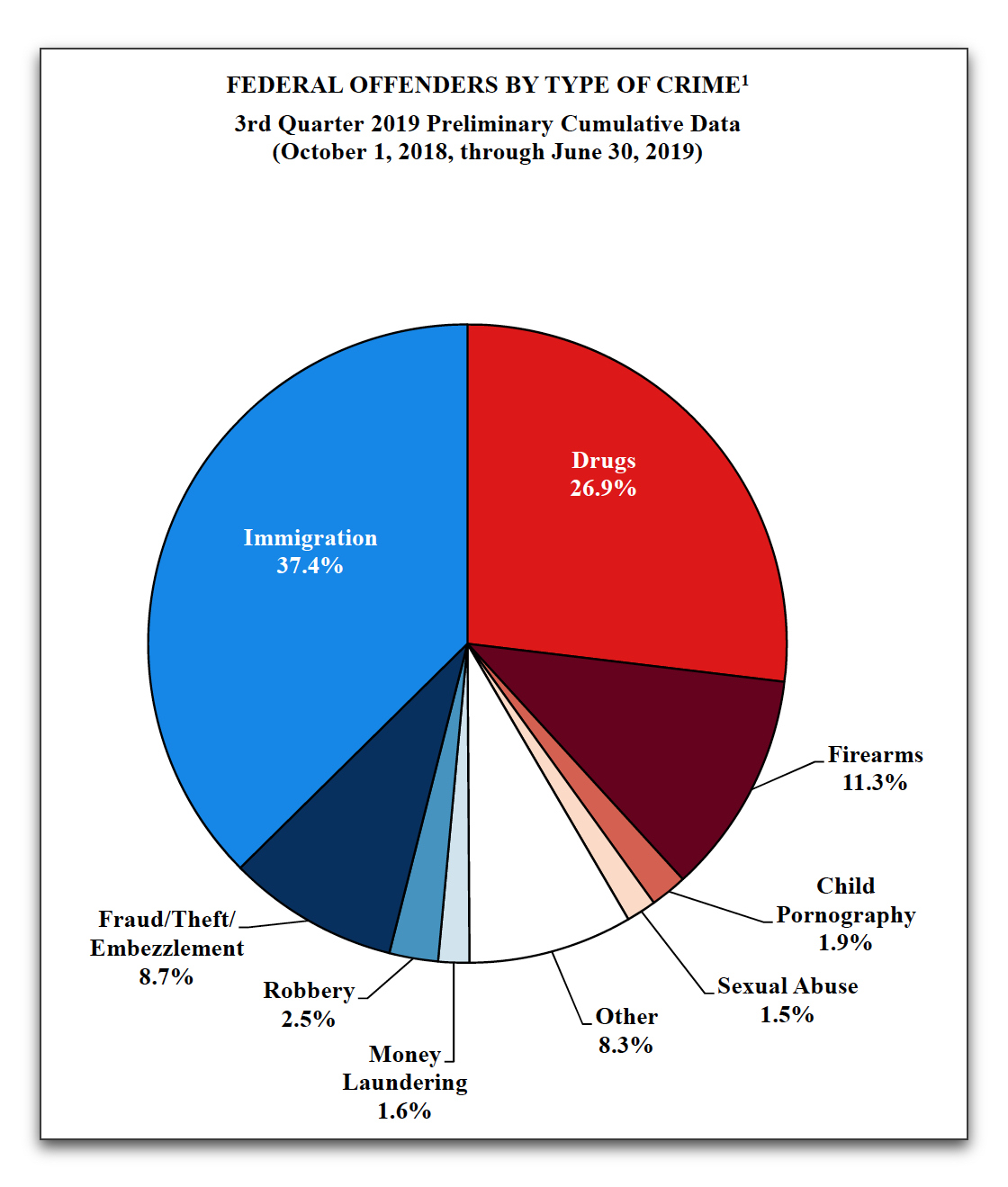
The Sentencing Commission Fiscal Year 2018 Annual Report and Sourcebook came out last week. Besides the obvious (which the Annual Report sort of soft-pedaled, that the Commission lacks a quorum, and thus cannot perform its primary duties), the release contains some interesting numbers taken from 2018’s 69,400 district court sentencings. (All years are fiscal years, running from Oct. 1 to Sept. 30):

• The Feds are busier this year than last. The sentencing caseload increased by 3.7% from 2017, the first increase in caseload since 2011.

numbers180327• It’s not what you did, it’s where you’re from, that matters. Immigration crimes replaced drug offenses as the largest single group of offenses. Immigration cases increased from 30.5% in 2017 to 34.4% in 2018, while drug and firearms prosecutions fell.

• Meth is the drug of choice. Methamphetamine offenses, the most common drug type in the federal system, continued to rise (from 30.8% of all drug offenses in 2016 and 34.6% in 2017 to 39.8% in 2018).

• The Guidelines still rule. 75% of federal offenders were sentenced under the Guidelines Manual in 2018. Of those, 51.0% were sentenced within the defendants’ Guidelines sentencing range, an increase of 1.9 points from 2017. The number of defendants getting downward departures for helping the government remained at 10.1%, the same level as 2017.

U.S. Sentencing Commission, FY 2018 Sourcebook (May 8, 2019)

– Thomas L. Root

If Not For Supervised Release, What’s Forever For? – Update for May 14, 2019

We post news and comment on federal criminal justice issues, focused primarily on trial and post-conviction matters, legislative initiatives, and sentencing issues.

FOREVER IS A LONG TIME

41475-Forever-Is-A-Long-TimeKevin Carson was convicted of having hundreds of kiddie porn images on his computers and having sent some such images to young girls. He got a below Guidelines sentence of 240 months and lifetime supervised release, with conditions prohibiting him from using Internet devices without probation office approval and avoiding from any social media.

Kevin appealed the lifetime supervised release term and the computer and social media restrictions. Because his trial lawyer did not object to the supervised release or the conditions (and for that matter, did not even bother filing a sentencing memorandum, something the appellate court noted with disdain), Kevin had to show that the mistakes were plain error that affected his substantial rights (under Fed.R.Crim.P. 52(b)).

computer190514Last week, the 8th Circuit upheld the lifetime supervised release term and the conditions. Kevin complained the trial court did not consider sentencing factors in giving him lifetime supervised release, but the Circuit said a sentencing court’s explanation “may be relatively brief if the district court rests its decision on the Sentencing Commission’s reasoning and decides simply to apply the Guidelines to a particular case.” Here, a Guidelines policy statement provided that if the offense of conviction is a sex offense, “the statutory maximum term of supervised release is recommended.” Thus, Kevin’s lifetime supervised release term “was a straightforward application of this policy.”

As for the computer restrictions, the Court ruled that as long as Kevin  could use computers and social media with Probation Office approval – rather than an outright ban – the condition is not too great a restriction on his freedom. Kevin argued that the social media restriction was unconstitutional under Packingham v North Carolina, but the Circuit said Packingham “invalidated only a post-custodial restriction and expressed concern that the statute applied even to persons who have already served their sentence.” Because Kevin will still be serving a sentence on supervised release for as long as he is able to draw breath, the Court held, he will never finish serving his sentence, and thus, Packingham does not make the district court’s restriction on social media during supervised release plain error.

forever190514The decision is noteworthy for Judge Kelly’s incisive dissent, in which he complains that the district court left the 8th Circuit with no explanation for why it varied downward one-third on the sentence but maxed out the supervised release. The need for individual tailoring of supervised release conditions to offenders is substantial, the Judge said, and the advent of IoT devices like thermostats and doorbells, and Amazon.com, could leave Kevin violating supervised release by turning up the heat.

The Judge underscored the problem with sweeping, blunt supervised release conditions like these: Kevin “was thirty-three at the time of his arrest, and his lifetime term of supervised release could very well last decades. We can only imagine the universe of internet-reliant electronic devices that will pervade everyday life by then. The length and conditions of his supervised release may well be justified, but such punishment deserves, at minimum, some reasoned explanation from the sentencing court.”

United States v. Carson, 2019 U.S. App. LEXIS 14044 (8th Cir. May 10, 2019)

– Thomas L. Root

No Running Out the Clock on Supervised Release – Update for May 13, 2019

We post news and comment on federal criminal justice issues, focused primarily on trial and post-conviction matters, legislative initiatives, and sentencing issues.

FLEEING IN PLACE

emily190513Emily Bernges, my high school Latin teacher, taught us that the Latin verb “fugare” means “to flee,” and is the basis of the English word “fugitive.” Based on that, you might think that to be a fugitive, you have to take flight, or at least do something that seems like running from the law.

Not necessarily, as Phillip Thompson found out. He did some federal time last decade, followed by five years of supervised release. The supervised release was not such a big deal to Phil, because he was deported to his native Jamaica as soon as he was released in 2010. Before he left for the islands, Phil was a told that one condition of his supervised release was that if he came back to the USA, he had to promptly report to his probation officer. Because returning to this country after being deported is a federal crime all by itself, you would think that the last thing Phil would want to do if he sneaked back onto the mainland was report to his PO.

You would be right. Phil returned to the USA in 2012, but got deported again about a month later, well before before his PO found out he had been back. When she did learn of it, she filed a violation petition, but Phil was already back in Jamaica and beyond the reach of the Probation Office. But Phil came back in December 2014, five months before his 5-year supervised release term expired, and this time he stayed. Having the foresight to use an alias and obtain a phony driver’s license, Phil flew under the radar for more than two years, during which time he was busily engaged in organizing large-scale marijuana importation and routing the money through bank accounts back to Jamaica (or so the authorities say).

Phil got arrested in 2017, and after his fingerprints ratted him out, his Probation Officer learned he was back. She amended the pending violation petition, and his supervised release was revoked. Phil challenged the district court’s jurisdiction to even hear his supervised release revocation, because supervised release had expired in June 2015. The district court disagreed, saying under the “fugitive tolling” doctrine, Phil was a fugitive from the time he got back to the USA until he was arrested, and his supervised release stopped running during that time.

Last week, the 4th Circuit agreed. As a general rule, the Court said, a district court’s power to revoke supervised release ends when the supervised release term expires, but the term stops running if the defendant absconds from supervised release and thus becomes a fugitive. Phil argued he was not a fugitive under the fugitive tolling doctrine, because only an active and knowing effort to evade adjudication of a supervised release violation petition is sufficient to trigger the fugitive tolling doctrine. He never knew about the July 2011 petition filed against him because he had been deported two months before.

fugitive190513The 4th disagreed. The fugitive tolling doctrine provides that a supervised release term “is tolled when a defendant absconds from supervision.” That is because Congress intended defendants to serve their full supervised release term, and just as an escaped prisoner’s sentence is not credited for the time the prisoner spends out of custody, a supervised release term should not be credited for the time that a defendant, “by virtue of his own wrongful act,” spends out of supervision. Fugitive tolling, the Court said, “prevents a situation in which we reward an absconder for his misconduct, allowing a fugitive defendant to run out the clock on his release term while refusing to submit to supervision.”

Here, Phil did not just come back to the USA and not report, but he used an alias, got phony ID, and admitted he knew he was supposed to report to the PO if he returned. That was enough to show active measures to hide, and to thus make him an absconder.

United States v. Thompson, 2019 U.S. App. LEXIS 14035 (4th Cir. May 10, 2019)

– Thomas L. Root

Too Much Frivolity For a Lawyer? – Update for May 9, 2019

We post news and comment on federal criminal justice issues, focused primarily on trial and post-conviction matters, legislative initiatives, and sentencing issues.

APPLES AND ORANGES

noBS190509A long time ago, Congress decided that prisoners filed too many nonsense lawsuits. There was no cost to the prisoner, who always qualified for in forma pauperis status (which meant, among other things, that the prisoner did not have to pay the federal district court filing fee of $400.00 plus). So in 1996, Congress amended 28 USC § 1915, which requires courts to perform what one lawyer I know crudely but accurately calls the “bullshit review.” If after the judge casts his or her practiced eye on the complaint, the court decides that the complaint is utter crap – known in the legal world as “frivolous” – the prisoner will be denied in forma pauperis status. Of course, the inmate can still go forward by paying the filing fee, but for a guy making a quarter an hour, $400.00 buys a lot of Honeybuns at the commissary.

But that’s all in the civil litigation world. If you find yourself behind the criminal 8-ball, things are different. Apples and oranges.

Matthew Didham wanted to appeal the district court’s revocation of his supervised release. He asked for appointment of counsel, because he could not afford to keep paying his retained attorney, who withdrew after Matt was revoked.

The district court turned him down, because Matt had $750 in his commissary account, and therefore, the court reasoned, he could afford the appeal filing fee. Plus, the district judge found, citing 28 USC § 1915(a)(3), Matt’s appeal was frivolous, because he had “not articulated any argument to suggest that the court revoked his supervised release in error.”

Last week, the 7th Circuit reversed, and appointed counsel for Matt. It held that the district court had confused apples for oranges, applying the statute which applies for prisoners’ civil appeals, with the Criminal Justice Act, governing criminal and supervised release appeals. In 28 USC § 1915 cases, the court can deny counsel if the filing is frivolous. But for a supervised release violation, the right to counsel is set out in 18 USC § 3006A “for any person financially unable to obtain adequate representation.” It is not for the district judge to deny where he thinks he was right, and an appeal of his decision must therefore be wrong.

United States v. Durham, 2019 U.S. App. LEXIS 13264 (7th Cir.  May 2, 2019)

– Thomas L. Root

11th Circuit Travels Farther From Earth – Update for May 8, 2019

We post news and comment on federal criminal justice issues, focused primarily on trial and post-conviction matters, legislative initiatives, and sentencing issues.

11TH CIRCUIT BAR FIGHT

Last week, the 11th Circuit denied en banc review of a case in which a pre-Booker Guidelines career offender sought collateral review of his sentence, based on the void-for-vagueness doctrine of Johnson v. United States. No surprise there. But a number of judges on that court, including the former acting chairman of the Sentencing Commission, Judge William Pryor, wrote 27 weird pages explaining the soundness of their denial.

earth190508Essentially, the majority said that the Guidelines were always advisory, even when they were mandatory, because the mandatory guidelines were never lawful. Therefore, a judge could have given the defendant the same high sentence even if he was not wrongly considered to be a career offender, despite the obvious fact that any judge who had done that would have been summarily reversed. If the sentence conceivably could not have changed, the majority wrote, then the ruling (in this case, Beckles) is obviously procedural, and the defendant cannot rely on it to change his sentence, because it is not retroactive.

Judge Rosenbaum and two other judges threw 36 pages back at the majority:

According to the Pryor Statement, the Booker Court did not make the Guidelines advisory because they were always advisory, since the Sixth Amendment never allowed them to be mandatory. That is certainly interesting on a metaphysical level.

But it ignores reality. Back here on Earth, the laws of physics still apply. And the Supreme Court’s invalidation of a law does not alter the space-time continuum. Indeed, there can be no dispute that from when the Guidelines were adopted in 1984 to when the Supreme Court handed down Booker in 2005, courts mandatorily applied them, as 3553(b) required, to scores of criminal defendants — including many who still sit in prison because of them.

The inmate, Stoney Lester, was lucky enough to get released on a 2241 motion by the 4th Circuit – in which circuit he was imprisoned at the time – making the 11th Circuit denial academic. But the otherworldly logic of the majority, especially from a circuit fast becoming notorious for accepting any tissue-thin reason to deny a defendant constitutional or statutory justice (see here and here, for instance), is mind-numbing.

Lester v. United States, 2019 U.S. App. LEXIS 12859 (11th Cir. Apr. 29, 2019)

– Thomas L. Root

The Year of No Guidelines – Update for May 7, 2019

We post news and comment on federal criminal justice issues, focused primarily on trial and post-conviction matters, legislative initiatives, and sentencing issues.

WHITHER GUIDELINES?

Guidelines red text and magnify glassThe first of May was both International Workers Day (for you Marxists) and Law Day (if you’re a lawyer). For the past 31 years, it has also customarily brought a package of Sentencing Guidelines amendments, each of which is to become effective on the following November 1st (six months hence) unless Congress objects, pursuant to 28 USC 994(p).

Not this year. For the fourth time in 31 years, the Commission will adopt no Guideline amendments to send to Congress. This has only happened before in  1996 and 1999, and more recently in 2017.

The problem is one of politics. The Sentencing Commission was established by Congress in the Sentencing Reform Act of 1984 as a permanent, independent agency within the judicial branch. The seven Commission members are appointed by the President and confirmed by the Senate for six-year terms. Commission members may be reappointed to one additional term, also with the advice and consent of the Senate. Three of the members must be federal judges, and no more than four may belong to the same political party. The Attorney General or his designee and the chair of the United States Parole Commission sit as non-voting members of the Commission.

No matter how important the Commission may be to federal inmates, Washington sees it as a political backwater. Already operating with only five members in 2017, the Commission’s voting membership fell further last year to four. Then, at the end of 2018, the terms of Judge William Pryor of the 11th Circuit and New York University law professor Rachel Barkow expired.

emptyroom190507For the past five months, the Commission has had only two voting members. Two more must be appointed and approved by the Senate just to have the minimum number needed for a meeting. Former Sentencing Commission chairwoman Patti Saris, who is Chief Judge of the U.S. District Court for the District of Massachusetts, complained in a Law360.com article last week, “Today, the United States Sentencing Commission sits without a confirmed chair, or even a quorum of members. This severely impairs the commission’s ability to study further reforms. For example, with only two current commissioners, the commission is unable to pass amendments to make the sentencing guidelines consistent with the statutory provision expanding the “safety valve.” While the research and training activities of the commission continue, the commission needs a quorum.”

Meanwhile, the amendment cycle for 2018 has come and gone without action for the second time in three years. Thank heaven that the Guidelines, after 30 years of development, are perfect in every regard (said no one ever).

Law360.com, The First Step Act Is A Major Step For Sentencing Reform (Apr. 28)

– Thomas L. Root

BOP Will Calculate First Step Extra Good Time on July 19th – Update for May 6, 2019

We post news and comment on federal criminal justice issues, focused primarily on trial and post-conviction matters, legislative initiatives, and sentencing issues.

JULTEENTH

imageMost everyone knows that “Juneteenth” is an unofficial but increasingly-popular holiday commemorating June 19, 1865, the date on which slavery was abolished in Texas, the last stronghold of the dying Confederacy. When the Texan slaves were declared free on that date, slavery was no longer legal anywhere in North America. 

This year, July 19, will become “Julteenth,” the date on which BOP computers will automatically update sentence records to credit the additional seven days per year good-time that was awarded in the First Step Act last December, crediting federal prisoners retroactively to the start of their sentences. Some prisoners will receive, in one fell swoop, a six months credit on their incarceration.

When First Step passed last December 21st, Congress intended that the seven days be credited immediately. Indeed, opponents and supporters of the bill predicted an immediate flood of federal prisoners released in time for Christmas. Proponents envisioned the happiest of Christmases for many reunited families. Opponents darkly predicted vicious criminals running amok on America’s Yuletide streets. But in the back-and-forth on debating and amending the measure to please some die-hard opponents of any criminal justice reform legislation that suggested common sense, the seven days’ good time got tucked in a section of the bill addressing the new risk assessment system. A subsection of that provision gave the Attorney General 210 days (which worked out to July 19, 2019) to roll out the risk assessment proposal. Broadly written and poorly conceived, the measure hooked the seven days’ additional good time to that section as well.

unintendedconsequences190506The additional good-conduct time was granted because it was what Congress always had intended. Unfortunately, the prior good-conduct time provision in 18 USC 3624(b)(1) but had written so poorly that the Bureau of Prisons was able to interpret it in the most miserly way possible. In irony that would be appreciated had it not dashed prisoners’ hopes so badly, the good time “fix” was screwed up to, enabling the Dept. of Justice to interpret it to delay the seven days’ good time until the risk assessment – which has nothing to do with the seven days’ additional good time – was completed.

Since First Step passed, DOJ has blown through a 30-day deadline for starting the risk assessment adoption process, leading some to speculate on whether it would ignore the July 19 deadline for the seven days’ additional good-time credit as well. Fortunately, BOP last week dispelled that speculation with a welcome announcement that the additional credit would be automatically applied on that date.

Whether the Attorney General will deliver a risk assessment program on July 19th, one that will meaningfully determine risk of recidivism in an efficient and fair way, is another thing altogether. Previously, we reported on the appointment of conservative think-tank Hudson Institute to host the Independent Review Committee, the group that is to recommend a risk assessment program for adoption. In a joint statement released a week ago last Tuesday, House Judiciary Committee Chairman Jerrold Nadler (D-New York) and Subcommittee on Crime, Terrorism and Homeland Security Chairwoman Karen Bass (D-California), sharply questioned the appointment, declaring that “our concerns about this decision remain” even after staff was briefed by the agency.

Under the Act, the IRC’s function is to create independent oversight of the law’s implementation and to ensure that reforms are carried out in a bipartisan and evidence-based manner. First Step directs the DOJ’s National Institute of Justice to “select a nonpartisan and nonprofit organization with expertise in the study and development of risk and needs assessment tools.”

strangelove190506“The Hudson Institute appears to have little or no expertise in the study and development of risk and needs assessment tools,” Nadler and Bass complained. “Committee staff questioned DOJ representatives charged with overseeing First Step Act implementation as to why the Hudson Institute was selected, and were told that DOJ representatives did not know. Staff asked whether the Hudson Institute has ever studied or developed a risk and needs assessment tool, and were told that DOJ representatives did not know. Staff asked on what date the Hudson Institute was selected, and were told that DOJ representatives did not know. Staff asked what process was used to select the Hudson Institute, and again were told that DOJ representatives did not know.”

The suggestion is that political sources out the DOJ (read “the White House”) dictated Hudson Institute’s appointment. “The Hudson Institute and its leadership have opposed sentencing reform and… the First Step Act’s reforms,” the joint press release said. “We are concerned that the selection of a biased organization lacking requisite expertise may reflect a lack of intent to diligently and effectively implement the bipartisan criminal justice reforms passed last Congress.”

Marc Mauer, executive director of the Sentencing Project, agreed. “The Hudson Institute has no interest or expertise in criminal justice policy, and to the extent they do have any opinion about policy, they’re very hostile to the kinds of provisions that are in the First Step Act,” Mauer told Salon magazine. “It’s a strange choice when there are so many other reputable think tanks and organizations that do have experience in these issues.”

Nadler and Bass demanded that The Hudson Institute’s appointment be rescinded, but DOJ sources report that such a move is very unlikely. Of more significance is the question of whether a workable risk assessment system is in place in the next two and a half months, so the BOP can roll out programs inmates can use to earn good-time credits.

In the midst of the flying political fur over Hudson Institute’s involvement, no one is speculating about that.

House Judiciary Committee, Nadler & Bass Statement on DOJ’s Selection of the Hudson Institute to Host First Step Act Independent Review Committee (Apr. 23)

Salon, Is the Trump Justice Department trying to sabotage the First Step Act? (Apr. 28)

– Thomas L. Root

Fake News on Second Step Act – Update for May 2, 2019

We post news and comment on federal criminal justice issues, focused primarily on trial and post-conviction matters, legislative initiatives, and sentencing issues.

JUST FOOLIN’

trumpaprilfool190502President Trump told an April Fools’ Day gathering the White House to celebrate the First Step Act that “I’m announcing that the Second Step Act will be focused on successful reentry and reduced unemployment for Americans with past criminal records, and that’s what we’re starting right away.”

Um… not really.

The Washington Examiner last week quoted White House sources as saying that “there’s definitely not a Second Step Act.” In fact, it appears that Trump wandered off script from the prepared speech, which did not mention a Second Step at all.

Instead, the source is quoted as saying, the White House is focused instead on implementing the First Step Act in a way that denies ammunition to opponents such as uber-critic Sen. Tom Cotton, R-Ark.

cotton190502So far, First Step has not been a roaring success. A drafting error stalled additional “good time” credit for 150,000 federal inmates, creating a likely wave of about 4,000 releases around July. White House officials considered options to move forward the date but ultimately did not. “There’s a lot of concern that they have to get this right. Folks like Tom Cotton are just waiting for someone to do something stupid,” said the source who has worked on White House efforts. “People are going to want to wait and see how this [First Step Act] works out.”

Meanwhile, a broad coalition of groups is pushing for repeal of the federal ban on Pell Grants for incarcerated students, as talks heat up over reauthorization of the Higher Education Act. Those organizations include civil rights groups, religious colleges and conservative organizations, argue that college access for students behind bars is an issue of equity for postsecondary education and also the logical extension of efforts to end mass incarceration.

Since 1994, federal law has prohibited prisoners from receiving Pell Grants, the primary form of need-based student aid. The Trump administration, however, has named financial aid for incarcerated students as a top priority for a new higher ed law.

Washington Examiner, Trump declared he was working on a Second Step Act. The proposal doesn’t exist (Apr. 26)

Inside Higher Ed, The Case for Pell in Prisons (Apr. 22)

– Thomas L. Root

Judge Weinstein (As Usual) Provides Detailed Opinion on Crack Resentencing – Update for May 1, 2019

We post news and comment on federal criminal justice issues, focused primarily on trial and post-conviction matters, legislative initiatives, and sentencing issues.

WISDOM OF THE ANCIENTS

weinstein160516At age 92, Senior Judge Jack Weinstein is not only still on the Eastern District of New York federal bench, but he remains one of the most industrious and thoughtful federal judges in America, a jurist prone to issuing detailed and resource-rich decision.

In a 15-page opinion hand down last week, Judge Weinstein released Cheyenne Simons under the retroactive Fair Sentencing Act after Chey had served 11 years of his 12-year sentence. This does not sound like such a big deal (a 9% discount on the original immurement), except that as a Guidelines career offender with 50 grams of crack, Cheyenne had faced a 262-month minimum Guidelines advisory sentencing range term in 2008, when Judge Weinstein sentenced him to 144 months instead. What’s more, because of a quirk in how EDNY was applying 18 USC 924(c)’s mandatory consecutive sentence (for using a gun in a drug trafficking crime) back then – a quirk since remedied by the Supreme Court in Abbott v. United States –  Chey did not get a 5-year mandatory consecutive sentence for the gun charge then. Unfortunately, he was obligated to get it now.

Cheyenne had pled to 50 grams of crack, but at the 2008 sentencing, the court attributed over 500 grams of crack to him for Guidelines sentencing purposes. The government argued that under the FSA resentencing, the 500 grams made him subject to the new 280-gram 10-year minimum. Judge Weinstein refused:

Any argument that Simons is ineligible for relief on the basis that his actual conduct involved distribution of 280 grams or more of cocaine base, triggering the 841(b)(1)(A) penalties and a 10-year minimum term of imprisonment, is unsound. Statutory penalties are determined by facts submitted to a grand jury, a trial jury, or established by a guilty plea. Findings by a judge… may be used to determine a sentence within the statutory penalties, but do not establish statutory penalties and cannot change the mandatory minimum sentence now applicable.

release160523Although the 924(c) penalty left Chey’s Guidelines at 262-327 months, Judge Weinstein held that the retroactive FSA gave him the discretionary authority to reduce the sentence. Because Chey had “taken substantial steps during his period of incarceration to achieve the rehabilitative goals sought by the original sentence imposed,” Judge Weinstein set him free.

United States v. Simons, 2019 U.S. Dist. LEXIS 67964 (EDNY, Apr. 22, 2019)

– Thomas L. Root