Conflicting Signals on Recalling CARES Act Home Confinees – Update for October 19, 2020

We post news and comment on federal criminal justice issues, focused primarily on trial and post-conviction matters, legislative initiatives, and sentencing issues.

THIS IS KIND OF TROUBLING

comeback201019At a hearing on an inmate’s motion for compassionate release last August, Dept of Justice attorney Michael P. McCarthy made a chilling statement about the Bureau of Prisons’ CARES Act home confinement program: “The defendant is being re-evaluated once he crosses that (50%) threshold and at that point potentially transferred to home confinement. Now, I want to be clear that in the BOP’s program, it’s a transfer until the end of the pandemic and then a return to prison if the pandemic is declared over…”

Writing in Forbes magazine last week, Walter Pavlo said, “While everyone wants an end to the pandemic, those on home confinement may be told that they will be returning to prison … or they could be asked to be immunized in order to return …. or the inmate could refuse immunization …. or the inmate may have only a few months remaining by the end of the pandemic and might file an appeal.”

trumplie201019Pavlo noted that FAMM president Kevin Ring told him a White House source said a return of home confinement people to prison after the pandemic ends – whenever that is – “will NOT be happening.” But White House assertions (remember President Trump’s promised 3,000 clemencies?) have a way of being wrong. The risk of reincarceration seemed real enough that the House of Representatives included a provision in last May’s HEROES Act that no one “granted placement in community supervision, termination of supervision, placement on administrative supervision, or pre-trial release shall be re-incarcerated, placed on supervision or active supervision, or ordered detained pre-trial only as a result of the expiration of the national emergency relating to a communicable disease.”

The HEROES Act stands no chance of passage in the Senate.

Ohio State University law professor Doug Berman, writing in his Sentencing Law and Policy blog, said last week, “Because of the opaque nature of BOP work and data, it is difficult to tell just how many persons have been transferred into home confinement and what percentage of these persons might have long enough still remain on their original sentences to perhaps prompt DOJ to seek their return to prison whenever the pandemic if over.”

Forbes, US Attorney States Federal Inmates On Home Confinement Will Return To Prison Once “Pandemic Is Declared Over” (Oct 15)

Sec 191102(f), HEROES Act, HR 6800

Sentencing Law and Policy, Will some (most? all?) federal prisoners transferred to home confinement be returned to prison after the pandemic ends? (Oct 16)

– Thomas L. Root

Hobbs Act “Attempt” Not Crime of Violence, 4th Says – Update for October 16, 2020

We post news and comment on federal criminal justice issues, focused primarily on trial and post-conviction matters, legislative initiatives, and sentencing issues.

4TH CIRCUIT CHIPS AWAY AT HOBBS ACT

Ever since the Supreme Court’s United States v. Davis decision a year ago – indeed, even before Davis with Mathis, Descamps and the line of Johnson cases – commentators have been asking “whither violence?”

chip201016OK, maybe nothing that fancy. But appellate courts have traditionally and dismissively held that if a crime is a crime of violence (and here we’re talking about crimes of violence for purposes of apply the 18 USC § 924(c) offense of using or carrying a gun during and in relation to a crime of violence), then any conspiracy or attempt to commit such a crime is necessarily a crime of violence as well.

(A “crime of violence,” for those of you joining us late, is defined in 18 USC § 924(c)(3)(A) as being one that “has as an element the use, attempted use, or threatened use of physical force against the person or property of another.” Read Davis, and then report back here).

The appellate courts’ formula that an attempt to commit a crime of violence is violent as well has the virtue of being easy to apply, if a little formulaic. And so what if defendants find themselves serving additional mandatory sentences of five, seven, ten or 25 years?

The Supreme Court made it clear in Davis (if not before) that the formula is wrong, at least where conspiracy is concerned. If people possess guns while conspiring to commit a violent crime – say, for example, while practicing to kidnap, try and shoot the governor of Michigan – the conspiracy certainly is punishable, but they cannot get a mandatory additional sentence under § 924(c) while maturing their felonious little plans.

That has left unanswered the question of whether an attempt to commit a crime of violence remains violent itself, even after Davis. Clearly, attempts to commit crimes of violence can carried out without force or threat of force. A carload of armed would-be bank robbers drive up to a bank, but before they can even get out of the car, they are surrounded by the police. Another bank robber approaches the bank’s front door, but an alert employee sees him coming and hits the button that automatically locks the door. The law says that’s an attempted bank robbery: the bad guy intended to rob the bank and carried out at least one significant step toward accomplishing it. But he at no time used force or attempted to do so.

I have written before about how a few district courts have rejected attempts to commit Hobbs Act robberies (18 USC § 1951) as crimes of violence. This week, the 4th Circuit did so, too, a necessary and bold step (in the face of three other circuits – the 7th, the 9th and the 11th – who have gone the other way).

robbery160321The facts were ugly. Justin Taylor – known to his friends as “Mookie” – and a buddy set up a drug buy. Their plan was not to buy weed from the hapless victim, Sylvester, but instead to rob him of his pot. Mookie’s friend brought a gun to the caper, and mishanded it somehow, shooting Sylvester dead. Mookie and his friend ran without taking the marijuana, thus making the Hobbs Act robbery an “attempt” instead of a completed act.

Justin got 20 years for the attempted robbery, and another 10 for firing a gun during the crime. (His friend fired the gun, but Justin was equally liable for that, a legal doctrine we won’t get into now).

After Johnson was decided in 2015, Justin brought a post-conviction motion under 28 USC § 2255, arguing that an attempted Hobbs Act robbery is not a crime of violence that will support a § 924(c) conviction. He wanted the court to take back the extra 10 years on his sentence.

Earlier this week, the 4th Circuit agreed in a most significant holding.

A Hobbs Act robbery may be accomplished by use of force (I hit you over the head and steal your pot) or a threat of force (I threaten to hit you over the head to make you hand over your pot). The Circuit found this alternative crucial:

[U]nlike substantive Hobbs Act robbery, attempted Hobbs Act robbery does not invariably require the use, attempted use, or threatened use of physical force. The Government may obtain a conviction for attempted Hobbs Act robbery by proving that: (1) the defendant specifically intended to commit robbery by means of a threat to use physical force; and (2) the defendant took a substantial step corroborating that intent. The substantial step need not be violent. See United States v. McFadden… (concluding that defendants took a substantial step toward bank robbery where they “discussed their plans,” “reconnoitered the banks in question,” “assembled weapons and disguises,” and “proceeded to the area of the bank”). Where a defendant takes a nonviolent substantial step toward threatening to use physical force — conduct that undoubtedly satisfies the elements of attempted Hobbs Act robbery — the defendant has not used, attempted to use, or threatened to use physical force. Rather, the defendant has merely attempted to threaten to use physical force. The plain text of § 924(c)(3)(A) does not cover such conduct.

violence181008The government argued that the 4th’s approach would mean that no attempt to commit a crime of violence would support a § 924(c) conviction. The Circuit responded that “this simply is not so. Rather, as we have repeatedly held, certain crimes of violence — like Hobbs Act robbery, federal bank robbery, and carjacking — may be committed without the use or attempted use of physical force because they may be committed merely by means of threats,” such as “Hobbs Act robbery, when committed by means of causing fear of injury,” bank robbery and carjacking. “But where a crime of violence requires the use of physical force — as is usually the case — the categorical approach produces the opposite outcome: because the substantive crime of violence invariably involves the use of force, the corresponding attempt to commit that crime necessarily involves the attempted use of force. Such an attempt constitutes a “crime of violence” within the meaning of the force clause in § 924(c)(3).” The appeals court cited murder as such an offense.

This decision could very well set up a Supreme Court challenge, given the split between the 4th Circuit and the 7th, 9th and 11th.

United States v. Taylor, Case No. 19-7616, 2020 U.S. App. LEXIS 32393 (4th Cir. Oct. 14, 2020)

– Thomas L. Root

BOP Bans – Then Unbans – Newsletters – Update for October 15, 2020 (Revised October 19, 2020)

We post news and comment on federal criminal justice issues, focused primarily on trial and post-conviction matters, legislative initiatives, and sentencing issues.

BOP TELLS NEWSLETTERS TO HIT THE BRICKS

Last Thursday, the Federal Bureau of Prisons blocked email access to at least three legal newsletters sent to inmates, including the one I have written every week for 58 months.

A little before 6 am, LISA began receiving – one email at a time – 10,219 notices that its newsletter had been banned:
ban201015

Brandon Sample, a well-known attorney whose practice focuses on federal criminal, post-conviction and prison matters, told LISA that he had received notices as well that his newsletter to federal inmates had been banned. Several inmates have reported that additional newsletters had been blocked as well.

Brandon filed suit against the BOP the same day. Because Brandon was seeking a temporary restraining order, he was obligated to first confer with the AUSA assigned to the case. Late Friday afternoon (October 16), the AUSA told Brandon his newsletter had been blocked by mistake – part of an “unrelated investigation” – and it had been restored.

LISA’s newsletter site was unblocked at the same time.

pyrrhicv201019The AUSA reported the BOP was not technically able to restore all of the contacts in the newsletter email lists. Brandon reported that he had lost all of the subscribers in his newsletter email account. LISA lost 10,971 subscribers from a list that had been built over nearly five years.

– Thomas L. Root

BOP Fiddles, COVID Burns – Update for October 14, 2020

We post news and comment on federal criminal justice issues, focused primarily on trial and post-conviction matters, legislative initiatives, and sentencing issues.

HEY, FATSO! YOU’VE GOT COVID-19!

livebutonce201014The Centers for Disease Control and Prevention cranked up its warning about obesity and COVID-19 last week. Last spring, if you had a BMI over 40 (6 feet tall and 295 lbs), you were at risk. At the end of June, that dropped to a BMI of 30+. That made a 6-feet tall guy weighing 221 lbs at risk.

Last week, the link between extra pounds and severe Covid-19 grew stronger as the CDC said that people who are merely overweight, not just the obese, may be at high risk of serious disease from the infection. Now, the risk starts with a BMI of 25. Besides the merely overweight (62% of America), smoking has been added to the risk-factor list.

The BOP, which has provided daily COVID-19 numbers since March 2020, dropped weekend reports a few weeks ago. Last Friday, the agency didn’t bother to update its numbers from the day before. Yesterday.s report had 1,745 sick inmates, 736 sick staff, COVID-19 in 119 institutions (98% of all facilities) and 135 inmate deaths.

The latest to die was Robert Pierce, a 52-year old Big Spring inmate, who fell ill September 18 and died last Friday. Meanwhile, the news media reported COVID-19 increases at USP Allenwood, Petersburg Medium, Raybrook and McDowell.

In a pair of letters to Attorney General William P. Barr and BOP Director Michael Carvajal, Senators Elizabeth Warren (D-Massachusetts) and Richard Durbin (D-Illinois) suggest that the agency’s response to coronavirus outbreaks in federal prisons is failing, and they question the BOP’s reliance on solitary confinement to isolate sick prisoners rather than granting compassionate release.

The Washington Post reported last week that “Federal prisoners, corrections staff, government inspectors and civil rights advocates have complained for months that the BOP’s strategies, when useful, are inconsistently applied. The overall inadequate response is leaving a vulnerable population at risk of infection and creating major vectors for transmission more than seven months into the pandemic.”

The BOP’s COVID death toll “is mounting evidence that efforts to contain the virus within BOP facilities are failing,” Durbin Warren wrote to Barr and Carvajal in one of the Oct. 2 letters, which were viewed by The Washington Post.

plague200406The Post previously reported that prison staff have raised concerns about a lack of personal protective equipment and unsafe workplace conditions — issues that have prompted federal employees to sue the government. According to reports by the DOJ Office of the Inspector General on federal corrections facilities nationwide, persistent staffing shortage has triggered regular lockdowns during the pandemic in which prisoners aren’t allowed out of their cells, are often unable to shower and face more restrictions than if they were in solitary confinement.

Bloomberg, CDC Expands COVID Risk Warning to Include Overweight People (October 8, 2020)

CDC, People with Certain Medical Conditions (October 6, 2020)

BOP, Inmate Death at FCI Big Spring (October 13, 2020)

Harrisburg Patriot, Another big increase in COVID-19 cases at the Allenwood medium-security prison (October 5, 2020)

Roanoke Times, Inmate at federal prison in Petersburg dies of COVID-19; 21 others are infected (October 7, 2020)

Washington Post, Warren, Durbin slam government’s ‘failing’ efforts to contain coronavirus in federal prisons (October 5, 2020)

– Thomas L. Root

BOP Compassionate Release Approval – Vegas Without Comp’d Drinks – Update for October 13, 2020

We post news and comment on federal criminal justice issues, focused primarily on trial and post-conviction matters, legislative initiatives, and sentencing issues.

THE DEFINITION OF FUTILITY

futile201012People seeking compassionate release know that 18 USC § 3582(c)(1)(A) requires that they exhaust administrative remedies first, that is, ask the warden of their facility to recommend that the BOP bring the motion on their behalf and then wait 30 days before filing.

Many prisoners have asked courts to waive the exhaustion requirement as being futile. Courts have uniformly refused, ruling – like the 6th Circuit did last June in United States v. Alam, that the exhaustion requirement “ensures that the prison administrators can prioritize the most urgent claims. And it ensures that they can investigate the gravity of the conditions supporting compassionate release and the likelihood that the conditions will persist. These are not interests we should lightly dismiss or re-prioritize.”

The courts’ confidence in the Bureau of Prisons would be laughable if the stakes were not so high. And a report last week from NBC and The Marshall Project underscores what attorneys, inmates, advocates and experts have long suspected: since March 1, wardens have denied or ignored over 98% of all compassionate release requests.

Of the 10,940 federal prisoners who applied for compassionate release in just the first two months of the pandemic, from March through May, wardens approved 1.4%, or 156. Some wardens, including those at Seagoville and Oakdale, did not respond to any request during those two months, while others deny every request presented to them. Of the 156 approved by wardens, only 11 were approved by the Central Office. Overall approval rate? One-tenth of one percent.

Here’s the breakdown: 84.8% of the requests were denied by wardens. Another 13.7% were not even answered.

Lose200615In other words, you have literally a one-in-a-thousand chance that the BOP will approve a compassionate release request. This is about the same as an inmate’s chance of dying from COVID-19 (0.09%). On the other hand, 16,000 people have received compassionate release (slightly more than 1% of the BOP population).

Notable pullouts from the data: At Elkton, an early COVID hot spot (with more than 900 cases and nine deaths), the warden denied 866 out of 867 requests for compassionate release. At FCI Terminal Island, 694 prisoners had tested positive by the end of May, the warden approved five of the 256 compassionate release requests filed between March and May.

A BOP spokesman told The Marshall Project that “we can share that the BOP has continued to process compassionate release requests as directed by the First Step Act and agency policy.”

United States v. Alam, 960 F.3d 831 (6th Cir. 2020)

NBC News/The Marshall Project, Thousands of Sick Federal Prisoners Sought Compassionate Release. 98 Percent Were Denied. (October 7, 2020)

Rochester, Minnesota, Post-Bulletin, Cases Continue in Federal Prison, Compassionate Release Hard to Get (Oct 9)

– Thomas L. Root

Something My Wife Never Says… – Update for October 8, 2020

We post news and comment on federal criminal justice issues, focused primarily on trial and post-conviction matters, legislative initiatives, and sentencing issues.

IRS WAS WRONG, I WAS RIGHT

b1fI think I will savor those few words. “I was right.” It is something my bride of 41 years has never told me. Really, it happens as often as this month’s blue moon. But I can crow about this: When I advised federal inmates last April that the CARES Act had been so shoddily and quickly written that it qualified them for the $1,200 stimulus payment, I was right. Right. Right. Bloody well right.

There were plenty of doubters. In early May, the IRS posted guidance that inmates were not eligible for stimulus payments. Arguments went back and forth about this all summer.  The Senate even proposed a change in the law that would deny prisoners stimulus checks, and making it retroactive to March’s CARES Act. (It’s a shame the Senate isn’t as handy with the “retroactive” bit when it comes to criminal justice legislation, but that’s another story).

The problem was this: Nothing in the CARES Act authorized the IRS to write inmates out of the stimulus payment. The best excuse the IRS could come up with was that prisoners cannot get social security benefits Out in California, a couple of incarcerated people did something about it. They sued the IRS, and a few weeks ago, U.S. District Judge Phyllis Hamilton issued a 45-page preliminary injunction against the IRS, preventing it from deny stimulus payments to people because they were locked up.

nothing170127A preliminary injunction does not mean the plaintiffs won, but it does mean that the Court believes that the plaintiffs are likely to prevail on the merits. Although much of the Order relates to procedural and collateral issues, such as standing, ripeness and sovereign immunity, the meat of the holding – the strength of the IRS’s position – was pretty straightforward:

The… inquiry is whether incarcerated persons are eligible individuals.  On this question, the statute is brief and to the point.  Section 6428(d) states:

For purposes of this section, the term “eligible individual” means any individual other than (1) any nonresident alien individual, (2) any individual with respect to whom a deduction under section 151 is allowable to another taxpayer for a taxable year beginning in the calendar year in which the individual’s taxable year begins, and (3) an estate or trust.

§ 6428(d).  There is no indication that Congress left the definition of “eligible individual” open-ended or otherwise up to the Secretary’s discretion to change.  See Jimenez v. Quarterman, 555 U.S. 113, 118 (2009) (“It is well established that, when the statutory language is plain, we must enforce it according to its terms.”).

The court also finds persuasive the fact that the IRS has asserted three different interpretations of the term “eligible individual” since the enactment of the Act, barely six months ago. Initially, the IRS disbursed nearly 85,000 EIPs to incarcerated persons and, when the Treasury Inspector General for Tax Administration (“TIGTA”) questioned IRS management about this decision, the IRS “noted that payments to these populations were allowed because the CARES Act does not prohibit them from receiving a payment.” Then, as reflected in the FAQ, the IRS’s internal procedure manual, and the TIGTA report, the IRS decided that incarcerated individuals are not eligible. Now, the IRS takes the position in this litigation that, subject to generally applicable administrative and judicial rules, the IRS plans to allow otherwise eligible individuals who were only incarcerated for a portion of tax year 2020 to claim a CARES Act tax credit. The shifting interpretation demonstrates that the IRS “went well beyond the ‘bounds of its statutory authority.’”

shocked180619What? The IRS just made stuff up to stick it to inmates? I’m sure we’re all shocked.

The biggest immediate problem facing the Court was to get all of the eligible inmates who were either denied, had payments returned by prison staff who believed the IRS malarkey, or were deterred from filing by the claptrap on the IRS website, signed up. The deadline for filing the IRS non-filer statement – which can be done from the website or on a Form 1040 – had been October 15. The Court concluded it lacked the power to force the agency to move the date, but it strongly urged the parties to agree to something later.

Yesterday, the agency caved, and announced that the deadline for filing non-filer statements is now November 21, 2020.

It appears that the non-filer tool on the Web does nothing more than complete a Form 1040 reporting filing status and lack of income. For inmates without Internet access (which would be close to 100%), the standard 1040 can be completed and mailed.

money160818Meanwhile, the IRS has filed a “protective appeal” to the Ninth Circuit — which appears to be a placeholder of sorts designed to give officials time to decide if the agency will fight the ruling. “The decision whether to proceed with the appeal will be made by the acting solicitor general, who has not yet made a decision,” the IRS said in a court filing on Monday.

Order Granting Motion for Prliminary Injunction and Motion for Class Certification, Scholl v. Mnuchin, Case No. 20-cv-05309, 2020 U.S. Dist. LEXIS 176870 (N.D.Cal. September 24, 2020)

IRS.gov, Economic Impact Payment Information Center — Topic A: EIP Eligibility and General Information (June 5, 2020)

KPIX-TV, IRS Tries To Claw Back COVID-19 Stimulus Checks Sent To Prison Inmates (June 24, 2020)

Forbes, IRS Must Pay $100 Million Worth Of $1,200 Stimulus Checks, Judge Orders In Prisoners’ Lawsuit (October 6, 2020)

CBS News, IRS extends deadline for 9 million people to register to get a stimulus check (October 7, 2020)

The Independent, US judge: IRS can’t keep coronavirus money from inmates (October 7, 2020)

– Thomas L. Root

Don’t Believe Us… Check COVID Numbers for Yourself – Update for October 6, 2020

We post news and comment on federal criminal justice issues, focused primarily on trial and post-conviction matters, legislative initiatives, and sentencing issues.

RUNNING THROUGH THE NUMBERS

Active inmate COVID cases in the Bureau of Prisons reportedly fell 20% last week, from 2,080 to 1,670. But the number of sick staff – who are the ones bringing the disease in from the community and taking it back out – increased again, going from 703 to 726. Likewise, the number of institutions with active cases went from 116 to 118.

OIGgraph201006Speaking of numbers, the Dept. of Justice Office of Inspector General last Thursday announced a new interactive dashboard with the most comprehensive data yet on the BOP’s COVID-19 cases, deaths, and testing results. The dashboard provides daily graphs and metrics on active and recovered cases for staff and inmates, and on COVID-19 deaths staff and inmates. The data are aggregated for the entire BOP as well as broken down by all 122 individual facilities. They also show testing trends by facility, and provides information on the number of confirmed COVID-19 cases in the county in which a selected prison is located.

The OIG data represents a substantial reference for people filing compassionate release motions. As the Appeal noted last Friday, “Bureau of Prisons facilities have seen some of the largest COVID-19 outbreaks since the start of the pandemic and the department has been criticized for lacking a coherent virus response plan.” The OIG data help make that point.

reinfection200831Some of the latest criticism of the BOP’s COVID response came in a filing a week ago in a suit by Lompoc inmates against the Bureau. Dr. Homer Venters, an expert in epidemiology appointed by the federal court to report on conditions at Lompoc, filed a report criticizing the institution’s use of temperature only (without noting symptoms) to screen for COVID, its quarantining of inmates in punitive conditions in the SHU, lack of effective infection control in housing areas, and a nonresponsive sick call and chronic care system.

In San Diego, where the BOP’s detention center has had 368 inmate COVID-19 cases, a local newspaper reported last week that “one key decision that appears to have facilitated the spread of the virus within the facility happened when a local hospital recommended that instead of bringing an inmate in for a procedure, medical professionals do it at the jail with phone support from the hospital. The inmate was brought to the hospital regardless, and wasn’t quarantined upon his return. Soon, he and the inmates around him tested positive for the virus.”

crazynumbers200519Outbreaks continue to rage in some locations. A full 77% of inmates at FCI Waseca have contracted COVID-19. As of last Friday, 143 women were still sick. At nearby FMC Rochester, 25 inmates currently have COVID. The prison was clear of the virus just a few weeks ago after an August outbreak sickened more than a dozen inmates. Numbers remain high at Big Spring, Oxford, Coleman, Oklahoma City, Forrest City and Allenwood.

EMS1, a publication for first responders, last week called on the President to “direct the Federal Bureau of Prisons to reduce movement of offenders between facilities, minimize the intake of non-violent offenders, and ensure corrections officers have necessary PPE to prevent further spread of COVID-19 within our nation’s prisons. COs are at high-risk for on-duty exposure and can’t perform their important duties if they are in fear of bringing COVID-19 home to their spouses and children.”

In Virginia, Brian Shoemaker, a USP Lee corrections officer and union president, said Tuesday that the union is concerned about transfers of COVID-19-positive inmates to the prison in September. Shoemaker said that seven inmates brought to the prison since last week tested positive for COVID-19. Two positive inmates arrived last week, he said, and five more positive inmates arrived Monday night. “Institutions in the bureau are eaten up with (COVID-19) and they’re sending cases into a COVID-free prison population,” Shoemaker said.

DOJ Office of the Inspector General, Interactive Dashboards Relating to COVID-19 within the Federal Bureau of Prisons (October 1, 2020)

The Appeal, Coronavirus in jails and prisons (October 2, 2020)

F.R.Ev. 706 Report of Dr. Homer Venters, Torres v, Mulusnic, Case No. 20cv4459 (C.D.Cal, filed September 25, 2020)

Santa Maria Times, Screening shortcomings, lack of timely care identified in federal report on Lompoc prison response to COVID-19 (September 30, 2020)

Minneapolis, KTTC-TV, 70% of inmates at Waseca prison have contracted COVID-19, FMC outbreak reaches new high (October 1, 2020)

EMS1, President Trump, a get-well letter (October 2, 2020)

Voice of San Diego, Morning Report: Key Decisions Fueled COVID’s Spread in Downtown Jail (September 28, 2020)

Johnson City Press, Virginia legislators, prison staff union concerned over inmate COVID-19 cases (September 30, 2020)

– Thomas L. Root

1st Circuit Gives Pre-Booker Career Offenders Some Relief– Update for October 5, 2020

We post news and comment on federal criminal justice issues, focused primarily on trial and post-conviction matters, legislative initiatives, and sentencing issues.

NO DEFENDANT LEFT BEHIND

vagueness160110The 2015 Supreme Court decision Johnson v. United States was a landmark, holding that the residual clause in the Armed Career Criminal Act’s definition of “crime of violence” was unconstitutionally vague. Johnson’s reasoning led to Sessions v. Dimaya (extending Johnson to the criminal code’s general definition of “crime of violence” at 18 USC § 16(b)) and 2019’s United States v. Davis holding extending Johnson to 18 USC § 924(c), the “use or carry a firearm” statute.

But thousands of inmates who were held to be Guidelines “career offenders” because of prior crimes of violence got no relief. A Guidelines “career offender” is very different from an ACCA armed career criminal. A Guidelines career offender is someone with two prior crimes of violence or serious drug convictions (federal or state). If a defendant qualifies as a Guidelines career offender, he or she will be deemed to have the highest possible criminal history score and a Guidelines offense level that ensures a whopping sentencing range.

After Johnson, a number of Guidelines career offenders, whose status had been fixed by including some dubious prior convictions as “violent,” sought the same kind of relief that Johnson afforded armed career criminals. But in 2017 the Supremes said that Johnson did not apply to the Guidelines. Beckles v. United States held that the Guidelines were not subject to the same kind of “vagueness” challenge that worked in Johnson, because the Guidelines did not “fix the permissible range of sentences, but merely guided the exercise of discretion in choosing a sentence within the statutory range.”

This may have been so for people sentenced under the advisory Guidelines. However, back before the 2005 Supreme Court decision in United States v. Booker, those “advisory” Guidelines were mandatory. They did not guide a judge’s discretion. Instead, the law required a judge to sentence within the applicable Guidelines sentencing range except in very narrow circumstances, and then only if the sentencing court jumped through the many hoops the Guidelines erected.

Robber160229So, how about guys like Tony Shea, who was sentenced after a bank robbery spree as a career offender back in 1998? Tony’s prior crimes of violence were pretty shaky bases for a career offender enhancement (not that Tony didn’t have plenty of problems for his string of armed robberies, but that’s another story). Tony was looking at minimum 430 months under normal Guidelines, nothing to sneeze at, but with the career offender label, Tony’s minimum sentence shot that up to 567 months (that’s 47-plus years, or 330 dog years).

Tony filed a § 2255 motion arguing that because his Guidelines career offender sentence was mandatory, not “advisory,” the Johnson holding should apply to wipe out his career offender status.

Last Monday, the 1st Circuit agreed. The appeals court noted that while Beckles was right that advisory Guidelines guide a judge’s discretion rather than “fix the permissible range of sentences,” the pre-Booker Guidelines did much more than this. The Circuit said “when the pre-Booker Guidelines ‘bound the judge to impose a sentence within’ a prescribed range, as they ordinarily did, they necessarily “fixed the permissible range of sentences” she could impose.”

Judicial despotism... probably not a good thing.
         Judicial despotism… probably not a good thing.

“It’s easy,” the 1st said “to see why vague laws that fix sentences… violate the Due Process Clause. The… rule applied in Booker serves two main functions. First, fair notice: requiring the indictment to allege ‘every fact which is legally essential to the punishment to be inflicted… enables the defendant to determine the species of offence with which he is charged in order that he may prepare his defense accordingly…” Second, “the rule also guards against the threat of ‘judicial despotism’ that could arise from ‘arbitrary punishments upon arbitrary convictions,’ by requiring the jury to find each fact the law makes essential to his punishment.”

Only the 11th Circuit has explicitly held that Beckles does not apply to mandatory Guidelines career offender enhancements. The 5th, 8th and 10th Circuits are on the fence. This 1st Circuit decision is the first to emphatically apply Johnson to give relief to people like Tony, who is already well into his third decade of imprisonment.

Shea v. United States, 2020 U.S. App. LEXIS 30776 (1st Cir., September 28, 2020)

– Thomas L. Root

COVID-19… BOP Not In A Good Place – Update for October 1, 2020

We post news and comment on federal criminal justice issues, focused primarily on trial and post-conviction matters, legislative initiatives, and sentencing issues.

WHISTLING PAST THE COVID-19 GRAVEYARD

The country may not “be in a good place” with coronavirus infections and deaths, as Dr. Anthony Fauci told ABC News on Monday, but you couldn’t tell that by looking at the Bureau of Prisons, a federal agency that specializes in keeping people in places that are not very good.

goodplace201001Apparently deciding that COVID-19 is only a five-day-a-week illness, the BOP has stopped posting COVID updates on the weekend. And, of course, visitation resumes this weekend, which will be a very good thing psychologically for inmates and families.

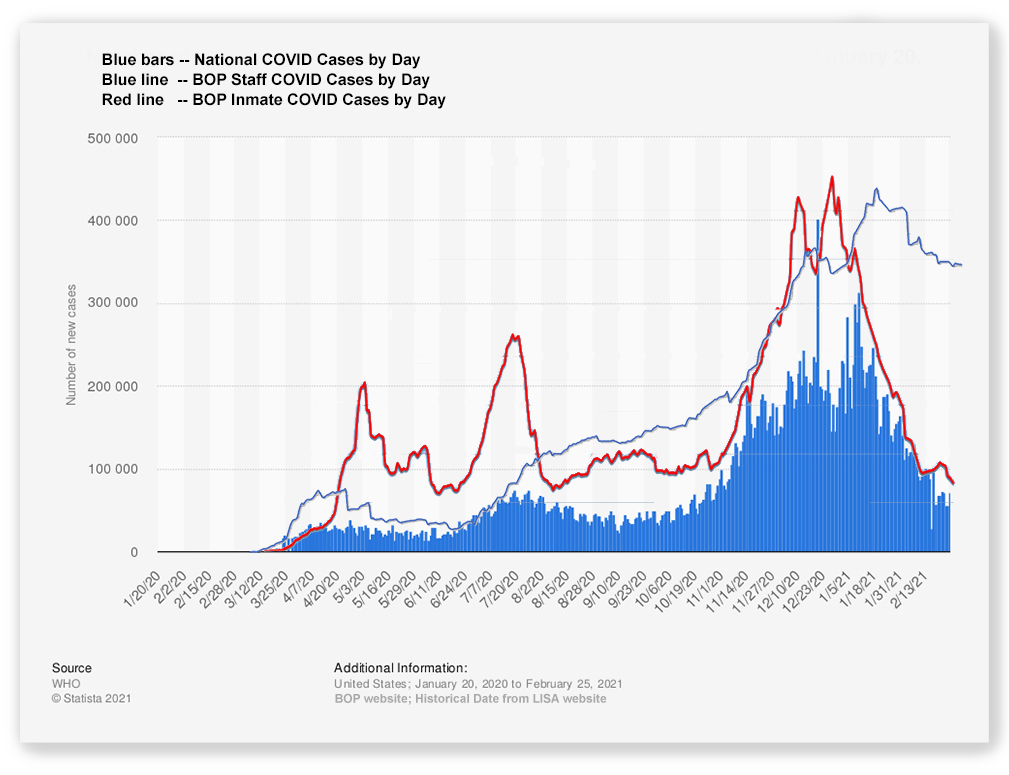
Nevertheless, COVID pays the BOP no heed, continuing on as before. Compared to where the agency was at the beginning of September, yesterday’s numbers represented a 1% increase in inmate virus cases (to 1,911), a 8% increase in BOP staff COVID cases (from 667 to 726), and eight more inmate deaths (from 125 to 133). As of yesterday, coronavirus is active in 119 facilities, 98% of all BOP institutions.

The continuing rise of COVID-19 among staff, and the near universality of COVID-19 among BOP prisons is troubling. Let’s hear it for the BOP’s “action plan…” 

BOPCOVIDCases200928

Of some concern ought to be the two latest deaths, one from FCI Edgefield and the other from FMC Lexington. At Edgefield, Barry Johnson tested positive for COVID-19 on August 16th. He remained asymptomatic and was released from isolation on eleven days later, having be declared “recovered” by the BOP. But 19 days after his recovery, Barry could not walk. Edgefield sent him to the hospital, which sent him back the same day. BOP health services staff declared him “stable” on September 20. Last Wednesday, Barry died of COVID-19.

Tom Krebs tested positive for the virus last May, spending a month in the hospital. He was returned to FMC Lexington in mid-June, when his COVID tests came back negative. He went back and forth to the hospital several times after that for treatment of other conditions, but not of COVID-19. Last Thursday, Tom died in his bed of COVID-19.

COVIDdeath201001In both cases, the inmates had been declared “recovered,” only to die of COVID-19 days or weeks later. Deaths of “recovered” inmates with CDC risk factors is becoming a recurring theme in the BOP, undercutting any thoughts that coronavirus is a one-and-done kind of illness.

The Minneapolis Star-Tribune reported last week that COVID-19 cases are spiking at FCI Waseca and FCI Sandstone. Nearly 300 of Waseca’s 600 inmates have contracted the virus, most in the past few weeks. Nine staff members also have tested positive. “People are scared,” Ryan Burk, president of the union that represents 150 prison staffers, told the Star-Tribune. “The concern is that we’re going to bring it home to our families, our parents and to the community.”

The prison reported its first three COVID-19 cases among inmates in July but had no new cases popped up until a busload of new prisoners arrived in late August, Burk said.

Meanwhile, a third new inmate at USP Hazelton tested positive for COVID-19, workers told the Morgantown Dominion Post.

COVIDheart200720

“This time [the transfer came] from one of our own BOP facilities in Oklahoma. The inmate was not even tested or quarantined before being sent to us. This is nothing short of negligence,” said Richard Heldreth, president of Local 420 of the American Federation of Government Employees, which represents workers at Hazelton.

West Virginia’s two U.S. Senators and First District Congressman, and prison workers, raised new concerns last month about inmate transfers. They argue it is wrong to send untested federal prisoners or prisoners who have been in areas with a high infection rate to states — like West Virginia — that have a low infection rate.

BOP, Inmate Death at FCI Edgefield (September 25, 2020)

BOP, Inmate Death at FMC Lexington (September 25, 2020)

Minneapolis Star-Tribune, COVID-19 cases spike at two federal prisons in Minnesota (September 24, 2020)

Morgantown Dominion Post, Third USP Hazelton inmate transfer tests positive for COVID-19 (September 24, 2020)

– Thomas L. Root

Barr Declines to Celebrate Festivus – Update for September 29, 2020

We post news and comment on federal criminal justice issues, focused primarily on trial and post-conviction matters, legislative initiatives, and sentencing issues.

ATTORNEY GENERAL TO CONGRESS: ‘DROP DEAD’

Jerry Seinfeld popularized the formerly-obscure anti-holiday Festivus, which included “The Airing of Grievances,” an event which immediately follows the festival feast. Attorney General William Barr effectively announced last week that for the House Judiciary Committee, Festivus came early this year.

festivus200929On September 21, the Justice Department declined a congressional oversight committee’s request to hear from various DOJ officials, including BOP Director Michael Carvajal to discuss  the BOP’s COVID-19 response. The reason? The Department has accusing Democrats of having “squandered” their opportunity to get relevant information from Attorney General William Barr this summer by instead using their time to “air grievances” instead of ask questions.

The House Judiciary Committee had asked that Eric S. Dreiband, the head of DOJ’s Civil Rights Division, appear this month to discuss the division, and that Carvajal and Donald Washington, the director of the U.S. Marshals Service, appear for an oversight hearing on Oct. 1.

Barr told Committee Chairman Jerrold Nadler (D-New York) that in July, Barr had been advised that he could be asked about police misconduct, voting rights, the coronavirus and federal prisons, and the civil unrest this spring and summer. But, Barr complained, when he appeared before the committee in July  to discuss those issues, but Democrats were more interested in “scolding and insulting” him.

meantome200929“Having squandered its opportunity to conduct a meaningful oversight hearing with the attorney general,” the letter said, “it remains unclear how further public spectacles with other department officials would now — a mere 14 legislative days since the attorney general’s hearing — advance the committee’s legitimate oversight efforts.”

Democrats and their allies argued after the hearing that Mr. Barr would not have answered their questions in good faith had they let him respond, and that he would have filibustered and wasted the time. Better, they said, to use the time to air their grievances.

DOJ argued to Nadler that this did “preciously little to advance any legitimate interest” because the committee as a result of this tactic learned no new information.

Meanwhile, several members of Congress from Virginia demanded answers from the BOP about prison conditions amid the pandemic. Senators Mark Warner (D) and Tim Kaine (R), along with Rep Morgan Griffith (R) are among those behind a letter sent last Tuesday to Director Carvajal.

The lawmakers are disturbed at reports of a lack of personal protective equipment and diminished quality of life for the incarcerated at USP Lee and FCC Petersburg. The letter said at least one prisoner who tested positive for COVID-19 was transferred to USP Lee, which they fear could cause a coronavirus outbreak in Lee County. The letter also alleges Petersburg inmates are being denied showers and workers continue to be denied lunch breaks.

control200511Carvajal responded Wednesday, claiming in a letter that both FCI Petersburg and USP Lee have “ample supplies of Personal Protective Equipment (PPE)” that includes face coverings, N95 respirators, gowns and gloves, and other sanitation equipment. The letter did not cite specific numbers.

“Indeed, the Bureau has ensured that all institutions nationwide have ample quantities of PPE, and has also established strategic stockpiles in each of our six regions where PPE can be drop-shipped within one day to any institution that might need additional supplies,” Carvajal wrote in the letter, a copy of which was provided to The Progress-Index.

The Virginia delegation lawmakers also wrote to the DOJ inspector general last Friday, asking that the IG include USP Lee and FCC Petersburg in its remote inspection list. “Our offices have received numerous reports from employees and families of incarcerated individuals regarding the spread of COVID-19 and allegations of deteriorating health and safety conditions within both facilities,” the letter said. “These concerns have been raised multiple times by several of our offices with BOP, and we remain deeply troubled by conditions at the two Virginia correctional facilities,” wrote the lawmakers… Many of our offices have received reports that – despite denials from BOP – cases are increasing and inadequate steps have been taken to limit transmission at this facility.”

prisonfood200919

In their letter, the lawmakers also note that they have received disturbing reports of diminished quality of life for inmates because of the COVID-19 lockdowns, including reports of spoiled food and reduced access to recreation, education, and other essential facilities.

The New York Times, Justice Dept. Denies House Panel’s Request for Officials to Appear After Combative Barr Hearing (September 22, 2020)

Letter from DOJ to Chairman Jerrold Nadler (September 21, 2020)

WCYB-TV, Bristol, Virginia, Federal lawmakers demand answers on COVID-19 conditions in Virginia prisons (September 23, 2020)

Petersburg, Virginia, Progress-Index, Director refutes claims by lawmakers about inadequate PPE at Petersburg federal prison (September 23, 2020)

Augusta Free Press, Virginia leaders urge DOJ to include Virginia correctional facilities in remote inspections (September 26, 2020)

– Thomas L. Root