Whither Sentence Reform After Biden Win? – Update for November 9, 2020

We post news and comment on federal criminal justice issues, focused primarily on trial and post-conviction matters, legislative initiatives, and sentencing issues.

SENTENCE REFORM DIDN’T WIN LAST TUESDAY, BUT IT DIDN’T LOSE, EITHER

Reform200819Anyone who read the House of Representatives’ version of The First Step Act (which was watered down substantially to satisfy the Republican-led Senate) or, for that matter, exulted at the House’s HEROES Act last May has some idea what an unbridled Democratic-controlled Congress and White House might do to advance sentence reform. Retroactivity, relaxed compassionate release and elderly offender programs, maybe even some relief for people convicted of violent crimes…

We probably did not get that last week. The Democrats still control the House (but with a smaller majority), and the weekend brought us a Democrat for president-elect. The Senate has 50 Republicans and 48 Democrats, however, with the final two Senate races in Georgia not to be decided until January. If even one of the two eventual winners is Republican (which is likely), the Republicans and Majority Leader Mitch McConnell (R-Kentucky) will still rule the Senate.

But that does not mean we won’t see some criminal justice reform in the next two-year Congress. President-elect Joe Biden spent decades in the Senate, and one of his great strengths is the ability to make deals. “And perhaps most importantly,” Politico reported last week, “Biden and McConnell have a real relationship — forged over the years as Senate colleagues and combatants. McConnell was the only Senate Republican to attend the funeral for Biden’s son Beau in 2015, and he’s largely stayed away from GOP attacks on Biden’s other son, Hunter.”

“They have negotiated big things before. They’ve come through some very hard and even bitter fights over judicial confirmations,” Sen. Chris Coons (D-Del.), a close Biden ally, told Politico in an interview. “But I think they’ve managed to stay friends or have a working, professional relationship even in the hardest of times.”

potscooby180713Voters may be ready for change. The Appeal called last Tuesday “a banner election against the war on drugs,” noting that Oregon voters approved a “groundbreaking initiative to decriminalize drugs” – not just marijuana – making low-level drug possession a civil offense, punishable by a fine, rather than jail time. Four other states made recreational pot legal, raising the number of states permitting it to 15.

President Trump, who was himself a reluctant supporter of the First Step Act, reminded everyone during the campaign that Biden was the sponsor of the Violent Crime Control and Law Enforcement Act of 1993,  (which morphed into the Violent Crime Control and Law Enforcement Act of 1994) – legislation that  critics claim is responsible for the large numbers of federal prisons locked up today. Some suggest that that fact gives the president-elect something to live down. For that matter, the vice-president elect, Kamala Harris, was hardly progressive during her days as a prosecutor. Some are already predicting she will lead the sentencing-law reform efforts of the Biden administration.

In his Sentencing Law and Policy blog, Ohio State University law professor Doug Berman said priorities that ought to be able to garner the bipartisan support of a Republican Senate and Democratic White House include repeal of mandatory minimums, further reduction of the crack/powder sentencing disparity, making all sentencing reforms retroactive, reinvigoration of compassionate release “so that the sick and elderly are transitioned out of incarceration so long as they do not pose a public safety risk,” and removing barriers to reentry.

bipartisanship201109Berman suggests that Politico’s observation that “’McConnell has already succeeded in his longtime goal of reshaping the judiciary’ has me wondering whether Senator McConnell might be less adverse to giving federal judges significantly more sentencing discretion now that he views so many as the product of his own king-making.”

Politico, America’s new power couple: Mitch and Joe (Nov 5)

The Appeal, How Criminal Justice Reform Fared at the Ballot Box on Tuesday (Nov 5)

Sentencing Law and Policy, Can we be hopeful federal leaders will make deals to advance federal criminal justice reforms in the next Congress? (Nov 6)

– Thomas L. Root

‘You May Be Sick, But You’re Still a Bad Guy’ – Update for November 5, 2020

We post news and comment on federal criminal justice issues, focused primarily on trial and post-conviction matters, legislative initiatives, and sentencing issues.

A COUPLE OF NOTES ABOUT COMPASSIONATE RELEASE…

Two decisions last week delivered some handy reminders to people seeking “compassionate release” sentence reductions under 18 USC § 3582(c)(1)(A)(i) that (1) a defendant’s being sick or prone to get sick is not the only concern of the judge; and (2) there are procedural pitfalls for the unwary.

death200330By now, everyone knows that you have to show “extraordinary and compelling” reasons warranting a sentence reduction. These days, such reasons are usually (but not always) that you have medical conditions that puts you at risk for catching COVID (although a variety of reasons from medical to questions of fairness have supported compassionate release in the two years since defendants first got the right to bring the motions themselves in the First Step Act).

But “extraordinary and compelling” is just part of the showing you have to make. The statute also requires that the court consider the “sentencing factors” of 18 USC § 3553(a). And whether the factors favor grant of your motion is almost solely the judge’s call.

The factors are framed in such terms as consideration of “the nature and circumstances of the offense and the history and characteristics of the defendant” and “the need for the sentence to reflect the seriousness of the offense, to promote respect for the law, and to provide just punishment for the offense; to provide adequate deterrence to criminal conduct; to protect the public from further crimes of the defendant; and to provide the defendant with education, training, medical care, or other treatment.” But what it all comes down to whether the judge thinks the defendant has been locked up long enough.

Keith Ruffin filed a motion with his sentencing court for compassionate release, arguing that his heart problems, high blood pressure, high cholesterol, and blood clots, put him more at risk for COVID. These are all pretty good reasons, according to the Centers for Disease Control and Prevention. But his sentencing judge disagreed that his health concerns were “extraordinary and compelling reasons” for relief, and held that even if they were,  the § 3553(a) sentencing factors argued against a sentence reduction.

lockedup201105Last week, the 6th Circuit upheld denial of Keith’s compassionate release motion. It ignored Keith’s solid argument that the district court had erred in holding that because Keith could currently manage his health conditions, his risk factors were not extraordinary and compelling reasons for compassionate release. Instead, the court said, the district court is pretty much all there is in deciding that cutting Keith loose was inconsistent with the 3553(a) factors.

“These ubiquitous factors,” the Circuit said, “consider such things as the characteristics of the defendant, the nature of the offense, and various penological goals, such as the need to promote respect for law and to protect the public. This last requirement confirms an overarching point: The district court has substantial discretion. The statute says that the district court “may” reduce a sentence if it finds the first two requirements met; it does not say that the district court must do so. Even if those conditions are met, therefore, a district court may still deny relief if it finds that the “applicable” 3553(a) factors do not justify it. And in a reduction-of-sentence proceeding, as at sentencing, the district court is best situated to balance the § 3553(a) factors.”

A district court might abuse its discretion, the 6th said, if its denial was based on a purely legal mistake (such as a misreading the extraordinary-and-compelling-reasons requirement) or if it engaged in a substantively unreasonable balancing of the § 3553(a) factors. Here, the district court considered the amount of time served, his somewhat uneven prison record as evidence of the extent of rehabilitation, and the fact Keith had committed his crimes while suffering from the same health concerns he now relied on to justify compassionate release.

In another case, Art Payton’s compassionate release motion was denied by his sentencing court last July 24th. He filed a notice of appeal on August 10th, 17 days later. Last week, the 6th Circuit dismissed his appeal.

timewaits200325The deadline for an appeal in a civil case is at least 30 days after the final order is issued (and can be more in some cases). But a motion under 18 USC § 3582(c)(1)(A)(i) is a continuation of a criminal case, and thus is subject to the 14-day deadline set out in Fed.R.App.P. 4(b)(1).

Rule 4(b)(4) authorizes the district court to extend the time in which a party may appeal for up to 30 days from the end of the fourteen-day appeal period provided in F.R.App.P 4(b)(1)(A). However, the court must find “good cause” or “excusable neglect” for the failure to timely file a notice of appeal.

The Court sent the case back to the district court to determine whether Art’s excuse – that the prison has been “on an institution-wide lockdown and getting copies in this environment is problematic” – should allow him to file a belated appeal.

United States v. Ruffin, Case No. 20-5748, 2020 U.S. App. LEXIS 33689 (6th Cir Oct 26, 2020)

United States v. Payton, Case No 20-1811, 2020 U.S. App. LEXIS 33965 (6th Cir Oct 28, 2020)

– Thomas L. Root

6th Circuit Finds Another Way to Shut the Post-Conviction Door – Update for November 3, 2020

We post news and comment on federal criminal justice issues, focused primarily on trial and post-conviction matters, legislative initiatives, and sentencing issues.

PROCEDURAL WHIPSAW

There’s an old military axiom, correctly or not attributed to World War II General Omar Bradley, that “amateurs talk strategy; professionals talk logistics.” If there is a criminal law version of that, it would be “prisoners talk substance; judges talk procedure.”

quicker200428Time and again, inmates say they want to challenge their conviction or sentence because their lawyers were idiots, the government was corrupt, or the witnesses lied. They often have great arguments and convincing proof. But when I ask, “so how are you going to get back into court after having lost two prior 2255 motions and one 2241 motion, and after 10 years have passed since you were convicted?” I usually just hear silence but occasionally a mumbled, “but man, I have a great case.”

The 6th Circuit last week reminded us just how hard it can be to get a post-conviction argument heard, even a “great case” and even when you think you’ve done everything right.

Johnny Gatewood was convicted in 1999 under the 18 USC § 3559(c), a “three strikes” statute that hammers people convicted of violent crimes who have been convicted of prior violent crimes. One of Johnny’s prior “strikes” was an Arkansas robbery. After the Supreme Court Johnson v. United States decision in 2015 held the Armed Career Criminal Act’s “crime of violence” definition was unconstitutionally vague, Johnny filed a 2255 motion arguing his prior robbery was no longer a crime of violence.

IACappeal201103The government countered that Johnny had procedurally defaulted on his argument, because he didn’t raise his Arkansas robbery claim in his direct appeal, 15 years before Johnson was decided. Generally, if a claim could have been raised on the appeal from the original conviction (generally called “direct appeal”) but was not, it is considered procedurally defaulted. A procedurally defaulted claim  cannot be raised later in a 2255 motion, for the very good and efficient reason that a direct appeal is where you appeal. A post-conviction motion is not an assistant deputy appeal, but instead, it is reserved for issues that could not have been raised on appeal because they were not around at the time, or because one needs to develop an evidentiary record.

To excuse a procedural default, a defendant must show “cause,” a good reason for not raising the claim on appeal, and must show he or she was prejudiced by the error alleged in the claim.

One way to show “cause” is to argue that claim is so novel that its legal basis “was not reasonably available” on appeal. That’s what Johnny argued.

Last week, the 6th Circuit turned Johnny down. The Circuit held the vagueness issue the Supreme Court decided in the 2015 Johnson case had in fact been raised back in 1997 in several other cases. This meant, the Circuit reasoned, that the argument was available to Johnny’s counsel at the time if he had only cared to use it.

Johnny agreed the issue was being raised in some cases, but everyone else who had raised it got hammered. Thus, he argued, raising the vagueness claim would have been futile, “foreclosed,” he said, “by ‘a near-unanimous body of lower court authority’.”

magic8ball201103The 6th Circuit didn’t care. Instead, it ruled that such futility cannot be excuse a procedural default, “at least where the source of the ‘perceived futility’ is adverse state or lower court precedent.” Instead, the Circuit said, “unless the Supreme Court has decisively foreclosed an argument, declarations of its futility are premature.” In other words, you must be sure to beat your head against the wall (and waste everyone’s time) by raising every conceivable issue that has been raised by every other defendant in your position, in the vain hope that a decade or two hence, the Supreme Court might hear that issue and decide it favorably.

In short, you’re procedurally sandbagged: if your lawyer didn’t see Johnson coming 15 years before the decision was handed down, tough luck. No court would say the attorney was ineffective because he or she couldn’t foretell the future. But if your Magic 8 Ball didn’t tell you to raise an issue that was still 15 years away, the 6th said, it’s your fault.

The Circuit admitted that two other circuits have gone the other way on the issue, and held that lower court rulings do create futility. Maybe the circuit split means that the Supreme Court will settle the question. Until then, it is futile to argue futility.

Gatewood v. United States, Case No. 19-6297, 2020 U.S. App. LEXIS 34200 (6th Cir Oct 29, 2020)

– Thomas L. Root

ACLU Brings Second FCC Butner Suit Over COVID – Update for November 2, 2020

We post news and comment on federal criminal justice issues, focused primarily on trial and post-conviction matters, legislative initiatives, and sentencing issues.

ACLU CLAIMS BOP COVID TESTING STRATEGY IS ‘INCOHERENT’

A coalition of civil rights groups led by the American Civil Liberties Union filed a class-action lawsuit against the Federal Bureau of Prisons last week over its handling of COVID-19 outbreaks at FCC Butner. The suit seeks an injunction to protect Butner prisoners, especially “vulnerable people… who, because of their medical conditions and/or advanced age, are at higher risk of severe injury or death from COVID-19.”

suit201102The lawsuit alleges that the BOP has “tested too few people at Butner, too infrequently, and too late,” and fails “to separate people who tested positive from those who tested negative for several days after receiving the test results.” The suit claims screening for symptoms has also been sporadic and ineffectual. The claims include allegations of inadequate cleaning and disinfecting procedures to adequately protect the men housed at Butner. As well, the allegations take aim at BOP management of CARES Act home confinement and compassionate release:

Despite direction from the US Attorney General months ago to expeditiously consider medically vulnerable people for home confinement or other release, Defendants continue to oppose motions for compassionate release made by medically vulnerable people, and they have failed to order furloughs or transfers to home confinement with sufficient speed and in sufficient numbers.

FCC Butner, located about 25 miles north of Raleigh, North Carolina, holds nearly 4,000 male inmates, with five facilities: a medical center, a minimum-security camp, a low-security prison and two medium-security facilities.

The civil rights groups filed suit against the BOP last spring, alleging that officials have failed to protect the Butner population. In early June, a federal judge sided with the BOP, agreeing it had “made reasonable efforts” to control the virus.

In another suit, Lompoc prison officials were ordered by a Los Angeles federal judge three weeks ago to expedite the evaluation of more than 120 inmates deemed eligible for home confinement due to their risks of COVID-19, although only 44 have been released since July. Five inmates brought the federal class-action lawsuit last May, seeking alternative confinement after a COVID outbreak at Lompoc infected more than 1,000 inmates and staff. At least four inmates died as a result of the outbreak.

The October 8 order directed the BOP to confirm that all 129 eligible inmates were released to home confinement.

expert160905The BOP had argued there is no specified timeline to release inmates to home confinement and that such release requires a three-judge panel, according to the response included in the Oct. 8 filing. Meanwhile, last Friday the agency blasted a court-ordered report by Dr. Homer Venters, countering with its own expert who concluded that “FCC Lompoc has acted reasonably and diligently in dealing with the COVID-19 pandemic based on the CDC guidance and BOP guidance applicable at the time, including the comprehensive BOP COVID-19 Pandemic Response Plan.” The expert complained that Dr. Venters “consistently bases his critical conclusions on unverified statements that were made to him by unidentified inmates, despite the harsh judicial criticism that he recently received in an Eastern District of New York COVID-19 case for following that unreliable methodology.”

The BOP’s COVID numbers – 1,766 sick inmates as of last Friday – are down 7% from a week ago. But ominously, the number of sick staff continues to climb, hitting 896 on Friday. A month ago, there were 724 sick staff. Nationwide, 75% of all prison and jail staff cases since March have recovered. But only 60% of BOP staff cases have done so, suggesting that BOP staff COVID cases are increasing at a much faster rate than the rest of the country. This is critical, because the staff is the primary means by which COVID is being brought into facilities.

Circumstances surrounding the latest inmate COVID-19 death, Joe McDuffie at El Reno, are concerning. Joe tested negative for COVID on Oct 13. After that, according to the BOP, “he received daily symptom checks and did not express any symptoms associated with COVID-19. On Friday, October 23, 2020, institution staff found Mr. McDuffie unresponsive.” He died later that day.

The BOP says 46% of the inmate population has been tested for COVID. One out of four of those 69,500 tests has been positive.

Hallinan v. Scarantino, Case No 5:20-ct-3333 (ED NC, filed Oct 26, 2020)

The Appeal, Coronavirus in Jails and Prisons (October 28, 2020)

BOP, Inmate Death at El Reno (October 29, 2020)

Santa Maria Times, Lompoc prison officials release 44 inmates to home confinement; more than 120 deemed eligible (October 30, 2020)

Respondents’ Statement, Torres v. Milusnic, Case No 20cv4450 (CD California, October 30, 2020)

– Thomas L. Root
State Can’t Make You Say “Uncle” – Update for October 30, 2020

We post news and comment on federal criminal justice issues, focused primarily on trial and post-conviction matters, legislative initiatives, and sentencing issues.

BRANDED

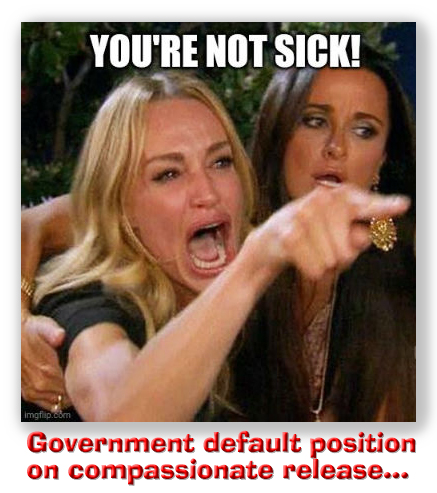
Remember when you were a kid, and the neighborhood bully would knock you down and push your face into the mud or twist your arm or something until you cried “Uncle”? That is what is known as “compelled speech.

Nine states require sex offenders to carry driver’s licenses emblazoned with some variation of the words “SEX OFFENDER” in bright capital letters across the top of the card. It’s like making the former defendant say “Uncle!” for the rest of his life, every time he writes a check, votes or goes to the doctor (all places we regularly have to show our DLs, at least in Ohio).

brand201031In Louisiana, Tazin Hill had had enough crying “Uncle.” He altered his license to hide the sex-offender label, and he was charged with a felony for doing so. Last week, the Louisiana Supreme Court ruled that making sex offenders carry the labeled licenses violated the 1st Amendment by compelling them to say something the government ordered them to say, known as “compelled speech.” In this case, the label “SEX OFFENDER” was what the license holders were compelled to say.

The court held the identification card, branded with the words “sex offender” and the person’s “name, picture, address, and other identifying characteristics… is that “readily associated with him” and must be routinely displayed to others. Thus, “the branded identification card is compelled speech, and it is a content-based regulation of speech that consequently must pass strict scrutiny. While the state certainly has a compelling interest in protecting the public and enabling law enforcement to identify a person as a sex offender, Louisiana has not adopted the least restrictive means of doing so. A symbol, code, or a letter designation would inform law enforcement that they are dealing with a sex offender and thereby reduce the unnecessary disclosure to others during everyday tasks… As Louisiana has not used the least restrictive means of advancing its otherwise compelling interest, the branded identification requirement is unconstitutional.”

A state could as easily require people to carry licenses labeled “convicted felon” or “annoying neighbor” or even “leaves toilet seat up.” The mischief a state government can cause once people are being labeled is vast, making this and other similar decisions applicable to everyone, not just people convicted of sex offenses.

Louisiana v Hill, Case No 20-0323, 2020 LA LEXIS 2512 (LA Sup Ct Oct 20, 2020)

– Thomas L. Root

“If At First You Don’t Succeed…” Doesn’t Work in Habeas Corpus – Update for October 28, 2020

We post news and comment on federal criminal justice issues, focused primarily on trial and post-conviction matters, legislative initiatives, and sentencing issues.

WHEN TOO MUCH IS MORE THAN ENOUGH

oneshot201029You pretty much only get one shot trying to convince your judge you were wrongly convicted in a habeas corpus motion under 28 USC § 2255 (except for a few circumstances not relevant here). But how about the “saving clause” in § 2255(e) which lets an inmate use another route to file habeas corpus when a § 2255 petition “is inadequate or ineffective to test the legality of detention?”

Roberto Beras, convicted of using his check cashing/money transfer business to launder millions in drug proceeds, figured § 2255(e) meant he could file a § 2241 petition for habeas corpus if the § 2255 no longer worked (because it had already been filed and denied in the 2nd Circuit, and two requests to file successive § 2255s denied as well).

Roberto figured the Supreme Court’s 2008 Cuellar v. United States decision was his ticket home. So even while his § 2255 motion was pending in New York, Roberto was filing § 2241 habeas corpus motions wherever he happened to be. In two petitions filed in U.S. District Court for the Northern District of Ohio, he claimed he was innocent under the Cuellar statutory interpretation decision, but the Northern District court disagreed, finding Roberto would have been found guilty even under Cuellar. When Roberto was transferred to a facility in the Western District of Louisiana, he filed the same claim again.

Last week, the 5th Circuit threw out Roberto’s latest § 2241 petition as an “abuse of the writ.”

The § 2255(e) “saving clause” permits an inmate to file a 28 USC § 2241 petition based on new interpretations of federal statutes – like Cuellar – when the claim was previously “foreclosed by circuit law at the time when it should have been raised” and when the “retroactively applicable decision establishes that the petitioner may have been convicted of a nonexistent offense.” But, the Circuit said, that wasn’t the issue here. Instead, Roberto’s § 2241 should be dismissed as “an abuse of the writ of habeas corpus.”

2255(e)filings201029“Abuse of the writ” is a common-law based “body of equitable principles informed and controlled by historical usage, statutory developments, and judicial decisions.” Under 28 USC § 2244(a), the Circuit held, it can dismiss a successive habeas application as an “abuse of the writ” where the movant raises a claim in a subsequent petition that either was raised or could have been raised in an earlier petition.

The 5th said Roberto “has filed claims in at least four circuits and for nearly twenty years. To allow him to repeat the same claim – heard and denied by another circuit – would be to condone forum-shopping… Perpetual disrespect for the finality of convictions disparages the entire criminal justice system.”

Beras v. Johnson, Case No. 18-30684, 2020 U.S. App. LEXIS 33058 (5th Cir Oct 20, 2020)

– Thomas L. Root

Ain’t Over Till It’s Over, DC Circuit Rules on 2255 – Update for October 27, 2020

We post news and comment on federal criminal justice issues, focused primarily on trial and post-conviction matters, legislative initiatives, and sentencing issues.

WAS IT OVER WHEN THE GERMANS BOMBED PEARL HARBOR?

“Hell, no!” Animal House’s Bluto Blutarsky shouted. He could have been arguing about the mess a district court made of deciding only part of Floyd Clark’s  motion.

bluto201027Floyd was convicted of kidnapping and beating a man. After hewas convicted, the victim recanted his testimony identifying Floyd as his assailant. Floyd filed a 28 USC § 2255 motion claiming ineffective assistance of counsel at trial, denial of his due process rights (based on the recantation) and a claim that his 18 USC § 924(c) use-of-a-gun conviction should be thrown out, based on Johnson v. United States.

The district court denied all of Floyd’s issues except for the § 924(c) claim. The district judge deferred judgment on the gun argument, saying his opinion “resolves three of Mr. Clark’s claims but leaves the § 2255 motion open until the Court is able to resolve his fourth claim,” because United States v. Davis was pending in the Supreme Court. Floyd appealed the denied claims.

Last week, the DC Circuit held that it lacked jurisdiction to hear the appeal because Floyd’s district court denial was not final. “Because it leaves Clark’s 924(c) claim pending,” the Circuit ruled, “the district court’s order appears nonfinal on its face. A judgment is typically final only when the whole case is complete… We consider an order ‘final’ if it ‘terminates’ the case and leaves nothing for the court but [to] execute the judgment. This final-judgment rule — derived from the common law and codified since the First Congress — has long promoted efficient judicial administration by avoiding the delay and expense of piecemeal appeals.”

It isn’t uncommon for district court § 2255 denials to omit deciding a claim, especially where the inmate’s petition raises a lot of grounds. This decision suggests prisoners should be assertive when a district court opinion purports to resolve a § 2255 petition without deciding every issues raised.

United States v Clark, Case No 19-3040, 2020 U.S. App. LEXIS 32644 (DC Cir Oct 16, 2020)

– Thomas L. Root

ACLU Sues to Get the Real COVID Story from BOP – Update for October 26, 2020

We post news and comment on federal criminal justice issues, focused primarily on trial and post-conviction matters, legislative initiatives, and sentencing issues.

ACLU SUES BOP OVER COVID RECORDS

The American Civil Liberties Union sued the Federal Bureau of Prisons and Centers for Disease Control and Prevention last week in District of Columbia federal court, demanding information about the government’s response to the risk of COVID-19 in detention facilities it has been seeking since last April.

OPRFOIA180814The ACLU said it “seeks to uncover critical information about the federal government’s response — and lack thereof — to the coronavirus in detention facilities across the country. Based on the limited data available, it appears that the BOP has failed to prevent the spread of the coronavirus in its facilities.” It first sought BOP records relating to COVID-19 in April and sought DOJ and CDC records in July, according to the lawsuit. While the agencies acknowledged the requests, they have yet to provide the ACLU with the documents.

“Although the BOP, HHS, and other offices granted the ACLU’s request for expedited processing, that was a dead letter,” the complaint alleges, “Defendants have failed to produce any records. Meanwhile, the pandemic continues to threaten the people in federal prisons and the communities where they operate.”

That is hardly surprising. Anyone with experience seeking records under the Freedom of Information Act knows that, primarily because the Act exacts scant penalties from federal agencies that violate it. If the choice is between dedicating resources to complying with FOIA and finally turning documents over on the courthouse steps months later, guess which option the agencies will select?

Complaint, ACLU v BOP, Case No 1:20cv3031 (D.D.C., filed Oct 21, 2020)

Vice News, The Trump Administration Is Getting Sued Over COVID Exploding in Prisons (Oct 21)

Indiana Public Media, ACLU Sues Bureau of Prisons Over COVID-19 Record Keeping (Oct 22)

– Thomas L. Root

Adding Family Insult to Injury, BOP-style – Update for October 22, 2020

We post news and comment on federal criminal justice issues, focused primarily on trial and post-conviction matters, legislative initiatives, and sentencing issues.

COVID NUMBER NOT REASSURING… NEITHER ARE BOP DEATH NOTIFICATION PROTOCOLS

As of yesterday, the BOP was reporting 1,750 federal inmate COVID-19 cases in BOP and private prisons (up 6% from last week), 802 staff cases (up 9%), COVID still present in 118 out of 122 facilities, and one more death, for a total of 136. With 44% of all inmates tested, one out of four tests is still coming back positive.

covid19-201022

Just as Wisconsin is now spiking in new COVID cases, FCI Oxford led BOP facilities as of Oct 16th with 409 inmate cases, followed by El Reno (108 cases), Petersburg Medium (89), Tallahassee (88), Big Spring (79), Pekin (74), Leavenworth (73) and Oklahoma City (61). Sixteen more BOP joints have between 10 and 48 cases.

Three days before, the BOP announced the death of a Big Springs inmate, and noted that the facility had 398 inmate COVID cases. Over 300 inmates apparently recovered in merely three days.

The family of Tommy Sisk, the Petersburg inmate who died of COVID October 4, blasted the BOP last week for not notifying them of his death. They found out that their loved one had died when a family friend called them last Tuesday to say he had seen the death reported in a newspaper. That was a full week after the BOP issued a press release about Tommy’s passing.

tears201022Tommy’s brother Wayne Sisk said a representative from FCI Petersburg told him his sister was listed and tried to call her. “What freed up that information,” he asked about the Oct 6 BOP press release, “but they couldn’t free up the information to tell his family and notify them before the newspaper. During the times that we live in now, with COVID and injustices and everything… tell me how much injustice is that?”

As of last weekend, the BOP still had not told the family the location of the body. “They should’ve contacted our family and showed us some respect. We don’t have our brother. We don’t have anything,” Sisk said. “We don’t have our family member.” Perhaps the BOP intends to have Mr. Sisk’s body serve the remainder of his sentence before burial.

The BOP told a Richmond TV station, ““While for privacy reasons we cannot speak about specific circumstances surrounding a particular inmate, we can tell you protocols were followed in the case you reference.”

Of that I have no doubt. Perhaps the protocols should be leavened with a little human decency.

San Angelo Live, Nearly Half of Big Spring Prison Inmates Have COVID-19 (Oct 13)

WFXR-TV, Brother of inmate who died of COVID-19 demands answers: ‘We found out from a news article’ (October 17, 2020)

– Thomas L. Root

3rd Circuit Says Nothing Extraordinary in Supervised Release Early Termination – Update for October 20, 2020

We post news and comment on federal criminal justice issues, focused primarily on trial and post-conviction matters, legislative initiatives, and sentencing issues.

WE MAY HAVE MISREAD THAT, THE COURT SAYS…

supervisedrelease180713Supervised release is a period after a federal inmate completes his or her prison sentence – a lot like parole and kind of like probation – during he or she is subject to a series of reporting conditions and limitations imposed by the court. A U.S. Probation Officer supervises the former inmate, and holds the power to seek revocation of supervised release and return to prison under evidentiary and procedural standards that are rather lax, to say the least.

Fortunately for the former inmate, under 18 USC § 3583(e), someone on supervised release can get that supervision term ended early. The statute requires the court, in deciding whether to terminate early, to apply the 18 USC § 3553(a) sentencing factors. No surprise there, but many courts have been buying into the government’s argument that just being good while on supervision isn’t enough: the movant has to show something extraordinary or exceptional justifying saving the government money and the former inmate aggravation.

supervisedleash181107Aggravation? Well, yes. The former inmate must make monthly filings detailing his or her finances, purchases and employment. He or she cannot leave the federal district without permission of the Probation Officer. Often, he or she cannot change jobs without the Probation Officer’s OK, and woe betide anyone who has an unreported contact with someone who has a criminal record (that would be one out of three adult Americans). Oh, yes, the Probation Officer can search the former inmate’s home at any time without a warrant.

supervisedrevoked181106Nationally, the rate of violations that result in a hearing before the judge (where return to prison is a possibility) is about 17%.  The prevalence of supervision violations, however, varies considerably among the federal judicial districts. In a July 2020 U.S. Sentencing Commission study, more than a third of individuals on supervision risked reimprisonment in violation hearings in the Southern District of California (42.1%), District of Minnesota (37.4%), Western District of Missouri (34.3%), District of Arizona (33.7%), and District of New Mexico (33.4%). In contrast, violations accounted for less than five percent of individuals on supervision in the Districts of Connecticut (4.5%) and Maryland (4.7%).

No wonder people on supervised release want to “get off paper,” as they put it. But few can meet the “extraordinary or exceptional reason” for early termination standard many courts impose.

Last week, the 3rd Circuit traced the twisted history of this “extraordinary or exceptional reason” requirement, and found no support for the standard.

The 3rd acknowledged that its prior non-precedential decisions had required “something exceptional or extraordinary” to warrant early termination, relying on the Second Circuit’s United States v. Lussier decision. “But this was a misreading of Lussier,” the 3rd Circuit said, in a rare acknowledgement that it had previously been wrong:

As the Second Circuit explained more recently, ‘Lussier does not require new or in order to modify conditions of release, but simply recognizes that changed circumstances may in some instances justify a modification’. In other words, extraordinary circumstances may be sufficient to justify early termination of a term of supervised release, but they are not necessary for such termination. We think that generally, early termination of supervised release under § 3583(e)(1) will be proper only when the sentencing judge is satisfied that new or unforeseen circumstances warrant it. That is because, if a sentence was ‘sufficient, but not greater than necessary’ when first pronounced, we would expect that something will have changed in the interim that would justify an early end to a term of supervised release. But we disavow any suggestion that new or unforeseen circumstances must be shown.”

Got that? “Extraordinary or exceptional reasons” no longer necessarily apply, except when they generally do.

money160118Each person being supervised costs the government about $4,400.00, according to the Administrative Office of United States Courts. You’d think that saving that money might be a factor for more courts, especially where there is no discernible benefit to the supervisor or supervisee by continued oversight.  

But then, what’s $4,400 a year, even when multiplied by the 133,000 people under supervision?  Answer: a half billion a year, a mere flyspeck to Uncle Sam.

United States v. Melvin, 2020 U.S. App. LEXIS 32683 (3rd Cir. October 16, 2020)

– Thomas L. Root