All posts by lisa-legalinfo

Havis: the 6th Circuit Gift That Keeps on Giving – Update for September 9, 2020

We post news and comment on federal criminal justice issues, focused primarily on trial and post-conviction matters, legislative initiatives, and sentencing issues.

HAVIS MEANS CONSPIRACY DOESN’T COUNT FOR CAREER OFFENDER, EITHER

You remember United States v. Havis, the 2019 en banc decision in which the 6th Circuit held that the Guidelines’ definition of ‘controlled substance offense’ did not include attempt crimes, meaning that a defendant’s prior conviction for attempted drug distribution could not be counted to make him a career criminal. (If you don’t recall it, refresh yourself here).

snakes200909Eddie Valesquez made a deal over the phone with a buddy of his to kill a troublesome witness. (Note: Contrary to popular culture’s suggestions to the contrary, murdering a witness is both illegal and a bad idea). In fact, Eddie found out that the mere planning such a murder problematical: he was convicted of an 18 USC § 1958 conspiracy to commit murder for hire.

Eddie’s prior drug conspiracy conviction was used at sentencing to make him a career offender under the Sentencing Guidelines, which raised his sentencing range to stratospheric heights, resulting in a 262-month term in prison.

Last week, the 6th Circuit reversed the sentence. It ruled that “although the specific facts of Havis involved an attempt crime, its reasoning applies with equal force to other inchoate crimes not listed in the text of § 4B1.2(b). Accordingly, we have acknowledged that, in light of Havis, conspiracy to distribute controlled substances is not a “controlled substances offense” under § 4B1.2(b).”

United States v. Cordero, Case No. 19-3543, 2020 U.S. App. LEXIS 28128 (6th Cir. Sep 3, 2020)

– Thomas L. Root

Visits Are Back… Sort Of – Update for September 8, 2020

We post news and comment on federal criminal justice issues, focused primarily on trial and post-conviction matters, legislative initiatives, and sentencing issues.

JAIL-STYLE VISITS ARE BETTER THAN NO VISITS AT ALL

The Bureau of Prisons announced last week that visitation at federal prisons will resume by October 3rd, but that all visits will be county jail-style: non-contact, and social distancing between inmates and visitors will be enforced with plexiglass or similar barriers, or physical distancing. Inmates in quarantine or isolation will not allowed visits.

jailvisit200908The BOP plan will permit every inmate up to two visits a month. Visitors will be symptom-screened and temperature-checked, and both inmate and visitor must wear masks. Tables, chairs and other “high-touch” surfaces will be cleaned following the completion of visiting each day, the BOP said.

Kevin Ring, president of FAMM, said the BOP’s action represents a “first step” for anxious families who have gone months without seeing loved ones. But he said the proposed restrictions, particularly the prohibition on physical contact, will be “difficult.”

Leaders of BOP employees’ unions think the visits will be difficult, too, but for different reasons. They question the timing of the decision, inasmuch as it’s being instituted just as flu season begins and – experts predict – the coronavirus pandemic may worsen again. Some suggest the BOP is opening “Pandora’s box.”

In order to ensure inmates all get at least two visits per month, visitation days could occur seven days per week, according to Aaron McGlothin, the union leader for employees at FCI Mendota, California. That means more risks for exposure for staff, he said.

pandora200908“I’m seeing a lot of anger,” said Joe Rojas, the Southeast regional vice president for the national prison union. “We’re coming to the flu season, there’s still a pandemic and then they’re putting up visiting.” Rojas said he knew visitation was important to inmates, and he does not want to remain closed to visits. But “this is important for keeping them safe,” he said.

McGlothin said the BOP should try other methods first, such as allowing inmates to use Zoom or Skype to video chat.

At the same time, questions are now being asked about the longer-term psychological effects of pandemic restrictions on prisoners. Elizabeth Kelley, an attorney and author who has written two books on mental illness and prison, told Forbes magazine that she is concerned that prolonged lack of visitation, along with other COVID-19 limitations, may contribute to a spate of mental illnesses among inmates. “Someone who does not have diagnosable mental illness before going to prison,” Kelley said, “may very well develop one during the pandemic because of profound anxiety, depression and later PTSD caused by the trauma associated with the COVID-19 conditions in federal prison.”

BOP Press Release, Bureau to Resume Social Visitation (September 1, 2020)

USA Today, Federal prisons resume visitation in October, 7 months after COVID-19 forced suspension (September 1, 2020)

Impact 2020, Federal prisons are lifting COVID-19 visitor restrictions — and workers are worried (September 3, 2020)

Forbes, Mental Fatigue, Anxiety and Hopelessness, Welcome to Today’s American Federal Prison Experience (August 28, 2020)

– Thomas L. Root

Procedure Matters on a 2241 Motion, 4th Circuit Says – Update for September 4, 2020

We post news and comment on federal criminal justice issues, focused primarily on trial and post-conviction matters, legislative initiatives, and sentencing issues.

JUST BECAUSE A 2255 WON’T WORK DOESN’T MEAN A 2241 WILL

A military aphorism credited to more than one general (the oldest of whom was General Omar Bradley) isamateurs talk strategy, but professionals talk logistics.” A post-conviction adjunct might be, “clients talk substantive issues, but lawyers talk procedure.”

nuns200903What we mean is in post-conviction proceedings on federal convictions, the best case on the planet (imagine a newly-discovered busload of nuns who all swear they saw you helping your mother weed her garden 50 miles from the back that was being robbed at the same time) does not help you if you have no procedural course for getting back into court. And the procedural snares of 28 USC § 2255 are many and varied.

Lee Farkas was charged with various white-collar fraud offenses, and the government got court permission to freeze all of his considerable assets before trial. The purported reason is to be sure there is enough money to pay criminal forfeiture and restitution if the government wins, but the real reason, of course, is that it hamstrings the defendant, making it impossible to afford a defense that might level the playing field with the U.S. Attorney’s Office.

And it worked (for awhile). Lee had a lot of trouble affording the lawyers he needed. The result showed it: Lee was convicted, and got 360 months in prison.

A few years later, after Lee had filed and lost a 28 USC § 2255 motion, the Supreme Court ruled in Luis v. United States that freezing all of a defendant’s innocent assets violated the 6th Amendment. Based on that decision, the 4th Circuit ruled that criminal forfeiture statutes could not reach assets that might be substituted for forfeitable assets if the defendant lost.

Based on these decisions, Lee filed a 28 USC § 2241 petition for habeas corpus, arguing that under the 28 USC § 2255(e) savings clause, he could use the § 2241 to demand a new trial, because the seizure had violated the 6th Amendment and statute. Last week, the 4th Circuit shot him down.

"Actual innocence" is important for procedural reasons as well as substantive ones...
“Actual innocence” is important for procedural reasons as well as substantive ones…

The Circuit followed its three-part test defining the “limited circumstances” under which § 2255 will be “inadequate to test the legality of the prisoner’s detention.” First, at the time of conviction, the settled law of the Circuit or the Supreme Court must have established the conviction’s legality. Second, after the prisoner’s direct appeal and previous § 2255 motion, the substantive law must have changed so that the conduct of which the prisoner was convicted is no longer criminal or the sentence is illegally extended. And third, the prisoner cannot satisfy the gatekeeping provisions of § 2255(h) because the new rule is not one of constitutional law.

The 4th said a constitutional issue can never be heard on a § 2241 motion, because a § 2255 motion is intended for adjudicating such claims. What’s more, Lee was not claiming that he was actually innocent of the offense or sentence, but rather that taking his money was a fundamental defect in the proceeding. That is not good enough for a § 2241, the Circuit said.

Farkas v. Warden, Case No. 19-6347, 2020 U.S. App. LEXIS 27233 (4th Cir. Aug. 26, 2020)

– Thomas L. Root

Judging the Whole Person in Fair Sentencing Act Proceeding – Update for September 3, 2020

We post news and comment on federal criminal justice issues, focused primarily on trial and post-conviction matters, legislative initiatives, and sentencing issues.

CRACK FSA RESENTENCING MUST CONSIDER MOVANT’S PRISON RECORD

Shawn Williams was sentenced in 2005 to 262 months in prison for a crack cocaine trafficking offense. Five years later, Congress finally bowed to Sentencing Commission pressure and public opinion, passing the Fair Sentencing Act (FSA).  That Act changed the draconian penalties for crack cocaine (which had considered 10 grams of crack to be the equivalent of one kilogram of powder cocaine) to bring them more in line with other drug offenses.

crack-coke200804Not that the change did much for Shawn. In order to satisfy some of the more puritanical members of the Senate – such as the unlamented former Sen. Jefferson Beauregard Sessions III –  the changes made by the FSA were not retroactive. This meant that people like Shawn were serving sentences that were grossly disproportionate to sentences being imposed on people with the same drug quantity who were being sentenced after the FSA went into effect.

The First Step Act fixed that eight years later, making the FSA retroactive. Now, Shawn could apply to his sentencing court for relief, because the Act – when applied to Shawn –  to reduced his statutory minimum sentence to 10 years from 20. However, for reasons not relevant to this blog, the FSA did not reduce his advisory Guidelines sentencing range.

Shawn nevertheless filed a motion to reduce his sentence under the retroactive FSA, arguing, among other things, that his good conduct in prison warranted a reduced sentence. He noted that he had not failed a single drug test, that he had helped 13 other prisoners earn their GEDs, and that he had held the same job for over eight years. The district court denied his motion, however, explaining that it had considered the 18 USC § 3553(a) sentencing factors (including Shawn’s prior drug convictions, and concluded that the 262-month sentence “remains sufficient and necessary to protect the public from future crimes of the defendant, to provide just punishment, and to provide deterrence.” The court did not address Shawn’s prison record.

A sidebar here: Back in 2011, the Supreme Court ruled in Pepper v. United States that “consistent with the principle that the punishment should fit the offender and not merely the crime… a sentencing judge [may] exercise a wide discretion in the sources and types of evidence used to assist him in determining the kind and extent of punishment to be imposed within limits fixed by law, particularly the fullest information possible concerning the defendant’s life and characteristics.” In other words, Pepper held, when a case comes back for resentencing – often years after the first sentencing, during which the defendant was doing time in prison – the sentencing court may consider the defendant’s prison record (such as good conduct and completion of educational or rehabilitative programs) in the resentencing.

goodboy200903But Pepper did not say that the district court was required to do so.  The issue Shawn raised on appeal was  whether the sentencing judge was at least required to acknowledge post-sentencing conduct raised by the defendant, and explain how that did or did not factor into the resentencing decision.

Last week, the 6th Circuit reversed the sentencing court, sending the FSA resentencing back to the district court. The 6th held that while the district court “need not respond to every sentencing argument… the record as a whole must indicate the reasoning behind the court’s sentencing decision.” Here, the district court did not mention Shawn’s prison conduct, and “that conduct by definition occurred after his initial sentencing in 2005, which means that neither the record for his initial sentence nor for his First Step Act motion provides us any indication of the district court’s reasoning as to that motion.”

The case was remanded “for further consideration of Williams’ good-conduct argument.”

United States v. Williams, 2020 U.S. App. LEXIS 27219 (6th Cir. Aug 26, 2020)

– Thomas L. Root

A Little Arithmetic Lesson Here – Update for September 2, 2020

We post news and comment on federal criminal justice issues, focused primarily on trial and post-conviction matters, legislative initiatives, and sentencing issues.

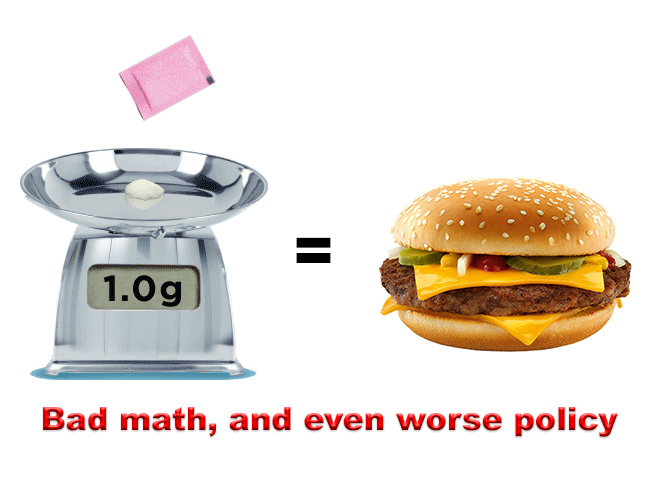
“TWO THIRDS” DOES NOT EQUAL 65%, AND 65% EQUALS NOTHING

I have had a lot of questions asked recently about the new line item in the Federal Bureau of Prison’s Sentencing Monitoring Computation Data form. The line lists the date on which an inmate will have completed 66.67% of his or her sentence.

SMCD200902The Sentencing Monitoring Computation Data form is the calculation used by the BOP to determine when an inmate is to be released. A lot of what is on the form is a mystery, but not the two-thirds date. That date, simply enough, is used by the BOP for those 60-year old plus nonviolent inmates who may qualify for the elderly offender home detention program under 34 USC § 60541(g).

false200902I have had nearly as many questions about the “65% Law,” some legislative initiative that supposedly increases good conduct time from 15% of an image’s sentence to 35%.

The “two thirds” line item has nothing to do with the “65% Law.” In fact, the only things that have to do with the “65% Law” are fairies and unicorns, because they are all just as real. Which is to say, not real at all.

THERE IS NO 65% LAW. PERIOD. The HEROE Act passed by the House, as full of goodies as it is for prisoners (mandatory placement of vulnerable and 50+ people in home confinement, for example), includes no change in good time. And HEROES stands scant chance of passing the Senate.

unicorn200902

There may be some sentencing benefits in a Senate-House compromise COVID-19 bill, as some are urging, but a change in good-time will not be one of them.

HEROES Act, HR 6800 (passed House May 25, 2020)

New York Daily News, Demand criminal justice reform in the next COVID relief bill (August 28, 2020)

– Thomas L. Root

4th Circuit Hands Down a Primer on Brady – Update for September 1, 2020

We post news and comment on federal criminal justice issues, focused primarily on trial and post-conviction matters, legislative initiatives, and sentencing issues.

A “VERY BRADY” EN BANC DECISION ISSUES FROM RICHMOND

The 4th Circuit last week released an en banc decision reversing denial of a federal habeas corpus filed by a North Carolina state prisoner who has spent 44 years in prison for a rape he in all likelihood had nothing to do with. The 93-page decision (with an additional 28-page dissent) is a virtual Brady primer, analyzing almost every element in a successful Brady undisclosed-evidence claim.

Pat Brady - Roy Rogers' comical sidekick back in the 1950s – had nothing to do with Brady v. Maryland, which is deadly serious for many defendants.
Pat Brady – Roy Rogers’ comical sidekick back in the 1950s – had nothing to do with Brady v. Maryland, which is deadly serious for many defendants.

In 1976, Ronnie Long – a black man – was accused of raping a 56-year old white woman in her home. Her description of the assailant changed over time, and she identified Ronnie by sitting in a courtroom watching a parade of defendants appear in front of a judge. Not a shred of physical evidence connected Ronnie to the offense, and his alibi – he had been at a family function some distance away – seemed pretty solid.

Actually, saying that no physical evidence connected him to the scene is an understatement. The state had gathered all sorts of physical evidence at the scene, including 43 separate fingerprints and all sorts of fiber. The crime lab report found that not even one of 43 fingerprints matched the defendant’s prints, and none of the fiber connected Ronnie to the scene.

Sounds like a slam-dunk, right? Well, maybe on a level playing field. But in Ronnie’s case, the defense never saw the crime lab report, because the police falsely testified no such report existed and (needless to say) the prosecutor never produced it. Furthermore, detectives failed to disclose they had lost the only DNA sample taken from the victim. So Ronnie was convicted.

You remember Brady v. Maryland, right? Brady evidence is evidence in the hands of the prosecution that is favorable to the defendant. Such evidence must be disclosed. If you need a refresher, read this.

The 4th Circuit’s 9-6 decision rejects a state court holding that a prisoner must demonstrate “by a preponderance of the evidence,” that the withheld evidence would have changed the result at trial. The proper standard, the Court said, is a “reasonable probability of a different result,” a relaxed standard that makes much more sense, inasmuch as the defendant was wronged in the first place by having the evidence hidden from him.

The decision also rips the state court’s holding that Brady evidence must be “impeachment or exculpatory evidence” in order to be “favorable” to the accused.  Evidence may not itself impeach a prosecution witness or exculpate a defendant, but may still lead to other yet-undiscovered evidence that is impeaching or exculpatory, or – as in Ronnie’s case – simply be one piece of a cumulative mosaic that makes his guilt questionable.

The State argued that undisclosed evidence that police testified falsely about the crime lab report was not Brady material, because the cops’ testimony might have been explained as merely a “mistake, misunderstanding, or the report itself could be incorrect.” But, as the Circuit said, that has nothing to do with whether the undisclosed evidence was Brady material. While the state’s hypothetical explanations for the false testimony “may have been useful arguments for the State to make to the jury at trial, the rule is not that only unassailable evidence must be disclosed to the defense. Rather, it is clearly established federal law that any favorable and material evidence must be disclosed.”

brady200901The State said the undisclosed crime lab report – which concluded that nothing tied Ronnie to the rape – was merely cumulative, because defense counsel argued to the jury in closing that no forensic evidence tied the defendant to the crime. So the fact the jury never heard about the report, the state argued, hardly mattered. The Circuit rejected this stinker of an argument, holding that (1) everyone knows that the attorneys’ arguments are not evidence; (2) a government report showing that none of a big pile of physical evidence tied a defendant to a crime is much more persuasive to a jury than anything a defendant’s lawyer says in an argument; (3) and the cumulative effect on the jury of negative test after negative test after negative test is undeniable.

Finally, the Court noted, the very existence of evidence the police denied having had in their possession would have badly undermined the credibility of the detective witnesses.

This decision should be read by anyone with a Brady issue.

Long v. Hooks, Case No 18-6980, 2020 U.S. App. LEXIS 27138 (4th Cir. Aug 24, 2020)

– Thomas L. Root

A Depressing COVID “New Normal” At BOP – Update for August 31, 2020

We post news and comment on federal criminal justice issues, focused primarily on trial and post-conviction matters, legislative initiatives, and sentencing issues.

COVID-19 SLEEPERS

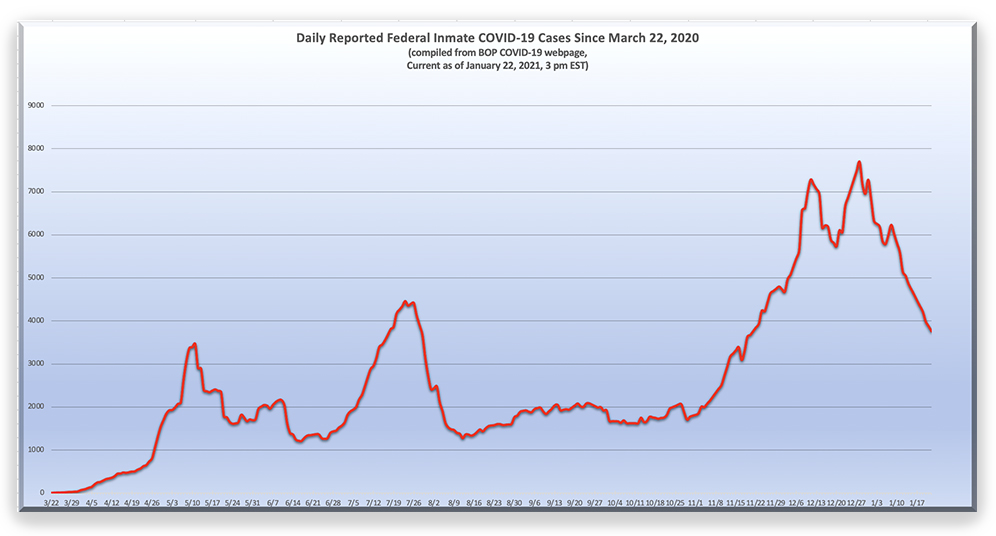
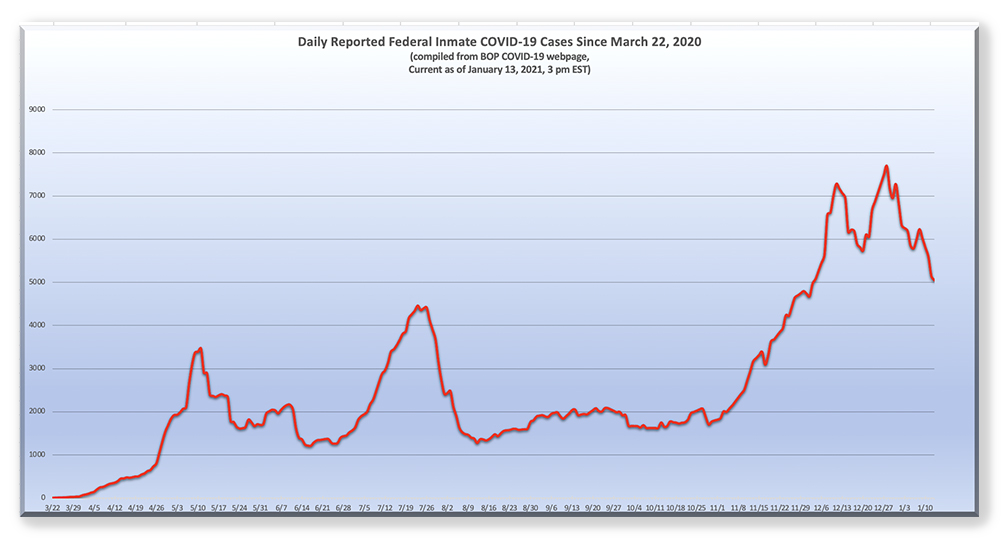
Is this the new normal? A baseline of 1,500+ COVID-19 inmates, flareups at places where COVID hasn’t gained a foothold before?

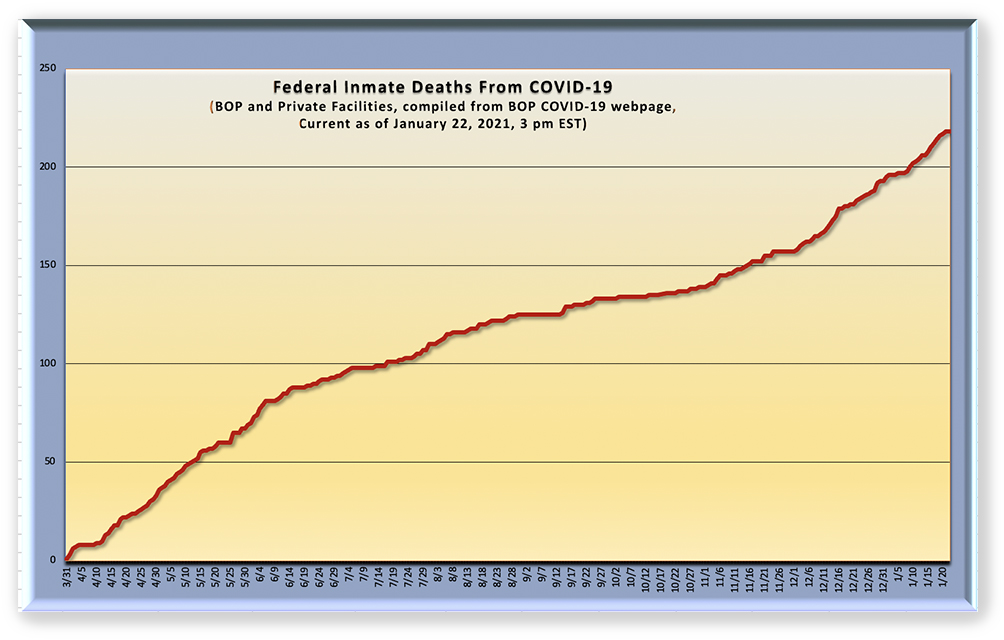
As of last night, 1,717 inmates have COVID, up 9% from last week. Sick staff numbered 661, up 5% from a week ago. Two more inmates died, bringing the total to 124, and COVID-19 was present in 112 prisons, 90% of the Bureau of Prisons’ facilities.

BOPStaff200831

Hidden in the data are two disturbing “sleepers.” First, the BOP cannot control COVID-19 among staff. Since hitting a low of 133 sick staffers on June 26, the number of BOP employees COVID-19 has steadily climbed, and is now up 500% in two months.

Perhaps more concerning, only a few days after Hong Kong researchers reported that someone who had recovered from COVID-19 caught it again, a study to appear in The Lancet reported last Thursday that a 25-year old Nevada man had become reinfected as well. He first tested positive for COVID-19 in mid-April, then recovered, but got a more severe case in late May.

Then there is Marie Neba, an inmate at FMC Carswell. She tested positive for COVID-19 on July 3rd. “On Tuesday, August 4, 2020,” according to a BOP press release, “Ms. Neba was considered recovered by medical staff as determined by CDC guidelines.” But eight days later, she was hospitalized coronavirus. She died last Tuesday.

reinfection200831This is not a first. Last May 10th, FCI Terminal Island declared inmate Adrian Solarzano, who tested positive for COVID-19 in April, to be “recovered following the completion of isolation and presenting with no symptoms… in accordance with [CDC] guidelines.” Five days later, according to a BOP press release, Mr. Solarzano was hospitalized for the COVID-19 he no longer had. He died on May 24th.

These cases suggest one of three things, none of them good. Either (1) reinfection of recovered COVID-19 patients has been going on far longer than scientists know; or (2) the CDC recovery guidelines are defective; or (3) the BOP is too quick to declare people cured.

Meanwhile, unrest among BOP staff and inmates continues. The Washington Post reported last Monday that Kareen Troitino, president of the Miami correctional officers’ union, “acknowledged that prisoners and guards don’t always find themselves on the same team; but in a pandemic, everyone’s fates are intertwined. ‘All of us are trying to survive,’ Troitino said. ‘Your health affects me, and vice versa. Inmates and staff, we do not feel safe’.”

control200511Troitino told the Post that “the virus has spread so efficiently through federal facilities because of inconsistent protocols that are almost always reactive rather than preventive… prisoners were only getting tested if they had a fever — a testing threshold that hobbled the early months of the U.S. coronavirus response on the outside, before it spread to prisons.”

“The strain of the virus we got in the facility shows no fever,” Troitino told the Post. “Most inmates complain of extreme low energy, a headache, can’t get out of bed, vomiting, diarrhea.”

As of last night, the BOP has administered enough tests that – if only one to an inmate– would only cover a third of all BOP prisoners. One out of those four tests is coming back positive or COVID.

Latest BOP COVID-19 hotspots, in addition to all of the ones mentioned before, include FDC Seatac and FMC Rochester.

Japan Times, First documented coronavirus reinfection reported in Hong Kong (August 25, 2020)

NBC, COVID-19 reinfection reported in Nevada patient, researchers say (August 28, 2020)

The Lancet (preprint), Genomic Evidence for a Case of Reinfection with SARS-CoV-2 (August 27, 2020)

BOP Press Release, Inmate Death at FMC Carswell (August 26, 2020)

BOP Press Release, Inmate Death at Terminal Island (May 27)

Washington Post, Prisoners and guards agree about federal coronavirus response: ‘We do not feel safe’ (Aug 24)

– Thomas L. Root

Prisons Not Testing Right For COVID, CDC Says – Update for August 26, 2020

We post news and comment on federal criminal justice issues, focused primarily on trial and post-conviction matters, legislative initiatives, and sentencing issues.

BOP LOSING AT WHACK-A-MOLE

whack200602Not quite three months ago, Bureau of Prisons Director Michael Carvajal confidently told the Senate Judiciary Committee, “at this point, we have more recoveries than new infections. And I believe that this shows that we are now flattening the curve.”

What is being “flattened” is the BOP’s response to the pandemic.

Twelve weeks later – after inmates spiked July 26 at 4,413 – the BOP’s numbers have stopped falling, and in fact increased slightly. As of Tuesday night, 1,597 inmates were sick, up 8% from last week. Sick staff numbered 638, up 11% from a week ago, four more inmates died, bringing the total to 122, and COVID-19 was present in 109 facilities, 89% of BOP facilities.

Complaints continued last week about the BOP’s handing of the pandemic continue, mostly from staff. When the correctional officer union president at USP Thomson (Illinois) found out he was COVID-19 positive, the 20th BOP staffer there to come down with the virus, he told ABC news he had to find an independent testing site on his own. “Testing for staff isn’t available at the prison but they test inmates for COVID-19 at the prison,” ABC quoted him as saying. “Staff also can’t get tested due to being forced to work double 16-hour shifts almost on a daily basis.”

BOPCOVID200826

Meanwhile, the Centers for Disease Control and Prevention issued a study last week that looked at 15 prisons, including five unidentified BOP facilities. The CDC found that mass testing at the facilities “suggests that symptom-based testing underestimates the number of COVID-19 cases in these settings. Mass testing resulted in a median 12.1-fold increase in the number of known infections among incarcerated or detained persons in these facilities, which had previously used symptom-based testing strategies only.” Symptom-based testing, of course, is the preferred BOP approach, in which only inmates with symptoms get tested.

Additionally, the study found that “in two federal prisons, all persons who had tested negative during mass testing events and had subsequently been quarantined as close contacts of persons testing positive were retested after 7 days. At retesting, 20.5% of persons in BOP prison 2 and 26.8% in BOP prison 3 had positive test results.”

As of last night, the BOP had still only conducted enough tests to cover 31% of the BOP population, with 26% of those tests coming back positive.

The failure of symptoms-only testing is illustrated in the whack-a-mole problems the BOP faces. Besides USP Thomson, the BOP is facing outbreaks at FCC Petersburg (Virginia), FDC San Diego and FCI Victorville in California, FCC Coleman (Florida), and FCI Manchester (Kentucky). Numbers are finally dropping at FCI Seagoville and FCI Beaumont (both Texas).

Marketwatch ran a piece last week on the cost to taxpayers of COVID-19 in prisons, noting that “the public understands the urgent need for action. A national survey found that 66% of likely voters, including 59% of those identifying as ‘very conservative,’ believe elected officials should consider measures to reduce overcrowding in prisons and jails. Survey research over many years has shown that most Americans believe the U.S. locks up too many people.”

poorcorresp200826Meanwhile, U.S. Senator Marco Rubio (R-Florida) is not happy, and last week, he let Attorney General William Barr know it. The Miami Herald reported that “nearly nine months after demanding an investigation of allegations of rampant sexual abuse at Coleman Federal Correctional Complex exposed in a Miami Herald story, Sen. Marco Rubio says he still hasn’t gotten a ‘substantive response’. And he is not happy — especially since there is new cause for concern with COVID-19.”

On Thursday, Rubio wrote to Attorney General William Barr to express his “dissatisfaction that the DOJ has not sufficiently responded to inquiries I have made in regard to FCI Coleman” about the allegations. As well, he complained that “my office continues to receive numerous complaints that FCI Coleman staff are not following the CDC’s Guidance for Correctional and Detention Facilities, which — among other measures — recommends BOP officers and inmates wear masks when in close proximity with others. Most concerning, my office has been made aware that facility management may have ordered staff to return to work despite testing positive for COVID-19. I have already requested the BOP take immediate action to address this allegation, and I look forward to the outcome of its investigation.”

ABC News, ‘Who is going to man the prison if everyone tests positive?’ Corrections officer union warns of dual threat facing federal prisons (August 19, 2020)

CDC, Mass Testing for SARS-CoV-2 in 16 Prisons and Jails — Six Jurisdictions, United States, April–May 2020 (August 21, 2020)

Marketwatch, U.S. taxpayers already pay a high price to support America’s giant prison population. Now COVID-19 is costing them even more (August 20, 2020)

Miami Herald, Rubio demands answers from Barr on sexual abuse, COVID response at Florida prison (August 20, 2020)

– Thomas L. Root

During Vacation Season, The Courts Stay Busy – Update for August 24, 2020

We post news and comment on federal criminal justice issues, focused primarily on trial and post-conviction matters, legislative initiatives, and sentencing issues.

10TH CIRCUIT RULES ON FAIR SENTENCING ACT PARAMETERS; 4TH DOUBLES DOWN ON REHAIF

The 10th Circuit last week handed down a consolidated appeal from two defendants seeking sentence reductions under the 2018 First Step Act’s grant of retroactivity for the 2010 Fair Sentencing Act (“FSA“), ruling that a prisoner is eligible to seek relief under the retroactive 2010 FSA if he or she was convicted of and sentenced for a violation of a federal criminal statute, the statutory penalties for which were modified by section 2 or 3 of the 2010 FSA, prior to August 3, 2010.

crackpowder191216

Those penalties, for those who came in late, are mandatory minimum sentences for offenses involving a certain amount of crack cocaine. Even since the crack cocaine panic of the 1980s that resulted in the Anti Drug Abuse Act of 1988, the amount of crack that would trigger a mandatory minimum sentence was one one-hundredth (1/100th) the amount of powder. In other words, that white frat boy in suburbia selling a kilo of cocaine powder got the same sentence as a black kid on a ghetto corner hawking 10 grams worth of rocks.

The FSA changed the ratio from 1:100 to 1:18 (why it did not become 1:1 is a story for another time), but its provisions were not retroactive. That meant that the crack defendant sentenced on August 2, 2010, got slammed, while the guy whose lawyer read the papers (and saw the new law about to be enacted) delayed his guy’s sentencing and got him a whopping break).

First Step finally made FSA retroactive, permitting people with pre-2010 sentences to seek sentence modifications.

One of the people seeking modification was appellants was Arthur Mannie, who complained that the district court should not have denied his FSA motion without a hearing. The Circuit disagreed, holding that a court’s jurisdiction to hear an FSA motion arises from 18 USC § 3582(c)(1)(B). Neither the First Step Act nor  § 3582(c)(1)(B) entitles FSA movants to a hearing, the 10th held, an FSA resentencing being fundamentally different from an initial sentencing.

The other FSA movant, Mike Maytubby, had multiple counts of conviction, only one of which was for crack. He had concurrent 151-month sentences on all of them. Because the FSA let the court adjust the term only on his crack sentence – which would not have affected the non-crack sentences – the 10th said “any reduction in the sentence of Knott’s covered offense would not actually reduce the length of his incarceration. Hence, the court cannot redress Knotts’s injury, and Knotts’s FSA motion does not present a live controversy.”

guns170111Meanwhile, the 4th Circuit has doubled down on its United States v. Gary holding that a Rehaif error is structural. In Rehaif, the Supreme Court held a year ago that in a prosecution for unlawful possession of a gun under 18 USC § 922(g), the government had to prove a defendant knew he was in the class of people the statute prohibited from possessing a gun. Early this year, the 4th Circuit held in Gary that failure to advise a defendant of that element was a structural error, that is, it was so basic a flaw that the plea could be undone even without proving the failure prejudiced the defendant.

Gary is a real outlier. Every other circuit that has considered it requires a defendant to show that if he had been advised properly, he would have gone to trial. In the 4th, Gary holds that the mistake alone is enough for a defendant to carry the day.

The 4th Circuit denied the government rehearing on Gary, but there is little doubt it will go to the Supreme Court. Meanwhile, last week, the Circuit held that even where a defendant was indicted and went to trial, a Rehaif error requires that the 922(g) verdict be set aside (even where it is pretty clear that the defendant would have been found guilty if there had been no error).

The Circuit held that the indictment’s omission of the element and the judge’s failure to instruct the jury on the missing element were both plain error, no matter that the defendant was probably guilty anyway. “Were this Court to affirm this conviction simply to avoid burdening the criminal justice system, we would diminish the public faith in the integrity of our courts. What gives people confidence in our justice system is not that we merely get things right… Rather, it is that we live in a system that upholds the rule of law even when it is inconvenient to do so.”

marijuanahell190918While rejecting the 4th Circuit’s “structural error” approach, the 7th Circuit last week decided that Blair Cook was entitled to a new trial. Blair, a pot fan, was convicted of a 922(g) offense for carrying a gun while being an unlawful drug user. The Circuit set aside the verdict, because the jury had not been given the Rehaif instruction. “The error in this case relieved the government of the burden of proving an essential element of offense beyond a reasonable doubt,” the 7th said. “The error was not so fundamental that it qualifies as structural. Nonetheless, it was a serious error, in the sense that it both omitted a key element of the government’s case and deprived Cook of the right to have the jury assess the sufficiency of that evidence as to that element.”

United States v. Mannie, 2020 U.S. App. LEXIS 26192 (10th Cir Aug 18, 2020)

United States v. Medley, 2020 U.S. App. LEXIS 26721 (4th Cir. Aug 21, 2020)

United States v. Cook, 2020 U.S. App. LEXIS 26023 (7th Cir. Aug 17, 2020)

– Thomas L. Root

Trump (Finally) Rolls Out Sentencing Commission Slate, Albeit Unbalanced One – Update for August 20, 2020

We post news and comment on federal criminal justice issues, focused primarily on trial and post-conviction matters, legislative initiatives, and sentencing issues.

TRUMP FINALLY DECIDES TO NOMINATE NEW SENTENCING COMMISSION MEMBERS, AND FAMM SHOUTS “NOT SO FAST!”

The U.S. Sentencing Commission has lacked a full slate of commissioners for the entirety of Trump Administration, and has not even had a quorum since the First Step Act passed in December 2018. That is why no sentencing guideline has been amended since the November 2018 amendments went into force.

Last week, the White House announced nominees for the vacant Commissioner slots (which persons must be approved by the Senate). They include Judge K. Michael Moore of Florida, to be chairman; Judge Claria Horn Boom of Kentucky; Judge Henry E. Hudson of Virginia; John G. Malcolm, Vice President for the Institute for Constitutional Government and the Director of the Meese Center for Legal & Judicial Studies at the Heritage Foundation; and Judge Luis Felipe Restrepo of Pennsylvania.

HudsonA170811The bad news is that four of the five nominees have been Assistant U.S. Attorneys, and that three of those four are sitting judges as well. The worse news is that Judge Henry Hudson, who has the well-deserved nickname of “Hang-‘em-High Henry,” is one of the nominees. A lonely piece of good news is that Judge Luis Restrepo comes from a public defender background.

How’s that for balance?

hudsonB170811“The administration has put forth a slate that is all white, mostly male, and lacking in diverse experiences or backgrounds,”  Sakira Cook, director of the justice reform program at the Leadership Conference on Civil and Human Rights, told NPR. “It is critically important that the Sentencing Commission reflects the diversity of background, experience, and expertise that would make the work of the Commission most effective. It is also important to note that at least two of the candidates have records or expressed views on sentencing issues that raise serious concerns.”

FAMM (formerly Families Against Mandatory Minimums) wrote to Senate Judiciary Chairman Sen. Lindsey Graham (R-South Carolina), and ranking minority member Sen. Dianne Feinstein (D-California) last week to urge them to refrain from acting on the nominations until next year:

There are less than 20 legislative days before the election. That is not nearly enough time to give nominees to this important agency the thorough examination and consideration they deserve – and that the people who will be subject to the Commission’s decisions deserve.

FAMM noted specifically that one of the Sentencing Commission’s urgent priorities will be to “address a federal prison system that has been overwhelmed by the spread of COVID-19. The deaths to date of 112 federal prisoners and at least one staff member compel serious reflection about various aspects of the federal prison system, including sentence lengths and early release mechanisms, over which the commission has some authority.”

privateprison200820(Note: The BOP hit 120 dead inmates a couple of days ago, being 114 in BOP custody and another six federal prisoners in private prisons. But no one seems want to count the people who are guests of the for-profits. That is perhaps a topic to cover for another day.)

Of course, what FAMM is really saying is that if the Senate waits until January, there may be a new President and a much different slate of commissioner nominees to consider.

The White House, President Donald J. Trump Announces Intent to Nominate and Appoint Individuals to Key Administration Posts (August 12, 2020)

FAMM, Letter to Sens. Lindsey Graham and Dianne Feinstein (August 14, 2020)

NPR, Concern Mounts Over Possible Trump Picks For Influential Crime Panel (August 19, 2020)

– Thomas L. Root