All posts by lisa-legalinfo

The Ugly Gets Uglier in Coleman Sex Assault Suit – Update for September 24, 2020

We post news and comment on federal criminal justice issues, focused primarily on trial and post-conviction matters, legislative initiatives, and sentencing issues.

FLORIDA NEWSPAPER REPORTS COLEMAN GUARDS WHO SEXUALLY ABUSED FEMALE INMATES WERE NOT PROSECUTED

Hey, all you male predators: Want a job where you can freely sexually assault women? And retire with fat benefits (and a nonprosecution agreement)? Have we got an opportunity for you at the BOP!

inconceivable170817In a story published last week, The Tampa Bay Times reported that the government admitted in a court filing that six of eight COs named in a civil suit by 15 current and former female inmates at Coleman engaged in sexual misconduct, but were not prosecuted, but rather allowed to resign or retire. Some are still getting federal retirement benefits.

The suit contends the Coleman prison was a “sanctuary” for abusers. In some cases, the women allege, the abuse lasted for years. The women, who range in age from 26 to 59, were threatened if they didn’t comply, the suit maintains.

Tampa Bay Times, No consequences after Florida officers admit to sexually abusing inmates, lawsuit says (September 17, 2020)

– Thomas L. Root

Sentencing Sanity the 3rd, 7th Circuits – Update for September 23, 2020

We post news and comment on federal criminal justice issues, focused primarily on trial and post-conviction matters, legislative initiatives, and sentencing issues.

THREE FIRST STEP/FAIR SENTENCING DECISIONS OF NOTE

Last week was a good one for the First Step Act.

Sentencestack170404Hector Uriante was convicted of running with a gang that kidnapped and robbed drug dealers, including several 18 USC 924(c) counts that got stacked in the pre-First Step days. On the first 924(c) count, he got seven years for brandishing, but the brandishing was found by the judge, not the jury. On direct appeal, the Circuit remanded the case for resentencing because of Alleyne v. United States‘ holding that the jury had to find facts supporting an enhanced mandatory minimum.

The district court resentenced him last year, after First Step passed, but the judge still stacked his 924(c) counts, giving him 25 years for the second one. The district judge held that since Hector was first sentenced before First Step passed, the Act’s ban on stacking 924(c) convictions did not apply.

Last week, the 7th Circuit reversed in an en banc opinion that rejects the 3rd Circuit decision in United States v. Hodge. Because the prior sentence had been vacated, the 7th said, it was a “nullity.” A vacatur “wipes the slate clean,” meaning that at the time First Step passed, Harry was convicted and awaiting sentencing. Congress wrote First Step’s changes in 924(c) stacking to “apply to any offense that was committed before the date of enactment of this Act, if a sentence for the offense has not been imposed as of such date of enactment,” making no distinction between defendants who had never been sentenced and those whose sentence had been vacated fully and who were awaiting the imposition of a new sentence. “In this way,” the Circuit explained, “Congress stanched, to the degree that it could without overturning valid and settled sentences, the mortmain effect of sentencing policies that it considered no longer in the Nation’s best interest. It ensured, moreover, all persons awaiting sentencing on the effective date of the Act would be treated equally, a value long cherished in our law.”

So Hector’s good fortune in getting his sentence overturned under Alleyne, which appears to have saved him two years, in fact reduces his sentence by a full 22 years (two years off the 7-year “brandishing” sentence and a reduction of the second 924(c) sentence from 25 to five years).

conspiracy160606The 7th Circuit last week held that the same rule benefitted Rashod Bethany. Rashod was sentenced for a crack conspiracy in 2013, but later won a § 2255 motion on the grounds his lawyer erred in letting the court use the wrong edition of the Guidelines. He was resentenced after First Step passed, but his sentencing court would not let him benefit from the lower drug mandatory minimums passed in § 401 of the Act.

The 7th said that same rule applied. The § 2255 motion vacated his sentence, so Rashod was in the same position as a defendant who had never been sentenced. The Circuit remanded the case to district cout for a ruling of whether the sentence would have changed if lower mandatory minimums had been applied.

Finally, in the 3rd Circuit, James Easter had filed for a resentencing under First Step § 404, the section that made the 2010 Fair Sentencing Act retroactive. The court decided that James was eligible for a reduction, but denied him one because, the judge concluded, James’s Guidelines range did not change even if the FSA was applied.

James appealed, arguing that a district court had to consider the sentencing factors in 18 USC § 3553(a), not just a mechanistic look at the guidelines. Last week, the 3rd Circuit agreed.

While other circuits generally agree that minimum, a district court may consider the § 3553(a) factors, the 3rd said a judge must do so. “Section 404(b) uses the word ‘impose’ twice, and the first instance clearly refers to the act of imposing the original sentence.” The Circuit ruled. “Because Congress used the same word, we can infer that it conceived of the district court’s role as being the same when it imposes an initial sentence and when it imposes a sentence under the First Step Act. As the text of § 3553(a) makes clear, district courts look to the factors set forth there whenever they impose a sentence on a defendant.”

The 3rd Circuit joins the 4th and 6th Circuits in adopting the rule.

United States v. Uriarte, 2020 U.S. App. LEXIS 29234 (7th Cir. Sept 15, 2020)
United States v. Bethany, 2020 U.S. App. LEXIS 29246 (7th Cir. Sept 15, 2020)
United States v. Easter, 2020 U.S. App. LEXIS 29243 (3d Cir. Sept 15, 2020)

– Thomas L. Root

Is BOP COVID-19 Climbing Again – Update for September 22, 2020

We post news and comment on federal criminal justice issues, focused primarily on trial and post-conviction matters, legislative initiatives, and sentencing issues.

COVID-19: NEW REASONS TO BE VERY AFRAID

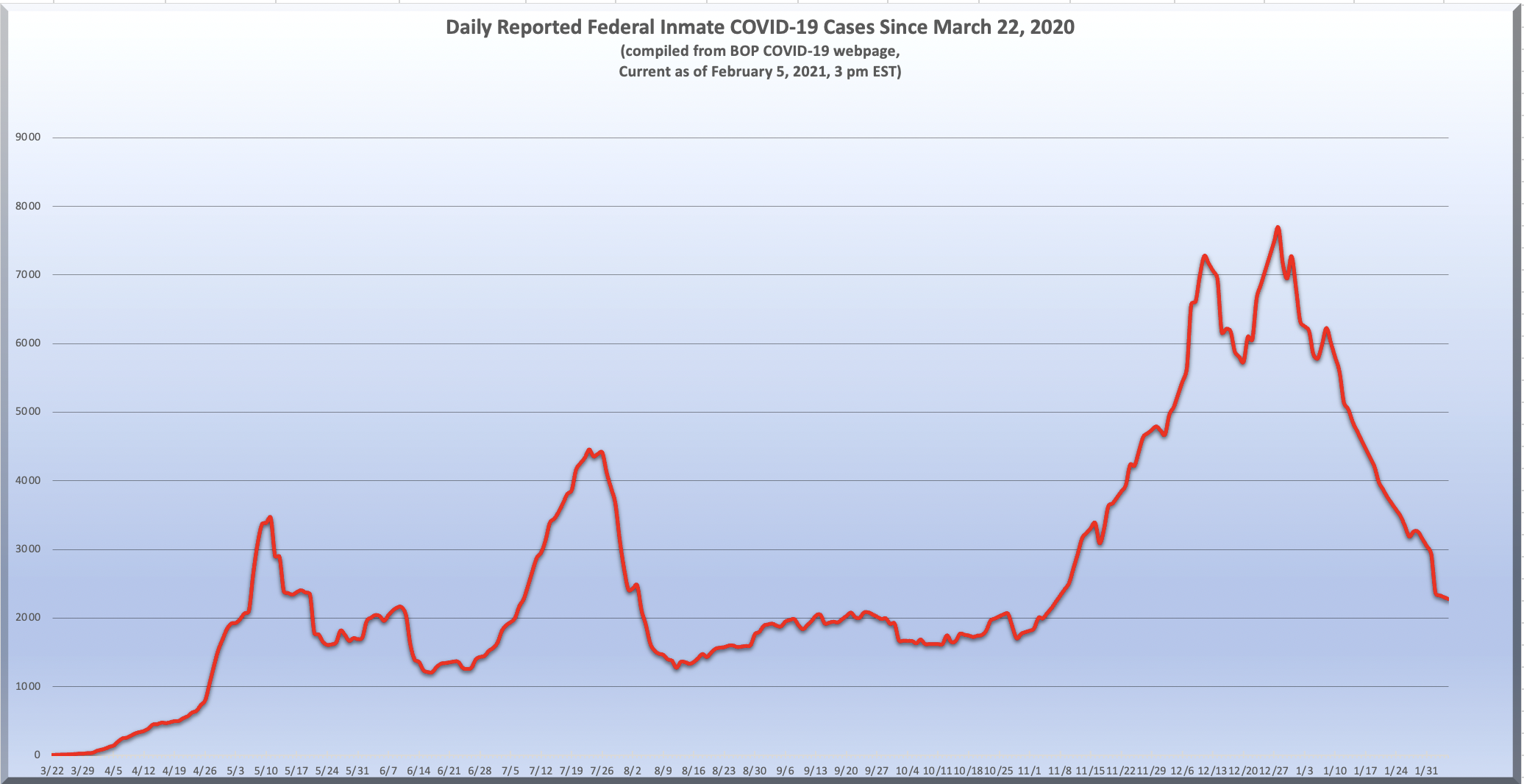
The Federal Bureau of Prisons once again gained nothing last week in its fight against COVID-19. The number of inmates sick with the hovered all week between 1,915 and 2,045, and last night, hit 2,076. The number of sick staff started climbing again, too, from 631 a week ago to 669. The number of BOP facilities with the virus climbed as well to 117, a whopping 95% of all institutions. Ominously, the number of dead inmates jumped from 125 to 130.

The increase is consistent with concerns that the nation is in for another coronavirus increase in the coming days. And just in time for the fall spike.

The BOP has done enough COVID-19 tests as of last night to test 37% of the BOP inmate population. The percentage of tests that are positive remains 25%.

BOPInmatcases

One of last week’s deaths is especially troubling. On June 1, FCI Butner inmate Ricky Miller tested positive for COVID-19. A month later, he was tested again and declared to be recovered. Two months later, on Sept 9, Ricky developed shortness of breath and leg edema, and was hospitalized. The hospital found that he had COVID-19. He died a day later.

The timing suggests that Ricky caught COVID twice within a few months. If that is so, then the idea that having the disease once confers immunity against getting it again is cast into doubt. And that could mean that COVID-19 will remain a risk until a vaccine is available for inmates.

This comes as new research released last week suggests that the coronavirus can sometimes hijack brain cells, using the cells’ internal machinery to copy itself.

The research, which has not yet been published in a peer-reviewed journal, provides evidence that the virus can directly infect neurons. Although the coronavirus has been linked to various forms of brain damage, from deadly inflammation to brain diseases known as encephalopathies, all of which can cause confusion, brain fog and delirium, there was little evidence of the virus itself invading brain tissue until now.

imageScientists at Oak Ridge National Labs in Tennessee announced last week that supercomputer analysis of COVID-19 suggests that the virus triggers a “bradykinin” storm in the body. Bradykinin is a chemical that regulates blood pressure. The researchers found that some people with the coronavirus may produce it in extreme excess, according to Business Insider, throwing major systems — including respiratory, gastrointestinal, and neurological pathways — off balance.

death200330The theory aligns with researchers’ growing view of the coronavirus as a vascular disease instead of a respiratory one. Research has shown that COVID-19 can lead to blood clots, leaky capillaries, and inflamed blood vessels — which is why some patients may experience heart damage or stroke. “We were really scratching our heads for a while, how does this disease have this darn broad set of symptoms across lots of different organ systems?” Dr. Daniel Jacobson, the lead researcher behind the supercomputer study, told Business Insider. “As we looked at the effects of bradykinin, our model was that this virus can affect several different types of tissues, several different organs.”

Meanwhile, the BOP faces new eruptions of COVID-19 at USP Leavenworth, as well as continuing crises at Big Spring, San Diego, Coleman, Waseca and Manchester.

BOP, Inmate Death at FCI Butner (Low) (Sept 17)

Livescience, The new coronavirus can infect brain cells, study finds (Sept 13)

Business Insider, A supercomputer found a promising theory about why COVID-19 cases go downhill fast. It even explains the bizarre range of symptoms (Sept 13) 

Hays, Kansas, Post, Leavenworth tops all federal prisons in COVID-19 cases (Sept 15)

– Thomas L. Root

Ginsburg’s Death Leaves Washington in Turmoil, Stimulus in Doubt – Update for September 21, 2020

We post news and comment on federal criminal justice issues, focused primarily on trial and post-conviction matters, legislative initiatives, and sentencing issues.

TOP OF THE NEWS

Supreme Court Justice Ruth Bader Ginsburg died Friday, leaving a vacancy on the Court that the Republicans have vowed to fill quickly (in the face of virulent Democratic opposition).

Justice Ginsburg’s many accomplishments will be written about by many in the coming days, but prisoners might recall that she was the sole justice to vote with both majority opinions in United States v. Booker: she was the fifth vote in a 5-4 decision holding the mandatory sentencing guidelines unconstitutional and she was the fifth vote for the separate Booker opinion making the guidelines advisory. Her two votes gave us the advisory guideline system that has now defined the federal sentencing system for 15 years.

Ginsburg200921The Senate must confirm a presidential appointment for the Supreme Court. If the Republicans fill the seat, the likelihood is remote that the Court would get another Justice as friendly to reasonable interpretation of criminal justice issues.

Plus, approving a new Supreme Court pick tosses another task into the Senate’s basket for the few remaining legislative days in the session, making the passage of any COVID-19 stimulus bill that might contain provisions improving CARES Act release and compassionate release even less likely.

Last week, President Trump called on the Senate to compromise with the House on getting a stimulus package. Senate Republicans immediately threw cold water on his proposal. “This used to be the White House versus Pelosi up until about now — now the president’s coming in and saying we can maybe go to $1.5 trillion,” Senate Finance Chairman Chuck Grassley told Bloomberg on Thursday. “He better be careful of that because I don’t think that will get through the United States Senate.”

Sentencing Law and Policy, In (sentencing) memoriam: noting a few major sentencing majority opinions by Justice Ginsburg (September 19, 2020)

Bloomberg, Trump’s Shift on Stimulus Leaves Republicans Skeptical, Divided (September 17, 2020)

– Thomas L. Root

Don’t Listen to the Judge – Update for September 17, 2020

We post news and comment on federal criminal justice issues, focused primarily on trial and post-conviction matters, legislative initiatives, and sentencing issues.

SHUT UP, YOUR HONOR

You’d think that when a federal judge tells you that a plea offer stinks, you could take that to the bank.

shutup200917That didn’t happen for Seneca Harrison. After he was charged with an 18 U.S.C. § 922(g) felon-in-possession, the government offered him a 70-87 month plea deal. At Seneca’s change of plea hearing, the judge – upon hearing the deal – threw the Assistant United States Attorney out of the courtroom, and then told Seneca the federal (as opposed to the state) system “sucks” and is “really harsh.” The judge advised Seneca he’d get a better deal going to trial.

So Seneca did what the judge suggested… and he got hammered. Because going to trial took away his Guidelines acceptance-of-responsibility points, his sentencing range increased. He was sentenced to 92 months.

Last week, the 10th Circuit vacated the sentence and sent the case to a different judge for resentencing. Everyone agreed that the judge’s comments on the plea violated F.R.Crim.P. 11(c)(1). And Seneca was prejudiced by it, because there was a reasonable probability he would have taken the government deal if the court had kept its mouth shut. To be sure, the district court’s comments were “inappropriate. Commenting on the sentencing practices of another judge and making disparaging remarks about the federal system harms the public reputation of judicial proceedings.”

United States v. Harrison, 2020 U.S. App. LEXIS 28621 (10th Cir Sept. 10, 2020)

– Thomas L. Root

Nothin’ Happening’ Here… – Update for September 16, 2020

We post news and comment on federal criminal justice issues, focused primarily on trial and post-conviction matters, legislative initiatives, and sentencing issues.

… WHEN CONGRESS PAINTS AT ALL

Remember Harry S Truman’s “do-nothing” Congress? If you do, you’re old…like I am. But as Yogi Berra is reputed to have said, “It’s deja vu all over again.”

yogi200917Hopes for any new COVID-19 stimulus package cratered last week, when the Republican-led Senate passed a “skinny” stimulus package that the Democrat-led House refused to consider.

Remember that the House version of the latest stimulus included several provisions easing compassionate release, CARES Act home confinement and elderly offender home detention. But with fewer than 12 work days left for the House and 13 for the Senate before the election, the chances any COVID-19 (or criminal justice) legislation will pass before the election have evaporated.

What happens after the election depends on what happens to control of the White House and Senate, and that won’t be decided until Nov. 3. Meanwhile, deadlock reigns supreme in Washington.

Wall Street Journal, Second Stimulus Check Not Showing Up Soon, if Ever (September 11, 2020)

Politico, 2020 Congressional Calendar (September 12, 2020)

HR 6800, HEROES Act

– Thomas L. Root

Fair Sentencing Act Courts Fill in the Blanks – Update for September 15, 2020

We post news and comment on federal criminal justice issues, focused primarily on trial and post-conviction matters, legislative initiatives, and sentencing issues.

CONGRESS PAINTS IN BROAD STROKES…

brush200915When Congress passed the First Step Act, it authorized retroactive application of the 2010 Fair Sentencing Act in just 222 words. Two cases last week, which fill in the fine points that the statute leaves unaddressed, do so with over 5,000 words, and that number is a small percentage of all the cases since 2018 interpreting § 404 of First Step.

Still, the devil’s in the details, and last week’s decisions answer some questions § 404 leaves ambiguous. One is what constitutes “a complete review on the merits.” A second is exactly what prior Guidelines determinations by the court may be revisited on a § 404 resentencing.

Richard Hoskins pled guilty to a crack offense in 2009, making a Federal Rule of Criminal Procedure 11(c)(1)(C) agreement (a deal in which the actual sentence is negotiated, and the court must take it or leave it) to 327 months. The deal let him dodge a mandatory life sentence. The Fair Sentencing Act dropped his plea Guideline range to 262-327 months, but when he petitioned for § 404 relief, his district court issued an order saying that it believed he was not eligible, and even if he were eligible, his sentence should stay at 327 months. However, the court invited Rich and the government to submit “persuasive objections” to what the court proposed to do.

Despite the parties’ filings, the court denied Rich a sentence reduction. Last week, the 8th Circuit affirmed, despite Rich’s objections that the judge’s announcement before briefing of what he intended to do deprived Rich of the right to be heard.

On appeal, the government conceded that the district court was wrong (in that Rich was clearly eligible for § 404 reduction), but it argued the court had given Rich the review “on the merits” that § 404 promised.

hearme200406Section 404(c) precludes a successive FSA motion if a previous motion was “denied after a complete review of the motion on the merits.” While “complete review on the merits” has not been addressed before, the 8th said it “means that a district court considered petitioner’s arguments in the motion and had a reasoned basis for its decision.” Here, the district court’s final order stated that it had considered the parties’ briefs and exhibits, and it briefly explained why the court concluded that Rich’s initial sentence was ‘sufficient but not greater than necessary to address the essential sentencing considerations’.” This was sufficient to satisfy the Circuit that the district court had exercised its discretion, which was apparently the key to determining that Rich had gotten a “complete review on the merits.”

fivegrams200915Meanwhile, back in Oklahoma, when Dymond Brown was sentenced for five grams of crack back in 2007, he was held to be a Guidelines career offender for, among other reasons, feloniously pointing a firearm at another person. (“Career offender” status sends a defendant’s sentencing range into the stratosphere, in Dymond’s case to 22 years for five grams of cocaine base instead of the five years he would have gotten otherwise). Between 2007 and 2018, the 10th Circuit reversed course on the Oklahoma “feloniously pointing a gun” offense, and decided it was not a crime of violence after all (because one could commit the offense without employing or threatening violence).

Dymond filed a § 404 motion, and argued that the district court should consider sentencing law as it existed the day Congress passed the First Step Act in 2018. Predictably, the government argued that although Dymond should never have been a career offender, the district court could not recognize that fact in a § 404 resentencing. The district court agreed with the government, and resentenced him to a reduced career offender sentencing range of 210 months.

For a non-lawyer, the notion that someone was sentenced to an extra 17 years because of a court’s mistake in applying the law, but should not be able to correct that error, is both shocking and nonsensical. The government, of course, was able to argue for precisely that notion without a moment’s hesitation or shame.

error161022Fortunately, the 10th Circuit is made of better stuff than the U.S. Attorney’s office. It sided with Dymond. While a § 404 resentencing is a limited one, still, the sentencing judge must calculate the defendant’s correct Guideline range. “When the court calculates a defendant’s Guideline range,” the 10th said, “it implicitly adopts the underlying legal conclusions… Our holding [that ‘feloniously pointing’ was not a violent offense] was not an amendment to the law between Dymond’s original sentencing and his First Step Act sentencing; it was a clarification of what the law always was… If the district court erred in the first Guideline calculation, it is not obligated to err again. What reasonable citizen wouldn’t bear a rightly diminished view of the judicial process and its integrity if courts refused to correct obvious errors of their own devise that threaten to require individuals to linger longer in federal prison than the law demands? Especially when the cost of correction is so small?”

Thus, when the correction is a clarification of the law, not an amendment, a § 404 resentencing should consider it. Dymond will get resentenced with a correct, lower Guidelines sentencing range.

United States v. Hoskins, 2020 U.S. App. LEXIS 28190 (8th Cir. Sept 4, 2020)

United States v. Brown, 2020 U.S. App. LEXIS 28454 (10th Cir. Sept 9, 2020)

– Thomas L. Root

Six Months Later, BOP Making No Progress on COVID-19 – Update for September 13, 2020

We post news and comment on federal criminal justice issues, focused primarily on trial and post-conviction matters, legislative initiatives, and sentencing issues.

COVID-19 GRINDS ON

You’d think, reading enough BOP blandishments about its “Action Plan” to address the COVID-19 pandemic that today, six months after the pandemic began, we’d be doing better. Instead, thehe number of inmates sick with the virus climbed above 2,000 for the fourth time (May 5, June 3, June 7 and July 6), standing last night at 2,033, up 4% from last week’s 1,947. The number of sick staff has fallen 2%, from 643 to 631. The number of facilities with outbreaks has increased by two, from 112 to 114, representing 93% of all institutions (an all-time high).

BOPSickInmates200913

The BOP has done enough COVID-19 tests as of last night to test 36% of the BOP inmate population, if the BOP were testing each inmate once (which it is definitely not doing). Twenty-five percent of all tests are positive for COVID.

The Sentencing Resources Counsel for the Federal Defenders organization last week issued a blistering review of the BOP’s COVID-19 response, quoting Joe Rojas, a BOP employee and regional vice president of the American Federation of Government Employees Council of Prison Locals. “They’re making the virus explode.” The report identifies 19 BOP inmates “who died in BOP custody after filing —and in some cases, even after being granted—requests for release” and note that “at least four individuals — Adrian Slarzano, Gerald Porter, Robert Hague-Rogers, and Marie Neba — have died of COVID-19 after either testing negative or after BOP erroneously pronounced them ‘recovered’.” It noted the Washington Post’s description of prison response to COVID-19 as exemplifying “a culture of cruelty and disregard for the well-being of incarcerated people,” and described FMC Carswell, a women’s medical facility, as a “house of horror.”

plague200406The report observes that because of the First Step Act of 2018, inmates may file their own motions for compassionate release, but it complains that the 30-day mandatory exhaustion period before filing, “coupled with DOJ’s routine opposition, prevents vulnerable defendants from obtaining critical relief.” Significantly, the Report notes that “based on a survey of defense attorneys representing clients across the country, we are not aware of a single BOP-initiated motion for compassionate release based on heightened risk of severe illness from COVID-19 infection.”

Things are unlikely to improve in the coming months. The Institute for Health Metrics and Education (part of the University of Washington), predicts that the daily US death rate, “because of seasonality and declining vigilance of the public, will reach nearly 3,000 a day in December. Cumulative deaths expected by January 1 are 410,000.” Current deaths stand at 197,000. this is 225,000 more deaths from now until the end of the year.

To make matters worse, prisons are bracing for simultaneous outbreaks of the flu and COVID-19 as the weather turns colder. “The flu regularly spreads through prisons and jails in the US for some of the same reasons that COVID-19 does,” the Verge reported last week. “The facilities pack vulnerable people in close quarters, with limited access to soap or other ways to protect themselves against an infectious disease. Handling a single outbreak is already a struggle in these places, which often don’t do enough to protect the health of the people living in them. Now, they may have to handle two.”

plagueB200406Flu shots are offered to all BOP staff and older and health-compromised inmates, “but those guidelines don’t mean most inmates in the US get flu shots; outbreaks regularly happen in prisons where most inmates aren’t vaccinated.”

In the continuing and deadly game of COVID-19 whack-a-mole, the BOP is battling major outbreaks (over 100 cases) at FDC San Diego, Big Spring, USP Leavenworth, Coleman, Petersburg Low and Victorville. Other significant infections are going on at FTC Oklahoma, Waseca, FCI Miami, Forrest City and FDC SeaTac.

A Seattle-area newspaper published a story last week alleging that a BOP CO came to work one day in August with a fever and headache, spreading the virus throughout the facility before his shift ended. The paper said FDC SeaTac violated its own protocols of taking every staff person’s temperature before each shift, thus letting the coronavirus into the facility. As of last night, FDC SeaTac reported 46 sick inmates and seven sick staff.

whack200602

CoreCivic, the private prison operator that runs facilities holding immigration detainees and thousands of federal prisoners, is getting grilled as well. New Mexico’s congressional delegation wrote to ICE, Marshals and CoreCivic last month about conditions in Cibola County Correctional Institution, a CoreCivic immigration detention prison. CoreCivic took troublingly long to realize that it had “a massive outbreak in its facility endangering the safety of inmates, detainees, staff and the community,” the delegation said, noting that the state Department of Health had to direct CoreCivic to conduct mass testing. The delegation was also concerned that “correctional officers working at the Cibola facility are not wearing adequate [personal protective equipment] when escorting COVID-19 positive inmates into the local hospital.”

Neither any of the agencies nor CoreCivic has responded.

Sentencing Resource Counsel for the Federal Public Community Defenders, The COVID-19 Crisis in Federal Detention (Sept. 9, 2020)

The Verge, Prisons battling COVID-19 face another disease threat this fall (Sept. 11, 2020)

IMHE, Model Updates for Sept. 3, 2020

South Seattle Emerald, SeaTac Federal Detention Center Exposed Prisoners to the Coronavirus by Allegedly Failing to Follow Coronavirus Protocols (Sept. 7, 2020)

Santa Fe New Mexican, Prison’s virus outbreak brings fear to rural area (Sept. 12, 2002)

– Thomas L. Root


COVID Deadlier in Prison (No Surprise There) – Update for September 11, 2020

We post news and comment on federal criminal justice issues, focused primarily on trial and post-conviction matters, legislative initiatives, and sentencing issues.

COVID-19 THIS WEEK

corona200313The reopening of visitation, even with the restrictions the Federal Bureau of Prisons anticipates, suggests that the BOP is getting a handle on COVID-19. But the numbers hardly suggest that. As of last night, 1,834 inmates were sick, about the same as a week ago. Sick staff remained at 648, and only one additional inmate died during the week, bringing the total to 125. But COVID-19 remains stubbornly present in 113 institutions, 91% of Bureau of Prisons facilities, one more than a week ago.

A disturbing report from the Council for Criminal Justice issued last week found that the COVID-19 mortality rate within prisons is 61.8 deaths per 100,000 inmates, twice that of the general public mortality rate, even adjusted for the sex, age and race or ethnicity of those incarcerated. The rate of COVID-19 cases reported by state and federal prisons is nearly 7,000 cases per 100,000 people in prison, more than four times the rate of confirmed cases per 100,000 US residents. Geographically, prisons with the highest number of COVID-19 cases are those located in the southern region of the U.S., and in prisons with over 1,000 inmates. The highest COVID-19 mortality rates come from large prisons and those in the midwest. Overall, the BOP COVID mortality rate is twice that of the general population.

A Minnesota TV station reported last Friday that Ambjar Anderson, the chief steward of the BOP staff union at FCI, told reporters that a month ago “the prison received a couple of buses of inmates. One bus was mostly comprised of positive COVID-cases.”

distancing200911
“We’ve had the proper PPE in place and that’s what helped us mitigate things so far,” Anderson was quoted as saying, but “it’s really hard when the Bureau sends a busload of them. The numbers – it’s spreading – because it’s a prison and it’s hard to social distance.”

Anderson told the station that “we have staff who have families and communities that they are living in and going to and they care about and they don’t want to pass it around to everyone, yet now it’s spreading in our institution.”

A US Sentencing Commission study of the first year of the First Step Act, released last week, reported that 145 motions seeking compassionate release were granted through the end of September 2019, a five-fold increase from fiscal year 2018. Two thirds were filed by the defendant, one third by the BOP. The average length of the sentence reduction was 68 months in fiscal 2018; 84 months in 2019. The average months of time served at the time of release also increased from 70 months to 108 months.

judge160229No stats are yet available for the COVID-19 series of compassionate releases. However, last week a Colorado Politics review of 42 court opinions issued between March 1 and August 31 the District of Colorado found that only in five coronavirus-related instances did a judge agree to “compassionate release.” Two judges who oversaw half of the requests did not grant a single release. One of them contended that an inmate who contracted COVID-19 in prison should remain there so as not to infect others.

Council on Criminal Justice, COVID-19 in State and Federal Prisons (September 2, 2020)

KIMT-TV, Rochester, Minnesota, Outbreak Concerns at FCI Waseca (September 4, 2020)

US Sentencing Commission, The First Step Acct: One Year of Implementation (Aug 31)

Colorado Politics, Federal judges in Colorado granted 12% of pandemic-related early release requests (September 1, 2020)

– Thomas L. Root

Sobering § 2255 Lessons – Update for September 10, 2020

We post news and comment on federal criminal justice issues, focused primarily on trial and post-conviction matters, legislative initiatives, and sentencing issues.

A COUPLE OF CAUTIONARY 2255 DECISIONS

A pair of Circuit decisions on 28 U.S.C. § 2255 motions last week did not deliver a lot of hope to petitioners.

bribeB160627In one 6th Circuit decision, former Cuyahoga County Commissioner Jimmy Dimora got a number of bribery-related convictions vacated because of the intervening 2016 Supreme Court decision in McDonnell v. United States. The decision is instructive for public officials and employees caught up in so-called pay-to-play cases, where they are accused of trading official favors for profit. But the cautionary note for the rest of § 2255 movants relates to cumulative error.

Jimmy, like many § 2255 movants, argued that even if no single error he cited justified reversal, the cumulative effect of the many errors he cited was to violate his due process rights. “Cumulative error” is a favorite catch-all issue, added to the end of a § 2255 motion to give it sufficient heft.

Thehe cumulative error doctrine provides that an aggregation of errors that are in and of themselves insufficient to require a reversal can nevertheless yield a denial of a defendant’s 5th Amendment right to a fair trial, and thus – by the sheer weight of the pile of mistakes, require a mistrial.

As a circuit court of appeals observed in a case almost 30 years ago, “the possibility of cumulative error is often acknowledged but practically never found persuasive.” The doctrine justifies reversal only in the unusual case in which synergistic or repetitive error violates the defendant’s constitutional right to a fair trial.

The 6th Circuit poured additional cold water on the doctrine last week. The Circuit doubts that “cumulative error” has any place in a § 2255 motion: “We note, however, that we are uncertain whether this theory of prejudice is available to § 2255 petitioners… And we are especially uncertain that it is available where one of two claimed errors is an evidentiary error… But we leave these questions for the district court to consider on remand after it assesses the harmlessness of the instructional error independent of any cumulative effect.”

shootemup161122Meanwhile, in the 5th Circuit, Lauro Valdez used a convenient handgun to shoot a man Lauro said was trying to break in. His self-defense claim might have worked, except that after Lauro shot him once, he walked over to the prostrate victim and pumped more three rounds into him.

An old lawyer I knew used to say, “Two bullets or two bodies, and you’ve got a problem.” That was Lauro’s predicament. He could explain the one shot at an intruder. The other three a minute later – not so easy.

Lauro was charged with being a felon-in-possession of a gun in violation of 18 USC § 922(g). His lawyer told him that he faced a 24-36 month Guidelines range if he were convicted. That was wrong, because USSG § 2K2.1(c)(1) has a cross-reference for murder – which clearly applied here – that would raise Lauro’s Guidelines to at least 324 months. That meant Lauro would undoubtedly get 10 years, the maximum sentence for felons-in-possession allowed by statute.

Being advised wrongly by his lawyer, Lauro figured he would use the “justification” defense at trial, arguing he had just grabbed a gun to protect himself from an imminent threat. This might have worked for him, too, except that on the eve of trial, he learned that his wife would testify the gun had been on Lauro’s nightstand a week before the shooting, way too long ago to let him argue a sudden need to possess a gun against an imminent threat.

Lauro decided to plead guilty. At the change-of-plea hearing, the judge explained that § 922(g) carried a 120-month statutory maximum, and that regardless of what his lawyer might have said about a possible sentence, “it’s not a guarantee and it’s not binding on this Court.”

Lauro, of course, agreed. Defendants in those hearings usually are able to process nothing the judge says, and Lauro was no exception.

At sentencing, the judge gave Lauro the full 10 years, using the Guidelines cross reference for murder. Lauro later claimed in his § 2255 motion that his lawyer had predicted only 36 months, and had said nothing about a murder cross-reference to the Guidelines.if he had known about the Guidelines’ murder cross-reference, Lauro wrote in his motion, he would not have waived his right to a jury trial. His lawyer admitted in an affidavit that he had completely missed the murder cross-reference when he advised Lauro.

lawyer15170317The issue when a defendant alleges his counsel’s errors led him to take a plea rather than go to trial is not whether the defendant could have won the trial, but instead only whether a rational defendant would have chosen to go to trial. Here, the 5th Circuit held Lauro’s lawyer’s performance was not deficient, because both he and the court told Juan about the 10-year statutory maximum. The Circuit so much as said that a competent lawyer can’t figure out the Guidelines, so misadvising his or her client was not deficient representation.

What’s more, the 5th said, Lauro suffered no prejudice, because it was clear that “rather than risking conviction by the jury (with no sentencing benefits whatsoever), Lauro hoped to parlay a late guilty plea into a credit for acceptance of responsibility and additional benefit from cooperating or rendering substantial assistance. In other words, knowing that wifey was going to blow up his defense, the Circuit said, Lauro did what any rational defendant would do.

One judge dissented, as he should have, from this terrible decision. Any rational defendant – being told that if he pled, he would get 120 months and if he went to trial, he would get 120 months – would take his chances with a jury.

Dimora v. United States, Case No. 18-4260, 2020 U.S. App. LEXIS 27675 (6th Cir Aug 31, 2020)

United States v. Valdez, Case No. 18-40495, 2020 U.S. App. LEXIS 27909 (5th Cir. Sep 1, 2020)

– Thomas L. Root