Tag Archives: FIRST STEP Act

6th Extends Section 404 Reduction to Sentence Packages – Update for October 21, 2025

We post news and comment on federal criminal justice issues, focused primarily on trial and post-conviction matters, legislative initiatives, and sentencing issues.

A “PACKAGE” DEAL

“Best Friends” sounds like a warm and cuddly name for a gang, more like a gaggle of 6-year-old girls back in the 1980s swapping Cabbage Patch Kids. But the 1980s and 1990s Motor City’s “Best Friends” gang was a little more into drug distribution, for-hire murders and drive-by shootings than ugly-faced little dolls with birth certificates.

In 1995, four of the principals were convicted of conspiracy to distribute crack cocaine, possession of crack, and several counts of intentional killing in furtherance of a continuing criminal enterprise in violation of 21 USC § 848(e)(1)(A), with a few 18 USC § 924(c) use-of-gun counts tossed in for good measure. The four besties were all convicted and received life sentences.

After the First Step Act was passed, the four filed for sentence reductions under Section 404, which allowed for retroactive application of the Fair Sentencing Act’s reduction in statutory punishments for crack cocaine offenses. After a tortuous trek through the district court to the court of appeals and back again, the U.S. District Court for the Eastern District of Michigan deemed the four amigos eligible for a Section 404 reduction. After a 2022 hearing, the district court reduced their sentences for the drug conspiracy and homicide convictions from life imprisonment to various terms of years.

The government appealed, and last week, the 6th Circuit reversed and remanded.The Circuit rejected the District Court’s interpretation of Section 404 that would allow unlimited resentencing authority for any offense if a covered offense happened to also present. The 6th concluded that such a reading of the section did not align with the First Step Act’s purpose of resentencing “as if sections 2 and 3 of the Fair Sentencing Act were in effect.”

After all, the 6th reasoned, even if the Fair Sentencing Act had been in force when the four best friends were sentenced in 1998, the homicide life sentences under § 848(e) would still have been permitted independent of the crack possession and conspiracy convictions.

The “sentencing package doctrine” recognizes that sentencing multiple counts is an inherently interrelated, interconnected, and holistic process, and that when an appellate court vacates a sentence and remands for resentencing, the sentence becomes void in its entirety and the district court is free to revisit any rulings it made at the initial sentencing. In this case, the 6th held that when sentences are interdependent or form a ‘package,’ modifying one sentence may require reconsideration of the entire sentencing scheme to maintain the court’s original sentencing intent. Finding that the ‘sentencing package‘ doctrine is consistent with First Step Section 404’s text and context, the Circuit vacated everyone’s resentencings and remanded for the District Court to determine whether each defendant’s homicide sentence was part of a ‘sentencing package’ with the covered crack drug offense.

The holding aligns with decisions by the 4th and 7th Circuits.

United States v. Dale, Case No. 23-1050, 2025 U.S. App. LEXIS 26682 (6th Cir. October 14, 2025)

~ Thomas L. Root

BOP Would Walk 500 Miles… – Update for October 3, 2025

We post news and comment on federal criminal justice issues, focused primarily on trial and post-conviction matters, legislative initiatives, and sentencing issues.

TAKE THE LONG WAY HOME

One of several pervasive First Step Act myths I hear regularly from inmates is that the BOP is required to place them in facilities located within 500 driving miles from their homes. FSA sponsors trumpeted this as a great gift to prisoners when FSA passed nearly 7 years ago, but – as always – the fine print is what counts. And the fine print has more holes than a window screen.

In 18 USC § 3621(b), Congress said that “subject to bed availability, the prisoner’s security designation, the prisoner’s programmatic needs, the prisoner’s mental and medical health needs, any request made by the prisoner related to faith-based needs, recommendations of the sentencing court, and other security concerns,” the BOP shall place the prisoner in a facility as close as practicable to the prisoner’s primary residence, and to the extent practicable, in a facility within 500 driving miles of that residence.”  Any BOP manager whose had his or her morning coffee can find another “security concern” exception sufficient to place a prisoner anywhere there’s an opening.

Now, the Dept of Justice Inspector General has reported that the BOP has been dogging it. In an audit released last week, the IG said that the BOP’s inmate placement data showed that a third of the inmates the audit evaluated were over 500 miles from their release residence on September 28, 2024. What’s more, despite the law, the BOP continued to use a straight-line, or “as the crow flies” calculation instead of driving miles, resulting in an undercalculation for the inmates evaluated of about 8% (8,600 people).

Additionally, the IG found that out of a sample of 100 inmates (placed both more and less than 500 miles from home), for 26% the auditors could not determine the reason the inmates were placed where they were, “particularly when there were comparable facilities closer to the inmate’s residence.”

Not that it matters. Under § 3621(b), BOP designation decisions are “not reviewable by any court.”

Dept of Justice Office of Inspector General, Audit of the Federal Bureau of Prisons’ Efforts to Place Inmates Close to Home (Report 25-083, September 25, 2025)

~ Thomas L. Root

Bureau of Prisons Says ‘Union, No’ – Update for September 30, 2025

We post news and comment on federal criminal justice issues, focused primarily on trial and post-conviction matters, legislative initiatives, and sentencing issues.

BOP CANCELS UNION CONTRACT FOR 30,000 EMPLOYEES

The Federal Bureau of Prisons last Thursday canceled its collective bargaining agreement with Council of Prison Locals 33, the national union representing more than 30,000 of its 34,900 workers. Cancellation of the contract, which would have expired in 2029, makes BOP employees “the latest group to be targeted by the Trump administration’s effort to assert more control over the government work force,” according to the New York Times.

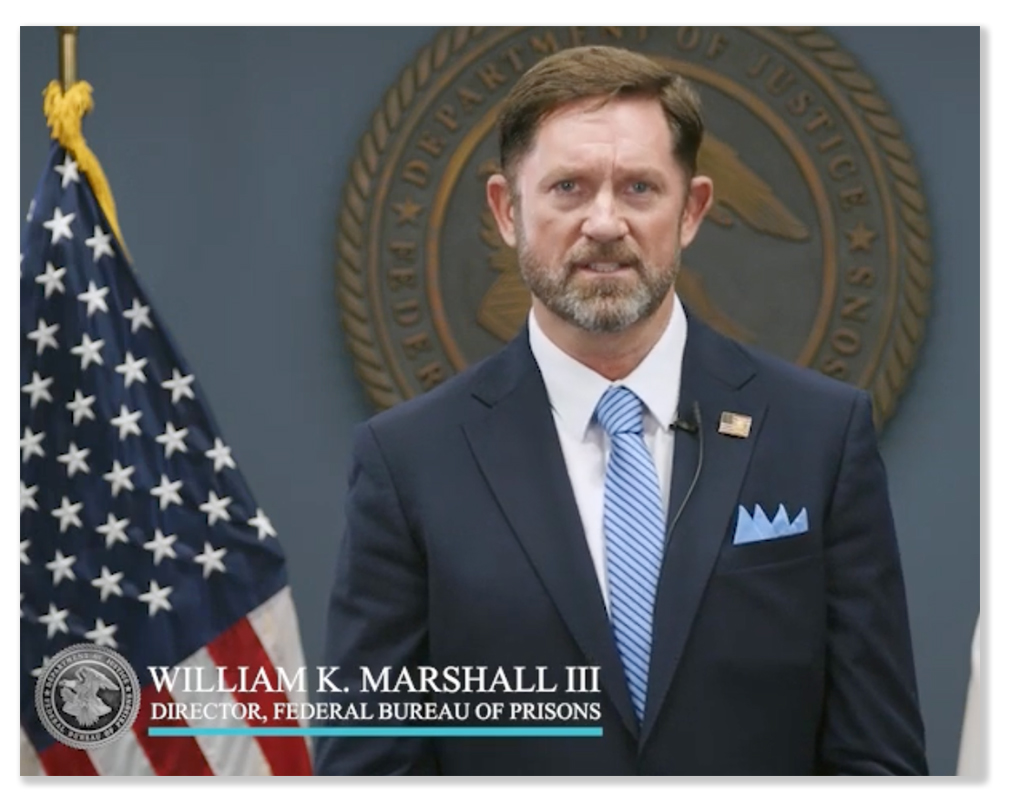
BOP Director William K. Marshall III told employees that the union “has a proud history of advocating for its members, and I want to acknowledge the positive contributions it has made over the years… But when a union becomes an obstacle to progress instead of a partner in it, it’s time for change. And today, thanks to President Donald J. Trump and Attorney General Pamela Bondi, we’re making that change. Today, I’m announcing the termination of our contract with CPL-33 effective immediately.”

Marshall said that workers would not be fired, suspended or demoted without cause or due process, and that their pay and benefits were guaranteed by law to stay in place. Nevertheless, he told Brandy Moore White, the union’s president, that employees no longer have a right to union representation during meetings with management, investigative interviews or other proceedings. Earlier this year, the BOP prohibited the deduction of union dues from employee paychecks, causing union membership to plummet.

Moore White said, “Don’t be fooled, this is not about efficiency or accountability — this is about silencing our voice… “The vast majority of our members are Republicans and voted for this president. I literally cannot explain to you how many messages I’ve gotten from them saying this is such a slap in the face. This man vowed to protect law enforcement, and this is what we get in return. They just feel so blindsided and so frustrated with how this is going.”

She said the union plans to take legal action and seek a Congressional remedy.

Although Trump’s Executive Order issued last spring to cancel government union contracts made use of a narrow legal provision that lets a president suspend collective bargaining for national security, Marshall’s  announcement made no mention of any national security concerns. Instead, he just said the agency was ending the agreement because it believed collective bargaining was a “roadblock” to progress.

John Zumkehr, president of AFGE Local 4070 at FCI Thomson, argued the cancellation increases what he said is an already high risk of suicide among BOP employees. “When you strip away the protections we’ve fought for, you endanger the well-being of every officer and undermine the entire system,” Zumkehr said. “Instead of standing behind us, the Bureau is tearing down the few safeguards we have left.”

Writing in Forbes, Walter Pavlo noted that the BOP “has often been criticized by advocate groups as not being responsive to implementing laws, such as the First Step Act and Second Chance Act. Both of these pieces of legislation were slow to be implemented with some blaming the union for the lack of progress.”

He quoted Rabbi Moshe Margaretten, president of the Tzedek Association, a group instrumental in the creation and passing of the First Step Act, “As someone who has spent years working closely with the Bureau of Prisons on reform, I can say without hesitation that the union has been one of the greatest obstacles to real progress. For too long, every new policy, no matter how commonsense or beneficial to staff and inmates alike, had to be dragged through an approval process where the default answer was ‘no’… This is a watershed moment — an opportunity to finally build a Bureau of Prisons that works better for the men and women who serve in it and for the country as a whole.”

New York Times, Federal Bureau of Prisons Ends Union Protections for Workers (September 26, 2025)

BOP, Director’s Message (September 25, 2025)

AFGE CPL-33, Bureau of Prisons Union Condemns Administration’s Attack on Workers’ Collective Bargaining Rights (September 25, 2025)

Federal News Network, Federal Bureau of Prisons terminates collective bargaining agreement with AFGE (September 26, 2025)

Associated Press, Federal Bureau of Prisons moves to end union protections for its workers (September 25, 2025)

Forbes, Bureau of Prisons Cancels Collective Bargaining Agreement With Union (September 26, 2025)

~ Thomas L. Root
The 65% Law (And Other Silliness) – Update for September 18, 2025

We post news and comment on federal criminal justice issues, focused primarily on trial and post-conviction matters, legislative initiatives, and sentencing issues.

EASTER BUNNY SAYS 65% LAW GOES INTO EFFECT ON NOVEMBER 1ST

I would say the silly season is upon us, but that would wrongly imply that it ever left.

Last week, I had a half-dozen questions about changes in the First Step Act to provide relief to people with gun convictions under 18 USC § 924, about how the Armed Career Criminal Act’s drug predicates are changing, and – of course – how the long-anticipated “65% law” is about to go into effect. And every one of the questions said the same – it’s all happening on November 1st.

I repeat what has become my annual myth-busting ritual over the past decade:

  • No Guideline amendment becoming effective on November 1st will apply to anyone who has already been sentenced (that is, become retroactive). This is unfortunate, because the amendments represent fundamental changes that alter how judges impose sentences, manage post-conviction supervision, and evaluate requests for sentence reductions. But the sad fact is that the Commission proposed retroactivity for a few of the changes and then failed to adopt it for any of this year’s slate of changes.

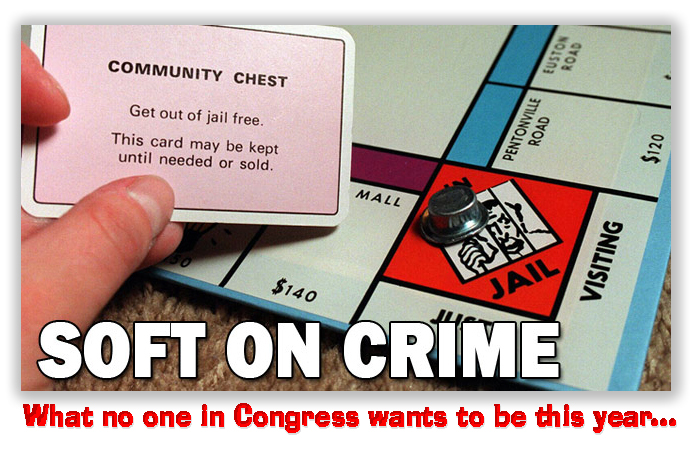
And what will Congress do? Well, yesterday, the House passed H.R. 5140, lowering the age for which youth offenders in the District of Columbia can be tried as adults for certain criminal offenses, changing the threshold to 14 years of age. The Hill reports that “Republicans are set to vote on several other bills relating to D.C. crime later this week as they carry on President Trump’s crusade against crime in the nation’s capital after his 30-day takeover of the city’s police force expired.”

It’s a safe bet that no one in Congress has the stomach to pass any bill that will ease criminal laws or help prisoners.  The crusade, as The Hill described it, is against crime, not for crime.

  • This means that there is NO 65% bill, 65% law or 65% anything. There is NO proposal to cut federal sentences so that everyone will only serve 65% of their time. There is NO bill, law, NO directive from Trump, and NO anything else that will give inmates extra time off. Nothing, nada, zilch, bupkis.

As the Federalist – commenting on the mentally ill suspect accused of stabbing a Ukrainian immigrant to death last month in Charlotte, North Carolina – said last week, “Instead of buying into the dangerous lie that mass incarceration doesn’t work, we should be building more prisons and sending violent criminals there for lengthy sentences… What we’ve been doing for years now is dangerous and morally indefensible. Releasing violent criminals onto the streets, as White House deputy chief Stephen Miller said Tuesday, is a ‘form of political terrorism’ — perpetrated by Democrat elected officials against the people who live in their jurisdictions.”

Do these people sound like they’re interested in any common-sense criminal justice reform? Is there an Easter Bunny?

I am sure that I will have to write this again next year.  And the year after that.  And the year after that. Ad infinitum.

The Hill, House passes 2 bills overhauling DC sentencing policies (September 16, 2025)

The Federalist, We Need To Bring Back Mass Incarceration And Involuntary Commitment (September 10, 2025)

~ Thomas L. Root

Trump Seeks Crime Reform… And It’s Not First Step Act 2.0, Either – Update for September 4, 2025

We post news and comment on federal criminal justice issues, focused primarily on trial and post-conviction matters, legislative initiatives, and sentencing issues.

GOOD NEWS AND BAD NEWS
McTrump the Crime Dog

President Trump said last Wednesday that Republican leaders in Congress were working with him on a “comprehensive crime bill” in what the New York Times called “his latest effort to push the issue of crime to the foreground of American politics.”

“It’s what our Country needs, and NOW!” Trump said on his Truth Social platform. “More to follow.” He said both House and Senate Republican leadership were working on the bill, but he offered no details.

A new crime bill would normally be a welcome opportunity to amend the First Step Act, especially to address the Federal Time Credit program. However, the bad news is that Trump does not appear to have a crime bill of that kind in mind.

Targeting what he calls “out of control” crime was central to Trump’s 2024 presidential campaign, although US crime is near its lowest level in decades. He has raised the issue in the last two months, with the deployment of National Guard in Washington DC to allegedly control crime there.

Politico reported last week that Trump’s latest comments have puzzled Republicans on Capitol Hill, who don’t know what “comprehensive” measure the president is talking about. Trump discussed extending his control over the DC police with House Speaker Mike Johnson (R-LA) last Tuesday. The House Oversight Committee, which has jurisdiction over DC issues, plans to advance some bills this month to crack down on juvenile crime, reform the education system, and unwind certain policing policies. However, Politico notes, “it’s the Judiciary Committee that would have to advance any crime-related bills that are national in scope.”

Trump ramrodded First Step through Congress in 2018. But running in 2024, Trump distanced himself from his own achievement, barely mentioning FSA on the campaign trail. In 2023, Florida’s governor and a rival presidential candidate, Ron DeSantis, attacked FSA as a “jailbreak bill” and pledged to repeal it.

And while Trump did appoint Alice Marie Johnson, a woman he pardoned in 2020, as pardon czar soon after returning to the White House, “he doesn’t appear eager,” the New York Times said last week, “to remind voters of his criminal justice reform measures… Instead, Trump is pushing for tougher sentencing, including against minors.”

“They’re children, but they’re criminals,” Trump said at last Tuesday’s marathon Cabinet meeting as he turned to his attorney general, Pam Bondi. “We are getting that changed, Pam, I hope, because you have 14-year-old kids that are evil, they’re sick, and they have to be put away.”

At the same meeting, Trump said he wants to see the death penalty imposed on every person convicted of murder in DC. “If somebody kills somebody in the capital, Washington, D.C., we’re going to be seeking the death penalty,” Trump said. “And that’s a very strong preventative.”

Trump appointed Fox News commentator Jeanine Pirro as US Attorney for the District of Columbia after even Republicans refused to confirm firebrand Ed Martin for the post. Pirro has talked a tough game in support of Trump’s theme that DC crime is out of control, demanding that her prosecutors bring the harshest charges allowable, even for minor infractions. Now, Salon reported this past weekend, “her aggressive posture is colliding with real-world constraints, exposing both her limitations and the fragility of politicized law enforcement.”

Pirro recently revealed that she is getting help from military lawyers, because her office is short 90 prosecutors and 60 investigators and paralegals. DC federal courts, which normally process about six new criminal cases per week, now face six or more cases per day, many stemming from low-level offenses that would’ve been diverted or even dismissed previously.

The increase in workload may be unique to DC, but the staffing is not. According to reports I have received, seasoned AUSAs and support staff have been resigning from US Attorneys’ offices around the country. One federal defense attorney told me last week that the quality of work and responsiveness of AUSAs in his district, the Southern District of Ohio, has fallen dramatically since January. “It’s hard to get a call back,” he said.

Salon said last week, “It’s clear that Pirro’s [charging] directives are unsustainable.” With so many people around the country heading for the exits, US attorneys’ offices may be unable to execute on a harsh new crime bill, even if one passes. That does little to address the bad news that an opportunity to reduce recidivism even more by tweaking FSA – and helping prisoners in the process – may be lost in the tough-on-nonexistent–crime posturing.

Writing in Sentencing Law and Policy last week, Ohio State University law professor Doug Berman observed that “[a] decade into the Trump era, I have learned not to take too literally or too seriously what Donald Trump says on social media.  But given that Prez Trump and his GOP allies are viewing crime fighting and crime policy as a winning political issue (and also that Democrats are struggling with a response… new political talk of a new “Comprehensive Crime Bill” makes lots of sense… But, of course, the devil is in the details when it comes to enacting big new federal legislation and in navigating the modern politics and policy-making of crime and punishment.  The First Step Act was truly the culmination of decades of federal criminal justice reform debates, and it is unclear what sets of criminal justice proposals will get enough support in Congress to get to the desk of the President. (I assume a crime bill would not find a way to be immune from the Senate filibuster, so at least 60 Senate [votes] would seem to be a necessity for any bill.)”

New York Times, Trump Says Republicans Are Working on a ‘Comprehensive’ Crime Bill (August 27, 2025)

Politico, Republicans scratch their heads over Trump’s ‘comprehensive’ crime bill (August 27, 2025)

New York Times, In Trump’s 2nd Term, More Incarcerations, Less Talk of Reform (August 27, 2025)

Washington Post, Trump wants expanded death penalty, longer control over police in D.C. (August 26, 2025)

Salon, Fox News star’s jump to the Trump administration is backfiring (August 31, 2025)

Sentencing Law and Policy, Is it too early to speculate about what could be in a new “Comprehensive Crime Bill”? (August 27, 2025)

~ Thomas L. Root

Will First Step Task Force Make A Difference? – Update for August 1, 2025

We post news and comment on federal criminal justice issues, focused primarily on trial and post-conviction matters, legislative initiatives, and sentencing issues.

FIRST STEP TASK FORCE FINDING ITS FOOTING

Rick Stover, Senior Deputy Assistant Director of the Federal Bureau of Prisons’ Designation and Sentence Computation Center (DSCC), says that the BOP’s new First Step Act task force has begun evaluating prisoners now in halfway houses who could be transferred to home confinement if they were to receive the full benefit of “stacking” recommended Second Chance Act placement atop FSA time credits.

Writing in Forbes, Walter Pavlo said the task force – with over 30 DSCC analysts assigned – noted that while the SCA limits home confinement to the final 6 months (or 10%) of a sentence, “the end of the sentence is a moving target for some inmates because they continue to earn FSA credits each month even when they are at the halfway house. The Task Force is manually calculating these dates for inmates in halfway houses, because the BOP’s own computer program currently does not calculate these dates once inmates are released [to] halfway houses.” Mr. Stover said the task force is ensuring that such calculations will occur with the recent application updates.

Once that is done, Mr. Stover told Mr. Pavlo, the Task Force will focus on those currently in prison. Mr. Stover said, “As we… move inmates from the halfway houses to home confinement, we expect this to create a sizable number of open beds in many of our halfway houses across the country. This allows us to then revisit the placement dates for inmates currently in our institutions and increase the number of inmates that we can place in the community, and in many instances, allow inmates to get out of prison quicker to begin their transition to go home.”

Mr. Stover is optimistic, Mr. Pavlo reports. “While the Bureau has made marked improvements in our time credit calculation applications since the onset of the FSA statute, more improvements are needed. We have changes forthcoming that will simplify the data for both staff and inmates.”

The BOP effort to push prisoners out to halfway house and home confinement as early as possible is laudable, especially because some prison consultants think that the BOP has discretion to deny inmates their entitlement to FSA credits. I reported a month ago on the U.S. District Court for the District of Columbia’s dismissal of Crowe v. BOP. Former BOP Unit Management Section Chief Susan Giddings (now a private prison consultant), writing for herself and prison consultant Bruce Cameron last week, lauded the dismissal. She said that the Crowe court’s denial of class status

was particularly gratifying for the authors because they have consistently argued that 1) there is nothing in the FSA that eliminated or modified the Bureau’s designation authority, including halfway house and home confinement designations, and 2) the idea that the FSA required the Bureau to transfer an individual solely based their eligibility date regardless of any other compelling issues undermined the requirements of the Second Chance Act (SCA). The SCA required the Bureau to ensure that incarcerated individuals were provided with the same individualized consideration when making prerelease designation decisions as they were when making institution designation decisions. The decision-making process for prerelease placement (i.e., halfway house and home confinement) includes the inmate’s unit team making a prerelease placement recommendation based on a variety of factors, including but not limited to individual release needs, institutional conduct, the current offense, history of success or failure in prior community placement, and criminal history. The completed designation request is then sent to residential reentry staff, who then consider all the information provided by the institution, as well as the community program resources and any community safety issues when making the designation decision.

I disagree with Dr. Giddings and Mr. Cameron that Crowe went as far as they argues it does and that the decision is a good thing. Walt Pavlo may agree with me. He implicitly suggests that keeping inmates in BOP prisons when they are legally eligible for less restrictive incarceration may be due to a BOP mindset as much as anything. Earlier this week, Mr. Pavlo described the problem as being that

the BOP has lacked leadership to lead it into the modern era of incarceration. It is an Agency that prospered during the days of locking up drug offenders that saw the federal prison population top over 220,000 in 2013. Then as buildings became old and decrepit, it failed to keep up and now BOP employees sit in the same rotting, molded facilities that house the inmates they watch.

Dr. Giddings and Mr. Cameron seem confident that BOP decisionmakers will do the right thing by the inmates they oversee, and that they both need and will responsibly use the authority to withhold FSA placement based on SCA factors that they argue that the law provides. Their view is shared by a number of commentators and many US Attorneys’ offices, and is worth noting.

At the same time, Mr. Pavlo’s blunt suggestion that Bureau employees are locked in old thinking is a notion shared by its own cohort of observers.  New BOP Director Marshall so far has made some promising moves, including the Task Force. Now, the Task Force has to perform.

Forbes, Bureau of Prisons Task Force Taking Shape, Challenges Remain (July  23, 2025)

Giddings, Crowe, et al. v Federal Bureau of Prisons, et al: Common Sense for the Win! (July 25, 2025)

LISA, Class Action FSA Credit Lawsuit Against the BOP Case Dismissed (June 16, 2025)

Forbes, Bureau Of Prisons Could Fix First Step Act, If It Had The Will (July 29, 2025)

~ Thomas L. Root

A Short Rocket of BOP News – Update for July 24, 2025

We post news and comment on federal criminal justice issues, focused primarily on trial and post-conviction matters, legislative initiatives, and sentencing issues.

LAST WEEK AT THE BUREAU OF PRISONS

You’d think that the sole focus of the Federal Bureau of Prisons in the last week had been how to produce celebrity prisoner Ghislaine Maxwell for a Congressional deposition. But from Duluth to Alcatraz, there was a lot else going on as well. Here’s the short rocket…

Marshall Establishes FSA Task Force:   Bureau of Prisons Director William K. Marshall III announced the established of an FSA Task Force at the BOP’s Grand Prairie, Texas, Designation and Sentence Computation Center.

Marshall cited inmate “frustration that their paperwork for home confinement under the First Step Act (FSA) wasn’t being processed by staff despite Director Marshall’s directive to maximize the use of community placement. But at the same time, the staff told [Marshall] that the systems they rely on weren’t always showing the right dates… The majority of staff were doing their best with the information they had, but, unfortunately, they were taking the blame from inmates and families who thought they were dragging their feet. That wasn’t fair to them.”

The task force will identify prisoners in halfway houses who are eligible for home confinement; manually calculate home confinement dates that “stack[] both the FSA and Second Chance Act;” and ‘[r]eview eligible incarcerated individuals inside institutions for additional community placement opportunities.”

Writing in Forbes, Walter Pavlo said, “Having a person serve a portion of their sentence in the community is not something new and has been used for decades by the BOP. However, the Agency has been slow to move inmates after the [First Step Act] was codified… in January 2022. The initiative is part of Director Marshall’s broader strategy of “Leadership in Action,” which has included institutional walk-throughs, direct engagement with frontline staff, and timely operational changes based on what he hears.”

BOP, Director Marshall Launches FSA Task Force (July 14, 2025)

Forbes, Bureau of Prisons Launches First Step Act Task Force (July 14, 2025)

Alcatraz Moves Forward:  Never mind that the price tag has blown through $2 billion to renovate a prison closed for 60 years that only houses 325 prisoners and has no water supply. A visit to Alcatraz Island in San Francisco Bay last week by Attorney General Bondi, Dept of the Interior Secretary Doug Burgum, Marshall, and BOP Deputy Director Joshua J. Smith makes it clear that President Trump’s May musings on social media that he wanted to reopen Alcatraz as a federal prison to “house America’s most ruthless and violent offenders” and remove criminals “who came into our country illegally,” is going to happen.

A BOP press release underscores that reopening Alcatraz is pure symbolism, the fevered dream of President Trump: “Reopening Alcatraz isn’t just about a building, it’s about sending a message: crime doesn’t pay, and justice will be served. If feasible, Alcatraz will stand as a beacon of American resolve, where the most dangerous offenders face accountability. For the public, it’s a promise fulfilled—a stronger, safer America. And for President Trump, it’s a project that will make our nation proud.”

Alcatraz was closed as a maximum-security prison in 1963 after 29 years of operation, because it was too expensive to continue operating. Now managed by the National Park Service, the island is one of San Francisco’s most popular tourist destinations.

BOP, The Rebirth of Alcatraz (July 17, 2025)

NY Times, Trump’s Plan to Reopen Alcatraz Appears to Move Forward With Officials’ Visit (Jul 17)

FPC Duluth to Remain Open: Seven months after the then-BOP Director Colette Peters listed FPC Duluth with six other facilities that would be closed because of “aging and dilapidated infrastructure,” new BOP boss William K. Marshall III announced last week after a site inspection that the minimum-security camp “will not be deactivated.”

Currently, there are only about 258 inmates remaining at the facility, but officials anticipate repopulating the camp to its rated capacity of about 800 prisoners. The camp is located on the grounds of the former Duluth Air Force Base.

Minnesota Public Radio, Duluth prison camp to remain open, reversing earlier decision to ‘deactivate’ the facility (July 16, 2025)

ICE Sending Immigrant Detainees to FDC Honolulu, Proposes Using Fort Dix: Under normal circumstances, scoring an all-expenses-paid trip to Hawaii would be a Wheel of Fortune moment.  But these are not normal circumstances.

It turns out that over 70 immigrant detainees, some from as far east as Florida, are being flown to imprisonment at the Federal Detention Center in Honolulu.

The Honolulu Civil Beat quoted one immigration lawyer as saying that a client “was taken into custody in Florida and went to two detention centers there before he was transferred to Louisiana, Arizona and two facilities in California before finally coming to Hawaiʻi.” Attorneys are complaining that the endless moves and distances make consultation with their clients almost impossible.

Homeland Security Secretary Tom Homan said over the weekend that 60,000 immigrants are currently in custody, with plans for 40,000 more.

Still, air conditioning in the Aloha State may be better than a tent in the South Jersey heat. Last week, Secretary of Defense Pete Hegseth approved the use of Joint Base McGuire-Dix-Lakehurst, where FCI Fort Dix is located, to confine immigrants. The Defense Department said detainees would be confined in “temporary soft-sided holding facilities,” suggesting for now that facilities at the aging FCI Fort Dix – located on base grounds – will not be used.

Honolulu Civil Beat, ICE Is Moving Immigrants Arrested On The Mainland To Honolulu (July 16, 2025)

Philadelphia Inquirer, Trump administration plans to hold immigration detainees on South Jersey military base (July 18, 2025)

~ Thomas L. Root
Surprising Support for DOJ Gun Rights Proposal – Update for July 1, 2025

We post news and comment on federal criminal justice issues, focused primarily on trial and post-conviction matters, legislative initiatives, and sentencing issues. 

DEMOCRATS SPLIT ON RESTORING FELON GUN RIGHTS

Jake Fogleman of The Reload, a weekly report on the politics of gun control, reported last weekend that the Dept of Justice’s proposal to reauthorize the long-dormant gun rights restoration process for people convicted of nonviolent felonies appears to be pitting federal and local Democrats against one another.

Last February, President Donald Trump ordered a review of federal gun policy. One of the first proposals to come from that review was a proposed rulemaking to let DOJ use 18 USC § 925 to restore gun rights, essentially waiving 18 USC § 922(g) for those people. The initial recipient of this administrative grace, even before the rulemaking began, was actor and Trump supporter Mel Gibson, disqualified from gun possession by a prior domestic violence conviction.

In the comment period just ended, 16 Democratic state attorneys general – including those representing liberal bastions like California, Hawaii, Illinois, Connecticut and New Jersey – submitted a letter supporting the proposal (subject to what The Reload called “numerous caveats… intended to ensure that no one truly dangerous is able to make it through the process”). But their letter was surprisingly sympathetic to the resurrection of the process.

“While there is no constitutional requirement that mandates any particular form of firearms rights restoration by states or the federal government, as a policy matter, we believe that our residents’ lives should not be defined by the worst mistakes of their pasts,” the letter said.

On the other hand, six Democratic senators and representatives filed comments arguing that the proposed rule is an unlawful exercise of executive power being done to “help violent criminals regain firearms.”

“Given the pervasiveness of gun violence in our nation, this Administration should not be circumventing Congress’s authority to prioritize restoring firearm privileges to individuals convicted of serious or violent crimes,” the Congressional letter said. “Our country is plagued by an epidemic of gun violence.”

The Reload suggested that “part of the driving force behind the rift, at least for those who oppose the new process, [may be] over who is pursuing the new federal policy. Democratic officials, particularly those in Congress, have been under intense pressure from their constituents to demonstrate their resistance to the Trump Administration’s aggressive executive actions in its second term. It’s possible that, under different political circumstances, the lawmakers now vocally opposed to the move might have been more amenable to the idea… In an era in which the Democratic coalition has largely homogenized around a set of hardline gun restrictions, and in which the question of gun rights for felons has primarily been confined to the courts, it is notable to see new differences of opinion on the question emerge in the political arena.”

No doubt, having a rational, consistent means of restoring gun rights to people subject to 922(g) is a good idea. My concern, however, is that adoption of such a plan may make DOJ unwilling to press for a Supreme Court resolution on the constitutionality of 18 USC § 922(g)(1) as applied to nonviolent felons. DOJ already refused to seek certiorari on Range v. Bondi, the 3rd Circuit en banc decision that stands as the best case for limiting § 922(g)(1). That case now binds courts in Pennsylvania, New Jersey and Delaware, but without a SCOTUS decision, it lacks nationwide applicability and, perhaps more important, does not support a 28 USC § 2244 motion to bring a second or successive § 2255 motion.

That procedural fact leaves thousands of prisoners unable to challenge the constitutionality of their convictions in the post-Bruen world.

The Reload, Analysis: Is Rights Restoration for Convicts a New Dividing Line on Guns for Democrats? (June 29, 2025)

DOJ, Withdrawing the Attorney General’s Delegation of Authority (March 20, 2025)

Letter from 16 State Attorneys General (June 18, 2025)

Letter from Rep Rosa DeLauro et al (June 18, 2025)

 – Thomas L. Root

Less than Meets the Eye – Update for June 30, 2025

We post news and comment on federal criminal justice issues, focused primarily on trial and post-conviction matters, legislative initiatives, and sentencing issues.

A TRULY SHORT STACK

A week ago, I reported that BOP Director William K. Marshall III had announced the dawning of a new day in the use of First Step Act credits (FTCs) and the Second Chance Act. Among his several promises was that his new policy “ensures that FSA Earned Time Credits and SCA eligibility will be treated as cumulative and stackable, allowing qualified individuals to serve meaningful portions of their sentences in home confinement when appropriate.”

It turns out that the new memo doesn’t exactly say “cumulative and stackable”. Instead, it directs that “[i]n addition to FTCs for those individuals who have earned less than 365 days of FTCs, staff must also consider adding up to an additional 12 months of prerelease time under the SCA, based on the five-factor review.”

Under the heading “The Rules Are Clear,” a number of institutions last week issued guidance that doubled down on the memo. The “guidance” stated, “For individuals who have earned less than 365 days of FSA time credits towards supervised release, staff must also consider adding up to an additional 12 months of pre-release time under the SCA based on the five-factor review. The FSA Time Credit Worksheet for time under the SCA defaults to and will remain “zero” until your Unit Team inputs the pre-release time as determined based on the five-factor review. The number will range from zero to 12 months.”

Notwithstanding the heading, the only thing “clear” in all of this is the implication that, despite what the Director said, people who have more than 365 FTCs to be used toward prerelease custody will probably not be getting any SCA time whatsoever.

Practically speaking, no one with a sentence of under 46 months will earn any FTCs that go to prerelease custody. That’s because it is only mathematically possible to earn 365 days in a sentence of that length, after being adjusted for good time granted under 18 USC § 3624(b). All of the 46-monthers’ FTCs will be used up in cutting their sentences by 12 months. It will take a sentence of at least 74 months before a prisoner has accumulated more than 365 additional FTCs to be used toward more halfway house or home confinement. So the people with the most time – more than 74 months – being the ones most likely to benefit from the stacking, who will feel the impact of the non-stacking “stacking.”

Much of the problem arises from the tension between First Step and the SCA. Under the “five-factor review” (set out in 18 USC § 3621(b)), inmates are placed in halfway house not as a reward but rather because they need the prerelease custody time to give them “a reasonable opportunity to adjust to and prepare for the reentry.” 18 USC § 3624(c). First Step, on the other hand, treats halfway house/home confinement as a reward for earning FTCs. There’s nothing wrong with either approach, but the problem comes in mixing the two: despite all the fine talk about time being “cumulative and stackable,” the five-factor review applied to someone who is already entitled to 12 months in a halfway house as an incentive under the FSA is very unlikely to need any more than that amount of time there to have “a reasonable opportunity to adjust to and prepare for the reentry.”

The “five-factor review” will and probably should disqualify anyone with 12 months of prerelease custody under the FSA from any additional SCA prerelease time. If 12 months in a halfway house isn’t enough to prepare an inmate for release into the community, then (1) he or she probably is not rated as having a low chance of recidivism to begin with, and thus is ineligible to use any accumulated FTCs; and (2) will not make it in society once released.

I got email from an inmate last week denouncing the institutional guidance as “a very inmate-unfriendly interpretation of how FSA and SCA interact (despite the FSA saying time limits on SCA don’t apply and that FTCs should be in addition to other incentives).” But SCA halfway house was never meant to be an incentive, but rather was intended to be a tool for people who needed the transition time and services of a halfway house.

For now, the Director’s new policy suggests that we’ll see a lot more FSA prerelease time served on home confinement. That’s probably good for the BOP and prisoner alike. However, despite the “stackable and cumulative” talk, there is little reason to think that the “five-factor review” will result in stacked FSA and SCA prerelease custody time than it did before.

BOP, Bureau of Prisons Issues Directive to Fully Implement First Step Act and Second Chance Act (June 17, 2025)

BOP, Memorandum on Use of Home Confinement as a Release Option (June 17, 2025)

BOP, Home Confinement and Pre-Release Placement Updates (June 25, 2025)

– Thomas L. Root

Grammar Gets the ‘Gold’ at Supreme Court – Updates for June 27, 2025

We post news and comment on federal criminal justice issues, focused primarily on trial and post-conviction matters, legislative initiatives, and sentencing issues.

A GOLD MEDAL FOR LENITY?

Is “lenity” the word that dare not be uttered? You might think so after yesterday’s Supreme Court decision in Hewitt v. United States.

The issue seems straightforward enough. Among the many changes made by the 2018 First Step Act was a long-overdue modification of 18 USC § 924(c), the penalty statute that mandates a consecutive minimum sentence for carrying a gun during a drug trafficking crime or crime of violence. Before First Step, the initial § 924(c) offense carried a mandatory sentence of at least five years, but every subsequent § 924(c) offense was punished by a 25-year term. Lousy drafting of the statute led to courts concluding that if you sold drugs while carrying a gun on Monday, you’d get time for the drug crime and an extra five years for the gun. If you sold some more drugs the next day while still carrying the gun, you’d probably get no more time for the drugs, but you would get a mandatory 25 years on top of Monday’s five-year term for a second § 924(c) crime, an outcome known as “stacking.”

It wasn’t difficult to figure. A hard-working street corner drug dealer plying his trade for a five-day work week, with a gun in his pocket the whole time, would run up a sentence of maybe 51 months for the drugs he sold but a whopping mandatory consecutive sentence of 105 years for five days of § 924(c) counts.

Congress never meant for this to happen. What it intended was that if you violated § 924(c) with a pistol in your pocket, you’d get an extra five years for carrying the gun (seven years if you “brandished” it). If you did your time and then were stupid enough to pack heat again, you would get a 25-year consecutive sentence. And why not? If five or seven years hadn’t taught you a lesson, you really needed an attitude adjustment.

Congress finally got around to fixing it in the First Step Act, changing § 924(c)(1)(C) to require that you actually be convicted of a § 924(c) offense before being hammered with the 25-year term for a second § 924(c) offense. You could still get stacked five-year terms for a week’s worth of armed drug dealing (25 years total for gun-toting from Monday through Friday), but you would not get the extra 80 years for your poor decision-making.

The usual horse-trading needed to get the Senate to pass First Step in the 11th hours of the 115th Congress resulted in a deal embodied in § 403(b) of the Act that the changes in § 924(c) would apply to “any offense that was committed before the date of enactment of this Act, if a sentence for the offense has not been imposed as of such date of enactment.”

Back in 2007, a gang dubbed the “Scarecrow Bandits” began a crime spree of bank robberies in the Dallas-Fort Worth area that totaled 20 heists. Dubbed the “Scarecrow Bandits” due to the clothing and face coverings they wore during their initial offenses, the gang was finally taken down by 11 months of cell tower analytics that sifted a haystack of data to find phones that had been pinging towers in the vicinity of each target bank only at times around the robbery. When the gang prepared to hit bank number 21 in Garland, Texas, the police arrested them.

Thanks to the § 924(c) in force at the time, the government hung 330 years on the perpetrators. The passage of the First Step Act didn’t help, because the robbers had long since been sentenced. However, after the Supreme Court held in 2019 that the “crime of violence” definition the Government routinely used to support some § 924(c) convictions was unconstitutionally vague, several of the Hewitt defendants successfully petitioned to have their sentences set aside. When they were resentenced, they argued that because the new sentences were being imposed after First Step passed, they were entitled to the benefit of having their subsequent § 924(c) sentences cut from 25 years apiece to seven years apiece or less.

The 5th Circuit (joining the 6th but in opposition to the 3rd and 9th), ruled that § 403(b) excluded any defendant who was sentenced prior to the enactment date of the First Step Act, even if his sentence was later vacated. The 5th argued that First Step applies only “if a sentence for the offense has not been imposed as of” the Act’s enactment date. Even if the Scarecrow sentences were later vacated, they still had “been imposed” upon that defendant prior to the Act “as a matter of historical fact.”

Justice Ketanji Brown Jackson, writing for the 5-4 majority, reminded everyone why all of that tedious junior high school English grammar was consequential after all. She explained that the operative phrase of § 403(b) is “not written in the past-perfect tense, excluding anyone upon whom a sentence “had” been imposed. Rather, Congress employed the present-perfect tense—thereby requiring evaluation of whether “a sentence . . . has . . . been imposed” upon the defendant.” Citing sources including the Chicago Manual of Style and The Cambridge Grammar of the English Language, she argued “the primary focus is on the present” while “the past maintains ‘current relevance.’”

Justice Brown offers this example:

Suppose the U. S. Olympic Committee enacted a rule stating that athletes may call themselves Olympic champions if a gold medal “has been awarded” to them. Pursuant to that rule, a U. S. sprinter who took first place in the 2016 Summer Olympics’ 100-meter finals could validly proclaim—today—that she is “an Olympic champion.” The existence of her win as a historical event triggers the rule’s proper application, because it gives rise to the inference that the athlete remains an Olympic gold medalist at present, thereby justifying her continued use of the “Olympic champion” title…

But now imagine that the Olympic Committee stripped this sprinter of her medal after discovering that she used performance-enhancing drugs during the competition. Can that athlete, under the rule, still call herself an Olympic champion? The answer is no. Yes, she had been awarded such a medal, but it was revoked; the fact that she stood on the podium and was declared the winner in 2016 is inapposite for purposes of establishing whether she qualifies for Olympic-champion bragging rights under the rule today.

When used in this way, the present-perfect tense conveys to a listener that the event in question continues to be true or valid.

Her point was that a sentence once imposed but later vacated is not a sentence at all because it does not remain valid. The law thus denies sentencing relief to only those pre-First Step Act sentences with “continued legal validity, not those that have been vacated,” Jackson wrote.

The decision produced a strong dissent from Justice Samuel Alito Jr., who accused the majority of “disfigur[ing]” the law to “march in the parade of sentencing reform… Animating the court’s atextual interpretation is a thinly veiled desire to march in the parade of sentencing reform. But our role is to interpret the statute before us, not overhaul criminal sentencing,” he wrote in a dissent joined by Justices Clarence Thomas, Brett Kavanaugh and Amy Coney Barrett.

Writing his Sentencing Law and Policy blog, Ohio State University law professor Douglas Berman was as disappointed in the decision as one who supported the result could be. He wrote that “Justice Gorsuch has extolled the rule of lenity in a number of notable recent statutory interpretation cases (e.g., Wooden; Pulsifer), stressing that “lenity has played an important role in realizing a distinctly American version of the rule of law.” The issue in Hewitt may not be a “classic” rule of lenity case, but it clearly is one in which traditional tools of statutory interpretation yield no clear answer and a defendant’s liberty is at stake… [I]t seems notable that this word gets not a single mention in the Hewitt opinions… These opinions function to suggest there is more legislative meaning and purpose in verb choice than in how to redefine just and fair punishments in the enactment of the First Step Act.”

Hewitt v. United States, Case Nos. 23-1002, 23-1150, 2025 U.S. LEXIS 2494 (June 26, 2025)

I2 Group, Catching the Scarecrow Bandits

United States v. Davis, 588 U.S. 445 (2019)

Law.com, Split Supreme Court Allows Lighter Sentences for Bank Robbers Dubbed ‘Scarecrow Bandits’ (June 26, 2025)

Courthouse News Service, Justices side with bank robbers seeking new sentences under reform law (June 26, 2025)

Sentencing Law and Policy, Where are concerns for liberty and lenity and broader constitutional values in Hewitt? (June 26, 2025)

– Thomas L. Root