Tag Archives: BOP

CARES Act Home Confinees Must Return to Prison, Trump’s DOJ Says in Parting Shot – Update for January 22, 2021

We post news and comment on federal criminal justice issues, focused primarily on trial and post-conviction matters, legislative initiatives, and sentencing issues.

A FINAL STEAMING PILE OF LEGAL EXCREMENT AS THE TRUMP ADMINISTRATION LEAVES THE BUILDING

DOJOLC210122Under the March 2020 CARES Act, Congress gave the Director of the Federal Bureau of Prisons the authority to send inmates to home confinement at any time, despite the 6-month/10% limitation on home confinement set by 18 USC § 3624(c). The conditions set by the legislation were only two: (1) the national emergency declared because of COVID-19 had to be in effect, and (2) the Attorney General had to determine that COVID-19 was materially affecting BOP operations.

Attorney General William Barr concluded in short order that BOP operations were being affected, and that nonviolent inmates with good prison records (and US citizenship and a few other requirements) should be sent to home confinement. The BOP added its own gloss, that the inmate must have completed 50% of his or her sentence (or, for short-timers, 25% of the sentence with 18 months or less to go). By mid-April 2020, the prison-to-parlor pipeline was flowing.

snakeoil170911Since then, the BOP has trumpeted that it has sent over 18,000 inmates to home confinement. It turns out, however, that – like most BOP claims – this one is misleading, if not downright dishonest. The BOP has sent 18,112 people to home confinement in the last 10 months, but 60% of those were eligible for home confinement under 18 U.S.C. § 3624(c)(2) anyway, because they were within their last six months of their sentences (or 10%, if they were sentenced to under five years).

But this leaves about 7,245 people who were sent home who could not have been sent if not for the CARES Act. I know at least two sent home with more than 10 years of sentence left to serve. While that’s a long time to spend in a Barcalounger, nevertheless, there is no doubt that an inmate’s worst day on home confinement is better that his or her best day in prison.

There was a kerfuffle last fall, when a DOJ Attorney said in open court, almost as an aside, that once the pandemic ended, all of the federal inmates sent to home confinement would have to come back to prison.

At the time, FAMM president Kevin Ring said that he had communicated his concern that CARES Act inmates might be recalled to the White House. He said the Trump Administration assured him it would never happen.

Back then I said

but White House assertions (remember President Trump’s promised 3,000 clemencies?) have a way of being wrong. The risk of reincarceration seemed real enough that the House of Representatives included a provision in last May’s HEROES Act that no one “granted placement in community supervision, termination of supervision, placement on administrative supervision, or pre-trial release shall be re-incarcerated, placed on supervision or active supervision, or ordered detained pre-trial only as a result of the expiration of the national emergency relating to a communicable disease.

I generally like being right, but not this time…

Although the end of the pandemic appears to be months away (former basketball point guard and rockstar doctor Anthony Fauci said yesterday that “if the country can get over the hurdle of vaccine hesitancy and reach a 70% to 85% uptake, Americans can expect normalcy in the fall”), the Trump Administration was seemingly unable to resist breaking one final promise.

Last week, the DOJ Office of Legal Counsel issued an opinion entitled “Home Confinement of Federal Prisoners After the COVID-19 Emergency,” concluding that

the CARES Act authorizes the Director of BOP to place prisoners in home confinement only during the statute’s covered emergency period and when the Attorney General finds that the emergency conditions are materially affecting BOP’s functioning. Should that period end, or should the Attorney General revoke the finding, the Bureau would be required to recall the prisoners to correctional facilities unless they are otherwise eligible for home confinement under 18 U.S.C. § 3624(c)(2). We also conclude that the general imprisonment authorities of 18 U.S.C. § 3621(a) and (b) do not supplement the CARES Act authority to authorize home confinement under the Act beyond the limits of section 3624(c)(2).

kick210122Ohio State University law professor Doug Berman said yesterday in his Sentencing Law and Policy blog that “this opinion is certain contestable, the new Biden Justice Department could reconsider it and a court might reject it, and we are surely a long ways from reaching a post-pandemic world.” Kevin Ring denounced the opinion as “one last kick in the groin from the Trump Justice Department,” calling it “is a poorly reasoned piece of cruelty that could make families worry unnecessarily.”

I consider it very unlikely that Biden’s new Attorney General, Merrick Garland, is going to rescind Barr’s finding “that the emergency conditions are materially affecting BOP’s functioning” any time soon. Although the pandemic emergency declaration expires in March, I suspect Joe is more likely to invite Donald Trump over to the White House for a drink than he is to end the emergency. There’s plenty of precedent. At the time the COVID emergency was declared, 60 national emergencies had been declared since the National Emergencies Act was enacted 45 years ago, and 31 of them (including the emergency are still in effect, having been renewed repeatedly. I figure the pandemic emergency to last for another nine months at least.

As I noted above, the House HEROES Act last May sought to plug the CARES Act hole that left home confinees in a non-permanent status. HEROES died a lonely death on January 2nd, but the new 117th Congress can fix the home confinement problem simply enough. Even if Congress does not, the President could grant conditional clemency or district courts could grant compassionate release to keep these folks on home confinement.

Even if it doesn’t, the Biden DOJ can walk back the OLC opinion (and the reasoning is shaky enough that there is plenty of room for reinterpretation) without much difficulty.
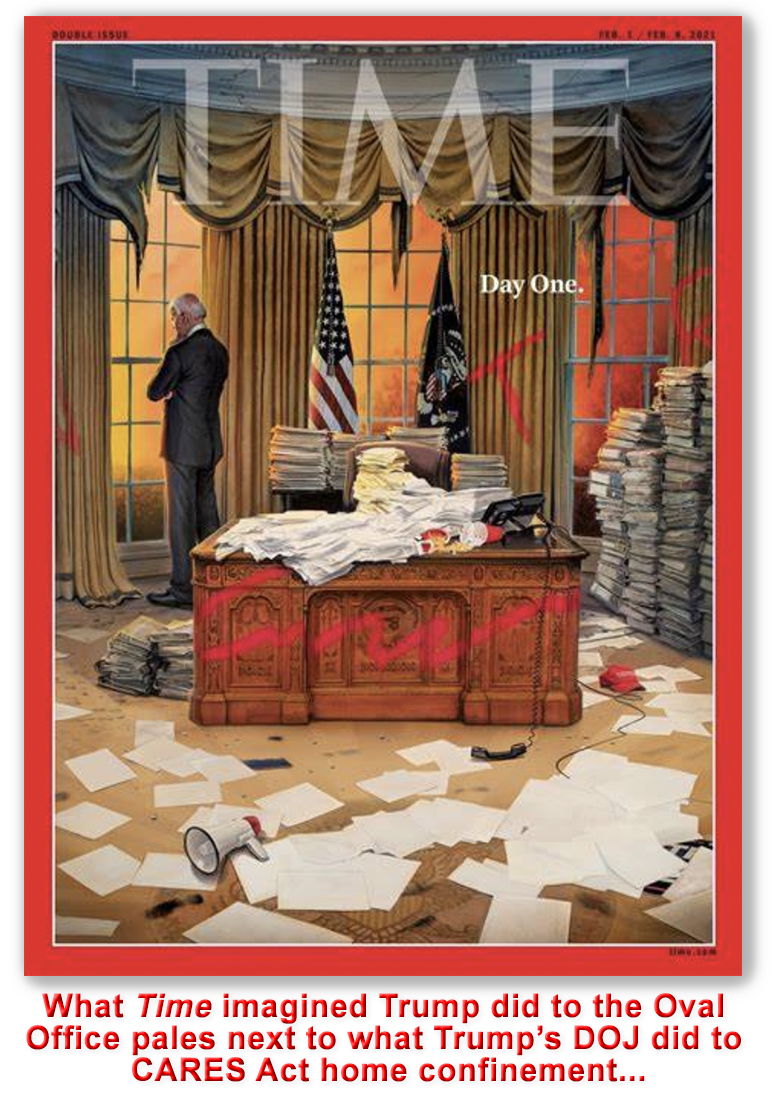
timecover2310122There is scant policy justification for returning people on home confinement to prison, unless sheer meanness is now an Administration goal. (Sheer meanness is a criterion more at home in the last Administration, the one that issued the OLC opinion, than with the new people in charge). The BOP has first determined that inmates it proposes sending to home confinement pose little risk to public safety but high risk of COVID, meaning that the CARES Act cohort includes a lot of older and sicker folk. They’re the ones, unsurprisingly who cost the BOP the most to care for. And the lower BOP prisoner population (a drop of 12.5% in a year) has eased the burden the BOP faces from staff shortages. Because the BOP has always had the discretion to return these persons to prison for misconduct, there’s no compelling public safety or cost justification for sending everyone back to prison after the pandemic is over.

In fact, there was probably no compelling need for the outgoing Administration to drop this opinion on the way out the door, unless of course the Trump appointees wanted to create as much legal vandalism for the Biden DOJ to clean up as possible.

Dept. of Justice, Memorandum Opinion for the General Counsel of the Federal Bureau of Prisons (January 15, 2021)

Sentencing Law and Policy, Notable OLC opinion on “Home Confinement of Federal Prisoners After the COVID-19 Emergency” (January 21, 2021)

Forbes, Department Of Justice Lays Plans For Federal Inmates On Home Confinement To Return To Prison (January 21, 2021)

– Thomas L. Root
BOP’s Good and Bad At COVID Management – Update for January 19, 2021

We post news and comment on federal criminal justice issues, focused primarily on trial and post-conviction matters, legislative initiatives, and sentencing issues.

COVID – BOP GETS PAT ON BACK, KICK IN PANTS

pat-on-back210119In a self-congratulatory press release issued late last week, the BOP said it has been commended by Operation Warp Speed – the Trump COVID-19 vaccine program – for having been the most efficient agency in the entire government at administering COVID vaccine. According to the CDC, the BOP has used 97% of the doses it has received.

Of course, it helps that the BOP has a captive audience. Not among staff so much: in a troubling report, the BOP said only half of its staff offered the vaccine have taken it. But the inmates… that’s another story. Doses not used by staff at the locations receiving it – about 68 of 122 facilities so far – have been offered to inmates using CDC priorities, and there are plenty of takers. The BOP so far has administered over 17,000 doses of the vaccine, a first dose to about 7,600 staff and 5,500 inmates, and a second dose to about 1,000 staff and 1,100 inmates. In other words, only 24% of staff and 4% of inmates have been vaccinated so far.

As of last Thursday – the last day the BOP bothered to release numbers – 4807 inmates and 2049 staff were reported to be sick with COVID. The BOP has tested two out of three inmates at least once, with a positivity rate that keeps climbing. Currently, 43% of inmate tests come back positive.

Death took no holiday last week as an additional eight inmates died last week. Significantly, two of the deaths – at FCI Jesup and FCI Memphis – were of inmates the BOP has previously declared to be “recovered.”  The BOP is quite quick to declare inmates “recovered” when 10 days pass after a positive teas. The declaration is based on CDC guidance, the BOP says, but is often misapplied, with the agency ignoring any continuing symptom other than a fever. 

FCI Fort Dix, where 321 inmates are still reported to have the virus, is set to get the COVID-19 vaccine next week, according to NJ Advance Media. BOP case management coordinator James Reiser told a court on Wednesday that the prison expects to receive COVID-19 vaccine on Jan 19. It is unclear how many doses the prison will initially receive, Reiser said.

kickinpants210119New Jersey Senators Bob Menendez and Cory Booker and Congressman Andy Kim led members of the New Jersey congressional delegation last week in urging the DOJ Inspector General to expand his ongoing investigation into the BOP COVID-19 response to include its handling of the Fort Dix outbreak.

Finally, a kick in the pants: the DOJ Inspector General last week reported that last April, BOP employees at FCC Coleman were threatened with discipline if they wore personally-acquired masks , and sometimes were sent home on sick leave for wearing such coverings. One complainant reported that a supervisor had said wearing a mask would “scare the inmates,” the OIG report said.

BOP, COVID-19 Vaccination Efforts Commended (January 16, 2021)

New Jersey Advance Media, N.J. prison with worst COVID-19 outbreak in the country set to get vaccine next week (January 13, 2021)

InsiderNJ, Menendez, Booker, Kim Lead NJ Delegation Call for IG Probe into COVID-19 Outbreak at Fort Dix (January 15, 2021)

Orlando Sentinel, Federal prison in Central Florida banned masks for staff as pandemic began, report says (January 14, 2021)

– Thomas L. Root
Risk of COVID Interrupts Death For A Bit – Update for January 14, 2021

We post news and comment on federal criminal justice issues, focused primarily on trial and post-conviction matters, legislative initiatives, and sentencing issues.

HOW BAD IS COVID?

Despite the 11th-hour Supreme Court petitions, the celebrity protests, the scathing editorials, nothing has stopped the Trump Administration’s headlong rush to execute federal inmates. Thirteen have been executed this century, 10 of them in the last six months.

Then came COVID.

President-elect Joe Biden has promised to halt the lethal injections, but three more were scheduled to die this week until last Tuesday, when SD Indiana Judge Jane Magnus-Stinson ruled that the federal government’s poor management of the previous 10 executions “has created a substantial risk” that other inmates and staff may contract the virus.

The judge got promptly overruled by higher-ups, so the death march continued with killing Lisa Montgomery two days ago. The government plans on doing in two more inmates between today and next Wednesday at noon, when the new President stops it.

executionwoman21011For the BOP to be able to carry out the remaining executions, the judge ruled, it has to create a contact log that tracks staff who come into close contact with others during the execution process. For 14 days after the execution, execution staff have to take daily rapid COVID-19 tests, and anyone who produces a positive test must go through contact tracing. “The defendants have touted the availability of testing but have chosen not to utilize rapid testing of staff and visitors who enter prison grounds,” the judge wrote. “Most disconcerting, the defendants represented to the Court that contact tracing would occur after any BOP staff member involved in the executions tested positive. This has not been the case—and the Court finds the failure was not by accident but by design.”

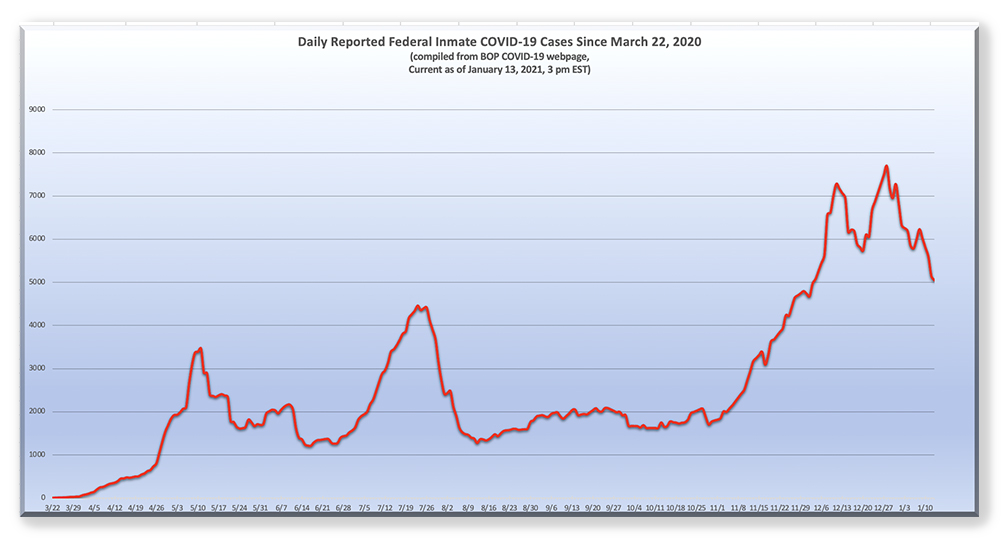
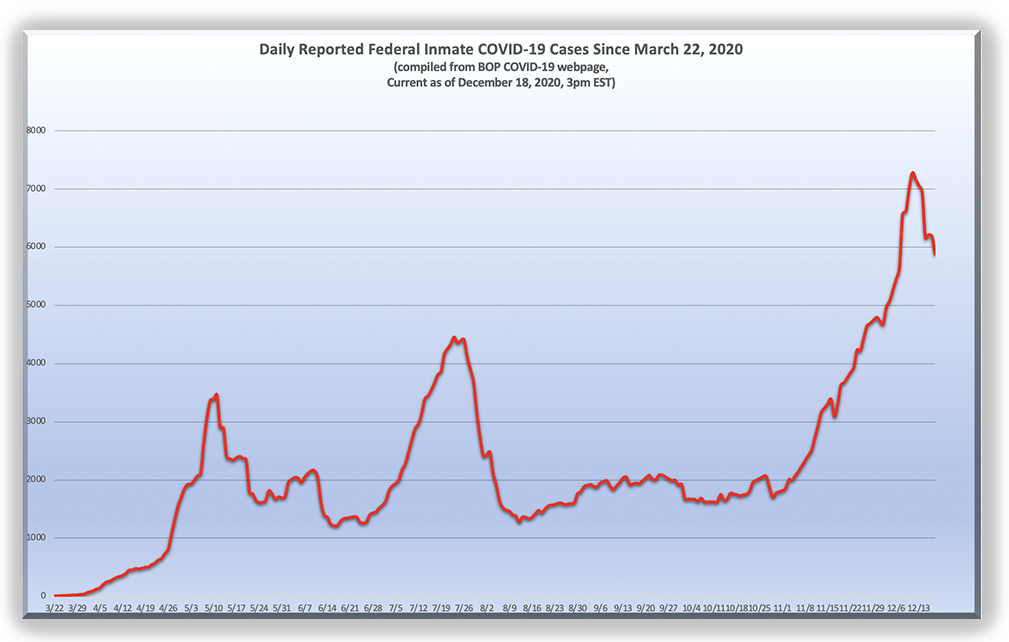
COVID might have been stymied at stopping the intentional killing, but it remains adept at bringing death to inmates. The number of dead inmates hit 198 last Friday. Inmate COVID cases fell 25% between Dec 31 and last Wednesday, but then jumped back up to 6,227 as of Friday. They started falling again (as the BOP continues to declare anyone who tested positive 10 days ago to be cured), settling at 5,043 yesterday.

Ominously, BOP staff cases continue to climb. The number crossed  2,000 for the first time ever last week, and stood at 2,107 yesterday. If the staff keeps getting sick, more inmates invariably will contract it as well.

BOPCOVID210113

As of yesterday, FCI Ft Dix reported 461 cases, with Lexington (444 cases), Butner Medium II (208 cases) and nine other facilities with more than 100 cases each, with 19 more having 50 or more cases.

The BOP’s vaccine program is not going all that well. Government Executive reported last week that the Bureau “has received just 12,800 vaccine doses, but has already used 57% of those.” The BOP has distributed the vaccine to only 31 of its roughly 150 facilities. COs and health care workers are receiving the vaccine in the BOP’s first phase of distribution, although some inmates have gotten vaccines when stocks remained after all employees who elected to get vaccinated had been served. Only about “half of staff at each of the 31 facilities receiving vaccines have so far been vaccinated, according to Justin Long, a bureau spokesman. Inmates will begin receiving doses when more become available under a plan developed by the Trump administration’s Operation Warp Speed, Long said.”

Meanwhile, a national debate is brewing over whether inmates should be inoculated before the general population. Health officials say inoculating prison employees without giving the shot to prisoners won’t help stop the spread. “It doesn’t make sense to vaccinate workers but not vaccinate the people they are charged with protecting,” said Wanda Bertram, a spokeswoman for the Prison Policy Initiative, which is advocating that staff and inmates receive the vaccine.

nothing170125But a typical reaction came from Colorado Gov. Jared Polis, a Democrat, who said last month, “There’s no way it’s going to go to prisoners before it goes to people who haven’t committed any crime.”

Meanwhile, the Minnesota ACLU accused FCI Waseca staff of showing deliberate indifference to inmates during a massive COVID-19 outbreak in a hearing last Wednesday. The ACLU represents a plaintiff class of inmates seeking a temporary injunction to release many Waseca inmates to home confinement to curb the spread of the outbreak.

ACLU lawyer Clare Diegel called it a “drastic remedy” but necessary because of “terrifying” conditions at the prison. But Erin Secord, an AUSA representing the BOP, insisted the prison had taken numerous steps to protect inmates, the infections had been quelled and the court lacked jurisdiction to release prisoners. She said the suit should be dismissed.

control200511The president of a union representing employees at FCI Williamsburg in South Carolina last week blamed prison leadership for decisions that led to skyrocketing COVID-19 cases there. ”They made some changes on the process of what we were doing… that allowed COVID to actually walk into the institution,” American Federation of Government Employees’ Local 525 President Stephen Pinckney said. “From there, it spread like wildfire once it got in.”

Pinckney alleged that the process of screening people entering the complex to determine whether they had potential symptoms of COVID-19 symptoms was shifted from outside the facility to inside in early December. “I really would like to see our executive staff removed for one thing because they are more concerned right now on the financial side of the institution that they are about the health and wellbeing of staff there,” Pinckney said.

Indianapolis Star, Terre Haute executions paused by judge until COVID-19 measures are instituted (January 8, 2021)

Government Executive, Federal Agencies Have Distributed 200K Coronavirus Vaccine Doses So Far (January 4, 2021)

Wall Street Journal, As Covid-19 Surges in Jails, Guards Want Vaccine Early (January 4, 2021)

WCSC-TV, Charleston, South Carolina, Prison workers union calls for action on COVID-19 outbreak at FCI Williamsburg (January 8, 2021)

– Thomas L. Root

Where Did The HEROES Go? (And Other Stories That Puzzle Inmates) – Update for January 4, 2021

We post news and comment on federal criminal justice issues, focused primarily on trial and post-conviction matters, legislative initiatives, and sentencing issues.

DEAD HEROES

deadheroes210104Last May, the House of Representatives passed the HEROES Act, intended to be the second coronavirus stimulus. The bill, which included in its $3 trillion giveaway a number of criminal justice changes (like letting eligible elderly offenders get home confinement after two-thirds of their good-time adjusted sentences, instead of gross sentences), was promptly denounced by Republicans appalled at its price tag and then ignored by the Senate.

Eight months later, I am still getting questions about it, mostly from people who may have been sleeping in the back of the classroom during high school government class.

A bill passed by the House must then be passed by the Senate and then signed by the President in order to become law. In the case of HEROES, the Senate refused to consider the bill. Rather, the Senate passed the HEALS Act in response to HEROES, a bill that was then immediately not considered by the House.

sleep210104What finally happened last month was that the Senate and House worked out a compromise bill that was neither HEROES nor HEALS. The compromise bill included no sentencing provisions at all, a fact that seems not to detain prisoners at all. One inmate wrote me last weekend, asking me to confirm the rumor that § 205 of the stimulus bill gave elderly offenders the home confinement adjustment they sought. Alas, § 205 is entitled “Pipeline Safety Management Systems,” a provision of interest to elderly offenders only if they’re in the natural gas transmission business.

Another inmate asked me whether HEROES might still pass in January or February. Remember this from high school civics, boys and girls: every Congress lasts two years, and ends on January 3. The 116th Congress ended yesterday, and the 117th Congress starts its two-year run today. When a two-year Congress ends, any bill not passed by both the House and Senate is dead.

That means the sentencing changes contained in HEROES will have to be introduced all over in a new bill.

caresbear210104Someone else wondered how long the BOP’s home confinement authority will last under the CARES Act. There are three answers to that. First, the BOP’s authority lasts until 30 days after the COVID-19 national emergency declared by Trump ends. The National Emergencies Act requires any emergency to end one year after it is declared, unless extended by the President. Since some national emergencies (such as with respect to Iranian assets) have continued for four decades. The current COVID emergency ends in March, but there is little doubt Biden will extend it.

Second, the BOP’s authority only lasts as long as the Attorney General’s determination that the emergency conditions are “materially affect[ing] the functioning of the BOP.” Attorney General Barr made that determination last April, but he or the new AG could withdraw the finding at any time.

Finally, the CARES Act lets the BOP Director put prisoners in home confinement “as the Director determines appropriate.” This provision delegates virtually unreviewable power to the BOP. If the Director decided tomorrow that he had sent all the people he needed to send, he could pull the plug.

A year ago, the BOP population stood at 175,858 inmates. As of last week, the number had fallen 13.5% to 152,184. That’s a 31% drop from six years ago.

No one knows when the BOP will no longer place prisoners in home confinement. But we’re much closer to the end than we are to the beginning.

HEROES Act, H.R. 6800 (May 15, 2020)

HEALS Act, S.4318 et al. (July 27, 2020)

Section 205, Consolidated Appropriations Act, 2021 (December 27, 2020)

Section 12003(b)(2), CARES Act, H.R. 748 (March 28, 2020)

Sentencing Law and Policy, Federal prison population closes out 2020 at new modern low of 152,184 according to BOP (December 31, 2020)

– Thomas L. Root

Light at the End of the Tunnel is an Oncoming COVID Train – Update for December 31, 2020

We post news and comment on federal criminal justice issues, focused primarily on trial and post-conviction matters, legislative initiatives, and sentencing issues.

STILL LOOKING FOR THE PEAK?

Last week, I reported that the Bureau of Prisons’ numbers had dropped 25% from the week before, suggesting that maybe the latest BOP COVID spike had peaked, and recovery was at hand.

BOPCOVID201230

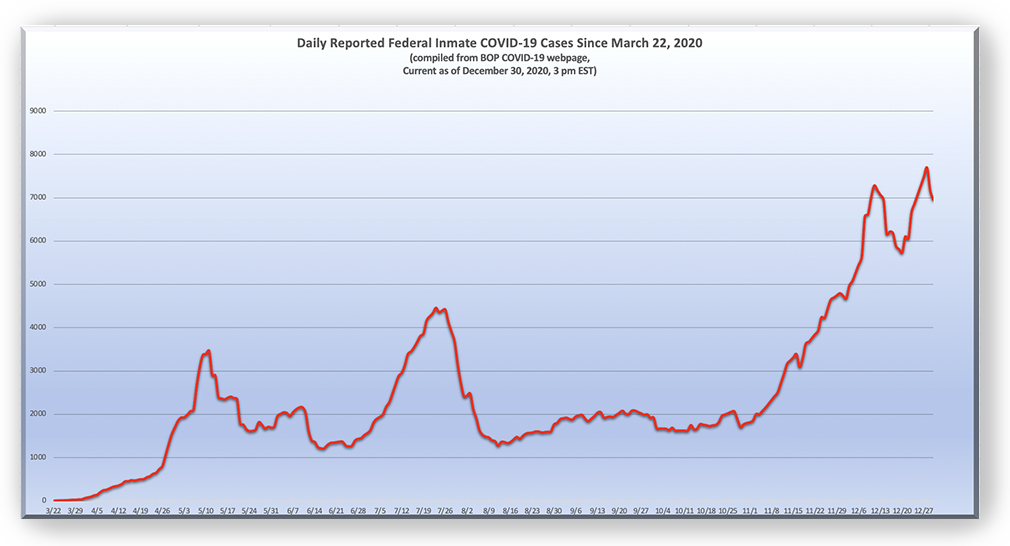
No such luck. As of last Monday, the system’s active cases had jumped 12% from a week earlier, to 7,690 active inmate cases and 1,616 sick staff, COVID in 127 BOP facilities and 188 dead inmates. The number of sick inmates fell yesterday to 6,949, still 11% higher than two weeks ago. As of last night, BOP has tested 64% of all inmates at least once, with a worrisome positivity rate of 40%.

lighttunnel201231Last week, I noted that despite official pronouncements that only BOP staff were getting COVID-19 vaccine, I had received inmate reports that some prisoners had been vaccinated at two Texas facilities and one in North Carolina. Last Tuesday, the BOP told Associated Press that the vaccine had been delivered to four facilities that had been among some of the hardest hit during the pandemic, including FCC Butner. AP quoted a BOP spokesman as saying that while it continued to plan to offer vaccines to full-time staff, “at this time, we can confirm high risk inmates in a few of the BOP facilities in different regions of the country have received the vaccine.” AP noted the BOP did not say how many inmates had been vaccinated, how the inmates were selected, or how many doses of the vaccine the agency had received.

The agency told the AP about half of the staff at each of the four facilities that received the vaccine had been inoculated. The balance was offered to inmates.

COVIDvaccine201221Forbes magazine reported last Monday that “word came from someone who is an inmate in an institution in the mid-Atlantic US that they are on a list to receive the vaccination at the first of the year. The vaccinations represent the first step in curbing the spread of COVID-19 in prisons. The roll-out of the vaccines to inmates will certainly cause a disruption in the number of compassionate release cases and the release of inmates under the CARES Act.” Forbes is a usually reliable publication, but the report – from a single unidentified inmate – is pretty thinly sourced.

As of last night, Fort Dix, Terre Haute, Safford, Pekin, Lexington, Schuykill and Atwater were all reporting more than 200 inmate COVID-19 cases. Another 14 facilities had more than 100 inmate cases.

Every inmate death is concerning, but three last week were especially troubling. An inmate at Talladega died of COVID-19 without ever being diagnosed with the disease or presenting symptoms. A Lompoc inmate had COVID in May and was declared “recovered,” but was hospitalized in August with COVID. He remained there until dying December 15. In a third case, a Memphis inmate with no prior medical conditions whatsoever fell ill on December 2, was hospitalized 10 days later, and died December 19.

Finally, a most unusual compassionate release: After a mix-up by the BOP, a Guam federal judge granted Jesse Cruz’s sentence reduction motion and ordered his immediate release.

Jesse had health issues including post-traumatic stress disorder, degenerative spinal disc disorder, sciatica, sleep apnea and other issues, according to US District Court Judge Frances Tydingco-Gatewood.

release161117There was also an “extremely rare and unique situation” in Jesse’s case: the BOP miscalculated his release date, releasing him from FCI Sheridan on October 14, although his home confinement was not supposed to start until next February. The BOP didn’t give Jesse any medication when he was sent to Guam, even though the FCI Sheridan doctor had ordered he get his medication upon release.

Upon arriving on Guam, Jesse had to quarantine at a government facility. While Jesse was in quarantine, the BOP realized its mistake and had Cruz arrested when he left the quarantine facility.

During a hearing last Wednesday, the Judge learned Jesse hasn’t received any medication at all while incarcerated on Guam, even after Jesse and his wife presented numerous requests for medication and a CPAP machine to the detention facility and the U.S. Marshals. While Jesse’s health conditions would not normally justify compassionate release, the Judge ruled, “the disturbing failure of the BOP to properly calculate his release date from FCI Sheridan has resulted in a total lack of care for Cruz’s ailments.” Jesse “has been forced to serve several months of his sentence at a non-BOP facility while suffering from numerous maladies of the mind and body without respite,” the Judge held.

The Hill, Federal Bureau of Prisons reverses on withholding COVID-19 vaccine from inmates (December 22, 2020)

Greensboro, N.C. News & Record, Reversing course, feds say some N.C. inmates got virus vaccine (December 23, 2020)

Forbes, Federal Bureau of Prisons Starts Vaccination of Staff, Inmates Soon Thereafter (December 21, 2020)

Pacific Daily News, ‘Extremely rare and unique situation’: Sentence reduced for man mistakenly released (December 24, 2020)

– Thomas L. Root

Inmate Vaccine Not In The Near Term? – LISA Newsletter for December 21, 2020

We post news and comment on federal criminal justice issues, focused primarily on trial and post-conviction matters, legislative initiatives, and sentencing issues.

INMATES NO PRIORITY FOR VACCINE, ADVISORY PANEL RECOMMENDS

COVIDvaccine201221The Federal Bureau of Prisons received its first shipment of COVID-19 vaccines last Wednesday, and began administering the drug to its correctional officers and health care staffers. The agency said inmates will follow “when additional doses are available.”

And that’s not going to be anytime soon. Earlier this month, the Advisory Committee on Immunization Practices said health care workers and nursing home residents — about 24 million people — should be at the very front of the line for the vaccines. Sunday afternoon, the panel voted 13-1 that next in line should be people 75 and older, who number about 20 million, as well as certain front-line workers, who total about 30 million. Those essential workers include firefighters and police; teachers and school staff; those working in food, agricultural and manufacturing sectors; corrections workers; U.S. Postal Service employees; public transit workers; and grocery store workers.

The committee also voted that behind those groups should be people aged 65 to 74, numbering about 30 million; those aged 16 to 64 with certain medical conditions such as obesity and cancer, that are at higher risk if they get infected with COVID-19, numbering as many as 110 million; and a tier of other essential workers. This group of as many as 57 million includes a wide category of food service and utility workers but also those in legal and financial jobs and the media.

How about vaccine for inmates? The BOP told CBS last week that it is up to Operations Warp Speed to decide when inmates will receive the vaccine. CBS reported, however, that a spokesperson for Operation Warp Speed said the BOP would decide about the timeline.

The National Commission on Covid-19 and Criminal Justice last week recommended that inmates receive priority consideration for Covid-19 vaccines equal to that for police and correctional officers. That recommendation, however, appears to be one of many rejected by the Advisory Committee.

inoculation201221And yet… I received several inmate emails last week (and this is totally unconfirmed) that a handful of BOP inmates at two facilities received vaccine last week. The emails gave no indication of how the inmates were selected for the vaccine. One – from a Texas BOP facility written two days ago – said

well the good news and vibes ran out on the [institution] compound. we ran out of vaccines before we completed even one building. of course the fact that no one was planned to receive it inmate wise. what we did get is hopefully helpful. my building has about 40% done on the first dose.

Another inmate email, received early this morning, independently reported that some inmates at the same institution (“at least a couple hundred,” the report stated) received vaccine.

An inmate in a separate Texas facility reported Friday night:

I thought you’d be interested in reports that 100 inmates received their first dose of the vaccine today. Some of these are known personally to me, so I can confirm that they were sent to the clinic and given a shot. They were told that they would be called back to the clinic in 21 days for their second dose. Reportedly, all staff who wanted the vaccine have received their first dose.

One can reasonably infer from the emails that perhaps the vaccine being administered was left over after staff inoculations had been completed, and – having been thawed – had to be used within five days.

[Later note: An inmate from a North Carolina facility reported by email on Monday, December 21, that he had gotten the vaccine: “Once the staff here at the [institution] received their vaccinations if they chose, there were doses left over. Instead of letting those doses go to waste, the staff chose to offer them to some of the inmates based on their medical conditions.  There were probably around 30 or so in my housing unit, including myself, that were offered the vaccine.  Most of us chose to take it.  I, myself, am thankful to the staff for making that decision and offering them to us and I felt that I needed to let you know that some of us are getting it.” ]

More than two dozen members of House of Representatives last Wednesday demanded details about how inmates will be vaccinated for COVID-19, questioning whether the most vulnerable prisoners will have priority access.

In a letter to BOP director Michael Carvajal and Centers for Disease Control and Prevention chief Dr. Robert Redfield, the 26 lawmakers, led by Rep. Bobby Scott (D-Virginia), wrote,

The BOP has provided informal information regarding the vaccine distribution plan. We are deeply concerned that the current plan places the most vulnerable incarcerated individuals who have a cancer diagnosis, chronic kidney disease, chronic obstructive pulmonary disease, heart conditions, compromised immune systems, sickle cell, diabetes, and individuals 65 years or older in priority level 3 behind incarcerated individuals in minimum security facilities who are in open bay housing and are currently listed in priority group 2. Incarcerated individuals with these types of medical conditions are at a high risk of complications if they contract COVID-19 as it spreads through federal prisons yet are slated to receive the vaccine after prison staffers in phase 1 and other incarcerated individuals listed in phase 2.

Despite reporting that over 1,500 inmates “recovered” from COVID-19 within just a few days of each other, the BOP still reported having 5,881 active inmate cases,1,694 sick staff, COVID in 126 BOP facilities and 180 dead inmates (up 13 in one week). The BOP has tested 62% of all inmates at least once, with the positivity rate continuing to ratchet up. As of last Friday, 36% of all inmate tests are positive for COVID.

Still, the trend apparently suggests that the latest BOP outbreak has peaked.

BOPCOVID201218

As of last Friday, Sandstone, Florence, Loretto and Pekin all reported over 200 inmate COVID-19 cases, another 12 facilities had more than 100 cases, and another 20 joints had 50 or more. Loretto had been written down from over 600 cases earlier in the week as inmates are declared to be recovered.

A cautionary note about those “recovered” inmates. Of the 13 inmates who died last week, two – a 64-year old man at FCI Victorville I and a 72-year old man at FCI Lompoc – had contracted COVID-19 months ago, and were considered “recovered” before getting much sicker and dying. In fact, the State of Michigan Dept of Health said last week that it is currently investigating 115 of “recovered” state inmates testing positive for COVID-19 three months after they were believed to be COVID-free.

New York Post, Federal prison workers to start getting vaccinated Wednesday (December 14, 2020)

Chicago Tribune, Federal panel says people over 75, essential workers should be next in line for COVID-19 vaccine as Moderna shots begin shipping out (December 20, 2020)

CBS News, Federal prisons to prioritize staffers for COVID-19 vaccine and give to inmates when more doses are available (December 18, 2020)

National Commission on Covid-19 and Criminal Justice, Experience to Action: Reshaping Criminal Justice After COVID-19 (December 14, 2020)

Letter to BOP from Rep. Robert C. Scott (D-Virginia) (December 15, 2020)

Reuters, U.S. lawmakers press prison authorities on inmate COVID-19 vaccination plans (December 16, 2020)

Detroit Free Press, State reviewing possible COVID-19 reinfections after 115 prisoners test positive twice (December 12, 2020)

– Thomas L. Root

Director Says BOP “Has A Sound Pandemic Plan In Place…” As COVID-19 Spirals Out of Control – Update for December 14, 2020

We post news and comment on federal criminal justice issues, focused primarily on trial and post-conviction matters, legislative initiatives, and sentencing issues.

COURT ORDERS BOP TO HONOR SETTLEMENT, WHILE INMATE COVID CASES INCREASE 30% IN ONE WEEK

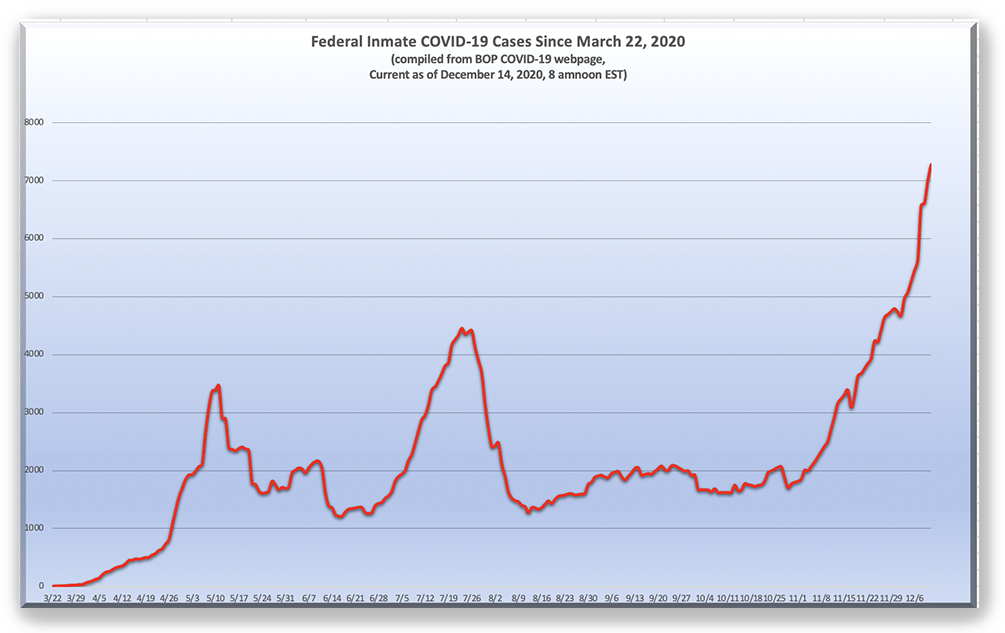
Ten days ago, the number of Bureau of Prisons inmate COVID-19 cases passed 5,000. That was a first… but it was nothing compared to last week.

As of last Friday, the BOP reported 7,278 ill inmates (a 30% from the week before),1,716 sick staff (up 9% from last week), COVID-19 in 127 BOP facilities and 167 dead inmates. The BOP has tested 58% of all inmates at least once, with the positivity rate continuing to ratchet up. As of last Friday, 34% of all inmate tests are positive for COVID.

BOPCOVID201214

Recall that on December 2, BOP Director Michael Carvajal told a House Subcommittee that the BOP’s COVID-19 “procedures have proven effective as this is evidenced by the steep decline in our inmate hospitalizations, inmates on ventilators and deaths.” Some feel differently.

Last Friday, a Connecticut U.S. District Court found that the BOP had violated its settlement agreement in a class action of 450 medically vulnerable prisoners brought last spring over COVID-19 conditions at FCI Danbury. The unhappy judge ordered the BOP to release 17 medically vulnerable inmates by 5 p.m. the next day (a Saturday), prohibited the BOP from relying on administrative roadblocks to delay the release of those granted home confinement, and directed the BOP to report to the plaintiffs’ attorneys whenever the agency expects to fail to release inmates granted CARES Act home confinement within 14 days of grant.

The court order followed a long hearing the day before, where the court heard about a new Danbury COVID-19 outbreak and the BOP’s corresponding failure to mitigate the spread of the disease. In one week, the number of Danbury COVID-19 cases went from zero to nearly 50. The plaintiffs said despite the BOP’s promise to check daily for symptoms for the duration of the pandemic, the BOP failed to follow this pledge for two weeks during a surge of the disease around the country.

A July settlement of the lawsuit required the BOP to promptly identify prisoners who are low security risks and have a greater chance of developing serious complications from the virus and release them to home confinement. The settlement called for prisoners to be released within 14 days of being approved. But the plaintiffs’ lawyers say some of them have been waiting nearly three months to be released after being approved for home confinement.

whoyabelieve201214The BOP cited several reasons for the delays in releasing the inmates, including required 14-day quarantines due to the virus and BOP guidelines in releasing inmates to the community. The Court was not impressed.

Meanwhile, in Minnesota, the ACLU last week filed suit alleging the BOP’s FCI Waseca has “failed to respond in any meaningful way to the pandemic.” The ACLU says the prison did not release medically vulnerable people from the prison, where two out of three inmates contracted COVID-19, making social distancing impossible.

New Jersey congressional leaders last week renewed their call to end inmate transfers to FCI Fort Dix. Led by Senators Robert Menendez and Cory Booker (both D-New Jersey), the state’s congressional delegation sent a second letter to BOP Director Carvajal week calling for the end of inmate transfers and asking the BOP to outline its plan for allocating and administering the COVID vaccine.

The BOP had previously instituted a moratorium on all inmate transfers to Ft Dix through Nov. 23 as active cases hit 300. The lawmakers and BOP staff have pointed to the October transfer of inmates from FCI Elkton to Ft Dix as the cause of the outbreak. BOP officials have denied the accusation. The moratorium was not extended, the BOP said last week, despite a previous letter from the state’s lawmakers demanding the moratorium continue until there are no active cases at the prison.

“By resuming transfers of incarcerated individuals into and out of the facility in the midst of a severe outbreak, BOP is putting at risk the lives of both staff and incarcerated individuals,” the lawmakers wrote in the letter.

COVIDheart200720The BOP is seeing a resurgence of COVID at institutions where it had previously been controlled. The virus is again at FCC Lompoc, site of one of the worst prison COVID outbreaks in the country, according to the Santa Barbara Independent. An investigation last summer by the Dept. of Justice Inspector General found that the BOP’s initial response to COVID “failed on a number of fronts and likely contributed to the severity of the outbreak, including staffing shortages, inadequate screenings, and a scarcity of protective equipment.”

As of Friday, Englewood and Loretto each have more than 600 sick inmates, Texarkana and Pekin more than 300 each, five more facilities with more than 200, and 12 more BOP institutions with over 100 active COVID cases.

When a local newspaper asked the BOP about Loretto, a spokesman said the prisons are following accepted guidelines. While declining to address the Loretto situation “due to privacy, safety and security reasons,” the spokesman told the paper, “we can tell you all institutions have areas set aside for quarantine and medical isolation.”

Meanwhile, The New York Times last week criticized the BOP for its management of COVID at FDC Brooklyn. Noting that 55 inmates had tested positive for COVID-19, The Times said, “many months into this pandemic, the Federal Defenders of New York, a legal advocacy group, said officials at the jail aren’t following basic public health guidelines to prevent the spread of the virus, to care for sick inmates or to protect those who are most vulnerable. The reports… are disturbing. Corrections officers, they say, aren’t properly wearing masks, including while interacting with inmates. Sick inmates aren’t receiving proper medical attention and are being placed in cells with healthy individuals. One person incarcerated at the facility told an attorney with the Federal Defenders that severely ill inmates who asked for medical attention didn’t get it.”

A BOP spokesman disputed the Defenders’ claims. Nevertheless, the Times said, “if the conditions are anything like what the Federal Defenders describe, they are an affront to human dignity and a threat to the public health of Americans in and out of the Brooklyn facility.”

lies170310And here’s an interesting glimpse at the BOP’s record-keeping, a factoid that could suggest to reasonable people that the BOP’s numbers cannot necessarily be trusted. A Youngstown, Ohio, news website, reporting on Columbiana County, Ohio, COVID numbers, was trying to derive a number of people recovered from the virus. It noted that FCI Elkton – located in the county – reported “896 incarcerated people and 54 employees had recovered from COVID-19 as of today… That number has declined in recent weeks, suggesting the bureau removes cases from its total when people are transferred out of the prison.”

Yale University Law School, CJAC Wins Speedy Release of Medically Vulnerable Individuals from Federal Prison in Danbury (December 12, 2020)

Order, Whitted v Easter, Case No 3:20-cv-00569 (D. Conn, December 11, 2020)

WWLP-TV, Judge orders release of 17 virus-vulnerable federal inmates (December 12, 2020)

KMSP-TV, ACLU sues federal prison in Waseca, Minn. after 67% of inmates test positive for COVID-19 (December 10, 2020)

Burlington County Times, More NJ lawmakers renew call for end to inmate transfers at FCI Fort Dix (December 10, 2020)

Johnstown Tribune-Democrat, Feds: Loretto prison following guidelines (December 11, 2020)

Mahoning Matters, Columbiana County reports 244 new COVID-19 cases, 2 new deaths (December 11, 2020)

New York Times, Stop the Coronavirus Outbreak at Brooklyn’s Federal Jail (December 8, 2020)

– Thomas L. Root

Whither Vaccine? – Update for December 10, 2020

We post news and comment on federal criminal justice issues, focused primarily on trial and post-conviction matters, legislative initiatives, and sentencing issues.

VACCINE DELIVERY TO FALL SHORT WHILE DEBATE OVER INMATE ACCESS INTENSIFIES

The Washington Post reported last Saturday that federal officials have slashed the amount of coronavirus vaccine they anticipate will ship in December because of constraints on supply, sending local officials into a scramble to adjust vaccination plans and highlighting how early promises of a vast stockpile before the end of 2020 have fallen short.

COVIDstockpile201210

And if that were not enough, it now appears that before Pfizer’s coronavirus vaccine was proved highly successful in clinical trials last month, the company offered the Trump administration the chance to lock in supplies beyond the 100 million doses the pharmaceutical maker originally agreed to sell the government. The New York Times reports, however, that the administration, according to people familiar with the talks, never made the deal, “a choice that now raises questions about whether the United States allowed other countries to take its place in line.”

papertiger201210

The President issued an executive order on Tuesday that proclaimed other nations will not get the U.S. supplies of its vaccine until Americans have been inoculated. But, the Times said, “the order appears to have no real teeth and does not expand the U.S. supply of doses…”

Instead of the delivery of 300 million or so doses of vaccine immediately after emergency-use approval and before the end of 2020, as the administration had originally promised, current plans call for availability of around a tenth of that, or 35 to 40 million doses. And that is out of a maximum delivery of 100 million Pfizer doses, enough to inoculate 50 million people.

Meanwhile, The New York Times reported a week ago that as public health officials are scrambling to develop guidelines for the equitable allocation of limited vaccine supplies, “inmates are not ranked in the top tiers of the federal criteria, even though some of the largest outbreaks have occurred in the nation’s prisons.” The CDC advisory committee has prioritized correctional officers and others who work in jails and prisons for the first phase of immunizations, a decision the Times says “raises a chilling prospect: another prison outbreak that kills scores of inmates after the only preventive was reserved for staff.”

corona200313Several groups, including the American Medical Association, are calling for coronavirus vaccines to be given to inmates and employees at prisons, jails and detention centers, citing the unique risks to people in confinement — and the potential for outbreaks to spread from correctional centers, straining community hospitals. “We aren’t saying that prisoners should be treated any better than anybody else, but they shouldn’t be treated any worse than anybody else who is forced to live in a congregate setting,” said Dr. Eric Toner, co-author of a report on vaccine allocation published by the Johns Hopkins Center for Health Security.

But a political backlash has been brewing over the idea that inoculating people behind bars should be a priority. “Killers and rapists set to get COVID vaccines before Granny,” a recent Fox News segment proclaimed.

Curiously (and this should be treated as probably true but unconfirmed) two inmates from two very different locations – FCI Petersburg Medium and FMC Carswell – told me yesterday that BOP health services personnel were surveying inmates at each location to determine their willingness to be vaccinated.

Can we pronounce the word “optimism,” boys and girls?

The Washington Post, Trump’s Operation Warp Speed promised a flood of COVID vaccines. Instead, states are expecting a trickle (December 5, 2020) 

The New York Times, Trump administration officials passed when Pfizer offered months ago to sell the U.S. more vaccine doses (December 7, 2020)

The New York Times, Prisons Are Covid-19 Hotbeds. When Should Inmates Get the Vaccine? (December 2, 2020)

– Thomas L. Root

Higher and Higher… – Update for December 8, 2020

We post news and comment on federal criminal justice issues, focused primarily on trial and post-conviction matters, legislative initiatives, and sentencing issues.

BOP COVID CASES BREAKS 5,000 AS LEGISLATORS GRILL CARVAJAL

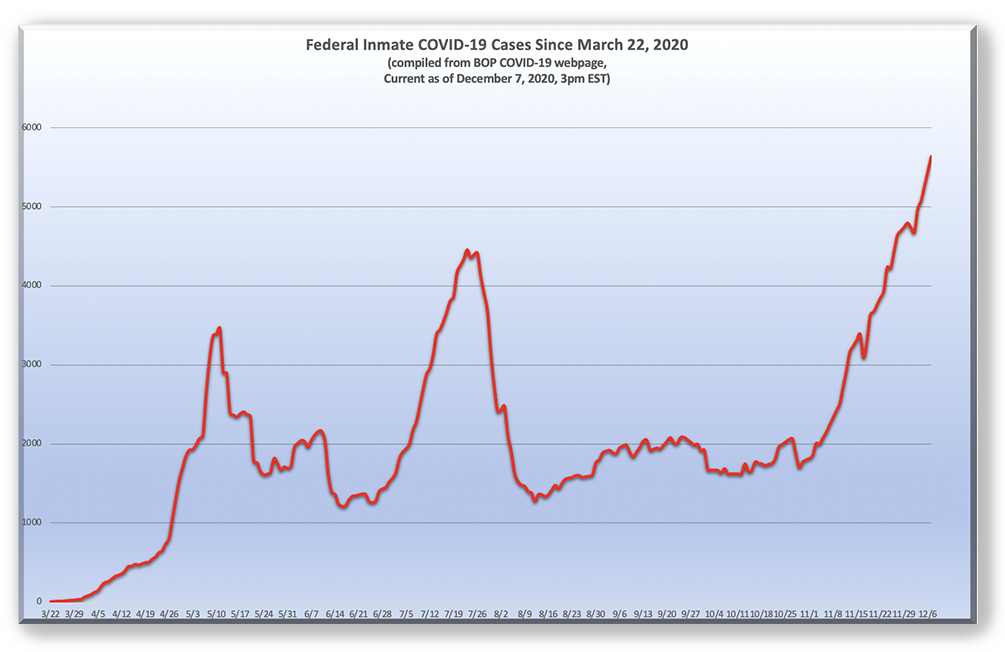
rocket-312767BOP inmate COVID-19 cases passed a grim milestone last Friday, rocketing past the 5,000 mark. That number jumped another 10% over the weekend. As of last night, the BOP had ended with

•     5,634 ill inmates (up 15% from the week before);

•    1,613 sick staff (up 12% from last week);

•    COVID in 128 BOP facilities; and

•    163 dead inmates.

The BOP has tested 57% of all inmates at least once, with the positivity rate climbing from 25% – where it has hovered for months – to over 32%.

To put this in perspective, one out of every five federal inmates who has ever had the virus has it right now.

BOPCOVID201208jpg

Two BOP facilities have more than 300 sick inmates, Loretto and Texarkana, three more with over 200 ill, andand another 16 with over 100 COVID cases. USP Tucson has 75 sick staffers, with Pollock in second place with 60 and Oklahoma FTC with 50.

Last Wednesday, BOP Director Michael Carvajal testified before the House Subcommittee on Crime, Terrorism, and Homeland Security. It wasn’t pretty. After he delivered his prepared statement – a BOP puff piece about how in response to COVID-19, the BOP had “implemented a decisive and comprehensive action plan to protect the health of the inmates in our custody, the staff, and the public, to the greatest extent possible, consistent with sound medical and corrections principles” and how the BOP’s “procedures have proven effective as this is evidenced by the steep decline in our inmate hospitalizations, inmates on ventilators and deaths” – the knives came out.

fired161227Subcommittee Chair Karen Bass (D-California) quoted a Dept of Justice Inspector General report that found up to six days elapsed before FCI Oakdale inmates who had been exposed or tested positive for COVID-19 were isolated, and wondered how that squared with the BOP’s representations. Carvajal insisted that the situation in Oakdale was not representative of BOP policies, and blamed the then-warden. “In a nutshell, we had some leadership issues there,” he said. “Our regional director had some concerns about the procedures not being enforced or followed. In essence, without getting into details, I removed the leadership.”

Carvajal pushed back at Subcommittee demands the BOP institute a blanket staff testing plan (arguably a good idea considering that 43% of all staff who have had COVID since March are sick right now). He argued that the BOP could not compel employee COVID tests. But a written statement filed with the Subcommittee by Shane Fausey, national president of the BOP employees’ unions, disputed that, complaining that despite unions’ urging, the BOP “has repeatedly refused” to offer voluntary coronavirus testing to staff members at the prison facility where they work. Instead, Fausey said, “employees who believe they were exposed or might be infected with the coronavirus must get tested on their own time and in their own communities.” For good measure, Fausey also blasted BOP and Marshals Service for transferring inmates without adequate quarantining, which he said has put “the health and safety of tens of thousands of federal correctional workers, their families, and their communities at risk.”

covidtest200420In a separate exchange with Representative Sheila Jackson Lee (D-Texas), the director said he could not force his employees to get tested for Covid-19, although the BOP waives insurance copays for those tests.

“I understand civil liberties, civil rights the Constitution, but you’re talking about individuals coming into contact with incarcerated persons who can’t walk away, who can’t get out,” Jackson Lee said. “And that means they are endangering themselves, their families at home.”

Rep. Hakeem Jeffries (D-New York) braced Carvajal about underutilization of compassionate releases. Before filing for a compassionate release, an inmate must first ask the BOP to bring the motion for him or her, a vestige of the procedure before the First Step Act broadened the law to let inmates bring their own motions. Jeffries noted that while about 2,000 such motions had been granted by courts, the BOP had approved only 11 requests when inmates first asked to the agency to do so. Jeffries asked Carvajal, “10,929 requests out of 10,940 requests were rejected, does that sound right?”

Carvajal said the BOP has been intentionally careful. Given public safety considerations, Carvajal said, the BOP’s approval rate of 0.1% makes sense: it is “not a process that should be rushed.” This suggests that the courts, with compassionate release approval rates that are 182 times higher than the agency, are profligate.

The day before the hearing, Government Executive magazine published a sobering piece in which BOP employees said that staffing shortages and COVID-19 are creating a crisis. “If not for COVID, we would still have augmentation but it wouldn’t be as crazy,” Joe Rojas, a union official. “It’s already a dangerous workplace with COVID and it’s made worse by understaffing.”

quit201208Several employees said they expect that attrition to accelerate in the coming months. Rojas said he and many others have stuck around in part due to a retention bonus the BOP offered to veteran workers in recent years. That incentive is disappearing next year, he said. A BOP spokesman said the Bureau is providing incentives “where appropriate” and taking other steps to boost recruiting. He noted the agency has hired 3,400 employees in 2020, a sharp uptick over recent years.

Already some of the prisons in the Southeast, Rojas said, are operating at 70% or less of their expected workforce level. “You can’t run a prison like that. The seams are going to burst,” he said. “I’m afraid.”

DOJ, Statement of Michael D. Carvajal, Director Federal Bureau Of Prisons (December 2, 2020)

Courthouse News Service, Officials Spar Over Covid Spread Through Prison System (December 2, 2020)

Statement of Shane Fausey, National President, Council of Prison Locals (December 2, 2020)

Government Executive, Federal Prison Employees Fear Staff Shortages and Mass Reassignments as COVID-19 Cases Spike (Dec 1)

– Thomas L. Root

Pinching a Statute ‘Til It Hollers: BOP and Earned Time – Update for December 2, 2020

We post news and comment on federal criminal justice issues, focused primarily on trial and post-conviction matters, legislative initiatives, and sentencing issues.

BOP ROLLS OUT PROPOSED FSA EARNED TIME RULES

Twenty-three months after passage of the First Step Act authorized the Federal Bureau of Prisons to give earned time credits to inmates who complete programs that have been shown to reduce recidivism, the BOP is finally getting around to adopting rules on how such credits will be rewarded. And, unsurprisingly, the BOP is making Ebenezer Scrooge look like Santa Claus.

scrooge201202First Step focused on assessing each prisoner’s likelihood of recidivism and rolling that assessment into a recidivism and needs assessment system known as PATTERN. The BOP was then to determine which of the programs identified as likely to reduce recidivism each inmate needed. As the inmate completed the programs, he or she would see the PATTERN score – ranging from “high risk” down to “minimum risk” – decrease. To encourage the prisoners to complete the programs, First Step authorized the award of “earned time credits,” equal to 10 to 15 days for each 30 days of programming completed. The earned-time credits can be used for more halfway house, more home confinement, or up to 12 months of early release.

Of course, the devil’s in the details. The language in the Act says:

A prisoner shall earn 10 days of time credits for every 30 days of successful participation in evidence-based recidivism reduction programming or productive activities.

rules201202What exactly does First Step mean by “30 days of successful participation?” The BOP has finally announced proposed rules to define that, and the definition is a doozy.

The proposed rule figures that “30 days” means 30 program days. A “program day” is eight hours, the BOP says. In other words, a 500-hour program would be worth 500 hours/8 hours-to-a-day, or 62.5 program days. Completion of the 500-hour program would award an inmate two months (60 days) of program credit, which is worth 20 days earned time credit for inmates with medium or high recidivism risk, and 30 days credit for inmates with minimum or low risk.

In the BOP, a 500-hour program takes 12-18 months to complete.  That may seem like a fairly substantial commitment for a month more of home confinement. But it is consistent with what we’ve come to expect from the BOP: given a chance to interpret the extent of its authority to be lenient, it invariably interprets that authority in the most chary way possible.

results201202The proposed rule does settle one question which has been coming up often in the last few months: FSA earned time credits may only be earned for successful completion of an Evidence-Based Recidivism Reduction Program and Productive Activity assigned to the inmate based on the inmate’s risk and needs assessment, and only for those successfully completed on or after January 15, 2020.

The proposed rule does not address the procedures for determining whether an individual inmate will have FSA earned time credits applied towards prerelease custody, early transfer to supervised release, a combination of both, or neither. Instead, it only addresses the procedures for earning, awarding, loss, and restoration of FSA credits.

The public may submit comments to the BOP on the proposed rule until January 25, 2021.

Federal Register, Proposed Rule: FSA Time Credits (November 25, 2020)

– Thomas L. Root