Tag Archives: BOP

COVID Peaks, Vaccine on the Horizon – Update for December 1, 2020

We post news and comment on federal criminal justice issues, focused primarily on trial and post-conviction matters, legislative initiatives, and sentencing issues.

BOP HITS UGLY COVID MILESTONE AS VACCINE IS PROMISED

With yesterday’s numbers, the Bureau of Prisons continues into new  COVID-19 record with 4,792 sick inmates, topping previous records of 3,461 on May 11 and 4,454 on July 23. The inmate death toll hit 157 last week, with one fatality – Louis Rector at FMC Butner – having been declared recovered in July, only to be hospitalized two months later and then to linger for two months before dying.
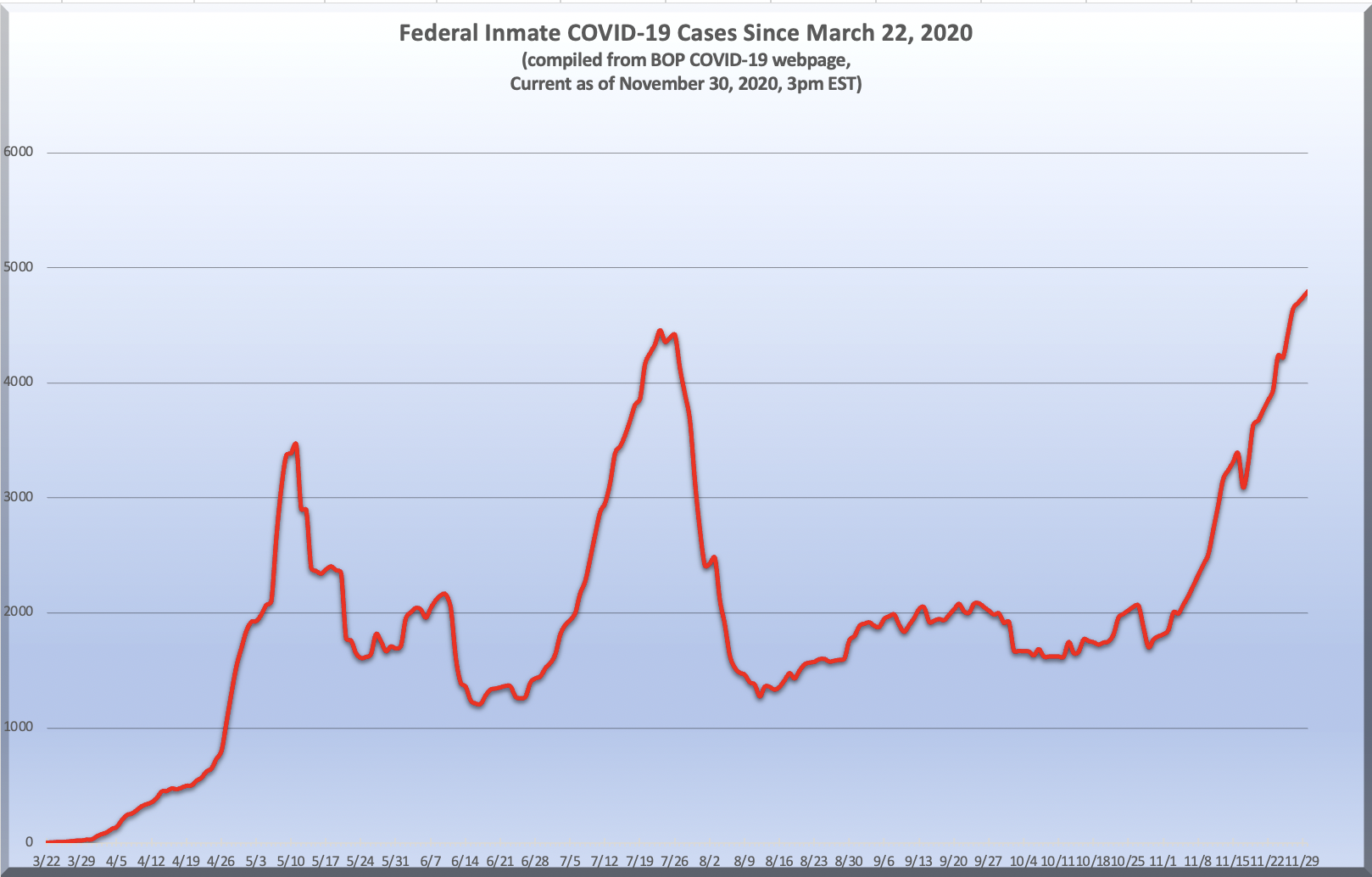
BOPCOVID201201A record 1,414 BOP staff are sick. COVID is in 126 BOP facilities. Fifteen joints have more than 100 inmates sick, and four have more than 200 COVID cases. The BOP says it has tested 54% of all inmates at least once, with a positivity rate of 29%.

The big news now is about vaccine. The Associated Press reported last week that the BOP would be “among the first government agencies to receive the coronavirus vaccine, though initial allotments of the vaccine will be given to staff and not to inmates, even though sickened prisoners vastly outnumber sickened staff,” citing documents it had obtained from the BOP.  AP said the BOP has “been instructing wardens and other staff members to prepare to receive the vaccine within weeks, according to people familiar with the matter. The people could not discuss the matter publicly and spoke to the AP on condition of anonymity.”
reinfection200831Government Executive reported that the BOP “would provide vaccines to all staff and inmates under the interim plan. Employees and inmates at private contract facilities are not slated for inclusion. In a recent memorandum for staff obtained by Government Executive, the bureau said employees, rather than inmates, would receive ‘initial allocations.’ CDC will determine the size of that allocation. The memo also provided a glimpse into the process federal workers will follow to receive a vaccine from their agencies: staff will follow a specific link that will allow them to register and, once registered, they can set up an appointment at their facility’s health services department.”

The government has not yet approved any vaccine, a necessary step before any doses can be delivered. Several vaccine makers have asked for expedited permission, and CBS reported yesterday that vaccine may be available by Christmas.

Advocates say the federal government should be doing more to ensure vulnerable, at-risk inmates have access to the vaccine as soon as possible. “If true, it’s a disgrace,” David Patton, the head of the federal defender office in New York, said of the Bureau of Prisons plan. “Prisoners are among the very highest-risk groups for contracting COVID-19. The conditions of confinement make social distancing and proper hygiene and sanitation nearly impossible. The government should certainly prioritize prison staff, but to not also prioritize the people incarcerated is irresponsible and inhumane.”

AP said the BOP “has been accused of missteps and scattershot policies since the virus reached the U.S. earlier this year.”

A prime example may be the one reported by WUSA-TV, Washington, DC, last week. Fabian Tinsley died of COVID last April at Butner, but no one told his family Fabian’s niece discovered news accounts of his death when she Googled him in August.
johndoe201201WUSA-TV said, “Officials with the Federal Bureau of Prisons failed to inform Tinsley’s family of his death in April. Staff from the North Carolina facility only notified next-of-kin after reports from the CBS News affiliates in Raleigh and Washington. “I think they thought we wouldn’t care enough, and that’s been the problem,” said Latesha Boyd, Tinsley’s niece. “We have no closure, that’s how I feel.”

The TV station reported that “After the communications breakdown became apparent in August, Boyd said Butner staff called frequently with apologies. Yet the family said they could only describe their current situation as being trapped in a bureaucratic runaround, with no firm details on where to find Tinsley’s body.”

In an October statement from the BOP, “a spokesperson said communication with the family continues,” WUSA-TV reported.

BOP, Inmate Death at FMC Butner (November 23, 2020)

Associated Press, Federal prisons to prioritize staff to receive virus vaccine (November 23, 2020)

Government Executive, Several Federal Agencies to Deliver COVID-19 Vaccines to Employees Directly (November 23, 2020)

CDC, COVID-19 Vaccination Program – Interim Playbook for Jurisdiction Operations (October 29, 2020)

WUSA-TV, 224 days after a DC man died of coronavirus, his family still has no idea where to find his body (November 26, 2020)

– Thomas L. Root
BOP and COVID: The Best of Times, The Worst of Times – Update for November 24, 2020

We post news and comment on federal criminal justice issues, focused primarily on trial and post-conviction matters, legislative initiatives, and sentencing issues.

INMATES CATCHING COVID, BOP CATCHING HEAT

Last week, we said the Bureau of Prisons was feeling the third wave of coronavirus. The numbers bear us out.

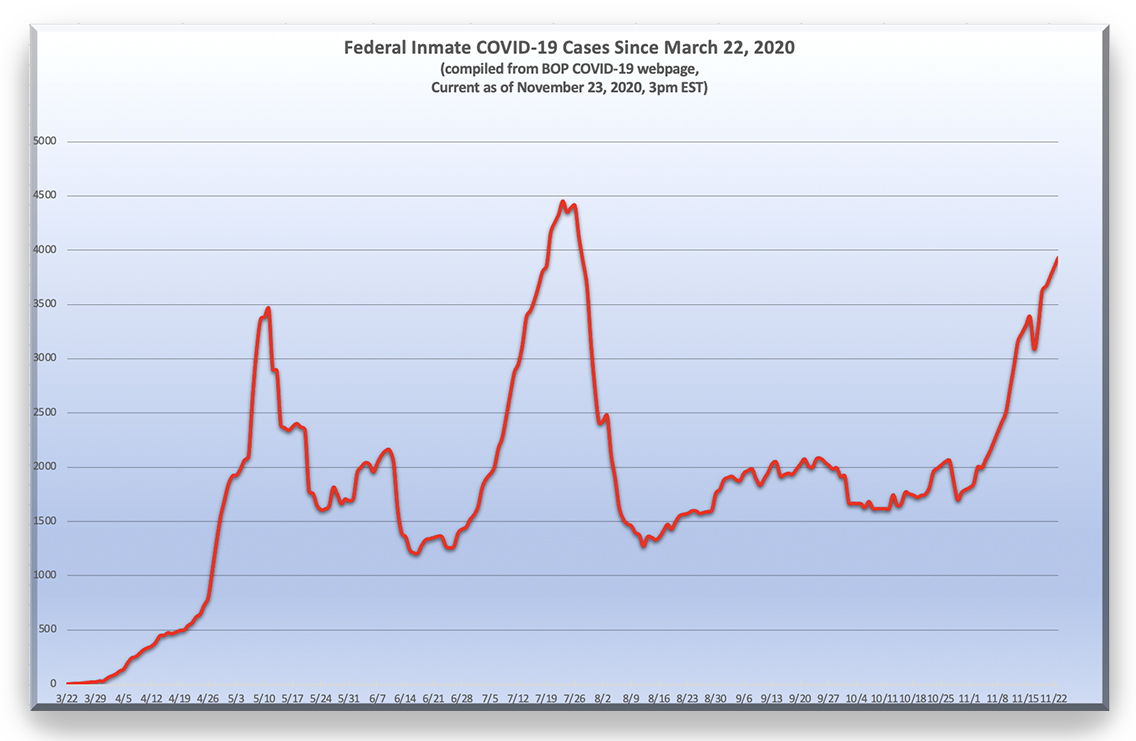
Inmate cases, which have averaged 2,065 active cases a day since Sept 1, hit 3,933 last night. That’s the highest number since the end of July, an increase of 117% since Nov 1 and 16% over a week ago. At the same time, BOP staff cases hit an all-time high of 1,264, up 17% in a week. The virus is again present in all 122 BOP facilities. The BOP has tested 53% of its inmate population, with 28% returning as positive.

BOPCOVID201124

The Dept. of Justice Inspector General reported a week ago that BOP officials made a number of mistakes that hobbled the agency’s ability to control the spread of COVID-19 at FCI Oakdale, Louisiana. The DOJ’s internal watchdog found Oakdale officials “failed to promptly” implement COVID-19 screening protocols, took too long to limit inmate movement and failed to properly quarantine and isolate inmates, among other issues. Specifically, Oakdale lacked adequate personal protective equipment and left inmates with the virus in their housing units for a week without being isolated.

Oakdale was the initial BOP prison to experience a serious COVID-19 outbreak, and chalked up the first of what is now over 150 federal inmate deaths.

Failure201124Predictably, the BOP criticized the report, arguing its officials and staff complied with guidance to screen staff and inmates for COVID, took proper steps to limit inmate movement during the pandemic, and provided proper protective gear and guidance to employees on how to take precautions to protect against the spread of the disease.

Drug manufacturer Pfizer has applied for emergency use authorization for its COVID-19 vaccine from the Food and Drug Administration, to be followed by competing vaccine maker Moderna on December 4, and AstraZenica/Oxford about a month later. An emergency use authorization is a fast-track vaccine authorization that can be processed much more quickly than normal approval. The FDA is expected to take one to three weeks to go through the application and make a decision on issuing the emergency authorization. USA Today reports that vaccine could be approved by the week of December 14.

By the end of December, the government expects to have about 40 million vaccine doses available for distribution. The Pfizer and Moderna vaccines both require two doses given between 21 days apart. The BOP has reportedly told the inmate population that it is working to obtain vaccine for its staff and inmates. However, correctional facilities are currently reported to be included in “phase two” of the vaccine rollout, despite the fact healthcare professionals and prisoner advocates argue that they should be given a higher priority.

“We’re hearing promising news that we are one of the targeted areas to get the first dosage—at least our staff is in the first group, and then our patients with higher risk factors would be next,” said Thomas Weber, CEO of a private company providing medical services to state prisons and detention centers. “However, we have a concern about the availability of enough vaccines and how they’re going to distribute them.”

money160818Finally, 15 members of Congress, all Democrats, wrote to DOJ and the BOP last Tuesday to ask about the changing policies for medical copayments in federal prisons during the pandemic where there have been widespread coronavirus outbreaks. “On March 30, the BOP issued a memorandum waiving the requirement that incarcerated individuals pay ‘copay fee[s] for inmate requested visits to health care providers.’ That waiver expired on October 1, and it is unclear whether that waiver has been extended, given the continued spread of COVID-19 throughout the nation and in federal prisons,” they wrote. “It is also unclear whether the BOP has considered making its copay waiver permanent.”

Office of Inspector General, Remote Inspection of Federal Correctional Complexes Oakdale and Pollock (November 17, 2020)

Reuters, U.S. Justice Dept watchdog: Louisiana prison officials botched COVID-19 pandemic (November 17, 2020)

Atlanta Journal-Constitution, Federal prison in Louisiana left inmates with virus in housing for week (November 18, 2020)

USA Today, When could the first COVID-19 vaccines be given in the US? (November 18, 2020)

Letter to Attorney General William Barr and BOP Director Michael Carvajal (November 16, 2020)

– Thomas L. Root

Third COVID Wave Breaking Over BOP – Update for November 16, 2020

We post news and comment on federal criminal justice issues, focused primarily on trial and post-conviction matters, legislative initiatives, and sentencing issues.

BOP TRANSFEREES BRING COVID TO FORT DIX, SENATORS SAY

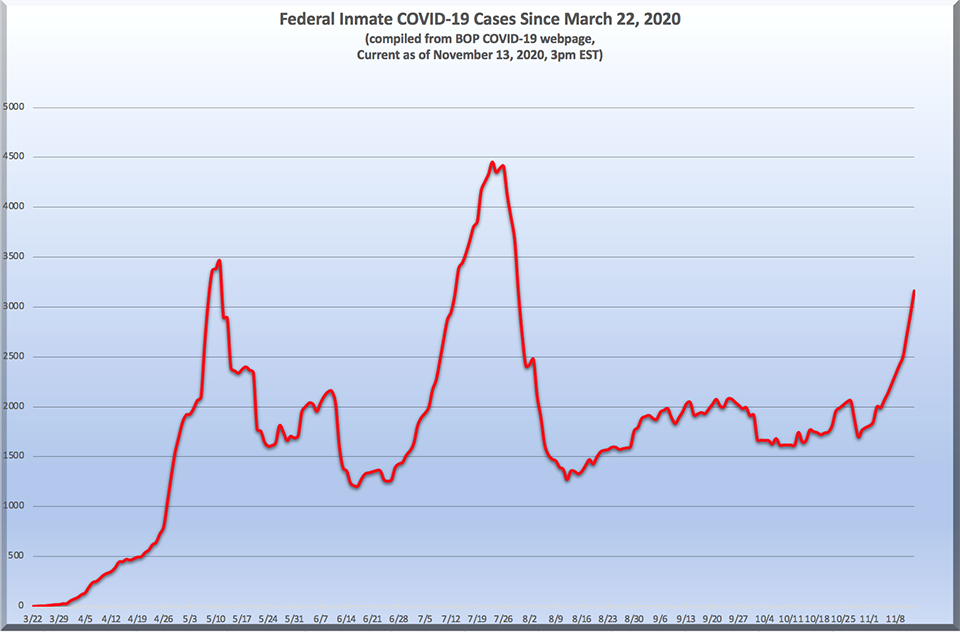
The third wave of COVID-19 sweeping the country apparently does not intend to exempt the Federal Bureau of Prisons. Active inmate cases, which have averaged 1,900 a day since September 1, have shot up last over the last two weeks, hitting 3,163 last Friday. That’s the highest number of BOP cases since the end of July. At the same time, BOP staff cases hit an all-time high of 1,049. The virus is present in 119 of 122 BOP facilities.

BOPCOVID201116

Last week, Government Executive magazine reported that the BOP “has experienced perhaps the worst outbreak of any federal agency per capita, with about 7% of its workforce contracting the virus. All told, more than 2,500 bureau employees have tested positive. Nearly 20,000 federal prisoners have also contracted COVID-19, or about 14% of the federal inmate population.”

The death toll has mounted as well. Three more federal inmates deaths were reported since November 6th, one at USP Tucson and two at the Springfield medical center. Citing a National Commission on COVID-19 and Criminal Justice study, the Washington Post reported last week that “when adjusted for age, sex and ethnicity, the mortality rate in federal prisons is twice that of the general population.”

The BOP has reported that as last Friday that it has tested half of all inmates at least once. The number testing positive inched up a point last week to 26%. One out of four tests has been positive ever since the BOP began reporting testing last spring.

reinfection200831The hottest BOP facilities for COVID-19 last week were USP Tucson (Arizona) with 363 inmate cases, and FCI Fort Dix, New Jersey (233 cases). These were followed by FCI Beaumont Low (Texas), USP Thomson (Illinois), FCI Bastrop (Texas), the FMCs at Butner, North Carolina, and Springfield, Missouri, USP Marion (Illinois), FCI Yazoo Medium (Mississippi), FCI Gilmer (West Virginia), FCI Greenville (Illinois) and FCI Jesup (Georgia), all with 100 or more cases.

The Fort Dix epidemic is especially troublesome, with Congressional criticism raining down on the BOP even as employee unions finger-point. Senators Robert Menendez and Cory Booker (both D-New Jersey) wrote to BOP Director Michael Carvajal last Monday, accusing the BOP of negligently transferring COVID-19 infected prisoners from FCI Elkton to Fort Dix, thus introducing the disease to Fort Dix. The senators said, “It is clear that BOP does not have an effective plan to ensure COVID-19 positive inmates are not transferred between facilities…”

The Philadelphia Inquirer reported last week that “as recently as mid-October, US Attorneys opposing compassionate release motions by Fort Dix prisoners argued that ‘the BOP has taken effective steps to limit the transmission of COVID-19’.” Now, the paper said, “videos purportedly taken by a prisoner inside Building 5812 and circulating among family members show a unit in chaos — debris scattered and trash overflowing — a byproduct of a shortage of staff and healthy inmate workers, according to family members.”

The BOP says all prisoners are quarantined for 14 days and tested prior to being moved. The receiving prison is also to test and quarantine new prisoners for two weeks, which is what Brian Kokotajlo, a BOP union official at Fort Dix, says happened there. He’s skeptical about how things were handled at Elkton. “They said the inmates were tested when they left Elkton, but personally I don’t believe that to be true,” Kokotajlo said. “If they tested them at Elkton, how they made it on the bus and how they made it to us and became positive in a six-hour drive across the state of Pennsylvania, nobody seems to be able to figure that out.”

fingerpoint201116But Joseph Mayle, the Elkton union chief, blamed false negatives produced by COVID-19 rapid testing for infected prisoners being sent to Fort Dix. “My staff here, they’re not going to throw inmates on a bus without testing them,” Mayle said. “If that’s what they’re saying, that’s not what’s happening.”

BOP spokesman Justin Long issued a statement denying that Elkton transfers caused the Fort Dix outbreak. “Contact investigations indicate the infections were not the result of this inmate movement but rather may have originated from the community,” Long said.

In Pekin, Illinois, local residents protested this past weekend, complaining that the BOP is failing to protect inmates from coronavirus and asking the agency to release eligible inmates to home confinement. Dozens of protesters gathering Saturday, “demanding inmate get proper medical care, nutrition and hygiene needed to keep safe from the virus,” a local TV station reported.

The group also alleged that “the BOP’s website is not keeping up-to-date information, saying the 66 confirmed cases within the Pekin prison is a false number,” WMBD-TV reported. “They believe that number is well over 100.”

Washington Post, Prisons and jails have become a ‘public health threat’ during the pandemic, advocates say (November 12, 2020)

Government Executive, Coronavirus Cases Are Spiking at Federal Agencies (November 12, 2020)

Philadelphia Inquirer, COVID-19 outbreak infecting hundreds at Fort Dix is ‘escalating crisis,’ N.J. senators warn (November 10, 2020)

VICE NEWS, Federal Prisons Keep Turning Into COVID Nightmares: ‘Everyone Looks Like Death’ ( November 12, 2020)

WMBD-TV, Pekin community members say federal prison system isn’t taking COVID-19 seriously (November 14, 2020)

– Thomas L. Root

COVID’s a Mess in America… the BOP is No Different – Update for November 10, 2020

We post news and comment on federal criminal justice issues, focused primarily on trial and post-conviction matters, legislative initiatives, and sentencing issues.

THIRD WAVE BREAKING?

Over the past few weeks, the BOP’s official COVID-19 count has not been climbing with the rest of the nation’s, but late last week, the numbers took off, suggesting a third wave may be breaking over the BOP as well as the rest of the country.

plague200406As of last night, the BOP reported 2,418 sick inmates, up a whopping 24% from the Friday before. There are a record 953 sick staff, up 5% last week. Ominously, six federal inmates died last week, including four at MCFP Springfield (Missouri), one at FCI Big Spring (Texas), and one in a private prison.

The current outbreak at FCI Fort Dix illustrates the virulence of COVID. WHYY Radio reported last week that “in October no inmates tested positive. On Thursday, there were 214 positive cases, according to a report from the Federal Bureau of Prisons. It’s the second-highest amount of active cases out of every system in the country.”

After an inmate complained to a federal court that Elkton prisoners transferred to Fort Dix “were placed in a unit that later had 10 inmates test positive for COVID-19,” a federal judge last week ordered the government to “provide details on how the prison has mitigated the spread of COVID-19.”

The Appeal last week ran an interview with Dr. Homer Venters, who has provided expert testimony in several suits against the BOP on COVID in prisons, most recently at Lompoc. Venters was especially critical of the availability of health services:

All these detention settings have ‘sick call’ and that’s the primary way for people to report COVID symptoms and get care. But when you talk to incarcerated people, they routinely tell you that their sick call requests go unanswered, or they have to submit multiple sick call requests just to get a response, or they may get a response that says, ‘Here’s some Tylenol,’ but it isn’t really an assessment or care for COVID. In some cases, those sick call requests get thrown out. And so we have this group of people who, when they seek care for COVID-19, they must use this process to access care. It’s a system that’s broken.

The current COVID hotspots in the BOP system are Fort Dix, Bastrop, Springfield, Tucson, Thompson and Butner, all with over 100 inmate cases each. As of yesterday, the BOP reports it has tested 48.8% of all inmates. The positivity rate remains at 25.6%.

The Appeal, Coronavirus in Jails and Prisons (November 6, 2020)

WHYY Radio, COVID-19 outbreak inside Fort Dix prison is spreading (November 7, 2020)

Burlington County Times, U.S. attorneys for Fort Dix ordered to detail COVID-19 response; cases at prison top 200 (November 5, 2020)

Memorandum Order, R.24, November 3, 2020, Whiteside v. Fort Dix Federal Prison, Case No 1:20cv5544 (Dist. New Jersey)

– Thomas L. Root

ACLU Brings Second FCC Butner Suit Over COVID – Update for November 2, 2020

We post news and comment on federal criminal justice issues, focused primarily on trial and post-conviction matters, legislative initiatives, and sentencing issues.

ACLU CLAIMS BOP COVID TESTING STRATEGY IS ‘INCOHERENT’

A coalition of civil rights groups led by the American Civil Liberties Union filed a class-action lawsuit against the Federal Bureau of Prisons last week over its handling of COVID-19 outbreaks at FCC Butner. The suit seeks an injunction to protect Butner prisoners, especially “vulnerable people… who, because of their medical conditions and/or advanced age, are at higher risk of severe injury or death from COVID-19.”

suit201102The lawsuit alleges that the BOP has “tested too few people at Butner, too infrequently, and too late,” and fails “to separate people who tested positive from those who tested negative for several days after receiving the test results.” The suit claims screening for symptoms has also been sporadic and ineffectual. The claims include allegations of inadequate cleaning and disinfecting procedures to adequately protect the men housed at Butner. As well, the allegations take aim at BOP management of CARES Act home confinement and compassionate release:

Despite direction from the US Attorney General months ago to expeditiously consider medically vulnerable people for home confinement or other release, Defendants continue to oppose motions for compassionate release made by medically vulnerable people, and they have failed to order furloughs or transfers to home confinement with sufficient speed and in sufficient numbers.

FCC Butner, located about 25 miles north of Raleigh, North Carolina, holds nearly 4,000 male inmates, with five facilities: a medical center, a minimum-security camp, a low-security prison and two medium-security facilities.

The civil rights groups filed suit against the BOP last spring, alleging that officials have failed to protect the Butner population. In early June, a federal judge sided with the BOP, agreeing it had “made reasonable efforts” to control the virus.

In another suit, Lompoc prison officials were ordered by a Los Angeles federal judge three weeks ago to expedite the evaluation of more than 120 inmates deemed eligible for home confinement due to their risks of COVID-19, although only 44 have been released since July. Five inmates brought the federal class-action lawsuit last May, seeking alternative confinement after a COVID outbreak at Lompoc infected more than 1,000 inmates and staff. At least four inmates died as a result of the outbreak.

The October 8 order directed the BOP to confirm that all 129 eligible inmates were released to home confinement.

expert160905The BOP had argued there is no specified timeline to release inmates to home confinement and that such release requires a three-judge panel, according to the response included in the Oct. 8 filing. Meanwhile, last Friday the agency blasted a court-ordered report by Dr. Homer Venters, countering with its own expert who concluded that “FCC Lompoc has acted reasonably and diligently in dealing with the COVID-19 pandemic based on the CDC guidance and BOP guidance applicable at the time, including the comprehensive BOP COVID-19 Pandemic Response Plan.” The expert complained that Dr. Venters “consistently bases his critical conclusions on unverified statements that were made to him by unidentified inmates, despite the harsh judicial criticism that he recently received in an Eastern District of New York COVID-19 case for following that unreliable methodology.”

The BOP’s COVID numbers – 1,766 sick inmates as of last Friday – are down 7% from a week ago. But ominously, the number of sick staff continues to climb, hitting 896 on Friday. A month ago, there were 724 sick staff. Nationwide, 75% of all prison and jail staff cases since March have recovered. But only 60% of BOP staff cases have done so, suggesting that BOP staff COVID cases are increasing at a much faster rate than the rest of the country. This is critical, because the staff is the primary means by which COVID is being brought into facilities.

Circumstances surrounding the latest inmate COVID-19 death, Joe McDuffie at El Reno, are concerning. Joe tested negative for COVID on Oct 13. After that, according to the BOP, “he received daily symptom checks and did not express any symptoms associated with COVID-19. On Friday, October 23, 2020, institution staff found Mr. McDuffie unresponsive.” He died later that day.

The BOP says 46% of the inmate population has been tested for COVID. One out of four of those 69,500 tests has been positive.

Hallinan v. Scarantino, Case No 5:20-ct-3333 (ED NC, filed Oct 26, 2020)

The Appeal, Coronavirus in Jails and Prisons (October 28, 2020)

BOP, Inmate Death at El Reno (October 29, 2020)

Santa Maria Times, Lompoc prison officials release 44 inmates to home confinement; more than 120 deemed eligible (October 30, 2020)

Respondents’ Statement, Torres v. Milusnic, Case No 20cv4450 (CD California, October 30, 2020)

– Thomas L. Root

ACLU Sues to Get the Real COVID Story from BOP – Update for October 26, 2020

We post news and comment on federal criminal justice issues, focused primarily on trial and post-conviction matters, legislative initiatives, and sentencing issues.

ACLU SUES BOP OVER COVID RECORDS

The American Civil Liberties Union sued the Federal Bureau of Prisons and Centers for Disease Control and Prevention last week in District of Columbia federal court, demanding information about the government’s response to the risk of COVID-19 in detention facilities it has been seeking since last April.

OPRFOIA180814The ACLU said it “seeks to uncover critical information about the federal government’s response — and lack thereof — to the coronavirus in detention facilities across the country. Based on the limited data available, it appears that the BOP has failed to prevent the spread of the coronavirus in its facilities.” It first sought BOP records relating to COVID-19 in April and sought DOJ and CDC records in July, according to the lawsuit. While the agencies acknowledged the requests, they have yet to provide the ACLU with the documents.

“Although the BOP, HHS, and other offices granted the ACLU’s request for expedited processing, that was a dead letter,” the complaint alleges, “Defendants have failed to produce any records. Meanwhile, the pandemic continues to threaten the people in federal prisons and the communities where they operate.”

That is hardly surprising. Anyone with experience seeking records under the Freedom of Information Act knows that, primarily because the Act exacts scant penalties from federal agencies that violate it. If the choice is between dedicating resources to complying with FOIA and finally turning documents over on the courthouse steps months later, guess which option the agencies will select?

Complaint, ACLU v BOP, Case No 1:20cv3031 (D.D.C., filed Oct 21, 2020)

Vice News, The Trump Administration Is Getting Sued Over COVID Exploding in Prisons (Oct 21)

Indiana Public Media, ACLU Sues Bureau of Prisons Over COVID-19 Record Keeping (Oct 22)

– Thomas L. Root

Adding Family Insult to Injury, BOP-style – Update for October 22, 2020

We post news and comment on federal criminal justice issues, focused primarily on trial and post-conviction matters, legislative initiatives, and sentencing issues.

COVID NUMBER NOT REASSURING… NEITHER ARE BOP DEATH NOTIFICATION PROTOCOLS

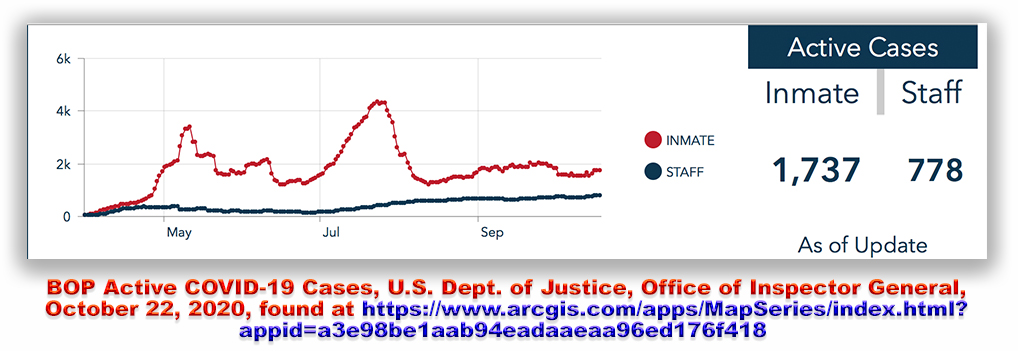
As of yesterday, the BOP was reporting 1,750 federal inmate COVID-19 cases in BOP and private prisons (up 6% from last week), 802 staff cases (up 9%), COVID still present in 118 out of 122 facilities, and one more death, for a total of 136. With 44% of all inmates tested, one out of four tests is still coming back positive.

covid19-201022

Just as Wisconsin is now spiking in new COVID cases, FCI Oxford led BOP facilities as of Oct 16th with 409 inmate cases, followed by El Reno (108 cases), Petersburg Medium (89), Tallahassee (88), Big Spring (79), Pekin (74), Leavenworth (73) and Oklahoma City (61). Sixteen more BOP joints have between 10 and 48 cases.

Three days before, the BOP announced the death of a Big Springs inmate, and noted that the facility had 398 inmate COVID cases. Over 300 inmates apparently recovered in merely three days.

The family of Tommy Sisk, the Petersburg inmate who died of COVID October 4, blasted the BOP last week for not notifying them of his death. They found out that their loved one had died when a family friend called them last Tuesday to say he had seen the death reported in a newspaper. That was a full week after the BOP issued a press release about Tommy’s passing.

tears201022Tommy’s brother Wayne Sisk said a representative from FCI Petersburg told him his sister was listed and tried to call her. “What freed up that information,” he asked about the Oct 6 BOP press release, “but they couldn’t free up the information to tell his family and notify them before the newspaper. During the times that we live in now, with COVID and injustices and everything… tell me how much injustice is that?”

As of last weekend, the BOP still had not told the family the location of the body. “They should’ve contacted our family and showed us some respect. We don’t have our brother. We don’t have anything,” Sisk said. “We don’t have our family member.” Perhaps the BOP intends to have Mr. Sisk’s body serve the remainder of his sentence before burial.

The BOP told a Richmond TV station, ““While for privacy reasons we cannot speak about specific circumstances surrounding a particular inmate, we can tell you protocols were followed in the case you reference.”

Of that I have no doubt. Perhaps the protocols should be leavened with a little human decency.

San Angelo Live, Nearly Half of Big Spring Prison Inmates Have COVID-19 (Oct 13)

WFXR-TV, Brother of inmate who died of COVID-19 demands answers: ‘We found out from a news article’ (October 17, 2020)

– Thomas L. Root

BOP Bans – Then Unbans – Newsletters – Update for October 15, 2020 (Revised October 19, 2020)

We post news and comment on federal criminal justice issues, focused primarily on trial and post-conviction matters, legislative initiatives, and sentencing issues.

BOP TELLS NEWSLETTERS TO HIT THE BRICKS

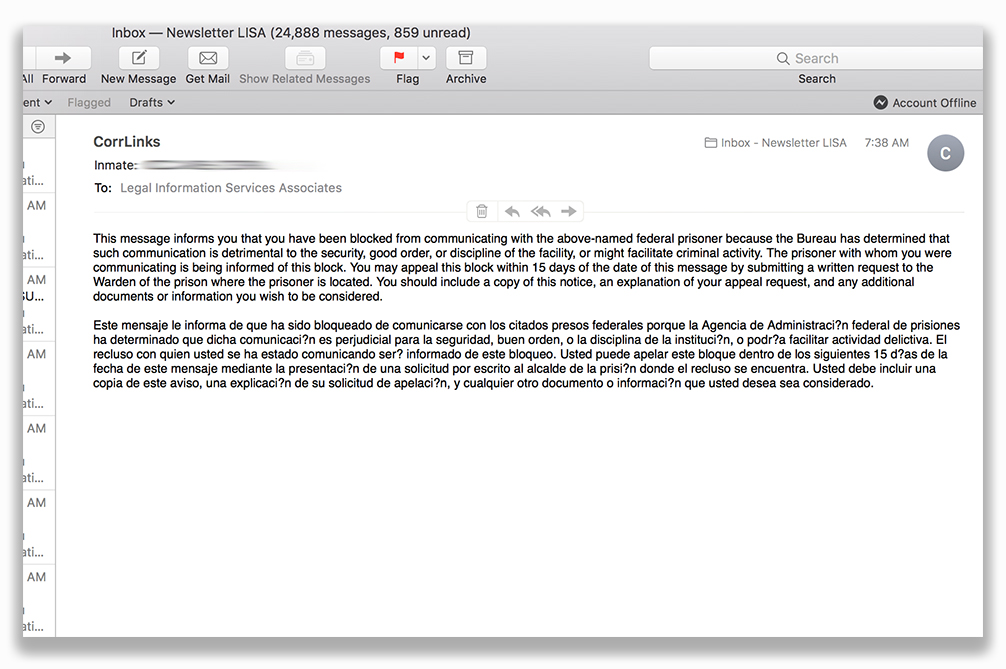
Last Thursday, the Federal Bureau of Prisons blocked email access to at least three legal newsletters sent to inmates, including the one I have written every week for 58 months.

A little before 6 am, LISA began receiving – one email at a time – 10,219 notices that its newsletter had been banned:
ban201015

Brandon Sample, a well-known attorney whose practice focuses on federal criminal, post-conviction and prison matters, told LISA that he had received notices as well that his newsletter to federal inmates had been banned. Several inmates have reported that additional newsletters had been blocked as well.

Brandon filed suit against the BOP the same day. Because Brandon was seeking a temporary restraining order, he was obligated to first confer with the AUSA assigned to the case. Late Friday afternoon (October 16), the AUSA told Brandon his newsletter had been blocked by mistake – part of an “unrelated investigation” – and it had been restored.

LISA’s newsletter site was unblocked at the same time.

pyrrhicv201019The AUSA reported the BOP was not technically able to restore all of the contacts in the newsletter email lists. Brandon reported that he had lost all of the subscribers in his newsletter email account. LISA lost 10,971 subscribers from a list that had been built over nearly five years.

– Thomas L. Root

BOP Fiddles, COVID Burns – Update for October 14, 2020

We post news and comment on federal criminal justice issues, focused primarily on trial and post-conviction matters, legislative initiatives, and sentencing issues.

HEY, FATSO! YOU’VE GOT COVID-19!

livebutonce201014The Centers for Disease Control and Prevention cranked up its warning about obesity and COVID-19 last week. Last spring, if you had a BMI over 40 (6 feet tall and 295 lbs), you were at risk. At the end of June, that dropped to a BMI of 30+. That made a 6-feet tall guy weighing 221 lbs at risk.

Last week, the link between extra pounds and severe Covid-19 grew stronger as the CDC said that people who are merely overweight, not just the obese, may be at high risk of serious disease from the infection. Now, the risk starts with a BMI of 25. Besides the merely overweight (62% of America), smoking has been added to the risk-factor list.

The BOP, which has provided daily COVID-19 numbers since March 2020, dropped weekend reports a few weeks ago. Last Friday, the agency didn’t bother to update its numbers from the day before. Yesterday.s report had 1,745 sick inmates, 736 sick staff, COVID-19 in 119 institutions (98% of all facilities) and 135 inmate deaths.

The latest to die was Robert Pierce, a 52-year old Big Spring inmate, who fell ill September 18 and died last Friday. Meanwhile, the news media reported COVID-19 increases at USP Allenwood, Petersburg Medium, Raybrook and McDowell.

In a pair of letters to Attorney General William P. Barr and BOP Director Michael Carvajal, Senators Elizabeth Warren (D-Massachusetts) and Richard Durbin (D-Illinois) suggest that the agency’s response to coronavirus outbreaks in federal prisons is failing, and they question the BOP’s reliance on solitary confinement to isolate sick prisoners rather than granting compassionate release.

The Washington Post reported last week that “Federal prisoners, corrections staff, government inspectors and civil rights advocates have complained for months that the BOP’s strategies, when useful, are inconsistently applied. The overall inadequate response is leaving a vulnerable population at risk of infection and creating major vectors for transmission more than seven months into the pandemic.”

The BOP’s COVID death toll “is mounting evidence that efforts to contain the virus within BOP facilities are failing,” Durbin Warren wrote to Barr and Carvajal in one of the Oct. 2 letters, which were viewed by The Washington Post.

plague200406The Post previously reported that prison staff have raised concerns about a lack of personal protective equipment and unsafe workplace conditions — issues that have prompted federal employees to sue the government. According to reports by the DOJ Office of the Inspector General on federal corrections facilities nationwide, persistent staffing shortage has triggered regular lockdowns during the pandemic in which prisoners aren’t allowed out of their cells, are often unable to shower and face more restrictions than if they were in solitary confinement.

Bloomberg, CDC Expands COVID Risk Warning to Include Overweight People (October 8, 2020)

CDC, People with Certain Medical Conditions (October 6, 2020)

BOP, Inmate Death at FCI Big Spring (October 13, 2020)

Harrisburg Patriot, Another big increase in COVID-19 cases at the Allenwood medium-security prison (October 5, 2020)

Roanoke Times, Inmate at federal prison in Petersburg dies of COVID-19; 21 others are infected (October 7, 2020)

Washington Post, Warren, Durbin slam government’s ‘failing’ efforts to contain coronavirus in federal prisons (October 5, 2020)

– Thomas L. Root

BOP Compassionate Release Approval – Vegas Without Comp’d Drinks – Update for October 13, 2020

We post news and comment on federal criminal justice issues, focused primarily on trial and post-conviction matters, legislative initiatives, and sentencing issues.

THE DEFINITION OF FUTILITY

futile201012People seeking compassionate release know that 18 USC § 3582(c)(1)(A) requires that they exhaust administrative remedies first, that is, ask the warden of their facility to recommend that the BOP bring the motion on their behalf and then wait 30 days before filing.

Many prisoners have asked courts to waive the exhaustion requirement as being futile. Courts have uniformly refused, ruling – like the 6th Circuit did last June in United States v. Alam, that the exhaustion requirement “ensures that the prison administrators can prioritize the most urgent claims. And it ensures that they can investigate the gravity of the conditions supporting compassionate release and the likelihood that the conditions will persist. These are not interests we should lightly dismiss or re-prioritize.”

The courts’ confidence in the Bureau of Prisons would be laughable if the stakes were not so high. And a report last week from NBC and The Marshall Project underscores what attorneys, inmates, advocates and experts have long suspected: since March 1, wardens have denied or ignored over 98% of all compassionate release requests.

Of the 10,940 federal prisoners who applied for compassionate release in just the first two months of the pandemic, from March through May, wardens approved 1.4%, or 156. Some wardens, including those at Seagoville and Oakdale, did not respond to any request during those two months, while others deny every request presented to them. Of the 156 approved by wardens, only 11 were approved by the Central Office. Overall approval rate? One-tenth of one percent.

Here’s the breakdown: 84.8% of the requests were denied by wardens. Another 13.7% were not even answered.

Lose200615In other words, you have literally a one-in-a-thousand chance that the BOP will approve a compassionate release request. This is about the same as an inmate’s chance of dying from COVID-19 (0.09%). On the other hand, 16,000 people have received compassionate release (slightly more than 1% of the BOP population).

Notable pullouts from the data: At Elkton, an early COVID hot spot (with more than 900 cases and nine deaths), the warden denied 866 out of 867 requests for compassionate release. At FCI Terminal Island, 694 prisoners had tested positive by the end of May, the warden approved five of the 256 compassionate release requests filed between March and May.

A BOP spokesman told The Marshall Project that “we can share that the BOP has continued to process compassionate release requests as directed by the First Step Act and agency policy.”

United States v. Alam, 960 F.3d 831 (6th Cir. 2020)

NBC News/The Marshall Project, Thousands of Sick Federal Prisoners Sought Compassionate Release. 98 Percent Were Denied. (October 7, 2020)

Rochester, Minnesota, Post-Bulletin, Cases Continue in Federal Prison, Compassionate Release Hard to Get (Oct 9)

– Thomas L. Root