Barr Doubles Down on Quick Home Confinement for At-Risk Inmates – Update for April 6, 2020

We post news and comment on federal criminal justice issues, focused primarily on trial and post-conviction matters, legislative initiatives, and sentencing issues.

CAN YOU HEAR ME NOW?

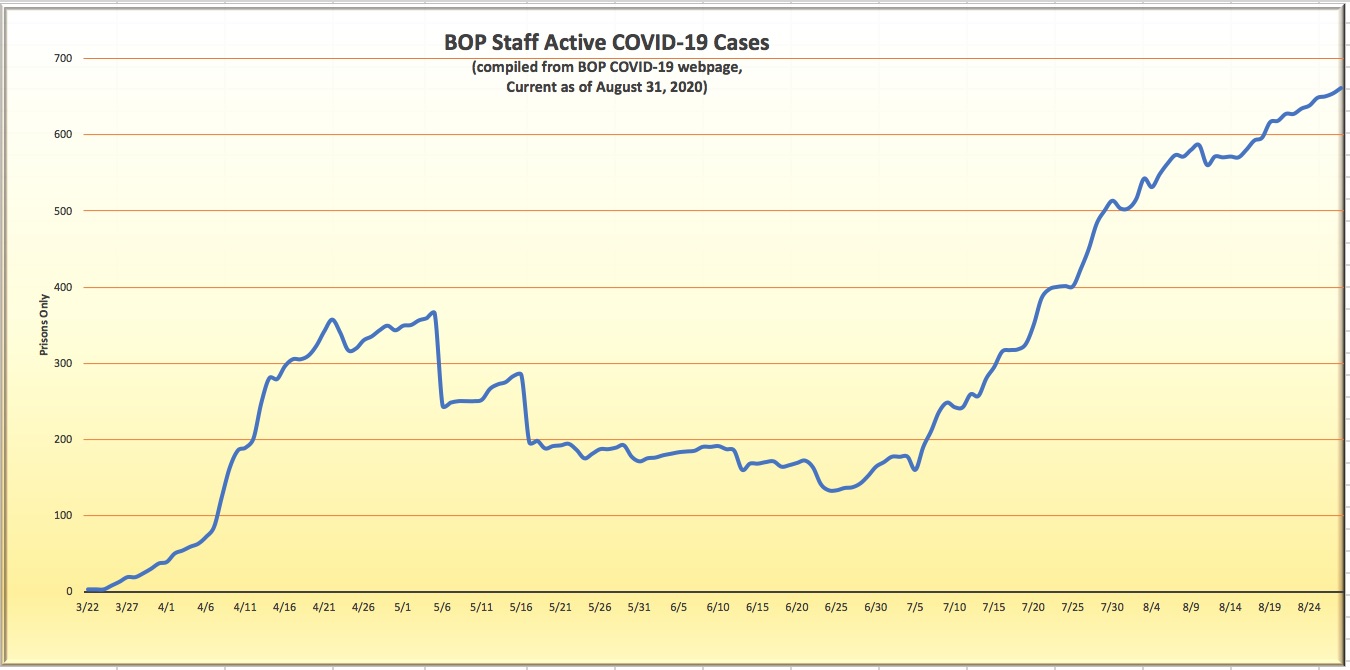
plague200406A week ago, America had 136,000 COVID-19 cases with 2,052 deaths. As of 6 am EDT today, the nation had over 336,830 cases and 9,618 deaths. A week ago, the Bureau of Prisons reported 14 inmates and 13 staff down with the virus. As of 3 pm yesterday, the BOP had 138 inmates and 59 staff down with the virus at Atlanta, Brooklyn, Bennettsville, the Butner complex; Canaan; Carswell; Chicago; Danbury; Elkton; Forrest City; Ft. Dix; Leavenworth, Lompoc, Milan, New York, Oakdale, Otisville, Ray Brook, Talladega, Tucson, the Yazoo City complex, and several RRC offices and facilities.

Also a week ago, Attorney General William Barr urged the BOP to use its statutory authority to release low-risk inmates at heightened risk because of COVID-19. Since then, response has been spotty: at some places, staff has quickly and efficiently carried out the directive, at others, staff is reviewing only people over 65, and at one institution I heard about, the warden told inmates that despite the Barr memo “no one was going anywhere.”

Meanwhile, inmates have begun dying, five at Oakdale and three at Elkton. Danbury has 21 female inmates down with COVID-19, and Lompoc has 17 sick male inmates.

Last Friday, maybe out of desperation as the virus spread, maybe out of irritation with the BOP’s snail pace, Barr issued another memo to BOP Director Michael Carvajal, “directing you to immediately review all inmates who have COVID-19 risk factors, as established by the CDC, starting with the inmates incarcerated at FCI Oakdale, FCI Danbury, FCI Elkton, and similarly situated facilities where you determine that COVID-19 is materially affecting operations. You should begin implementing this directive immediately at the facilities I have specifically identified and any other facilities facing similarly serious problems.”

The memo ordered that the BOP’s review should “include all at-risk inmates—not only those who were previously eligible for transfer.” The eligible inmates should immediately be processed for transfer to home confinement and put in 14-day quarantine.

hearme200406Noting that the US Probation Office is unable to monitor large numbers of inmates in the community, Barr “authorize[d] BOP to transfer inmates to home confinement even if electronic monitoring is not available, so long as BOP determines in every such instance that doing so is appropriate and consistent with our obligation to protect public safety.”

It almost seems that Barr is asking the BOP, “Can you hear me now?”

The directive that the BOP use its CARES Act § 12003(b)(2) authority will clearly cause some disparities in treatment. By focusing on institutions where the COVID-19 is present, nearly 100 facilities may see few if any releases for now. Furthermore, the release may skew strongly in favor of minimum-security inmates.

Kyle O’Dowd, associate executive director of policy for the National Association of Criminal Defense Lawyers, expressed his concern to Law360 a week ago that the release directive “won’t be implemented as robustly as it needs to be. There is a history of BOP being pretty conservative in their application of authorities they already have.” He was especially concerned that PATTERN scores would be used as a basis for home confinement decisions. “”If it is relied on too heavily, I think we will see just a trickle of releases rather than the more expansive application of that authority that we need under the current circumstances,” he said.

corona200313The BOP, of course, is in the middle of a 14-day lockdown, intended to arrest the spread of COVID-19. The action, started April 2, is subject to extension. One criminal justice advocate expressed disappointment in the lockdown, saying it is likely to aggravate problems related to the virus, not ameliorate them.

“How incredibly short-sighted, contrary to the advice of any experts, and inhumane,” Chris Geidner of the Justice Collaborative wrote on Twitter. The Week complained that the lockdown may be “too little, too late. Inmates will remain packed in close quarters, eating and bathing communally, disproportionately likely to have comorbidities which exacerbate the risk posed by COVID-19, and too often stuck with insufficient medical care or hygiene supplies.”

At the same time, there is ample concern that the BOP is not an especially trustworthy arbiter of home confinement decisions, based on its COVID-19 record to date. A week ago, the Washington Post noted that the BOP “updates confirmed coronavirus cases most afternoons on its website, but there has been a lag between cases reported by the officers’ union and prison officials.” It observed that BOP staff at Oakdale had “asked prison officials — weeks before the first coronavirus case — to shut down a prison labor program within the facility, where more than 100 prisoners make inmate clothing.” According to correctional officers union official Corey Trammel, the UNICOR line was not shut down until after the first inmate tested positive.

And although the BOP has admitted to COVID-19 outbreaks at BOP-contracted halfway houses in five locations, it told a reporter for The Appeal that it had “no factual evidence to support… allegations” that the facilities were at high risk for coronavirus outbreak.

plagueB200406Most damning, however, might be last Friday’s Marshall Project report that Dr. Sylvie Cohen, the BOP’s chief of occupational and employee health, ordered several Oakdale staff members back to work the day after they took inmate Patrick Jones (who later became the BOP’s first COVID-19 death) to the hospital. The correctional officers were issued no protective equipment other than latex gloves. Dr. Cohen, according to the story, directed that “officers should work unless they showed symptoms. This contradicts the recommendations the Centers for Disease Control was giving for first responders and other frontline workers and the specialized guidance it issued a day later for prisons and jails, calling for people who have had close contact with a confirmed case of COVID-19 to isolate themselves at home for 14 days.”

Like the Post, The Marshall Project suggested that the BOP’s official count of inmates and staff with COVID-19 was low. “Union officials say the toll is much higher,” the story noted. “On Wednesday,” the story reported, “prison brass met with a few dozen people held at the camp to discuss the virus, according to two of their family members. ‘Look, we probably all have it,’ officials told the prisoners, according to the wife of one man who attended. ‘It’s too late for us.’ They apologized, and said they were scared too, said the woman…”

Dept. of Justice, Increasing Use of Home Confinement at Institutions Most Affected by COVID-19 (Apr. 3)

Law 360, Federal Prisons Can Send More Inmates Home. Will They? (Mar. 26)

Washington Post, An explosion of coronavirus cases cripples a federal prison in Louisiana (Mar. 29)

Politico, Federal prisons start 14-day lockdown to fight virus (Apr 1)

The Week, When a prisoner dies of coronavirus, is the virus really to blame? (Apr. 2)

The Appeal, Halfway House Residents Describe ‘A Scary Situation’ As Coronavirus Sweeps the U.S. (Mar. 31)

The Marshall Project, Federal Prisons Agency “Put Staff in Harm’s Way” of Coronavirus (Apr. 3)

– Thomas L. Root

Melon Thumping at the Supreme Court – Update for April 2, 2020

We post news and comment on federal criminal justice issues, focused primarily on trial and post-conviction matters, legislative initiatives, and sentencing issues.

SCOTUS PUNTS ON SUCCESSIVE 2255 MOTION CASE

thumpmelon200402The Supreme Court last week refused to hear a challenge to 28 USC § 2244, the statute governing when prisoners should be permitted to file a second or successive habeas corpus motion under 28 USC § 2254 (for state prisoners) or 28 USC § 2255 (for federal prisoners). The denial is noteworthy for Justice Brett Kavanaugh’s published statement that the high court should settle a circuit split on the issue the next time a similar case comes before it.

Section 2244 states that a second or successive habeas corpus application filed under § 2254 must be dismissed unless it meets one of two very narrow exceptions, being based on a new Supreme Court retroactive constitutional ruling or on newly-discovered facts that just about guarantee the petitioner would have been acquitted by a jury. Like the Biblical eye-of-the-needle, it’s a pretty tight standard to squeeze through.

Although § 2244 by its express terms applies to § 2254 motions, federal appellate courts have traditionally interpreted the provision to apply to § 2255 motions as well.

Ed Avery filed a successive § 2255 motion, but the district court dismissed it based on his failure to get appellate court permission to file under 28 USC § 2244. He appealed to the 6th Circuit, which upheld the dismissal in an unpublished opinion. Six federal courts have ruled that the § 2244 dismissal statute applies to § 2255 motions. But last fall, the 6th Circuit flipped on the issue, holding in a published opinion that § 2244 clearly did not apply to a § 2255 motion.

In the appellate court world, a published opinion becomes precedent that binds all courts, even three-judge panels on the Court of Appeals. An unpublished opinion, along with about $5.00, will get you a venti latte at Starbucks. Ed, no latte drinker, wanted the published opinion to apply to his case, too. Having no other avenue, he went to the Supreme Court.

ventilatte200402An influential Washington, D.C., law firm took up the battle for Ed, arguing in a petition for writ of cert that the 6th Circuit’s published contrary ruling created a circuit split that called for resolution. He faced no pushback: the government had already filed a brief in the 6th Circuit saying it agreed that 28 USC § 2244 does not apply to § 2255 motions.

Predicting what cases the Supreme Court will decide to hear is more of an art than a science. The issue can be one the Court would like to decide, but it may still decline to review a case if the justices don’t think the facts of the case are quite right. It’s kind of like thumping melons in the produce section to decide which one is ready to eat. As you get better at it, you can find a good one more often. But in the end, it’s still how you hear the “thump” on any given day.

The Supremes decided for whatever reason that Ed’s case was not the right one to review in order to resolve the circuit split. Nevertheless, Justice Kavanaugh noted in a separate statement (which in itself is unusual on a denial of certiorari) that “[i]mportantly, the United States now agrees with the Sixth Circuit that ‘Section 2244(b)(1) does not apply to Section 2255 motions’ and that the contrary view is ‘inconsistent with the text of Section 2244.’ In other words, the Government now disagrees with the rulings of the six Courts of Appeals that had previously decided the issue in the Government’s favor. In a future case, I would grant certiorari to resolve the circuit split on this question of federal law.”

Avery v. United States, 2020 U.S. LEXIS 1651 (certiorari denied March 23, 2020)

– Thomas L. Root

Sloppy Bill-Writing Leads to Potential Windfall for Inmates – Update for April 1, 2020

We post news and comment on federal criminal justice issues, focused primarily on trial and post-conviction matters, legislative initiatives, and sentencing issues.

SLEEPER

The CARES Act passed last Friday included a $2 trillion stimulus package to provide financial relief to individuals, families and businesses. As with most hastily-passed laws, no one spent a lot of time giving careful thought to the fine print. But unlike most hastily-passed laws, this one does not clobber inmates (unlike, say, the good-time snafu in the First Step Act or the accidental “stacking” provisions of the old 18 USC § 924(c) gun statute). Instead, inmates stand to benefit.

money160118Unless you have been self-quarantining in a cave, you are aware by now that the government is sending payments of $1,200 to “eligible individuals,” defined by the CARES Act as any person other than a nonresident alien or a person who is a dependent of another taxpayer. That’s right – unlike other government benefits, this one does not exclude people in prison.

I’ll get this out of the way right up front: Congress has prohibited inmates from using Pell grants for college under 20 USC § 1070(a)(8), denied drug offenders access to certain benefits upon order of the court, and denied social security payments to people while in prison under 42 USC § 402(x). I have little doubt that Congress, had anyone thought about it, would have denied stimulus payments to prisoners.

But Congress did not.

Stimulus checks — up to $1,200 for individuals, $2,400 for joint taxpayers and an additional $500 for each qualifying child — will be based on information from your most recent tax filings, either 2019 or 2018 (if the taxpayer has not yet filed this season). If the taxpayer made under $75,000 last year, he or she gets the full $1,200.00.

If an inmate is married, he or she should be sure the couple files jointly, in order to get the extra $1,200 for the family. If the inmate’s spouse has already filed separately, he or she should file a 1040X to change things. Professional tax preparers or accountants can help with this procedure.

It does not matter that all the inmate made was inmate pay for sweeping the compound. Inmate pay is easily gross income under 26 USC § 61(a)(1). The inmate should file anyway, declaring all the money he or she was paid. Paper 1040 forms can be downloaded.

The stimulus check will be paid this year based on information from the most recent tax return and will be reconciled in tax year 2020 to ensure the taxpayer received the correct rebate amount.

taxreturn200401By law, anyone who made more than $1,100 in interest or dividend or over $12,200 in earned income must file a federal return, even prisoners. But filing tax returns even when the inmate does not make the minimum to is always a good idea, if for no other reason than to establish for the future what was earned for the year. Turns out that filing is an especially good idea right now.

The inmate should be warned that inmate pay may be gross income, but it is not “earned income.” It cannot be used to claim an earned income tax credit (an area that is rife with fraud). And there is no place to “claim” the $1,200.00 stimulus payment. Just file the tax return (a good habit to get into), and let the government determine eligibility for the stimulus.

Sec. 2201, CARES Act, H.R. 748 (signed into law March 27, 2020)

Turbotax, What the Coronavirus Stimulus Package Means for You (Mar. 27)

Bloomberg, When and How Will I Get That $1,200 Stimulus Payment? (Mar. 26) 

– Thomas L. Root

Virus or No, The World Keeps Turning on Hobbs Act and FSA – Update for March 31, 2020

We post news and comment on federal criminal justice issues, focused primarily on trial and post-conviction matters, legislative initiatives, and sentencing issues.

MEANWHILE, A COUPLE OF IMPORTANT FAIR SENTENCING ACT/HOBBS ACT CASES…

Two appellate cases handed down last week would have been headliners any other time except for now, with the coronavirus crowding everything else out of the news.

crackpowder160606In 2001, Brandon Gravatt was convicted of conspiracy to possess with intent to distribute 5 kilograms or more of powder cocaine and 50 grams or more of crack cocaine (21 USC § 846). He pled guilty to the dual-object drug conspiracy charge, facing sentences of 10 years-to-life for the coke and 10-to-life for the crack. The court sentenced him to just short of 22 years.

After the Fair Sentencing Act became retroactive due to the  provision at Section 404 of the First Step Act (passed in December 2018), Brandon filed for a sentence reduction because the crack statutory minimum had fallen to five years. But the District Court denied his motion, because the 10-to-life sentence for the powder cocaine remained the same.

Last week, in a decision awaited by a lot of people, the 4th Circuit reversed. It held that even in a multi-object conspiracy like Brandon’s – where the penalties of one object (possession of crack) were reduced by the FSA while the penalties of the other (powder cocaine) were not – if the crack minimum sentence fell, Brandon was eligible for resentencing. The Circuit said because Brandon’s “sentence involved a covered offense under Section 404(a) [of the First Step Act], the district court should have reviewed Gravatt’s motion on the merits, applying its discretion under Sections 404(b) and (c).”

Of course, the 4th said, the quantity of powder cocaine in Gravatt’s case could mean the district court would decide not to lower his sentence. “Our decision today,” the Circuit said, “only requires that Gravatt’s sentence receive a substantive review. It should not be construed as expressing any view on how the district court should rule.”

Meanwhile, the 11th Circuit held last week that a Hobbs Act robbery was not a crime of violence for purposes of determining whether a defendant was a “career offender” under Chapter 4B of the Guidelines.

violence151213Joining the 6th and 9th Circuits, the 11th held that because the Guidelines definition of robbery and extortion only extends to physical force against persons, while under Hobbs Act robbery and extortion, the force can be employed or threatened against property as well, the Hobbs Act (18 USC § 1951) is broader than the Guidelines definition, and thus cannot be a crime of violence for career offender purposes.

Unfortunately, because 18 USC § 924(c) does include threats to property as well as to people, the 11th Circuit holding does not apply to defendants with § 924(c) counts supported by Hobbs Act convictions.

United States v. Gravatt, 2020 U.S. App. LEXIS 9053 (4th Cir Mar 23, 2020)

United States v. Eason, 2020 U.S. App. LEXIS 9096 (11th Cir Mar 24, 2020)

– Thomas L. Root

BOP Records First COVID-19 Death As Congress OKs Expanded Home Confinement – Update for March 30, 2020

We post news and comment on federal criminal justice issues, focused primarily on trial and post-conviction matters, legislative initiatives, and sentencing issues.

BARR AND THE CARES ACT

death200330A week ago, America had 35,000 COVID-19 cases with 40 deaths. As of this morning, the nation has over 143,000 cases and 2,052 deaths. The Federal Bureau of Prisons’ very questionable numbers, as of yesterday, showed 14 inmates and 13 staff down with the virus. The actual inmate number is undoubtedly much higher than what the BOP is willing to admit.

On Saturday night, a low-security inmate at FCI Oakdale I, 49-year old Patrick Jones, became the BOP’s first COVID-19 death. Jones, 49, was transferred to a hospital on March 19, days before the BOP admitted to having any inmates who had tested positive for COVID-19. He was placed on a ventilator the next day. Jones, who suffered from “long-term, pre-existing medical conditions” considered risk factors for severe coronavirus illness, died Saturday at the hospital, a BOP news release said.

Last Thursday, Attorney General William Barr instructed the Bureau of Prisons to “prioritize the use of your statutory authorities to grant home confinement for inmates” in response to the virus.

That “statutory authority” got a lot broader the next day, when Congress passed The CARES Act, which President Trump signed the same day. Buried in its 373 pages is a single section devoted to the BOP.  Section 12003(b)(2) provides that

(2) HOME CONFINEMENT AUTHORITY.—During the covered emergency period, if the Attorney General finds that emergency conditions will materially affect the functioning of the Bureau, the Director of the Bureau may lengthen the maximum amount of time for which the Director is authorized to place a prisoner in home confinement under the first sentence of section 3624(c)(2) of title 18, United States Code, as the Director determines appropriate.

emergency200330The “covered emergency period” began when Trump declared a national emergency and ends 30 days after he declares that the emergency has ended.

Under 18 USC § 3624(c)(2), the BOP can send an inmate to home confinement for not more than 10% of his or her sentence, up to a maximum of 6 months. The CARES Act provision has lifted the 10%/6-month limitation. This means that the BOP can send anyone with anything short of a life sentence to home confinement right away.

Sec. 12003 provides no guidance whatsoever as to how the BOP should pick the people to go to home confinement, or even if it should send anyone at all. However, Sec. 12003(c)(2) exempts any BOP rules on how to do it from the notice-and-comment requirements of the Administrative Procedure Act, which means the BOP can roll out its own rules immediately.

The CARES Act passage makes Barr’s Thursday memo much more important. While the only authority the BOP has to wield as of Thursday was the Elderly Offender Home Detention Program (34 USC § 60541(g)(5)), it can now move many more people. Barr’s memo specified what the BOP should consider in making its decisions:

• inmate’s age and vulnerability to COVID-19 under Centers for Disease Control and Prevention (CDC) guidelines;

• The inmate’s security level, with priority given to inmates residing in low and minimum security facilities;

• The inmate’s conduct in prison, with inmates who have engaged in violent or gang-related activity in prison or who have incurred a BOP violation within the last year not receiving priority treatment;

• The inmate’s PATTERN score, with inmates who have anything above a minimum score not receiving priority treatment;

• Whether the inmate has a “demonstrated and verifiable re-entry plan that will prevent recidivism and maximize public safety, including verification that the conditions under which the inmate would be confined upon release would present a lower risk of contracting COVID-19 than the inmate would face in his or her BOP facility;” and

• The inmate’s crime of conviction, and assessment of the danger posed by the inmate to the community.

The memo stated that “some offenses, such as sex offenses, will render an inmate ineligible for home detention. Other serious offenses should weigh more heavily against consideration for home detention.”

BOP proposes holding anyone it releases in quarantine for 14 days prior to release to home confinement.

corona200313How much of this will happen? The devil’s in the details. The U.S. Probation Office has to approved residences for people going to home confinement, and Probation monitors people once they go home (usually with ankle monitors). There is a real possibility for a bottleneck as the U.S. Probation Office runs short of people to approve residences and of ankle monitors with which to take home confinement detainees.

Yesterday, the Marshall Project complained that Barr’s memo blocks anyone convicted of a sex offense or violent crime from being released to home confinement. DOJ policy also bars all non-citizens convicted of immigration-related offenses from serving out their time at home. Neither “sex crime” nor “violent crime” is defined in the memo, leaving the interpretation to the BOP. Note that The CARES Act leaves implementation of expanded home confinement to the BOP’s discretion.

Of course, nothing in the Barr memo or The CARES Act limits anyone’s right – even people with sex offenses or violent crimes – to seek compassionate release under 18 USC § 3582(c)(1)(A)(i).

Washington Post, An explosion of coronavirus cases cripples a federal prison in Louisiana (Mar. 29, 2020)

William Barr, Prioritizarion of Home Confinement as Appropriate In Response to COVID-19 Pandemic (Mar. 26, 2020)

The CARES Act, H.R. 748 (signed into law Mar. 27, 2020)

The Marshall Project, How Bill Barr’s COVID-19 Prisoner Release Plan Could Favor White People (Mar 28, 2020)

– Thomas L. Root

BOP Directed to Send Some Boomers Home – Update for March 27, 2020

We post news and comment on federal criminal justice issues, focused primarily on trial and post-conviction matters, legislative initiatives, and sentencing issues.

ATTORNEY GENERAL TELLS BOP TO SEND SOME PEOPLE HOME

Attorney General William Barr moved yesterday to release some federal inmates at heightened risk from the coronavirus, but he said no one would be freed immediately under the policy because of the need to make sure prisoners are not spreading the virus into the community.

corona200313Barr told the BOP in a memo to prioritize granting home confinement to inmates who were convicted of lower level crimes, have shown good conduct behind bars and have plans for release that won’t put them and others at greater risk for contracting the virus.

“We don’t want our institutions to become petri dishes,” Mr. Barr said at an unrelated news conference. “We have the protocols that are designed to stop that. One of those tools will be identifying vulnerable prisoners who would make more sense to allow to go home to finish their confinement.”

The attorney general said he asked BOP officials last week about protecting vulnerable inmates and lowering the chances of a serious outbreak by lowering prison populations.

“I asked if it was possible to expand home confinement, particularly for those older prisoners who have served substantial parts of their sentences and no longer pose a threat and may have underlying conditions that make them particularly vulnerable,” Barr said.

Barr told prison officials to give priority to inmates held in low and minimum security facilities; to those who haven’t been involved in violence or gang activities; and to those with low PATTERN scores. Those convicted of serious offenses, including sex crimes won’t be eligible, Barr said.

Barr’s guidance overlaps with a provision in the relief bill the U.S. House of Representatives is expected to pass TODAY, which lets the BOP shift federal inmates into home confinement sooner. Under 18 USC § 3624(c) as currently written, home confinement is capped at six months or 10% of a sentence, whichever is shorter. The bill removes that limit during the pandemic. The moves come as prisons are detecting more cases of the deadly virus.

release160523As of Thursday morning, Barr said six federal inmates and four staffers had tested positive for the virus, prompting the lockdown of several facilities, including ones in New York City, Atlanta and Louisiana. Barr said he’s getting reports of additional cases as well, but didn’t have the details.

As of yesterday’s 3 pm BOP update, the number had climbed to 10 inmates and eight staff, at MDC Brooklyn, MCC New York, USP Atlanta, FCI Oakdale and in halfway houses in Phoenix and Brooklyn. Staff have tested positive at Butner, NC; Ray Brook, NY; New York City; Danbury, CT; Yazoo City, MS; Leavenworth, KS; Atlanta, GA; and Grand Prairie, TX.

Criminal justice experts welcomed the idea of releasing more inmates to home confinement, but hoped the BOP would break its track record of granting release or home confinement in fewer cases than it could. Kyle O’Dowd, associate executive director of policy for the National Association of Criminal Defense Lawyers, told Law360 that while the law and the memo are steps in the right direction, it remains to be seen how the BOP will carry them out.

“My concern is that it won’t be implemented as robustly as it needs to be. There is a history of BOP being pretty conservative in their application of authorities they already have,” O’Dowd said.

Any prisoners moved out of federal facilities as part of the effort would be held in quarantine within the prison for 14 days before release to make sure they are not infectious, Barr’s memo said. Those convicted of sex offenses would not be considered for release, and those serving time for “serious offenses“ would have less chance of getting out, the directive said.

In some cases, vulnerable prisoners might be at less risk in jail than they would be at home, Barr argued. “Many inmates will be safer in BOP facilities where the population is controlled and there is ready access to doctors and medical care,“ he wrote.

Ohio State University law professor Doug Berman wrote in his Sentencing Law and Policy blog that

[e]ven assuming that only a very small percentage of prisoners, say, only 1 out of every 15 current federal prisoners, meet the home confinement criteria, that would still mean that well over 11,000 federal prisoners would be eligible to head home to serve out the rest of their sentences. Because BOP has a well-earn reputation for being unwilling or unable to help prisoners get out of federal facilities early, I am not so confident that we will soon be seeing thousands of federal prisoners heading home. But the directive from AG Barr now would seem to make that more of a possibility.

Politico, Feds may send some prisoners home due to virus risk (Mar. 26, 2020)

Wall Street Journal, Barr Tells Federal Prisons to Increase Use of Home Confinement, Fearing Spread of Coronavirus (Mar. 26, 2020)

Law360.com, Federal Prisons Can Send More Inmates Home. Will They? (Mar. 26)

Sentencing Law and Policy, Will thousands of federal prisoners be eligible for home confinement under AG Barr’s new guidelines? (Mar. 26)

– Thomas L. Root

At Halftime, It’s Inmates 1, BOP 0 – Update for March 26, 2020

We post news and comment on federal criminal justice issues, focused primarily on trial and post-conviction matters, legislative initiatives, and sentencing issues.

FEDERAL DEFENDERS WIN REMAND AGAINST BOP

Last winter, during the water and electrical breakdowns at MDC Brooklyn, the Federal public defenders organization sued the BOP and then-Warden Herman Quay, claiming they curtailed inmate-attorney visits in violation of the Administrative Procedure Act and the 6th Amendment. A district court threw the suit out, ruling that the Federal Defenders lacked the right to bring the action.

accessdenied191111Last week, the 2nd Circuit reversed. It ruled that the district court failed to consider BOP regulations in its zone-of-interests analysis and misconstrued the 6th Amendment claim: the Federal Defenders invoked the court’s traditional equitable powers in the 6th Amendment claim against Defendants, but the district court treated the claim as arising under the Constitution itself.

The Circuit remanded the case, and directed the district court “to consider appointing a master to mediate the parties’ differences at the earliest possible time to ensure that the Federal Defenders have meaningful, continuous access to their clients either in person or by remote access pending adjudication of these claims, as these claims may be amended to address similar issues of access arising during the current public health emergency.”

On Tuesday, the District Court appointed former Attorney General Loretta Lynch, now a partner at white-shoe law firm Paul, Weiss, Rifkind, Wharton & Garrison LLP, to referee the dispute. My read is that the 2nd Circuit wants this case settled, and wants the attorneys and their clients to come out on top.

Federal Defenders of New York v. BOP, 2020 U.S. App. LEXIS 8845 (2nd Cir Mar 20, 2020)

Law 360, Loretta Lynch To Referee Dispute Over Detainees’ Atty Access (March 24, 2020)

– Thomas L. Root

Ask Not For Whom The Deadline Tolls… – Update for March 25, 2020

We post news and comment on federal criminal justice issues, focused primarily on trial and post-conviction matters, legislative initiatives, and sentencing issues.

9TH CIRCUIT DELIVERS TIMELY WARNING ON LIMITS OF EQUITABLE TOLLING

With law libraries closed across the federal prison system, and typewriters, forms, copiers and the like largely unavailable, more than one inmate is probably going to blow a court deadline. A quick handwritten request for more time is always a good idea, but some deadlines – for motions under 28 USC § 2255, notices of appeal, and F.R.Civ.P. 59(e) motions, for example – have deadlines that courts can only extend with great difficulty, if at all.

equitabletolling200325A quick answer that inmate late filers have often heard from law library dwellers is to ask for “equitable tolling.” To hear some jailhouse lawyers describe it, equitable tolling is the fairy dust of forgiveness spread by judges riding unicorns. In fact, it is a bit more complex than that.

Equitable tolling is a doctrine in which courts, as a matter of fairness, pretend the deadline moved to the day the party actually filed his or her document, rather than the day on which the statute or rules said it was due. Last week, the 9th Circuit reminded everyone of equitable tolling’s limits, and what a movant has to show in order to qualify for equitable tolling when it does apply.

Tony Smith’s state lawyer waited 66 days to send him the appeals court’s denial order. The one-year period for Tony to file his federal habeas claim began with the state court’s decision. Tony figured, however, that because his lawyer caused a 66-day delay in getting the order to him, it was only equitable that he take an extra 66 days (at the end of the one-year period he had to file a federal 28 USC § 2254 action), to make up for the 66-day delay caused by his lawyer’s laziness.

Sorry, Tony… that’s not what “equitable” means in this sense. The district court held that Tony’s 28 USC § 2254 filing – 66 days after the deadline – was late, and not entitled to equitable tolling. The 9th Circuit agreed.

To be eligible for equitable tolling, a movant has to demonstrate he has been pursuing his rights diligently, not only while an impediment to filing caused by an extraordinary circumstance (his lawyer’s laziness) existed, but before and after as well, up to the time of filing his claim in federal court. The court rejected the “stop-clock” approach, the idea that when a movant is impeded from filing his petition by extraordinary circumstances while the statutory time is still running, he may add the time during which he was impeded to extend the limitations period.

timewaits200325Instead, the movant must show he was reasonably diligent in using the time after impediment was removed. In Tony’s case, this would have been in the 10 months after he got his appeals decision from his attorney.

Only when an extraordinary circumstance prevented a movant who was acting with reasonable diligence from making a timely filing that equitable tolling may apply. There is no hard rule (which is a feature of equity, not a bug). Instead, the court will look closely at the facts of the case. Because Tony could not explain how he was not able to file in the remaining 10 months of the period, equitable tolling did not help him.

Smith v. Davis, 2020 U.S. App. LEXIS 8810 (9th Cir Mar 20, 2020)

– Thomas L. Root

SCOTUS Says 5th Circuit Plainly Erred – Update for March 24, 2020

We post news and comment on federal criminal justice issues, focused primarily on trial and post-conviction matters, legislative initiatives, and sentencing issues.

SUPREME COURT REBUKES 5TH CIRCUIT’S OUTLIER “PLAIN ERROR” STANDARD

Chuck Davis failed to complain when the district court made his federal sentence consecutive to a state sentence that was imposed for the same course of conduct. On appeal, however, he raised the issue under the “plain error” standard.

error161101“Plain error” under Rule 52(b) of the Federal Rules of Criminal Procedure is a standard which is tougher to meet than the usual standard of review when a defendant has raised an objection below, but still one that can be met in some cases. It holds that an error that a defendant failed to raise in the trial court cannot be entertained on appeal unless it relates to a district court error that was plain (obvious), that affected the defendant’s substantial rights, and is such that it affects the integrity of the criminal justice system.

That’s a tough standard in and of itself, but the 5th Circuit has traditionally added its own gloss: if the error depended on facts that could have been raised in the trial court, it does not meet the standard. Under this cobbled-on addition to “plain error,” the 5th Circuit refused to entertain Chuck’s argument at all. The Circuit does not permit plain-error review where a defendant’s argument raised factual issues that could have been raised in the district court, because “questions of fact capable of resolution by the district court upon proper objection at sentencing can never constitute plain error.”

By contrast, almost every other Court of Appeals in America conducts plain-error review of unpreserved arguments, including unpreserved factual arguments.

Plain error in real life...
                              Plain error in real life…

Yesterday, the Supreme Court said that the 5th Circuit had to do so as well. Rule 52(b) holds that “a plain error that affects substantial rights may be considered even though it was not brought to the court’s attention.”  The Supreme Court said the “text of Rule 52(b) does not immunize factual errors from plain-error review. Our cases likewise do not purport to shield any category of errors from plain-error review… Put simply, there is no legal basis for the Fifth Circuit’s practice of declining to review certain unpreserved factual arguments for plain error.”

Chuck’s case was remanded to the 5th Circuit for plain-error review.

Davis v. United States, Case No. 19-5421 (Supreme Court, Mar. 23, 2020)

– Thomas L. Root

COVID-19 Wave About to Break on Prisons? – Update for March 23, 2020

We post news and comment on federal criminal justice issues, focused primarily on trial and post-conviction matters, legislative initiatives, and sentencing issues.

CORONAVIRUS TSUNAMI THREATENS PRISON SYSTEM

A week ago, the United States had 3,500 confirmed COVID-19 cases, with 40 deaths. A scant seven days later, those numbers have increased by an order of magnitude: the nation has just passed 35,000 confirmed cases – including several members of Congress – and 413 deaths. And although some local and state governments are releasing thousands of inmates in order to prevent a coronavirus outbreak in crowded jails and prisons, there is no federal move to do so.

corona200323

As of last night, The Wall Street Journal reported, the Bureau of Prisons had confirmed three staff and three inmate cases. One of the BOP staff members who is presumed positive worked at a New Hampshire facility and may have been in contact with inmates, a BOP official told CBS News. The BOP only admits to one staffer at its offices in Grand Prairie, Texas (no prison there), one at USP Leavenworth (who, the BOP states, had no inmate contact), and one at FCI Yazoo City, Mississippi. The inmates are allegedly at MDC Brooklyn and FCI Oakdale II, Louisiana.

But despite inmate rumors to the contrary (and there are a lot of them), the BOP is not using its furlough power, its home confinement placement policies under 18 USC § 3624(c)(2), the Elderly Offender Home Detention program under 34 USC §60541(g), or ability to recommend compassionate release under 18 USC § 3582(c)(1)(A) to speed the release of vulnerable inmates.

And it’s not for lack of pressure: Last week, the ACLU called on Attorney General William Barr to “immediately seek sentences consistent with retroactive application of provisions of the First Step Act, including the 851 enhancement, safety valve, and 924(c) “stacking” provisions.” The ACLU demanded that BOP increase use of compassionate release for those over 65, have a medical condition; or who suffer from diseases making them vulnerable to the COVID-19 disease, and people within a year of release.

On Thursday, the Federal Public & Community Defenders asked DOJ to direct the BOP to grant the maximum amount of home confinement and to expand its reasons for recommending compassionate release to include risks of coronavirus to “identified persons over the age of 60, as well as persons with diabetes, respiratory problems, and compromised immune systems as facing special danger from COVID-19.”

Inmate rumors that the BOP will release minimum security inmates were stoked last night when President Trump said the White House is considering issuing an executive order to release elderly, nonviolent offenders from federal prisons amid the coronavirus pandemic.

“We have been asked about that, and we’re going to take a look at it. It’s a bit of a problem,” Trump told reporters at a White House news conference. “But when we talk about totally nonviolent, we’re talking about these are totally nonviolent prisoners, we’re actually looking at that, yes.”

The President said no more on the subject than that, and readers should be cautioned that the President has made similar statements previously (such as having a list of 3,000 people for clemency) that have not ripened into action.

Last week, inmates were buzzing about a petition posted at the website change.org, demanding that President Trump order all BOP campers be sent to home confinement for the duration of the COVID-19 emergency. As of this morning, the petition had over 39,000 signatures.

coronadog200323Inmates face substantial risks due to the tight spaces in crowded conditions and strained health-care systems, according to experts. An opinion column in The New York Times last week warned that prisons and jails would be “the epicenter of the pandemic” unless action was taken. A similar column in The Washington Post warned, “Unless government officials act now, the novel coronavirus will spread rapidly in our jails and prisons, endangering not only prisoners and corrections workers but the general public as well.”

“We’re all headed for some dire consequences,” The Wall Street Journal quoted Daniel Vasquez, a former California warden, as saying. “I think it’s going to be impossible to stop it from spreading.”

CBS News reported Thursday that BOP employees say their lives are in danger after bungled instructions and widespread supply shortages. “The agency is in chaos,” CBS quoted Joe Rojas, regional vice president of a correctional officer labor union, as saying. “We are just scrambling to get things in order.” At a Florida FCI, BOP staffers told CBS News that officers transferring inmates lack access to protective gear, soap, and hand sanitizer. Gloves are in short supply, and workers plan to reuse disposable masks.

“Our supply is very limited,” Kristan Morgan, vice president of an officers’ union, told CBS. “It’s kind of like survival of the fittest at this point.” She said she spent Tuesday afternoon admitting a busload of 12 new inmates, all of whom had high fevers. The facility’s doctor is out sick, and their two nurses and one nurse practitioner are working around the clock. BOP staff have started to call in sick in order to avoid exposure. “They feel really betrayed,” said union president Ray Coleman said.

A BOP spokesperson told CBS everything was fine. Cleaning, sanitation and medical supplies at federal prisons had been inventoried as part of the bureau’s pandemic influenza contingency plan, she said, and “an ample amount of supply is on hand and ready to be distributed or moved to any facility as deemed necessary… The Bureau of Prisons is prepared to address any supply concerns if necessary.” Uh-huh.

Pinocchio160812Inmate COVID-19 fears do not much impress government prosecutors. Federal prosecutors argued in an SDNY felon-in-possession case that being locked up was probably safer than being free. Jail is “by its very nature isolated from the outside world,” they said, opposing a request for home confinement by Clifford Taylor, who is currently in MCC New York awaiting trial. The government said Taylor had not shown that the apartment of his children and mother, where he asked to be allowed to stay, would be any safer from the virus.

Wall Street Journal, Jails Release Prisoners, Fearing Coronavirus Outbreak (Mar 22)

CNN, President Trump says he is considering an executive order freeing elderly nonviolent federal prisoners (Mar. 22, 2020)

Wall Street Journal, Trump Shuns Use of Law Allowing Control Over Manufacturers (Mar. 23)


ACLU, Letter to DOJ and BOP On Coronavirus And The Criminal Justice System (Mar 18)

Federal Public & Community Defenders Legislative Committee, Letter to Attorney General William Barr (Mar 19)

Change.org, Home-confinement to lessen Camper’s exposure to the deadly COVID-19 virus (Mar 11)

The New York Times, An Epicenter of the Pandemic Will Be Jails and Prisons, if Inaction Continues (Mar 16)

Washington Post, We must release prisoners to lessen the spread of coronavirus (Mar 17)

CBS News, Federal prison workers say conflicting orders on coronavirus response is putting lives at risk (Mar 19)

Bloomberg, Jail Safer Than Outside, U.S. Says As Release Bids Mount (Mar 18)

– Thomas L. Root