State Can’t Make You Say “Uncle” – Update for October 30, 2020

We post news and comment on federal criminal justice issues, focused primarily on trial and post-conviction matters, legislative initiatives, and sentencing issues.

BRANDED

Remember when you were a kid, and the neighborhood bully would knock you down and push your face into the mud or twist your arm or something until you cried “Uncle”? That is what is known as “compelled speech.

Nine states require sex offenders to carry driver’s licenses emblazoned with some variation of the words “SEX OFFENDER” in bright capital letters across the top of the card. It’s like making the former defendant say “Uncle!” for the rest of his life, every time he writes a check, votes or goes to the doctor (all places we regularly have to show our DLs, at least in Ohio).

brand201031In Louisiana, Tazin Hill had had enough crying “Uncle.” He altered his license to hide the sex-offender label, and he was charged with a felony for doing so. Last week, the Louisiana Supreme Court ruled that making sex offenders carry the labeled licenses violated the 1st Amendment by compelling them to say something the government ordered them to say, known as “compelled speech.” In this case, the label “SEX OFFENDER” was what the license holders were compelled to say.

The court held the identification card, branded with the words “sex offender” and the person’s “name, picture, address, and other identifying characteristics… is that “readily associated with him” and must be routinely displayed to others. Thus, “the branded identification card is compelled speech, and it is a content-based regulation of speech that consequently must pass strict scrutiny. While the state certainly has a compelling interest in protecting the public and enabling law enforcement to identify a person as a sex offender, Louisiana has not adopted the least restrictive means of doing so. A symbol, code, or a letter designation would inform law enforcement that they are dealing with a sex offender and thereby reduce the unnecessary disclosure to others during everyday tasks… As Louisiana has not used the least restrictive means of advancing its otherwise compelling interest, the branded identification requirement is unconstitutional.”

A state could as easily require people to carry licenses labeled “convicted felon” or “annoying neighbor” or even “leaves toilet seat up.” The mischief a state government can cause once people are being labeled is vast, making this and other similar decisions applicable to everyone, not just people convicted of sex offenses.

Louisiana v Hill, Case No 20-0323, 2020 LA LEXIS 2512 (LA Sup Ct Oct 20, 2020)

– Thomas L. Root

“If At First You Don’t Succeed…” Doesn’t Work in Habeas Corpus – Update for October 28, 2020

We post news and comment on federal criminal justice issues, focused primarily on trial and post-conviction matters, legislative initiatives, and sentencing issues.

WHEN TOO MUCH IS MORE THAN ENOUGH

oneshot201029You pretty much only get one shot trying to convince your judge you were wrongly convicted in a habeas corpus motion under 28 USC § 2255 (except for a few circumstances not relevant here). But how about the “saving clause” in § 2255(e) which lets an inmate use another route to file habeas corpus when a § 2255 petition “is inadequate or ineffective to test the legality of detention?”

Roberto Beras, convicted of using his check cashing/money transfer business to launder millions in drug proceeds, figured § 2255(e) meant he could file a § 2241 petition for habeas corpus if the § 2255 no longer worked (because it had already been filed and denied in the 2nd Circuit, and two requests to file successive § 2255s denied as well).

Roberto figured the Supreme Court’s 2008 Cuellar v. United States decision was his ticket home. So even while his § 2255 motion was pending in New York, Roberto was filing § 2241 habeas corpus motions wherever he happened to be. In two petitions filed in U.S. District Court for the Northern District of Ohio, he claimed he was innocent under the Cuellar statutory interpretation decision, but the Northern District court disagreed, finding Roberto would have been found guilty even under Cuellar. When Roberto was transferred to a facility in the Western District of Louisiana, he filed the same claim again.

Last week, the 5th Circuit threw out Roberto’s latest § 2241 petition as an “abuse of the writ.”

The § 2255(e) “saving clause” permits an inmate to file a 28 USC § 2241 petition based on new interpretations of federal statutes – like Cuellar – when the claim was previously “foreclosed by circuit law at the time when it should have been raised” and when the “retroactively applicable decision establishes that the petitioner may have been convicted of a nonexistent offense.” But, the Circuit said, that wasn’t the issue here. Instead, Roberto’s § 2241 should be dismissed as “an abuse of the writ of habeas corpus.”

2255(e)filings201029“Abuse of the writ” is a common-law based “body of equitable principles informed and controlled by historical usage, statutory developments, and judicial decisions.” Under 28 USC § 2244(a), the Circuit held, it can dismiss a successive habeas application as an “abuse of the writ” where the movant raises a claim in a subsequent petition that either was raised or could have been raised in an earlier petition.

The 5th said Roberto “has filed claims in at least four circuits and for nearly twenty years. To allow him to repeat the same claim – heard and denied by another circuit – would be to condone forum-shopping… Perpetual disrespect for the finality of convictions disparages the entire criminal justice system.”

Beras v. Johnson, Case No. 18-30684, 2020 U.S. App. LEXIS 33058 (5th Cir Oct 20, 2020)

– Thomas L. Root

Ain’t Over Till It’s Over, DC Circuit Rules on 2255 – Update for October 27, 2020

We post news and comment on federal criminal justice issues, focused primarily on trial and post-conviction matters, legislative initiatives, and sentencing issues.

WAS IT OVER WHEN THE GERMANS BOMBED PEARL HARBOR?

“Hell, no!” Animal House’s Bluto Blutarsky shouted. He could have been arguing about the mess a district court made of deciding only part of Floyd Clark’s  motion.

bluto201027Floyd was convicted of kidnapping and beating a man. After hewas convicted, the victim recanted his testimony identifying Floyd as his assailant. Floyd filed a 28 USC § 2255 motion claiming ineffective assistance of counsel at trial, denial of his due process rights (based on the recantation) and a claim that his 18 USC § 924(c) use-of-a-gun conviction should be thrown out, based on Johnson v. United States.

The district court denied all of Floyd’s issues except for the § 924(c) claim. The district judge deferred judgment on the gun argument, saying his opinion “resolves three of Mr. Clark’s claims but leaves the § 2255 motion open until the Court is able to resolve his fourth claim,” because United States v. Davis was pending in the Supreme Court. Floyd appealed the denied claims.

Last week, the DC Circuit held that it lacked jurisdiction to hear the appeal because Floyd’s district court denial was not final. “Because it leaves Clark’s 924(c) claim pending,” the Circuit ruled, “the district court’s order appears nonfinal on its face. A judgment is typically final only when the whole case is complete… We consider an order ‘final’ if it ‘terminates’ the case and leaves nothing for the court but [to] execute the judgment. This final-judgment rule — derived from the common law and codified since the First Congress — has long promoted efficient judicial administration by avoiding the delay and expense of piecemeal appeals.”

It isn’t uncommon for district court § 2255 denials to omit deciding a claim, especially where the inmate’s petition raises a lot of grounds. This decision suggests prisoners should be assertive when a district court opinion purports to resolve a § 2255 petition without deciding every issues raised.

United States v Clark, Case No 19-3040, 2020 U.S. App. LEXIS 32644 (DC Cir Oct 16, 2020)

– Thomas L. Root

ACLU Sues to Get the Real COVID Story from BOP – Update for October 26, 2020

We post news and comment on federal criminal justice issues, focused primarily on trial and post-conviction matters, legislative initiatives, and sentencing issues.

ACLU SUES BOP OVER COVID RECORDS

The American Civil Liberties Union sued the Federal Bureau of Prisons and Centers for Disease Control and Prevention last week in District of Columbia federal court, demanding information about the government’s response to the risk of COVID-19 in detention facilities it has been seeking since last April.

OPRFOIA180814The ACLU said it “seeks to uncover critical information about the federal government’s response — and lack thereof — to the coronavirus in detention facilities across the country. Based on the limited data available, it appears that the BOP has failed to prevent the spread of the coronavirus in its facilities.” It first sought BOP records relating to COVID-19 in April and sought DOJ and CDC records in July, according to the lawsuit. While the agencies acknowledged the requests, they have yet to provide the ACLU with the documents.

“Although the BOP, HHS, and other offices granted the ACLU’s request for expedited processing, that was a dead letter,” the complaint alleges, “Defendants have failed to produce any records. Meanwhile, the pandemic continues to threaten the people in federal prisons and the communities where they operate.”

That is hardly surprising. Anyone with experience seeking records under the Freedom of Information Act knows that, primarily because the Act exacts scant penalties from federal agencies that violate it. If the choice is between dedicating resources to complying with FOIA and finally turning documents over on the courthouse steps months later, guess which option the agencies will select?

Complaint, ACLU v BOP, Case No 1:20cv3031 (D.D.C., filed Oct 21, 2020)

Vice News, The Trump Administration Is Getting Sued Over COVID Exploding in Prisons (Oct 21)

Indiana Public Media, ACLU Sues Bureau of Prisons Over COVID-19 Record Keeping (Oct 22)

– Thomas L. Root

Adding Family Insult to Injury, BOP-style – Update for October 22, 2020

We post news and comment on federal criminal justice issues, focused primarily on trial and post-conviction matters, legislative initiatives, and sentencing issues.

COVID NUMBER NOT REASSURING… NEITHER ARE BOP DEATH NOTIFICATION PROTOCOLS

As of yesterday, the BOP was reporting 1,750 federal inmate COVID-19 cases in BOP and private prisons (up 6% from last week), 802 staff cases (up 9%), COVID still present in 118 out of 122 facilities, and one more death, for a total of 136. With 44% of all inmates tested, one out of four tests is still coming back positive.

covid19-201022

Just as Wisconsin is now spiking in new COVID cases, FCI Oxford led BOP facilities as of Oct 16th with 409 inmate cases, followed by El Reno (108 cases), Petersburg Medium (89), Tallahassee (88), Big Spring (79), Pekin (74), Leavenworth (73) and Oklahoma City (61). Sixteen more BOP joints have between 10 and 48 cases.

Three days before, the BOP announced the death of a Big Springs inmate, and noted that the facility had 398 inmate COVID cases. Over 300 inmates apparently recovered in merely three days.

The family of Tommy Sisk, the Petersburg inmate who died of COVID October 4, blasted the BOP last week for not notifying them of his death. They found out that their loved one had died when a family friend called them last Tuesday to say he had seen the death reported in a newspaper. That was a full week after the BOP issued a press release about Tommy’s passing.

tears201022Tommy’s brother Wayne Sisk said a representative from FCI Petersburg told him his sister was listed and tried to call her. “What freed up that information,” he asked about the Oct 6 BOP press release, “but they couldn’t free up the information to tell his family and notify them before the newspaper. During the times that we live in now, with COVID and injustices and everything… tell me how much injustice is that?”

As of last weekend, the BOP still had not told the family the location of the body. “They should’ve contacted our family and showed us some respect. We don’t have our brother. We don’t have anything,” Sisk said. “We don’t have our family member.” Perhaps the BOP intends to have Mr. Sisk’s body serve the remainder of his sentence before burial.

The BOP told a Richmond TV station, ““While for privacy reasons we cannot speak about specific circumstances surrounding a particular inmate, we can tell you protocols were followed in the case you reference.”

Of that I have no doubt. Perhaps the protocols should be leavened with a little human decency.

San Angelo Live, Nearly Half of Big Spring Prison Inmates Have COVID-19 (Oct 13)

WFXR-TV, Brother of inmate who died of COVID-19 demands answers: ‘We found out from a news article’ (October 17, 2020)

– Thomas L. Root

3rd Circuit Says Nothing Extraordinary in Supervised Release Early Termination – Update for October 20, 2020

We post news and comment on federal criminal justice issues, focused primarily on trial and post-conviction matters, legislative initiatives, and sentencing issues.

WE MAY HAVE MISREAD THAT, THE COURT SAYS…

supervisedrelease180713Supervised release is a period after a federal inmate completes his or her prison sentence – a lot like parole and kind of like probation – during he or she is subject to a series of reporting conditions and limitations imposed by the court. A U.S. Probation Officer supervises the former inmate, and holds the power to seek revocation of supervised release and return to prison under evidentiary and procedural standards that are rather lax, to say the least.

Fortunately for the former inmate, under 18 USC § 3583(e), someone on supervised release can get that supervision term ended early. The statute requires the court, in deciding whether to terminate early, to apply the 18 USC § 3553(a) sentencing factors. No surprise there, but many courts have been buying into the government’s argument that just being good while on supervision isn’t enough: the movant has to show something extraordinary or exceptional justifying saving the government money and the former inmate aggravation.

supervisedleash181107Aggravation? Well, yes. The former inmate must make monthly filings detailing his or her finances, purchases and employment. He or she cannot leave the federal district without permission of the Probation Officer. Often, he or she cannot change jobs without the Probation Officer’s OK, and woe betide anyone who has an unreported contact with someone who has a criminal record (that would be one out of three adult Americans). Oh, yes, the Probation Officer can search the former inmate’s home at any time without a warrant.

supervisedrevoked181106Nationally, the rate of violations that result in a hearing before the judge (where return to prison is a possibility) is about 17%.  The prevalence of supervision violations, however, varies considerably among the federal judicial districts. In a July 2020 U.S. Sentencing Commission study, more than a third of individuals on supervision risked reimprisonment in violation hearings in the Southern District of California (42.1%), District of Minnesota (37.4%), Western District of Missouri (34.3%), District of Arizona (33.7%), and District of New Mexico (33.4%). In contrast, violations accounted for less than five percent of individuals on supervision in the Districts of Connecticut (4.5%) and Maryland (4.7%).

No wonder people on supervised release want to “get off paper,” as they put it. But few can meet the “extraordinary or exceptional reason” for early termination standard many courts impose.

Last week, the 3rd Circuit traced the twisted history of this “extraordinary or exceptional reason” requirement, and found no support for the standard.

The 3rd acknowledged that its prior non-precedential decisions had required “something exceptional or extraordinary” to warrant early termination, relying on the Second Circuit’s United States v. Lussier decision. “But this was a misreading of Lussier,” the 3rd Circuit said, in a rare acknowledgement that it had previously been wrong:

As the Second Circuit explained more recently, ‘Lussier does not require new or in order to modify conditions of release, but simply recognizes that changed circumstances may in some instances justify a modification’. In other words, extraordinary circumstances may be sufficient to justify early termination of a term of supervised release, but they are not necessary for such termination. We think that generally, early termination of supervised release under § 3583(e)(1) will be proper only when the sentencing judge is satisfied that new or unforeseen circumstances warrant it. That is because, if a sentence was ‘sufficient, but not greater than necessary’ when first pronounced, we would expect that something will have changed in the interim that would justify an early end to a term of supervised release. But we disavow any suggestion that new or unforeseen circumstances must be shown.”

Got that? “Extraordinary or exceptional reasons” no longer necessarily apply, except when they generally do.

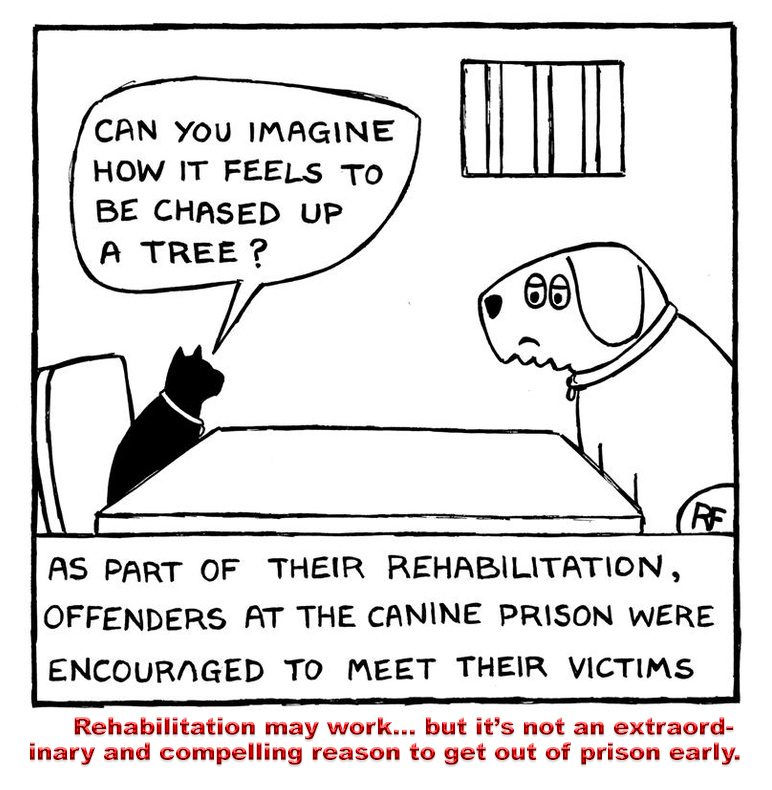
money160118Each person being supervised costs the government about $4,400.00, according to the Administrative Office of United States Courts. You’d think that saving that money might be a factor for more courts, especially where there is no discernible benefit to the supervisor or supervisee by continued oversight.  

But then, what’s $4,400 a year, even when multiplied by the 133,000 people under supervision?  Answer: a half billion a year, a mere flyspeck to Uncle Sam.

United States v. Melvin, 2020 U.S. App. LEXIS 32683 (3rd Cir. October 16, 2020)

– Thomas L. Root
Conflicting Signals on Recalling CARES Act Home Confinees – Update for October 19, 2020

We post news and comment on federal criminal justice issues, focused primarily on trial and post-conviction matters, legislative initiatives, and sentencing issues.

THIS IS KIND OF TROUBLING

comeback201019At a hearing on an inmate’s motion for compassionate release last August, Dept of Justice attorney Michael P. McCarthy made a chilling statement about the Bureau of Prisons’ CARES Act home confinement program: “The defendant is being re-evaluated once he crosses that (50%) threshold and at that point potentially transferred to home confinement. Now, I want to be clear that in the BOP’s program, it’s a transfer until the end of the pandemic and then a return to prison if the pandemic is declared over…”

Writing in Forbes magazine last week, Walter Pavlo said, “While everyone wants an end to the pandemic, those on home confinement may be told that they will be returning to prison … or they could be asked to be immunized in order to return …. or the inmate could refuse immunization …. or the inmate may have only a few months remaining by the end of the pandemic and might file an appeal.”

trumplie201019Pavlo noted that FAMM president Kevin Ring told him a White House source said a return of home confinement people to prison after the pandemic ends – whenever that is – “will NOT be happening.” But White House assertions (remember President Trump’s promised 3,000 clemencies?) have a way of being wrong. The risk of reincarceration seemed real enough that the House of Representatives included a provision in last May’s HEROES Act that no one “granted placement in community supervision, termination of supervision, placement on administrative supervision, or pre-trial release shall be re-incarcerated, placed on supervision or active supervision, or ordered detained pre-trial only as a result of the expiration of the national emergency relating to a communicable disease.”

The HEROES Act stands no chance of passage in the Senate.

Ohio State University law professor Doug Berman, writing in his Sentencing Law and Policy blog, said last week, “Because of the opaque nature of BOP work and data, it is difficult to tell just how many persons have been transferred into home confinement and what percentage of these persons might have long enough still remain on their original sentences to perhaps prompt DOJ to seek their return to prison whenever the pandemic if over.”

Forbes, US Attorney States Federal Inmates On Home Confinement Will Return To Prison Once “Pandemic Is Declared Over” (Oct 15)

Sec 191102(f), HEROES Act, HR 6800

Sentencing Law and Policy, Will some (most? all?) federal prisoners transferred to home confinement be returned to prison after the pandemic ends? (Oct 16)

– Thomas L. Root

Hobbs Act “Attempt” Not Crime of Violence, 4th Says – Update for October 16, 2020

We post news and comment on federal criminal justice issues, focused primarily on trial and post-conviction matters, legislative initiatives, and sentencing issues.

4TH CIRCUIT CHIPS AWAY AT HOBBS ACT

Ever since the Supreme Court’s United States v. Davis decision a year ago – indeed, even before Davis with Mathis, Descamps and the line of Johnson cases – commentators have been asking “whither violence?”

chip201016OK, maybe nothing that fancy. But appellate courts have traditionally and dismissively held that if a crime is a crime of violence (and here we’re talking about crimes of violence for purposes of apply the 18 USC § 924(c) offense of using or carrying a gun during and in relation to a crime of violence), then any conspiracy or attempt to commit such a crime is necessarily a crime of violence as well.

(A “crime of violence,” for those of you joining us late, is defined in 18 USC § 924(c)(3)(A) as being one that “has as an element the use, attempted use, or threatened use of physical force against the person or property of another.” Read Davis, and then report back here).

The appellate courts’ formula that an attempt to commit a crime of violence is violent as well has the virtue of being easy to apply, if a little formulaic. And so what if defendants find themselves serving additional mandatory sentences of five, seven, ten or 25 years?

The Supreme Court made it clear in Davis (if not before) that the formula is wrong, at least where conspiracy is concerned. If people possess guns while conspiring to commit a violent crime – say, for example, while practicing to kidnap, try and shoot the governor of Michigan – the conspiracy certainly is punishable, but they cannot get a mandatory additional sentence under § 924(c) while maturing their felonious little plans.

That has left unanswered the question of whether an attempt to commit a crime of violence remains violent itself, even after Davis. Clearly, attempts to commit crimes of violence can carried out without force or threat of force. A carload of armed would-be bank robbers drive up to a bank, but before they can even get out of the car, they are surrounded by the police. Another bank robber approaches the bank’s front door, but an alert employee sees him coming and hits the button that automatically locks the door. The law says that’s an attempted bank robbery: the bad guy intended to rob the bank and carried out at least one significant step toward accomplishing it. But he at no time used force or attempted to do so.

I have written before about how a few district courts have rejected attempts to commit Hobbs Act robberies (18 USC § 1951) as crimes of violence. This week, the 4th Circuit did so, too, a necessary and bold step (in the face of three other circuits – the 7th, the 9th and the 11th – who have gone the other way).

robbery160321The facts were ugly. Justin Taylor – known to his friends as “Mookie” – and a buddy set up a drug buy. Their plan was not to buy weed from the hapless victim, Sylvester, but instead to rob him of his pot. Mookie’s friend brought a gun to the caper, and mishanded it somehow, shooting Sylvester dead. Mookie and his friend ran without taking the marijuana, thus making the Hobbs Act robbery an “attempt” instead of a completed act.

Justin got 20 years for the attempted robbery, and another 10 for firing a gun during the crime. (His friend fired the gun, but Justin was equally liable for that, a legal doctrine we won’t get into now).

After Johnson was decided in 2015, Justin brought a post-conviction motion under 28 USC § 2255, arguing that an attempted Hobbs Act robbery is not a crime of violence that will support a § 924(c) conviction. He wanted the court to take back the extra 10 years on his sentence.

Earlier this week, the 4th Circuit agreed in a most significant holding.

A Hobbs Act robbery may be accomplished by use of force (I hit you over the head and steal your pot) or a threat of force (I threaten to hit you over the head to make you hand over your pot). The Circuit found this alternative crucial:

[U]nlike substantive Hobbs Act robbery, attempted Hobbs Act robbery does not invariably require the use, attempted use, or threatened use of physical force. The Government may obtain a conviction for attempted Hobbs Act robbery by proving that: (1) the defendant specifically intended to commit robbery by means of a threat to use physical force; and (2) the defendant took a substantial step corroborating that intent. The substantial step need not be violent. See United States v. McFadden… (concluding that defendants took a substantial step toward bank robbery where they “discussed their plans,” “reconnoitered the banks in question,” “assembled weapons and disguises,” and “proceeded to the area of the bank”). Where a defendant takes a nonviolent substantial step toward threatening to use physical force — conduct that undoubtedly satisfies the elements of attempted Hobbs Act robbery — the defendant has not used, attempted to use, or threatened to use physical force. Rather, the defendant has merely attempted to threaten to use physical force. The plain text of § 924(c)(3)(A) does not cover such conduct.

violence181008The government argued that the 4th’s approach would mean that no attempt to commit a crime of violence would support a § 924(c) conviction. The Circuit responded that “this simply is not so. Rather, as we have repeatedly held, certain crimes of violence — like Hobbs Act robbery, federal bank robbery, and carjacking — may be committed without the use or attempted use of physical force because they may be committed merely by means of threats,” such as “Hobbs Act robbery, when committed by means of causing fear of injury,” bank robbery and carjacking. “But where a crime of violence requires the use of physical force — as is usually the case — the categorical approach produces the opposite outcome: because the substantive crime of violence invariably involves the use of force, the corresponding attempt to commit that crime necessarily involves the attempted use of force. Such an attempt constitutes a “crime of violence” within the meaning of the force clause in § 924(c)(3).” The appeals court cited murder as such an offense.

This decision could very well set up a Supreme Court challenge, given the split between the 4th Circuit and the 7th, 9th and 11th.

United States v. Taylor, Case No. 19-7616, 2020 U.S. App. LEXIS 32393 (4th Cir. Oct. 14, 2020)

– Thomas L. Root

BOP Bans – Then Unbans – Newsletters – Update for October 15, 2020 (Revised October 19, 2020)

We post news and comment on federal criminal justice issues, focused primarily on trial and post-conviction matters, legislative initiatives, and sentencing issues.

BOP TELLS NEWSLETTERS TO HIT THE BRICKS

Last Thursday, the Federal Bureau of Prisons blocked email access to at least three legal newsletters sent to inmates, including the one I have written every week for 58 months.

A little before 6 am, LISA began receiving – one email at a time – 10,219 notices that its newsletter had been banned:
ban201015

Brandon Sample, a well-known attorney whose practice focuses on federal criminal, post-conviction and prison matters, told LISA that he had received notices as well that his newsletter to federal inmates had been banned. Several inmates have reported that additional newsletters had been blocked as well.

Brandon filed suit against the BOP the same day. Because Brandon was seeking a temporary restraining order, he was obligated to first confer with the AUSA assigned to the case. Late Friday afternoon (October 16), the AUSA told Brandon his newsletter had been blocked by mistake – part of an “unrelated investigation” – and it had been restored.

LISA’s newsletter site was unblocked at the same time.

pyrrhicv201019The AUSA reported the BOP was not technically able to restore all of the contacts in the newsletter email lists. Brandon reported that he had lost all of the subscribers in his newsletter email account. LISA lost 10,971 subscribers from a list that had been built over nearly five years.

– Thomas L. Root

BOP Fiddles, COVID Burns – Update for October 14, 2020

We post news and comment on federal criminal justice issues, focused primarily on trial and post-conviction matters, legislative initiatives, and sentencing issues.

HEY, FATSO! YOU’VE GOT COVID-19!

livebutonce201014The Centers for Disease Control and Prevention cranked up its warning about obesity and COVID-19 last week. Last spring, if you had a BMI over 40 (6 feet tall and 295 lbs), you were at risk. At the end of June, that dropped to a BMI of 30+. That made a 6-feet tall guy weighing 221 lbs at risk.

Last week, the link between extra pounds and severe Covid-19 grew stronger as the CDC said that people who are merely overweight, not just the obese, may be at high risk of serious disease from the infection. Now, the risk starts with a BMI of 25. Besides the merely overweight (62% of America), smoking has been added to the risk-factor list.

The BOP, which has provided daily COVID-19 numbers since March 2020, dropped weekend reports a few weeks ago. Last Friday, the agency didn’t bother to update its numbers from the day before. Yesterday.s report had 1,745 sick inmates, 736 sick staff, COVID-19 in 119 institutions (98% of all facilities) and 135 inmate deaths.

The latest to die was Robert Pierce, a 52-year old Big Spring inmate, who fell ill September 18 and died last Friday. Meanwhile, the news media reported COVID-19 increases at USP Allenwood, Petersburg Medium, Raybrook and McDowell.

In a pair of letters to Attorney General William P. Barr and BOP Director Michael Carvajal, Senators Elizabeth Warren (D-Massachusetts) and Richard Durbin (D-Illinois) suggest that the agency’s response to coronavirus outbreaks in federal prisons is failing, and they question the BOP’s reliance on solitary confinement to isolate sick prisoners rather than granting compassionate release.

The Washington Post reported last week that “Federal prisoners, corrections staff, government inspectors and civil rights advocates have complained for months that the BOP’s strategies, when useful, are inconsistently applied. The overall inadequate response is leaving a vulnerable population at risk of infection and creating major vectors for transmission more than seven months into the pandemic.”

The BOP’s COVID death toll “is mounting evidence that efforts to contain the virus within BOP facilities are failing,” Durbin Warren wrote to Barr and Carvajal in one of the Oct. 2 letters, which were viewed by The Washington Post.

plague200406The Post previously reported that prison staff have raised concerns about a lack of personal protective equipment and unsafe workplace conditions — issues that have prompted federal employees to sue the government. According to reports by the DOJ Office of the Inspector General on federal corrections facilities nationwide, persistent staffing shortage has triggered regular lockdowns during the pandemic in which prisoners aren’t allowed out of their cells, are often unable to shower and face more restrictions than if they were in solitary confinement.

Bloomberg, CDC Expands COVID Risk Warning to Include Overweight People (October 8, 2020)

CDC, People with Certain Medical Conditions (October 6, 2020)

BOP, Inmate Death at FCI Big Spring (October 13, 2020)

Harrisburg Patriot, Another big increase in COVID-19 cases at the Allenwood medium-security prison (October 5, 2020)

Roanoke Times, Inmate at federal prison in Petersburg dies of COVID-19; 21 others are infected (October 7, 2020)

Washington Post, Warren, Durbin slam government’s ‘failing’ efforts to contain coronavirus in federal prisons (October 5, 2020)

– Thomas L. Root