During Vacation Season, The Courts Stay Busy – Update for August 24, 2020

We post news and comment on federal criminal justice issues, focused primarily on trial and post-conviction matters, legislative initiatives, and sentencing issues.

10TH CIRCUIT RULES ON FAIR SENTENCING ACT PARAMETERS; 4TH DOUBLES DOWN ON REHAIF

The 10th Circuit last week handed down a consolidated appeal from two defendants seeking sentence reductions under the 2018 First Step Act’s grant of retroactivity for the 2010 Fair Sentencing Act (“FSA“), ruling that a prisoner is eligible to seek relief under the retroactive 2010 FSA if he or she was convicted of and sentenced for a violation of a federal criminal statute, the statutory penalties for which were modified by section 2 or 3 of the 2010 FSA, prior to August 3, 2010.

crackpowder191216

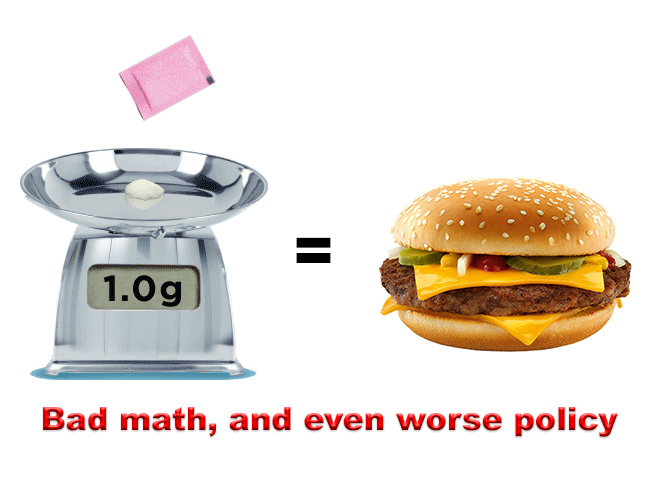
Those penalties, for those who came in late, are mandatory minimum sentences for offenses involving a certain amount of crack cocaine. Even since the crack cocaine panic of the 1980s that resulted in the Anti Drug Abuse Act of 1988, the amount of crack that would trigger a mandatory minimum sentence was one one-hundredth (1/100th) the amount of powder. In other words, that white frat boy in suburbia selling a kilo of cocaine powder got the same sentence as a black kid on a ghetto corner hawking 10 grams worth of rocks.

The FSA changed the ratio from 1:100 to 1:18 (why it did not become 1:1 is a story for another time), but its provisions were not retroactive. That meant that the crack defendant sentenced on August 2, 2010, got slammed, while the guy whose lawyer read the papers (and saw the new law about to be enacted) delayed his guy’s sentencing and got him a whopping break).

First Step finally made FSA retroactive, permitting people with pre-2010 sentences to seek sentence modifications.

One of the people seeking modification was appellants was Arthur Mannie, who complained that the district court should not have denied his FSA motion without a hearing. The Circuit disagreed, holding that a court’s jurisdiction to hear an FSA motion arises from 18 USC § 3582(c)(1)(B). Neither the First Step Act nor  § 3582(c)(1)(B) entitles FSA movants to a hearing, the 10th held, an FSA resentencing being fundamentally different from an initial sentencing.

The other FSA movant, Mike Maytubby, had multiple counts of conviction, only one of which was for crack. He had concurrent 151-month sentences on all of them. Because the FSA let the court adjust the term only on his crack sentence – which would not have affected the non-crack sentences – the 10th said “any reduction in the sentence of Knott’s covered offense would not actually reduce the length of his incarceration. Hence, the court cannot redress Knotts’s injury, and Knotts’s FSA motion does not present a live controversy.”

guns170111Meanwhile, the 4th Circuit has doubled down on its United States v. Gary holding that a Rehaif error is structural. In Rehaif, the Supreme Court held a year ago that in a prosecution for unlawful possession of a gun under 18 USC § 922(g), the government had to prove a defendant knew he was in the class of people the statute prohibited from possessing a gun. Early this year, the 4th Circuit held in Gary that failure to advise a defendant of that element was a structural error, that is, it was so basic a flaw that the plea could be undone even without proving the failure prejudiced the defendant.

Gary is a real outlier. Every other circuit that has considered it requires a defendant to show that if he had been advised properly, he would have gone to trial. In the 4th, Gary holds that the mistake alone is enough for a defendant to carry the day.

The 4th Circuit denied the government rehearing on Gary, but there is little doubt it will go to the Supreme Court. Meanwhile, last week, the Circuit held that even where a defendant was indicted and went to trial, a Rehaif error requires that the 922(g) verdict be set aside (even where it is pretty clear that the defendant would have been found guilty if there had been no error).

The Circuit held that the indictment’s omission of the element and the judge’s failure to instruct the jury on the missing element were both plain error, no matter that the defendant was probably guilty anyway. “Were this Court to affirm this conviction simply to avoid burdening the criminal justice system, we would diminish the public faith in the integrity of our courts. What gives people confidence in our justice system is not that we merely get things right… Rather, it is that we live in a system that upholds the rule of law even when it is inconvenient to do so.”

marijuanahell190918While rejecting the 4th Circuit’s “structural error” approach, the 7th Circuit last week decided that Blair Cook was entitled to a new trial. Blair, a pot fan, was convicted of a 922(g) offense for carrying a gun while being an unlawful drug user. The Circuit set aside the verdict, because the jury had not been given the Rehaif instruction. “The error in this case relieved the government of the burden of proving an essential element of offense beyond a reasonable doubt,” the 7th said. “The error was not so fundamental that it qualifies as structural. Nonetheless, it was a serious error, in the sense that it both omitted a key element of the government’s case and deprived Cook of the right to have the jury assess the sufficiency of that evidence as to that element.”

United States v. Mannie, 2020 U.S. App. LEXIS 26192 (10th Cir Aug 18, 2020)

United States v. Medley, 2020 U.S. App. LEXIS 26721 (4th Cir. Aug 21, 2020)

United States v. Cook, 2020 U.S. App. LEXIS 26023 (7th Cir. Aug 17, 2020)

– Thomas L. Root

Trump (Finally) Rolls Out Sentencing Commission Slate, Albeit Unbalanced One – Update for August 20, 2020

We post news and comment on federal criminal justice issues, focused primarily on trial and post-conviction matters, legislative initiatives, and sentencing issues.

TRUMP FINALLY DECIDES TO NOMINATE NEW SENTENCING COMMISSION MEMBERS, AND FAMM SHOUTS “NOT SO FAST!”

The U.S. Sentencing Commission has lacked a full slate of commissioners for the entirety of Trump Administration, and has not even had a quorum since the First Step Act passed in December 2018. That is why no sentencing guideline has been amended since the November 2018 amendments went into force.

Last week, the White House announced nominees for the vacant Commissioner slots (which persons must be approved by the Senate). They include Judge K. Michael Moore of Florida, to be chairman; Judge Claria Horn Boom of Kentucky; Judge Henry E. Hudson of Virginia; John G. Malcolm, Vice President for the Institute for Constitutional Government and the Director of the Meese Center for Legal & Judicial Studies at the Heritage Foundation; and Judge Luis Felipe Restrepo of Pennsylvania.

HudsonA170811The bad news is that four of the five nominees have been Assistant U.S. Attorneys, and that three of those four are sitting judges as well. The worse news is that Judge Henry Hudson, who has the well-deserved nickname of “Hang-‘em-High Henry,” is one of the nominees. A lonely piece of good news is that Judge Luis Restrepo comes from a public defender background.

How’s that for balance?

hudsonB170811“The administration has put forth a slate that is all white, mostly male, and lacking in diverse experiences or backgrounds,”  Sakira Cook, director of the justice reform program at the Leadership Conference on Civil and Human Rights, told NPR. “It is critically important that the Sentencing Commission reflects the diversity of background, experience, and expertise that would make the work of the Commission most effective. It is also important to note that at least two of the candidates have records or expressed views on sentencing issues that raise serious concerns.”

FAMM (formerly Families Against Mandatory Minimums) wrote to Senate Judiciary Chairman Sen. Lindsey Graham (R-South Carolina), and ranking minority member Sen. Dianne Feinstein (D-California) last week to urge them to refrain from acting on the nominations until next year:

There are less than 20 legislative days before the election. That is not nearly enough time to give nominees to this important agency the thorough examination and consideration they deserve – and that the people who will be subject to the Commission’s decisions deserve.

FAMM noted specifically that one of the Sentencing Commission’s urgent priorities will be to “address a federal prison system that has been overwhelmed by the spread of COVID-19. The deaths to date of 112 federal prisoners and at least one staff member compel serious reflection about various aspects of the federal prison system, including sentence lengths and early release mechanisms, over which the commission has some authority.”

privateprison200820(Note: The BOP hit 120 dead inmates a couple of days ago, being 114 in BOP custody and another six federal prisoners in private prisons. But no one seems want to count the people who are guests of the for-profits. That is perhaps a topic to cover for another day.)

Of course, what FAMM is really saying is that if the Senate waits until January, there may be a new President and a much different slate of commissioner nominees to consider.

The White House, President Donald J. Trump Announces Intent to Nominate and Appoint Individuals to Key Administration Posts (August 12, 2020)

FAMM, Letter to Sens. Lindsey Graham and Dianne Feinstein (August 14, 2020)

NPR, Concern Mounts Over Possible Trump Picks For Influential Crime Panel (August 19, 2020)

– Thomas L. Root

Representatives Want BOP Reform – Update for August 19, 2020

We post news and comment on federal criminal justice issues, focused primarily on trial and post-conviction matters, legislative initiatives, and sentencing issues.

CONGRESSMAN FORMS BOP REFORM CAUCUS IN CONGRESS

Representative Fred Keller (R-Pennsylvania) has created a bipartisan Bureau of Prisons (BOP) Reform Caucus in Congress.

Reform200819Keller said during news conference in Lewisburg, Pennsylvania, last Friday that  the aim of the caucus is to improve BOP accountability and transparency, address systemic issues within the system and ensure the health and safety of corrections officers, staff, inmates and the communities surrounding the prisons.

“With a $7 billion budget, more than 36,000 employees and 172,000 inmates, the BOP is a massive government agency, yet its leadership in Washington lacks adequate congressional oversight,” he said. “”This will bring transparency to the Bureau of Prisons as a whole. Our goal is once we start shining a light on this, we’ll be able to affect change in the leadership of the Bureau of Prisons and the way they conduct business.”

The recent COVID-19 outbreak at the Lewisburg Federal Penitentiary and several cases at the three-prison Allenwood complex “are proof that the policies BOP set in place to mitigate the spread of the disease have failed,” Keller complained.

andykim200820Other members of the caucus are Republican Reps. Glen Thompson of Pennsylvania, Elise Stefanik of New York and Rodney Davis of Illinois and Democrat Reps. Matt Cartwright of Pennsylvania and Andy Kim of New Jersey.

Don’t kid yourself that this caucus has anything to do with the welfare of inmates. Rather, it’s aimed at how the BOP treats its employees and the communities surrounding its facilities, a “straw-that-broke-the-camel’s-back moment resulting from USP Lewisburg’s COVID-19 outbreak and its effect on the surrounding county’s coronavirus case numbers. Nevertheless, any Congressional focus on the highhandedness of BOP management – whether it’s the dismissive treatment of its staff or the cavalier approach to the communities in which the agency facilities are located – can only help.

Pennlive.com, Congressman creates bipartisan Bureau of Prisons Reform Caucus (August 14, 2020)

WNEP-TV, Lawmakers form prison reform caucus (August 14, 2020)

– Thomas L. Root
5th Circuit Hands Down ‘Blue Moon’ Decision on Vindictive Sentencing – Update for August 18, 2020

We post news and comment on federal criminal justice issues, focused primarily on trial and post-conviction matters, legislative initiatives, and sentencing issues.

A “TWO-FER”

bluemoon200818It’s rare for an appellate court to hand down a vindictive sentencing decision. It’s rarer still for an appellate court to use its 28 USC § 2106 power to dictate a remedy, instead of just remanding the case to a district court. The 5th Circuit handed down a decision last week containing both, a genuine “two-fer.”

And the next blue moon is still a few months away. Imagine.

What’s vindictive sentencing? It’s pretty easy to understand. A district court sentences you to 121 months, which happens to be the low end of your Guidelines range. But the Judge incorrectly gave you one point too many, so your Guideline range was really 108-135 months. You appeal, and the Circuit Court corrects the judge’s error and remands the case for resentencing. When you get to resentencing the district judge – unhappy at being publicly corrected by the appellate court – takes it out on you. You get resentenced to 135 months, the top of your new Guidelines range (and 14 months more than if you had just kept your appellate lawyer’s mouth shut).

hammertime200818That, my friend, is vindictive sentencing: very effective in discouraging defendants from appealing, but brutal on due process rights.

That brings us to Vicente Galileo Penado-Aparicio, a guy who loves America. In fact, he loves America so much that he keeps sneaking into the USA from Mexico, even after being arrested and imprisoned for sneaking into America on prior occasions. After he got caught the latest time – while his supervised release term was still running on his prior sentence for an illegal border crossing – the district court sentenced him to 72 months, with a separate 24-month term for violating supervised release. It still only totaled 72 months, because the district court said the supervised release should run concurrently, that is, at the same time as the 72-month sentence.

bestintheworld200818Unfortunately, Vince’s guideline sentencing range was calculated using the 2016 version of the Guidelines, which were harsher on America-lovin’ aliens like Vince than were the Guidelines in effect when he climbed the impenetrable wall.  That, you recall from high school government class, is a violation of the Constitution’s Ex Post Facto Clause. Simply put, you cannot use a law passed after the fact to make some conduct criminal if it wasn’t criminal at the time, or to make a punishment for a crime harsher than it was when the crime was committed.

Vince’s appellate lawyer argued the ex post facto violation to the 5th Circuit, and it agreed, vacating Vince’s sentence and sending it back to the trial court for resentencing.

At resentencing, the district court expressed its unhappiness that no one called the ex post facto problem to its attention at the first sentencing. That, of course, was the fault of the lawyers (both Vince’s and the government’s). But the court could hardly throw them in jail (as much as that might seem to some to be a good idea). So the judge looked around the courtroom for someone on which to take out its frustrations. Lo and behold, there was Vince!

expostfacto200818The judge resentenced Vince to 60 months (instead of 72 months) and reimposed the 24-month supervised release sentence. With one change – the court said while the supervised release sentence “would have been concurrent at the sentence I gave before… it’s not going to be concurrent now.” Vince was thus sentenced to a consecutive 24-month supervised sentence, for a total of 84 months (a year longer than the original sentence.)

Last week, the 5th Circuit reversed the sentence again. Whenever a district court resentences a defendant to a longer imprisonment after a remand from a court of appeals, the new sentence is presumed by law to be vindictive, and thus violates a defendant’s due process rights under the 5th Amendment. The presumption may be rebutted if the sentencing court “articulates specific reasons, grounded in particularized facts that arise either from newly discovered evidence or from events that occur after the original sentencing” that warrant a more severe sentence.

USAmetric200818For example, at sentencing, both lawyers and the Probation Officer added up the Guidelines points wrong, scoring the defendant at a Total Offense Level of 22 instead of 24. The sentence was reversed for a completely different reason. On resentencing, the court caught the error, and the defendant was resentenced at the correct but higher range. There, the presumption of vindictiveness was rebutted: no one was trying to flay the defendant for having had the temerity to appeal.

Vince’s district court said it was relying on Vince’s “extensive” criminal record in imposing the higher sentence, but the 5th Circuit didn’t buy that. The appeals court noted that there was nothing new about that criminal record: the district court had the same information in front of it when Vince first got sentenced.  Nothing undercut the presumption that the district court vindictively re-sentenced Vince, the 5th said, and for that reason, the 84 months had to be set aside.

A court of appeals has the authority under 28 USC § 2106 to “modify, vacate, set aside or reverse any judgment.” This is one powerful little section of the law. It essentially means the court of appeals is free to fashion its own remedy – here, its own sentence – if it wants to. With great power comes great responsibility, and for that reason, courts of appeal apply 28 USC § 2106 very sparingly.

hammer160509But the Circuit believed it was called for here. “Granting appellate relief to defendant only requires that we exercise our appellate authority to modify the consecutive sentencing designation so that his sentence runs concurrent with his revocation sentence… More importantly, granting his request will effectively eliminate any perception of a potential constitutional error.” The 5th thus modified Vince’s sentence so that the 24-month supervised release violation sentence again ran concurrent with his underlying month sentence.

So, after all the dust settled from two sentencing and two trips to New Orleans, Vince got a net sentence of 60 months. 

United States v. Penado-Aparicio, 2020 U.S. App. LEXIS 25673 (Aug 13, 2020)

– Thomas L. Root

You’re Not Sick If We Say You’re Not Sick – Update for August 17, 2020

We post news and comment on federal criminal justice issues, focused primarily on trial and post-conviction matters, legislative initiatives, and sentencing issues.

MIRACLE RECOVERIES SEEM TO FLATTEN OUT AS CRITICS TAKE AIM AT BOP AND MARSHALS

The Federal Bureau of Prisons COVID-19 numbers fell 9% last week, but that statistic is only part of the story.

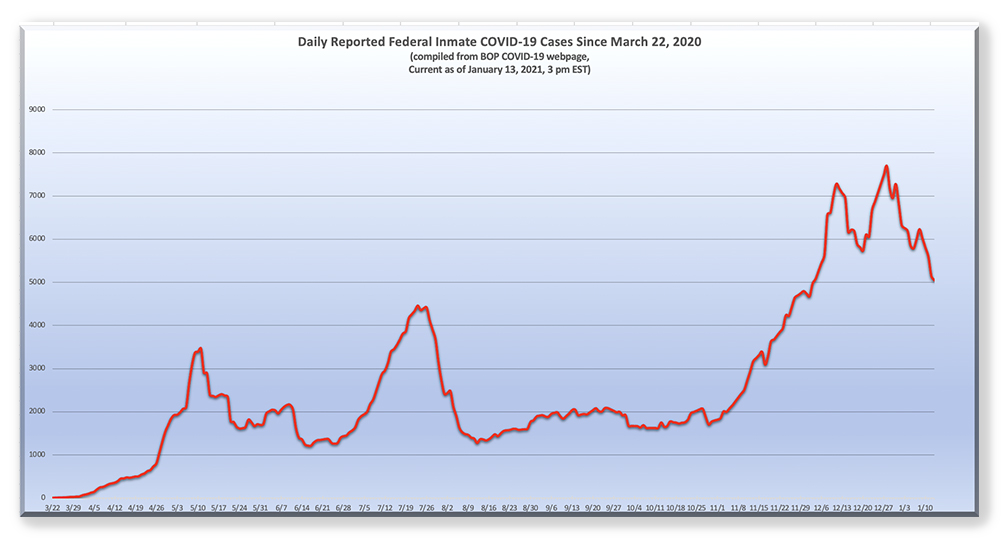
After bottoming out at 1,272 on Tuesday, the number of active inmate coronavirus cases climbed back into the 1,300s, where they stayed all week. Last night, the number was 1,356. What’s more, BOP staffers with COVID-19 stands at 570, virtually the same as the 571 sick staffers a week ago. The number of BOP facilities with active cases fell slightly from 114 to 111. Deaths, unsurprisingly, rose from 116 to 118 (this number, like the number of inmate cases, includes federal prisoners in private prisons as well).

InmateCOVID200817

Since March, the BOP has administered 45,702 tests. If this were one test per inmate, the agency would have completed tests on 29% of its population (but there’s no assurance some people have not been tested multiple times). The BOP is still finding an infection rate among inmates to be 26%.

What the stats show is that the BOP has exhausted its supply of infected inmates it can now miraculously declared to be cured because of a lapse of 10 days from the date the positive test came back. Once again, it appears that the Bureau is finding new cases as fast as it can write off old one.

At the same time, the number of sick staffers is stubbornly refused to fall, and remains nearly double a month ago and three times the level in mid-June. Likewise, the number of institutions where the virus is present is not budging.

transfer200817These Transfers Are Killing Me: Nevertheless, Phase Nine is now in place, and the BOP is seeing inmate transfers and admissions once again. Meanwhile, VICE News published a lengthy article last week alleging that continued US Marshal Service transfer of prisoners during the pandemic was responsible for much of the spread of COVID-19 throughout the BOP. According to VICE News, whistleblower complaints it had obtained alleged “federal prisoners infected with the coronavirus have been shipped as far as Puerto Rico in recent weeks, and to federal lock-ups in Alabama and Florida. BOP employees say prisoners have also tested positive after being shuffled around to facilities in Colorado, Illinois, Texas, Oklahoma, Pennsylvania, and Louisiana.”

VICE News quoted Anthony Koeppel, a BOP union local official at FCI Pollock, as saying, “It’s putting staff at risk, it’s putting inmates at risk, and it’s putting the community at risk. We’re talking about lives here. This is an extremely dangerous situation.”

The Marshals say they aren’t required to do any testing because “an agreement was made” that the BOP would handle tests and quarantines once prisoners are transferred into its lock-ups.

VICE News said BOP staff and prisoners have blamed transfers for helping the COVID-19 “wreak havoc across the BOP, killing 111 prisoners and at least one staff member, and infecting over 10,000 prisoners and 1,200 workers… The agency officially halted most movement of prisoners in March in an effort to limit the spread of the virus; when it does transfer prisoners itself, it requires them to undergo coronavirus testing and a 14-day quarantine before and after being moved. But the Marshals don’t abide by those rules — and they keep moving people. While transfers have slowed — down 76% from April to July compared to the same period last year, according to the Marshals — they never truly stopped.”

herd200817Prisons and Herd Immunity:  The Los Angeles Times noted last week that the prison experience with COVID-19 at San Quentin State Prison north of San Francisco suggests that herd immunity would come with substantial cost. “Herd immunity” is the idea is that eventually, a sufficient percentage of the population will have survived COVID-19 and become immune, which in turn protects the rest of the uninfected population by interrupting the spread of the virus.

“COVID-19 spread unchecked across California’s oldest prison,” the Times reported, “in ways that stunned public health experts, despite efforts to control the disease. As of Monday, there had been more than 2,200 cases and 25 deaths, among a population of more than 3,260 people.”

Expert Questions BOP “Recovered” Declarations: The BOP has experienced its own “San Quentins,” the latest arguably being FCI Seagoville, Texas, where 77% of the 1,746 inmates had COVID-19. As of Sunday night, only 35 inmates reportedly had active cases.

But Dr. Homer Venters – an epidemiologist investigating COVID-19 in the BOP – is skeptical. “People that tested positive, let’s say three, four weeks ago, may be considered recovered or not part of active cases,” Venters told KXAS-TV. “When you kind of wave a wand over people and say they’re recovered, my experience going into jails and prisons is many of them are not actually recovered. Many of them have new shortness of breath, chest pain, ringing in the ears, headaches. Other very serious symptoms.”

Serious Long-Term Effects: Another recent concern has arisen over long-term heart damage among younger people who contract COVID-19. Experts have linked coronavirus to development of a condition called viral myocarditis, which is a weakening of the general heart muscle.

COVIDheart200720“That is happening upwards of 50% of the people who are hospitalized with COVID will end up with some kind of cardiac damage. Some more severe than others,” Dr. Scott Miscovich, a Honolulu COVID specialist, said. “When you have that much damage to your heart muscles, not only are you going to be short of breath walking to a chair to the bathroom, you’re probably only going to survive five years.”

VICE News, ‘Con Air’ Is Spreading COVID-19 All Over the U.S. Prison System (August 13)

Los Angeles Times, San Quentin’s coronavirus outbreak shows why ‘herd immunity’ could mean disaster (August 11)

KXAS-TV, Seagoville Federal Prison COVID-Cases Fall Drastically, Expert Warns Against New Data as Family Mourns Loss (August 14)

KHON-TV, Hawaii COVID-19 expert concerned about heart damage for young people (August 10)

– Thomas L. Root

Chance and Death at the BOP – Update for August 14, 2020

We post news and comment on federal criminal justice issues, focused primarily on trial and post-conviction matters, legislative initiatives, and sentencing issues.

COMPASSIONATE CRAPSHOOT

dice161221A BuzzFeed News review of more than 50 cases seeking an 18 USC § 3582(c)(1)(A) “compassionate release” sentence reduction by federal inmates shows that with little legal precedent to guide courts in deciding the flood of release motions during a pandemic, decisions about who gets out of prison and who does not can appear arbitrary. That’s probably because they are.

Prisoner advocates and defense lawyers say these cases can come down to the luck of the draw, with some judges proving to be more sympathetic than others. Judges are making medical assessments about how much of a threat COVID-19 poses to an individual inmate and then deciding how to balance that against the public safety risk of sending that person back into the community. And judges are reaching different conclusions about how to measure an inmate’s risk of exposure in state and federal prisons, which have seen some of the worst clusters of COVID-19 cases nationwide.

In some denials, judges relied on the fact that there weren’t any COVID-19 cases at a particular prison, but sometimes that wasn’t a barrier. Some judges insisted inmates have served at least half of their sentence. Nearly all judges required proof of a specific medical condition.

compassion160208

Not only are the standards being applied by district courts grossly inconsistent across the 673 active federal district judges. The BOP has added to the chaos as well. Twenty-five inmates have died in its custody this year while their requests for sentence reduction were under consideration, including 18 since March 1, around the time the coronavirus began spreading in U.S. communities. In the 50 July cases examined by Buzzfeed, the BOP opposed or failed to respond to 38 compassionate release requests that the courts denied. The Bureau also opposed 10 releases that courts eventually granted. Only in two cases did the agency agree to a release before a court intervened.

More than one inmate has died of COVID-19 after being denied compassionate release by the BOP. Perhaps the latest was Saferia Johnson, coldly described as “inmate” – along with her crime of conviction – by the BOP media machine (more interested in making the agency look good in a bad situation than in compassionately reporting the death of a mother of two young boys). Saferia died of the virus after the BOP denied her compassionate release (not that the BOP press release would note that). She was serving 46 months for a fairly plain-vanilla white-collar embezzlement offense at Coleman.

“Now I have to bury my daughter and figure out how to raise these kids,” Ms. Johnson’s mother, Tressa Clements, told the Miami Herald. Clements said she and other family members told Johnson’s boys — Kyrei, 7, and Josiah, 4 — Monday that their mother isn’t coming home.

“We told them that God wanted her as an angel with him,” she said. “But she will always be in their lives and be their guardian angel.”

fault200814Incidentally, the BOP death count inched up to 117 yesterday (112 in BOP custody, five federal inmates in private prisons) with virtually all of the deceased “memorialized” by BOP press releases.

Forget that de mortuis nil nisi bonum nonsense. The BOP is much more into speaking ill of the deceased, who after all was an inmate more than a person, and interring any good with his or her bones. The BOP press release obituary (written formulaically by some BOP press office minion), is intended to let the world know that (1) it really wasn’t the BOP’s fault, because the agency did everything it could to save the victim, (2) it really wasn’t the BOP’s fault, because the victim had all of these unidentified “long-term, pre-existing medical conditions,” and, of course, (3) the dead inmate was a scumbag who was serving a sentence for doing truly horrible things, so – in the scheme of things – the death is not that lamentable, except for the fact it may make the BOP look bad unfairly.

compassionaterelease190517It’s worthwhile that we are reminded, once in awhile, that the “inmate” described as “a 36-year-old female who was sentenced in the Middle District of Georgia to a 46-month sentence for Conspiracy to Steal and Embezzle Public Money and Aggravated Identity Theft” was a mom leaving behind a second-grader and a preschooler.

The None of us is as good as our finest moment, nor as bad as our worst. And few of us have a heart as cold as a BOP obituary.

Buzzfeed News, “I Had Hit The Lottery”: Inmates Desperate To Get Out Of Prisons Hit Hard By The Coronavirus Are Racing To Court (August 8, 2020)

Washington Post, Frail inmates could be sent home to prevent the spread of covid-19. Instead, some are dying in federal prisons. (August 3, 2020)

Miami Herald, Woman asked for compassionate release. The prison refused. She just died of COVID-19 (August 6, 2020)

– Thomas L. Root

Known By The Company You Keep – Update for August 13, 2020

We post news and comment on federal criminal justice issues, focused primarily on trial and post-conviction matters, legislative initiatives, and sentencing issues.

7TH CIRCUIT LIMITS 18 USC 2251 CHILD PORN PRODUCTION STATUTE

pervert160728Section 2251 of Title 18 is a federal child pornography statute. The statute mandates a minimum 15-year prison term for “[a]ny person who employs, uses, persuades, induces, entices, or coerces any minor to engage in … any sexually explicit conduct for the purpose of producing any visual depiction of such conduct.” So, it stands to reason, after reading anything about it – even a federal appellate court decision – may make you feel as though you should wash your hands (and not merely as a COVID-19 preventative).

It seems that Matthew Howard made some rather disturbing videos of himself next to his sleeping 9-year old niece while associating online with like-minded perverts. Matt recorded himself in some disgusting chat session, and then – while his buddies were watching (and Matt was recording) – he engaged in, shall we say, onanism or – as the Victorians like to say – an act of self-abuse. The child, fully clothed, did nothing but sleep.

The government’s theory was that Matt violated the statute by “using” the clothed and sleeping child as an object of sexual interest to produce a visual depiction of himself engaged in solo sexual conduct. Matt’s attorney, on the other hand, acknowledged that his client’s conduct was reprehensible and perhaps even criminal under state law, but challenged whether it fell within the scope of § 2251(a). Counsel argued the statute required that Matt be shown to have somehow caused the child to engage in such conduct as well.

perv160201Matt’s computers contained plenty of kiddie porn he had collected on the Internet, so some prison time was assured under the rather punitive federal statutes. But the § 2251(a) conviction kicked the sentence into overdrive, locking Matt up for at least 15 years, so knocking out that count would be a big deal.

It mattered not to the jury, which was unanimously grossed out enough to convict Matt of producing child porn in violation of 18 USC § 2251.

Last week, the 7th Circuit – while hardly excusing the conduct – reversed the conviction. The court very properly engaged in an act of noscitur a sociis — which is really not gross at all. Rather, noscitur a sociis counsels that a word of doubtful meaning is more precisely defined by the neighboring words with which it is associated.

company200812

Here, the 7th said that the word “uses” in the statute “must be construed in context with the other verbs that surround it. When read in this commonsense way, the word has a more limited meaning than the government proposes… Five of the six verbs on this statutory list require some action by the offender to cause the minor’s direct engagement in sexually explicit conduct. The sixth should not be read to have a jarringly different meaning.”

The Court ruled that the “videos in question do not depict a child engaged in sexually explicit conduct; they show” Matt doing so “next to a fully clothed and sleeping child. In other words, the videos are not child pornography.”

United States v. Howard, 2020 U.S. App. LEXIS 24360 (7th Cir. August 3, 2020)

– Thomas L. Root

BOP Whistles a Happy Tune – Update for August 11, 2020

We post news and comment on federal criminal justice issues, focused primarily on trial and post-conviction matters, legislative initiatives, and sentencing issues.

DEATH DOESN’T TAKE A HOLIDAY, BUT BOP SEEKS NORMALCY

Six more inmates died of COVID-19 last week, bringing the BOP’s death total to 116. Twenty-two have died since July 1. Even while the BOP heralded a drop in the number of sick inmates from 2,476 to 1,395, a reduction of 44%, the number of sick staffers hit 580, an increase of 14% from last week (and all-time high). COVID-9 has now reached a record 114 institutions (93% of all BOP facilities).

whistle200811Still, the BOP bravely whistles a happy tune, seeking a return to normalcy as though it has the virus on the run. The agency announced Phase 9 of its rickety COVID-19 “Action Plan.” Phase 9 relaunches a number of EBRR-sanctioned programming (the programs that earn First Step Act credit), some – like the Residential Drug Treatment Program – to 100% and others to half capacity. UNICOR, the federal prison industry, is to spool up to 80% by September 1 and 100% a month later. Recreation time outside will resume, with limitations on group size and length of rec sessions. Inmate transportation begins again.

Meanwhile, fresh breakouts of COVID-19 were reported at USP Lewisburg (51 ill), FCI Loretto (37 ill), the Victorville, California, prison complex (127), USP Marion (70 ill) and FCI Edgefield (60 ill). Those locations join Coleman, Miami, Elkton, Forrest City, Beaumont, Carswell, Oklahoma City, Three Rivers and scores of other BOP institutions with the virus. CNN last week branded FCI Seagoville as “the hardest-hit federal prison in the United States” where “more than 1,300 of the roughly 1,750 prisoners have tested positive for the virus — a stunning three out of every four inmates.”

Since the beginning of May, when there was only a single coronavirus case at Seagoville, the number of inmates testing positive soared to 1,333, according to BOP. Twenty-eight of the roughly 300 prison employees have also tested positive. The outbreak means that the facility has more coronavirus cases than about 85% of the counties in the US.

covidmap200811The virus has reached FCC Florence (Colorado) and FDC Honolulu as well.

At FCI Miami, in Florida, nearly half of the inmates reportedly have tested positive. Kareen Troitino, the FCI Miami corrections officer union president, told ABC News that the virus was spread by one employee to inmates at the facility and, within a day cases at the facility went from one to four. Troitino says the only protective equipment the BOP issued were surgical masks. “One employee walked into work. He did not show a fever. He passed our screening procedures. He was positive. And that one employee spread it to numerous inmates. And then that’s it. Ever since then, it’s been a disaster.”

Troitino’s union local has sued the BOP and several other federal agencies, seeking hazard pay for at-risk essential workers.

In Washington, D.C., Democratic senators and representatives sponsored legislation in both chambers last Thursday to require the array of agencies that administer the nation’s jails and prisons to collect and report publicly detailed information about the spread of COVID-19 in their facilities. Joe Rojas, southeast regional vice president of the federal prison employees, told ABC News, “The Bureau is the largest agency within the DOJ and there’s no oversight. The BOP director doesn’t even get confirmed he just gets appointed.”

Forbes magazine complained last week that the BOP’s “Phase 9 Action Plan… looks a lot like Phase Eight… which looked a lot like Phase Seven. It begs the question as to whether there is a cohesive plan to address the COVID-19 pandemic that has infected over 10,000 federal inmates and over 1,000 correctional staff… killed 110 inmates and one staff member.”

coronadog200323BOP employees at FCI Tallahassee publicly expressed concern over Phase 9’s inmate transportation. “If we’re going to receive inmates that are positive, if we’re going to be assigned to inmates that have already tested positive it’s pretty shaky from day-to-day,” Yalimany Dudley, CO, told WTXL-TV.

Dr. Kristian Morgan, a nurse at the FCI, said inmates are coming in without being tested beforehand, bringing the virus with them. “We received about eight inmates from the Marshal Service last week. Five of those tested positive as soon as they entered inside the institution when we did rapid testing.”

BOP Memorandum, Coronavirus (COVID-19) Phase Nine Action Plan (August 5, 2020)

CNN, Inside the federal prison where three out of every four inmates have tested positive for coronavirus (August 8, 2020)

KTVT, Inside the Federal Prison Where Three Out of Every Four Inmates Have Tested Positive for Coronavirus (August 9, 2020)

Canon City Daily Record, 3 new cases of COVID-19 in Fremont County; Bureau of Prisons reporting 3 cases (August 3, 2020)

Honolulu Civil Beat, First Hawaii Inmate Tests Positive for COVID-19 Along With 4 Corrections Officers (August 7, 2020)

ABC News, As coronavirus spreads through nation’s jails and prisons, lawmakers demand more transparency on toll (August 6, 2020)

WXII-TV News, ‘We’re Risking Our Lives’: Front-Line Federal Workers Sue For Hazard Pay (August 7, 2020)

Forbes, As Bureau of Prisons Enters “Phase 9” Of COVID-19 Plan, BOP Staff Wonder If There Is A Real Plan (August 7, 2020)

WTXL-TV, FCI Tallahassee employees fear the worst as inmate transportation restarts (August 6, 2020)

– Thomas L. Root

Congress Leaves Stimulus – and Federal Prisoners – Up In The Air – Update for August 10, 2020

We post news and comment on federal criminal justice issues, focused primarily on trial and post-conviction matters, legislative initiatives, and sentencing issues.

DON’T START TO FEEL TOO STIMULATED JUST YET

Congress left Washington, D.C. last Friday for its August recess without passing a supplemental stimulus bill. The Democrats are pushing the HEROES Act, passed by the House last May, which proposes $3.5 trillion in spending and includes a lot of beneficial provisions for federal prisoners. The Republican-controlled Senate favors the HEALS Act, which includes about $1 trillion in spending but nothing of the sentencing relief measures favored by the House.

senatestimulus200810The HEROES Act provides that the Bureau of Prisons shall send to home confinement anyone who is 50 or over, is within 12 months of release, or has a list of COVID-19 risk conditions. Those conditions, which were just expanded for a second time by the Centers for Disease Control and Prevention on July 30, include pregnancy, heart disease, asthma, diabetes, HIV, cancer, sickle-cell anemia, respiratory problems, obesity, hypertension, or immune system weaknesses. The only exception are people who pose a specific and substantial risk of bodily injury to or to use violent force against another person.

What’s more, courts would be required to reduce sentences for people unless the government can show by clear and convincing evidence that the defendant poses a risk of “serious, imminent injury” to an identifiable person. The Act also incorporates a reduction of the elderly offender home detention program sentence requirement (the subject of a separate bill that has already passed the House, H.R. 4018) to two-thirds of the sentence reduced by good time, instead of the current two-thirds of the whole sentence.

The Health, Economic Assistance, Liability Protection and Schools (HEALS) Act being pushed by the Senate is a mashup of eight other bills, none of which favors prisoners. What’s worse, HEALS’ stimulus package of an additional $1,200 per person is now withheld from people who were prisoners for every day of the 2020 calendar year.

Senate Democrats are trying to get the HEALS Act to require that phone calls from federal prisons remain free during the pandemic, which is a fig leaf (but not much of one) for prisoners.

No one knows whether a final bill, if there even is one, will include any of the House provisions.

housestimulus200810Several groups led by ACLU wrote to Senate and House leaders last week, urging that any stimulus package require the BOP to transfer vulnerable federal inmates to home confinement, clarify the authority of courts to order compassionate release based on COVID-19, and reduce the amount of time courts must wait before considering compassionate release motions during the pandemic. The letter also called on Congress to expand the elderly offender home detention program.

Finally, the House last week added an amendment to the 2021 Commerce, Justice, Science, and Related Agencies Appropriations bill which prohibits the BOP from collecting its 25% fee from halfway house or home confinement inmates. “For returning citizens lucky enough to find jobs, especially in the midst of a national pandemic and economic crisis,” Congresswoman Eleanor Holmes Norton (D-District of Columbia) said, “charging up to 25% of their income in unnecessary fees is not only unfair, it is counterproductive. Returning citizens could far better use this money to save for future rent, child support and fines and fees associated with their conviction, such as restitution.”

H.R. 6800, HEROES Act

S.4318 – American Workers, Families, and Employers Assistance Act

The Hill, Senate Democrats push to include free phone calls for incarcerated people in next relief package (August 6, 2020)

ACLU Leadership Conference, Open Letter to Senate and House Leaders (August 4, 2020)

Press Release, Norton Amendment Prohibiting Bureau of Prisons from Collecting Subsistence Fees from Returning Citizens Passes House (August 3, 2020)

– Thomas L. Root

Not Everyone Has An Opinion Since COVID-19 Hit – Update for August 6, 2020

We post news and comment on federal criminal justice issues, focused primarily on trial and post-conviction matters, legislative initiatives, and sentencing issues.

YOU’RE NOT THE ONLY ONE SHUT OUT OF THE LAW LIBRARY

One victim of the pandemic, if “victim” is the right word, would be inmate legal filings, hobbled since inmate access to the law libraries at institutions across the country has been curtailed along with recreational and educational activities. A report last week from Law360 found that the coronavirus has affected the courts in another way as well.

sleepingjudge200806COVID-19 has seriously reduced the amount of work coming out of federal courts. In March, the number of written opinions was down 11% compared to the average number filed in March of the four previous years. In April, the decline was 15%, and in May, 24%. June written opinions were down 20%.

The average number of written opinions was down 18% during these four months compared to the average number of written opinions filed in those same four months in the four previous years.

Substantial variance showed between districts, too. The number of written opinions increased 79% in the Western District Texas and 34% in the Southern District of Florida. Meanwhile, the number of written opinions fell 41% in the Northern District of California and 25% in the Northern District of Florida for the same time period.

Law360.com, How Pandemic Is Affecting The Pace Of Judicial Opinions (July 30)

– Thomas L. Root