All posts by lisa-legalinfo

Biden to Ask Fox To Advise on Emptying Henhouse – Update for May 26, 2021

We post news and comment on federal criminal justice issues, focused primarily on trial and post-conviction matters, legislative initiatives, and sentencing issues.

GOOD AND BAD NEWS ON CLEMENCY

clemencypitch180716The New York Times reported last week that Biden Administration officials have begun evaluating clemency requests and have let activists know that President Biden may start issuing pardons or commutations.

That’s the good news. The bad news is that White House officials have indicated privately that it is working with the Department of Justice’s Office of the Pardon Attorney to process clemency requests with the intent of issuing some clemencies the president sign some before the 2022 midterm elections in. The White House has indicated that it will rely on the rigorous application vetting process overseen by the OPA, an office that most clemency advocates see as an impediment to clemency, not a facilitator.

henhouse180307Several pretty influential commentators, including NYU law prof and former Sentencing Commission member Rachel Barkow, have urged White House officials to consider moving the clemency process out of DOJ, “noting the paradox of entrusting an agency that led prosecutions with determining whether the targets of those prosecutions deserve mercy,” as The Times put it. But the Biden administration is not inclined to circumvent the OPA, according to the paper, instead following the approach adopted by President Barack Obama, who issued more than 1,900 clemency grants, mostly to people recommended by the DOJ and who had been serving drug trafficking sentences.

Biden’s team has hinted it is establishing a deliberate, systemic process geared toward identifying entire classes of people who deserve mercy. The approach could allow the president to make good on his campaign promise to use his authority to address racial equity. Given that 70% of federal prisoners are nonwhite, and 48% of all inmates are convicted of drug offenses, a focus on racial equity could have substantial impact.

pardon160321An April push by the National Council for Incarcerated and Formerly Incarcerated Women and Girls, called on Biden to grant pardons or to commute the sentences for 100 women during his first 100 days of office. Nothing came of it.

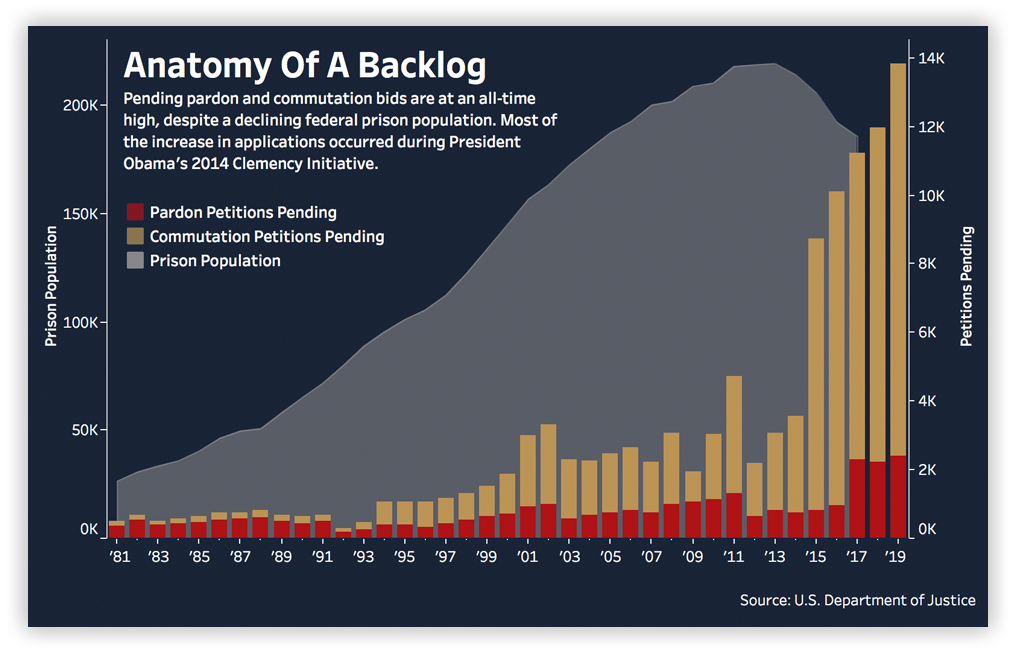
As of May 10, there were 3,211 pardon and 11,804 clemency petitions pending, according to DOJ statistics. Of those, 14 pardons and 461 clemency petitions were “closed without presidential action.”

New York Times, Biden Is Developing a Pardon Process With a Focus on Racial Justice (May 17)

US Sentencing Commission, Quick Facts – Offenders in Federal Prison (March 2021)

CNN, Advocates push for Biden to use his executive powers to grant clemency for hundreds of women in federal prisons (May 19)

DOJ, Clemency Statistics (May 23)

– Thomas L. Root

That ‘Teague’ Thing? We Were Just Kidding – Update for May 25, 2021

We post news and comment on federal criminal justice issues, focused primarily on trial and post-conviction matters, legislative initiatives, and sentencing issues.

BAD (BUT UNSURPRISING) NEWS ON RETROACTIVITY

sadprison210525How would you like to be convicted of a federal crime with a long sentence, only to have the Supreme Court hold well after the fact that something about your trial was unconstitutional? How would you like that?

That’s an easy one. You would not like to be convicted.  Period. Whether it was done constitutionally or not. No one wants to be convicted. So that was a stupid question.

But over 50,000 people are convicted of federal crimes every year. And they don’t like it, either. They like it even less if, say, if the government grabbed your cellphone location data without a warrant, or you were convicted by a jury vote of 9-2, or the judge jacked up your statutory minimum because he thought your revolver was really a machine gun.

All of those were deemed to be unconstitutional.  The cellphone location data? Carpenter v. United States, 2018. Less-than-unanimous jury? Ramos v. Louisiana, 2020. A nonjury finding jacking your mandatory minimum? Alleyne v. United States, 2013.

The problem is that if your conviction was final before these decisions established that you were constitutionally wronged, you have no right to ask the court for a do-over. That is not unless the decisions are declared to be retroactive, which means that cases like yours that are already final may reopen the issues on collateral review (habeas corpus).

watershed210525Thirty-two years ago, the Supreme Court explained in Teague v. Lane that decisions holding substantive criminal laws to be unconstitutional (such as the Armed Career Criminal Act residual clause in Johnson v. United States) are always retroactive to cases on § 2255 review. However, Teague held, a case in which a criminal procedure was declared unconstitutional (like searches in Carpenter or a less-than-unanimous jury in Ramos) is only retroactive on habeas review only if the new rule was “watershed,” “bedrock” or “essential.”

So what kind of ruling would be “watershed?” Prisoners and defense attorneys have looked for that elusive “watershed” decision for three decades without success. Last week, the Supreme Court heard a case asking whether last year’s Ramos rule on unanimous juries had to be unanimous (a holding which affected Louisiana and Oregon only) was retroactive. The Court ruled 6-3 that Ramos was not a “watershed” rule. More important, the Court gave up pretending that anything could ever be a “watershed” rule.

“This Court has repeatedly stated that a decision announcing a new rule of criminal procedure ordinarily does not apply retroactively on federal collateral review,” Justice Kavanaugh wrote for the majority. “Indeed, in the 32 years since Teague underscored that principle, this Court has announced many important new rules of criminal procedure. But the Court has not applied any of those new rules retroactively on federal collateral review… And for decades before Teague, the Court also regularly declined to apply new rules retroactively, including on federal collateral review… At this point, some 32 years after Teague, we think the only candid answer is that… no new rules of criminal procedure can satisfy the watershed exception. We cannot responsibly continue to suggest otherwise to litigants and courts… It is time — probably long past time — to make explicit what has become increasingly apparent to bench and bar over the last 32 years: New procedural rules do not apply retroactively on federal collateral review. The watershed exception is moribund.”

squarepeg210525So prisoners, at last, can give up trying to pound round constitutional procedure decisions into Teague’s square holes. The Supreme Court has said what a lot of us suspected ever since Apprendi was declared non-retroactive. Teague’s promise is now and always has been an illusion: there simply are no watershed decisions.

Edwards v. Vannoy, Case No 19-5807, 2021 US LEXIS 2584 (May 17, 2021)

– Thomas L. Root

It Depends on What the Meaning of ‘And’ Is – Update for May 24, 2021

We post news and comment on federal criminal justice issues, focused primarily on trial and post-conviction matters, legislative initiatives, and sentencing issues.

GOOD NEWS FROM CONJUNCTION JUNCTION

conjunction210524The “safety valve” in 18 USC § 3553(f) allows a district court to sentence a drug defendant below an otherwise mandatory-minimum sentence if he or she meets certain criteria – such as the offense having no gun or violence, the defendant not being a leader in the offense, and the defendant truthfully admitting his or her role in the offense. But the first criterion has always been the tough one, that the defendant’s criminal history score could be no higher than one, a requirement that disqualified everyone but the most virginal of miscreants.

Congress changed all of that in the First Step Act. In expanding the number of people covered by the safety valve, Congress wrote that a defendant now must only show that he or she “does not have… (A) more than 4 criminal history points… (B) a prior 3-point offense… and (C) a prior 2-point violent offense.”

The “safety valve” was one of the only sensible things to come out of the Violent Crime Control and Law Enforcement Act of 1994, the bill championed by then-Senator Joe Biden that, a quarter-century later, has been used to brand him a mass-incarcerating racist.  The safety valve was intended to let people convicted of drug offenses as first-timers avoid the crushing mandatory minimum sentences that Congress had imposed on just about all drug dealing.

Eric Lopez got caught smuggling meth across the border. Everyone agreed he qualified for the safety valve except for his criminal history. Eric had one prior 3-point offense, and the government argued that was enough to disqualify him. Eric argued that the First Step Act amendment to the “safety valve” meant he had to have all three predicates: more than 4 points, one 3-point prior, and one 2-point prior violent offense.

andor210524Remember the fun that the media had when Bill Clinton famously dodged a deposition question by saying, “It depends on what the meaning of ‘is’ is?” That’s not so funny in the world of statutory construction. In Eric’s case, the government was contending that the First Step amendment meant that if a defendant had any one of the listed conditions – more than 4 points total, at least one 3-point prior, or at least one 2-point prior violent offense – he or she could not get the safety valve. In other words, the government was arguing that “and” means “or.” The district court, however, agreed with Eric that the conjunction “and” means “and.”

Last week, the 9th Circuit agreed. In a decision that dramatically expands the reach of the safety valve, the Circuit applied the rules of statutory construction and held that the First Step amendment was unambiguous. “Put another way, we hold that ‘and’ means ‘and.’”

The government argued that such an interpretation could lead to crazy results (by which it meant “pro-defendant” results, no doubt). The 9th was unswayed:

“We recognize that § 3553(f)(1)’s plain and unambiguous language might be viewed as a considerable departure from the prior version of § 3553(f)(1), which barred any defendant from safety-valve relief if he or she had more than one criminal-history point under the Sentencing Guidelines… As a result, § 3553(f)(1)’s plain and unambiguous language could possibly result in more defendants receiving safety-valve relief than some in Congress anticipated… But sometimes Congress uses words that reach further than some members of Congress may have expected… We cannot ignore Congress’s plain and unambiguous language just because a statute might reach further than some in Congress expected… Section 3553(f)(1)’s plain and unambiguous language, the Senate’s own legislative drafting manual, § 3553(f)(1)’s structure as a conjunctive negative proof, and the canon of consistent usage result in only one plausible reading of § 3553(f)(1)’s “and” here: “And” is conjunctive. If Congress meant § 3553(f)(1)’s “and” to mean “or,” it has the authority to amend the statute accordingly. We do not.”

angels170726It’s pretty clear that this is an example of bad draftsmanship, an amendment that gives defendants much more than the Senate intended. But that’s irrelevant. For very good reason, when the text of a statute says something plainly, courts will not check it against the legislative history to determine whether what it says is consistent with legislative intent.  It may seem to some that statutory interpretation debate has an “angels on the head of a pin” quality to it, but reading statutes to mean what they say rather than what the courts wish they said or what the legislators might have said had they been more careful is vital to avoiding judicial mischief.

This decision could be huge for a lot of people sentenced to drug offenses after the effective date of the First Step Act in December 2018.

United States v. Lopez, Case No. 19-50305, 2021 U.S. App. LEXIS 15184 (9th Cir. May 21, 2021)

Sentencing Law & Policy, Ninth Circuit panel interprets FIRST STEP amendment to statutory safety valve to greatly expand who can avoid federal mandatory-minimum sentences (May 22)

– Thomas L. Root

Fascinating District Court Use of Compassionate Release to Correct Sentencing Error – Update for May 21, 2021

We post news and comment on federal criminal justice issues, focused primarily on trial and post-conviction matters, legislative initiatives, and sentencing issues.

DISTRICT COURT GRANTS COMPASSIONATE RELEASE DUE TO SENTENCING ERRORS

There’s a precedential pecking order that few do-it-yourselfer prisoner litigants appreciate.

coffee210521It’s easy… a Supreme Court decision binds every lower federal court in America. A “published” decision of a federal court of appeals (and “published” means the court declares it to be published, not just that you can find a copy of it on the Internet) binds every district court in that particular circuit. But the opinion of a district court only binds the parties to the action. If the Chief Judge of the Federal District Court for the Eastern District of Northern South Dakota rules that red is really green, the judge in the office next to hers is nonetheless entitled to rule the next day in a different case that red is more blue than green.

So district court decisions ultimately are sometimes interesting, sometimes illuminating, occasionally infuriating and usually boring, but whatever they might be, $5.00 and the combined output of the best district court in America will get you a Strawberry Funnel Cake Frappuccino at Starbucks, but little else.

oracle210521That doesn’t stop prisoners, many of whom breathlessly cite opinions from some knuckleheaded district court a thousand miles away like they are the immutable words of the oracle descended from Mt. Olympus.

But while district court decisions are not binding precedent, they can be what lawyers like to call “persuasive authority.” That kind of authority says to a district court, ‘look how smart Judge Elihu Smails held in this similar case, and don’t you want to look as bright as he does?’ Sometimes that kind of persuasion works, sometimes it doesn’t.

With that prologue, we were impressed with a decision handed down last week by a judge in the District of Massachusetts, granting compassionate release to a man doing life for a 1991 bombing that killed one cop and injured another.

The movant had discovered an error many years after his conviction which made the life sentence unlawful. He filed a motion with the District Court back in 2007 pointing out the error, and the sentencing court granted him relief. Unfortunately for the defendant, the First Circuit reversed the district court on procedural grounds, specifically that the prisoner had no right to bring what was in effect a second 28 USC § 2255, so the sentencing error was unreviewable.

The prisoner tried again 13 years with a motion for compassionate release under 18 USC § 3582(c)(1)(A)(i).  The motion turned on the prevalence of COVID-19 at USP Tucson and the 65-year old prisoner’s vulnerability to it, but as well raised arguments that the conviction and sentence were tainted by the government having played on the homophobia of the jury, and the sentencing error that was argued futilely in 2007.

The district court rejected the COVID-19 argument due to the fact that the prisoner had received the vaccine, and it characterized the evidence of innocence and homophobia as “serious but not overwhelming arguments” that “raise questions and perhaps even doubts – but no more.”

But the court was convinced by the sentencing error. It rejected the government’s argument that the First Circuit had already settled the issue:

The First Circuit’s holding was premised upon a strict application of AEDPA… But now Congress has spoken again. And this time it has given trial judges broad authority – indeed it has imposed a statutory duty, upon a defendant’s motion – to conduct an individualized review of the defendant’s case for extraordinary and compelling circumstances that call out for correction… Moreover, at the time of this writing, there is a growing consensus among courts that there are few if any limitations on what may be considered an extraordinary and compelling reason warranting release, even those claims that have been rejected on direct appeal or collateral attack.

compassion160208The district court used compassionate release to do what it could not do in a § 2255 motion: it ruled that “it is both extraordinary and compelling that (1) a judge sentenced a defendant to life imprisonment using a preponderance of the evidence standard where the controlling statute provided that a life sentence could be imposed only by the jury; and (2) there exists no available avenue for relief from this legal error.”

The court ruled that there was “no question that this Court may conclude that a legal error at sentencing constitutes an extraordinary and compelling reason, and reduce the sentence after conducting an individualized review of the case. Here, the Court is deploying the broad discretion provided in one statute – § 3582(c)(1)(A) – to effectuate Congress’s clearly stated intent in a separate statute, see 18 USC § 34, as incorporated by 18 USC § 844.”

United States v. Trenkler, Case No 92-10369, 2021 U.S. Dist. LEXIS 87567 (D. Mass. May 6, 2021)

– Thomas L. Root
If Today’s Thursday, My Position Has Changed – Update for May 20, 2021

We post news and comment on federal criminal justice issues, focused primarily on trial and post-conviction matters, legislative initiatives, and sentencing issues.

DANCE WITH THE GIRL WHO BRUNG YOU

dancegirlbrung210520I used to practice in front of crusty old judge Walter J. Miller, who liked to warn attorneys that he expected them to “dance with the girl who brung you.” By that he meant that if you argued an evidentiary position in front of him, you were expected to maintain that position even if it became uncomfortable.

The government – which has a history of changing its position as the day, fashion, and its overarching goal of keeping people imprisoned may dictate – ran smack into that doctrine last week in the 7th Circuit. Dean Guenther was convicted of being a felon in possession of a firearm (18 USC § 922(g)(1)) in the District of Minnesota. Because he had three prior Minnesota burglaries, he was sentenced under the Armed Career Criminal Act. He appealed, and then tried a § 2255 motion. Both failed.

But some time after that, the 8th Circuit held that the Minnesota burglary statute was too broad to count as the kind of generic burglary that the ACCA intended to count against its predicate. Then, Johnson v. United States threw out the ACCA’s residual clause. Dean brought a 28 USC § 2241 habeas corpus motion in the 7th Circuit (where he was imprisoned) under the § 2255(e) saving clause. The district court denied his motion.

miscarriage-of-justiceLast week, the 7th Circuit reversed. A § 2255 motion is normally the exclusive method to collaterally attack a federal sentence, but the § 2255(e) saving clause provides a limited exception, letting a prisoner seek § 2241 habeas relief in the district where he is confined if “the remedy by motion is inadequate or ineffective to test the legality of his detention.” Generally, the saving clause works when the prisoner relies on an intervening statutory decision announcing a new, retroactive rule that could not have been invoked in his first § 2255 motion and the error is serious enough to amount to a miscarriage of justice.

Dean’s motion fit everything except the question of whether his ACCA-enhanced sentence amounts to a miscarriage of justice. Since ruling that the Minnesota burglary was not an ACCA predicate, the 8th Circuit has reversed its position, but the 7th Circuit more recently ruled that the Minnesota burglary could not be used to qualify a defendant for the ACCA.

Dean and the government argued whether the ACCA sentence was a miscarriage should rely on 7th Circuit law (which said it was) or the 8th Circuit (which now says it might not be). The Circuit settled the issue easily, noting that in a prior case, the government argued that “the law of the circuit of confinement — this circuit — should control. That position, if accepted, meant no relief.” At the time, the 8th had held Minnesota burglary was not an ACCA predicate but the 7th had not ruled on the question. By the time that case reached the court of appeals, the tables had turned. The 8th had reversed itself, but the 7th had held that Minnesota burglary could not be counted under the ACCA.

flipflop170920In the prior case, of course, the government’s position was that the 7th Circuit’s interpretation should govern, because that had a more severe outcome for the defendant. In Dean’s case, however, the 8th Circuit’s interpretation would have hammered the defendant more. Bu the government’s logic, that one should apply.

The court did not state the obvious in such stark terms, but it did rather pointedly note that prior case, “we held the government to the position it took in the district court and applied the law of this circuit. We follow the same approach here.”

Thus, under 7th Circuit precedent, Dean’s Minnesota burglary convictions are not ACCA predicates (meaning he faces a maximum sentence of 10 years instead of a minimum sentence of 15 years).

Enjoy the dance, Mr. United States Attorney. She’s your date, after all.

Guenther v. Marske, Case No 17-3409, 2021 USApp LEXIS 14055 (7th Cir May 12, 2021)

– Thomas L. Root
The Big Payoff at BOP – Update for May 18, 2021

We post news and comment on federal criminal justice issues, focused primarily on trial and post-conviction matters, legislative initiatives, and sentencing issues.

SEX ABUSE AND MORONS

payoff210518Fourteen female prisoners who alleged in a lawsuit two years ago that they were sexually abused by officers at the Federal Correctional Complex Coleman women’s camp have settled with the government.

The Attorney General has approved the settlement, but the funds have not yet been released. An attorney for one of the women said he could not discuss the amount of the settlement until the money is released. Another lawyer, however, told the Tampa Bay Times (which first reported the settlement) that his three clients will share $1.26 million.

The suit contended that Bureau of Prisons correctional officers Coleman sexually abused female inmates for years and threatened the women if they didn’t comply. The women said they feared that if they came forward they’d be sent to another prison far from their families, interrupting the education and work programs they had at Coleman. The COs, who were identified by name in the litigation, have all retired or resigned, and some with full benefits from the bureau, according to the suit. None has faced any criminal charges.

It may be tougher for female inmates than for male ones, as the BOP’s cave-in on this suit suggests.

And not just for female inmates. A few years ago, 524 female BOP employees received a $20 million settlement of a suit that alleged Coleman management didn’t protect them from sexual harassment by male inmates and dissuaded the employees from documenting their complaints.

suit201102Meanwhile, for the second time in recent weeks, a lawsuit was filed in Kentucky accusing a Lexington Federal Medical Center employee of raping an inmate at the women’s minimum-security camp. A prior suit alleged that a CO raped a female inmate, according to court records. The new filing accuses an instructor in the RDAP program (who is no longer a BOP employee) of raping a different female inmate.

RDAP,  the intensive Residential Drug Abuse Program, rewards inmates who successfully complete the 9-12 month regimen with up to one year off their sentences. An instructor, whose decision could eject an inmate from RDAP and thereby deprive her of the year off, would have substantial leverage over an inmate in the program.

The BOP told the Herald-Leader it does not comment on pending litigation. One of the attorneys representing the two women, said, “Sexual misconduct in our nation’s prisons is not limited to one bad actor or one specific facility… We intend to hold these bad actors responsible for the harm they have caused.”

On a different topic, a week ago I reported on newspaper reports on the condition of MCC New York and MDC Brooklyn. Last week, the New York Daily News reported that BOP “brass visited New York City’s federal jails last weekend — one day after the Daily News highlighted a judge’s scathing comments that the lockups were “run by morons.”

“The same day the BOP learned of the recent commentary about the conditions at MCC New York and MDC Brooklyn, staff were sent from agency headquarters and its Northeast Regional Office to review and ensure conditions for safety and security are maintained,” a BOP spokeswoman told the paper.

Apparently, the facilities had a bit of notice on the inspection. An MCC inmate told The News “that orderlies worked to clean up the jail until 3 a.m. on Saturday, hours before the BOP officials arrived. Correctional staff told detainees the visit was due to the jail being ‘in the newspaper,’ according to the inmate who is not allowed to speak to the press. Correctional officers brushed off McMahon’s comments, saying they were directed at captains and wardens, the inmate said.”

potemkin210518Potemkin would have been proud. But probably not so the MDC and MCC managers, who are guilty of the cardinal bureaucratic sin: they made their bosses look bad, something that is not easily forgiven.

Other sources told the paper that “inmates were being shuffled to different units and transferred to MDC for repairs at MCC.”

Finally, the numbers: As of Friday, the BOP said it had 73 inmates and 153 staff with COVID. The percentage of vaccinated staff stood at 50.4%, inmates at 40.5%. One more death, a USP Yazoo City inmate, raised the federal inmate death toll to 250.

Miami Herald, Feds pay seven figures to settle suit over systemic sexual abuse at Florida women’s prison (May 13, 2021)

Tampa Bay Times, Lawsuit settled in which 15 women alleged sexual abuse at Florida prison (May 6, 2021)

Lexington Herald-Leader, Second Lexington FMC inmate files lawsuit accusing prison employee of rape (May 15, 2021)

New York Daily News, NYC federal jails visited by Bureau of Prisons bigwigs after judge’s criticism (May 14, 2010)

BOP, Inmate Death at USP Yazoo City (May 13, 2021)

– Thomas L. Root

11th Circuit Does Addition by Subtraction on First Step Crack Resentencing – Update for May 17, 2021

We post news and comment on federal criminal justice issues, focused primarily on trial and post-conviction matters, legislative initiatives, and sentencing issues.

SECTION 404 – WHERE LESS IS LESS, EVEN WHEN IT’S MORE

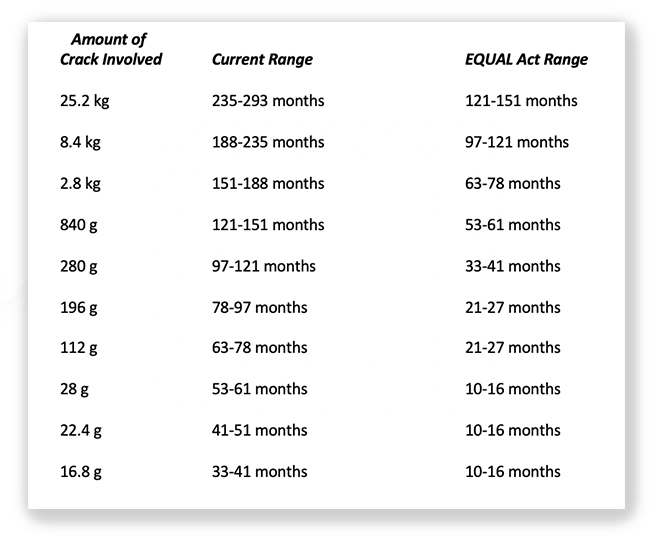
numbersA lot of times, prisoners – who are rightly focused on the substance of their claims – skip over the finer points of procedure. After all, procedure is kind of boring. But paying attention can bring dividends, or – as the old proverb goes – “God is in the details.”

Ask Nolan Edwards. He was doing life for a crack offense when the First Step Act passed, letting him seek retroactive application of the Fair Sentencing Act. First Step Act § 404(b) provides that the court that originally sentenced a defendant for a crack offense may, when certain conditions are met, “impose a reduced sentence.” Meanwhile, 18 USC § 3582(c)(1)(B) (the section many § 404 motions cite), is similar but not identical. It authorizes a district court to “modify an imposed term of imprisonment to the extent otherwise permitted by statute…”

Nolan filed a motion under First Step Act § 404 and § 3582(c)(1)(B). The district court reduced his sentence to time served, but concluded the First Step Act required it to impose an 8-year supervised release term. Nolan appealed the supervised release term, arguing that § 404 only empowers a court to subtract from a sentence, not add to one.

Last week, the 11th Circuit agreed. A § 404 motion “is self-contained and self-executing,” the Circuit said, and does not need to rely on 18 USC § 3582(c)(1)(b) to be granted. Therefore, a district court is entitled only to reduce a prisoner’s overall sentence pursuant to a § 404 motion.

goddetails210517But that didn’t help Nolan. The 11th said that the focus was on the overall sentence, not just the components. So if the “unitary” sentence – imprisonment and supervised release considered together – was reduced, First Step Act § 404’s requirements were met. Here, Nolan’s life sentence was cut to 260 months and eight years of supervised release. That was clearly a reduced sentence, the Circuit said, despite the fact supervised release went from zero to 8 years.

United States v. Edwards, Case No. 19-13366, 2021 U.S.App. LEXIS 14140 (11th Cir., May 13, 2021)

– Thomas L. Root

Dog Bites Man: Judge Says NYC BOP Facilities Run By Morons – Update for May 14, 2021

We post news and comment on federal criminal justice issues, focused primarily on trial and post-conviction matters, legislative initiatives, and sentencing issues.

JUDGE SAYS “DISGUSTING, INHUMAN” BOP NYC FACILITIES ARE RUN BY MORONS

moron210514A senior Federal judge who navigated her Manhattan-based court through the pandemic denounced conditions at MDC Brooklyn and MCC New York as “disgusting” and “inhuman” during the sentencing last month of a woman who spent months in solitary confinement after contracting COVID-19.

US District Court Judge Colleen McMahon said in a transcript just obtained by the Washington Post that the facilities are “run by morons.” During the sentencing, McMahon castigated the BOP, saying the agency’s ineptitude and failure to “do anything meaningful” at the MCC in Manhattan and MDC Brooklyn amounted to the “single thing in the five years that I was chief judge of this court that made me the craziest.”

“It is the finding of this court that the conditions to which the defendant was subjected are as disgusting, inhuman as anything I’ve heard about any Colombian prison,” McMahon said on the record, “but more so because we’re supposed to be better than that.”

The BOP responded in a statement that it “takes seriously our duty to protect the individuals entrusted in our custody, as well as maintain the safety of correctional staff and the community.”

plague200406Meanwhile, The Trentonian reported last week that FCI Fort Dix set as COVID-19 record for the worst outbreaks of any federal facility. New Jersey US Senators Bob Menendez and Cory Booker, both Democrats, called on the BOP last month to “prioritize the vaccination program” at FCI Fort Dix. More than 70% of the 2,800 prisoners at Fort Dix have tested positive for COVID-19 since the pandemic began. As of last week, 52% of Fort Dix inmates have been vaccinated.

Also last week, the Legislative Committee of the Federal Public and Community Defenders wrote a 16-page letter to Senate Judiciary Chairman Richard Durbin (D-Illinois) and Ranking Member Charles Grassley (R-Iowa) asking for Congressional action to reform the BOP in areas as varied as inmate healthcare to compassionate release to First Step Act programming credits.

“Although the Biden Administration has taken significant steps to beat back COVID-19 in the community,” the letter said, “individuals in BOP custody remain at high risk. Over a year into the pandemic, they are subject to harsh and restrictive conditions of confinement and lack adequate access to medical care, mental health services, and programming. The improvements to programming promised by the First Step Act  generally stand unfulfilled.”

Most significant was criticism of BOP healthcare that went beyond the pandemic: “Dr. Homer Venters, a physician and epidemiologist who has inspected several BOP facilities to assess their COVID-19 response, identified a “disturbing lack of access to care when a new medical problem is encountered” and is concerned that “[w]ithout a fundamental shift in how BOP approaches… health services, people in BOP custody will continue to suffer from preventable illness and death, including the inevitable and subsequent infectious disease outbreaks.”

COVIDvaccine201221The letter also took aim at the high vaccine refusal rate by BOP staff (currently 50.5% refused), staffing shortages, and the BOP’s poor record on granting compassionate release.

The letter complains that the BOP’s proposed rule on awarding earned time credit “impermissibly restricts an individual’s ability to earn time credits, makes it too easy to lose those credits, and unduly excludes broad categories from the earned time credit system. In short, these provisions kneecap the FSA’s incentive structure and make it less likely individuals will participate in programs and activities to reduce recidivism and increase public safety.” The letter notes that if a prisoner programmed 40 hours a week, it would take more time to earn a year’s credit than the length of the average federal sentence.

The Trentonian, Ft Dix FCI has largest total COVID-19 cases among U.S. federal prisons (May 4, 2021)

Federal Public and Community Defenders, Letter to Sens Durbin and Grassley (May 4, 2021)

Washington Post, Judge says ‘morons’ run New York’s federal jails, denounces ‘inhuman’ conditions (May 7, 2021)

– Thomas L. Root

Two Very Distinguished Cases – Update for May 13, 2021

We post news and comment on federal criminal justice issues, focused primarily on trial and post-conviction matters, legislative initiatives, and sentencing issues.

A SOLITARY RAY OF LIGHT…

There was a single bright spot in otherwise dreary judicial news last week.

light210513When an appeals court 3-judge panel issues a precedent-making opinion, no other 3-judge panel can invalidate it. Only the court of appeals sitting en banc (all of the active judges as one court) can do that.

So when a 3-judge panel does something stupid, what can another 3-judge panel do about it?

Last week, a 6th Circuit panel employed one method of finessing a way around a lousy opinion: it distinguished it. That means the judges found some factual difference that let them rule the way they thought they should rule, regardless of the prior opinion.

Ian Owens was charged with one count of bank robbery. He wouldn’t take a deal, so the government added an 18 USC § 924(c) count for using a gun in the commission of a violent crime. He still wouldn’t deal, so the government added another. By the time Ian went to trial, the government had heaped five § 924(c) counts on top of the robbery. Because the case was decided much before the First Step Act changed things around, the § 924(c) counts were stacked, with the second through fifth counts each carrying a mandatory 300 months. Ian was sentenced to 1370 months (114 years).

When Ian filed a compassionate release motion claiming that he wouldn’t get that kind of time after the First Step Act ended § 924(c) stacking and that his co-defendants all got a lot less time than he did, he ran into two prior 6th Circuit decisions, United States v. Tomes and United States v. Wills. Both of those cases said First Step changes in 18 USC § 924(c) could not be used as extraordinary and compelling reasons for a compassionate release sentence reduction. The district court did not consider Ian’s evidence of rehabilitation, any other bases for a finding of extraordinary and compelling reasons, or the 18 USC § 3553(a) sentencing factors.

hares210513Last week, the 6th Circuit split hairs in a split decision, and explained away Tomes and Wills. In those cases, the Circuit said, the prisoner argued only that the First Step Act changed § 924(c) stacking. But Ian had three reasons supporting his extraordinary and compelling showing, not just one. That made his case “factually distinguishable,” the 6th said. “Owens points to the fact that his lengthy sentence resulted from exercising his right to a trial and to his rehabilitative efforts as additional factors that considered together constitute an extraordinary and compelling reason meriting compassionate release,” the Circuit said. “Further, the district court in Owen’s case did not consider these other factors and, instead, summarily concluded that his First Step Act 403 argument was meritless.”

It was not necessarily meritless, the 6th said. “In making an individualized determination about whether extraordinary and compelling reasons merit compassionate release, a district court may include, along with other factors, the disparity between a defendant’s actual sentence and the sentence that he would receive if the First Step Act applied…”

The decision seems to have jumped onto a rather technical difference between Ian’s situation and the prior cases, but those prior decisions largely stink. Now, the odor has been contained, or – as lawyers like to say – Tomes and Wills have been “limited to their facts.”

United States v. Owens, Case No 20-2139, 2021 US App LEXIS 13656 (6th Cir May 6, 2021)

– Thomas L. Root

Can Clemency Save CARES Act Home Confinees? – Update for May 11, 2021

We post news and comment on federal criminal justice issues, focused primarily on trial and post-conviction matters, legislative initiatives, and sentencing issues.

RUMBLINGS OF FIXING CLEMENCY AND HOME CONFINEMENT

biden210511White House officials are signaling that President Biden is prepared to “flex his clemency powers” as officials wade through the 14,000+ clemency requests on file.

I reported last week on a Zoom call the White House held to discuss criminal justice reform with advocates and former inmates. While the White House did not signal any imminent moves, officials indicated that Biden will not hold off until later in his term to issue pardons or commutations, The Hill reported last week.

“It was clear that they are working on something,” Norris Henderson, founder and executive director of Voice of the Experienced, who participated in the call, told The Hill. “They are looking at that right now as an avenue to start doing things.”

Meanwhile, an opinion piece in USA Today suggested Biden grant clemency to people on CARES Act home confinement as a means of thwarting last January’s Dept of Justice opinion that those people would have to return to prison after the pandemic ends.

noplacelikehome200518The Hill reported Saturday that Biden and Attorney General Merrick Garland have been facing mounting calls to rescind the DOJ memo. a policy implemented in the final days of the Trump administration that would revoke home confinement for those inmates as soon as the government lifts its emergency declaration over the coronavirus.

Randilee Giamusso, a Federal Bureau of Prisons spokesperson, told The Hill that the Biden administration had recently expanded the eligibility for home confinement, the clearest admission yet the pressure from above is forcing a renewed emphasis on CARES Act home confinement. Giamusso noted that Biden has extended the national COVID emergency declaration and that the Dept of Health and Human Services expects the crisis to last through the end of 2021.

insincerity210511“The BOP is focused right now on expanding the criteria for home confinement and taking steps to ensure individualized review of more inmates who might be transferred,” Giamusso said.  

Of course it is. No one who has ever dealt with the BOP can fairly doubt its laser focus on its mission or the helpfulness and professional polish of its staff.

The Hill, Biden set to flex clemency powers (May 5, 2021)

USA Today, COVID-19 concerns sent thousands of inmates home. Give clemency to those who deserve it. (May 5, 2021)

The Hill, DOJ faces big decision on home confinement (May 9, 2021)

– Thomas L. Root