Mistakes Were Made… and Tough Luck to You, Ezralee – Update for June 26, 2020

We post news and comment on federal criminal justice issues, focused primarily on trial and post-conviction matters, legislative initiatives, and sentencing issues.

9TH CIRCUIT SAYS COURTS MUST KEEP THE OLD ERRORS IN FSA RESENTENCING

You’d think that if a court had a chance to fix an old mistake when it resentenced someone, the judge would welcome the opportunity to do it right. You would be wrong.

mistake170417Ezralee Kelley was sentenced in 2006 on a crack distribution charge, with a sentencing range of 262-327 months due to her being a Guidelines “career offender.” After the First Step Act made the 2010 Fair Sentencing Act (FSA) retroactive, she filed for a reduced sentence.

A word about “career offenders”: Back many, many years ago, I was in the Air Force. It being the dawn of the recreational drug era, we all had to fill out a questionnaire about our drug use (or abstinence). Being smart airmen (no women in our unit back then), we all knew how much the brass would appreciate our candor, so we lied like a president on Twitter.

What struck me about the questionnaire was its categories. If you admitted to a single dalliance with controlled substances, you were classified as an “experimenter.” If you admitted to two or more uses of controlled substances, you were a “chronic abuser.” While how many drug abuse events were necessary to rank one as a “chronic abuser,” we were all pretty sure that number was a lot larger than two. Nevertheless, the categories were useful, because it informed us of the Air Force’s view of drug abuse. If we were to admit to “getting high,” we had better be talking about flying an airplane.

USAF200626Chapter 4B of the Guidelines is like that. If you have two prior convictions for a drug trafficking offense or crime of violence, or a mix, the Guidelines calls you a “career offender.” Under the Guidelines, a career offender’s offense level automatically shoots into low earth orbit (usually a 37) and your criminal history is deemed to be Category VI (which is the max).  If you sold me 50 lbs of pot, and you had two prior pot-selling convictions – federal or state – you could easily have a Criminal History score of II and a Guidelines Level of 12 (USSG. § 2D1.1(c)(12) for you technical folks). Your sentencing range would be 24-30 months, a veritable vacation.

But because of your two prior state felony convictions  – even if you only got probation for those – you would be a Guidelines career offender. Your offense level would shoot up to a 32 and your Criminal History category to VI. Your sentencing range would be 210-262 months (that’s 17.5 years to almost 22 years).

Like the Air Force “chronic abuser,” your two prior flirtations with the law (even if they were 14 years before), just turned two years in a federal prison camp into almost two decades in a place with guards with guns and razor wire.

(The foregoing is a mere illustration: you could not sell me 50 lbs of marijuana, because I have never, never even once used the stuff. Just check my Air Force questionnaire response if you doubt me.)

In today’s case, Ezralee’s youthful indiscretions had netted her two prior Washington state convictions for drugs. When she got a federal crack distribution case, she was “careered out,” as they say, and got a fearsomely long sentence. But when First Step made her eligible for an FSA reduction, she hoped to hit a home run.

bettethanezra200626A few years ago, the 9th Circuit had ruled that the some of Ezralee’s Washington state convictions used back in 2006 to make her a career offender do not count toward career offender. As a result, Ezralee said, she should be resentenced without the career status, which should drop her from 262-327 to a 51-month range.

The district court ruled that, mistake or not, it could not reconsider on an FSA resentencing whether she was a career offender.

neverhappened200626Last week, the 9th Circuit agreed. The Circuit explained that First Step permits the court to sentence as if parts of the FSA had been in place at the time the offense occurred, not as if every subsequent change in the law benefitting the defendant had occurred. In an FSA resentencing, the 9th said, the district court has to apply the laws that existed when the defendant’s crack offese was committed, only adding the FSA’s statutory reductions.

Thus, Ezralee’s new sentence assumed only that the FSA was in existence, resulting in a recalculated Guidelines range of 188 to 255 months. The Court gave her 180 months at resentencing.

United States v. Kelley, 2020 US App LEXIS 18834 (9th Cir Jun 15, 2020)

– Thomas L. Root

Sentencing Commission Redux – Update for June 25, 2020

We post news and comment on federal criminal justice issues, focused primarily on trial and post-conviction matters, legislative initiatives, and sentencing issues.

TRUMP MAY BE MOVING TO REPOPULATE SENTENCING COMMISSION

USSC170511The U.S. Sentencing Commission, a judicial-branch agency established by the Sentencing Reform Act of 1984, Pub. L. No. 98-473, § 235(b)(3), 98 Stat. 2032 (1984), is responsible for promulgating and amending the Sentencing Guidelines that have profoundly influenced virtually every federal criminal sentence for the past 30 years (and in fact were mandatory from inception until 2005).

But the Commission – which customarily amends the Guidelines annually – has been unable to issue new or amended Guidelines since the end of 2018, because the terms of three of the five USSG members expired at the end of that year. Since then, the President has made one attempt to nominate replacements to the Commission without success. He may be about to try again.

NPR reported last week that the White House has been consulting Capitol Hill and the criminal justice community about four Republican candidates for two of the slots on the Commission, three of them federal judges and the other from the conservative think tank Heritage Foundation.

HudsonA170811Republican candidates include Senior US District Judge Henry Hudson (Eastern District Virginia), a former director of the US Marshals Service known as “Hang ‘Em High Henry” for his work as a local prosecutor. Hudson has a reputation for handing out long sentences. Another is Chief Judge K. Michael Moore (Southern District Florida), also a former director of the Marshals. Eastern District of Kentucky Judge Claria Horn Boom, a favorite of Senate Majority Leader Mitch hudsonB170811McConnell (R-Kentucky), is in the running, as is John Malcolm, director of the Heritage Foundation’s Meese Center for Legal and Judicial Studies and a former AUSA. Malcolm helped then-candidate Trump put together a list of candidates in the event a Supreme Court vacancy opened up. Malcolm has reached out to allies across the political aisle to try to overhaul mandatory minimums.

One of the Commission slots is reserved for a Democrat. The President is proposing 3rd Circuit Appeals Judge L. Felipe Restrepo, a former public defender appointed to the judgeship by President Barack Obama.

NPR, Concerns Mount Over Possible Trump Picks For Influential Crime Panel (June 19)

– Thomas L. Root

11th Circuit Beats Down Fair Sentencing Act – Update for June 24, 2020

We post news and comment on federal criminal justice issues, focused primarily on trial and post-conviction matters, legislative initiatives, and sentencing issues.

11th CIRCUIT APPLIES ‘RULE OF SEVERITY’ TO PARSING FAIR SENTENCING ACT

Every defendant knows that the Rule of Lenity holds that any ambiguity in a criminal statute must be resolved in the defendant’s favor. Defendants can be forgiven if they think that the 11th Circuit follows the opposite rule – call it a “Rule of Severity” – to never miss a chance to parse a statute in favor of the government.

angryjudge190822I wrote a week ago about Supreme Court Justice Sotomayor’s blast at the 11th Circuit’s abuse of the 28 USC § 2244 process to foreclose meritorious direct appeal claims. The 11th is already notorious for eviscerating the § 2255(e) escape clause, a provision which lets defendants file for conviction or sentence relief under 28 USC § 2241 where, for procedural reasons, the § 2255 remedy is unavailable.

In its most recent entry, the 11th last week rejected the combined reasoning of six other circuits by interpreting the Fair Sentencing Act in a way that forecloses relief to many defendants who, had they been convicted in any other circuit, would have gotten relief. In so doing, the Circuit has denied First Step Act Section 404 relief to hundreds of inmates.

Section 404 says a “covered offense” entitled to retroactive FSA sentence reduction is a violation of a Federal criminal statute, “the statutory penalties for which were modified by section 2 or 3” of the FSA. The meaning of “covered offense” depends on what the clause in quotation marks — the “penalties clause” — modifies. Every other circuit to address the question believes that the penalties clause modifies “Federal criminal statute.” That means that if a defendant was sentenced for crack prior to August 2010, he or she is eligible to seek a sentence reduction.

Not the 11th. Instead, the Circuit held if the statutory minimum for the defendant’s sentence under the FSA would not have changed – say, the indictment claimed 40 grams of crack, which would have been a five-year minimum post-FSA as well as pre-FSA – a defendant is not eligible for § 404 relief.

To make matters worse, the 11th held that just because it is a “covered offense” does not necessarily mean that a district court can reduce a sentence. Any reduction must be ‘as if sections 2 and 3 of the Fair Sentencing Act…” The 11th said “the ‘as-if’ requirement imposes two limits relevant to these appeals. First, it does not permit reducing a movant’s sentence if he received the lowest statutory penalty that also would be available to him under the Fair Sentencing Act. Second, in determining what a movant’s statutory penalty would be under the Fair Sentencing Act, the district court is bound by a previous finding of drug quantity that could have been used to determine the movant’s statutory penalty at the time of sentencing.”

jackson200624Four defendants were involved In the case the 11th decided, Jones, Johnson, Allen and Jackson. (I say this because an inmate contacted me a few days ago to complain that I had written about United States v. Jones, but he had heard the 11th had also ruled on the “Allen case,” and what about that one?).  Four defendants, only one awful ruling.

Two of the four defendants had juries that did not make a drug finding. In that case, the Circuit said, the district court’s stratospheric holding at sentencing (287 grams of crack for one guy, 75 kilos of crack for the other) made each ineligible for the FSA.

One can only hope that the defendants will take the lopsided circuit split this case creates to the Supreme Court. For now, it is just another illustration of why the 11th Circuit is an terrible court  in which a defendant can find himself.

United States v. Jones, 2020 US App. LEXIS 18828 (11th Cir. June 16, 2020)

– Thomas L. Root

Death, SWAT and Smokes: A Quick Trip Around the BOP – Update for June 23, 2020

We post news and comment on federal criminal justice issues, focused primarily on trial and post-conviction matters, legislative initiatives, and sentencing issues.

NEWS FROM AROUND THE BOP

Deadly Business: The Dept. of Justice last week set new dates to begin executing federal death-row inmates following a months-long legal battle over the plan to resume executions, which have been on hold since 2003 .

death200623Attorney General William Barr directed the BOP to schedule the executions, beginning in mid-July at USP Terre Haute, of four inmates convicted of killing children. Three of the men had been scheduled to die last year, when Barr ended an informal moratorium on capital punishment.

Congress Queries BOP: House of Representatives Homeland Security Chairman Bennie Thompson (D-Mississippi) last week asked the BOP for details about whether agency officers who helped police the Washington, DC, protest have been quarantined or tested for COVID-19 before returning to work.

Thompson, who joined with Rep. Raja Krishnamoorthi (D-Illinois), Rep. Jamie Raskin (D-Maryland) and Sen. Cory Booker (D-New Jersey), noted that some BOP officials deployed to the protest — part of a display of force demanded by President Trump — came from FCI Petersburg, in Hopewell, Virginia (site of a significant coronavirus outbreak), yet were seen without wearing masks.

IG Out of SORTS with BOP: The DOJ Inspector General last week issued a report last week recommending that BOP Special Operations Response Teams (SORT) be suspended until comprehensive guidelines are developed.

cops200623BOP institutions maintain their own SORTs. A typical Special Operations and Response Teams has 15 members, including an emergency medical treatment specialist, a firearms instructor, a rappel master, a security/locking systems expert, a blueprint expert, and several firearms and tactical planning/procedures experts. As of 2013, the Bureau maintained 44 SORTs involving more than 700 BOP staff. 

The DOJ Inspector General wrote, “SORT members deployed a distraction device munition in a confined space, which was not authorized for use under BOP policy; SORT members deployed real OC spray rather than inert OC spray during a training exercise, allegedly without proper authorization; and SORT members used force, including firing a simunition round, against staff members who were allegedly yelling to the SORT that they were ‘out of role’ and physically vulnerable… BOP policies we reviewed did not clearly specify the types of weapons, less than lethal weapons, and munitions, if any, that are authorized for use during BOP training exercises; and did not provide safeguards to ensure that exercises are conducted safely.”

cigarette200623BOP CO Gets Charged: The US Attorney’s Office for the Middle District of Pennsylvania announced on June 10 that a former correctional officer at FCI Schuylkill was charged on June 9 with bribery and corruption. The criminal information filed by the USAO alleged that between 2011 and 2016, the CO had smuggled tobacco into FCI Schuylkill in exchange for payments by prisoners.

AP, New dates set to begin federal executions (June 15, 2020)

Politico, Dems ask Bureau of Prisons for coronavirus update on staffers who manned protests (June 15, 2020)

DOJ Inspector General, Management Advisory Memorandum of Concerns Identified During Mock Exercises by Federal Bureau of Prisons Special Operation Response Teams (June 18, 2020)

Special Ops Magazine, Special Operations and Response Teams (SORT) (Jan. 2013)

DOJ, Former FCI Schuylkill Correctional Officer Charged In Bribe Scheme to Provide Tobacco to Inmates (June 10, 2020)

– Thomas L. Root

Coronavirus Simmers While BOP Gets Fried – Update for June 22, 2020

We post news and comment on federal criminal justice issues, focused primarily on trial and post-conviction matters, legislative initiatives, and sentencing issues.

COVID-19 AIN’T GOIN’ AWAY

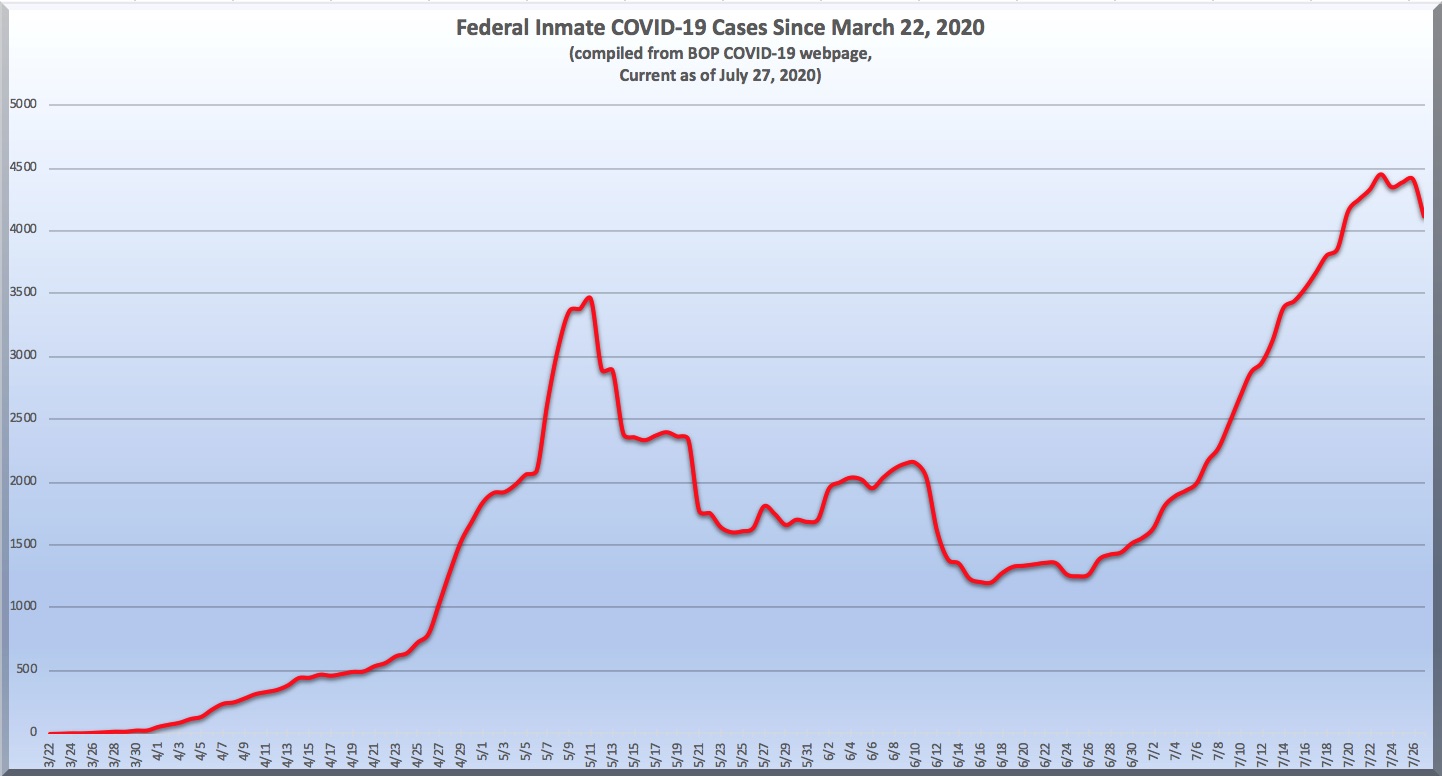
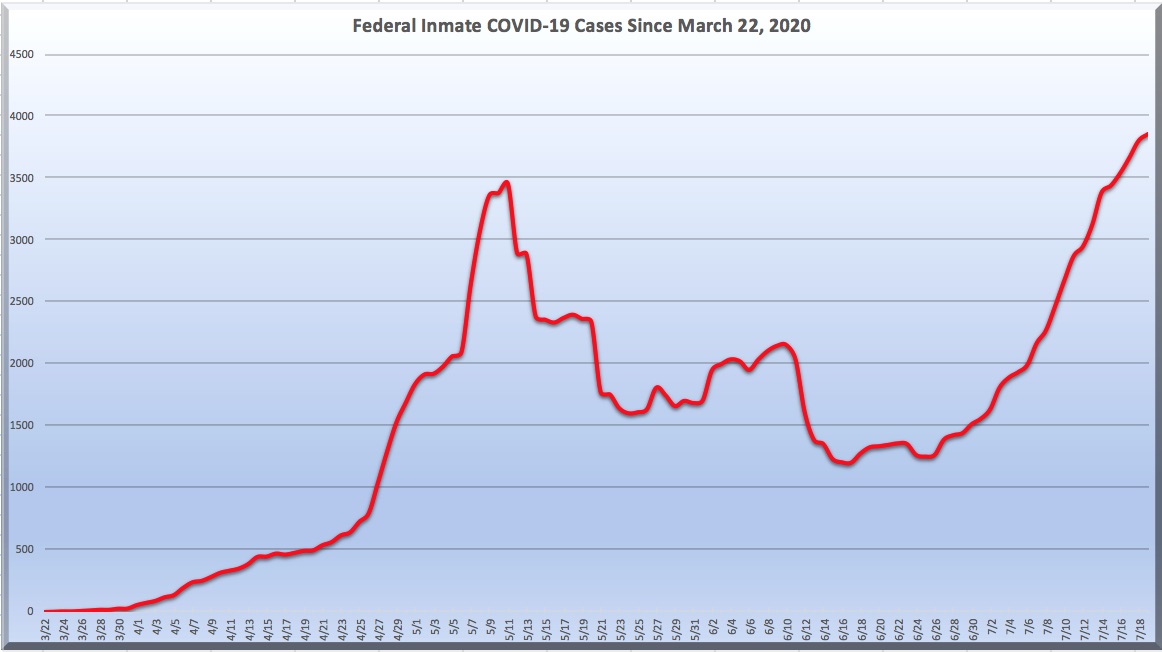
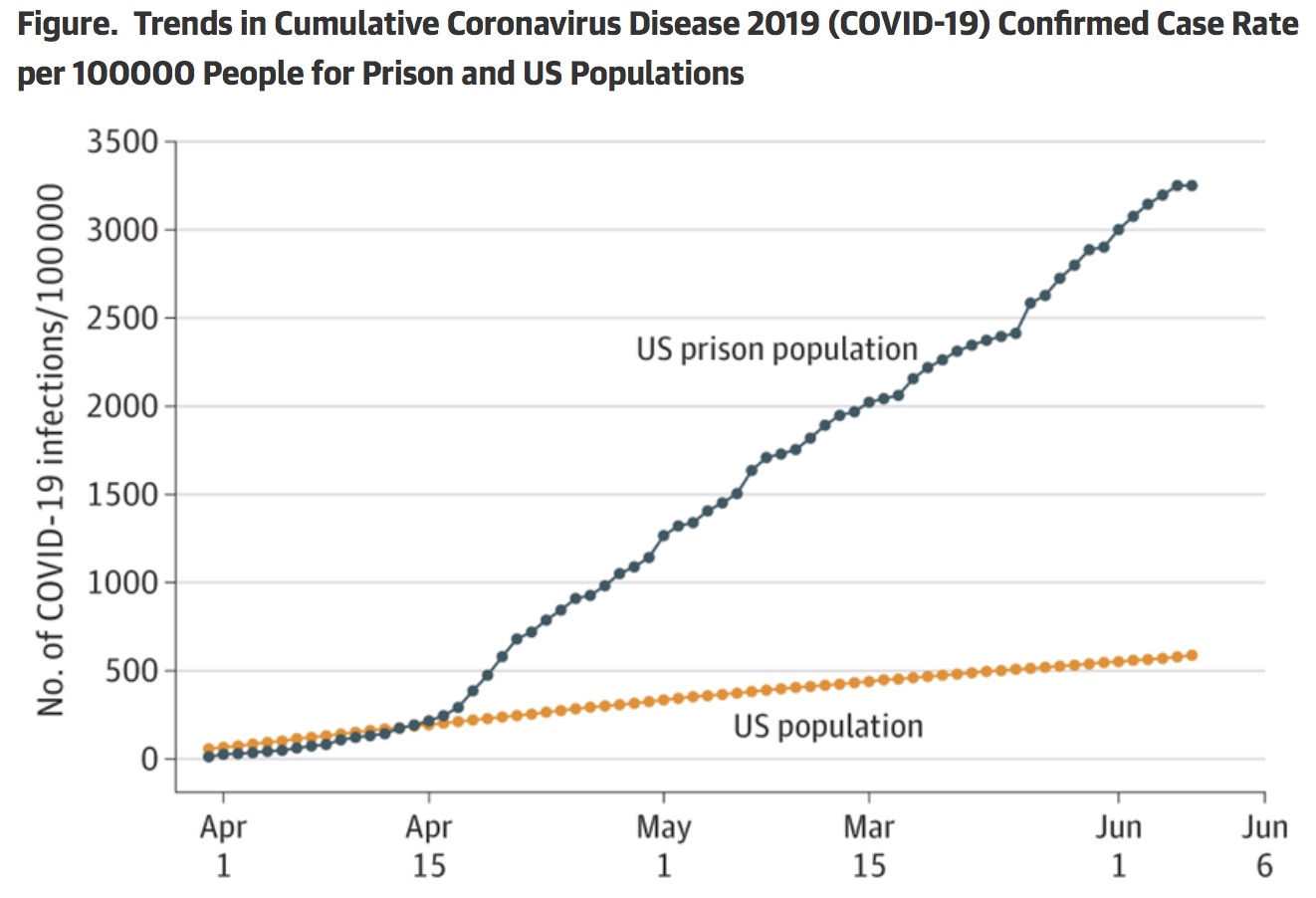
corona200313The New York Times reported last week that “cases of the coronavirus in prisons and jails across the United States have soared in recent weeks, even as the overall daily infection rate in the nation has remained relatively flat.” Certainly, the BOP’s own numbers suggest that little progress has been made in combatting COVID-19 in the BOP, and the stats contain an ominous sign.

Active inmate COVID-19 cases increased 9% to 1,351, but only one additional inmate death was recorded. What should worry the BOP, however, is a 9% increase in facilities reporting active coronavirus cases, from 64 to 70 prisons (well more than half of all BOP facilities). A month ago, the facilities count was 52. Two months ago, it was at 46.

The BOP reports that it has completed nearly 19,000 inmate COVID-19 tests, and one out of three inmates has tested positive. Yet the testing is a mere drop in the bucket: 86% of all federal inmates have yet to be tested.

coronadog200323

A June 18 Marshall Project/VICE News collaboration blasted the BOP’s management of the pandemic. Based on over 100 interviews and reviews of dozens of internal BOP memos, emails, and other documents, the story reported that

•   “staff ignored or minimized prisoners’ COVID-19 symptoms, and mixed the sick and healthy together in haphazard quarantines”;

•   thousands of prisoners being transferred around country in February and early March transmitted the pandemic from prison to prison, according to BOP records;

•   BOP staff felt pressured to report to work after being exposed to sick prisoners;

•  the BOP failed to follow its own pandemic response plan by spacing out prisoners;

•   the agency deliberately limited testing so that it would not have to report positive cases; and

•  prisoner quarantines were set up in “filthy buildings that had been vacant for years or in tents that flooded during rainstorms.”

BOPCOVID-19-200622The report said BOP Director Michael Carvajal refused an interview request, but a BOP spokesperson – while declining to comment on some of the allegations – maintained the agency’s response to the pandemic “was carefully planned and coordinated, and that it took an array of precautions to contain the outbreak.”

New York Times, Coronavirus Cases Rise Sharply in Prisons Even as They Plateau Nationwide (June 16, 2020)

ABC, More than 1 out of 3 tested federal inmates were positive for coronavirus (June 16)

The Marshall Project, “I Begged Them To Let Me Die”: How Federal Prisons Became Coronavirus Death Traps. (June 18)

– Thomas L. Root

Short Rockets – Update for June 18, 2020

We post news and comment on federal criminal justice issues, focused primarily on trial and post-conviction matters, legislative initiatives, and sentencing issues.

SOME SHORTS FROM LAST WEEK…

rocket190620Crack Retroactivity: Monae Davis won release a year ago when a district court gave him a retroactive crack sentence reduction under Section 404 of the First Step Act. However, he has lived under a cloud since then because the government appealed, arguing that because his offense involved 1.5 kilos of crack, he was not eligible for a Section 404 reduction (because his Guidelines would not change).

The question of eligibility has haunted Section 404 applicants since First Step passed. Does 404 relief turn on whether only on whether the punishment specified in the statute under which the defendant was charged has changed, or must the change mean that the Guidelines for the amount of drugs with which the defendant was involved changed?

Freedom is vastly preferred over prison, but Monae’s joy must have been muted, knowing as he did that a case in front of the Court of Appeals could send him back to prison tomorrow (and I mean “tomorrow” in its most literal sense).

Luckily for Monae, two weeks ago his joy became unbounded. The 2nd Circuit joined the surge of courts of appeal disagreeing with the government’s draconian view of Section 404. The Circuit rejected the government’s argument that Section 404 eligibility turns on a defendant’s actual conduct, holding that “eligibility depends on the statutory offense for which a defendant was sentenced, not the particulars of any given defendant’s underlying conduct. Because the retroactivity meant that the Fair Sentencing Act now applied, and because the FSA modified the statutory penalties for Monae’s offense, he was eligible for Section 404 relief.

United States v. Davis, Case No. 19-874, 2020 U.S. App. LEXIS 17736 (2nd Cir June 5, 2020)

Drug “Safety Valve”:  Devin Hodgkiss pled guilty to distributing meth on an occasion in April 2018 and to possessing a firearm in furtherance of a drug trafficking offense in June 2018 (an 18 USC § 924(c) offense). He asked for “safety valve” sentencing under 18 USC 3553(f) to duck under the 10-year drug statutory minimum, but the district court denied him, holding that he was ineligible for the safety valve because he had possessed a gun as relevant conduct.

safetyvalv200618[Background: The “safety valve,” found in 18 USC § 3553(f), permits a drug defendant who meets certain limiting criteria (light criminal history, no leadership role, no violence, no gun, etc) to be sentenced without regard to statutory minimum sentences (and with a Guidelines break as well)].

Last week, the 8th Circuit reversed, holding that Devin was entitled to the safety valve despite its requirement that the defendant not have possessed a firearm “in connection with the offense.”

“Relevant conduct,” the Circuit said, “is a concept developed by the Sentencing Commission… The ‘safety-valve‘ limitation on statutory minimums, however, appears in an Act of Congress that is not governed by definitions in the sentencing guidelines. Therefore, to determine whether Hodgkiss possessed a firearm ‘in connection with the offense,’ 18 USC 3553(f)(2), we must consider what the statute means by ‘the offense’.”

The 8th concluded that the term “offense” should be strictly defined as “offense of conviction.” Here, Devin was convicted of distribution based on an April 2018 drug sale. The § 924(c) was based on a June 2018 drug distribution. Therefore, the gun was not possessed in connection to the drug conviction. He still faced a mandatory minimum of five years for the gun, but the 10-year statutory minimum no longer applied.

United States v. Hodgkiss, Case No. 19-1423, 2020 U.S. App. LEXIS 17874 (8th Cir June 8, 2020)

– Thomas L. Root

Sotomayor Unhappy With 11th Circuit’s Need for Speed – Update for June 16, 2020

We post news and comment on federal criminal justice issues, focused primarily on trial and post-conviction matters, legislative initiatives, and sentencing issues.

JUSTICE SOTOMAYOR WOODSHEDS 11th CIRCUIT ON § 2244 OPINIONS

Alone among the federal circuit courts of appeal, the 11th has a practice of publishing its decisions on inmates’ 28 USC § 2244 motions seeking the right to bring a second-or-successive § 2255 motion.

oneanddone200616A little background: Every convicted defendant has the right to file one motion to set aside the conviction or sentence under 28 USC § 2255, the federal statute that controls how a petition for writ of habeas corpus challenging convictions is brought in the federal system. The filing is subject to strict time limits, and once an inmate files a § 2255 motion and has that motion decided on the merits, he or she cannot bring another unless some tough-to-get permission is first granted by a federal court of appeals.  Like March Madness, this freedom tourney is “one and done.”

To get that permission, a defendant files a motion under 28 USC § 2244 for permission to file a second-or-successive § 2255. Permission is only granted in limited, well-defined circumstances. The § 2244 proceeding is a quickie: the appellate court is to decide the motion in 30 days, leaving the court little time to consider a complex inmate application. The government rarely is permitted to file an opposition to the request. Any denial of an inmate’s § 2244 motion cannot be appealed, reconsidered or taken to the Supreme Court. What is more, the appeals court has to decide it within 30 days of filing, 

Some circuits make it even tougher. In the 11th Circuit, an applicant must confine his or her entire legal argument to a single-page form. To make matters worse, the 11th Circuit publishes its decisions on § 2244 motions.

speeddating200616“Publishes its decisions?” you ask. “How can that be a bad thing? Doesn’t it help future filers by explaining the Court’s position on the issues that may be raised?”

That is true, but the problem is that the courts publish everything, as long as “publish” has a small “p.” When a court Publishes a case with a capital “P,” that means that the case becomes precedent. All district courts in the circuit must follow the precedent, and the court of appeals itself cannot reverse or abandon the precedent unless the court does so in an en banc proceeding. What’s more, the holdings don’t just bind § 2244 filers. They will bind future litigants on direct appeal as well.

(By the way, I use the capital “P”/small “p” for illustration only.  It is not a term of art in law).

Thus, published decisions that are binding on future litigants (including those on direct appeal) are being decided on the sketchiest of records, in a judicial version of “speed dating.”

Last week, Justice Sonia Sotomayor issued a rare concurring statement in a decision denying certiorari to an appellant who had been bound by an 11th Circuit § 2244 denial. Michael St. Hubert argued on appeal that his Hobbs Act robberies were not “crimes of violence” that could support convictions under 18 USC § 924(c) for using a gun during their commission. The issue is quite a live one after last summer’s United States v. Davis. But Mike and several other defendants were shut out by the Circuit because it had already settled the question they raised in its § 2244 proved.

25words200616Justice Sotomayor suggested that the appellate court’s § 2244 practice “raises a question whether the Eleventh Circuit’s process is consistent with due process.” She wrote, “In sum, the Eleventh Circuit represents the ‘worst of three worlds.’ It “publishes the most orders, adheres to a tight timeline that the other circuits have disclaimed,” and “does not ever hear from the government before making its decision.” In this context, important statutory and constitutional questions are decided (for all future litigants) on the basis of fewer than 100 words of argument.”

The Justice urged the 11th Circuit to adopt procedures that “better accord with basic fairness—and would ensure that those like [this defendant] would not spend several more years in prison because of artificially imposed limitations like 100 words of argument.”

United States v. St. Hubert, 2020 US LEXIS 3146 (Supreme Ct. June 8, 2020)

– Thomas L. Root

BOP 4, Inmates 0 in COVID-19 Litigation – Update for June 15, 2020

We post news and comment on federal criminal justice issues, focused primarily on trial and post-conviction matters, legislative initiatives, and sentencing issues.

THE WEEK IN COVID-19 LITIGATION

prisonhealth200313As of last night, June 14th, the number of Federal Bureau of Prisons inmates with COVID-19 had dropped from 2,109 a week ago to 1,341. The number of BOP facilities with COVID-19 on premises rose from 62 to 65, and then fell back to 62 as of last night. Deaths continued to climb, however, from 81 a week ago to 87 last night.

The numbers aren’t bad for the BOP. Inmate sickness has been fluctuating between 1,300 and 2,100 for a few weeks, and the number of prisons affected has leveled. But the BOP’s big advances last week were in the courtroom, not the medical suite.

Besides the 6th Circuit’s stay in FCI Elkton litigation, last Tuesday, Judge Rachel P. Kovner of the U.S. District Court for the Eastern District of New York denied prisoners a preliminary injunction because of inept medical care they claim amounts to cruel and unusual punishment, reasoning that despite deficiencies in MDC Brooklyn’s COVID-19 response, officials likely did not act with “deliberate indifference” to the health threat.

“Petitioners have not shown a clear likelihood that MDC officials have acted with deliberate indifference to substantial risks in responding to COVID-19,” Judge Kovner ruled. “Rather than being indifferent to the virus, MDC officials have recognized COVID-19 as a serious threat and responded aggressively.”

Nevertheless, the court cited significant problems with the BOP’s response to the pandemic. In particular, the judge noted the prison was way too slow responding to sick-calls requests and generally failed to isolate symptomatic inmates. “The MDC appears not to be isolating individuals who report COVID-19 symptoms,” in “tension with the CDC’s guidance” that they should be kept away from other inmates, Judge Kovner wrote. “Under standards of care that both parties have accepted, MDC officials’ apparent failure to fully implement the CDC guidance in these areas constitutes a deficiency in the MDC’s response to COVID-19.”

destroyevidence200615Judge Kovner also held the BOP had destroyed evidence by shredding the paper sick call requests used as the pandemic worsened. She sanctioned the BOP by drawing the inference that “the destroyed records would have contained additional reports of COVID-19 symptoms.” Still, the judge accepted the prison’s claims that it was doing the best it could under the circumstances, ruling that the evidence before the court did not clearly show that the inmates were at risk of serious harm, considering the MDC’s virus response, or that the prison did not care enough to shield them from that risk.

Meanwhile, last Thursday, a Massachusetts district court dealt a blow to the inmate habeas corpus/8th Amendment action against FMC Devens. The court held that the action – while calling itself a habeas corpus petition – was really a suit about prison conditions subject to the Prison Litigation Reform Act. The plaintiffs were given until the end of this week to show compliance with the PLRA, which mandates exhaustion of BOP administrative remedies as a jurisdictional condition. This holding conflicts with the 6th Circuit’s Wilson holding of three days before.

Lose200615The North Carolina habeas corpus case against FCC Butner likewise suffered a setback on Thursday, when the Eastern District of North Carolina federal court denied a preliminary injunction. Like the 6th Circuit in the Elkton case, the district court ruled that while the inmate plaintiffs met the objective prong of the deliberate indifference showing, by showing that COVID-19 “poses significant health risks to both the world and community at large” and that the “disease’s uncontrolled spread within FCC Butner therefore presents a substantial risk of serious or substantial physical injury resulting from the challenged conditions,” they had not shown that the BOP was ignoring the spread of the illness.”

Chunn v. Edge, Case No. 20-cv-1590, 2020 U.S. Dist. LEXIS 100930 (E.D.N.Y., June 9, 2020)

Grinis v. Spaulding, Case No. 1:20-cv-10738-GAO, 2020 U.S. Dist. LEXIS 103251 (D.Mass., June 11, 2020)

Hallinan v. Scarantino, Case No. 5:20hc2088, 2020 U.S. Dist. LEXIS 103409 (E.D.N.C., June 11, 2020)

– Thomas L. Root

Compassionate Release Exhaustion Requirement Nonwaivable, Court Says – Update for June 12, 2020

We post news and comment on federal criminal justice issues, focused primarily on trial and post-conviction matters, legislative initiatives, and sentencing issues.

6TH CIRCUIT HOLDS THERE’S NO EXCUSING EXHAUSTION UNDER COMPASSIONATE RELEASE

notime160915The 6th Circuit ruled last week that 18 USC § 3582(c)(1)(A)’s requirement that an inmate first ask the warden to recommend compassionate release, and then either exhaust remedies or wait 30 day before going to court is a “mandatory claims-processing rule” that cannot be waived because of emergency.

Ever since the start of the COVID-19 pandemic in March, the volume of motions filed with federal courts seeking compassionate release has skyrocketed. The statute requires that a prisoner may file the motion with his or her sentencing court only “after the defendant has fully exhausted all administrative rights to appeal a failure of the Bureau of Prisons to bring a motion on the defendant’s behalf or the lapse of 30 days from the receipt of such a request by the warden of the defendant’s facility, whichever is earlier…” A large number of filers skipped that requirement, arguing to their courts that they should be allowed to skip the administrative exhaustion requirement, because the COVID-19 dangers make every second count.

timewaits200325To be sure, the exhaustion requirement makes no sense. First, the notion that anyone can navigate the BOP’s three-level administrative remedy process in under six months is fantasy. The agency not only has 20 to 40 days to respond at each level, but the rules entitle the BOP to automatic extensions of time. An inmate has fair winds and following seas if he or she can push an administrative remedy to conclusion in six months.

Second, the old compassionate release statute permitted only the BOP to file motions for compassionate release on behalf of inmates. Congress became so irked at the BOP’s chary use of its power that in the First Step Act, it granted inmates the right to file themselves. But in order to let the BOP salvage a shred of honor from its stripping the BOP of its sole authority to make such motions, Congress offered the BOP a fig leaf of what is essentially a right of first refusal.

But the odds that the BOP is any more likely to bring such motions now than at any time in the past are really long. That makes the requirement that an inmate make a request to the warden and then wait 30 days little more than a pointless ritual.

No matter. Congress wrote it the way it wrote it, and anyone who recalls those hectic days in December 2018 pushing First Step to fruition should not be surprised that the 149-page bill is somewhat less pellucid that the Declaration of Independence.

time161229Last week, the 6th Circuit held that the exhaustion requirement of the statute means what it says, and that court-made “equitable carveouts” to its terms – including the excuse that the request is an emergency – make no sense. “Remember that Congress made compassionate release available only to elderly prisoners and those with “extraordinary and compelling” reasons for release. For such prisoners, time usually will be of the essence. That would make nearly every prisoner eligible to invoke ‘irreparable harm’ and eligible to jump the line of applications — making the process less fair, not more fair.”

United States v. Alam, 2020 U.S. App. LEXIS 17321 (6th Cir, June 2, 2020)

– Thomas L. Root

6th Circuit FCI Elkton Holding a Mixed Bag – Update for June 11, 2020

We post news and comment on federal criminal justice issues, focused primarily on trial and post-conviction matters, legislative initiatives, and sentencing issues.

THREE WINS AND A LOSS AT THE 6TH CIRCUIT

winloss200611On the third try, the Federal Bureau of Prisons finally succeeded in getting a higher court to issue a stay in the FCI Elkton (Ohio) habeas corpus/8th Amendment case, stopping for the moment the U.S. District Court for the Northern District of Ohio’s injunction demanding that the BOP identify and either transfer or release medically vulnerable inmates.

On Tuesday, the U.S. Court of Appeals for the Sixth Circuit ruled that the preliminary injunction – which can only issue if a moving party can show irreparable harm and likelihood that it will succeed on the merits of the case – should be set aside. This does not mean that the inmate plaintiffs in the class action cannot win, but I suspect the BOP is betting that time (and attrition of the medically vulnerable inmates, as one after another comes down with COVID-19), will render the whole lawsuit moot before it’s done.

Technically, the lawsuit is a petition for writ of habeas corpus, addressed to unconstitutional conditions of confinement. The remedy in a habeas action is release of the prisoner or abatement of the unconstitutional condition. Here, the prisoners claimed that the BOP was violating the 8th Amendment, exacting “cruel and unusual punishment” by the Elkton administration’s “deliberate indifference” to a deadly medical condition, COVID-19.

plague200406In a 2-1 decision, the 6th Circuit panel struck down the district court’s order to thin the ranks of the 2,000 inmates at Elkton (located in Lisbon, Ohio, about 65 miles southeast of Cleveland), where more than a quarter have tested positive for the coronavirus and 19 inmates have died. U.S. District Judge James Gwin ruled in April that the administration was not doing enough to protect inmates, and ordered that the BOP transfer or release elderly or medically compromised prisoners.

“Deliberate indifference” has two components, one objective and one subjective. The Circuit ruled that while the plaintiffs had shown that objectively, COVID-19 was a genuine medical danger at the facility, they were unlikely to prove that the steps the BOP had taken as of April 22 — such as screening for symptoms, limiting visitation, increasing cleaning and providing masks — were insufficient to raise the administration’s response above the “deliberate indifference” standard. The majority on the panel agreed that the BOP’s “actions show it has responded reasonably to the risk posed by Covid-19 and that the conditions at Elkton cannot be found to violate the Eighth Amendment.”

Chief Judge R. Guy Cole Jr. dissented, writing that he was “left with the inescapable conclusion that the BOP’s failure to make use of its home confinement authority at Elkton, even as it stared down the escalating spread of the virus and a shortage of testing capacity, constitutes sufficient evidence for the district court to have found that petitioners were likely to succeed on their Eighth Amendment claim.”

habeasB191211Inmate advocates were disappointed with the ruling, but I think there were three wins in the decision for inmates. First, the BOP has argued in this case as well as in other pending cases elsewhere that inmates could not proceed on habeas corpus, but instead had to use a cumbersome procedure that would not have permitted as a remedy the release of inmates. The Court roundly dismissed this argument, holding that the claim being made can proceed on a 28 USC § 2241 habeas corpus petition.

Second, the Court swept aside BOP arguments that the inmates had to “exhaust” administrative remedies under the Prison Litigation Reform Act. This would have required each inmate plaintiff to file administrative remedies to the warden, then the regional BOP office, and final with the BOP in Washington, a cumbersome and largely futile procedure that would have consumed six months before a suit could even be brought.

Finally, the Court held that

“petitioners have provided evidence that they are ‘incarcerated under conditions posing a substantial risk of serious harm.’ The COVID-19 virus creates a substantial risk of serious harm leading to pneumonia, respiratory failure, or death. The BOP acknowledges that ‘[t]he health risks posed by COVID-19 are significant.’ The infection and fatality rates at Elkton have borne out the serious risk of COVID-19, despite the BOP’s efforts. The transmissibility of the COVID-19 virus in conjunction with Elkton’s dormitory-style housing—which places inmates within feet of each other—and the medically-vulnerable subclass’s health risks, presents a substantial risk that petitioners at Elkton will be infected with COVID-19 and have serious health effects as a result, including, and up to, death. Petitioners have put forth sufficient evidence that they are ‘incarcerated under conditions posing a substantial risk of serious harm’.”

tryhard200611This is a powerful foil to the government’s oft-repeated claim in opposing compassionate release motions that the BOP is adequately meeting inmate medical needs despite COVID-19, and that there is thus no need to protect vulnerable inmates by compassionate release under 18 USC § 3582(c)(1). In other words, the 6th said that the BOP was trying, but that it was not succeeding.

That may save the BOP from 8th Amendment claims – at least at the preliminary stage of litigation such as the Elkton case – but it refutes any government claim that no one needs to go home, because the BOP is keeping everyone safe.

Wilson v. Williams, Case No. 20-3447, 2020 U.S. App. LEXIS 18087 (6th Cir. June 9, 2020)

– Thomas L. Root