Tag Archives: martin

Who to Buy, Who to Influence For Trump Clemency – Update for May 28, 2026

We post news and comment on federal criminal justice issues, focused primarily on trial and post-conviction matters, legislative initiatives, and sentencing issues.

NAVIGATING CLEMENCY IN THE ERA OF TRUMP II

In a long New York Times magazine article, former federal prosecutor Jeffrey Toobin provides some lesser-known facts about President Trump’s clemency process, which he describes as a “quasi-royal quasi-selling of indulgences” that “has created an extraordinary free-for-all as supplicants try to make their cases in any way they can.”

What has emerged is what the article calls “a sort of common law of Trump pardons, as those who pay attention learn how to argue and to whom.”

(“Clemency” is a catchall term that includes pardons, which invalidate a criminal conviction, and commutations, which free a recipient from prison but leave intact the conviction.)

Changes in the Dept of Justice Office of Pardon Attorney (OPA) website have obscured the number of pending clemency applications, but The Times reports that a tally by Elizabeth G. Oyer, who was Pardon Attorney during the Biden administration, shows more than 20,000 clemency requests are pending now. This compares with about 5,000 at the end of the Biden term and eclipses the 18,000 on file at the end of Biden’s first year in office.

The Trump clemency process is a departure from tradition. Prior to 2025, people seeking a pardon or commutation would submit written applications to the OPA, typically an apolitical appointee. For commutations, OPA would consult with some or all of the Bureau of Prisons, the US Attorney’s Office that prosecuted the case, the judge that sentenced the petitioner, the victim, and people supporting the petition. Applications that made the cut would be sent to the White House, where a group of staff members would review the petitions. Their views were then conveyed to the president, who makes the final decision.

Pardons traditionally were not considered until the applicant had been out of prison for at least five years. Even now, OPA’s pardon application specifies that pardons are only for people who have completed their sentences. Nevertheless, favored people are being pardoned right out of active prison sentences. In some cases, pardons are granted before trials have occurred or sentences have even begun.

Toobin, author of the February 11, 2025, book, The Pardon: The Politics of Presidential Mercy, identifies the people reviewing clemency applications in the White House as While House counsel David Warrington, his deputy Sean Hayes, and White House chief of staff Susie Wiles. “The president is going to take Susie’s advice over David’s every time,” Toobin quotes a lawyer for a successful pardon applicant as having said. “David has taken the position of trying to be no-drama. He doesn’t want to cause problems, and the knives have not come out for him because he goes about his business that way.”

Trump’s Pardon Attorney, Ed Martin, has no significant criminal law experience to speak of, a fact that didn’t keep the President from nominating him to be US Attorney for the District of Columbia, one of the two highest-profile US Attorney slots in the nation. However, Martin represented a number of January 6, 2021, Capitol rioters, and his “views and conduct were so extreme that he was unconfirmable for the permanent post, even in the Republican-controlled Senate,” as Toobin put it.

Trump then named Martin Pardon Attorney, where Martin explained his clemency recommendations in a social media post as being “No MAGA left behind.” One of the first pardon applications Martin pushed through was of a longtime supporter and former Virginia sheriff named Scott Jenkins, who got a full pardon last Memorial Day,  24 hours before he was to self-surrender to serve a 120-month sentence for a federal bribery conspiracy conviction.

New York magazine reported in February that Martin is uninterested in the Pardon Attorney position and apparently appears at the office about once a week.  “He’s just not there that much,” the staffer said.

Trump created a White House position known as the pardon czar, to which he appointed Alice Marie Johnson in February 2025. During Trump’s first term, he granted clemency to Johnson for her 1996 crack conspiracy life sentence after Kim Kardashian lobbied him for the commutation. Trump later made it a full pardon when Johnson spoke in support of his candidacy at the 2020 Republican National Convention.

Johnson has said that as pardon czar, she looks for other federal inmates who were punished in a similarly excessive way and recommends them to the president for clemency.  Toobin said, “To date, Johnson’s influence seems limited. Since 2016, Trump has pardoned dozens of people convicted of white-collar crimes like fraud, but few who were, like Johnson herself, low-level participants in narcotics conspiracies.”

So how to go about clemency in the Trump era? Political influence, large contributions to Trump-backed political action committees, or even knowing the right people, all help. But for the vast majority of the 20,000 “pardon seekers, then, the question became which of the two — Martin or Johnson — offered the best route for success. According to people who have engaged in the process, the answer appears clear: neither. ‘The safe thing to do is go through the formal application process… You file the papers with Ed Martin’s office, and you make sure Alice Johnson knows it’s there. But they don’t have the power to deliver anything. They can give you a sense of how things stand, but they are not deciders.’”

In any given case, Toobin concludes, “the chaotic structure of the Trump White House might produce a different answer. Indeed, according to people who have been involved in the process, there is often a desperate search for ties, however tenuous, to any of the leading players. ‘Everyone knows Trump often listens to the last person who talked to him,” a consultant for a pardon seeker said. “So the goal is to get to as many people in the room when he’s thinking about pardons.’”

Last fall, Trump pardoned Changpeng Zhao, founder of crypto-currency network Binance. Binance has been a crucial backer of the Trump family’s crypto venture, World Liberty Financial, which has earned the Trumps at least $1.2 billion since 2024. However, last week, the Wall Street Journal reported in the runup to the current Iran conflict, Binance “made $850 million in transactions over two years” for Iran to collect on the sale of sanctioned oil.

The New York Times, How to Get a Pardon in Trump’s Washington (May 22, 2026)

DOJ, Pardon Application

Toobin, Jeffrey, The Pardon: The Politics of Presidential Mercy (February 11, 2025)

New York magazine, Trump’s Pardon Office Is ‘Totally Decimated’ The team has been virtually replaced by highly paid lobbyists and friends of the president. (February 27, 2026)

Wall Street Journal, Iran Moved Billions Through Binance to Fund Regime – Continuing Into This Month (May 21, 2026)

~ Thomas L. Root

Mountains of Evidence Trumps Molehills Every Time – Update for January 18, 2024

We post news and comment on federal criminal justice issues, focused primarily on trial and post-conviction matters, legislative initiatives, and sentencing issues.

MORE IS BETTER

By now, everyone knows that for a federal prisoner to win a sentence reduction motion under 18 USC § 3582(c)(1)(A) – known to all by the misleading but convenient shorthand “compassionate release” – he or she must show that extraordinary and compelling reasons exist for the motion (a list of what situations fit this bill may be found in the U.S. Sentencing Commission’s new § 1B1.13(b)) and that grant of the requested reduction is consistent – whatever that means – with the sentencing factors of 18 USC § 3553(a). Such factors include the history of the offense and the offender, the need for just punishment, protection of the public, deterrence, and other considerations.

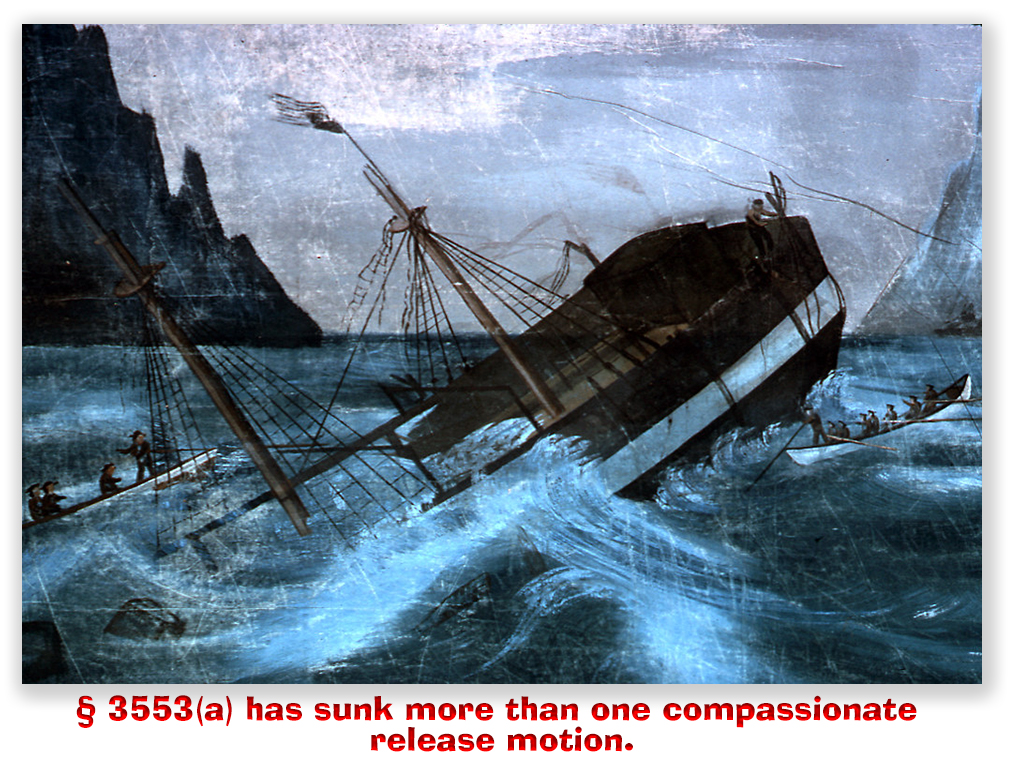
founderingship240118Unsurprisingly, most federal prisoners seeking compassionate release focus on the “extraordinary and compelling reasons” standard, because it’s easier to quantify, and people generally like to focus more on the bad things currently happening to them than bad things they might have done in the past. Yet as many compassionate release motions founder on the shoals of § 3553(a) as ever die on the “extraordinary and compelling” hill.

While you sit back to drink in the beautiful symmetry of the prior paragraph’s mixed metaphor, consider the strange position that  “post-sentencing rehabilitative efforts” occupy in the compassionate release firmament. Post-sentencing rehabilitative efforts may not be the sole extraordinary and compelling reason for a sentence reduction, but they may be one of several. At the same time, post-sentencing rehabilitative efforts are relevant to the § 3553(a) sentencing factors: good behavior and completion of in-prison programming suggest that the prisoner will not pose a danger to the public and perhaps has already been justly punished so as to correct his or her errant ways.

So what kind of consideration must a district court give evidence of good conduct and programming? The 4th Circuit ruled almost five years ago in United States v. Martin that “where a movant presents substantial evidence of post-sentencing rehabilitative efforts, a district court must provide a more robust and detailed explanation in ruling on a motion for compassionate release.” Last week, the appellate court reminded everyone that for the Martin rule to apply, a movant should remember that more is better.

violent160620Historically, Angel Centeno-Morales had been anything but an angel. Before his current felon-in-possession conviction, he had been convicted of aggravated assault with a deadly weapon, burglary, battery, and several gun and drug offenses. In his current case, he sold meth and threatened people with his gun to discourage cooperation with law enforcement.

While he was locked up, Angel’s wife died of COVID, leaving their young son without a caregiver. He filed for compassionate release, arguing that the death of the primary caregiver for the minor child was an extraordinary and compelling reason for a compassionate release grant.

The district court agreed but denied the compassionate release motion nonetheless based on the § 3553(a) factors. The judge cited that Angel had distributed a lot of meth while on probation, used guns for intimidation and coercion, and had gotten two disciplinary infractions in his six years in prison. The district court held that Angel’s continued incarceration was “necessary to reflect the seriousness of his offenses, protect the public from further crimes, provide for just punishment, promote respect for the law, and provide deterrence.”

angels240118On appeal, Angel complained that the district court violated Martin by not providing enough detail supporting its denial, but the 4th Circuit disagreed. The Martin defendant presented “a mountain of new mitigating evidence that the sentencing court never evaluated,” the Circuit said. “What’s more, the movant in Martin was incarcerated for nearly two decades, became a respected tutor for other inmates, and exhibited such exemplary behavior that correctional staff moved her into a low-security facility.” But district courts must only “set forth enough to satisfy our court that it has considered the parties’ arguments and has a reasoned basis” for its decision. “The district court does not owe every movant for compassionate release a ‘robust and detailed’ explanation on every argument about post-sentencing rehabilitative efforts,” the 4th said.

Angel presented no “mountain” of mitigating evidence that he had become an angel. “He completed just a few vocational courses and received two disciplinary infractions while incarcerated. Importantly, he remains classified as a ‘medium’ security inmate. This is not the kind of exceptional post-sentencing evidence for which Martin would require a ‘robust and detailed’ explanation,” the Circuit held.

United States v. Centeno-Morales, Case No. 22-6607, 2024 U.S. App. LEXIS 310 (4th Cir. January 5, 2024)

United States v. Martin, 916 F.3d 389 (4th Cir. 2019)

– Thomas L. Root