Tag Archives: BOP

There Once Was an Inmate Who Lived in a SHU – Update for February 12, 2024

We post news and comment on federal criminal justice issues, focused primarily on trial and post-conviction matters, legislative initiatives, and sentencing issues.

GAO EXCORIATES BOP FOR INEFFECTIVE AND POORLY MANAGED SPECIAL HOUSING UNITS

The Federal Bureau of Prisons says restrictive housing – that is, Special Housing Units (SHUs) – is not an effective deterrent for bad behavior and can even increase future misconduct. So guess who still keeps 12,000 of its “persons in custody” locked up 23 hours a day in SHUs around the country?
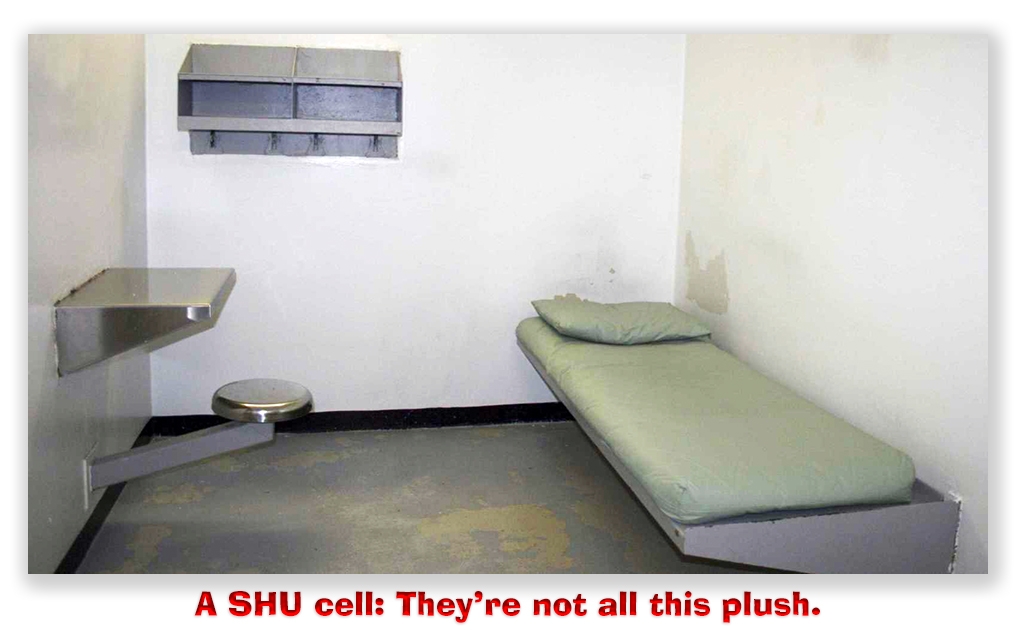
shucell240212A Government Accountability Office report wondered that last week, complaining that “while the BOP was previously called out for the practice of SHU placement of prisoners, little has changed.” The GAO criticized the BOP for its “slow progress toward taking action on longstanding recommendations, partly because the Bureau hasn’t established roles or time frames for doing so.” In fact, how the BOP monitors and evaluates all of its programs is such a problem that the GAO added the agency to the GAO’s High-Risk List annual update issued last April. It’s unlikely to be dropped from the 2024 list, due out in two months.

A SHU is a “housing unit” in name only, a warren of individual cells – some of the barred like old-time jails but more modern ones with solid metal doors with a small port through which food can be passed. The SHU residents – sometimes two to a cell, sometimes only one, are locked down 23 hours a day according to policy and removed from the cells only when handcuffed. A “recreation area” is usually a larger cage, sometimes with a basketball hoop, where often only the sky is visible. Inmates get a shower three times a week. There are no TVs, often no radios, scant reading material, and absolutely nothing to do.

“The management of federal prisons, including the use of restrictive housing, requires immediate attention,” the GAO found. “This issue is so pressing that, in 2023, Addressing these issues will enhance the Bureau’s approach to improving and ultimately reducing its use of restrictive housing.”

The BOP’s problems with its management of SHUs are nothing new. A Dept of Justice study a year ago criticized the BOP’s failure to reduce the number of SHU inmates. In a year, nothing improved.
dungeon180627Writing in Forbes last week, Walter Pavlo said, “The primary purpose of SHU is for disciplinary reasons. Disciplinary segregation is a punitive housing status imposed as a sanction for violating a disciplinary rule… However, SHU has been used for those under investigation for a disciplinary violation, protective custody (fear of being assaulted by fellow prisoners), pending transfer to another institution, or to protect a prisoner at the end of their disciplinary confinement term to prevent them from being assaulted on returning to general population.”

During the pandemic, prisoners testing positive for COVID were often isolated in the SHU, a practice that court-appointed expert Homer Venters, M.D., observed that locking COVID inmates in the SHU “runs counter to CDC guidelines on making COVID-19 responses in detention settings non-punitive” and resulted in prisoners with COVID symptoms to hide those from staff in order to avoid the SHU.”

“Some prisoners can be in SHU for months with little communication with the outside world and hardly a recreation outside of the cell in which they are confined,” Pavlo wrote. “While prisoners may be in SHU for these administrative reasons, it certainly feels like punishment.”

shit240212The GAO recounted that SHU inmates had complained that they felt hungry “because meal portions were insufficient or were smaller than the meals provided in general population.” Others reported that recreation time was much less frequent than policy dictated. “One individual,” the GAO reported, “said that facility staff kept a toilet ‘full of excrement’ in one of the SHU cells to use as a punishment and then directed an orderly to clean it before a visit from the regional director.”

Senate Majority Whip Richard Durbin (D-IL), chairman of the Judiciary Committee, said the GAO report “shows a troubling trajectory for the number of federal prisoners in restrictive housing” and expressed concern that the “BOP has not fully implemented 54 of the 87 recommendations from two prior studies on improving restrictive housing practices.” One of those studies was commissioned at BOP’s own request in 2014, meaning that some of the unmet recommendations are a decade old. Other recommendations are from a 2016 DOJ report that, among other things, recommended that the BOP ensure people with serious mental illness conditions were not put in restrictive housing.

BOP Director Colette Peters responded to GAO’s report by asserting that the BOP knows restrictive housing is not an effective deterrent and can increase future recidivism. Pavlo reported that Peters said the BOP plans to reduce the use of disciplinary segregation – part of a new rule proposed in the Feb 1 Federal Register – and will conduct unspecified “other studies… to address the issues brought forward by GAO.”

GAO, Federal Prisons Haven’t Addressed Longstanding Concerns About Overuse of Solitary Confinement (February 6, 2024)

GAO, High-Risk Series: Efforts Made to Achieve Progress Need to Be Maintained and Expanded to Fully Address All Areas (April 20, 2023)

Dept of Justice, Department of Justice Efforts to Ensure that Restrictive Housing in Federal Detention Facilities is Used Rarely, Applied Fairly, and Subject to Reasonable Constraints (February 2023)

Homer Venters, M.D., COVID-19 Inspection of BOP Lompoc by Dr. Homer Venters, Dkt. NO. 101-1 (filed in Case No 2:20-cv-04450, CD Cal (September 25, 2020)

GAO, Bureau of Prisons: Additional Actions Needed to Improve Restrictive Housing Practices (February 6, 2024)

Forbes, GAO Releases Report On Federal Prisons’ Use Of Restrictive Housing (February 6, 2024)

Senate Committee on the Judiciary, Durbin Statement on GAO Report on BOP’s Continued Failure to Eliminate Overuse of Solitary Confinement (February 6, 2024)

– Thomas L. Root

BOP Crackdown On Inmates In Rules Changes Dressed in Sheep’s Clothing – Update for February 6, 2024

We post news and comment on federal criminal justice issues, focused primarily on trial and post-conviction matters, legislative initiatives, and sentencing issues.

BOP SEEKS TO TOUGHEN PROHIBITED ACTS LIST

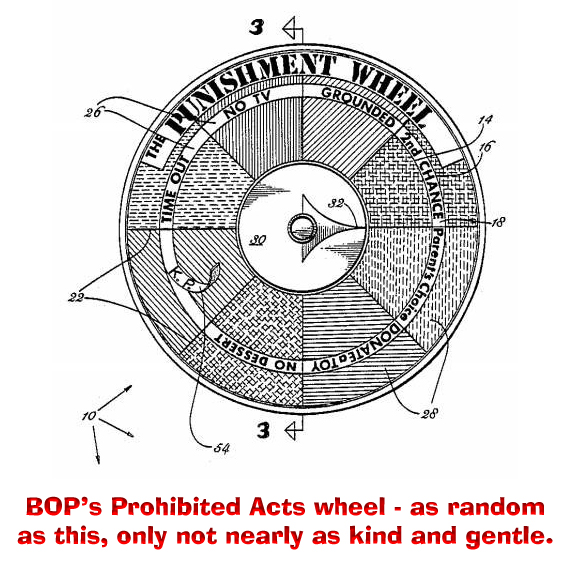
randompunishment240206There is little about prison life more arbitrary and random than inmate discipline. The offenses – like the infamous “engaging in anti-Soviet agitation” crime in communist Russia – are so general and squishy that virtually any conduct can be shaped and kneaded to fit within some offense confines.

The evidentiary standard that the prison must meet in order to find that an inmate is guilty of an offense is so low that if an inmate is charged, she is as good as convicted. The Supreme Court has declared it to be the “some evidence” standard:

This standard is met if there was some evidence from which the conclusion of the administrative tribunal could be deduced. Ascertaining whether this standard is satisfied does not require examination of the entire record, independent assessment of the credibility of witnesses, or weighing of the evidence. Instead, the relevant question is whether there is any evidence in the record that could support the conclusion reached by the disciplinary board.

Superintendent, Mass. Corr. Inst. v. Hill, 472 U.S. 445, 455 (1985),

Still, when the Federal Bureau of Prisons releases a proposed rule changing its list of prohibited acts, it’s a big deal. The BOP did so last Thursday, seeking public comment on a broad updating of its list of Prohibited Acts that sweepingly expands the conduct that is encompassed by some greatest severity category acts but dramatically cutting the use of disciplinary segregation.

Solitary confinement has gotten a well-deserved black eye in the last few years, and the BOP got that memo. Under the prohibited acts proposal, open for public comment until April 1, 2024, maximum first-offense disciplinary segregation would fall from a maximum of 365 days for a first 100-series violation to 60 days and 180 days to 30 days as a maximum punishment for a 200-series shot. No DS time could be assessed for a 300-series shot.

This is good.  It makes the BOP look progressive and forward-thinking, exactly how an outfit that has jettisoned the expression “inmate” in favor of “Adults in Custody” ought to look. Correct. Compassionate. Fair.

However, most of the BOP’s disciplinary decisions don’t include a term in solitary as a sanction. Instead, the BOP has a whole menu of lesser punishments – including forfeiting good time, FSA credits, loss of commissary or phone or visiting privileges. The new proposal doubles down on lesser, more common penalties while looking virtuous for cutting seldom-used disciplinary segregation.

punishmentwheel240206The fun doesn’t stop there. The proposal rolls out “additional examples of privileges that may be removed as a potential sanction: video visits, electronic device(s), and the use of electronic mail and messaging of any kind, including, but not limited to, through the TRULINCS system.”

The proposal expands a number of definitions of what constitutes particular prohibited acts, including

• Code 102 regarding escape will now include any unauthorized departure from the buildings, lands, property or perimeter (inside or outside) of any facility; unauthorized departure from community confinement, work detail, program or activity (whether escorted or unescorted); and unauthorized departure from any authorized location regardless of electronic monitoring devices.

• Code 108, possession of a hazardous tool – the code applied to people caught with cellphones – will now include as hazardous tools “items necessary in the use of these devices. Making these changes would allow for discipline “if telltale evidence of such items as a cellphone, electronic device, or escape paraphernalia were not found,” the BOP says, “but items which could only be used with prohibited items are found to have been used.”

• A new Code 194 is proposed, regarding unauthorized use of social media and fund transfer services. This Code would be applied “for accessing, using, or maintaining social media accounts” such as “Facebook, Twitter, Instagram, Snapchat, TikTok, etc… or directing others to establish or maintain social media accounts on the inmate’s behalf” for the purpose of committing criminal acts or any Greatest category prohibited act. This code would also prohibit inmate use of fund transfer services such as CashApp.

After the public comment period, a final version of the rule will be rolled out.

All of this matters because in text and in practice, the expansive prohibited acts definitions permit BOP employees – largely untrained in the disciplinary system – to write up inmates for conduct that seems far beyond any reasonable interpretation of the regs.  In one case I worked on, an inmate became aware of a large stash of cellphones and other contraband.  She had been trying to get the warden to sign off on a pending recommendation that she be sent to home confinement. When she explained to a BOP secretary that she wanted to talk to her unit manager about it, and hoped she could trade her information for the unit manager pushing the warden to sign off on her home confinement, the secretary accused her of trying to bribe a BOP employee.

The inmate was charged with Prohibited Act 216, which is described in the rules as “Giving or offering an official or staff member a bribe, or anything of value.” 28 CFR § 541.3, Table 1.  Prohibited Act 216 is defined as a “high severity” offense.  She got a hearing, after which the BOP hearing officer ruled that the evidence “shows you are willing to give information as long as you receive something in return. This demonstrates your willingness to bribe staff.”

The unit manager herself testified that she did not feel as though the inmate was trying to bribe her, but in the BOP, the allegation alone is usually treated as presumptive evidence of guilt. The secretary said it sounded like a bribe, so it was a bribe.

But is it bribery? The BOP thinks so.

Every defendant who cooperates with the government in hopes of getting a lesser sentence does the same thing this prisoner did, trade useful information for potential benefit. No matter. Providing information that contributed to institutional security was considered to be a bribe. The prisoner lost 21 days of good conduct time, four months of commissary, spent two months locked up in a cell awaiting disposition (this did not include any disciplinary segregation time), and was transferred to a higher-security facility. What’s worse is that the disciplinary record will be paraded in front of her judge as an argument against a sentence reduction, which will adversely affect her recidivism score.

The inmate’s habeas corpus appeal is still pending, but even if she wins and gets her 21 days back, most of the damage has been done.

The BOP already routinely punishes inmates with the Greatest category discipline for just living in a cell or cubicle where a cell phone is found, whether the inmate even knew of its presence.  Expanding the sweep of already expansive Prohibited Acts will only give BOP staff greater opportunity for mischief.  

BOP, Inmate Discipline Program: Disciplinary Segregation and Prohibited Act Code Changes (February 1, 2024), 89 FR 6455

– Thomas L. Root

‘Tis Some Visitor,’ I Muttered, ‘Tapping At My Prison Door’ – Update for January 31, 2024

We post news and comment on federal criminal justice issues, focused primarily on trial and post-conviction matters, legislative initiatives, and sentencing issues.

ONLY THIS AND NOTHING MORE

Dublinraven240130US District Court Judge Yvonne Gonzalez Rogers (Northern District of California) told the associate warden at FCI Dublin last Friday that she’s coming to perform a short-notice inspection of the women’s prison to see how things operate.

Rogers plans to email the facility after 9:30 pm sometime in the next month to announce she will be showing up at the front gate at 5:30 the next morning. “I don’t want you to prep for it,” she told the AW. “I just want to show up.”

“’Tis some visitor entreating entrance at my prison door—
Some early visitor entreating entrance at my prison door;—
This it is and nothing more.”

(apologies to Edgar Allen Poe).

The judge will bring two of her staff and lawyers for the government and the class of sexual assault victims suing the BOP, but – according to KTVU-TV, Oakland – “but she also might shoo them away so that she can talk to anyone in the building that she wants.”

Rep Jackie Speier (D-Cal), since retired, visited the prison twice in early 2022. During her visit, Speier said, acting warden (and Deputy Regional Director) T. Ray Hinkle), tried to block her from speaking with several inmates who reported abuse and instead sent her to speak with hand-picked prisoners. Speier said Hinkle – later dismissively called sexual abuse committed by employees “an embarrassment.”

welcometohell230518Speier said she told him: “This isn’t an embarrassment. This is a toxic work environment. It is a reprehensible set of circumstances.” Afterward, in an email to Dublin staff obtained by the AP, Hinkle alleged Speier “mistreated” prison workers and treated one employee “as though she had committed a crime.” Hinkle later was accused of retaliating against BOP employees who complained about prisoner abuse at Dublin, and he admitted to having beaten prisoners back in the 1990s. After these allegations and admissions, he was promoted.

Judge Rogers does not intend to be buffaloed like Rep Speier says she was. During her inspection of the facility, she told Dublin management, “there won’t be anything you can do other than follow me around.”

The Judge is hearing a lawsuit by the California Coalition of Women Prisons, asking the court to stop many of the harms reported at FCI Dublin, such as sexual abuse by the guards and retaliation for speaking up, and possibly appoint a “special master” over the facility to make sure reforms are being met, according to KTVU-TV.

Government attorneys representing the BOP maintain that while there used to be sex scandals at the prison, they are now part of a long-gone era because of new leadership.

KTVU-TV, Scandal-plagued FCI Dublin to receive semi-surprise visit from judge (January 26, 2024)

Associated Press, Whistleblowers say they’re bullied for exposing prison abuse (February 24, 2022)

Associated Press, AP Investigation: Prison boss beat inmates, climbed ranks (December 9, 2022)

KTVU-TV, ‘Cultural rot:’ U.S. Congressional team tours Dublin prison after sex scandal widens (Machr 14, 2022)

– Thomas L. Root

’60 Minutes’ Looks Behind BOP’s Potemkin Village Facade – Update for January 29, 2024

We post news and comment on federal criminal justice issues, focused primarily on trial and post-conviction matters, legislative initiatives, and sentencing issues.

’60 MINUTES’ PUTS BOP DIRECTOR ON THE HOT SEAT

The American public got a primer on the Federal Bureau of Prisons last night on “60 Minutes,” and what the public saw was sobering.

BOP Director Colette Peters walked 60 Minutes reporter Cecilia Vega around FCI Aliceville. She told CBS that she wanted “people to see the good stuff” going on in the BOP. Inmates were shown in UNICOR, at a “Life Connections” graduation, and in classes. CBS did not fall for the Potemkin village.

dogandpony240129First, in a surprisingly candid interview between Vega and five or so inmates, the women freely admitted that CBS was seeing a dog-and-pony show. Director Peters admitted that things had been cleaned up but explained, “I’ve been doing this work for a long time– so I can see when things have been swept under the rug, if you will. I’m not naïve. And when anybody comes to your house you clean it up.”

Vega pressed Peters on the issue of short staffing and augmentation, asking how many more employees are needed.

Colette Peters: So we hope to have that real number for– you and the public– very soon.

Cecilia Vega: That seems like a critical number. How was that not on your desk when you s– took this job on day one, and– and still not there a year later?

More surprising than Peters’s non-answer was her assertion that the BOP would hire the employees needed to solve short staffing by October.

Shane Fausey, the recently retired national president of the Council of Prison Locals 33 and a former BOP lock and security specialist, was much more certain. He told Vega, “We’re short about 8,000 positions nationwide. ” He complained:

The[ BOP’s] buzz phrase is, “Everybody’s a correctional officer first.” That sounds good on paper. But if you take the teacher out of the classroom, and nobody’s teaching the offender the skills to go back out to society, we’re just back to warehousing people.

forcedsex161202Vega also focused on sexual abuse of women inmates at FCI Dublin and in other facilities, most of which Peters inherited from years of prior BOP directors who found it convenient to ignore allegations that, after all, came from untrustworthy and unworthy inmates. Peters claimed that the BOP is cleaning up the “Rape Club” culture at Dublin.

Colette Peters:  We’ve done a tremendous job in the last year rebuilding that culture and creating– an institution that is more safe, where individuals feel comfortable coming forward and reporting claims

Cecilia Vega: You just used the phrase, “tremendous job” in Dublin. Eight inmates have filed a class action lawsuit, and they’ve got testimony from more than 40 current and former Dublin inmates who say that the abuse is ongoing.

Colette Peters: That means the– the process is working, that they have the ability to come forward. They have the right to bring that class action lawsuit together.

bartsimpson240129Vega noted that more than 45 women have filed suits against the BOP, some of which claim that abuse continues, and that female inmates claim continuing retaliation by staff against those who voice allegations. Peters was skeptical:

Cecilia Vega: It’s one thing for you to say that retaliation is not tolerated, but it sounds like it’s actually still happening.

Colette Peters: Again, I would say those are allegations. I would like to be more grounded in fact around proven retaliation.

CBS 60 Minutes, Inside the Bureau of Prisons, a federal agency plagued by understaffing, abuse, disrepair (January 28, 2024)

– Thomas L. Root

New Year, Old Woes at the Federal Bureau of Prisons – Update for January 19. 2024

We post news and comment on federal criminal justice issues, focused primarily on trial and post-conviction matters, legislative initiatives, and sentencing issues.

BOP: CRIME’S UP, INCENTIVES ARE DOWN

Instances of Federal Bureau of Prisons employees running afoul of the law continue along with staff shortages, even as the agency finds ways to provide additional disincentives to employees’ desire to work.

truecrime240119Former BOP Correctional Officer Quandelle Joseph pled guilty last week in US District Court for the Eastern District of New York to receiving bribes in exchange for providing phones and drugs to prisoners at MDC Brooklyn. The government said Joseph, who began working at MDC in May 2020, “accepted tens of thousands of dollars from inmates in exchange for smuggling narcotics, cigarettes, and cell phones into the MDC… He also warned inmates about upcoming contraband searches at the MDC.”

Last Friday, a former BOP CO at FCI Aliceville (AL) pled guilty to one count of sexual abuse of a ward. In February 2019, the indictment alleged, Smith had sex with a female inmate. He also admitted engaging in a sexual act with another female inmate under his control.

The Marshall Project reported a week ago on the continuing short-staffing at BOP facilities, noting that FCI Florence (CO) was short at least 188 staff members. Senators John Hickenlooper and Michael Bennet told BOP Director Colette Peters a year ago that “fatigue, exhaustion, and low morale have reduced staff productivity and led to more sick leave, retirements, and resignations.” The Marshall Project called the situation “a downward spiral.”

pay240119The BOP had been offering retention pay incentives for employees at prisons hard hit by staffing shortages, but those programs are ending. A week ago, the BOP terminated incentives at USP Thomson (Illinois), and last week announced that officers at USP Canaan (Pennsylvania) will soon see similar cuts.

The American Federation of Government Employees is urging the BOP to reverse course at USP Canaan, which is about to open more units and bring in more inmates, according to AFGE. Without the incentive, the union says, officers may leave their jobs.

understaffed220929

The real cost of the staffing shortfall to prisoners? Obviously, the frequent and repeated facility lockdowns – because confining inmates to their housing units requires fewer BOP employees than normal operations – is the most visible. But last week, I heard from a prisoner who willingly transferred to an institution hundreds of miles farther from his home to enroll in the faith-based Life Connections program. He told me that upon arrival, he found that the Life Connections Program was not running due to shortness of staff and government funding, and no one had any idea when that would change: “I have made the choice to seek change while incarcerated,” he wrote, “signing up for this program. It’s not my fault that they have no staff to run the program and lack the funds to pay outside contractors to facilitate the classes for the purpose of education.”

US Attorney EDNY, Ex-Federal Correction Officer Pleads Guilty to Taking Bribes in Exchange for Smuggling Contraband into Federal Jail in Brooklyn (January 11, 2024)

Trussville AL Tribune, Former Federal Bureau of Prisons Corrections Officer pleads guilty to sexually abusing inmate in his custody (January 12, 2024)

Federal News Network, More Bureau of Prisons pay incentives get death penalty (January 10, 2024)

The Marshall Project, Federal Prisons Are Over Capacity — Yet Efforts to Ease Overcrowding Are Ending (January 6, 2024)

Senators Bennet and Hickenlooper, Letter to Colette Peters (December 5, 2022)

– Thomas L. Root

It’s a New Year, and BOP Still Has Big Problems – Update for January 8, 2024

We post news and comment on federal criminal justice issues, focused primarily on trial and post-conviction matters, legislative initiatives, and sentencing issues.

IANUS DOESN’T LIKE THE VIEW ON BOP – IN EITHER DIRECTION

ianus240108You no doubt recall from high school Latin class that the Roman god Ianus (“Janus” if you don’t like classic Latinspeak) had two faces, one looking forward into the future while the other gazes into the past. It’s where we derived “January” for the first month of the new year.

Ianus would not be happy at what his backward-looking face sees in the Bureau of Prisons’ 2022 record:

•  sex abuse-related convictions at FCI Dublin in California, FCI Marianna in Florida, FMC Carswell in Texas and FMC Lexington in Kentucky;

•  Dept of Justice Inspector General reports ripping the BOP for $2 billion in past-due maintenance, for cooking its books on the number of inmates with COVID, and for subjecting inmates at FCI Tallahassee to living conditions that the IG himself said were “something you should never have to deal with;” and

• NPR reporting that the BOP has misrepresented the accreditation of its healthcare facilities while compiling a record of ignoring or delaying medical treatment – especially in cancer care – leading to needless inmate disability and death.

Ianus’s forward-looking face isn’t so happy, either. Last week, NPR reported that while the “CDC says natural deaths happen either solely or almost entirely because of disease or old age,” 70% of the inmates who died in BOP custody over the past 13 years were under the age of 65.” NPR found that “potential issues such as medical neglect, poor prison conditions and a lack of health care resources were left unexplained once a ‘natural” death designation ended hopes of an investigation. Meanwhile, family members were left with little information about their loved one’s death.”

The BOP stonewalled NPR, failing to respond to a Freedom of Information Act request for all mortality review reports generated since 2009 and refusing to provide any official to be interviewed on the report. However, the BOP assured NPR that it has “detailed procedures to notify family members after an inmate’s death.”

That makes us all feel much better.

death200330Not NPR. It remained skeptical, citing the case of Celia Wilson. Celia, sister of Leonard Wilson – who died last April – heard from an inmate that he had collapsed on the walking track and had been taken to the hospital. The first call she got from the BOP came two days later from her brother’s case manager. “He said that my brother is communicating and we think he’s going to be just fine,” Wilson said. “We were so relieved at that point.” But the records his lawyer got from the BOP after he died told a different story. “Celia would say they think that there’s signs of life and maybe vitals are getting better,” Lenny’s lawyer told NPR. “And then we would ask for those medical records and they wouldn’t actually say that.”

Meanwhile, a federal judge in the Southern District of New York last week found that conditions at MDC Brooklyn were not just bad: they were “exceptional[ly] bad,” “dreadful” and an “ongoing tragedy.”

calcutta240108Defendant Gustavo Chavez, age 70, entered a guilty plea to drug offenses. After a guilty plea in a case like his, 18 USC § 3143 requires that a defendant be detained unless “exceptional circumstances” within the meaning of 18 USC § 3145 are found by the court.

Judge Mark Furman held that the “near-perpetual lockdowns (no longer explained by COVID-19), dreadful conditions, and lengthy delays in getting medical care” at MDC Brooklyn constituted “exceptional circumstances.” The judge’s 19-page opinion provided a litany of horrors at MDC Brooklyn, including

[c]ontraband — from drugs to cell phones — is widespread. At least four inmates have died by suicide in the past three years. It has gotten to the point that it is routine for judges in both this District and the Eastern District to give reduced sentences to defendants based on the conditions of confinement in the MDC. Prosecutors no longer even put up a fight, let alone dispute that the state of affairs is unacceptable.

In a class action suit against the BOP by female inmates over sexual abuse, U.S. District Judge Yvonne Gonzalez Rogers began a three-day evidentiary hearing last week in Oakland, California. The plaintiffs claim they endured abuse and sexual assault by BOP staff, including voyeurism, drugging and abuse during medical exams, and rape. Despite being aware of the violence and harassment for decades, the plaintiffs contend, the BOP failed to take action.

Witnesses for the government admitted that “abuse and misconduct… so “rampant” at FCI Dublin that new officials struggled to implement reforms.”

sexualassault211014An FCI Dublin deputy corrections captain said before she took the job in 2022, “here was a lot of misconduct rampant within the institution.” She admitted that before she took the job, multiple prisoners were placed in the SHU (locked up in the special housing unit) after reporting they had been assaulted.

“You say it’s not punitive, but the inmates don’t agree with that,” Judge Rogers said. “If these things were already happening, and you have the same process, how is it any different?”

“I guess we’ve improved as far as what we’ve required,” the BOP captain responded, citing regular meetings and new systems for identifying issues at the prison. She took a tissue to wipe away tears, according to a Courthouse News Service report, saying she wanted to ensure the BOP changed. Of incarcerated women, she said, “They really just want to be heard, they want somebody to listen.”

From cooking the books over inmate deaths to running facilities that mimic the Black Hole of Calcutta to letting rape and sexual abuse run “rampant” in women’s prisons, the BOP is hardly listening to anyone.

NPR, There is little scrutiny of ‘natural’ deaths behind bars (January 2, 2024)

United States v. Chavez, Case No. 22-CR-303, 2024 U.S. Dist. LEXIS 1525  (S.D.N.Y., January 4, 2024)

New York Daily News, Judge says conditions “too dreadful” at Brooklyn fed jail to lock up 70-year-old defendant (January 4, 2024)

Courthouse News Service, Misconduct ‘rampant’ at California women’s prison, deputy corrections captain testifies (January 3, 2024)

California Coalition for Women Prisoners v. BOP, Case No. 4:23-cv-4155 (ND Cal, filed Aug 16, 2023)

If you have a question, please send a new email to newsletter@lisa-legalinfo.com.

– Thomas L. Root

Last Gift in the Bag: Something For The First Step Act – Update for December 29, 2023

We post news and comment on federal criminal justice issues, focused primarily on trial and post-conviction matters, legislative initiatives, and sentencing issues.

FINALLY, A CANDY CANE FOR THE FIRST STEP ACT (BUT A LUMP OF COAL TO THE BOP)

I end my year-end emptying of Santa’s bag with this: The First Step Act turned five years old last week.


candycane231229I still wonder how the First Step Act ever passed. Back then, back in those dark November and December days in 2018, I was wondering how the bill would make it through the 115th Congress before the session expired. In fact I wrote its obituary several times in those waning days.

Back then, I publicly lamented the bill’s “dumbing down” to appease the Senator Tom Cottons, Josh Hawleys and Ted Cruzs of the world and wondered how quickly prisoners would see any advantages. It didn’t unfold like I thought it would, but then, who saw the pandemic coming?

First Step emerged from Congress leaner and definitely meaner than it started. Changes in 18 USC 924(c) to limit draconian mandatory sentences for successive violations were made nonretroactive. The list of convictions excluded from getting credit for successful completion of programming intended to reduce recidivism got longer and longer.

But for all of the belly-aching at the time, there has not been a piece of criminal justice reform legislation like First Step for at least 50 years. It’s easy to complain about the failings of the bill, largely due to political horse-trading needed to get the measure passed and Federal Bureau of Prisons administrative misfeasance and malfeasance. For the public, it has been an unqualified success. Without it, the federal prison population would be substantially higher than it is today. What’s more important, as The Hill put it last week, “since the First Step Act passed, thousands more people leaving the federal prison system have rebuilt their lives without reoffending — in fact, the federal recidivism rate has dropped by an estimated 37%t since the law was enacted.”

compassion160124What’s more, nearly 4,000 people received retroactive Fair Sentencing Act sentence reductions, over 4,600 people went home on compassionate releases, almost 1,250 elderly offenders went to home confinement under the 34 USC 60541(g)(5) pilot program, and almost 27,000 inmates have gotten earlier release through FSA credits.

As we approach the 2024 elections, some Republican candidates have been grousing about the First Step Act. Florida Gov Ron DeSantis, who voted for First Step as a Congressman in 2018, denounced the bill last summer as a “jailbreak bill” and said he would get it repealed. But last week, Trump published his campaign’s “Platinum Plan” including a commitment to “continue to make historic improvements to the criminal justice system through common sense actions like the First Step Act” with a “Second Step Act.”

One commentator said that “the Act’s positive outcomes, such as significantly lower recidivism rates among those released under its provisions, demonstrate that public safety reforms are not inherently linked to the recent surge in violent crime… On the other end of the spectrum, we find the likes of Chris Christie and Nikki Haley. Their records of reform in New Jersey and South Carolina, respectively, have been lauded as models of successful criminal justice reform.”

lumpofcoal221215One piece of coal fell out of Santa’s bag along with First Step’s candy cane. The coal goes to the BOP for its disingenuous press release last week that said “the Federal Bureau of Prisons is proud of the work accomplished implementing the First Step Act. Including the support and collaboration of our partners and stakeholders, the dedication and hard work of our employees, and the courage and resilience of the AICs [‘adults in custody’ for you Philistines who still think of them as prisoners and inmates]and their families.”

Anyone who recalls the BOP’s approving 36 out of 31,000 compassionate release requests during the pandemic (an average of 1 in 1,000), its mean-spirited and chary November 2020 proposed rules for FSA credits that were rejected only by new leadership in the Dept of Justice just before adoption a year later, and its ham-handed efforts to timely credit and post FSA credits knows that First Step’s successes have been despite, not because, of BOP administration.

The Hill, Five years on, Congress must build on the First Step Act successes (December 21, 2023)

BNN, The First Step Act: A Pivotal Landmark in Criminal Justice Reform and its Political Implications (December 18, 2023)

BOP, Fifth Anniversary of the First Step Act (December 21, 2023)

– Thomas L. Root
An “AIC” Would Get More Prison Time For Doing What the BOP and ACA Did – Update for December 21, 2023

We post news and comment on federal criminal justice issues, focused primarily on trial and post-conviction matters, legislative initiatives, and sentencing issues.

INSPECTOR GENERAL UNMASKS BOP-ACA INSPECTION SCAM

Adults in Custody (that’s “prisoners” in normal-speak and so far, the new label is about all the progress BOP Director Colette Peters has made in 17 months at the helm) are fortunate that the institutions in which they’re housed are regularly audited by the American Correctional Association to ensure that they continue to meet that organization’s uncompromising high standards.

badcheck231221Of course. And the check’s in the mail, too…

A report issued by the Dept of Justice Inspector General last month found that instead of providing an independent evaluation of Federal Bureau of Prisons facilities, the ACA “instead relied on the prisons’ own internal reports during reaccreditation reviews.” In other words, as the DOJ put it, “it appears the BOP is, in effect, paying ACA to affirm the BOP’s own findings.”

The BOP awarded a $2.75 million contract to the ACA in 2018 to obtain accreditation and reaccreditation for BOP facilities. Five years into the agreement, the DOJ audit was intended to evaluate “the value the BOP receives through ACA accreditation for its prisons” and “how the BOP uses ACA’s accreditation to improve BOP standards for health, safety, and security of inmates and staff; and (3) the BOP’s contract administration and ACA’s performance and compliance with terms, conditions, laws, and regulations applicable to the contract.

nothingtosee230313The IG’s report found that “[a]lthough the contract requires ACA to perform its accreditation and reaccreditation in accordance with ACA’s policies, manuals, and procedures, current BOP and ACA officials… agreed that ACA would only perform independent reviews of BOP facilities as provided for in ACA policy during initial accreditation. For reaccreditation reviews, which was most of ACA’s work under the contract, the BOP and ACA agreed that ACA would rely on the BOP’s internal program review reports. As a result, it appears the BOP is, in effect, paying ACA to affirm the BOP’s own findings.”

The auditors also wrote they “did not identify instances where the BOP used ACA’s accreditation process to improve BOP standards for health, safety, and security of inmates and staff.” Of course not. If the BOP did a self-audit that the ACA signed off on, why bother to improve? Remember that only three months ago, NPR reported that the BOP claimed on its website that its medical centers were accredited by the Joint Commission, which accredits the vast majority of US hospitals, when in fact the certification had lapsed two years before.

NPR’s investigation – showing that federal prisoners die from treatable conditions that the BOP does not diagnose or treat in a timely way – was behind a call last week from Sens Richard Durbin (D-IL) and Charles Grassley (R-IA) for better BOP healthcare.

drquack191111“It is deeply upsetting that families are mourning the loss of their loved ones because they were not afforded the proper medical care they deserved while incarcerated,” Durbin, who is chairman of the Senate Judiciary Committee, told NPR. “BOP must immediately prioritize correcting the ineffective, harmful standards and procedures used to determine when an incarcerated person will be seen by medical professionals.”

Grassley, also a member of the Judiciary Committee, agreed. “BOP needs to be held responsible for this failure and take action to raise its standards.”

In response, a BOP spokesperson told NPR the Bureau “‘appreciates the Senators’ focus on this important issue’ and is committed to continue working with them on oversight.”

DOJ Office of Inspector General, Audit of the Federal Bureau of Prisons’ Contract Awarded to the American Correctional Association (November 16, 2023)

Lincoln, Nebraska, Journal-Star, Federal audit blasts nonprofit responsible for accrediting Nebraska’s prisons (December 10, 2023)

NPR, Lawmakers push for federal prison oversight after reports of inadequate medical care (December 12, 2023)

– Thomas L. Root

You’ve Got Mail – Update for December 7, 2023

We post news and comment on federal criminal justice issues, focused primarily on trial and post-conviction matters, legislative initiatives, and sentencing issues.

BOP MAIL SCANNING BILL INTRODUCED IN THE HOUSE

Legislation introduced by Representative Don Bacon (R-NE) proposes new procedures for handling mail in order to disrupt the flow of drugs into BOP facilities. It requires the agency to adopt a program to electronically scan all incoming inmate mail, give inmates an electronic copy of their mail within 24 hours of its reception, and deliver the original mail within 30 days if it’s drug-free.

youvegotmail231207The Interdiction of Fentanyl in Postal Mail at Federal Prisons Act, H.R, 5266, is based on a 2020 BOP interdiction pilot project that scanned inmate mail and “reduced the number of synthetic drug introductions via general postal mail to effectively zero over the pilot project period,” The Hill reported.

H.R. 5266 is an improvement over the old system, The Hill said, because while the pilot program destroyed the physical mail after scanning, “the proposed bill protects the right of incarcerated people to receive physical mail… Taking away the tactile experience of touching a handwritten letter, or smelling perfume on an envelope would likely have a negative impact on prisoner well-being, which can increase recidivism and antisocial behavior.”

It remains to be seen whether prisoners whose mail delivery is delayed while understaffed facilities scan all incoming letters and documents agree.

HR 5266, Interdiction of Fentanyl in Postal Mail at Federal Prisons Act

The Hill, A new bill will guard against lethal letters in US prisons (November 19, 2023)

– Thomas L. Root

Fun With Numbers – Update for December 6, 2023

We post news and comment on federal criminal justice issues, focused primarily on trial and post-conviction matters, legislative initiatives, and sentencing issues.

PRISON BY THE NUMBERS

The First Step Act requires the Dept of Justice’s Bureau of Justice Statistics to report data from the Federal Bureau of Prisons annually.

numbers160704The 2023 report issued last week includes stats running the gamut from yawn-inducing to fascinating. Of most significance, despite all of the drawdowns implicitly promised by First Step (retroactive crack cocaine sentencing, compassionate releases, and FSA credits), mass incarceration proceeds apace. The BOP population increased about one percent – from 156,542 at the end of 2021 to 158,637 at the end of 2022 – and is now at 157,811.

You’d think all of those early releases would have made a dent in the federal prison population. You’d be wrong.

Other facts:

•   The BOP admitted almost 44,873 new prisoners in 2022, a 6% change from 2021.

•   The BOP released 42,948 prisoners in 2022, a 9% change from 2021.

•   The BOP’s population exceeded rated capacity by 6.9%.

•   About 5% of BOP prisoners – 8,627 –are military veterans.

•  In 2022, the BOP released about 10,100 prisoners early because of FSA credits.

•   Just over 15% of BOP prisoners are non-U.S. citizens, about the same as 2020 and 2021.

• In 2022, BOP prisoners were found to have committed 80,490 prohibited acts, slightly more than one for every two prisoners.

• There were 10,177 instances of prisoners placed in special housing units in 2022, a 10% increase from 2021.

• There were 965 instances of prisoners assaulting staff. Two percent (19) of these assaults resulted in serious injuries, and only 12 were prosecuted.

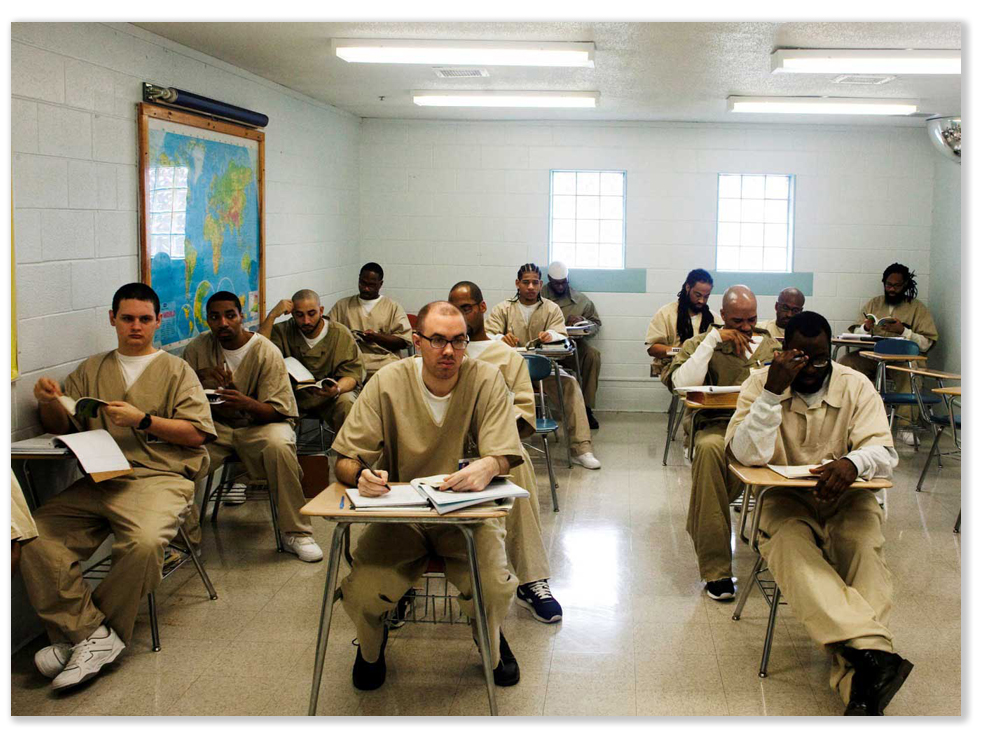
• About 70% of BOP prisoners had high school diplomas or GEDs prior to admission to prison (110,531), and an additional 3,543 (2.2%) earned their GEDs while locked up.

education180205•   In 2022, 13.2% of federal prisoners (20,880) participated in a nonresidential substance use disorder treatment program, while 7.6% (12,035) participated in RDAP.

•   PATTERN, the BOP’s recidivism risk tool, classified 54% of prisoners as minimum or low risk for recidivism, 27% as high risk for recidivism, and 19% as medium risk. Females were more likely than males to be minimum than low (81% vs 52%). Black (61%) and American Indian prisoners (59%) were more likely to be medium or high risk than white (36%) and Asian (27%).

BJS, Prisoners in 2022 – Statistical Tables (November 30, 2023)

– Thomas L. Root