We post news and comment on federal criminal justice issues, focused primarily on trial and post-conviction matters, legislative initiatives, and sentencing issues.

11TH CIRCUIT PANEL BARS 2255 BRADY CLAIM, THEN ASKS EN BANC COURT TO REVERSE DECISION
It’s pretty rare to see an appeals court beg for en banc review to reverse Circuit precedent, but a 3-judge panel of the 11th Circuit did that last week.
Gino Scott was convicted by a jury over a decade ago of drug trafficking. As do most defendants who lose jury trials, he filed a direct appeal and then a 2255 motion. He lost those. But a few years later, the government admitted to his trial court that it had Brady information about how its informant, whose testimony had help nail Gino, lied about his background on the stand.
Gino filed a second 2255 motion based on the newly-revealed information. But under 28 USC 2244, newly-discovered evidence will not allow a second-and-successive 2255 to go forward unless the new evidence would establish that no reasonable jury would have found the defendant guilty of the underlying offense.
The Supreme Court has held that not every second 2255 is a “second-and-successive” 2255 motion. Instead, “to determine whether an application is ‘second or successive,’ a court must look to the substance of the claim the application raises and decide whether the petitioner had a full and fair opportunity to raise the claim in the prior application.” But the 11th Circuit previously held in Tompkins v. Secretary, DOC that this Supreme Court holding did not apply to second 2255s raising Bradyclaims.
In last week’s decision, the 11th Circuit panel argued that Tompkins is wrong, and that a newly-discovered Brady claim is not a second-and-successive 2255. But, for the uninitiated, a three-judge panel has no power to reverse a prior published circuit decision. Rather, unless a Supreme Court decision does so, only the Court sitting en banc has the right to abandon Circuit precedent.
For that reason, after Gino’s panel explained in great detail why Tompkinswas wrong, it was nevertheless obligated to apply Tompkins to deny Gino’s claim anyway. Gino’s court ended with a plea to the other judges in the Circuit: “Supreme Court precedent, the nature of the right at stake here, and habeas corpus require a petitioner who has reasonably probably been convicted because the government failed to disclose material exculpatory evidence, to have a full and fair opportunity to obtain relief. For this reason, we urge our colleagues to rehear this case en banc and reevaluate the framework we established in Tompkins.”
We post news and comment on federal criminal justice issues, focused primarily on trial and post-conviction matters, legislative initiatives, and sentencing issues.
BOP DIRECTOR QUIT BECAUSE OF SESSIONS AND KUSHNER
As we reported last week, BOP director Mark Inch quietly resigned, ironically packing up his office a week ago last Friday even as President Trump’s senior adviser and son-in-law, Jared Kushner, was praising Inch’s leadership during a White House conference on prison reform. At the time, no one knew why he quit.
Now we do. The New York Times reported late last Thursday that Inch, a retired Army major general who had been appointed to oversee the Bureau just nine months ago, felt marginalized by Kushner’s prison reform planning, according to three unnamed sources the Times said had with knowledge of the situation. But even more than his ire at Kushner, Inch – a consummate bureaucrat – was frustrated with his boss, Attorney General Sessions, and believed he was in caught in the crossfire of a turf war between Kushner and Sessions, like Ben Franklin’s proverbial “mouse between two cats.”
Sessions had frozen Inch out of budget, staffing, and policy decisions, the Times reported, refusing even to approve his choice for deputy prisons director, the Times reports. For months Inch pleaded with Deputy AG Rod Rosenstein to install Sara M. Revell, North Central Region director, as his top deputy. Rosenstein repeatedly told Inch that Sessions had not yet approved the appointment. Inch reportedly resented Sessions’ habit of communicating with him through junior DOJ lawyers.
Inch also told Rosenstein he was tired of the Trump administration flouting “departmental norms,” and he was frustrated by Sessions trying to thwart Kushner’s reforms. This hardly meant that Inch was a fan of the FIRST STEP Act, however: the Times said Inch objected to the Kushner-backed requirement that inmates be placed in prisons within 500 miles of their homes. He also believed the FIRST STEP earned-credits program for more halfway house was impractical, in part because of a lack of available beds in halfway houses.
Mostly, it seems Inch was offended that he was largely excluded from discussion of prison reform bill. Even that shutout appears to have been engineered by Sessions. Two senior White House officials said Kushner made a point of inviting Inch to prison reform meetings, but Sessions often sent other officials in his place.
The Times said Inch – whose career was spent in the Army criminal justice and prison system – struggled to publicly explain the BOP’s response to sexual harassment, halfway house and staffing problems. Watching Inch testify before Congress was like getting a tooth pulled without novocaine. The director practiced James H. Boren’s bureaucrat’s creed: “When in doubt, mumble; when in trouble, delegate; when in charge, ponder.”
We post news and comment on federal criminal justice issues, focused primarily on trial and post-conviction matters, legislative initiatives, and sentencing issues.
FUTURE OF THE FIRST STEP ACT IS FAR FROM CLEAR
Supporters of a federal criminal justice system overhaul seemed well on their way to victory after the FIRST STEP Act breezed through the House last week on an impressive bipartisan vote. The Act, H.R. 5682, has strong administration backing, including the fingerprints of Jared Kushner, the presidential adviser and son-in-law. It has some important Senate supporters. But a lot of informed people are still predicting that neither the FIRST STEP Act nor any other criminal justice reform bill will pass the Senate this year.
First, senior Senate authors of the long-stalled Sentencing Reform and Corrections Act, S.1917 – including Senate Judiciary chairman Charles Grassley (R-Iowa), are steadfastly opposed to FIRST STEP. They consider it an insufficient half-measure for its focus on prison programs without changes in federal sentencing laws. Plus, Grassley is still smarting from his inability to pass SRCA last year, and he says he’s not going down without a fight.
Second, Senate Majority Leader Mitch McConnell (R-Kentucky) is highly unlikely to try to move the bill through the Senate as long as Grassley is opposed to it, according to Republican senators and aides. They say McConnell, who is not that keen on criminal justice legislation in general, is definitely uninterested in circumventing his Judiciary Committee chairman and provoking an intra-party fight that would eat up weeks of floor time. A Republican senator said flatly of McConnell’s view of the bill right now: “It’s not on the priority list.” If McConnell decides not to bring the bill to a vote, no one can force him to do so.
Third, impressive groups of opponents to FIRST STEP are lining up on both sides of the aisle. Attorney General Jefferson Beauregard Sessions III Sessions, a former senator himself, opposes SRCAand is lukewarm about FIRST STEP. And even the narrower FIRST STEP bill will probably face opposition on the right from Sessions’ allies, like Senator Tom Cotton (R-Arkansas), who once memorably said America has an “under-incarceration problem” and is reportedly stirring up opposition to FIRST STEP among law enforcement groups.
At the same time, FIRST STEP is opposed by some civil-rights groups, former Attorney General Eric Holder, and a coalition of leading Senate Democrats, including Richard Durbin (D-Illinois), Cory Booker (D-New Jersey), and Kamala Harris (D-California). In a letter last week, the senators said FIRST STEP would be “a step backwards” and that prison reform would fail if Congress did not simultaneously overhaul the nation’s sentencing laws. Also signing the letter were Representatives Sheila Jackson Lee (D-Texas) and John Lewis D-Georgia).
Last Wednesday, a group of senators asked McConnell for a last-ditch negotiation session to seek an acceptable compromise. SRCA backers fear this may be the only chance for years to come to pass major criminal justice reform. “You don’t get many opportunities around here to do anything meaningful or substantive,” said Durbin, a chief author of the sentencing provisions. “Let’s not waste this one. Let’s get this right.”
Although Trump supports FIRST STEP, it’s unclear how he would react if Congress sent him a bill that included SRCA-style sentencing reforms. A prison reform-only bill gives Trump what he wants: To look tough to his base by not budging on sentences while also showing evangelicals he believes in “second chances.” Adding sentence reform might be too much for him.
We post news and comment on federal criminal justice issues, focused primarily on trial and post-conviction matters, legislative initiatives, and sentencing issues.
THE 6TH CIRCUIT’S REFRESHINGLY DEFERENTIAL APPROACH TO INEFFECTIVE ASSISTANCE
In an opinion piece in theWall Street Journalyesterday,Richard Miniter urged President Trump to demand the returnof theUSS Pueblo, still held by North Korea after its 1968 illegal seizure in international waters. Miniter recalled Navy Commander Lloyd Bucher’s leading the crew to resist the North Koreans, who starved and tortured them. Once, the article recounted, Cmdr. Bucher instructed the crew to raise theirmiddle fingers, a gesture he told his captors was a “Hawaiian good-luck sign.”
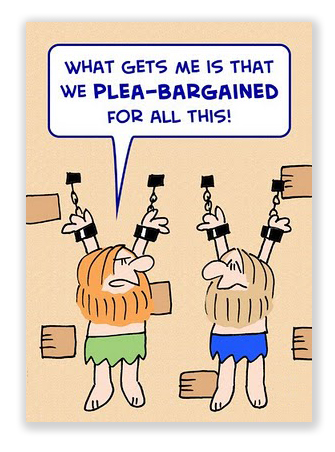
The change-of-plea pas de deux for defendant and judge in a federal criminal proceeding is dictated by Federal Rule of Criminal Procedure 11, and bears more than a passing resemblance to the staged photos and confessions so favored by despots such asRocket Man, hisdaddy andgrand-daddy. The defendant is asked whether everything has been fully explained to him, whether he’s happy with his lawyer, whether anyone has promised him anything not in the plea agreement, whether he feels forced into pleading guilty…
The truth, of course, is that the defendant is rarely happy with his lawyer right about then, usually has a slew of questions (many of which he does not yet know enough to ask), was told by counsel that all sorts of bad things would happen if he rejected the plea but that he would be treated gently if he took the deal… You get the idea. Deciding whether to accept a plea offer is a complex weighing of many factors: ironically, one of the least important, at least in the federal world, is whether the defendant is guilty of the offense.
Lawyers always tell their clients to not speak out of turn, let counsel do the talking, and – when asked any of the questions we described above – to answer affirmatively. Clients, fearful of the consequences of screwing up the plea deal after they had made the psychic investment needed to accede to it, follow counsel’s advice.
Of course, down the road the defendant may realize that counsel’s advice was not the gold-leaved diamond he believed it to be when he pled guilty or appeared for sentencing. Then, his defense attorney becomes a convincing witness for the government, and the defendant is, as Big Brother put in the iconic Apple Mac“1984” ad,buried with his own confusion.
Indeed, sometimes it seems the only time a district court believes a defense attorney is when he or she provides an affidavit opposing a defendant’s 28 USC 2255 motion. Last week, however, the 6th Circuit threw the hammer on defendants’ behalf, reminding district courts that something more than mindless rejection of 2255 ineffective-assistance-of-counsel motions is required by the law.
Andy Martin pled guilty to a scheme to rip off a mentally disabled patient, and then of conspiring to kill the patient’s trustee in order to pull off the fraud. Before sentencing, an attorney representing him in a civil suit over the same situation convinced him to file a pleading in the civil case in which Andy denied any intent to defraud the patient.
At sentencing, the government produced the pleading from the civil case, and argued Andy should not get any credit for acceptance of responsibility. Andy’s lawyer argued that the) motion was out of character for Andy, that he filed it in a misguided attempt to mitigate the damage done to his family, and that he nevertheless demonstrated an acceptance of responsibility by pleading guilty and in his allocution at the sentencing hearing. The district court denied any points off for acceptance.
Andy filed a pro se 2255 motion arguing that his trial attorneys provided ineffective assistance of counsel by telling him to file the civil motion, causing him to lose the 3-point reduction for acceptance of responsibility. Andy said one of his lawyers insisted that Andy include language in the civil motion that was contradictory to his guilty plea statement, and, when Andy asked whether it would affect his criminal case, his attorneys “assured him it wouldn’t.” Andy included an affidavit from his wife and mother saying the same thing.
The Government filed an opposition, attaching affidavits from Andy’s trial lawyers, the fee agreement between Andy and his lawyer relating to the civil case, and a billing statement from his lawyer for the civil representation.
Andy’s court denied the motion, saying that “although he asserts that there are facts in dispute, Martin offers no proof beyond mere self-serving allegations that either counsel was ineffective.”
The 6th Circuit reversed, pointing out that Andy has presented far more than mere assertions of innocence. Andy’s 2255 motion contained specific factual allegations about the deficiencies of his attorneys’ advice and assistance relating to the civil motion. He alleged his lawyer agreed to advise him on the civil matter and that Andy paid him a $4000 retainer. He alleged that between his lawyer advised him to file the civil motion, reviewed his draft motion, insisted that he include language that contradicted his guilty plea, and assured him that it would not affect his criminal case or sentencing.
Because Andy presented factual allegations that supported his ineffectiveness claim, the Court said, he is entitled to an evidentiary hearing unless the allegations cannot be accepted as true because “they are contradicted by the record” or are “inherently incredible.” The court’s statement that Andy offered no proof beyond “mere self-serving allegations” failed to acknowledge that Andy supported his allegations with more than just his own words, but the words of others, too. Plus, a “self-serving” affidavit is not inherently incredible. Most affidavits are self-serving. In fact, in the 6th Circuit, a defendant’s statements alone are sufficient to support a finding that he would have accepted a plea offer.
A self-serving affidavit is not the same as a conclusory one. And the fact that Andy did not object at sentencing when the court snatched away the 3-level reduction does not mean much, either, the Court said. “It is unusual—and generally discouraged—for a represented defendant to make objections on his own, to make his own arguments outside allocution, or to otherwise interrupt the judge or lawyers at his sentencing hearing. Martin’s failure to independently object may simply reflect a client’s reasonable decision to rely on his attorneys and follow typical court procedure.” In other words, the defendant is not expected to employ the Hawaiian “good-luck” sign at change-of-plea or sentencing in order to protect his rights later.
The 6th’s decision is a refreshing explanation of all the reasons district courts often place unjustified reliance on what a defendant does or does not say at sentencing, and how the fact that a defendant’s 2255 motion does not prove a fact does not necessarily make the fact inherently incredible, and thus undeserving of a hearing.
We post news and comment on federal criminal justice issues, focused primarily on trial and post-conviction matters, legislative initiatives, and sentencing issues.
FULL HOUSE OF REPRESENTATIVES PASSES FIRST STEP ACT, PUTS THE BALL IN THE SENATE’S COURT
The U.S. House of Representatives upped the ante on criminal justice reform late yesterday afternoon by passing the admittedly limited (and some say flawed) FIRST STEP Act,H.R. 5682, by an overwhelming 350-59 vote.
The House Judiciary Committee approved the bill two weeks ago by a 25-5 vote, sending it to the House floor for a vote, replacing the Prison Reform and Redemption Act, H.R. 3356. Reps. Doug Collins (R-Georgia) and Hakeem Jeffries (D-New York), co-sponsors of the PRRA, wheeled and dealt with committee members to revise a number of provisions, which resulted in their introducing the new FIRST STEP Act.
But if the measure did become law as it is written today, this is some of what it would do:
(1) RISK ASSESSMENT AND PROGRAMMING CREDIT
FIRST STEP proposes to use a new “risk assessment” tool, which the Federal Bureau of Prisons will develop and employ over 18 months to calculate how likely an inmate is to commit new crimes upon release. Once everyone is assessed as minimum, low, medium or high, some inmates will be entitled to get earned-time credits that may be cashed in for more halfway house or home confinement that what BOP was otherwise prepared to offer.
The BOP is responsible for identifying the programs that will entitle inmates to credit. Programs that could earn credit include working at UNICOR, RDAP, GED and adult education programs, as well as mental health programs. Inmates participating the approved programs can earn 10 days of credit for every 30 days of classes. Once an inmate has worked down to the minimum risk for recidivism, he or she can get 15 days for every 30 days of programming. The bill also provides that while inmates are successfully completing courses, the BOP should extend other benefits, including higher commissary spending limits, longer phone time, more visiting hours, and closer-to-home transfers. The bill suggests that all inmates can earn these rewards, but only eligible inmates can get time credits.
Priority for participation in recidivism reduction programs is to be given to medium-risk and high-risk prisoners, with access to productive activities given to minimum-risk and low-risk prisoners. Inmates may use credits earned in the programs to serve more time in halfway houses or on home confinement.
(2) GOOD TIME INCREASE
Title 18, USC 3624(b) has always said that inmates can earn 54 days a year in good time. The BOP, however, interpreted the statute to mean that after a year, you get your 54 days. Everyone else thought that you get 54 days after 319 days, to make a full year. The difference in interpretation, upheld by the Supreme Court, was seven days.
FIRST STEP cleans up the good-time language of 18 USC 3624(b) to give inmates the extra seven days, and makes the change retroactive to the first day of all current sentences. So in a 60-month sentence, an inmate would get 35 more days lopped off his sentence. It may not seem like a lot, but everyone with an “out date” – no matter what the offense – gets the cut. This is estimated to affect 93% of all federal inmates (the remainder serving life sentences or on death row).
(3) CLOSER TO HOME
The bill also directs the BOP to make placing an inmate near home for his or her whole bit a top priority. BOP still has wiggle room for bed space, programming, CIM status and the such, but the 500-mile distance will now be 500 driving miles, not the 500 straight-line miles BOP used previously, which were a hardship to so many. And it will make the 500-mile limit a statutory imperative, harder for the BOP to ignore.
(4) MAX HOME CONFINEMENT
The bill also amends 18 USC Sec. 3624(c)(2) to require the BOP, “to the extent practicable, place prisoners with lower risk levels and lower needs on home confinement for the maximum amount of time permitted under this paragraph.” That time, 10% of a sentence up to a maximum of six months, remains unchanged.
(5) ELDERLY OFFENDER, COMPASSIONATE RELEASE WILL BE D-I-Y
The bill changes the elderly offender program, extending it to the whole BOP system, not just a few prisons. It also drops the age for elderly offenders from 65 to 60, drops the requirement that the amount of the sentence served from 75% to 67%, and completely eliminates the requirement that the inmate serve a minimum of 10 years.
Best of all, the elderly offender program, the eligible terminally ill offender program, and the compassionate release programs would all now permit the inmate himself or herself to file with the courts for relief if the BOP fails or refuses to make the request itself.
(6) SO WHO IS ELIGIBLE?
Everyone other than those with life sentences will get an additional seven days off per year, retroactive to the beginning of their current sentence. Likewise, everyone will be eligible for in-prison benefits like higher commissary limits, better visitation, preferential housing, or more phone time.
However, the real prize for completion of rehab programs will be the RRC credits, additional time awarded to people for halfway house or home confinement, and there is a long list of inmates not eligible for RRC credits. The most common excluded categories are people serving sentences under Title 18 or Title 21 for
(1) Sec. 113(a)(1), relating to assault with intent to commit murder.
(2) Sec. 115, relating to influencing, impeding, or retaliating against an official by injuring a family member, except for a threat made in violation of that section
(3) Any section of chapter 10, relating to biological weapons.
(4) Any section of chapter 115, relating to chemical weapons.
(5) Any Sec. of chapter 39, relating to explosives and other dangerous articles, except for Sec. 836 (relating to the transportation of fireworks into a State prohibiting sale or use).
(6) Sec. 842(p), relating to distribution of information relating to explosive, destructive devices, and weapons of mass destruction, but only if the conviction involved a weapon of mass destruction (as defined in Sec. 23382a(c)(2) of such title).
(7) Subsec. (f)(38), (h), or (1) of Sec. 844, relating to the use of fire or an explosive.
(8) Sec. 924(e), relating to unlawful possession of a firearm by a person with 3 or more convictions for a violent, felony.
(9) Sec. 10380(a)(1), relating to fraud and related activity in connection with computers.
(10) Any section of chapter 951, relating to homicide, except for Sec. 1112 (relating to manslaughter), 1113 (relating to attempt to commit murder or manslaughter, but only 1f the conviction was for an attempt to commit manslaughter), 1115 (relating to misconduct or neglect of ship officers), or 1122 (relating to protection against the human immunodeficiency virus).
(11) Any section of chapter 55, relating to kidnapping.
(12) Any offense under chapter 77, relating to peonage, slavery, and trafficking in persons, except for Secs 1592 through 1596.
(13) Sec. 1751, relating to Presidential and Presidential staff assassination, kidnapping, and assault.
(14) Sec. 1841(a)(2)(C), relating to intentionally killing or attempting to kill an unborn child.
(15) Sec. 1992, relating to terrorist attacks and other violence against railroad carriers and against mass transportation systems on land, on water, or through the air.
(16) Sec. 2113(e), relating to bank robbery resulting in death.
(17) Sec. 2118(e)(2), relating’ to robberies and burglaries involving controlled substances resulting in death.
(18) Sec. 2119(3), relating to taking a motor vehicle (commonly referred to as ‘carjacking’) that results in death.
(19) Any section of chapter 109A, relating to sexual abuse, except that with regard to Sec. 2244, only a conviction under subsec. (c) of that section (relating to abusive sexual contact involving young children) shall make a prisoner ineligible under this subparagraph.
(20) Sec. 2251, relating to the sexual exploitation of children.
(21) Sec. 22514, relating to the selling or buying of children.
(22) Any of paragraphs (1) through (3) of Sec. 2252(a), relating to certain activities relating to material involving the sexual exploitation of minors.
(23) A second or subsequent conviction under any of paragraphs (1) through (6) of Sec. 2252A(a), relating to certain activities relating to material constituting or containing child pornography.
(24) Sec. 2260, relating to the production of sexually explicit depictions of a minor for importation into the United States.
(25) Sec. 2284, relating to the transportation of terrorists.
(26) Sec. 2291, relating to the destruction of a vessel or maritime facility, but only 1f the conduct which led to the conviction involved a substantial risk of death or serious bodily injury.
(27) Any section of chapter 1135, relating to terrorism.
(28) Sec. 2340A, relating to torture
(29) Sec. 2381, relating to treason
(30) Sec. 2442, relating to the recruitment or use of child soldiers.
(31) Sec. 401(a) of the Controlled Substances Act (21 U.S.C. 841) relating to manufacturing or distributing a controlled substance, but only in the case of a conviction for an offense described in subparagraph (A), (B), or (C) of subsec. (b)(1) of that section for which death or serious bodily injury resulted from the use of such substance.
(32) Sec. 276(a) of the Immigration and Nationality Act (8 U.S.C. 1326), relating to the reentry of a removed alien, but only if the alien is described in paragraph (1) or (2) of subsec. (b) of that section.
(33) Sec. 601 of the National Security Act of 1947 (50 U.S.C. 3121), relating to the protection of identities of certain United States undercover intelligence officers, agents, informants, and sources.
(34) An offense described in Sec. 3559(c)(2)(F), for which the offender was sentenced to a term of imprisonment of more than one year, if the offender has a previous conviction for which the offender served a term of Imprisonment of more than one year, for a Federal or State offense, by whatever designation and wherever committed, consisting of murder (as described in Sec. 1111), voluntary manslaughter (as described in Sec. 1112), assault with intent to commit murder (as described in Sec. 113(a)), aggravated sexual abuse and sexual abuse (as described in Secs 2241 and 2242), abusive sexual contact (as described in Secs 2244(a)(1) and (a)(2)), kidnapping (as described in chapter 55), carjacking (as described in Sec. 2119), arson (as described in Sec. 844(f)(3), (h), or ()), or terrorism (as described in chapter 113B).
We post news and comment on federal criminal justice issues, focused primarily on trial and post-conviction matters, legislative initiatives, and sentencing issues.
KNOCK ME OVER WITH A FEATHER
After a federal court of appeals decides a case, it issues a mandate, which is the appellate court’s transmittal of its order to the lower court for that court to carry out what the appeals court has ordered be done.
There is a procedure – a Hail Mary if ever there was one – known as recall of the mandate, in which the unsuccessful litigant asks the appellate court to recall its mandate to take another look at the decision. The standard for getting a mandate recalled varies by court, but the 5th Circuit’s Local Rule 41.2 is not atypical: “Once issued a mandate will not be recalled except to prevent injustice.”
Regardless of the announced standard, appellate advocates know that getting a court to actually recall its mandate is well-nigh impossible.
At least that was the case until last week brought a remarkable 5th Circuit decision. In 2015, Jesus Montalvo pleaded guilty to reentering the United States. The presentence report recommended applying a 16-level “crime of violence” enhancement pursuant to 2L1.2(b)(1)(A)(ii) of the Guidelines based on Jesus’s prior conviction for burglary under Texas Penal Code 30.02(a).
At the time, Jesus argued his prior conviction did not qualify for the enhancement because Texas Penal Code 30.02(a) is an “indivisible” statute and is categorically broader than generic “burglary of a dwelling. But at time, 5th Circuit precedent in United States v. Uribeheld otherwise, so Jesus’ sentence was upheld in May 2017.
But 10 months later, the en banc 5th Circuit issued United States v. Herrold, holding that the Texas burglary statute was indivisible and overruling Uribe. Jesus promptly filed a motion to recall the mandate and for leave to file an out-of-time petition for panel rehearing.
Last week, the 5th Circuit granted the motion. The Court agreed that Jesus was entitled to recall because Herrold had rendered the Court’s decision in his case was “demonstrably wrong,” and that failure to recall the mandate “would produce an unwarranted disparity between him and similarly situated defendants in other cases.” The Court said that “both of these factors favor recall and find that a third consideration — Montalvo’s demonstrated diligence in asserting his claim — does as well.” The Court said that “the interest in correcting our decision, now that Herroldhas rendered it ‘demonstrably wrong’ weighs heavily in favor of recalling the mandate in this case.”
The government faulted Jesus for not filing a petition for rehearing en banc or a petition for a writ of certiorari. But the Court said Jesus had “objected to his sentence enhancement in the district court, not just on appeal. That shows sufficient diligence on his part.”
The notable aspect of the case is that Jesus, who undoubtedly was entitled to recall, is really in no different position that many other petitioners. The Court said “here, recalling the mandate is necessary ‘to prevent injustice’” (a rarely-used expression in a 5th Circuit that gave us prizes like Buck v. Davis,overturned by the Supreme Court last year). The 5th Circuit, carrying on about “unwarranted disparities” and justice for criminal defendants: You could have knocked me over with a feather.
There are plenty of people in the same boat as is Jesus Montalvo. If this holding is faithfully applied, those folks may be entitled to similar relief.
We post news and comment on federal criminal justice issues, focused primarily on trial and post-conviction matters, legislative initiatives, and sentencing issues.
BOP DIRECTOR SUDDENLY QUITS – MARKY, WE HARDLY KNEW YE…
Last Friday, at about the same time Trump advisor and son-in-law Jared Kushner was praising Bureau of Prisons Director Mark Inch’s accomplishments at a White House prison reform summit, Inch was signing his resignation letter. What no one knows is why.
Inch, who as Commanding General of the Army’s Criminal Investigation and Corrections Commands, was the Army’s top cop. Inch served as an MP for 35 years, being promoted into flag ranks without ever serving in a combat unit. At Congressional hearings, he impressed us as little more than a Power Point Ranger (a derisive Army term for an officer who is more at home delivering Power Point briefings to fellow bureaucrat officers than schlepping his TA-50 and an M4 with a command of soldiers). Inch, whose uniform – bereft of any device suggesting he’d gotten within hearing distance of combat or, for that matter, had any appreciable warfighting training at all – even drew scorn from members of the House Oversight and Government Reform Committee last April for his lack of information and evasive answers to the committee members’ questions. And these people are politicians who steep in bullshit every day.
To be sure, General Inch seems to have pulled off a classic seagull mission – fly in, crap all over everything, fly out again. Halfway house time was slashed during his watch. In the Second Chance Act, Congress increased the amount of halfway house the BOP could authorize for an inmate from six to 12 months. Now, with eight months of Inch’s leadership, the BOP has people who served 15 years plus lucky to get 90 days to transition from prison to self-reliance and employment. Last summer, Attorney General Jefferson Beauregard Sessions III picked Inch to clean up the BOP, but if anything, controversy surrounding the agency only increased since that time. While there has been strong media implication the BOP’s hard times caused Inch’s resignation, there is no direct evidence that this is so.
The New York Times reported that “it was not immediately clear why Mr. Inch, a retired Army major general who had joined the bureau in September, resigned.” USA Today called him “director of the embattled federal Bureau of Prisons.” The Washington Times referred to him as “the embattled director” of the BOP.
The Times noted the BOP “has been the target of a probe by the House Oversight and Government Reform Committee. For the past year, the bureau has been dogged by sexual harassment staffing shortages. An April USA Today article alleged the bureau had used hundreds of staffers to fill guard posts because of shortages and overtime rules.”
Hugh Hurwitz, former BOP assistant director for reentry programs, will step in as acting director. Hurwitz is pretty much a BOP lifer, having started his career as a law clerk in the Bureau’s office of the general counsel in 1988.
We post news and comment on federal criminal justice issues, focused primarily on trial and post-conviction matters, legislative initiatives, and sentencing issues.
THE LAGNIAPPES
In New Orleans, a lagniappe is a little gift that comes with goods and services you buy. The FIRST STEP Act, which we’ve been writing about the past few days, has a few lagniappes, too.
First, the law has always said that inmates can earn 54 days a year in good time. The BOP, being the bureaucracy it is, interpreted that in the most restrictive way possible, a tortured reading that after a year, you get your 54 days. Everyone else with a GED or above thought that you get 54 days after 319 days, to make a full year. The BOP’s twisted interpretation, upheld by the Supreme Court (and – note to Justice Gorsuch, we cannot limit Chevron deference soon enough), screwed inmates out of seven days a year.
FIRST STEP cleans up the good-time language of 18 USC 3624(b) to get inmates the extra seven days, and makes the change retroactive to the first day of an inmate’s current sentence. So in a 60-month sentence, a prisoner will get 35 more days lopped off his or her sentence. It may not seem like a lot, but everyone with a release date (not including lifers and death sentence people) – no matter what the offense – gets the cut.
The bill also directs the BOP to make placing an inmate near home for his or her whole sentence a top priority. BOP still has wiggle room, but the 500-mile distance will now be 500 driving miles, not the 500 straight-line miles BOP used previously, which were a hardship to so many. A real-life example: an inmate from Port Huron, Michigan – at the southern end of Lake Huron – was sent to MDC Brooklyn, a federal prison in New York City. That was well within 500 air miles from Port Huron, but was 685 miles by road (unless the family cut through Canada, where it was still 610). Under the old BOP standard, New York City was “close to home” north of Detroit. Under the new one, not so much.
The bill also amends 18 USC Sec. 3624(c)(2) to require the BOP, “to the extent practicable, place prisoners with lower risk levels and lower needs on home confinement for the maximum amount of time permitted under this paragraph.” That time, 10% of the sentence up to six months, remains unchanged.
Finally, the bill re-ups the BOP’s elderly offender program. The original program, authorized by Congress in the Second Chance Act of 2008, was a whopping failure. Out of 200,000 inmates in the system, the BOP only found 85 people who met its criteria for the program. The BOP found that the program achieved no cost savings, a finding that was sufficiently puzzling that Congress sic’ed the Government Accountability Office on the project. The GAO, unsurprisingly, found that the BOP had cooked the books, and substantially understated the costs of keeping people locked. up.
The FIRST STEP Act extends the pilot program to the whole BOP system, not just a few prisons. Also, the bill drops the age for an elderly offender from 65 to 60, drops the requirement that the percentage of sentence completed from 75% to 67%, and completely eliminates the requirement that the inmate have served at least 10 years to be eligible.
Best of all, the elderly offender program, the eligible terminally ill offender program, and the compassionate release programs would all now permit the inmate to file with the courts for the program directly. Previously, the BOP was the sole gatekeeper under 18 USC 3582(c)(1). Generally, a snowball stood a better chance in Death Valley than an inmate stood of getting the BOP to recommend an elderly or compassionate release program.
We post news and comment on federal criminal justice issues, focused primarily on trial and post-conviction matters, legislative initiatives, and sentencing issues.
UNWRAPPING THE FIRST STEP BILL
We have been reporting on the FIRST STEP Act, H.R. 5682, the House’s current iteration of prison reform, now expected to be voted on next month. Today, we’re going to look briefly at what the bill would do.
FIRST STEP proposes to use a new “risk assessment” tool, which the BOP will employ during the first 18 months after passage to calculate how likely each inmate in its custody is to commit new crimes upon release. Once everyone is assessed as minimum, moderate or high likelihood of recidivism,, some inmates will be entitled to get earned-time credits that may be cashed in for more halfway house or home confinement that what BOP was otherwise prepared to offer (which isn’t much, see here).
The eligible programs will be those found by the BOP to reduce recidivism. The bill suggests that this definition is intended to be broad enough to enable inmates earn credits – up to 10 days off for every 30 days of a program – for everything from the Residential Drug Abuse Program (RDAP) and GED to Adult Continuing Educations courses (often taught by inmates) and even working at UNICOR (Federal Prison Industries), which already is a plum job assignment. Once an inmate has worked down to the minimum category for risk for recidivism, the benefit for every 30 days of programming will increase from 10 to 15 days.
The bill also provides that while inmates are successfully completing courses, they should be entitled to other in-prison benefits, including higher monthly commissary spending limits, longer monthly phone time (beyond the standard 300 minutes per month), more visiting hours, and closer-to-home transfers. The bill suggests that all inmates can earn these rewards, regardless of offense, but only eligible inmates can get time credits.
The “ineligibles” are comprised of some 49 offense categories, but generally can be grouped as people who were convicted of violent crimes, Armed Career Criminal Act inmates, and sex offenders.
FIRST STEP is not without critics, most of whom complain the bill seeks to get inmates into programs that already are too full. According to Kara Gotsch of the Sentencing Project, the wait list for BOP GED programs is currently at 15,000 people. In a letter to the House Judiciary Committee last month, dozens of civil rights groups described the legislation as “an empty promise” that would likely be “doomed to fail.”
And the credits that earn a prisoner more halfway house? Mother Jones magazine complains that halfway houses already lack enough beds to accommodate the number of inmates who should have access to them. Because FIRST STEP requires the BOP to honor earned-time credits, passage of the bill could very quickly have an irresistible force (the law) meet an immovable object (the capacity of the halfway house system).
Also, the bill doesn’t allow all inmates to cash in on earned-time credits accrued through rehabilitative programming. Prisoners convicted of a range of crimes of violence, some drug kingpin offenses and sex offenses, would not be eligible — although drug crimes account for nearly half the total federal prison population. Inmates who are deemed to have a high risk of recidivating could also be prevented from using their credit to reduce their time in prison, complained Gotsch: “The people who really need the programming won’t be able to cash in, which might make them less likely to participate.” However, an amended version of the bill, not yet introduced, would allow high-risk inmates to cash in credits if they get approval from the warden.
There may also be problems with the system by which inmates would be designated as high risk. The bill instructs the Bureau of Prisons to use a risk assessment tool to determine prisoners’ chances of recidivating—an approach that has never been tested, says Gotsch. (More commonly, risk assessment tools are used to help estimate inmates’ security risk inside a prison, to determine whether they should be housed in medium- or high-security facilities.) “Research shows that risk assessments often do not accurately predict risk,” the civil rights groups wrote in their letter to the House Judiciary Committee, and “that these tools can produce results that are heavily biased against Black defendants.”
Many facilities don’t have enough staff to run new programs, according to Jesselyn McCurdy at the American Civil Liberties Union. “Wardens regularly require teachers at federal prisons to postpone or cancel their classes so they can fill empty slots for correctional guards in the housing units,” she said, a system called augmentation. “The whole concept of this bill is not based in the reality of what is going on in the Bureau of Prisons at the moment,” McCurdy said.
Our own observation is different from the others: the bill relies on the BOP to identify eligible programs, select the in-prison benefits to be allowed, and to award the earned-time credits. The BOP has a terrible record of using congressionally-authorized discretion to reduce prison terms (like compassionate release under 18 USC 3582), the Elderly Offender Pilot Home Detention Program and additional halfway house under the Second Chance Act) and to grant prisoners discretionary benefits (furloughs for eligible minimum security prisoners). Trusting the BOP to wholeheartedly adopt programs that reduce prison populations seems rather naive to us.
H.R. 5682, The FIRST STEP Act, passed out of House Judiciary Committee May 9, 2018
We post news and comment on federal criminal justice issues, focused primarily on trial and post-conviction matters, legislative initiatives, and sentencing issues.
10th CIRCUIT SAYS DIMAYA MEANS 924(c) RESIDUAL CLAUSE IS UNCONSTITUTIONAL
Cliff Salas was convicted of conspiracy to commit arson under 18 USC 844 for using a Molotov cocktail to firebomb a tattoo parlor, which came with an add-on 30-year sentence for using a destructive device in a crime of violence.
Under 18 USC 924(c), a defendant who uses or possesses a firearm or destructive device in a drug trafficking offense or crime of violence receives a mandatory consecutive sentence of from five years to life, depending on the type of gun or device, on whether it’s a first 924(c) offense or subsequent offense, and on how the weapon was used. A “crime of violence” is defined as either (1) an offense that has as an element the threatened use or actual use of physical force against a person or property; or (3) an offense that presents a significant risk of physical harm to people or property.
Because an 18 USC 844 arson conviction is too broad for generic arson, the enumerated clause of 18 USC 924(c) does not encompass Sec. 844 arson. Likewise, the elements clause, which requires use of force against the property of another, does not encompass Sec. 844 arson, because the property burned up may be one’s own. That meant that that arson must come under the 924(c) residual clause.
Two weeks ago, the 10th Circuit hurled its own Molotov cocktail at the 924(c) residual clause, striking it as unconstitutional under the 5th Amendment. The Court concluded that the Supreme Court’s recent Dimaya decision required that the 924(c) residual clause be declared too vague. “Ultimately,” the Court said, “Sec. 924(c)(3)(B) possesses the same features as the ACCA’s residual clause and Sec. 16(b) that combine to produce ‘more unpredictability and arbitrariness than the Due Process Clause tolerates,’ and Dimaya’s reasoning for invalidating Sec. 16(b) applies equally to Sec. 924(c)(3)(B). Sec. 924(c)(3)(B) is likewise unconstitutionally vague.”
Currently, only the 6th Circuit holds that Sec. 16(b) is unconstitutional while 924(c)(3)(B) is not.