We post news and comment on federal criminal justice issues, focused primarily on trial and post-conviction matters, legislative initiatives, and sentencing issues.
3RD CIRCUIT SHUTS DOWN SOME GOVERNMENT FOIA GAMESMANSHIP
Anyone who has ever sought government records under the Freedom of Information Act knows how maddening the experience can be. Government agencies take much longer than the law allows because they’re so busy (which is like saying it is all right to steal bread from the store because you’re so hungry). Then, they ask you to rewrite your request to make it more specific. If you don’t, your FOIA request gets dismissed. If you do, the agency has you narrow it until it releases nothing. And if you do get any of the records you request, pages are omitted and lines blacked out with only vague references to FOIAexemptions.
Inmate Jim Beiar took on the DOJ over its employment of the usual roadblocks to granting his FOIA request. Last week the 3rd Circuit gave him some relief.
When Jim requested all records that mentioned his name, the DOJ told him to provide a more specific description. When Jim did not do so, the DOJ closed the file on his request because he failed to identify the Criminal Division section he believed would have or maintain responsive records. On Jim’s FBI FOIA request, he sued after the Bureau failed to respond. After he sued, the FBI produced some 1,100+ pages, some of which were blanked out entirely and others of which had large sections excised. The district court dismissed Jim’s claim as moot because the FBI had produced documents to him.
DOJ claimed Jim had not exhausted his FOIA rights because he did not tell the agency which section or subagency might have his records. The 3rd Circuit rejected the government’s position, saying Jim had asked for records mentioning his name, and that was specific enough. “It would be counterintuitive in the extreme,” the Court said, “to require such an individual to have sufficient knowledge of an agency’s organizational units to be able to identify the specific units of an agency that might contain the records sought.”
The Circuit also reversed the district court’s dismissal of the FBI suit, agreeing with Jim that a FOIA claim is not moot where there remain unresolved issues about the adequacy of an agency’s production. The burden of proving that an agency’s refusal to produce records rests with the agency. Where an agency has released documents, but issues about the adequacy of the release are unresolved, a district court cannot dismiss an action as moot.
We post news and comment on federal criminal justice issues, focused primarily on trial and post-conviction matters, legislative initiatives, and sentencing issues.
DISTRICT COURT SAYS NOT ALL FELONIES MAKE YOU A FELON-IN-POSSESSION
One of the most popular offenses charged by U.S. Attorneys is 18 USC 922(g)(1), the felon-in-possession statute. The section prohibits people who have been convicted in any court of a crime punishable by imprisonment for a term exceeding one year from possessing firearms or ammunition that have traveled in interstate commerce.
There’s a twist, however (isn’t there always?) Under 18 USC 921(20), a “crime punishable by imprisonment for a term exceeding one year” does not include any federal or state offenses “pertaining to antitrust violations, unfair trade practices, or other similar offenses relating to the regulation of business practices…”
Greg Reyes, a corporate executive who did 18 months in 2010 for fraudulent backdating of corporate stock options, has sued the Dept. of Justice, arguing that his securities law convictions were “similar offenses relating to the regulation of business practices,” and thus he was not prohibited from buying a handgun.
The government responded that “other similar offenses relating to the regulation of business practices…” were only those relating to antitrust or unfair trade practices. The district court, however, held a week ago that a similar offense is any other offense “if an examination of either its primary purpose or the elements of the violation reveals that the offense statute is designed primarily to address economic harm to consumers or competition.”
Under this standard, none of Greg’s prior convictions for securities fraud, falsifying corporate books and records, and making false statements to accountants required the government to prove an effect on competition or consumers. Nevertheless, the court ruled, each offense was clearly enacted for the purpose of protecting consumers.
The district court concluded that Greg’s felony convictions did not prevent him from possessing guns or ammo. The court did not have to reach Greg’s secondary issue, that the statute violated equal protection by artificially parsing the convictions which would or would not prevent possession of firearms.
The court denied a motion by DOJ to dismiss Greg’s lawsuit and set deadline this week to decide whether final relief should be granted in favor of the former executive.
We post news and comment on federal criminal justice issues, focused primarily on trial and post-conviction matters, legislative initiatives, and sentencing issues.
In the wake of Sessions v. Dimaya, a lot of people doing time for using or carrying a gun during a crime of violence have hoped to attack their 18 USC 924(c) convictions by arguing the underlying crime was not violent. Two courts of appeals – the most recent one last week – are making that pretty hard. A third circuit may be on the way there.
Section 924(c) makes it punishable by a minimum five-year consecutive sentence, to use, carry, or possess a firearm in connection with a “crime of violence.” The “residual clause” of 924(c) defines “crime of violence” to mean a felony “that by its nature, involves a substantial risk that physical force against the person or property of another may be used in the course of committing the offense.” In Johnson v. United States and, later, in Dimaya, the Supreme Court invalidated similar residual clauses, because what might or might not constitute a “substantial risk” was so vague that a reasonable person was unable to determine beforehand what the legal effect of conduct would be. For example, while murder certainly carried a substantial risk that physical force may be used against the victim, how about drunk driving (which, if it were the defendant’s fourth or tenth offense – depending on the state – might be a felony)?
Due to Johnson and Dimaya, all manner of offenses that may sound like they’re violent have been held not to be “crimes of violence.”
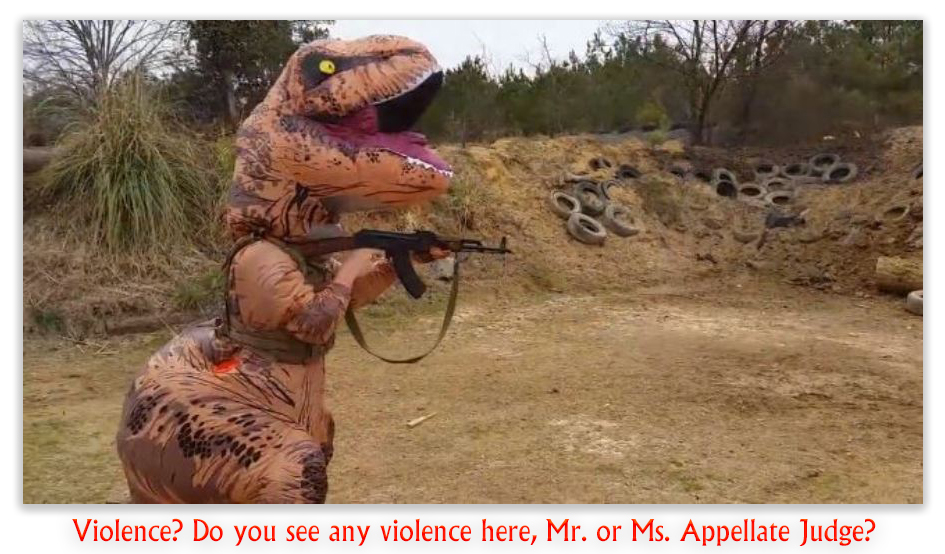
Irma Ovalles, convicted of being part of a carjacking crew that used baseball bats and assault rifles, filed a 2255 motion challenging her 924(c) conviction on the grounds that carjacking in its ordinarily sense is not a crime of violence. Last week, the 11th Circuit handed down a ruling that all but dooms her effort.
To determine whether a prior offense is a “crime of violence,” which is what Johnson and Dimaya address, a court is to use a “categorical approach,” which requires a reviewing court not to look at what the defendant actually did to, for example, assault a police officer in, say, Tennessee. Instead, the court is to ‘imagine’ an “idealized ordinary case of the crime,” and figure out whether it could be done without using violent physical force. Sure punching a cop would use violent physical force. But what if the defendant spit on the police officer instead? If Tennessee state law would permit prosecuting such an act, would that – disgusting though it might be – be held not to be “violent physical force?” If so, the predicate crime is not a “crime of violence.”
So assume the defendant were packing a gun hidden in her waistband while assaulting the officer? Or pulled the gun and pistol-whipped him? Would the fact that she reasonably been prosecuted for spitting on him instead mean that the crime was not violent, and thus render the 924(c) residual clause impermissibly vague?
The 11th Circuit cleanly cut the “categorical approach” Gordian knot. “On the flip side,” the Court said, “Johnson and Dimaya also make clear… that if 924(c)(3)’s residual clause is instead interpreted to incorporate what we’ll call a conduct-based approach to the crime-of-violence determination, then the provision is not unconstitutionally vague.” Unlike the categorical approach, the conduct-based approach does not focus on legal definitions and “hypothetical ordinary case,” but instead looks at how the defendant actually committed the underlying crime. The 11th held that where the crime of violence being weighed is not a prior offense, but instead a contemporaneous one (and you cannot commit a 924(c) offense without simultaneously committing a crime of violence or drug trafficking offense), then the conduct-based approach had to be used under the rule of “constitutional doubt.” The rule of “constitutional doubt” holds that any reasonable construction available must be used in order to save a statute from unconstitutionality. “Accordingly,” the Circuit ruled, “we hold that 924(c)(3)(B) prescribes a conduct-based approach, pursuant to which the crime-of-violence determination should be made by reference to the actual facts and circumstances underlying a defendant’s offense.”
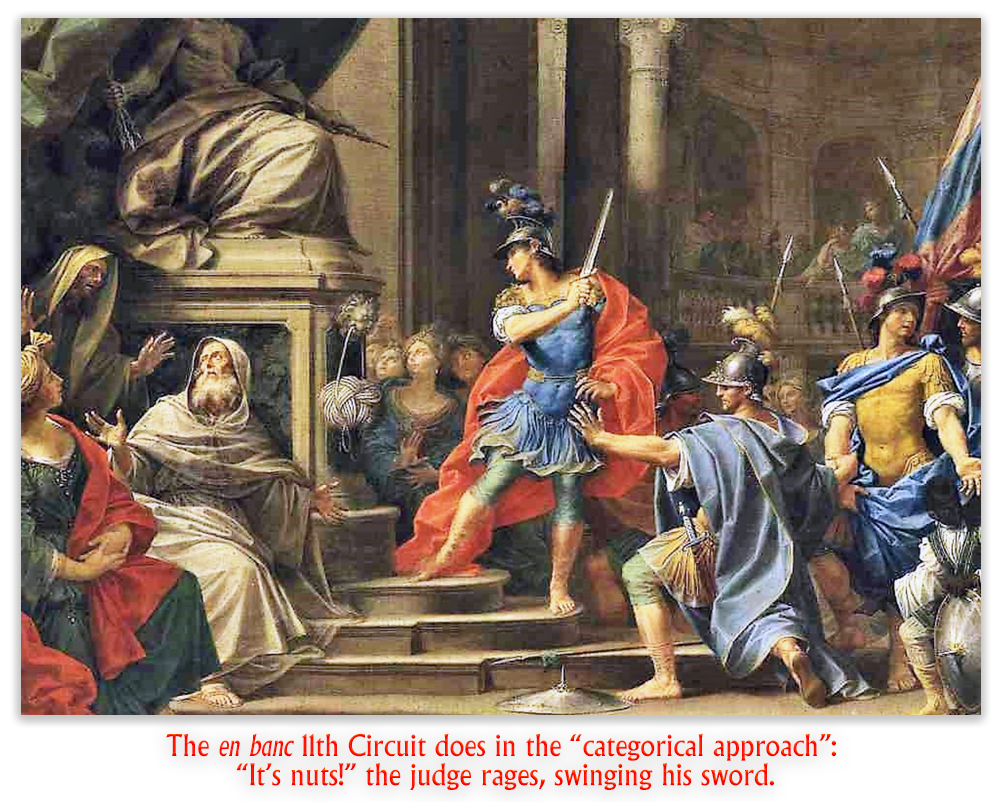
Under the conduct-based approach, Irma is clearly going to be in deep trouble when her case gets back to the district court. As one 11th Circuit judge asked in his concurring opinion, “How did we ever reach the point where this Court, sitting en banc, must debate whether a carjacking in which an assailant struck a 13-year-old girl in the mouth with a baseball bat and a cohort fired an AK-47 at her family is a crime of violence? It’s nuts.”
The 4th Circuit just last month heard en banc arguments in United States v. Simms, which may go the same way as Barrettand Ovalles.
We post news and comment on federal criminal justice issues, focused primarily on trial and post-conviction matters, legislative initiatives, and sentencing issues.
VACATED STATE CONVICTION DOES NOT LEAD TO LOWER RULE 11(c)(1)(C) SENTENCE
Brian Hoskins, a man with two prior felony drug convictions, made a deal under Federal Rule of Criminal Procedure 11(c)(1)(C) to plead to 112 months on a federal drug trafficking case. A so-called (c)(1)(C) plea specifies a precise sentence which the court may accept or reject, but not change. The (c)(1)(C) deal brought Brian’s sentence in way below what his Sentencing Guidelines “career offender” status would have gotten him.
But after sentencing, Brian was able to get his Vermont drug felony conviction – one of the two prior convictions that qualified him as a “career offender” – set aside because his state lawyer had screwed up the plea. All of a sudden, he no longer qualified as a career offender, dramatically lowering his sentencing range. His 112-month plea no longer looked like such a good deal.
Brian filed a 28 USC 2255 motion, arguing that his Rule 11(c)(1)(C) plea should be set aside. The district court agreed, holding that his “now-vacated state conviction clearly led to a significant enhancement of his sentence.” The district judge cut Brian’s sentence to 86 months, which Brian has now completed.
Not so fast, Brian. Last week, the 2nd Circuit upheld a government appeal of the 2255 grant. Noting that a non-constitutional error – like the state court conviction that had now gone away – can be recognized on a 2255 motion only if “the claimed error constituted ‘a fundamental defect which inherently results in a complete miscarriage of justice.’”
Here, the Circuit said, there was no miscarriage. Brian’s 112-month deal fell within his non-career offender sentencing range of 100-125 months. What’s more, the 2nd said, “Sec. 2255 does not encompass all claimed errors in conviction and sentencing.” Id. at 185. Rather, those instances where an error in conviction or sentencing rise to the level to be a cognizable basis for a collateral attack are reserved for when the “error of fact or law is of the fundamental character that renders the entire proceeding irregular and invalid… A “later development” that “did not affect the lawfulness of the judgment itself—then or now,” is not enough to vacate the sentence imposed.
The appellate court said Brian’s plea deal agreed he was a career offender, but applied a sentencing range well below it. The deal also let Brian avoid a superseding indictment with enhanced mandatory minimum sentence of ten years. “Together, these circumstances show that, even with a career offender enhancement applied to calculate Hoskins’s Guidelines range at 155 to 181 months, in securing agreement to a sentence of 112 months, Hoskins left the bargaining table with a deal that secured him real benefit, hardly indicating a a miscarriage of justice.”
Second, because the Guidelines are advisory, the district court necessarily had to make an individualized determination that the 112-month sentence was right for Brian. The district court obviously did so, the 2nd Circuit said, and the fact the 112-month deal was in the middle of his non-career offender range made it clear Brian’s sentence was no miscarriage of justice.
The 2255 grant was reversed, and Brian will have to return to prison.
We post news and comment on federal criminal justice issues, focused primarily on trial and post-conviction matters, legislative initiatives, and sentencing issues.
FIRST STEP ACT STANDING STILL
It’s no surprise to anyone that the Senate’s version of the FIRST STEP Act, which reportedly will be amended to include some mandatory minimum sentence patches contained in the Senate Reform and Corrections Act of 2017, has been standing still since the White House deal brokered in late August.
Recall that the White House convinced warring Republicans, led by Sen. Charles Grassley (R-Iowa), chairman of the Senate Judiciary Committee, to accept FIRST STEP as the vehicle to push prison and sentence reform through Congress. The irony was that Sen. Grassley and others did not think that FIRST STEP gave inmates too much. Instead, they complained that FIRST STEP gave inmates too little, because they see reform of drug mandatory minimums, Fair Sentencing Act retroactivity, and unstacking multiple 18 USC 924(c) sentences as essential.
Senate Majority Leader Mitch McConnell (R-Kentucky) fecklessly announced a month ago that he would not bring FIRST STEP to a floor vote until after the November mid-term elections, because he did not want to put Republican senators running for re-election in the position of having to take a stand on prison or sentencing reform. It hardly seems to be fraught with electoral peril: a recent University of Maryland poll found that over 70% of Americans favor reducing drug mandatory minimums and making the change retroactive.
The Brett Kavanaugh nomination fight could affect the chances of FIRST STEP passage, but what is going on in the nomination process is so unprecedented that no one can assess what that change will be. After one of the most bitter Senate battles in modern history, both parties might be eager to show the nation that the Senate can pass a measure with bipartisan support. As one commentator noted about the FIRST STEP Act last week, “The prison population is a lot smaller than the entirety of the American people and the ‘everyone wants this’ rationale doesn’t always work. In this case, however, bipartisanship is the truth.”
On the other hand, the Republicans could be too bitter over Kavanaugh or even suffer a loss of the Senate. Right now, the Real Clear Politics poll predicts 47 solid Republican seats, 44 solid Democrat seats, and nine that are too close to call. It is entirely possible that the November election will cause Sen. McConnell to use the remaining few weeks of the 115th Congress to do things he will not be able to do in 2019. If that is the case, the FIRST STEP Actcould become a casualty of political forces that have nothing to do with animosity toward federal inmates.
Last week, BOP inmate and former Illinois Governor Rod Blagojevich published a commentary in the Washington Examinersupporting prison reform, arguing that the government’s 97% conviction rate are strong arguments for reform. He wrote, “shouldn’t that fact raise an alarm bell to all freedom loving people? Michael Jordan, as great as he was, only made half the shots he attempted. And knowing what I now know through my experience, this almost perfect success rate is convincing proof that the federal criminal justice system works against the accused. It is neither a place to expect a fair trial nor is it a place where the promise of justice for all is a promise kept.”
Although you can be sure that there are good practical reasons for Congress to pass FIRST STEP, there is no guarantee that it will Another thing you can be sure of is that very little about the FIRST STEP Act will be heard in the next five weeks.
We post news and comment on federal criminal justice issues, focused primarily on trial and post-conviction matters, legislative initiatives, and sentencing issues.
FIRST MONDAY IN OCTOBER
The Supreme Court’s new year begins today and runs through next June. The term, known as October Term 2018, should begin with a bang for federal defendants.
As we mentioned last week, the Supreme Court will hear arguments tomorrow in Gundy v. United States, a case which asks whether the Attorney General can lawfully be given the power by Congress to determine who has to register under the Sex Offender Registration and Notification Act.
How the Supreme Court decides Gundy could have sweeping implications. Since SORNA was enacted, 4,000 sex offenders have been convicted of federal sex-offender registry violations: the government argues that “many of those offenders who failed to register would go free” if the Court were to invalidate Congress’ delegation to Attorney General in SORNA. What’s more, there are “hundreds of thousands” of pre-SORNA offenders now covered by the Attorney General’s designation, and the Court’s decision will determine whether or not they will face criminal liability for failure to comply with SORNA’s registration requirements.
Beyond sex-offender registration, the approach the Supreme Court takes in Gundy could affect many laws involving the administrative state. The nondelegation doctrine, which holds that Congress cannot delegate to the executive branch the power to declare that something is a crime or to specify the appropriate punishment, has been honored in the breach for well over 80 years, with federal agencies exercising increasing power to establish criminal offenses by administrative fiat. There was a time that the Supreme Court covered naked violations of the nondelegation doctrine with the fig leaf that such delegations were permissible as long as Congress furnishes a declaration of policy or a standard of action, “primary standards, devolving upon others the duty to carry out the declared legislative policy.”
In Gundy, the statute simply provides that “the Attorney General shall have authority to specify the applicability of the requirements of this subchapter.” 34 USC 20913(d). As the Cato Institute described it in a Supreme Court amicus filing, “He may require sex offenders to register based on the severity of their crime, the time since their conviction, or at random based on the first letter of their last names. He may consult the laws of the various states or various astrological charts. SORNAgrants him “an unlimited authority to determine the policy and to lay down the prohibition, or not to lay it down, as he may see fit. And disobedience to his order is made a crime punishable by fine and imprisonment.”
Broad delegations of authority to the executive branch form the foundation of modern regulatory government. But given a dissent from Justices Scalia and Ginsburg (who, although good friends, were truly the odd couple in the same dissent) in Reynolds v. United States, a recent concurrence by Justice Thomas in Department of Transportation v. American Association of Railroads, and a Justice Gorsuch dissent from his time on the 10th Circuit in United States v. Nichols, a case involving SORNA, it is quite possible that Gundy will revive the nondelegation doctrine from its 80-year slumber.
We post news and comment on federal criminal justice issues, focused primarily on trial and post-conviction matters, legislative initiatives, and sentencing issues.
A LITTLE BIT OF NOTHING FOR THE LADIES
Sure, they’re all inmates. But only the most callous observer would suggest that forcing female inmates to undergo strip searches in front of male Bureau of Prisons personnel is all right, because, after all, “if you can’t do the time, don’t do the crime…” and all that claptrap. It turns out that a critical shortage of BOP correctional officers is having a disparate effect on the 10,567 female inmates held in the system, the Dept. of Justice Inspector General reported last Thursday. “The lack of sufficient staff is most noticeable at larger female institutions,” the OIG Report said.
As of September 2016, female inmates represented 7% of the BOP sentenced inmate population of 146,084. The OIG review was sparked in part by Congress and public interest groups raising concerns with DOJ about deficiencies in BOP’s current management of female inmates.
Although BOP policy requires that female prisoners can only be searched by female correctional officers, the BOP is unable to ensure a female officer is available at each post where such searches are required, the report says. The report also concluded that 90% of the female inmate population would benefit from trauma treatment, but staffing shortages make it nearly impossible to provide eligible inmates with the care they need, according to the report.
In a response attached to the report, Hugh Hurwitz, acting BOP director, said he agrees with the IG’s recommendations and vowed to improve both staffing and training. How he is going to pull that off in light of the BOP’s budget reductions ought to be a neat trick.
We post news and comment on federal criminal justice issues, focused primarily on trial and post-conviction matters, legislative initiatives, and sentencing issues. Today, a few short takes from last week’s federal criminal news…
CASE SHORTS
Hobbs Act Robbery “Violent Crime” in Another Circuit: The 1st Circuit last week held that Hobbs Act robbery is a crime of violence under 18 USC 924(c), a statute that sets extra punishment for carrying or using a gun during a crime of violence. The Circuit joins a number of others that have reached the same conclusion.
DEA Takes a “Bath” in Analogue Case: In a case full of organic chemistry and implications for the regulatory state, the 6th Circuit held that the DEA rules criminalizing the possession of a “positional isomer” of a banned drug require the rule of lenity to be applied. The rule of lenity is a principle of criminal statutory interpretation that requires a court to apply any unclear or ambiguous law in the manner most favorable to the defendant. In this case, the defendant was tried for possessing ethylone, which under the DEA definition was a “positional isomer” of butylone, a scheduled drug. The problem was that under one of several accepted scientific definitions of “positional isomer,” ethylone is not a positional isomer of butylone at all. The Court ruled that where there was more than one definition, and the DEA rules were unclear what definition was to apply, the defendant gets the benefit of the less restrictive definition under the rule of lenity.
Motion Claiming Juror Lied About Her Background is Structural Error: A couple of guys being tried for a pot-growing operation discovered after the trial that one juror’s son had been convicted of being a marijuana trafficker, a fact the juror concealed on her jury questionnaire. When the defendants raised the juror problem in a motion for new trial, the district court ruled there was no proof of prejudice resulting from of the juror’s false statement, because the overwhelming evidence would have convicted the defendants anyway. The 1st Circuit reversed, ruling that a biased juror would “deprive defendants of ‘basic protections’ without which a criminal trial cannot reliably serve its function as a vehicle for determination of guilt or innocence.” Thus, it is what is known as a “structural error.” Generally, a constitutional error that does not contribute to the verdict is considered harmless, which means the defendant is not entitled to reversal. However, a structural error, one which “affects the framework within which the trial proceeds,” as defined in Arizona v. Fulminante, defies harmless error analysis. When a structural error is raised on direct review, the defendant is entitled to relief without any inquiry into harm. The Circuit granted French a new trial.
Written Judgment Cannot Add Anything to Terms Imposed at Sentencing: Lincoln R. Washington was sentenced on a conviction for failure to register as a sex offender. In the judgment form entering his sentence into the record, the district court added a supervised release term that Linc submit to polygraph testing, a requirement the court had not mentioned at the sentencing hearing. The 2nd Circuit ruled last week that imposing such a duty in the written judgment without doing so during the spoken sentence was an impermissible modification of the spoken sentence, notwithstanding the fact that the Presentence Report had made reference to the polygraph requirement.
We post news and comment on federal criminal justice issues, focused primarily on trial and post-conviction matters, legislative initiatives, and sentencing issues.
SEE YOU IN SEPTEMBER… SUPREME COURT GETS BACK TO WORK
Although the opening session of the Supreme Court is always the First Monday in October, the eight justices return to work today for the annual “long conference,” at which they consider the mass of petitions for certiorari, requests from unsuccessful lower-court litigants for review of their cases, that build up over the Court’s three-month vacation.
The Court hears about 70 cases out of the roughly 7,000 petitions for review it receives each term. It has already granted certiorari to hear 38 cases and will add more to the schedule over the next few months. Thirteen of those cases raise criminal law issues. This is about average: Between 25% to 33% of cases decided by the court every year are criminal-law-related. But a few of this term’s decisions could have huge implications.
First, next month the court will consider what constitute the “generic” elements of the common law “robbery” and “burglary” offenses. The Armed Career Criminal Act “crime of violence” definition includes “burglary” as a named offense, and also any crime that “has as an element the use… or threatened use of physical force.” That normally includes robbery.
The exact “generic” definitions of burglary or robbery has split lower circuits.
In Gamble v. United States, the court will consider whether to overrule the “separate sovereigns” exception to double jeopardy. The 5th Amendment provides that “no person shall… be subject for the same offence to be twice put in jeopardy of life and limb.” The common understanding of this is that a person may not be tried twice for the same offense. But the Supreme Court has ruled for well over a century that the clause allows “separate sovereigns” to each try a single defendant for what sure sounds like the “same offense.” A state may prosecute someone for the same crime that the federal government has already tried the person for, and the other way around.
There is no lower-court split on this question, but scholars have long criticized this “separate sovereigns” exception to the double jeopardy clause as being without support.
Another case, Timbs v. Indiana, addresses the “no excessive fines” provision in the 8th Amendment. When Tyson Timbs was convicted in Indiana of selling four grams of heroin, the state forfeited his $42,000 Land Rover because it had been used to transport the drugs. The Indiana Supreme Court refused to “impose federal obligations on the State that the federal government itself has not mandated.” A persistent split on the question, involving at least 18 states’ courts and two federal courts of appeals, led to a grant of certiorari.
Other criminal cases include Gundy v. United States, to be argued next week, that asks whether Congress’ delegation of authority to the attorney general to set sex-offender regulations, including deciding whether to retroactively apply the criminal statute, violate the Constitution’s “nondelegation” principle?
The Court’s decision to hear Gundy case came as a surprise. The Justices have not invalidated a congressional delegation in over 80 years, and all federal appellate courts addressing the issue have concluded that the delegation was proper. At least four Justices, the number needed to grant certiorari, however, thought the issue worth considering, clearing the way for a potential major assault on the modern administrative state, which is shaped by countless congressional delegations of authority to agencies.
On the merits, Mr. Gundy has a strong claim. For a delegation to be proper, Congress must provide an “intelligible principle” to guide the delegated decision, which as Chief Justice John Marshall stated in 1825 should merely “fill up the details” of a law’s application. With SORNA, Congress simply directed the attorney general to decide the retroactivity question — hardly a detail, as it affected half a million people and has required significant federal prosecutorial resources.
Two others include Nielsen v. Preap, asking whether a criminal alien exempt from otherwise mandatory detention if, after the person is released from criminal custody, the Department of Homeland Security does not immediately take the person into custody, and Garza v. Idaho, asking whether prejudice is presumed when a defense lawyer was instructed by the defendant to file an appeal but the lawyer did not file an appeal because the plea agreement contained an appeal waiver?
The Democrats react to Brett Kavanaugh… Regardless of your political persuasion, it’s a safe bet you would not want to be judged by some of the crap you pulled off in high school.
Of course, the big Supreme Court story this week is whether Judge Brett Kavanaugh’s confirmation as the ninth Supreme Court justice will occur, or whether he will be shot down over claims he groped a girl as a drunken teenager 30 years ago. With a second accuser – albeit one with a shaky recall about an incident when Kavanaugh was a college freshman – reportedly coming forward, the nomination is looking shakier than ever.
We post news and comment on federal criminal justice issues, focused primarily on trial and post-conviction matters, legislative initiatives, and sentencing issues.
3RD CIRCUIT RULES PREJUDICE NEED NOT BE SHOWN IN ATTORNEY INEFFECTIVENESS CASE
Most post-conviction motions brought under 28 USC 2254 or 2255 fail, especially the ones that claim that the defendant’s lawyer was ineffective. It is not that hard proving that the lawyer screwed up. That happens all the time. Instead, the problem is that the defendant has to show that if the lawyer had not messed up, there is a reasonable chance that things would have turned out different.
This “prejudice” showing is what trips up most such motions. After all, if a busload of nuns passing by saw you run out of the bank with a sack of money and a gun, it is pretty tough to convince the court that you would have been acquitted if only your lawyer had called your mother to the stand to swear you were at home helping her bake cookies.
The problem with post-conviction prejudice showings is what a 3rd Circuit decision last week so noteworthy. In August 2006, Gary Moses shot Lawson Hunt in Philadelphia. Hearing the shots, Jeff Workman ran to the victim, saw Gary and opened fire at him. One of Jeff’s bullets ricocheted off a solid object and struck the victim in the chest, who died (but of which shot no one was sure).
Jeff and Gary were both charged with first-degree murder. Before trial, Jeff’s lawyer told him that he could not be convicted, because the victim was already dead when Jeff’s bullet hit him. At trial, Jeff’s lawyer built his whole case on that fact, arguing to the jury that Jeff could not be found guilty because you cannot murder a dead man.
Except it was not a fact. The only evidence in the case record showed that the victim was still alive when Jeff’s bullet struck him. Jeff’s lawyer ignored this inconvenient fact. The jury did not. It convicted Jeff but acquitted Gary.
The 3rd Circuit last week ruled that Jeff’s lawyer gave substandard assistance that pervaded the whole proceeding. But normally, that’s not enough. Jeff was obligated to prove that if his lawyer had advanced a defense based on the facts in the case, Jeff might have been acquitted. Now how can he prove something like that?
The 3rd Circuit said that under the circumstances of the case, Jeff didn’t need to show prejudice. In United States v. Cronic, the Supreme Court held back in 1984 that “if counsel entirely fails to subject the prosecution’s case to meaningful adversarial testing, then there has been a denial of 6th Amendment rights that makes the adversary process itself presumptively unreliable.” Employing the Cronic holding, the 3rd Circuit ruled that Jeff need not show any prejudice:
Trial counsel’s failure to present a case on behalf of Workman or to modify his theory of the case to account for, if not rebut with evidence, the testimony offered by the Commonwealth, represents a near-total failure on the part of trial counsel to contest the Commonwealth’s case. This is not to say that the decisions not to call a rebuttal expert on a defendant’s behalf or to decline to call fact witnesses in a defendant’s case-in-chief are inherently unreasonable. Here, however, they clearly derived not from a legitimate and reasonable trial strategy but from trial counsel’s failure to understand what was happening in the case in which he was ostensibly participating. The Commonwealth sought to prove that Workman killed Hunt, but Workman’s counsel sought only to prove his chosen theory seemingly without regard for the facts in evidence. This deprived Workman of his 6th Amendment right to counsel.
Jeff will get a new trial, where exactly how the victim was killed to death will be addressed.


 Anyone who has ever sought government records under the Freedom of Information Act knows how maddening the experience can be. Government agencies take much longer than the law allows because they’re so busy (which is like saying it is all right to steal bread from the store because you’re so hungry). Then, they ask you to rewrite your request to make it more specific. If you don’t, your FOIA request gets dismissed. If you do, the agency has you narrow it until it releases nothing. And if you do get any of the records you request, pages are omitted and lines blacked out with only vague references to FOIA exemptions.
 DOJ claimed Jim had not exhausted his FOIA rights because he did not tell the agency which section or subagency might have his records. The 3rd Circuit rejected the government’s position, saying Jim had asked for records mentioning his name, and that was specific enough. “It would be counterintuitive in the extreme,” the Court said, “to require such an individual to have sufficient knowledge of an agency’s organizational units to be able to identify the specific units of an agency that might contain the records sought.”