‘A Uniform Change Away’ – Former BOP Inmate Now BOP Deputy – Update for June 10, 2025

We post news and comment on federal criminal justice issues, focused primarily on trial and post-conviction matters, legislative initiatives, and sentencing issues.

FORMER BOP INMATE NOW BOP DEPUTY DIRECTOR
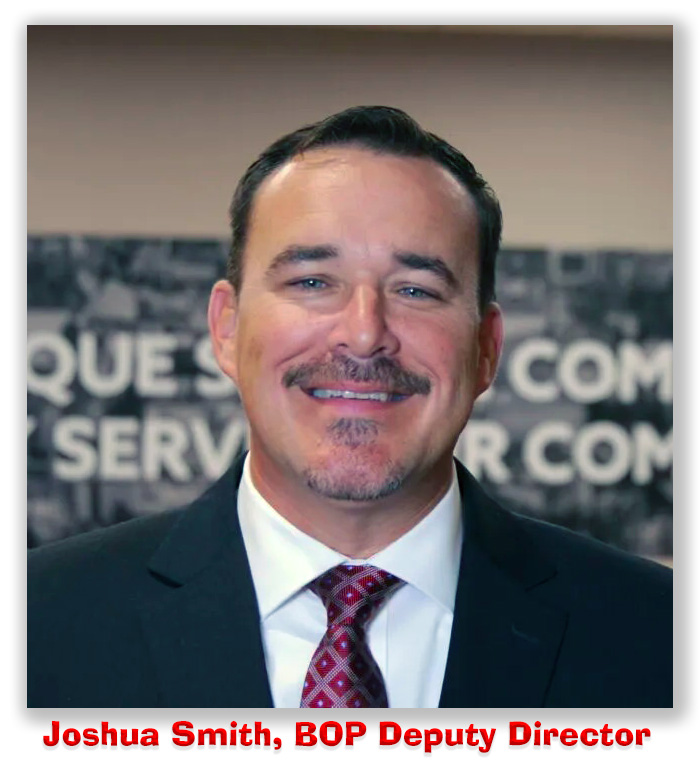
Some cynical Bureau of Prisons inmates have quipped before that certain BOP employees are “only a uniform change away” from being inmates, an aphorism occasionally proven by convictions of BOP staff for sexual abuse of inmates, bribery, introducing contraband, or general mayhem.

Last week, the cliché was turned on its head… but in a very good way. Joshua J. Smith, a former federal inmate who President Trump pardoned in 2021 for drug trafficking crimes committed more than two decades before, just swapped prison khakis from 20 years ago for a suit and corner office as the BOP’s Deputy Director.

Yeah, I know… a Trump pardon based on merit. That alone is amazing. But who would have ever predicted that someone would be involved with the BOP on both sides of the fence?

Last Thursday, BOP Director William K. Marshall III announced that he was naming Smith, a Tennessee businessman who founded inmate advocacy and rehabilitation nonprofit Fourth Purpose Foundation, as his second in command.

“Josh brings to this role something our agency has never had before at this level, a perspective shaped by lived experience, proven innovation and national impact,” Marshall said in a staff memo. “His firsthand understanding of our facilities — of the tension, the risk and the importance of trust — makes him uniquely positioned to advocate for the resources and reforms front-line staff need to do their jobs safely and effectively.”
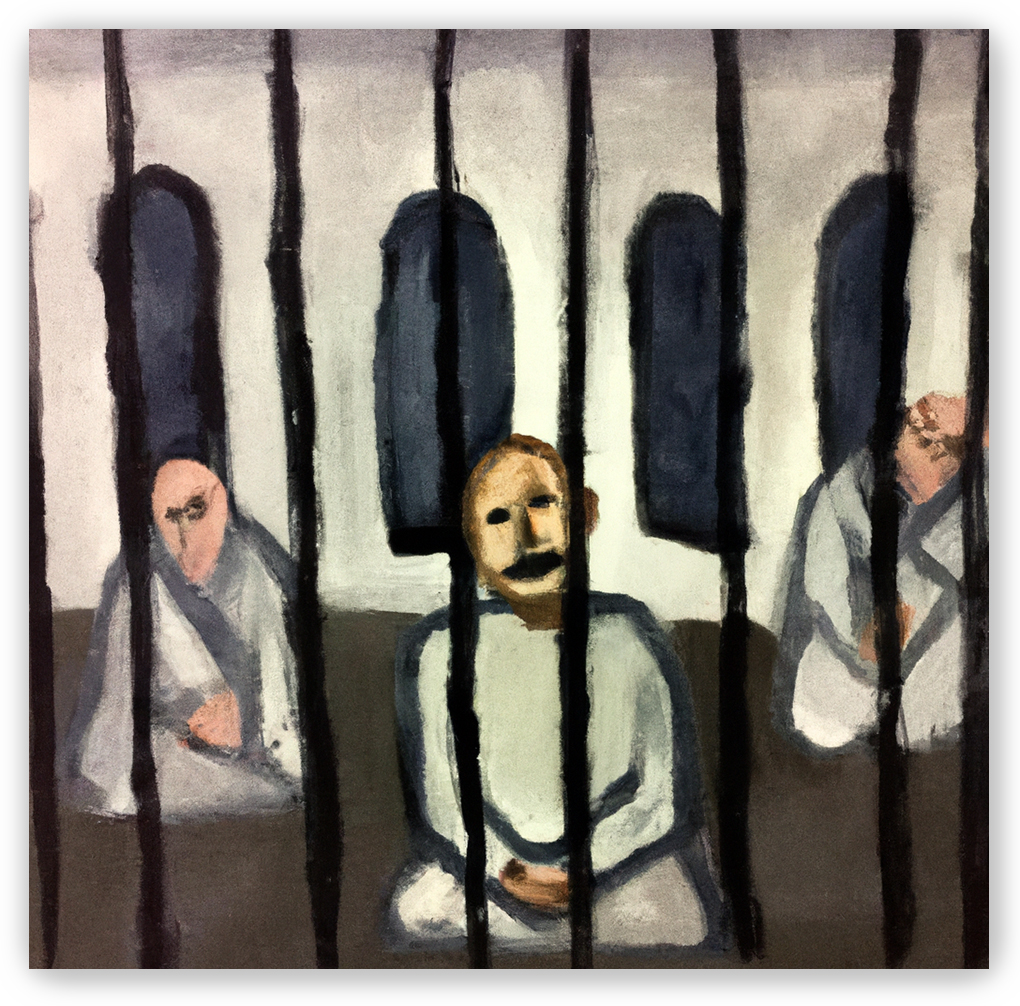
Smith entered the BOP as an inmate “at age 21 as an 11th-grade dropout with no plans to exit it any differently than how he entered,” Walter Pavlo wrote in Forbes last week. Smith served five years at FCI Manchester, Kentucky, being released in 2003.

The Fourth Purpose website says Smith “saw the system from the inside, its challenges, its blind spots, and its unrealized potential. While incarcerated, something began to shift. He found faith, discipline, and most importantly, he found a sense of purpose. For Josh, prison wasn’t just a consequence, it became a transformative experience. When he was released in 2003, he walked out determined not to waste a second chance he had been given. He created a plan to stay out of the system. But that sense of purpose followed him. Reentry wasn’t easy, but it shaped his empathy. It helped him understand the barriers people face on the outside and planted the seed of a deeper mission.”

When he was pardoned in January 2021, a Knoxville TV station reported, “Smith started a multi-million dollar company and a non-profit to help former inmates transform their lives.” The residential service company he started, Master Service Companies, grew into a $30 million enterprise with more than 180 employees, many of whom were ex-offenders.
Rabbi Moshe Margaretten, President of the nonprofit Tzedek Association, told Pavlo, “Director Marshall couldn’t have made a better choice. Josh Smith brings a deep moral clarity and transformative vision to the Bureau — grounded in lived experience and a passion for redemption and human dignity. His leadership on reentry is exactly what this moment demands.”

Pavlo wrote, “Smith realizes that real change is only going to occur if he has buy-in from the staff and that may be a challenge. Former Director Colette Peters, also an outsider to the BOP, found change difficult though she did manage to improve hiring and made a number of strides in implementing the First Step Act.”

Nevertheless, Pavlo cheered Smith’s appointment. “The BOP needs change and they need reform. Nothing says reform louder than bringing in someone like Josh Smith who has seen life on both sides of the fence.”

NBC, Former federal inmate pardoned by Trump tapped as Bureau of Prisons deputy director (June 6, 2025)

WBIR-TV, Knoxville businessman Josh Smith awarded Presidential Pardon (Jan 20, 2021)

Forbes, Meet Joshua Smith, New Deputy Director of Bureau of Prisons (June 6, 2025)

– Thomas L. Root

Supreme Court to Review Two More Compassionate Release Cases – Update for June 9, 2025

We post news and comment on federal criminal justice issues, focused primarily on trial and post-conviction matters, legislative initiatives, and sentencing issues.

COMPASSIONATE RELEASE ON DECK AT SUPREME COURT

In an unusual Friday evening order, the Supreme Court last week granted review of two more compassionate release cases, perhaps adding them to the one compassionate release case already on its docket for next fall or maybe issuing two separate decisions interpreting 18 USC § 3582(c)(1)(A) in the same Term.

Two weeks ago, the Court granted review to Fernandez v. United States, a case asking whether a combination of “extraordinary and compelling reasons” supporting a sentence reduction under 18 USC § 3582(c)(1)(A) can include reasons that may also be grounds for setting aside a sentence under 28 USC § 2255.

On Friday, the Court added Rutherford v. United States and Carter v. United States to the docket. The two cases are consolidated in one proceeding. Whether Fernandez will become part of that decision or become its own opinion has not yet been announced.

Rutherford and Carter ask whether in adopting new Guideline 1B1.13(b)(6), effective in November 2023, the Sentencing Commission exceeded its authority. That Guideline directs that a change in the law that means a prisoner’s current sentence could no longer be imposed–along with other factors–can be an “extraordinary and compelling reason” for compassionate release under the statute.

In one of the cases, defendant Daniel Rutherford committed two robberies using a gun in over a 5-day period. Using a gun in two robberies netted Dan two convictions for using a gun in a robbery (a violation of 18 USC § 924(c)). He was sentenced to 32 years for the two § 924(c)s, seven years for the one and 25 years for the second.

If Daniel had been sentenced after the First Step Act passed, he would have received a 14-year mandatory minimum for his two 18 USC 924(c) convictions, seven apiece. First Step amended § 924(c) to clarify that the 25-year sentence for a second conviction only applied after a defendant had been convicted of  § 924(c) once already. But before First Step, courts held that if a second § 924(c) was committed even a day after the first one, the 25-year minimum applied to the second one.

In the second case, Johnnie Carter, convicted of multiple bank robberies in 2007, argued that if he had been sentenced after First Step, he would have 21 years of mandatory time instead of the 70 years he is serving.

The Sentencing Commission’s enabling law directs it to define what constitutes an “extraordinary and compelling reason” for compassionate release. Nevertheless, some circuit courts have held that because the First Step Act changed § 924(c) but did not do so retroactively, the Commission exceeded its authority in making the disparity due to those changes in the law an element of compassionate release.

The 1st, 4th, 9th and 10th Circuits have OK’d allowing courts to consider the changes. The 3rd and 11th have gone the other way. Just a month ago, the 6th Circuit joined the naysayers, ruling in United States v. Bricker that adoption of § 1B1.13(b)(6) exceeded the Commission’s authority.

It does not overstate the case to say that SCOTUS’s holdings in Fernandez, Rutherford and Carter will define the future of compassionate release. The cases won’t be argued until late next fall or in early 2026, with a decision due by about a year from now.

Rutherford v. United States, Case No. 24-820 (Supreme Ct, petition for cert granted June 6, 2025)

Carter v. United States, Case No. 24-820 (Supreme Ct, petition for cert granted June 6, 2025)

Fernandez v. United States, Case No. 24-556 (Supreme Ct, petition for cert granted May 27, 2025)

United States v. Bricker, Case No 24-3286, 135 F.4th 427 (6th Cir. Apr 22, 2025)

Courthouse News Service, Justices take on sentencing reform issues, IQ tests for disabled facing death row (June 6, 2025)

– Thomas L. Root

Streamlining How To Get The Horse to Water – Update for June 5, 2025

We post news and comment on federal criminal justice issues, focused primarily on trial and post-conviction matters, legislative initiatives, and sentencing issues.

BILL INTRODUCED TO SPEED BOP CORRECTIONAL OFFICER HIRING

job210830Representatives Glenn Grothman (R-WI) and Elise Stefanik (R-NY) last month reintroduced the BOP Direct-Hire Authority Act (H.R. 3342), legislation intended to alleviate BOP staffing shortages by circumventing Office of Personnel Management procedures that can prolong the onboarding process for new hires to over six months.

Stefanik is chair of the House Republican Leadership Committee.

“One of the main hurdles in President Trump’s effort to reopen Alcatraz will be the ability to quickly hire Correctional Officers,” Grothman said in a press release. “That is why Congress needs to quickly pass this legislation to help the federal prison system which has been understaffed and overwhelmed for years.”

A prior version of the bill was introduced last December as H.R. 6628 but died when the 118th Congress expired at the end of 2024.

horsetowater250606Streamlining the process to hire correctional officers does not alter the desireability of the BOP as a career path. The agency continues to rank at the bottom of federal agencies as an employer, putting up dismal marks on quality of leadership, pay, recognition, and work-life balance. Leading the horse to water could get easier with passage of the BOP Direct-Hire Authority Act, but no one is floating any ideas on how to make the horse drink.

In an unrelated but dramatically illustrative example of the problem, the BOP employees union at FCI Phoenix last week bought a billboard ad near the prison demanding that the warden and regional director be fired.

FCIPhoenix250605The Arizona Republic reported that American Federation of Government Employees Local 3954 has accused prison leadership of failing to protect the lives of the people who work in the prisons.

H.R. 3342, BOP Direct-Hire Authority Act

The Sun, Stefanik supports reintroduction of BOP Direct-Hire Authority Act (May 14, 2025)

Arizona Republic, Phoenix federal prison union members call for warden, regional director to be removed (June 3, 2025)

– Thomas L. Root

The Wild, Wild West Wing – Update for June 3, 2025

We post news and comment on federal criminal justice issues, focused primarily on trial and post-conviction matters, legislative initiatives, and sentencing issues.

TRUMP MANAGES TO MAKE CLEMENCY EVEN CRAZIER

wildwildwestwing250603The rolling waves of pardons and commutations emanating from the White House seem like good news to federal prisoners, who are filing clemency petitions to get in on the frenzy. Think Robinhood investors piling into a meme stock

Over the past several weeks, President Donald Trump has issued a wave of pardons and sentence reductions to dozens of people. That’s good news. The bad news is that the recipients of Trump’s largesse are largely political allies, campaign donors, law enforcement officials, and Republican politicians.

I won’t try to recount them all, people from crooked cops to digital dope peddlers to gang bangers to celebrity fraudsters. Even George Floyd murderer Derek Chauvin and accused sex monster and rapper Sean ‘Diddy’ Combs are being talked about as candidates for Trumpian clemency largesse. Instead, I’ll look at the lessons to be derived from the freedom frenzy:

The three sure-fire ways to get clemency from this Administration are (1) to be a rabid Trump supporter, (2) to have millions to spend, or (3) to know someone who knows someone who knows someone in Trump’s inner circle.

clemencypitch180716For more than a century, career civil servants led the Dept of Justice Office of Pardon Attorney, evaluating clemency petitions based on legal and humanitarian criteria that were criticized for the glacial review pace, too much DOJ input, and opaque and sometimes inconsistent decisions. But now, newly appointed Pardon Attorney Ed Martin, a vigorous MAGA partisan, “has begun turning the office into a new pipeline for political allies to get their cases in front of Trump,” the Wall Street Journal reported last week.

Martin unabashedly described his pardon approach last week on X: “No MAGA left behind.”

Martin said he is working closely with Alice Johnson, the White House pardon czar whom Trump pardoned of drug offenses during his first term. That’s good news. The bad news is Martin’s approach: “The message should be clear that we’re sticking by people that do good things and the right things.”

MAGAhat250603Martin’s first pardon recommendation, adopted by Trump last week, was Scott Jenkins, the former sheriff of Culpeper County, Virginia. Jenkins was to report to prison last week after being convicted of selling no-show auxiliary sheriff’s deputy positions for over $75,000 in bribes. The evidence included videos of the sheriff accepting bags of cash and testimony of some of the people who bought the badges. He was sentenced to 120 months.

But as the Bulwark explained last week, “Jenkins was a rabidly anti-immigrant, pro-Trump sheriff who’d become a minor celebrity in MAGA world. Trump himself may not have known of him, but Ed Martin did… Martin celebrated his achievement just after the pardon: ‘Thank you, President Trump! I am thrilled that Sheriff Jenkins is the first pardon since I became your Pardon Attorney.’”

For those not connected to MAGA, seeking clemency “has become big business for lobbying and consulting firms close to the administration, with wealthy hopefuls willing to spend millions of dollars for help getting their case in front of the right people,” a lobbyist told NBC News. “From a lobbying perspective, pardons have gotten profitable.”

pardonsale210118Two people directly familiar with proposals to lobbying firms said they knew of a client who’d offered $5 million to help get a case to Trump. “Cozying up to a president’s allies or hiring lobbyists to gain access to clemency isn’t new,” NBC said. “But along with the price spike, what’s different now is that Trump is issuing pardons on a rolling basis — rather than most coming at the end of the administration.”

“It’s like the Wild West,” a Trump ally and lobbyist said. “You can basically charge whatever you want.”

But what about Alice Johnson, appointed as Pardon Czar to bring worthy clemency candidates to President Trump? Is that working?

Alice apparently was instrumental in bringing reality TV stars and celebrity whiners Todd and Julie Chrisley to Trump for full pardons of their bank and tax fraud convictions. Todd stayed in the headlines for the 24 months he served of his 12-year sentence by claiming, among other things, that FPC Pensacola was “literally” starving inmates to death, that the prisoners were forced to live in filth and eat contaminated food, and that he “feared for his life.”

“I know not only their stories, but I make sure that I’m selecting people who have either been rehabilitated, who pose no safety risk, and also we look at cases where there has been obvious weaponization against these individuals,” Alice Johnson told NewsNation Now. She was quoted in Eonline as saying “The celebrity part really didn’t play a role in this… These are everyday Americans who deserve a second chance,” she continued. “I’ve really been looking at those who pose no safety risk, don’t have victims of violent crimes. These people need to be returned to their families. They really get a chance to have a second shot at life.”

money170419A month ago, Trump pardoned Paul Walczak, a former nursing home executive sentenced to 18 months in prison and ordered to pay more than $4 million in restitution for tax crimes. The pardon came after Walczak’s mom, a GOP donor, Walczak’s pardon has received attended a $1-million-per-person fundraising dinner at Mar-a-Lago, the New York Times reported.

Even some of the people who are not rich or famous are lucky enough to get in on the act. An “everyday American” prisoner who was not a Chrisley but received clemency last week was serving a 50-year sentence for healthcare fraud. One of his co-defendants, however, had been Alice Johnson’s cellie at FCI Aliceville. Alice got her sprung in 2020. Five years later, the co-defendant lobbied Alice to get him out, too.

I helped him with his clemency petition a few years ago, a 100-page tome. No doubt he deserved clemency but no more or less than countless others whose conspiracies did not include someone who became Alice’s cellmate.

clemencytornado250603Ultimately, it’s depressing. Clemency has always been like a tornado tearing through a neighborhood, taking some lucky inmates seemingly at random while leaving others in their bunks to serve out their time. Now, there isn’t even a randomness factor anymore, a sense among prisoners that maybe, despite the ordinariness of their offense or their families’ quotidian circumstances, they may be the beneficiaries of a Presidential act of grace.

Now, it’s all about loyalty, wealth, connections.

We’re in a different clemency world than ever before, but the average federal inmate is further from fair consideration than ever.

CNN, ‘No MAGA left behind’: Trump’s pardons get even more political (May 28, 2025)

NBC, Trump pardons drive a big, burgeoning business for lobbyists (May 31, 2025)

Washington Post, Trump’s clemency spree extends to ex-gangster, rapper, former congressmen (May 29, 2025)

The Bulwark, Trump’s Dangerous Pardon Power (May 27, 2025)

Pensacola News Journal, Todd Chrisley served sentence at Pensacola Federal Prison Camp before pardon. What to know (May 28, 2025)

New York Times, Trump Pardoned Tax Cheat After Mother Attended $1 Million Dinner (May 27, 2025)

– Thomas L. Root

Things Are Seldom What They Seem – Update for June 2, 2025

We post news and comment on federal criminal justice issues, focused primarily on trial and post-conviction matters, legislative initiatives, and sentencing issues.

THE OL’ SWITCHEROO

buttercup250602Unless you’re my age (and I am not telling you what that age might be), you’re probably not familiar with Gilbert and Sullivan’s light opera, 19th-century musicals that parodied British life. In H.M.S. Pinafore – perhaps their best-known work – low-class Buttercup pines for the high-born captain of the Royal Navy warship HMS Pinafore. At one point, she tries to hint to the Captain that despite their difference in societal status, they might be able to hook up.

She sings,

Things are seldom what they seem, skim milk masquerades as cream, black sheep dwell in every fold, all that glitters is not gold…

Remember two months ago, when the BOP said no one would get more than 60 days of Second Chance Act halfway house time, only to recant a week or so later? It seemed that the problem had been solved. Unfortunately, as the Bureau of Prisons proved last week, the fix was illusory, as “storks turn out to be but logs” or “Bulls are but inflated frogs.”

A new BOP memorandum issued last week at first seemed to be a wonderful expansion of home confinement, but it in fact strips away SCA rights from prisoners who have been serving the longest sentences.

We have not seen the memo, just a press release. The release provides that home confinement will be “a priority for individuals who are eligible and do not require the structured support of an RRC. RRC placement will be reserved for those with the greatest need.” What’s more, unit teams are directed to “use FSA and SCA Conditional Placement Dates—based on projected Earned Time Credits (FTCs) expected to earn—to guide prerelease planning and ensure accurate and timely referrals.”

More home confinement? Great news, right?

Not really. The new policy does not expand the BOP’s authority to place people on home confinement by even one day. Ever since 2008, the BOP has had the authority to place inmates in home confinement for the final 10% of their sentences (up to a maximum of 6 months) under 18 USC § 3624(c)(2). Six years ago, the First Step Act amended § 3624(c)(2) to direct that the BOP, “to the extent practicable, place prisoners with lower risk levels and lower needs on home confinement for the maximum amount of time permitted under this paragraph.”

Just like Dorothy always had the power to go back to Kansas, the BOP has had the power to send prisoners to home confinement.

However, none of the BOP’s authority meant much up to now. BOP staff largely did not send people directly to home confinement. It was easier to send them to halfway house and then let the halfway house send them on to home confinement and do the monitoring. The halfway houses were glad to do it, because it freed up a bed they could sell for another inmate, and they still got some payment for the inmate they were continuing to monitor.

Suddenly, the BOP has figured out that it can better use the limited number of halfway house beds it has under contract (and save money) by sending low-risk inmates directly to home confinement. It’s the right call, but it doesn’t expand the availability of home confinement one bit. The BOP has no more power to put people on home confinement today than it had a week ago, a month ago, a year ago, or even as of December 21, 2018.

What’s worse is what the memo does NOT say. On Saturday, Walter Pavlo reported in Forbes that “[w]hen asked whether inmates are still eligible for Second Chance Act placement up to 12 months prior to their FSA conditional placement date, as has been the case, the BOP responded, ‘Due to statutory restrictions found in 18 U.S.C. § 3624(c)(1), an individual who has earned 365 days (12 months) of First Step Act credits to be applied to prerelease custody cannot receive additional prerelease time under the Second Chance Act.’”

This means that no one with 730 or more FSA credits will get any SCA halfway house or home confinement. Pavlo wrote, “The BOP’s current stance contradicts its position from just a few months ago, when it stated that stacking First Step Act and Second Chance Act benefits was permissible. Now, without addressing its previous position, the BOP asserts that home confinement under the Second Chance Act is only allowed by law during the final 12 months of a prison sentence.

home210218Additionally, the BOP claims that home confinement under the First Step Act can only be applied when the First Step Act time credits earned are equal to the remaining length of the prison term. This means an inmate cannot apply First Step Act credits to home confinement while also receiving up to 12 months of prerelease custody (6 months in a halfway house and 6 months in home confinement) under the Second Chance Act. For many inmates, this change means they will have to remain in prison for up to a year longer than they had initially expected.”

In the press release, BOP Director William K. Marshall III boasted that “President Trump said he would fight for the forgotten men and women of this country, and the First Step Act proved he meant it. Now, we are ensuring that this reform continues to work—not just as a policy, but as a promise to Americans seeking redemption and a path forward.”

BOP Press Release, Federal Bureau of Prisons Issues Directive to Expand Home Confinement, Advance First Step Act (May 28)

Forbes, Prisoners Set Back By Bureau Of Prisons Home Confinement Expansion (May 31)

– Thomas L. Root

A Pair and a Half of Shorts – Update for May 30, 2025

We post news and comment on federal criminal justice issues, focused primarily on trial and post-conviction matters, legislative initiatives, and sentencing issues.

Today, some shorts… just in time for warm summer weather.

shorts250530

SUMMER’S HERE – TIME FOR SOME SHORTS

Shocking News: BOP Healthcare Found Deficient – A report issued last week by the Dept of Justice Inspector General found that the BOP has failed to screen over a third of at-risk inmates for colorectal cancer (CRC). Between low screening offers and inmate refusals, less than half of average-risk inmates had a completed annual CRC screening.

healthbareminimum220603What’s more, out of a sample of 327 inmates, the IG found that around 10% had no documented follow-up after testing positive for CRC. Also, the Report found, the BOP lacked timeliness metrics for access to a colonoscopy for inmates with a positive CRC screening. The IG reported that “inmates in our sample waited an average of 8 months between a positive CRC screening and a colonoscopy.”

During the period covered by the Report, there were about 38,000 federal inmates who fell in the age range and “average risk” level for CRC. About 13,600 of them were not offered a screening, according to the Report.

BOP Director William K. Marshall III took time from being excited about a billion-dollar rebuild of Alcatraz (see below) to blame “longstanding staffing issues” for compromising efforts to screen inmates for colorectal cancer in certain facilities.

DOJ Inspector General, Evaluation of the Federal Bureau of Prisons’ Colorectal Cancer Screening Practices for Inmates and Its Clinical Follow-up on Screenings (Report 25-057, May 20, 2025)

Washington Post, Prisons bureau failed to screen inmates for colorectal cancer, watchdog says (May 20, 2025)

shorts250530

Sentencing Commission Releases 922(g) Data: About 7,500 people are convicted every year for 18 USC § 922(g) offenses, the US Sentencing Commission reported last week.

funwithnumbers170511The USSC said men accounted for 98% of all convictions, with 58% of them being black, 21% white and 17% Hispanic. The average age for defendants at conviction was 36 years old.

The defendants were overwhelmingly US citizens (95%). About 24% were Criminal History Category III and another 24% fell into Criminal History VI (the highest category).

USSC, Section 922(g) firearm offenses (May 22, 2025)

shorts250530

BOP Director Calls Rebuilding Alcatraz “Exciting Opportunity”: BOP Director William K. Marshall III, who has less than $200 million in his FY 2025 budget to make $3 billion in infrastructure repairs to existing prisons, told Fox News a week ago that his team is actively exploring the possibility of reopening Alcatraz, the 330-bed penitentiary on an island in San Francisco Bay.

excited250530Marshall called the project – a late-night idea President Trump hatched late on his inaptly-named “Truth Social” site a month ago – an “exciting opportunity” and one that aligns with the Trump administration’s law-and-order priorities.

Last week, KTVU-TV reported that estimates to make the repairs needed to reopen Alcatraz as a prison are close to $1 billion, plus another $40 million to $100 million a year in maintenance.

Corrections1, BOP director: Reopening Alcatraz is an ‘exciting opportunity’ (May 23, 2025)

KTVU, Bureau of Prisons director ‘excited’ about reopening Alcatraz as max-security prison (May 23, 2025)

– Thomas L. Root

Former BOP Officials Support Supreme Court Compassionate Release Petition – Update for May 29, 2025

We post news and comment on federal criminal justice issues, focused primarily on trial and post-conviction matters, legislative initiatives, and sentencing issues.

FORMER BOP OFFICIALS SUPPORT COMPASSIONATE RELEASE CERTIORARI

scotus161130A month ago, I reported that the 6th Circuit ruled that USSG § 1B1.13(b)(6), the compassionate release guideline subsection that lets courts consider overly long sentences that could not be imposed under current law, exceeded the Sentencing Commission’s authority. Several other circuits have held the same, notably the 3rd Circuit in United States v. Rutherford.

Rutherford is now before the Supreme Court on a petition for certiorari. The Justices have already relisted the case for more consideration (usually an indication that it is getting a serious look) at tomorrow’s conference.

Evidence of the Court’s interest came in Tuesday’s announcement that the Court would review a related issue, Fernandez v. United States. The issue in that case is whether whether a combination of “extraordinary and compelling reasons” supporting a sentence reduction under 18 USC § 3582(c)(1)(A) can include reasons that may also grounds for setting aside a sentence under 28 USC § 2255, the federal habeas corpus statute that can be used to attack the constitutionality of a conviction or sentence.

We'll see about that...
We’ll see about that…

In Fernandez, a district court granted the prisoner a “compassionate release” for reasons that included the court’s belief that there was substantial evidence that he was actually innocent of the murder and that his sentence was disparately long compared to those of his co-defendants (who became informants). The 2nd Circuit reversed (and ordered Joe back to prison), holding that factors that would work for a § 2255 motion could not be relied on for § 3582(c)(1)(A) compassionate release.

The Circuit’s holding was contrary to decisions of the First and Ninth Circuits, which have each held that district courts are not restricted from considering matters under 18 USC § 3582(c)(1)(A) other than the sole restriction – rehabilitation alone cannot support compasionate release – set forth in the law by Congress. The Supreme Court will decide what limits, if any, cabin a judge on what he or she may consider as extraordinary and compassionate reasons for compassionate release.

Fernandez is Rutherford’s spiritual cousin. I would not be surprised to see certiorari granted to Rutherford, and the two cases being combined for argument and decision.

Rutherford is notable for something else: Supporting petitioner Rutherford are amicus briefs, including ones filed by FAMM, six clinical law school professors, and 12 former federal judges. Most interesting may be an amicus brief by former Bureau of Prisons officials (now corrections consultants) represented by civil rights attorney Scott Lewis at Boston firm Anderson & Krieger.

prisonhealth200313Spotlighting the BOP healthcare crisis, the brief argues that expanding access to compassionate release for inmates serving unusually long sentences would benefit the BOP because “aging, unhealthy inmates consume a disproportionate share of BOP’s scarce resources, which has cascading effects on federal prison operations and the safety and security of BOP staff, as well as inmates… [a]nd the thousands of prisoners potentially eligible for compassionate release who are serving ‘unusually long sentence[s]’ with ‘gross disparity…’ are especially likely to become elderly and unhealthy or disabled in prison.”

United States v. Bricker, Case No. 24-3286, 2025 U.S.App. LEXIS 9538 (6th Cir. April 22, 2025)

Fernandez v. United States, Case No. 24-556 (certiorari granted May 23, 2025)

Rutherford v. United States, Case No. 24-820 (petition for certiorari pending)

Brief of Amici Curiae Former Bureau of Prisons Officials In Support of Petitioner, Rutherford v. United States (filed March 5, 2025)

– Thomas L. Root

You Don’t Have to Cheat Someone Out of Money to Commit Wire Fraud – Update for May 27, 2025

We post news and comment on federal criminal justice issues, focused primarily on trial and post-conviction matters, legislative initiatives, and sentencing issues.

STAM’S SCAM SLAMMED

Savingmoney250527The Supreme Court last Thursday upheld the fraud conviction of painting contractor Stamatios Kousisis. Stam got two government contracts that required him to work with disadvantaged business enterprises (DBEs), companies owned by racial minorities.

Stam set up a scam, a “pass-through” DBE company that was supposed to be supplying paint but really was just a front. Stam bought the paint, sold it to the DBE and then bought it back for a small markup that the minority “front” man got to keep for his part in the scam.

The catch was that Stam’s bid – with the sham DBE “front” – was below everyone else’s. As a result, the government paid less than it would have if it had accepted a bid from one of the other contractors who put their bids together with a legitimate DBE. The government charged Stam with wire fraud under the theory that he had fraudulently induced Pennsylvania to save money by contracting with him based on his claim that he was working with a real DBE. Stam argued that under the fraudulent inducement theory, the government had to show Stam intended to harm the government financially, which the government could not do.

The 3rd Circuit held that DBE participation in the deal was “an essential part of the contract,” and that was good enough to establish wire fraud, even if the government did save money. Last week, the Supreme Court agreed.

dbe250527The Supremes held that wire fraud simply requires someone to “devise” a scheme to “obtain money or property” through “false or fraudulent pretenses, representations, or promises.” The fraudulent-inducement theory, Justice Barrett wrote, does that: By using “a pass-through entity,” she said, Stam “‘devised’ a ‘scheme’ to obtain contracts through feigned compliance with PennDOT’s disadvantaged-business requirement.” The goal of the scheme was to obtain “tens of millions of dollars” from PennDOT by “making a number of ‘false or fraudulent… representations’ — first about their plans to obtain paint supplies from [the DBE] and later about having done exactly that.”

Fraud160811Obtaining money or property must be the goal of the wire fraud scheme, SCOTUS said, but the scheme does not “depend[] on economic loss.” The unanimous Court (with three concurring opinions) acknowledged that the wire fraud statute potentially has a “broad” sweep, “[b]ut Congress enacted the wire fraud statute, and it is up to Congress—if it so chooses—to change it.”

Kousisis v. United States, Case No 23-909, 2025 U.S. LEXIS 1982 (May 22, 2025)

SCOTUSBlog, Court upholds federal fraud conviction even without economic harm (May 22, 2025)

– Thomas L. Root

Mythbusters – Update for May 23, 2025

We post news and comment on federal criminal justice issues, focused primarily on trial and post-conviction matters, legislative initiatives, and sentencing issues.

NO, CAMPERS ARE NOT BEING SENT HOME (AND OTHER MYTHS)

twain250523Mark Twain once said, “A lie can travel half way around the world while the truth is putting on its shoes.”

Oh, the sweet irony! Because it appears that Mark Twain (whose name wasn’t really “Mark Twain,” another lie) did not really say that. In other words, it’s a lie that Twain (the name itself being another lie) said that “a lie can travel half way around the world…”

Fitting for today’s post, because it’s hard to say how a lie like that can take flight. That leads us to two whoppers spreading through the Federal Bureau of Prisons like flu in a housing unit.

home210218Myth 1 All minimum-security federal inmates with fewer than five years left are being sent to home confinement.  I get at least a dozen emails a week on this one: Is it true that Trump signed an executive order sending campers home? Is it true that it will all happen in September? Is it true that all the camps will close?

The answers are no, no, and no.

Trump has signed about 200 executive orders since January 20th, but not a one relates to the Bureau of Prisons (except the order to re-open Alcatraz). Nothing has been scheduled for September. BOP Director William K. Marshall III will not be personally driving everyone home. The camps will not close. It’s all a myth.

Here are the facts: The BOP is only allowed to send people to home confinement in one of two cases. Either the prisoner is in the last six months (or 10%, whichever’s less) of his or her sentence, or the prisoner is eligible to use FSA credits. For the former, 18 USC § 3624(c)(2) lets the prisoner go to home confinement. For the latter, 18 USC § 3624(g)(2)(A) permits spending those FSA credits on home confinement.

Congress has dictated when and how home confinement can be designated. Other Congressional home confinement programs (CARES Act and Elderly Offender Home Detention) expired two years ago. The President cannot order the BOP to send people to home confinement where Congress has passed laws expressly limiting it.

methuser161128Myth 2Send me a copy of the new meth law: I get nearly as many emails from people asking me to send them a copy of the “new meth law.” Do I look like a lending library? No matter, the response is straightforward. There is no new meth law.

In January, the Sentencing Commission said it was considering a change in the methamphetamine guidelines to do away with the purity enhancement, an increase in punishment where the meth was especially pure (or was “ice”). The change made great sense: these days, virtually all meth met the higher purity threshold, and so the old supposition – that very pure meth suggested the defendant was a high-level dealer – no longer had any legs.

In April, the USSC adopted proposed amendments that will take effect in November. The meth purity proposal was not among them. To this day, no one knows what happened to the idea.

yogi250523A few points: First, a Guideline is not a law. Judges must follow laws but not guidelines. Laws can be passed that trample guidelines, but guidelines cannot negate laws. Second, the drug trafficking sentence statute (21 USC § 841(b)) contains enhanced penalties for pure meth, and any guidelines change would not change the law and therefore have limited effect. Third, no one in the Republican majority Congress has any interest in easing the drug laws right now, even if fentanyl is the drug bad-boy-of-choice right now.

Recap: Home confinement for campers is a fantasy. A new meth law is a myth. And Mark Twain was not Mark Twain, and he probably never said most of the things he said.

– Thomas L. Root

An Offer You Can’t Refuse – Update for May 21, 2025

We post news and comment on federal criminal justice issues, focused primarily on trial and post-conviction matters, legislative initiatives, and sentencing issues.

LET’S MAKE A DEAL

letsmakeadeal250522Bad, bad Leo Brown… Well, maybe not so bad, but in bad trouble. In October 2016, Edwin Leo Brown was indicted on four counts of possession with the intent to distribute crack cocaine and a fifth count for being an 18 USC § 922(g)(1) felon in possession (F-I-P) of a gun. Leo was looking at a maximum sentence of 20 years’ imprisonment on each of the four drug charges, and up to 10 more on the F-I-P count.

Leo’s lawyer, Frank Harper, negotiated with the government, ultimately getting two plea agreements—one of which called for Leo to cooperate with the Feds and one of which did not—that both called for Leo to plead guilty only to the F-I-P count. That meant that taking either deal would limit Leo’s sentence to ten years. Harper advised Leo that he should take one of the plea agreements or the other, but Leo was skeptical. When Leo told Harper that he felt like the lawyer could have gotten him a better deal than 10 years, Harper apparently responded in exasperation, “It’s not my fault why you’re facing ten years.”

That offended Leo, who “from that moment” did not “trust [Harper’s] judgment” and told him so. The relationship deteriorated, and Harper subsequently withdrew as counsel.

Enter affable lawyer Brett Wentz. Leo liked Wentz, who agreed that Leo would face a firm sentence of 10 years if he took either plea deal, but told him that even if he did not–instead just entering an “open plea” to all counts without any–Leo’s sentencing guideline range would be the same. “In other words,” as the 4th Circuit described it, “Wentz advised Brown that he would be facing a statutory maximum of ten years’ imprisonment regardless of whether he accepted a plea offer or not.”

Leo really wanted to preserve his right to appeal, which he would have to waive under either version of the plea agreement. So after Wentz told him he’d get no more than 10 years with or without a plea deal, Leo thought it was a no-brainer. He rejected the plea offers and entered a guilty plea to all counts without benefit of a plea agreement.

harper250522At his change-of-plea hearing, the judge told Leo that he faced up to 20 years’ imprisonment on each of the four drug charges. At that point, Leo and lawyer Wentz conferred off the record. Leo then told the court he understood the penalties. The judge proceeded to tell Leo that he faced 10 years on the F-I-P. Leo again talked to Wentz off the record before telling the court he understood that potential penalty, too.

Unless there’s a plea deal that requires a particular sentence, the judge always tells a defendant during a change-of-plea hearing that even if defense counsel had given him an estimate of what the sentence might end up being, that estimate is not binding on the court. Leo’s judge told him this, but Leo “affirmed that he understood and subsequently entered an open guilty plea as to all five counts.”

You can see where this is headed, but Leo couldn’t. At sentencing a few months later, the court hammered Leo with 210 months’ imprisonment—17½ years—on all counts, an upward departure from the advisory guideline sentencing range of 87 to 108 months. Leo was not pleased.

After his sentence was affirmed on appeal, Leo filed a 28 USC § 2255 post-conviction motion arguing that Wentz provided ineffective assistance in giving Leo wrong advice on taking the plea deal.

Relying on the Supreme Court decision in Lee v. United States, the district court ruled that it would “not upset a plea solely because of post hoc assertions from a defendant about how he would have pleaded but for his [counsel’s] deficiencies.” Instead, it would look to “contemporaneous evidence to substantiate a defendant’s expressed preferences.” Based on the record, the district judge found, “even if Wentz had properly advised Brown about his sentencing exposure… Brown would not have signed the non-cooperation plea agreement with an appellate waiver and pleaded guilty to count five pursuant to the plea agreement” because avoiding having to “waivi[e] his right to appeal was more important to Brown than his sentencing exposure.”

On Tuesday, the 4th Circuit reversed the judgment, holding that Lee was the wrong standard to apply and that Leo had “demonstrated a reasonable probability that, but for Wentz’s erroneous advice regarding sentence exposure, he would have accepted the government’s offer.”

The 4th held that “the biggest distinction” between Lee and Leo’s case “is that Lee concerned an individual who accepted a guilty plea offer, while the instant appeal concerns an individual who rejected a guilty plea offer.” The Circuit said that the proper standard where a plea deal is rejected is set out in Missouri v. Frye and Lafler v. Cooper, a pair of Supreme Court decisions from 2012 that “articulated a different way to show prejudice” where a plea deal is not accepted, which is the issue in Leo’s case.

coulda250522A defendant who argues he rejected a plea offer because of ineffective assistance of counsel “need not present contemporaneous evidence to support his ineffective assistance claims,” the 4th Circuit said. Instead, a reasonable probability that a defendant would have accepted the plea offer but for counsel’s bad advice was met here by Leo’s testimony that he “would have taken the plea that the Government offered [him]” had he known he was facing a theoretical maximum of 90 years’ imprisonment, and that he believed, based on Wentz’s advice, that his “maximum exposure” when he pleaded to all five counts was “[n]o more than ten years.” The very fact that Leo pled guilty to more serious charges—namely, receiving 17.5 years’ imprisonment when the government’s plea offer offered a max of 10 years—was alone enough to show a “reasonable probability” Leo would have taken the deal, the Circuit said.

The Circuit ordered the case remanded and that Leo be offered the original 10-year deal.

United States v. Brown, Case No. 22-7105, 2025 U.S. App. LEXIS 12211 (4th Cir. May 20, 2025)

Lee v. United States, 582 U.S. 357 (2017)

Missouri v. Frye, 566 U.S. 134 (2012)

Lafler v. Cooper, 566 U.S. 156 (2012)

– Thomas L. Root