First Step 2.0 Already Being Planned – Update for January 30, 2019

We post news and comment on federal criminal justice issues, focused primarily on trial and post-conviction matters, legislative initiatives, and sentencing issues.

NEXT STEP ACT ALREADY IN WORKS

The bipartisan team that rallied House support for the First Step Act is drafting new legislation to clean up the existing criminal records of nonviolent drug offenders, a centerpiece of their efforts to pass further reforms.

Reps. Hakeem Jeffries (D-New York) and Douglas Collins (R-Georgia) are looking at how to expunge the criminal records of people convicted of drug crimes before minimum sentencing requirements were reduced, to restore their eligibility to apply for certain jobs. Nationally, one out of five jobs requires some kind of license, which excludes just about everyone with a prior felony. “’What is being contemplated is removing the stain that has been put on their life’s journey as a result of a nonviolent drug offense, often occurring at a very adolescent stage of their life,” Jeffries said.

jeffries-collinsA190130The bipartisan legislation could form the basis for what Collins said might be called a ”Next Step Act,” to follow up on the pair’s successful efforts to pass a First Step last year. Both lawmakers hope to continue their established partnership with President Donald Trump’s son in law and senior adviser Jared Kushner, with whom they worked on last year’s criminal justice reforms.

Jeffries said he also hopes to address marijuana as part of any future criminal justice package. “There’s a growing number of conservatives, libertarians and Republicans who are in agreement with Democrats, who believe that we should at least take a hard look at descheduling marijuana,” he said. “[It] shouldn’t actually be that controversial, and it’s consistent with Republican principles of states’ rights and federalism.”

Washington Post, Next step in criminal justice reform could target jobs for ex-convicts, marijuana law (Jan. 17, 2019)

Chicago Tribune, Bipartisan authors of federal sentencing reform have new goal (Jan. 23)

– Thomas L. Root

Err in Haste… Congress Screws Up First Step Implementation – Update for January 29, 2019

We post news and comment on federal criminal justice issues, focused primarily on trial and post-conviction matters, legislative initiatives, and sentencing issues.

TRYING TO FIX FIRST STEP’S 54-DAY FIASCO

finemess190129The expanded good-conduct time credit in the First Step Act – which increased the number of days awarded a federal inmate for good behavior from 47 to 54 days a year, retroactive to the beginning of an inmate’s current sentence – was intended by Congress to be immediately effective, The Congressional Budget Office estimated that the change would immediately release about 4,000 people.

The good-time fix, however, was inexplicably tucked into the earned-time credit section of the Act. A subsection of that provision, which was quite reasonably intended to delay implementation of the earned-time program until the Attorney General adopted a risk-assessment tool to use in order to measure its effectiveness, had the completely unintended effect of delaying award of the additional good-time credit as well. Thus, increased good-time will not be until July 19.

The Washington Examiner reported last Friday that “three sources who work closely with lawmakers and administration officials say it’s their understanding that the White House is looking for an administrative fix.”

White House Counsel Pat Cipollone reportedly met with advocates in mid-January to discuss the issue. “I think he really understood the intent,” said a person with direct knowledge of the meeting. “I think they understood this was a key provision… This was a key part of legislative negotiations.”

For people serving decades, seven additional days means release months early. The increased “good time” expansion and the extension of the Fair Sentencing Act were intended to be retroactive, unlike everything else in the bill.

Mybad190129It quickly became clear, however, that an immediate award of the extra seven days per year was not happening. “I think it was just an oversight,” said Kevin Ring, president of FAMM. “People were focused on making sure the good time got increased and that it was retroactive. It ended up getting put in the section with ‘earned time.’”

A few fixes are being discussed. The easiest would be for the White House to order the Justice Department to apply the 54 days of “good time” credit immediately. Other fixes would require legislation — either a unanimous consent motion or a spending bill provision — but legislative gridlock amid a partial government shutdown makes neither likely.

“I don’t think it’s something that gets cleared up quickly,” said Jessica Sloan of #cut50, one of the people at the White House meeting. “I’m hopeful the White House will issue some sort of directive to the DOJ, which will issue a directive to BOP, but there are a lot of administrative steps there.”

Ohio State University law professor Douglas Berman said last weekend in his Sentencing Law and Policy blog that he “had very little “faith” in anyone inside the Beltway fixing things these days, but it is encouraging that two very effective advocates had the opportunity to address the White House Counsel about potential fixes.”

Washington Examiner, Drafting error stalls inmate release under Trump plan (Jan. 25)

– Thomas L. Root

Simms Raises the Ante on 924(c) Crimes of Violence – Update for January 28, 2019

We post news and comment on federal criminal justice issues, focused primarily on trial and post-conviction matters, legislative initiatives, and sentencing issues.

4TH CIRCUIT SIMMS DECISION TEES UP 924(c) DEBATE FOR SUPREME COURT

The vigorous debate since the Supreme Court decided Sessions v. Dimaya last year at first seemed to surround whether the residual clause of 18 USC 924(c) – which defines “crime of violence” to include any offense that “by its nature, involves a substantial risk that physical force against the person or property of another” – was unconstitutionally vague. That is what the Supreme Court said about the same language in the Armed Career Criminal Act (in Johnson v. United States) and in Dimaya last spring referring to 18 USC 16(b).

violence181008But in the last few months, the argument has morphed into some more basic: when judging whether the offense underlying an 18 USC 924(c) charge is violent, should a court use the categorical approach (which asks whether the offense in its ordinary form is violent, not what the defendant did in the particular case under review)? Or should the court instead look only at how the defendant in the case under review committed the offense?

Three circuits have embraced the conduct-based approach, the 1st in United States v. Douglas, the 2nd in United States v. Barrett, and the 11th in Ovalles v. United States. Three others have backed the categorical approach, the 5th in United States v. Davis, the 10th in United States v. Salas, and the D.C. Circuit in United States v. Eshetu. Two weeks ago, the Supreme Court granted the government’s petition to review the 5th Circuit’s Davis decision.

The Circuit split deepened last Thursday with the 4th Circuit’s long-awaited decision in United States v. Simms. In a contentious 100-page decision, the en banc Circuit decided 8-7 that whether an underlying offense supporting a 924(c) conviction is a crime of violence, a trial court must use the categorical approach the Supreme Court adopted and used in Leocal v. Ashcroft. What’s more, using the categorical approach, the 4th said, it is clear that a conspiracy to commit a Hobbs Act robbery (18 USC 1951) is not a crime of violence.

By extension, this means that in the 4th Circuit, no conspiracy to commit a violent crime is itself a violent crime (although it is in the 2nd Circuit).

violence160110The 4th Circuit focused on the phrase “by its nature” in 924(c)(3)(B), saying that the language directs courts to consider only the basic or inherent features of “an offense that is a felony,” and that the phrase “directs courts to figure out what an offense normally… entails, not what happened to occur on one occasion. Had Congress intended a conduct-specific analysis instead, it presumably would have said so; other statutes, in other contexts, speak in just that way… We cannot adopt a reading of 924(c)(3)(B) that renders part of the statute superfluous over one that gives effect to its ‘every clause and word’.”

As important as Simms may be to the 924(c) debate, it is clear that it is not the last word. The Supreme Court is going to resolve the sharp circuit split in Davis as early as June, although it is could well hold off oral argument and a decision to the term beginning in October 2019.

United States v. Simms, 2019 U.S. App. LEXIS 2341 (4th Cir. Jan. 24, 2019)

– Thomas L. Root

First Step Act Beneficiaries By The Numbers – Update for January 25, 2019

We post news and comment on federal criminal justice issues, focused primarily on trial and post-conviction matters, legislative initiatives, and sentencing issues.

SENTENCING COMMISSION RELEASES FIRST STEP CHECKLIST, IMPACT STUDY

imageThe Romans had a phrase for it: “Cui bono?” Last week, the U.S. Sentencing Commission tried to answer that question about the First Step Act.

The extra seven days of good time granted by the Act will benefit the most inmates, about 142,500 federal prisoners (79% of the 180,390 federal prison population), excluding only people with life sentences or sentences of less than a year and a day (which are ineligible for good time under 18 USC 3624[b][1]). The earned time credit the Act awards for completing programs that reduce recidivism is in second place. The Commission estimates that it will benefit about 106,000 eligible inmates (about 59% of the population).

The retroactive Fair Sentencing Act provision of the First Step Act only touches about 2,660 inmates, but it has an outsized effect on racial disparity: 90% of whom are black.

elderly180517The elderly offender home detention program expanded by the Act has 1,880 inmates who are currently eligible (the right age, right offenses and right amount of time served). Of course, the EOHD program, unlike the other First Step programs, will see an influx of additional inmates who reach the right age and service of sentence.

The Commission also issued an 8-page fact sheet answering questions about implementing the sentencing portions of First Step. In it, the USSC notes that First Step requires no changes in the Guidelines (which is a good thing because the 7-member Commission is down to only two voting members, leaving it unable to approve any new Guidelines until the Senate approves additional commissioners).

USSC, Sentence and Prison Impact Estimate Summary (Jan. 18)

USSC, ESP Insider Express: First Step Act (Jan. 18)

– Thomas L. Root

Court Must Address Defense Arguments on Sentencing – Update for January 24, 2019

We post news and comment on federal criminal justice issues, focused primarily on trial and post-conviction matters, legislative initiatives, and sentencing issues.

TALK TO ME

A dozen years ago, the Supreme Court held in Gall v. United States that district courts must sufficiently address the parties’ arguments and provide an explanation for sentences for good enough for “meaningful appellate review.” The 4th Circuit last week found that some district courts still don’t get it.

kporn160124Carl Ross was convicted of receiving and possessing child porn. His Presentence Report that included a recommended term of confinement and recommended special conditions of supervised released. The PSR recommended a prison sentence 188-235 months and lifetime term of supervised release.

Carl was already serving a 120-month state sentence related to the same set of facts. He asked the district court to impose a 60-month mandatory minimum sentence to run concurrent with the state term. The government argued for a 120-month sentence stacked on top of the state sentence, whining that Carl’s proposed sentence would result in “essentially no sentence” and “absolutely zero impact, zero additional punishment as a result of the conduct in this case.” The prosecutor said Carl destroyed evidence, lacked remorse and had continued his criminal conduct even after the state had caught him.

sorry190124Carl argued the government’s sentencing position was above the advisory Guidelines sentencing range, because it would result in two separate 120-month sentences to be served one after the other. His lawyer argued that “felony convictions relating to sexual offenses are already very punitive and that the lifelong social stigma” Carl would experience justified a 60-month concurrent sentence. Also, he offered a mental health report showing Carl’s apparent lack of remorse was nothing more than a symptom of his mental disorders, which among other things caused him to insist on trial instead of taking a plea. Defense counsel argued that Carl maintained gainful employment, cared for his aging mother and had only a relatively small amount of illicit material compared to the average child porn offender.

After hearing the arguments, district court imposed a 120-month, stacked on the state sentence and lifetime SR. The judge said he found Carl’s arguments unpersuasive and that “the government’s recommendation is appropriate.” This was too little explanation even for the government, which asked the court to explain its basis for the sentence. The court replied with gibberish, saying essentially that it was concerned about the lack of remorse, and it believed “it’s a specific deterrence, requires the sentence I’m imposing. I did not find that the guidelines are so flawed as to essentially have no sentence at all. And in terms of general deterrence, I think that the sentence I’m imposing is required.”

Sentencestack170404Last week, the 4th Circuit threw out the sentence as procedurally unreasonable. Noting that a “district court must address or consider all non-frivolous reasons presented for imposing a different sentence and explain why he has rejected those arguments,” the Circuit complained that “the district court did not address or consider any of the numerous non-frivolous arguments advanced by Ross’s counsel requesting a lower and concurrent sentence.” The appellate panel was particularly unhappy that “the district court did not provide an individualized assessment regarding important mitigation evidence related to Ross’s mental health,” care of his mother, gainful employment, and the fact that he possessed a relatively small amount of kiddie porn.

The Circuit said, “the district court could have conceivably given Ross a different sentence if it had considered his non-frivolous mitigation arguments. The district court had an obligation to specifically address Ross’s non-frivolous arguments. It did not do so here.” This was equally true for the district court’s failure to explain why Carl got lifetime SR. “It is the settled law of this circuit,” the panel wrote, “that Ross has a right to know why he faces special conditions that will forever modify the course of his life, and the district court’s silence violated his rights.”

United States v. Ross, 2019 U.S. App. LEXIS 1186 (4th Cir. Jan. 14)

– Thomas L. Root

Time to Restart the Clemency Machine? – Update for January 23, 2019

We post news and comment on federal criminal justice issues, focused primarily on trial and post-conviction matters, legislative initiatives, and sentencing issues.

A RENEWED CRY FOR CLEMENCY

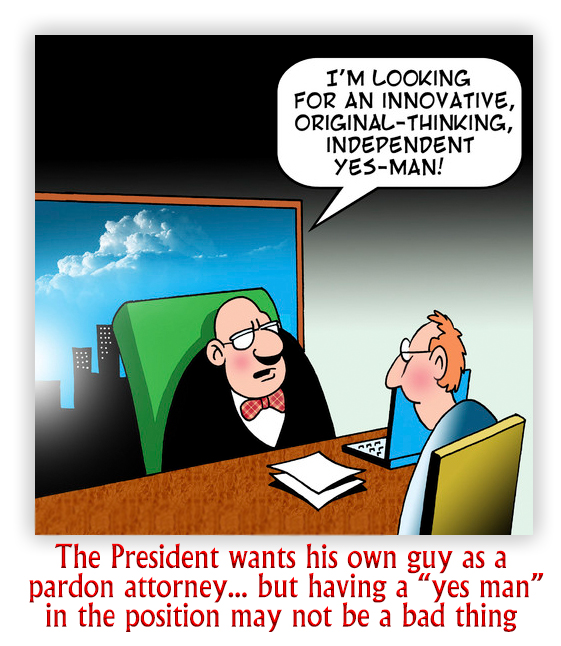
pardonme190123Focus on the First Step Act over the past six months has left President Trump’s push to reform clemency in the dark. Last week, however, The Atlantic published a proposal written by three prominent clemency advocates to revamp the process.

The two clemency processes now in use, law professors Mark Osler and Rachel Barkow, and Koch Industries general counsel Mark Holder argued, are the formal Dept. of Justice Pardon Attorney process and Trump’s much more informal celebrity-studded personal recommendation process.

Trump’s is informal: The president evaluates individual cases based on personal recommendations. The problem with the President’s system, the authors complain, is that it does not scale. Instead, it is a one-celebrated-case-at-a-time celebrity-driven approach, in which people with access to Trump lobby him in the Oval Office until he signs off.

But the DOJ process, the article contends, “isn’t any better. It courses through seven levels of review, much of it through a hostile… bureaucracy that tends to defer to local prosecutors who are, in turn, loath to undo the harsh sentences they sought in the first place. Indeed,” the authors observe, “the First Step Act passed in spite of DOJ opposition because those same prosecutors objected to lowering the mandatory minimum sentences that give them so much bargaining power.”

The articles cites some states as having better systems, including Arkansas, Connecticut, Georgia, and South Carolina. In those systems, an expert board – with people from criminal justice, social work, and psychology backgrounds, former judges, defense lawyers, prosecutors, and community activists – identify and evaluate clemency candidates.

obtaining-clemencyThe authors suggest that the President create a similar board of bipartisan clemency advisers who would work with a professional staff to identify cases for White House action. In 1975, President Gerald Ford impaneled an 18-member clemency board to help him with pardon requests from applicants charged with crimes related to avoiding the draft during the Vietnam War. That board was diverse and bipartisan, and ultimately recommended more than 13,000 pardons.

Trump convened a conference on revamp the clemency last summer, but nothing has come of it so far.

The Atlantic, The Clemency Process Is Broken. Trump Can Fix It (Jan. 15)

– Thomas L. Root

Loopholes Are Like the Tooth Fairy – Update for January 22, 2019

We post news and comment on federal criminal justice issues, focused primarily on trial and post-conviction matters, legislative initiatives, and sentencing issues.

CONFUSING WISHES FOR FACTS

I had the unpleasant task last week of telling a parent that her daughter had no procedural means of attacking her 6-year old conviction and sentence. The mother replied, ”But there has to be a loophole! There’s always a loophole!”

toothfairy190122Loopholes are like the Tooth Fairy. They’re fun to believe in, and pretending they exist is harmless enough. But you don’t want to factor the Tooth Fairy’s largesse into your retirement planning for one simple, very good reason. The Tooth Fairy doesn’t exist.

Likewise, contrary to the exclamation of my inmate’s mother, there does NOT have to be a loophole. Not confusing wishes for facts was the hard lesson Jason Lund learned last week.

In 2008, Jason got an enhanced sentence under 21 USC 841(b)(1)(A) because a death resulted from use of the drugs he was convicted of selling. But in 2014, the Supreme Court held in Burrage v. United States that finding a defendant guilty of the “death results” penalty requires proof that the harm would not have occurred in the absence of – that is, but for – the defendant’s conduct.

Jason filed a 2255 motion in 2016. But 28 USC 2255(f) sets strict deadlines for filing the motion, in this case one year from the date Burrage was decided or a year after discovering new evidence. Jason was well beyond both deadlines. But in 2013, the Supreme Court ruled in McQuiggin v. Perkins that if an inmate can show he or she is actually innocent, it “serves as a gateway through which a petitioner may pass whether the impediment is a procedural bar… or… expiration of the statute of limitations. Jason argued that the Burrage ruling made him actually innocent of the enhanced sentence, so his untimely filing did not matter.

Some of the people who say this really are. For others, it's just procedural...
Some of the people who say this really are. For others, it’s just procedural…

The actual innocence gateway exception is “grounded in the ‘equitable discretion’ of habeas courts to see that federal constitutional errors do not result” in innocent people being imprisoned. To establish actual innocence, a movant must show that it is more likely than not that no reasonable juror would have found him or her guilty beyond a reasonable doubt, if the new evidence or new legal holding were applied.

Last week, the 7th Circuit ruled that Jason was too late. It held that the actual innocence exception certainly does apply where a petitioner has new evidence, like DNA evidence, that proves him innocent. But “actual innocence” cannot be used to excuse untimely filing where a subsequent change to the scope of a law renders the conduct for which a movant was convicted to be no longer criminal.

The problem, the 7th said, was that Jason was trying to use Burrage both as his claim for actual innocence and his claim for relief on the merits. A petitioner’s actual innocence claim and claim for relief on the merits cannot be the same. If it could, “it would completely undermine the statute of limitations for bringing initial 2255 motions within one year from the date a new right is recognized by the Supreme Court.”

gateway190122The Court explained the actual innocence exception is merely a gateway through which a court can consider a petitioner’s otherwise barred claims on their merits. The whole idea is that a petitioner will have underlying claims separate from the actual innocence claim, and will use the actual innocence claim solely to excluse an untimely filing. The Supreme Court has not recognized a petitioner’s right to habeas relief based on a stand-alone claim of actual innocence.

The point of the exception, the Circuit said, is to ensure that federal constitutional errors do not result in innocent people being locked up. This suggests that the underlying claim must be a constitutional claim, rather than a statutory claim like Burrage.

Lund v. United States, 2019 U.S. App. LEXIS 1603 (7th Cir. Jan. 17,  2019)

– Thomas L. Root

First Step Rollout Already Behind Schedule? – Update for January 21, 2019

We post news and comment on federal criminal justice issues, focused primarily on trial and post-conviction matters, legislative initiatives, and sentencing issues.

COULD SHUTDOWN MESS WITH FIRST STEP ACT IMPLEMENTATION?

endshutdown190122The First Step Act sets July 19 as the hard deadline for adoption of a risk assessment system. That system is a precondition to the Bureau of Prisons beginning to grant earned time credit to inmates for programs that reduce recidivism.

But an even earlier deadline falls today, by which time the Dept. of Justice was to establish the committee tasked with creating the risk assessment system. The New York Times reported last week, however, that the Jan. 21 deadline would not be met, and no one still working at DOJ despite the shutdown will say when the committee will be formed.

No one is sure what happens if the risk assessment system is not in place by July 19. On the one hand, the deadline is written into the statute, so DOJ cannot ask for an extension. On the other hand, it is not clear who could sue or whether a court could effectively compel DOJ to meet the deadline.

Meanwhile, confusion continues to reign over the delay of the extra seven days of good time until July 19. “It absolutely makes no sense,” said Jack Donson, a former BOP case manager told the Times. Donson said the recalculation of good time should not have been linked to the new risk assessment system.

A staff member for Sen. Charles Grassley (R-Iowa), chairman of the Senate Judiciary Committee, said that the good-time effective date was inherited from a version of First Step passed by the House, and that Grassley was aware that questions had been raised about it.

While the staff member “wouldn’t necessarily characterize it as a drafting error,” he said Grassley “definitely has his eye on it and intends to keep working with the administration on a way forward.”

closed190122Meanwhile, the federal courts, which previously said their funds would run out on Jan. 18, announced last week that cost-cutting had extended the drop-dead date to at least Friday, Jan. 25. However, the Administrative Office of U.S. Courts warned that “at some point in the near future, existing funds will run out if new appropriated funds do not become available.”

If that happens, the courts will operate under the Anti-Deficiency Act, 31 USC 1341, which limits them to mission-critical work. In response to DOJ requests, some federal courts have issued orders suspending or postponing civil cases in which the government is a party, and others have declined to do so.

Criminal cases are expected to proceed uninterrupted.

New York Times, Shutdown Threatens to Delay Criminal Justice Reforms Signed Into Law by Trump (Jan. 16)

Administrative Office of U.S. Courts, Judiciary to Continue Funded Operations Until Jan. 25 (Jan. 16)

– Thomas L. Root

Shutdown Grinds on Federal Prisons – Update for January 18, 2019

We post news and comment on federal criminal justice issues, focused primarily on trial and post-conviction matters, legislative initiatives, and sentencing issues.

FEDERAL PRISON CONDITIONS NOT GOOD FOR STAFF OR INMATES AS SHUTDOWN CONTINUES

shutdown190118The partial government shutdown, about to enter its fifth week, has led to the furloughing of up to half of the BOP’s 36,000-person staff, including many who provide therapeutic programs and other services considered not to be “essential.” The agency is asking its remaining employees to keep working unpaid, focusing on maintaining security even if that’s not usually their primary job.

“It’s an absolute disaster,” said the president of the union chapter in Victorville, California, home to one of the nation’s largest concentrations of federal prison guards. “I have staff that are resorting to getting second employment – like Uber driving.”

Union officials reached by The Washington Post reported last week that the number of employees who are not showing up for work has at least doubled since the shutdown began. As a result, those showing up are routinely working double shifts, correctional officers and other prison staff members say. “There has been a rise in people calling in sick and taking leave during the shutdown,” said Richard Heldreth, president of the corrections officer union at Hazelton prison in West Virginia. “The staff who are showing up are dealing with this violence, long hours and extra overtime with the uncertainly of when we will be compensated.”

The BOP said only that the lack of funds from Congress means that only those employees whose duties involve “the safety of human life or the protection of property” are permitted to work.

The shutdown is having other consequences as well, including canceled visiting hours and empty commissary shelves. Also, applications of terminally-ill inmates awaiting “compassionate release” are going unread.

A more urgent problem, said Robert Hood, former warden of the ADMAX Florence, is the possibility of mental-health staff being furloughed. “Most BOP facilities will run without the myriad of programs normally offered” to address the needs of dangerous or mentally ill prisoners, Hood said.

emptyprison190118The U.S. courts are equally affected. Federal courts are funded only through next week. Beyond that, there is a likelihood of serious delays for many cases, but even experts and government officials are uncertain exactly how a prolonged shutdown might play out. The Administrative Office of the U.S. Courts (AOUSC) now says that federal courts can continue paid operations using “court fee balances and other ‘no-year’ funds” until Jan. 25.

If the court system runs out of reserves, according to AOUSC, the Anti-Deficiency Act kicks in. Involved parties can expect delays in discovery, briefing and other communications from the DOJ and other federal agencies.

Civil litigation, generally, will be the first casualty of the shutdown. Criminal cases will be prioritized, as they are matters of public safety, according to the Administrative Office. Every court will be affected, though it remains uncertain to what extent. Judges remain responsible for managing their cases, even during the shutdown, and will generally address stays, delays and important date changes on a case-by-case or district-by-district basis.

The Marshall Project, What the Government Shutdown Looks Like Inside Federal Prisons (Jan. 7)

Washington Post, Tensions rise in federal prisons during shutdown as weary guards go without pay and work double shifts (Jan. 10)

Law360, What Attorneys Need to Know About the Shutdown (Jan. 10)

Administrative Office of U.S. Courts, Judiciary to continue funded operations until Jan. 25 (Jan. 16)

– Thomas L. Root

BOP Guards Union Scams Media – Update for January 17, 2019

We post news and comment on federal criminal justice issues, focused primarily on trial and post-conviction matters, legislative initiatives, and sentencing issues.

THAT REALLY SUMPTUOUS CHRISTMAS STEAK BOP PRISONERS ENJOYED WAS FAKE NEWS…

Last week, we reported how NBC had run a story that inmates were eating shrimp and steak while making fun of the Federal Bureau of Prisons staff who were forced to serve the inmates without pay.

prisonfood190118It turns out that the story was not only fake (which our readers already knew), but it was successfully planted in the gullible national media by the correctional officers’ union.

Reason.com reported last week that in order to express their unhappiness with the federal shutdown, representatives of federal prison employee unions decided to act as though any tiny morsel of mercy granted to inmates is an insult to BOP employees:

While the holiday meals sound nice, the food prisoners receive every other day of the year is generally awful and frequently doesn’t contain enough nutrients to meet inmates’ dietary needs. But in order to make themselves look like the victims in this government shutdown, union officials shopped around a story to multiple media outlets about criminals being treated like kings while prison guards have to freelance as Uber drivers.

Lawandcrime.com reported that the “story appears to be largely based on information straight from the American Federation of Government Employees – the largest national correctional officers union. The story does not contain a firsthand quote from one single prisoner… [but] does provide ample opportunities for the president of the national prison workers union and the union chief at a federal prison in Florida to kvetch and moan about their employees being forced to feed inmates holiday meals.”

Reason.com reported that “many outlets ran with this tale in exactly the form union reps likely preferred. Over at USA Today, Kevin Johnson described these meals as a “display of culinary largesse.” Cleve Wootson, Jr., at The Washington Post called it an example of the “hypocritical” or “ironic” moments of the federal shutdown.

prisonfoodA190118NBC’s reporting included guards and union representatives describing it as “despicable” that inmates received a holiday meal. NBC described the letters and complaints it cited as having been mysteriously “obtained,” despite the fact that a Florida BOP union leader was quoted in all of these stories, suggesting that the union “shopped” the story to reporters like a normal PR pitch.

The union leader provided the media outlets with the contents of two inmate emails talking about the meal, which Reason said had been obtained from BOP staff who had screened the emails. the emails were “obtained” by prison staff who screened the emails.

Prison staff are on record complaining that inmates are still getting paid for their prison work. Reason notes that “inmates typically make pennies per hour. And unlike [COs], these inmates cannot find better working conditions elsewhere.”

Reason.com., Prison Guards Orchestrate Media Campaign to Complain About Inmates Getting Edible Food for Christmas (Jan. 7)

Lawandcrime.com, Viral Story About Prisoners’ Holiday Meals During Shutdown Reeks of Propaganda (Jan. 7)

– Thomas L. Root