We post news and comment on federal criminal justice issues, focused primarily on trial and post-conviction matters, legislative initiatives, and sentencing issues.
6TH CIRCUIT HOLDS THERE’S NO EXCUSING EXHAUSTION UNDER COMPASSIONATE RELEASE
The 6th Circuit ruled last week that 18 USC § 3582(c)(1)(A)’s requirement that an inmate first ask the warden to recommend compassionate release, and then either exhaust remedies or wait 30 day before going to court is a “mandatory claims-processing rule” that cannot be waived because of emergency.
Ever since the start of the COVID-19 pandemic in March, the volume of motions filed with federal courts seeking compassionate release has skyrocketed. The statute requires that a prisoner may file the motion with his or her sentencing court only “after the defendant has fully exhausted all administrative rights to appeal a failure of the Bureau of Prisons to bring a motion on the defendant’s behalf or the lapse of 30 days from the receipt of such a request by the warden of the defendant’s facility, whichever is earlier…” A large number of filers skipped that requirement, arguing to their courts that they should be allowed to skip the administrative exhaustion requirement, because the COVID-19 dangers make every second count.
To be sure, the exhaustion requirement makes no sense. First, the notion that anyone can navigate the BOP’s three-level administrative remedy process in under six months is fantasy. The agency not only has 20 to 40 days to respond at each level, but the rules entitle the BOP to automatic extensions of time. An inmate has fair winds and following seas if he or she can push an administrative remedy to conclusion in six months.
Second, the old compassionate release statute permitted only the BOP to file motions for compassionate release on behalf of inmates. Congress became so irked at the BOP’s chary use of its power that in the First Step Act, it granted inmates the right to file themselves. But in order to let the BOP salvage a shred of honor from its stripping the BOP of its sole authority to make such motions, Congress offered the BOP a fig leaf of what is essentially a right of first refusal.
But the odds that the BOP is any more likely to bring such motions now than at any time in the past are really long. That makes the requirement that an inmate make a request to the warden and then wait 30 days little more than a pointless ritual.
No matter. Congress wrote it the way it wrote it, and anyone who recalls those hectic days in December 2018 pushing First Step to fruition should not be surprised that the 149-page bill is somewhat less pellucid that the Declaration of Independence.
Last week, the 6th Circuit held that the exhaustion requirement of the statute means what it says, and that court-made “equitable carveouts” to its terms – including the excuse that the request is an emergency – make no sense. “Remember that Congress made compassionate release available only to elderly prisoners and those with “extraordinary and compelling” reasons for release. For such prisoners, time usually will be of the essence. That would make nearly every prisoner eligible to invoke ‘irreparable harm’ and eligible to jump the line of applications — making the process less fair, not more fair.”
We post news and comment on federal criminal justice issues, focused primarily on trial and post-conviction matters, legislative initiatives, and sentencing issues.
THREE WINS AND A LOSS AT THE 6TH CIRCUIT
On the third try, the Federal Bureau of Prisons finally succeeded in getting a higher court to issue a stay in the FCI Elkton (Ohio)habeas corpus/8th Amendment case, stopping for the moment the U.S. District Court for the Northern District of Ohio’s injunction demanding that the BOP identify and either transfer or release medically vulnerable inmates.
On Tuesday, the U.S. Court of Appeals for the Sixth Circuit ruled that the preliminary injunction – which can only issue if a moving party can show irreparable harm and likelihood that it will succeed on the merits of the case – should be set aside. This does not mean that the inmate plaintiffs in the class action cannot win, but I suspect the BOP is betting that time (and attrition of the medically vulnerable inmates, as one after another comes down with COVID-19), will render the whole lawsuit moot before it’s done.
Technically, the lawsuit is a petition for writ of habeas corpus, addressed to unconstitutional conditions of confinement. The remedy in a habeas action is release of the prisoner or abatement of the unconstitutional condition. Here, the prisoners claimed that the BOP was violating the 8th Amendment, exacting “cruel and unusual punishment” by the Elkton administration’s “deliberate indifference” to a deadly medical condition, COVID-19.
In a 2-1 decision, the 6th Circuit panel struck down the district court’s order to thin the ranks of the 2,000 inmates at Elkton (located in Lisbon, Ohio, about 65 miles southeast of Cleveland), where more than a quarter have tested positive for the coronavirus and 19 inmates have died. U.S. District Judge James Gwin ruled in April that the administration was not doing enough to protect inmates, and ordered that the BOP transfer or release elderly or medically compromised prisoners.
“Deliberate indifference” has two components, one objective and one subjective. The Circuit ruled that while the plaintiffs had shown that objectively, COVID-19 was a genuine medical danger at the facility, they were unlikely to prove that the steps the BOP had taken as of April 22 — such as screening for symptoms, limiting visitation, increasing cleaning and providing masks — were insufficient to raise the administration’s response above the “deliberate indifference” standard. The majority on the panel agreed that the BOP’s “actions show it has responded reasonably to the risk posed by Covid-19 and that the conditions at Elkton cannot be found to violate the Eighth Amendment.”
Chief Judge R. Guy Cole Jr. dissented, writing that he was “left with the inescapable conclusion that the BOP’s failure to make use of its home confinement authority at Elkton, even as it stared down the escalating spread of the virus and a shortage of testing capacity, constitutes sufficient evidence for the district court to have found that petitioners were likely to succeed on their Eighth Amendment claim.”
Inmate advocates were disappointed with the ruling, but I think there were three wins in the decision for inmates. First, the BOP has argued in this case as well as in other pending cases elsewhere that inmates could not proceed on habeas corpus, but instead had to use a cumbersome procedure that would not have permitted as a remedy the release of inmates. The Court roundly dismissed this argument, holding that the claim being made can proceed on a 28 USC § 2241habeas corpus petition.
Second, the Court swept aside BOP arguments that the inmates had to “exhaust” administrative remedies under the Prison Litigation Reform Act. This would have required each inmate plaintiff to file administrative remedies to the warden, then the regional BOP office, and final with the BOP in Washington, a cumbersome and largely futile procedure that would have consumed six months before a suit could even be brought.
Finally, the Court held that
“petitioners have provided evidence that they are ‘incarcerated under conditions posing a substantial risk of serious harm.’ The COVID-19 virus creates a substantial risk of serious harm leading to pneumonia, respiratory failure, or death. The BOP acknowledges that ‘[t]he health risks posed by COVID-19 are significant.’ The infection and fatality rates at Elkton have borne out the serious risk of COVID-19, despite the BOP’s efforts. The transmissibility of the COVID-19 virus in conjunction with Elkton’s dormitory-style housing—which places inmates within feet of each other—and the medically-vulnerable subclass’s health risks, presents a substantial risk that petitioners at Elkton will be infected with COVID-19 and have serious health effects as a result, including, and up to, death. Petitioners have put forth sufficient evidence that they are ‘incarcerated under conditions posing a substantial risk of serious harm’.”
This is a powerful foil to the government’s oft-repeated claim in opposing compassionate release motions that the BOP is adequately meeting inmate medical needs despite COVID-19, and that there is thus no need to protect vulnerable inmates by compassionate release under 18 USC § 3582(c)(1). In other words, the 6th said that the BOP was trying, but that it was not succeeding.
That may save the BOP from 8th Amendment claims – at least at the preliminary stage of litigation such as the Elkton case – but it refutes any government claim that no one needs to go home, because the BOP is keeping everyone safe.
Wilson v. Williams, Case No. 20-3447, 2020 U.S. App. LEXIS 18087 (6th Cir. June 9, 2020)
We post news and comment on federal criminal justice issues, focused primarily on trial and post-conviction matters, legislative initiatives, and sentencing issues.
COVID-19 ROUNDUP
Talk about illness… Everyone’s sick to death about COVID-19 talk. But wishing it gone is a little bit different than having it gone. That’s somewhat the problem that the Federal Bureau of Prisons has with the coronavirus in general, and that BOP Director Michael Carvajal has with it in particular.
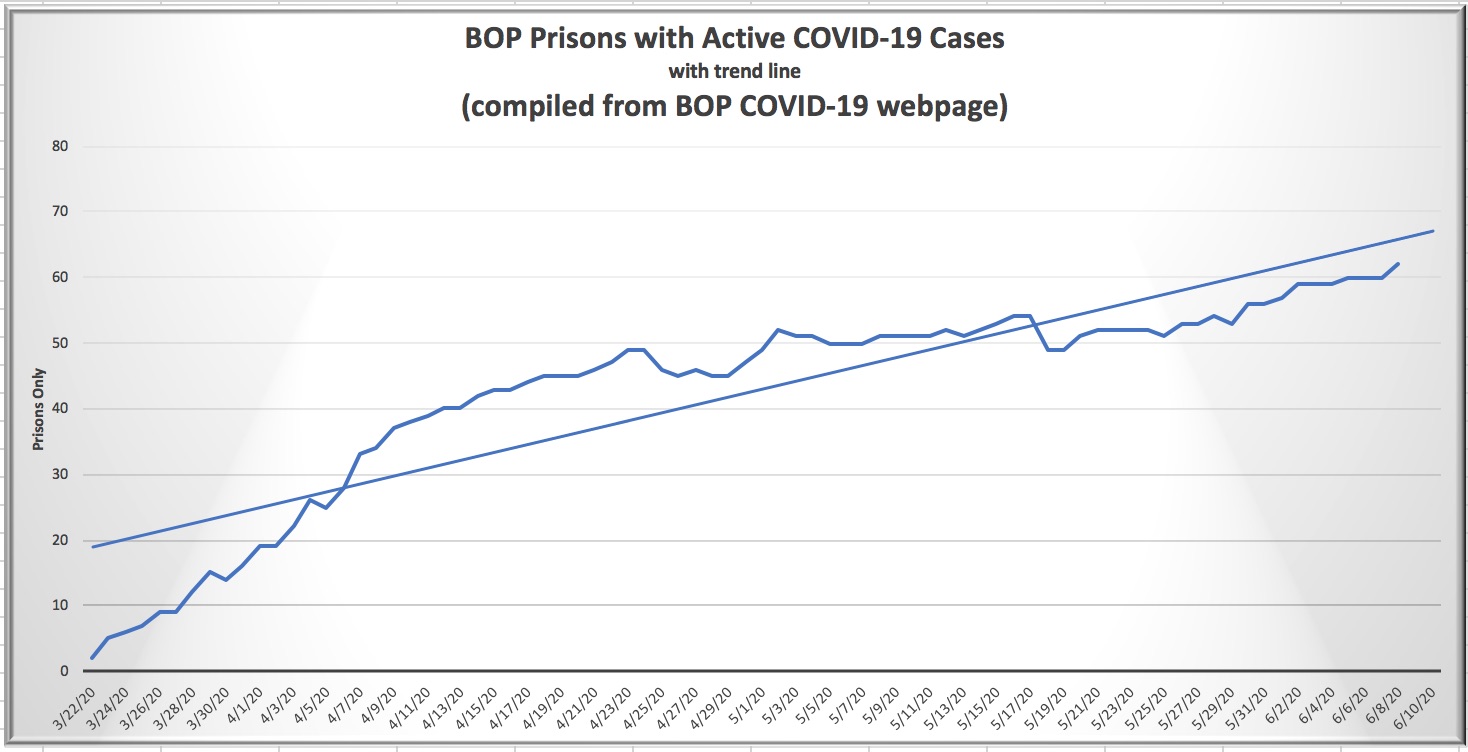
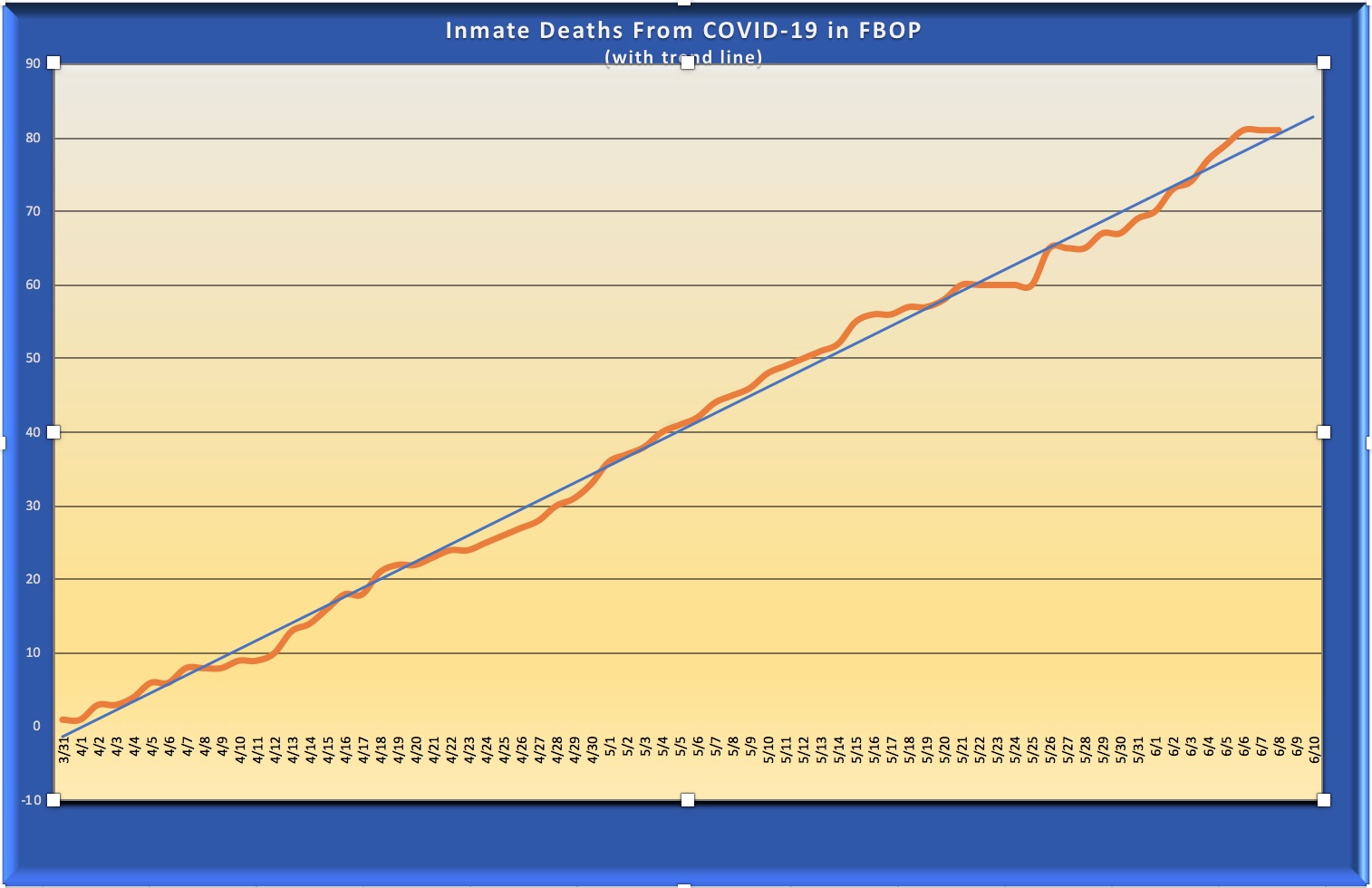
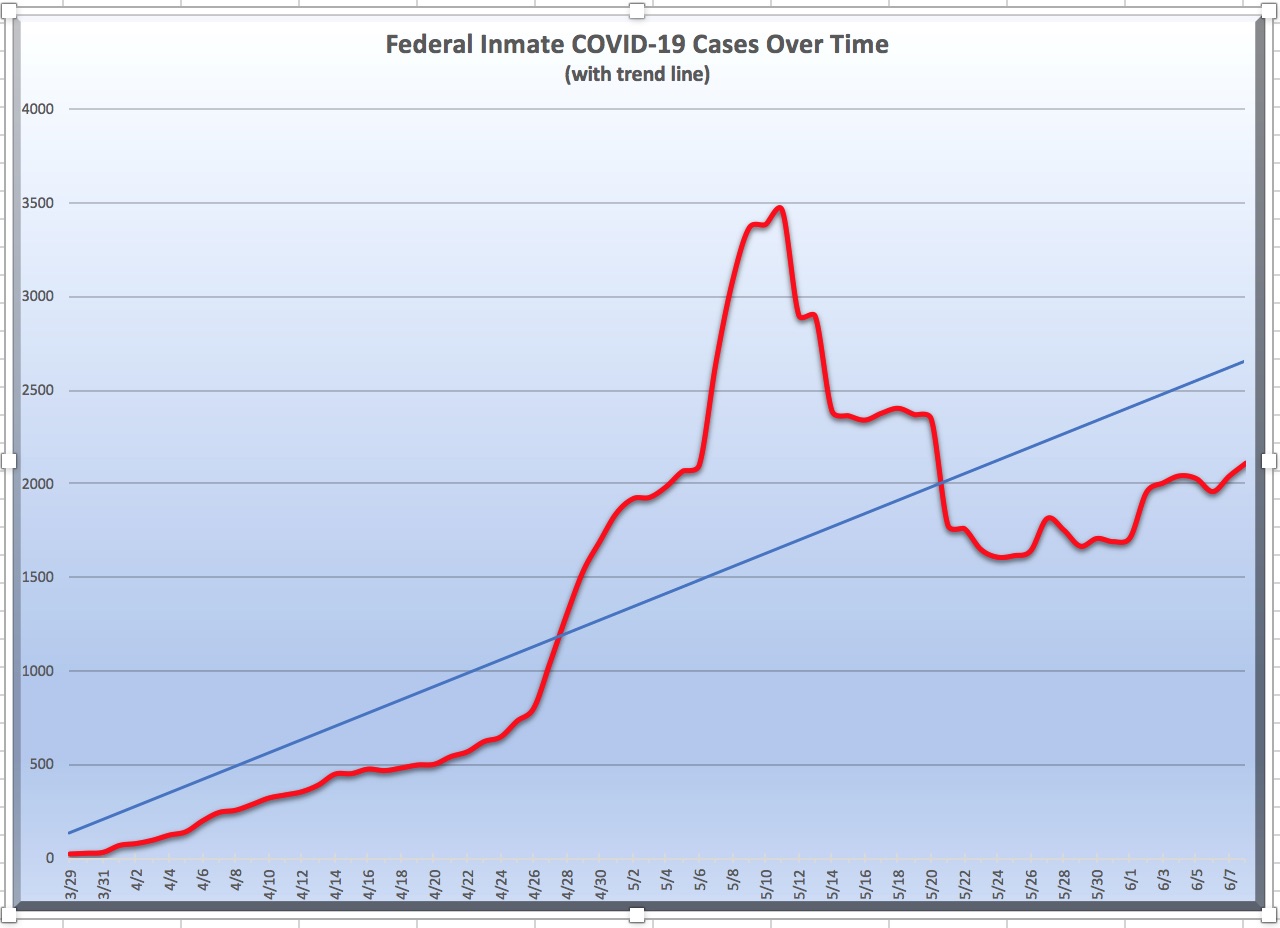
The BOP’s active coronavirus count jumped 23% this past week, from 1,710 sick inmates on June 1 to 2,109 yesterday. Staff infection ticked up from 171 to 185, and the number of BOP facilities reporting the virus jumped 7%, from 57 to 62. Cumulative inmate COVID-19 deaths increased last week from 70 to 81.
The numbers keep ticking up, and – what’s worse – at the same pace. Nevertheless, when the Senate Judiciary Committee held a hearing a week ago today, Director Carvajal told the senators that “at this point, we have more recoveries than new infections. I believe that this shows that we are now flattening the curve.”
That’s not what flattening the curve means. “Flattening the curve” means to stagger the number of new infections over a longer period of time, although I suppose that eventually – when the BOP runs out of inmates yet to be infected – the curve will necessarily flatten when there’s no one left to get sick. But whatever else is happening, the BOP’s curve is not flattening.
Something else that’s not happening is a decrease in inmate class actions against the BOP. Those are proceeding apace around the country:
Massachusetts: A class of inmate plaintiffs who had conditions identified by the Centers for Disease Control and Prevention that heightened their risk for contracting COVID-19 or having a worse outcome from it (the “medically vulnerable”) sued the Federal Medical Center at Devens, Massachusetts, seeking proper and complete home confinement relief from the administration there. The Massachusetts federal district court denied the inmates an emergency injunction in May, but they asked for reconsideration last week. The court had denied the injunction in part because there had only been a single COVID-19 case at Devens when the injunction was denied. But since then, 24 inmates have been diagnosed as having the virus.
The injunction was also denied because the BOP had convinced the judge that it was “immediately reviewing all inmates who have COVID-19 risk factors… to determine which inmates are suitable for home confinement.” But then Devens’ warden, testifying in a different proceeding last month (one seeking compassionate release for an inmate), admitted that medical vulnerability to COVID-19 has not been considered a factor by the Devens front office in its compassionate release decisions, and that Devens refuses to transfer any prisoner to home confinement due to COVID-19, regardless of age or medical vulnerability, until the prisoner has served at least 50% of his sentence or at least 25% of his sentence with under 18 months left to serve.
The judge who originally heard the warden’s testimony in the compassionate release action found the policy to be “utterly inconsistent” with the Attorney General’s direction to maximize the use of home confinement as a tool to combat COVID-19, leaving “at-risk inmates who are not being individually assessed for release. And some of them may get very sick. Some of them may die.”
That reconsideration motion is pending.
Connecticut:In litigation over FCI Danbury, the judge has ordered the parties to give inmates a release form that would let the court release their presentence reports to the plaintiffs’ lawyers. The plaintiffs say access to the PSRs – which include a section on the defendants’ medical conditions – would help inmates vulnerable to the virus.
New York:U.S. District Judge Edgardo Ramos was preparing to rule on an inmate motion for injunction after a doctor tasked with inspecting MCC New York issued a scathing report proclaiming basic sanitation and virus screening failures. In a May 26 filing, Dr. Homer S. Venters criticized poor inmate screening and concluded that the prison has “ignored” signs that the virus may be widespread. Dr. Venters also reported a lack of access to basic sanitation, including soap. and he saw evidence that the facility is “widely infested with mice and roaches.”
Ohio:The FCI Elkton injunction came to a screeching halt after the BOP went back to the Supreme Court last week and this time convinced Associate Justice Sonia Sotomayor to grant its stay request. The Northern District of Ohio injunction issued by Judge James Gwin is now on hold, pending an appeal to the 6th Circuit Court.
North Carolina: An inmate suit over conditions at the several prisons making up the Butner Federal Correctional Complex, like the ones in Massachusetts, Ohio and Connecticut, seeks a court order that the Butner administration accelerate home confinement and compassionate release due to the rampant coronavirus at Butner (which has 571 active inmate cases and 18 deaths).
The BOP has moved to dismiss the suit, arguing that things are not as bad as the plaintiffs say they are because a lower percentage of infected inmates are dying than victims in the general public. Yesterday, the inmates replied,
More than 900 men incarcerated at Butner—almost 21 percent of Butner’s population—have tested positive for the virus that causes COVID-19. Nineteen people (including a BOP staff member) have died1—far more than at any other BOP facility. Half of those deaths happened in the 13 days since Petitioners filed this lawsuit. Infections and deaths are rapidly rising. The situation gets worse by the day.
Despite these harrowing and undisputed facts, Respondents contend that “FCC Butner’s efforts have been effective in managing infections and treating inmates.” Because they have purportedly taken some steps to mitigate the spread (however ineffective and late), Respondents argue their response to this deadly outbreak cannot possibly be deemed constitutionally defective. But that is not the law.
California: The inmates in a habeas corpus action against FCI Terminal Island and FCC Lompoc have asked the Central District of California federal court to order “a highly expedited process — for completion within no more than 48 hours — for BOP to use procedures available under the law to review members of the Class for enlargement of custody… in order to reduce the density of the prison population… and subsequently ordering the release of those granted temporary enlargement.” Separately, the complaint requests injunctive relief under the 8th Amendment to order improved conditions for all prisoners remaining at the institutions in the form of social distancing and provision of hygiene products.
(The May 10 spike represented the explosion of cases at FCI Terminal Island)
The BOP has moved to dismiss the California suit for the same reasons it has raised elsewhere, that the court lacks the power to grant the asked-for relief and that the plaintiffs have not exhausted remedies. The court should decide the issue this week.
Grinis v. Spaulding, Case No 1:20cv10738 (D. Massachusetts)
Martinez-Brooks v. Easter, Case No 3:20cv569 (D Connecticut)
Hallinan v. Scarantino, Case No 5:20hc2088 (Eastern District of North Carolina)
Wilson v. Williams, Case No 4:20cv794 (Northern District of Ohio)
Fernandez-Rodriguez v. Licon-Vitale, Case No 1:20-cv-03315 (Southern District of New York)
Wilson v. Ponce, Case No 2:20cv4451 (Central District of California)
We post news and comment on federal criminal justice issues, focused primarily on trial and post-conviction matters, legislative initiatives, and sentencing issues.
LAWMAKERS’ QUESTIONS ABOUT BOP HOME CONFINEMENT ARE GETTING SHARPER
Congressional lawmakers last week started raising questions about the Federal Bureau of Prisons’ release of high-profile inmates, and began calling for widespread testing of federal inmates as the number of coronavirus cases has exploded in the federal prison system.
Sen. Kamala Harris and Rep. Hakeem Jeffries sent a letter Monday to Attorney General William Barr and BOP Director Michael Carvajal over the Bureau’s use of its CARES Act home confinement authority. The CARES Act permits the BOP essentially to designate an inmate’s home as his or her prison, and to send the inmate home for as much of his or her remaining sentence as the BOP wishes. This authority lasts as long as there is a national emergency declared by the President (read “pandemic”).
Citing the release of former Trump campaign chairman Paul Manafort and former Trump lawyer and fixer Michael Cohen to home confinement, the Harris/Jeffries letter said “these examples make clear that there are two systems of justice in our country – one for President Trump and his associates, and another for everyone else. These examples also heighten our concern about the politicization of the Department of Justice.”
The letter demanded to know whether the White House played any role in the release of Manafort or Cohen, and wanted a list of “each official at DOJ and BOP who considered and/or cleared Paul Manafort’s transfer to home confinement.” The lawmakers wrote, “As President Trump’s associates are cleared for transfer, tens of thousands of low-risk, vulnerable individuals are serving their time in highly infected prisons.”
Regular readers of this blog may be forgiven for thinking that the writer is no fan of the ham-handed management at the BOP, but despite this, the Cohen release has gotten a bad rap. The BOP announced that its standards for release of vulnerable inmates included a requirement that they have completed either 50% of their sentences, or 25% of their sentences and have fewer than 18 months remaining.
You may recall that Cohen (like many inmates) was identified as being a home confinement candidate in April. Then he was taken off the list, only to be relisted in late May. When that happened, I did the math. He had done well less than half his sentence, but he had done more than 25%, and he was within 18 months of release as of May 22, 2021. Type his name into the BOP website, and see whether I am wrong.
Of course, last time I checked, Trump is no Cohen fan. Why Harris and Jeffries would think the White House threw him a life ring on early release boggles the mind. Manafort – who had years to go on his sentence and was well under 50% done – is another matter.
The BOP has disputed that it is giving any preferential treatment to high-profile inmates and has said it has placed 3,544 inmates on home confinement since Barr first issued a memo ordering an increase in the use of home confinement in late March. However, as AP reported last Monday, “the response from the Bureau of Prisons on the coronavirus has raised alarm among advocates and lawmakers about whether the agency is doing enough to ensure the safety of the about 137,000 inmates serving time in federal facilities.”
At a Senate Judiciary Committee hearing last Tuesday, Carvajal was grilled by senators over whether minority inmates and those with fewer connections were receiving similar treatment to Manafort in being sent home.
Carvajal said the BOP has transferred more than 3,500 inmates to home confinement since the CARES Act passed. In response to questioning, he explained the BOP began by identifying 27,000 inmates with at least one COVID-19 risk factor. Only about 4,000 of those qualified for home confinement under Attorney General William Barr’s March and April memos. When the BOP decided to include those with only minor disciplinary problems in the last year, the number rose to 5,300.
Sen. Cory Booker (D-New Jersey) demanded a breakdown of the demographics of people BOP has approved for transfer to home confinement, saying he is concerned racial bias might be impacting the decisions, including in the application of PATTERN. Carvajal did not provide the demographic data at the hearing, but he assured Booker with the sincerity of a bureaucrat that the BOP administration is taking that concern seriously, and that home confinement approval data tracks with the demographics of the federal prison population.
We’ll see if any data are released to support that platitude.
We post news and comment on federal criminal justice issues, focused primarily on trial and post-conviction matters, legislative initiatives, and sentencing issues.
WHACK-A-MOLE
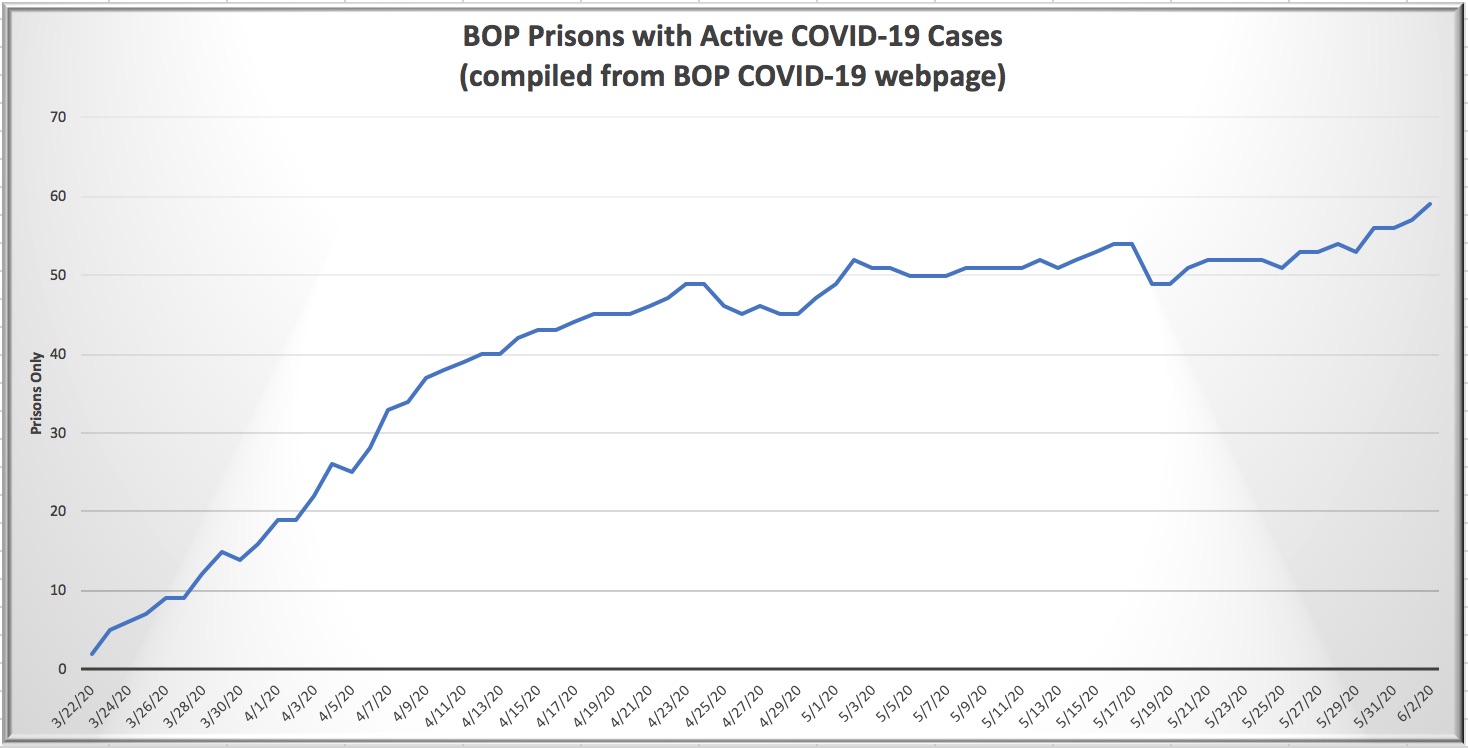
The BOP, in the new “normal” for COVID-19, is playing “whack-a-mole” with fresh coronavirus outbreaks at facilities that had been COVID-19 free a few weeks ago, as well as increasing illness numbers at institutions that had seemed to be on the mend, The number of inmate COVID-19 cases last night (1,954) is up about 8 percent from a week ago (1,813). Inmate deaths increased from 65 a week ago to 73. But ominously, the number of BOP facilities with COVID-19 cases hit 59 yesterday, an all-time high (and up from 53 a week ago).
New COVID-19 breakouts were reported for FCI Talladega and FMC Devens, to note two facilities. Both had reported infections a month before but were later cleared.
Perhaps more ominous, an FCI Terminal Island inmate died last week after the BOP had earlier said the man had recovered from the illness. Adrian Solarzano tested positive for the virus on April 16 and was placed in isolation. The Los Angeles Times said the BOP deemed him “recovered” on May 10 after he no longer showed symptoms. But five days later — on May 15 — Solarzano was admitted to a hospital after complaining of chest pain and anxiety. He was tested twice for COVID-19, and authorities said both results were negative. But his condition worsened, and he was pronounced dead by hospital staff Sunday.
Meanwhile, the Anchorage Daily News reported that an Alaska man granted compassionate release from FCI Terminal Island, which still has 32 inmates and four staff ill, tested positive one day before his release. The BOP put him on a commercial flight to Anchorage, without ever telling him he had the virus.
The inmate’s lawyer says a chain of misfires allowed the BOP to swab the inmate for testing on May 5, get positive-for-the-virus lab results on May 7, and release him to fly home commercially on May 8. “There are so many institutional failures you can identify in this,” said Daniel Poulson, a federal public defender who represented the inmate on his compassionate release motion.
A class action lawsuit – looking a lot like successful suits brought in Connecticut about FCI Danbury and Ohio on FCI Elkton – was filed May 26 on behalf of the inmates at the several prisons that are part of the Butner, North Carolina, complex. The suit, Hallanan v. Scarantino, was brought by prisoners represented by the American Civil Liberties Union, the ACLU of North Carolina, the Washington Lawyers’ Committee for Civil Rights and Urban Affairs, and the law firm of Winston & Strawn.
The action seeks an injunction ordering Butner to release or transfer vulnerable prisoners, and alleges that Butner officials “have not taken the necessary steps to address the risk faced by the people in their custody. They have opposed motions for compassionate release, and they have failed to order furloughs or transfers to home confinement with sufficient speed and in sufficient numbers. They have failed to make other arrangements within the facility to allow for adequate physical distancing. And they have failed to implement effective isolation, quarantine, testing, screening, hygiene, and disinfecting policies or meaningfully modify movement protocols for staff and incarcerated people.”
Meanwhile, the Intercept reported last week that while BOP’s COVID-19 numbers included 230 halfway house residents at 42 RRCs, it “is clear is that the real number of residents with Covid-19 in federal halfway houses is higher than what appears on the BOP website.” The Crime Report reported that because some halfway houses receive a per diem rate based on the daily population at a given facility, the contractors “have an incentive to keep halfway houses as full as possible. Critics blame such financial incentives for a reluctance to send more people home during the pandemic.”
But despite all of the foregoing, everything in the BOP is hunky-dory. Just ask BOP Director Michael Carvajal, who yesterday testified before the Senate Judiciary Committee that
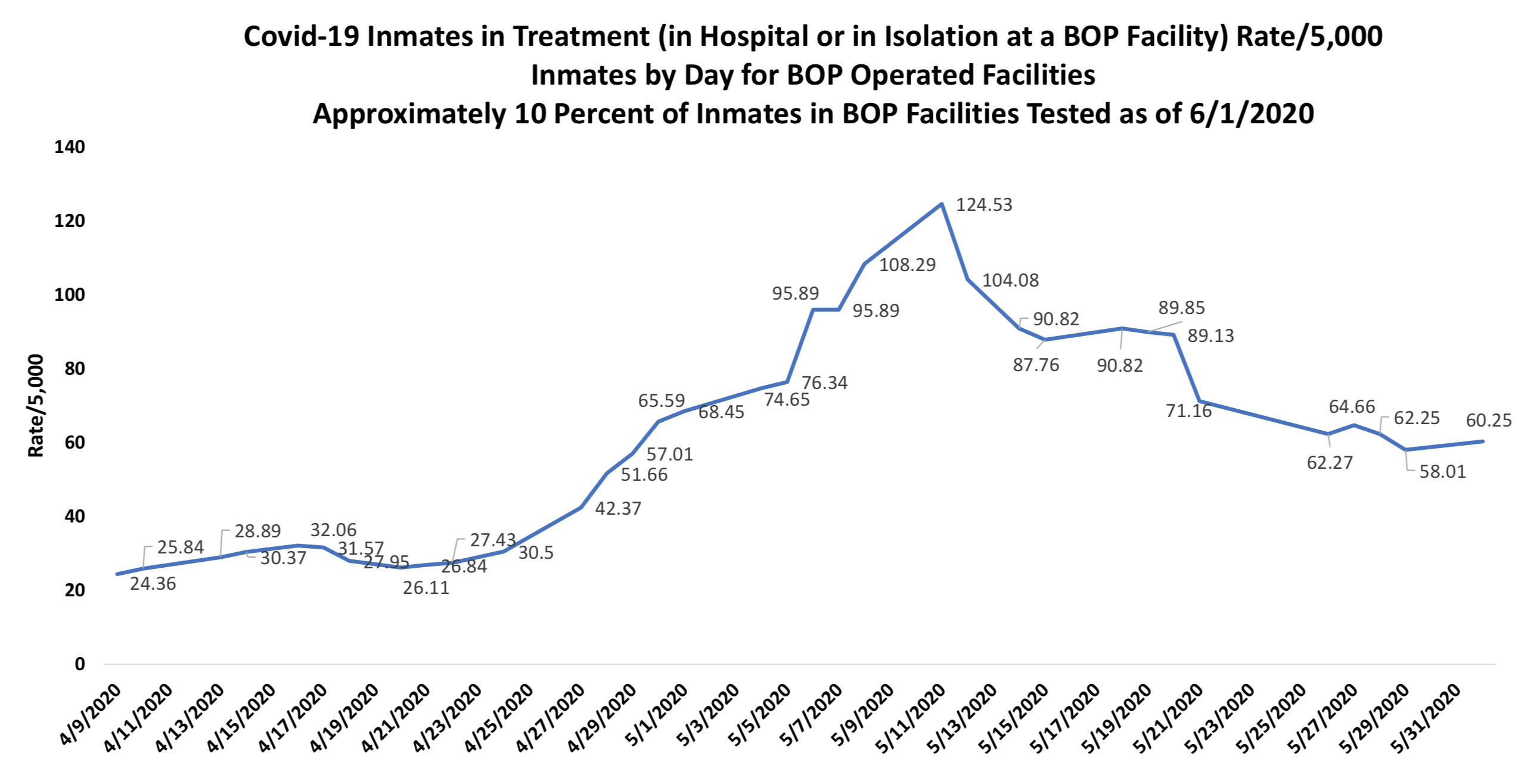
In total, from March 1, 2020, the date of the beginning of the national emergency proclaimed by President Trump, until today, 5,323 inmates total have tested positive for COVID- 19 and to-date, 3,784 have recovered. More than 80 percent of infected individuals have not become significantly ill. The number of hospitalized inmates – those who became significantly ill – is currently only 83 in total. And in fact, the number hospitalized is on a significant downward trajectory (see attached), suggesting that our attempts to mitigate the transmission of the virus is effective.
(I added the bold-face for emphasis). The attached graph:
But the fact that 80% of the inmates have not become significantly ill suggests very little (other than good fortune). More telling is that so far, only 10% of the inmate population has been tested for COVID-19. At the same time, the number of BOP facilities at which the virus is present keeps climbing:
The only certainty is that while the BOP bungles at institutions like Oakdale, Elkton, Danbury, Butner, Fort Worth and Terminal Island go on, the Director and his PR machine will continue to publicly proclaim, “In response to the COVID-19 pandemic, the Bureau has taken, and will continue to take, aggressive steps to protect the safety and security of all staff and inmates, as well as members of the public.”
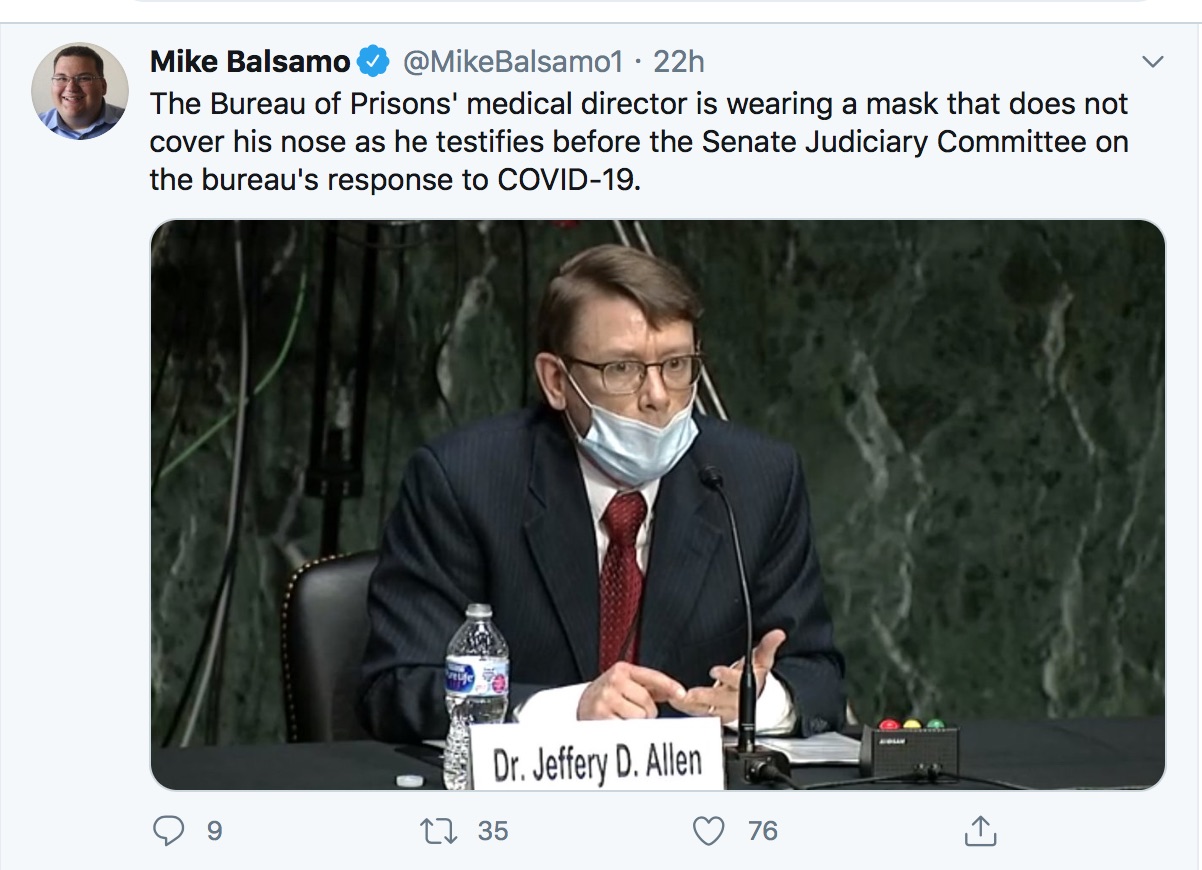
A parenthetic note: It is doubtful that the BOP’s Medical Director installed much confidence in the members of the Judiciary Committee at yesterday’s hearing. During his testimony, according to Associated Press reporter Mike Balsamo, he wore his face mask incorrectly:
We post news and comment on federal criminal justice issues, focused primarily on trial and post-conviction matters, legislative initiatives, and sentencing issues.
SUPREME COURT HOLDS 59(e) MOTION IS NOT A SECOND BITE OF THE HABEAS APPLE
For the last 2 years, prisoners seeking one final whack at the lawfulness of their convictions or sentences have had to contend with the limitations of a law known by the mouthful “Antiterrorism and Effective Death Penalty Act of 1996.”
Even the name of the Act is strange. No one can be opposed to “antiterrorism.” Well, almost no one. But “effective death penalty?” I suppose an effective death penalty is one that leaves you dead. But what Congress was getting at here was a means of limiting what some lawmakers thought were endless habeas corpus actions brought by the condemned, so that their date with the Grim Reaper could be delayed as long as possible. The AEDPA was intended to limit such collateral attacks, so that execution was more likely to kill the prisoner than old age.
But the practical effect of the AEDPA was to severely limit the right of prisoners to the federal writ of habeas corpus. The Act set hard time limits on filing motions under 28 USC 2254 (for state prisoners seeking federal habeas relief) and 28 USC 2255 (for federal prisoners), and – important for today’s topic – the right to bring a second 2254/2255 motion after the first one has been decided.
There was a time when a prisoner could file as many 2254 or 2255 motions (known as “second-or-successive” motions) as a court would accept before concluding that the prisoner was “abusing the writ.” But the AEDPA turned the equitable and flexible “abuse of the writ” doctrine into a rigid statutory rule. Now, a prisoner seeking to file a second-or-successive 2255 motion must first get permission to do so from the court of appeals, and the circumstances under which permission can be granted are tightly circumscribed by 28 USC 2244.
But water seeks and finds its own level, and in the wake of the AEDPA’s passage, crafty prisoners filed all manner of other motions instead of second-or-successive 2255s. They would file petitions for writs of mandamus or error coram nobis or audita querela, or Rule 60(b) motions, or civil actions. The courts would whack down the efforts as fast as the prisoners filed them, holding that a motion by any other name was in effect a second-or-successive 2255 if it attacked the conviction or sentence in some manner.
In civil procedure, a motion brought under Federal Rule Civil Procedure 60(b) asks a court to set aside a judgment that is already final, based on any of a variety of reasons (the favorite one probably being due to newly-discovered evidence). Rule 60(b) quickly became an inmate favorite, letting the movant try to reopen a former 2255 proceeding well after the fact because of evidence of some new constitutional violation or even just more evidence on an issue already raised and lost. In 2005, the Supreme Court ruled in Gonzalez v. Crosby that such a motion was really a second-and-successive 2255 prohibited by the AEDPA unless the motion was solely addressed to some infirmity in the 2255 proceeding itself.
Fast forward 15 years to yesterday. Texas prisoner Greg Banister lost his 28 USC 2254 proceeding, in which he challenged his state conviction in federal court after losing in all of the Texas courts. He lost in front of the federal district judge, too, but – having access to both a book of federal civil rules and a typewriter – Greg promptly filed a motion to alter or amend the judgment under Federal Rule of Civil Procedure 59(e). Rule 59(e) gives a party one more chance to convince the district court it was wrong in its judgment, and it stops a judgment from becoming final as long as it was filed on time and remains pending.
The federal judge, not any more impressed by Greg’s Rule 59(e) motion than it had been by the underlying 2254 petition, denied the motion. Greg then filed his notice of appeal. However, the district court ruled that the Rule 59(e) motion had really been a second-or-successive 2254 motion over which the court had no jurisdiction. Therefore, the court said, the Rule 59(e) motion had not kept the court’s judgment from becoming final the day it was entered, and that meant that Greg’s notice of appeal – which would have been timely if Greg’s Rule 59(e) filing had stayed finality of the judgment – was late.
The Fifth Circuit agreed with the trial judge. Thus, Greg was denied his appeal.
Yesterday, the Supreme Court reversed the decision. Justice Kagan, writing for a 7-2 court, observed that the case “is about two procedural rules. First, Rule 59(e) applies in federal civil litigation generally. (Habeas proceedings, for those new to the area, are civil in nature)… The Rule enables a party to request that a district court reconsider a just-issued judgment. Second, the so-called gatekeeping provision of the… AEDPA, codified at 28 USC §2244(b), governs federal habeas proceedings. It sets stringent limits on second or successive habeas applications.”
The Supreme Court observed that even under the old “abuse of the writ” standard, courts had historically considered Rule 59(e) motions filed in habeas corpus cases on their merits. Plus, a prisoner may invoke Rule 59(e) only to request “reconsideration of matters properly encompassed” in the challenged judgment. And, the Court said, “’reconsideration’ means just that: Courts will not entertain arguments that could have been but were not raised before the just-issued decision. A Rule 59(e) motion is therefore backward-looking; and because that is so, it maintains a prisoner’s incentives to consolidate all of his claims in his initial application.”
As well, the Rule consolidates appellate proceedings. “A Rule 59(e) motion briefly suspends finality to enable a district court to fix any mistakes and thereby perfect its judgment before a possible appeal,” Justice Kagan wrote. “The motion’s disposition then merges into the final judgment that the prisoner may take to the next level. In that way, the Rule avoids ‘piecemeal appellate review’… Its operation, rather than allowing re-peated attacks on a decision, helps produce a single final judgment for appeal.”
The Court contrasting the speed and efficiency of a Rule 59(e) motion with a Rule 60(b) motion, which can be filed years after the judgment. The availability of a Rule 60(b) motion “threatens serial habeas litigation; indeed, without rules suppressing abuse, a prisoner could bring such a motion endlessly. By contrast, a Rule 59(e) motion is a one-time effort to bring alleged errors in a just-issued decision to a habeas court’s attention, before taking a single appeal. It is a limited continuation of the original proceeding—indeed, a part of producing the final judgment granting or denying habeas relief. For those reasons, Gonzalez does not govern here.”
Banister v. Davis, Case No. 18–6943, 2020 U.S. LEXIS 3037 (Supreme Court, June 1, 2020)
We post news and comment on federal criminal justice issues, focused primarily on trial and post-conviction matters, legislative initiatives, and sentencing issues.
BAIT AND SWITCH?
For those of you who just came in, the First Step Act, among many other things, mandated that the Federal Bureau of Prisons would employ a state-of-the-art risk and needs assessment program, intended to determine how likely an inmate was to be a recidivist upon release, and what programs would best address the factors making him or her likely to reoffend.
First Step provided that inmates could then earn credits for successfully completing the programming, credits that would enable them to go home earlier or obtain extra halfway house.
It was intended to be a win all around.
The Dept. of Justice conducted a 10-month long study-and-comment period beginning in April 2019 on how to best develop a risk and need assessment program that met First Step standards. That resulted in adoption of PATTERN (“Prisoner Assessment Tool Targeting Estimated Risk and Needs” for you folks who eschew acronyms). PATTERN employed a series of about a dozen static and dynamic factors to provide an aggregate number placing the inmate being tested in the minimum, low, medium or high category.
The original PATTERN factors were very publicly modified last January to lessen the risk that PATTERN might be unconsciously biased so that it returned higher scores for racial minorities. And with that, PATTERN was ready for use.
The BOP announced that all inmates had been rated by PATTERN, but a number of people from different institutions expressed frustration at getting their PATTERN score from BOP staff. A few swore their BOP case managers had no idea what PATTERN even was. Using the revised PATTERN matrix over the past four months, I have helped several people estimate their PATTERN scores. But in almost every case, when the people I helped received their actual PATTERN scores from the BOP, those scores were higher – sometimes much higher – and the reason for the discrepancy was a mystery.
We may now have an answer to the conundrum, but it is not a pretty one. ProPublica, an independent investigative journalism nonprofit, last week reported that it had obtained a 20-page policy document drafted by the BOP earlier this year that altered the PATTERN standards to make “it harder for an inmate to qualify as minimum risk.” The draft document, which does not appear to have been finalized, dramatically changes the maximum number of points for each risk category, according to ProPublica. “It really tanks the whole enterprise if, once an instrument is selected, it can be strategically altered to make sure low-risk people don’t get released,” Brandon Garrett, a Duke University law professor who studies risk assessment, was quoted as saying. “If you change the cut points, you’ve effectively changed the instrument.”
ProPublica said a BOP spokesman had confirmed that the Bureau had revised the risk categories without informing the public. The 2019 report was an “interim report,” ProPublica quotes the spokesman as having said. “The interim report mentioned that DOJ would seek feedback and update the tool accordingly, which was done.” The spokesman said the draft policy document “was not authorized for release.”
So, as Dean Wormer might have said, it’s like a double secret PATTERN score.
Ohio State University law professor Doug Berman wrote in his Sentencing Policy and Law blog that the ProPublica report was “yet another ugly example of how the Department of Justice acts more like a Department of Incarceration.”
The ProPublica report came in a week in which former Trump lawyer Michael Cohen was sent to home confinement, although he has served only a third of his sentence. The Cohen and Paul Manafort releases, a Marshall Project/NBC report said, are “raising questions about the BOP’s opaque process and its fairness.”
ProPublica reported that Senators Richard Durbin (D-Illinois) and Charles Grassley (R-Iowa), who were First Step Act co-authors, said last week the DOJ’s inspector general has agreed to examine BOP’s compliance with Barr’s home confinement directive and overall response to the COVID-19 pandemic.
We post news and comment on federal criminal justice issues, focused primarily on trial and post-conviction matters, legislative initiatives, and sentencing issues.
MEDIA, ADVOCACY GROUPS CALL OUT BOP ‘CRUEL INDIFFERENCE”
Word that the BOP was sending Michael Cohen, President Trump’s former lawyer, from FCI Otisville to home confinement under the CARES Acthas sparked widespread criticism of the BOP’s management of the home detention program.
Cohen, serving a 36-month sentence, has not yet served half of his term. However, while the BOP has been closed-mouth about the release, it appears that as of May 22, he had served 25% and was within 18 months of his good-time release. Cohen was originally slated to go home last month, but he was pulled from the list because he had not met the BOP’s newly-ginned up minimum sentence requirements.
The Washington Post complained last Friday that the “disorganization” at the Bureau of Prisons has not been limited to Cohen. “Inmates in several institutions have complained that the agency has issued shifting, sometimes contradictory directives about who should be released, and applied the rules inconsistently… The bureau’s decisions on who gets out, though, have sparked considerable controversy. That was especially true for [one-time Trump campaign chairman Paul] Manafort, who had been imprisoned since 2018 and was serving a term of more than seven years.”
Last week in Newsweek, a public defender and prison advocate wrote that “[w]e aren’t angry that Manafort will serve the remainder of his sentence from the comfort of his three-bedroom home in Northern Virginia with his family. Far from it: We are outraged that the exact same reasonable argument and urgent call for release made by the millions of other people caged in jails and prisons across the country—with the support of their families, public defenders, advocates, organizers and medical professionals—have been met with cruel indifference or derision by those with the power to do something.”
In a Massachusetts case heard last week, according to Law360, FMC Devens’ warden was testifying that an inmate seeking compassionate release had served less than half his sentence, and thus was not considered for CARES Actrelease.
“As the warden was testifying,” the judge said later, “the Bureau of Prisons evidently ordered an exception to this requirement for President Trump’s former campaign manager Paul Manafort even though he had only served 23 months of a 77-month sentence. Every person and case is unique, and Mr. Manafort may have health problems that place him at a particularly high risk. However, making an exception to the policy for him and refusing to consider… and other elderly inmates on the merits will raise reasonable questions about whether justice is indeed blind.”
Since the CARES Act passed at the end of March, the number of people in home confinement increased by only 2,578, about 1.5 percent of the nearly 171,000 people in federal prisons and halfway houses when the Act passed.
The latest rumored high-profile release was the past weekend’s rumbling that former Detroit Mayor Kwame Kilpatrick, with 21 years left on a 27-year sentence, would be sent by the BOP to home detention for his remaining term. The widely-reported but unconfirmed release would send Kilpatrick to home confinement after about 25% of his sentence served. However, the BOP dashed the hopes of Kwame’s supporters Tuesday, when itannouncedthat he would not be getting CARES Act home confinement:
On Tuesday, May 26, 2020, the federal Bureau of Prisons reviewed and denied inmate Kwame Kilpatrick for home confinement. Mr. Kilpatrick remains incarcerated at the federal correctional institution in Oakdale, Louisiana.
Kwame’s supporter might reasonably ask why Manafort could go to home confinement after serving 25% of his sentence, but Kilpatrick could not, especially where Manafort left a prison where there had been no COVID-19 while Kilpatrick languished in a veritable coronavirus petri dish.
Many prisoners are excluded from the home detention program by the BOP’s restrictive view of what constitutes a prior crime of violence and PATTERN risk assessment scores that aren’t “minimum.” Some of those prisoners are turning to compassionate release motions under 18 USC § 3582(c)(1)(A). Since Trump signed the First Step Act in December 2018, only 144 people had been granted such release through April 1st. Since then, 268 prisoners nationwide received compassionate release.
The Dept of Justice has been reflexively fighting compassionate release motions. In a case decided last week, government lawyers called compassionate release a “Get Out of Jail Free Card” and referred to the pandemic as “a red herring.” DOJ contends that compassionate release is just judges micromanaging prisons, that the BOP knows best whom to release, and that the BOP’s COVID-19 Action Plan has controlled the pandemic and makes prison a safer place to be than at home.
We post news and comment on federal criminal justice issues, focused primarily on trial and post-conviction matters, legislative initiatives, and sentencing issues.
BUT WAIT, THERE’S MORE…
More in the continuing saga of Judge James Gwin versus FCI Elkton – in which the Cleveland-based Federal Judge issued a preliminary injunction against the Federal Bureau of Prisons facility because the conditions of confinement of inmates especially vulnerable to COVID-19 was likely to constitute “deliberate indifference” (a term loaded with 8th Amendment implications)… and the BOP ran to the Supreme Court to complain about an (allegedly) out-of-control federal district court.
Yesterday, the Supreme Court denied the BOP’s request that it stay the Judge’s injunction by a 6-3 vote. It reminded me of my Little League umpiring days… an exuberant base runner chugging around the diamond on his way to a home run misses touching second base by a foot or so. When he makes it to home, I have to call him out. A lot of parents boo.
Like that, the Supreme Court called the BOP out on an obvious blunder: the BOP effectively wanted a stay of last Tuesday’s District Court order that directed it to take specific steps to get Elkton inmates moving to home confinement. But the BOP did not seek a stay in the Court of Appeals first. Like base running, you can’t get away with crossing home plate if you don’t tag all of the preceding bases.
Practically speaking, the Supremes’ denial means that the District Court’s demand that the BOP actually address its disastrous management of COVID-19 at FCI Elkton may proceed unimpeded.
Last month, as I described at the time, Judge James Gwin of the U.S. District Court for the Northern District of Ohio granted a preliminary injunction ordering BOP officials at FCI Elkton (located about 70 miles southeast of Cleveland) to identify, and then to start transferring or releasing to home confinement medically vulnerable prisoners. The BOP promptly appealed this order to the U.S. Court of Appeals for the Sixth Circuit, but the Sixth bounced the appeal in a brief order finding that Judge Gwin had not abused his discretion.
After that (at least according to the plaintiffs and Judge Gwin) the BOP slow-walked the identification and transfer of vulnerable inmates. After all, judges retire, pandemics fade… if the agency could only do nothing long enough, the problem might take care of itself.
A week ago, Judge Gwin had had enough, and let the BOP know it. Finding that that BOP had not complied with his directive from last month to clear out Elkton in order to protect vulnerable people from the spread of coronavirus (which has already killed nine Elkton inmates and 64 federal inmates nationally), the Judge said the BOP had “made only minimal effort to get at-risk inmates out of harm’s way.” As of May 8, 2020, five subclass members were “pending [home confinement] community placement. Six inmates were identified as maybe qualifying for home confinement. No inmates were deemed eligible for furlough transfer. But to date, Respondents have not identified any inmates whose confinement has actually been enlarged as a consequence of the preliminary injunction.”
The Judge ordered the BOP to loosen requirements on who qualifies for placement on home confinement under the Bureau’s CARES Act authority by
• eliminating requirements about length of his or her sentence an inmate has served (reversing the BOP’s position that an inmate had to have served 50% of his or her entire sentence, or 25% and have less than 18 months to go, in order to be eligible);
• disregarding whether they committed had certain low or moderate offenses within the past 12 months (reversing the BOP’s position that any disciplinary report in the past 12 months – from possessing a shank or taking an apple from the chow hall to eat later) – was automatically disqualifying);
• eliminating a BOP requirement that the inmate be a U.S. citizen in order to get CARES Act home confinement placement;
• eliminating the requirement that an inmate with a “low” PATTERN risk score be denied CARES Act home confinement placement; and
• disregarding the fact that an inmate is serving time for a “violent” crime (and “violence” is being defined more broadly by the BOP than by any other government agency interpreting federal law) if the crime occurred more than five years ago.
The Court instructed the BOP to explain in detail to the court why any inmate was denied CARES Act placement or Bureau recommendation for compassionate release furloughed or moved to another facility, the prisons bureau must also explain why.
The judge’s order observed that “[b]y thumbing their nose at their authority to authorize home confinement, Respondents threaten staff and they threaten low security inmates.”
Previously, the BOP had tried without success to get the Sixth Circuit to stay the injunction. After last week’s order from the Judge spelling out what Elkton was to do right away, the BOP an application for a Supreme Court stay of Judge Gwin’s preliminary injunction “pending appeal of that injunction to the United States Court of Appeals for the Sixth Circuit and, if the court of appeals affirms the injunction, pending the filing and disposition of a petition for a writ of certiorari and any further proceedings in this Court.”
The problem with the BOP’s Supreme Court filing was evident from the get-go. Although it claimed to be seeking a stay of the April injunction, the BOP spent much of its brief complaining about last Tuesday’s order. As the inmate plaintiffs cheerfully pointed out in their response filed last Friday, the BOP had never asked the Sixth Circuit to review last week’s order, and jumping the appeals court to straight to SCOTUS is not allowed.
Yesterday, the Supremes agreed, but with a caveat:
[O]n May 19, the District Court issued a new order enforcing the preliminary injunction and imposing additional measures. The Government has not sought review of or a stay of the May 19 order in the U.S. Court of Appeals for the Sixth Circuit. Particularly in light of that procedural posture, the Court declines to stay the District Court’s April 22 preliminary injunction without prejudice to the Government seeking a new stay if circumstances warrant.
The Care Bears did not mean the Court cared much for the BOP’s application for stay…
The Court seemed to be leaving the door open a crack, inviting the BOP to come back if it was unsuccessful in getting the Court of Appeals to stay the latest order.
Justices Thomas, Alito and Gorsuch voted to grant the stay, meaning that Chief Justice Roberts, Kavanaugh, Breyer, Ginsburg, Kagan and Sotomayor were in the majority, denying the stay.
Williams v. Wilson, Case No. 19A-1041, 2020 U.S. LEXIS 2951 (Supreme Court, May 26, 2020)
We post news and comment on federal criminal justice issues, focused primarily on trial and post-conviction matters, legislative initiatives, and sentencing issues.
TIME FOR PHASE SEVEN…
The BOP launched Phase Seven of its COVID-19 Action Plan last week, announcing (among other things) that it will begin moving about 6,800 inmates who have been waiting in local detention centers across the U.S. to federal prisons to avoid further jail overcrowding.
And why not? When Phase Five began on April 2, the BOP had 75 sick inmates, 39 sick staff and two inmate deaths from COVID-19. That was over 3,000 COVID-19 cases ago. With a record of success like that, the BOP really ought to stick with a winner, and implement Phase Seven.
BOP Director Michael Carvajal told BOP staff in his weekly video message that the BOP will set up three designated testing and quarantine sites, at FTC Oklahoma City, FCC Yazoo City and FCC Victorville. The transferees will be tested for COVID-19 when they arrive at the quarantine site facility and again when they are transferred to their designation institution.
No plans have been announced for mass testing of people currently in BOP facilities, although groups as diverse as the ACLU and the Council of Prison Locals (representing 30,000 BOP employees, earlier this month called for universal testing in all prisons.
The number of inmate COVID-19 cases reported by the BOP dropped throughout the past week from 2,402 to 1,603, but the staff COVID-19 case numbers have remained stubbornly above 175. Likewise, the number of institutions with active COVID-19 cases has remained above 50. Three more inmates died last week, bringing the total dead to 60. More ominously, at least two facilities that had reported COVID-19 inmate cases but were later declared to be coronavirus-free are back on the list: FCI Talladega reports one inmate and one staff member with the illness, and FMC Devens- with no cases just two weeks ago – reports 24 inmates and two staff sick with the virus.
The real problem with the BOP numbers is that no one really believes them. Reuters reported last week that while a May 6 report by the Centers for Disease Control and Prevention that surveyed local, state and federal prisons for COVID-19 reported 5,000 inmate cases. Reuters performed its own data analysis, and found about 17,300, over three times CDC’s tally.
The infectious disease experts who filed the Supreme Court amicus brief in the FCI Elkton case noted that “over 3,000 confirmed cases of coronavirus have emerged in BOP’s federal correctional facilities. Given the dearth of testing, these numbers likely dramatically understate the problem.”
Incidentally, at the facility that started it all for the BOP, FCC Oakdale, has resumed universal testing of inmates. Also, last Friday, USA Today reported that the BOP reassigned Oakdale warden Rodney Myers to “temporary duty” at the BOP South Central Regional Office.
Although the BOP did not elaborate on the reason for the move, Ronald Morris, president of the local union representing the corrections workers, told the Wall Street Journallast Friday, “Warden Myers’s continued negligence and endangering of staff and inmates was creating a more difficult situation to control the spread of Covid-19.”
USA Today said that Myers did not immediately respond to requests for comment.


 The 6th Circuit ruled last week that 18 USC § 3582(c)(1)(A)’s requirement that an inmate first ask the warden to recommend compassionate release, and then either exhaust remedies or wait 30 day before going to court is a “mandatory claims-processing rule” that cannot be waived because of emergency.
 To be sure, the exhaustion requirement makes no sense. First, the notion that anyone can navigate the BOP’s three-level administrative remedy process in under six months is fantasy. The agency not only has 20 to 40 days to respond at each level, but the rules entitle the BOP to automatic extensions of time. An inmate has fair winds and following seas if he or she can push an administrative remedy to conclusion in six months.
 Last week, the 6th Circuit held that the exhaustion requirement of the statute means what it says, and that court-made “equitable carveouts” to its terms – including the excuse that the request is an emergency – make no sense. “Remember that Congress made compassionate release available only to elderly prisoners and those with “extraordinary and compelling” reasons for release. For such prisoners, time usually will be of the essence. That would make nearly every prisoner eligible to invoke ‘irreparable harm’ and eligible to jump the line of applications — making the process less fair, not more fair.”