All posts by lisa-legalinfo

ATF Stings Are Slimy… Just Not Slimy Enough – Update for March 20, 2018

We post news and comment on federal criminal justice issues, focused primarily on trial and post-conviction matters, legislative initiatives, and sentencing issues.

LISAStatHeader2small
N.D. ILLINOIS SLAMS STASH HOUSE STINGS, BUT DOES NOT DISMISS CASES

stash171120We have reported ad nauseam about the battle over whether stash house stings – where federal agents convince unwitting defendants to rob nonexistent stash houses of nonexistent drugs, all so they can arrest them – are designed to target minorities.

Last December, we told you that the issue had come to a head in an unprecedented three-day hearing in Chicago before a panel of nine U.S. district judges.

Each of the judges on the panel was presiding over one or more of 12 separate stash-house cases, with the liberty of 43 defendants at stake. The judges  simultaneously heard expert testimony about the stings after lawyers for all 43 defendants moved for the stash-house charges to be tossed on grounds of racial bias. The testimony focused on dueling experts who reached starkly different conclusions about the racial breakdown of targets in the stash house cases. 

stash171031
Real life is not like the movies…

In a decision last week, the chief federal judge in the Northern District of Illinois issued the first of at least nine decisions on the issue, finding that the controversial drug stash house stings run by the ATF have an ugly racial component and should be discontinued. However, Chief U.S. District Judge Ruben Castillo  stopped short of dismissing charges against eight defendants, finding that the evidence fell short of proving the stings unfairly targeted blacks and Hispanics.

“These… cases have served to undermine legitimate law enforcement efforts in this country,”  Judge  Castillo said from the bench. “It is time for these false stash house cases to end and be relegated to the dark corridors of our past… Fortunately for the government, the question before this court is not whether the practices used in these sting operations are honorable or fair.”

The remaining judges are expected to issue opinions of their own in coming weeks, and any significant differences among the rulings are expected to lead to appeals.

ATF180321How the 13 Chicago-area cases are decided is being watched across the country, where hundreds of similar stings have been used over the past two decades. While judges in other districts have criticized the operations for inventing crime and targeting vulnerable people, Judge Castillo’s ruling was the first to call them out on the issue of race.

United States v. Brown, Case No. 12-cr-632 (N.D.Ill. Mar. 12, 2018)

– Thomas L. RootLISAStatHeader2small

No Consensus Among “First Offender” Witnesses at USSC Hearing – Update for March 19, 2018

We post news and comment on federal criminal justice issues, focused primarily on trial and post-conviction matters, legislative initiatives, and sentencing issues.

LISAStatHeader2small
FIRST OFFENDER VIEWS CLASH AT SENTENCING COMMISSION HEARING

falsehope170206For the past year, we have constantly run into one federal inmate newsletter or another that has breathlessly predicted the imminent adoption of the U.S. Sentencing Commission’s First Offender proposal. One was soliciting money from inmates and their families last summer, so that it could determine whether the inmates were eligible for “first offender” relief and then presumably prepare whatever filing it believed would deliver this sentencing morsel to the door of the inmate’s prison.

Lately, another newsletter was stirring up hope by forecasting that the U.S. Sentencing Commission would adopt the “First Offender” proposal on March 14.

We revel in our well-deserved reputation as a wet blanket for most inmate rumors, a role we have undertaken because, face it, almost all inmate rumors have as much basis in fact as a Trump tweet. So, in that spirit, let us hose down the “First Offender” proposal with some cold water.

abscissa180319The USSC’s sentencing guidelines are based on a cartesian system with the abscissa being the offense level and the ordinate being the defendant’s criminal history. If you rob a bank, that offense is worth a base offense level of so many points. If you threatened an old lady in the process, that is worth a few more points, but if you confess after being caught, that takes a few points off.

Your criminal history is calculated based on the number, severity and age of prior criminal convictions. A prior drunk driving is not as bad as a felony burglary, and while a 12-year old misdemeanor possession of pot charge isn’t worth anything, a 12-year old felony trafficking in pot is. The result is a Total Offense Level and Criminal expressed in Arabic numbers (such as a Level 22) and a Criminal History Category expressed in Roman numerals (such as a “III”). On the sentencing table that is Chapter 5A of the Federal Sentencing Guidelines, a defendant with a Total Offense Level of 22 and a Crim History Level III would have a suggested sentencing range of  51-63 months.

Now for the “First Offender” proposal. It is entirely possible to have prior convictions galore and yet be a Criminal History I (the best score you can achieve). The Guidelines define a Crim I as someone with zero or one criminal history point, which means you could have had a couple of heroin distribution felonies in the 1980s, a string of misdemeanor domestic violences between 1990 and 2006, and one minor misdemeanor 2014, and – because of the age of the offenses – be a Criminal History I. Such a defendant is far different from the 55-year old guy who has never even gotten a traffic ticket, but ends up with a tax fraud conviction. Both defendants get the best treatment from the Sentencing Table that’s possible, but one is a genuine virgin while the other has simply mastered the talent of not getting caught. In recognition, the USSC proposed  that the Phoebe Snows of the criminal world get bonus points for a prior record that’s purer than Crim I.

phoebe170202Two options for a “First Offender” guideline were floated for this. One was that any defendant with zero criminal history points should be considered a First Offender. The stricter one was like an Academy Award for lifetime achievement, and would give bonus points to those with no criminal convictions any time in their past, no matter how old.

As for nomenclature, the First Offender guideline would adjust a first offender’s Total Offense Level downward. The Sentencing Commission suggested that either all defendants who qualify as “first offenders” would receive a 1-level reduction from their offense level, or perhaps that  defendants who qualify as “first offenders” would receive a 2-level reduction if their Total Offense Level was below 16 and a 1-level reduction if it’s above. 

The First Offender proposal, if adopted at all, will be included in the package of proposed amendments sent to Congress by the Commission on or before May 1. If Congress does not veto the proposal, it will become effective November 1.  But it became clear at  last week’s hearing on proposed amendments, the witnesses interested in First Offender had very different ideas on what should be done, leaving the Commission with a lot of work to do before deciding on the final product.

baddude180319The Dept. of Justice told the USSC there should be no “first offender” reduction at all, because it “ignores the reality that first offenders routinely engage in conduct that warrants stiff punishment.” The National Association of AUSAs agreed, but said if there is to be a First Offender reduction, it should award first offender status only where the offender has “no prior convictions of any kind,” since “offenders with ‘stale’ prior criminal convictions obviously present a higher recidivism risk than true first offenders.” The AUSAs also argued that any reduction to be limited to 1 level.

The Commission’s Probation Officer Advisory Group also argued against a First Offender reduction, suggesting instead that a current ban on criminal history downward departures be lifted. Currently, a judge may depart upward on criminal histories, but not downward. The POs suggested this change would let courts reduce criminal histories below Crim History I if the defendant’s criminal history category substantially over-represents the seriousness of his past or the likelihood that the he will commit other crimes. The USSC Victims Advisory Group proposed that “first offender” status should not be awarded to anyone convicted of a crime of violence.

Unsurprisingly, public defenders, faith-based groups and tribal advocates argued for giving “first offender” status to anyone without any crim history points, and for giving a 2-level reduction to people with a guidelines offense level under 16.

retro160110No witness said anything about retroactivity. A Guideline amendment that – had it been in effect before – lowered the Guidelines of people already convicted, does not automatically entitle anyone sentenced before to a reduction. Instead, the USSC must determine the amendment should be retroactive, and included in the retroactivity Guideline (1B1.10). Retroactivity is usually considered in a separate proceeding.

Although the Commission included language in last summer’s proposal inquiring about retroactivity (fairly standard boilerplate), nothing has been said about it since. Last week, not a single witness addressed it.

Without retroactivity, the First Offender proposal will not do a thing for people who are already locked up. This does not mean that the USSC may not make the change retroactive in the future, but it suggests any retroactivity decision will be made much later than April.

U.S. Sentencing Commission, Public Hearing (Mar. 14, 2018)

– Thomas L. Root

LISAStatHeader2small

Some Passion for Compassion? – Update for March 15, 2018

We post news and comment on federal criminal justice issues, focused primarily on trial and post-conviction matters, legislative initiatives, and sentencing issues.

LISAStatHeader2small
BOP FEELING MORE HEAT ON COMPASSIONATE RELEASE

We reported a month ago on the dismal numbers the BOP was compelled to turn over to Congress on compassionate release, that only one in four requests for compassionate release makes it past a warden, and only 6% get granted, as well as the 5 months plus it takes to get a decision.

compas160418Two weeks ago,  Sens. Brian Schatz (D-Hawaii), Mike Lee (R-Utah) and Patrick Leahy (D-Vermont) introduced S. 2471, the Granting Release and Compassion Effectively (GRACE) Act, to make the BOP accountable for compassionate release decisions made under 18 USC 3582(c)(1). That statute provides that a prisoner who has extraordinary reasons – usually medical, age-related or family-related, may receive a reduction in sentence (RIS). An inmate must first get a recommendation from the institution warden, and then from the BOP Director. If the Director forwards the motion to the district court, the district judge who originally sentenced the inmate will then decide the motion.

In data the BOP recently disclosed in response to a Senatorial inquiry, the agency admitted that only 9.6% out of 3,182 inmate requests for compassionate release were approved between 2014 and 2017. A full 75% of requests came from dying, sick or elderly inmates. During the period, 81 inmates died while their requests were under review. BOP takes an average of 141 days to approve compassionate release applications and nearly 200 days for denials. “Too many people who are eligible for compassionate release die in prison because the decision takes so long,” said Sen. Schatz. “And many others wait for months just to get a response. Clearly, the system is broken.”

The GRACE Act would allow an inmate to petition a federal court if BOP fails to bring a motion within 30 days; set up an expedited process for terminal illness cases; and allow inmates’ attorneys or families to file on their behalf.

recividists160314The bill’s sponsors noted that inmates released under compassionate release have a 3.5% recidivism rate, the lowest among all inmates. At the same time, they said, federal prisons house an increasing number of aging inmates, who often have serious medical conditions, making medical care one of the biggest expenses of the federal prison system. The elderly will represent 28% of the total federal inmate population by 2019.

This past week, the legislation may have gotten a boost, as The New York Times ran an analysis of last month’s data.

The Times, noting that nearly as many inmates (266) died awaiting a decision as were actually granted compassionate release (312), reviewed dozens of RIS cases. It reported that BOP officials “often override the opinions of those closest to the prisoners, like their doctors and wardens. Advocates for the program say the bureau, which oversees 183,000 inmates, denies thousands of deserving applicants. Roughly half of those who died after applying were convicted of nonviolent fraud or drug crimes.”

pinebox180316The Times said, “Case files show that prison officials reject many prisoners’ applications on the grounds that they pose a risk to public safety or that their crime was too serious to justify early release. In 2013, an inspector general reported that nearly 60 percent of inmates were denied based on the severity of their offense or criminal history. The United States Sentencing Commission has said that such considerations are better left to judges — but judges can rule on compassionate release requests only if the Bureau of Prisons approves them first.”

Capturing the attention of the most influential newspaper in the country is likely to put wind in The GRACE Act’s sails, as well as bring pressure on the BOP’s refusal to accept the Sentencing Commission’s demands that it leave the judging of the severity of the offense and dangerousness of the offender to the sentencing judges.

The New York Times, Frail, old and dying, but their only way out of prison is a coffin (Mar. 7, 2018)

Big Island Now, Legislation to Improve Compassionate Prison Release Process (Feb. 28, 2018)

– Thomas L. Root

LISAStatHeader2small

Law Books and Ouija Boards – Update for Wednesday, March 14, 2018

We post news and comment on federal criminal justice issues, focused primarily on trial and post-conviction matters, legislative initiatives, and sentencing issues.

LISAStatHeader2small
2255 FILERS: “IAC” IS NOT “INEFFECTIVE ASSISTANCE OF CLAIRVOYANT”

ouija180315One of the most common arguments made in a post-conviction motion under 28 USC 2255 – which is the federal prisoner’s stand-in for a writ of habeas corpus attacking the conviction or sentence – is that the defendant’s trial attorney rendered ineffective assistance. The Supreme Court has held that the 6th Amendment guarantees the right to counsel in felony cases, as every schoolchild knows, but the Court has gone beyond that, holding that the right to counsel is meaningless without the right to effective counsel, that is, an attorney who does not screw things up by committing what amounts to malpractice.

Unsurprisingly, to a prisoner employing hindsight, the end justifies the means (in a way). We once had a guy call us up to say, “I got convicted. My lawyer was ineffective.” We asked what his lawyer had done that constituted ineffective assistance, to which the inmate impatiently replied, “You don’t get it. My lawyer was ineffective. I got convicted.” We again asked how the lawyer had been ineffective, before it dawned on us that the inmate was saying that the fact of his conviction was proof of his lawyer’s ineffectiveness.

dumblawyer180108It really doesn’t work that way, as defendant Tyrone Kirklin learned last week. Ty was convicted of a string of robberies in which the jury found he had sent accomplices into banks with handguns. The jury did not find that the accomplices brandished the guns, which would have made Ty’s 18 USC 924(c) mandatory consecutive sentence at least seven years instead of five. However, at sentencing the judge found that Ty’s sidekicks had indeed brandished the weapons, and that Ty had convinced them to do so. He raised Ty’s mandatory consecutive sentence to seven years.

At sentencing, Ty’s lawyer did not argue that the jury – not the judge – had to make the “brandishing” finding, and that the finding had to be made beyond a reasonable doubt. But during Ty’s appeal, the Supreme Court handed down Alleyne v. United States, reversing its 2002 holding in Harris v. United States and holding that facts that set or raised a mandatory minimum sentence – like facts that raised a maximum sentence – had to be found by a jury beyond a reasonable doubt.

Ty’s Court of Appeals considered Ty’s appeal in light of the new Alleyne holding, but said that because Ty had not raised the issue in the district court, the seven-year minimum sentence could be reviewed for “plain error.”  Doing so, the Circuit affirmed his sentence because the court’s error did not affect the “fairness, integrity, or public reputation of the proceedings… The evidence that the accomplices brandished the firearms and that Ty was responsible for their having done so was overwhelming. It seemed ‘highly unlikely’ that the jury would have found him guilty of aiding and abetting the use or carrying of the firearms without finding him equally responsible for the brandishing.”

So Ty filed a 2255 motion, arguing his lawyer was constitutionally ineffective for not raising the Alleyne issue at sentencing. Last week, the 7th Circuit turned him down. After all, the Circuit said, Harris was the law when Ty was sentenced. It was not until three months after sentencing that the Supreme Court granted certiorari in Alleyne, which first “signaled that the Supreme Court would consider whether to overrule Harris.”

crystal180315Ty argued his attorney’s performance was objectively unreasonable because the lawyer should have anticipated the possible overruling of Harris, and thus should have objected that the district court made the brandishing finding instead of the jury (to preserve the objection in case something later happened at SCOTUS). Ty said a competent lawyer would have realized that the Alleyne decision overruling Harris was imminent.

The 7th said Ty’s “claim of ineffective assistance depends on hindsight, which Strickland v. Washington warns against… With the benefit of hindsight, the overruling of Harris can too easily seem almost inevitable. But it was not inevitable to Justice Scalia, who concurred in both Apprendi and Harris and dissented in Alleyne. Nor was it inevitable or appropriate in the view of the other Justices who dissented in Alleyne. We have said repeatedly that the guarantee of effective assistance of counsel does not require an attorney to anticipate every eventual change in the law.”

Kirklin v. United States, Case No. 17-1056 (7th Cir.  Mar. 5, 2018)

– Thomas L. Root

LISAStatHeader2small

Sex, Registration and Punishment – Update for March 13, 2018

We post news and comment on federal criminal justice issues, focused primarily on trial and post-conviction matters, legislative initiatives, and sentencing issues.

LISAStatHeader2small
DAY OF RECKONING APPROACHING FOR FEDERAL SEX OFFENSES?

perv160201The tide has been slowly turning for federal sex offenses, especially for downloading child pornography, in the past several years. First, several circuits have questioned whether the Guidelines for sex offense should be taken seriously, because they were the result of Congressional tinkering instead of expert evaluation. Then, the well-accepted “fact” that 80% of sex offenders repeat their crimes was exposed as a baseless assertion that had been repeated until even the Supreme Court believed. Finally, the offender registration laws of several states  – Michigan,  Pennsylvania and Colorado, specifically – have been rejected by federal courts as unconstitutional punishment.

Last week, the Supreme Court granted certiorari in Gundy v. United States, a Sex Offender Notification and Registration Act case that asks whether the law improperly delegates to U.S. Attorneys general authority to decide whether registration requirements should apply to sex offenders who were convicted before SORNA was passed. Gundy argues that only Congress has authority to legislate; it can, to at least some extent, outsource this power to another branch, but if it does so it must provide “clear guidance” – which it has failed to do with SORNA.

In an opinion piece published last Monday, The Hill criticized SORNA as “violating our nation’s founding documents by singling out a specific category of offenders for unfair, unconstitutional punishment. While the Department of Justice cites public safety as its rationale for continuing to enforce the overreaching requirements of SORNA, the program has metastasized, defacing some of our most treasured rights: the right to due process, the right to be free from double jeopardy and the right to avoid cruel and unusual punishment.”

Gundy v. United States, Case No. 17-6086 (cert. granted Mar. 5, 2018)

The Hill, The Sex Offender Registry: Vengeful, unconstitutional and due for full repeal (Mar. 5, 2018)

– Thomas L. Root

LISAStatHeader2small

Washington Sentencing Reform Soap Opera Grinds On – Update for March 12, 2018

We post news and comment on federal criminal justice issues, focused primarily on trial and post-conviction matters, legislative initiatives, and sentencing issues.

LISAStatHeader2small
THRILLS, CHILLS, AS SENTENCING REFORM GETS KICKED AROUND WASHINGTON

It’s kind of like a made-for-TV thriller, with all sorts of disconnected story lines swirling around the central theme of sentencing reform.

soap180312Starting with the good news/bad news on pardons: President Trump issued the third grant of clemency (and second pardon) of his presidency last Friday to former Navy sailor Kristian Saucier, who learned the news while driving a garbage truck, the only job he could find with a felony conviction. Saucier, who was sentenced to a year in prison in 2016 for taking pictures inside a nuclear submarine, was repeatedly cited by Trump during his presidential campaign as being “ruined” for doing “nothing,” while Hillary Clinton mishandled classified information and used a personal email account while serving as secretary of state, only to receive a “pass” from the FBI.

The bad news is that Trump so far has only granted clemency to people whose stories have contributed to his political narrative (Sheriff Joe Arpaio) or who had powerful political and financial friends (Sholom Rabashkin). There is no indication he cares to do anything about inmates not falling into either category.

Hopes that Trump may support sentencing reform were rekindled slightly this past week as the White House launched the Federal Interagency Council on Crime Prevention and Improving Reentry, intended to reduce crime while looking for ways to “provide those who have engaged in criminal activity with greater opportunities to lead productive lives.”

sessions180215Trump’s executive order calls for “mental health, vocational training, job creation, after-school programming, substance abuse, and mentoring,” for inmates. “Incarceration is necessary to improve public safety,” the Administration said, “but its effectiveness can be enhanced through evidence-based rehabilitation programs.” The council will be co-chaired by Jared Kushner (who strongly supports sentencing reform) and Attorney General Jefferson Beauregard Sessions III (who is strongly opposed to sentencing reform). Government study groups like this are usually good for burying the problem for an extended period of time, although Trump has called for the council to produce a list of proposals within 90 days.

At the same time, the Washington Post has reported that the Administration is studying a new policy that could allow prosecutors to seek the death penalty for drug dealers. President Trump last week suggested executing drug dealers as a effective way to make a dent in opioid addiction. Sources inside the White House say a final announcement could come within weeks. 

Sen. Charles Grassley (R-Iowa), the man with his hand on the Judiciary Committee throttle.

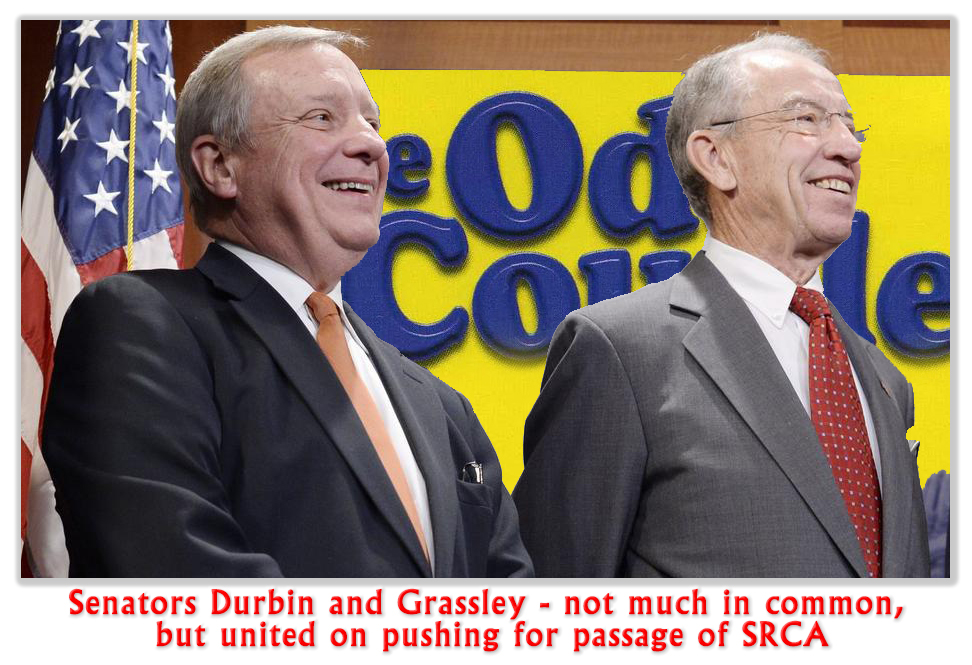
The Cedar Rapids, Iowa, Gazette, last week reported on the feud festering between the Chairman of the Senate Judiciary Committee, Sen. Charles Grassley (R-Iowa), and Sessions. Grassley’s desire to see his legislative baby, the Sentencing Reform and Corrections Act of 2017, passed – and his fury at Sessions’ outspoken opposition to the bill – is spreading now to Grassley head-butting fellow Republicans who say they won’t support the bipartisan proposal to reform sentencing laws. The Gazette reports that Grassley may even side with Senate Democrats to block other legislation until his bill gets a fair shot. The SRCA drew bipartisan support last month, being voted out of the Senate Judiciary Committee by a 16-5 vote without any changes.

Ohio State University law professor Doug Berman suggested in his Sentencing Law and Policy blog last week that Grassley should add the White House death penalty proposals to SRCA “as part of an effort to get the White House and AG Sessions to support that bill. Even if drafted broadly, any federal ‘death penalty for drug dealers’ law would likely only impact a few dozen cases per year, whereas the SRCA will impact tens of thousands of cases every year. And the SRCA could help tens of thousands of least serious drug offenders while any death penalty bill would impact only the most serious drug offenders.”

sessions180312Meanwhile, in the juicy rumor department, Fox Business host Lou Dobbs called on Attorney General Jeff Sessions to resign a week ago after President Trump and a number of Republicans criticized the AG. “Sessions has fallen ill, he’s incapacitated in some fashion, or he’s been coopted or captured: to preserve any dignity, for the good of the country he needs to resign,” Dobbs tweeted. Meanwhile, former Sen. Richard Shelby (R-Alabama), who for years served in the Senate alongside Sessions, says that if he were in the AG’s position, he would stop taking abuse from Trump. “I wouldn’t stay at all unless the president wanted me to stay, if he appointed me,” Shelby said. “I wouldn’t be anybody’s whipping boy. I wouldn’t be belittled because the president’s saying he doesn’t have any confidence in you.”

Washington Examiner, Trump pardons Kristian Saucier, former sailor jailed for submarine pictures (Mar. 9, 2018)

Axios, Trump launches council for prison reform and crime prevention (Mar. 7, 2018)

Washington Post, Trump administration studies seeking the death penalty for drug dealers (Mar. 9, 2018)

Sentencing Law and Policy: Trump Administration reportedly looking (seriously?) at the death penalty for serious drug dealers (Mar. 10, 2018)

The Cedar Rapids Gazette, Grassley the maverick re-emerges in feud with Sessions (Mar. 6, 2018)

The Hill, Fox Business host claims ‘Sessions has fallen ill,’ calls for him to resign (Mar. 3, 2018)

The Hill, Alabama senator: If I were Sessions, I’d quit and stop being Trump’s ‘whipping boy’ (Mar. 1, 2018)

– Thomas L. Root

LISAStatHeader2small

Saying It Doesn’t Make It So – Update for March 8, 2018

We post news and comment on federal criminal justice issues, focused primarily on trial and post-conviction matters, legislative initiatives, and sentencing issues.

LISAStatHeader2small
I DIDN’T MEAN IT LIKE THAT

fineprint180308Anyone who every entered a guilty plea (like 97% of federal prisoners) knows that at the change-of-plea hearing and in the plea agreement, the defendant signs off on a lot of fine print. Most of it goes by in a blur, and means little until much later, when the court and government beat the inmate over the head with “admissions” he made in writing and on the record.

Last week, the 7th Circuit suggested there were limits to holding a defendant to everything he or she said at the change-of-plea. Vance White pled guilty to a white-collar conspiracy. His plea agreement said, “beginning no later than in or around the fall of 2009 and continuing until at least in or around the summer of 2013…” Vance and his buddies had run a scheme to rip off merchants with bad checks. The only problem was that Vance had been locked up for most of the period, being actually free for only about a year of the 4-year conspiracy.

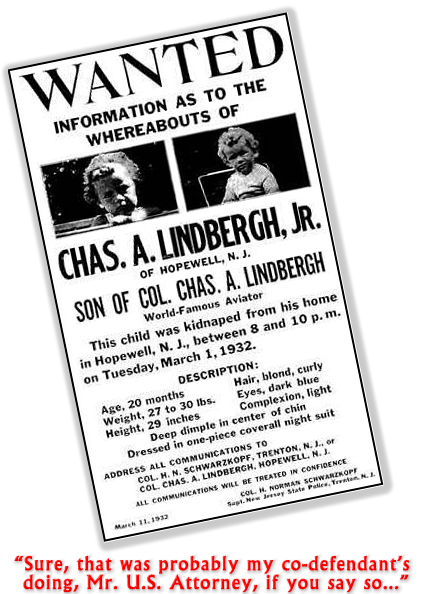
The mistake made a big difference in his Guidelines sentencing range, but the government was unapologetic. The AUSA argued that the truth didn’t matter, because Vance had admitted to all of the conspiracy involvement in his plea agreement. One presumes that if Vance had admitted to having assassinated President Kennedy, kidnapping the Lindbergh baby and masterminding 9/11, the government would have said that must be so, too.

lindbergh180308Last week, the 7th Circuit decided that common sense should prevail. “As a general rule,” the Circuit said, “the government must show an aggravating offense characteristic under the Guidelines by a preponderance of the evidence, and this rule applies to the loss amount in a fraud offense… White’s guilty plea and his admission in the plea agreement are insufficient because they are too ambiguous on the key point. A plea agreement and admissions in a guilty plea hearing may of course establish a factual foundation for sentencing. The question here is just what White admitted. Our broad holdings about the evidentiary force of admissions in a plea agreement do not hold that a general admission in a plea agreement to a conspiracy or scheme spanning a certain time conclusively establishes individual participation during that entire time… White’s admission… is no better than a plea to an indictment — which admits only the essential elements of the offense. The beginning and end dates of a scheme are not essential elements.”

United States v. White, Case No. 17-1131 (7th Cir. Mar. 2, 2018)

– Thomas L. Root

LISAStatHeader2small

Four Foxes Nominated to Guard Henhouse – Update for March 7, 2018

We post news and comment on federal criminal justice issues, focused primarily on trial and post-conviction matters, legislative initiatives, and sentencing issues.

LISAStatHeader2small
FOUR FOXES NOMINATED TO GUARD SENTENCING COMMISSION HENHOUSE

The U.S. Sentencing Commission, currently considering a “first offender” proposal that would reduce the Guidelines of people with no prior record, had better act quickly. Last Thursday, President Trump announced four nominees to the Commission, three federal judges and a guy named Bill Otis. All of them will require Senate approval.

henhouse180307Otis’ nomination marks one of Trump’s most powerful statements yet against sentencing reform. A man described as “a prominent pro-prosecution crusader,” Otis has a history as the worst kind of AUSA, a guy who oversaw criminal prosecutions without ever actually doing any of them himself. He is a vigorous advocate for lengthy prison sentences and mandatory minimum laws (especially for drug sentencing, and is a staunch supporter of the Attorney General’s re-emphasis on them. He dismisses reformers as “pro-criminal” advocates who want to be “nice to drug pushers” by letting “robe-wearing partisans” impose more lenient sentences. And he supports life without parole for juveniles. Slate.com quotes him as writing that to avoid longer sentences, criminals should “consider quitting the smack business and getting a normal job like everybody else.”

“Congress should abolish the Sentencing Commission,” Otis testified at a 2011 House Judiciary Committee hearing. “By far the most important purpose for which it was created no longer exists—to write binding rules for district courts to use in sentencing. It does have some secondary functions—for example, to study possible statutory improvements, as well as gather and publish statistics about sentencing practices—but when its core function has been demoted to making increasingly ignored non-rules, it’s time to turn the page.”

Otis’ appointment to the Commission “drew reactions of horror and condemnation from criminal justice advocates,” Reason.com reported. Those denouncing the choice ranged from the pro-inmate Families Against Mandatory Minimums and the conservative Cato Institute. Such criticism of Otis and Judge Henry Hudson of Virginia could make it harder for the full slate of four to win swift U.S. Senate confirmation. Before Trump’s announcement, criminal justice reform activists were quietly urging the White House not to nominate Hudson.

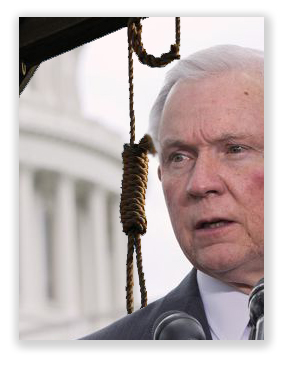
hudsonB170811Trump and Sessions appeared to have had a falling out last week, when the President called the AG’s handling of the FISA wiretap investigation “disgraceful.” Sessions then pushed back against the insult, saying he was presiding over DOJ’s investigation in a constitutional manner. But the next day, Trump nominated three Republicans and one Democrat to the USSC, and all three Republicans – Hudson, Otis, and Judge William Pryor – are Sessions allies. Of particular note is Hudson, known colloquially in Virginia as Henry “Hang ’em High” Hudson. Sessions recommended Hudson for the USSC in August 2017 and has now gotten his wish.

The primary concern for inmates is that provisions like “First Offender,” even if adopted before the newbies are confirmed on the Commission, will never become retroactive. Retroactivity is usually decided after a new Guidelines provision is adopted, but the new appointees are unlikely to support that.

Slate.com, Law and Order: Dinosaurs (Mar. 1, 2018)

Business Insider, Trump’s sentencing panel picks may face uphill Senate path (Mar. 2, 2018)

Daily Caller, Trump’s Sentencing Commission Nominees Show He May Not be That Angry at Jeff Sessions (Mar. 1, 2018)

Reason.com, Trump Nominates Man Who Called for Abolishing U.S. Sentencing Commission to U.S. Sentencing Commission (Mar. 1, 2018)

– Thomas L. Root

LISAStatHeader2small

Going Gently Into the Night – Update for March 6, 2018

We post news and comment on federal criminal justice issues, focused primarily on trial and post-conviction matters, legislative initiatives, and sentencing issues.

LISAStatHeader2small
4TH CIRCUIT SAYS SOUTH CAROLINA INVOLUNTARY MANSLAUGHTER NOT ‘CRIME OF VIOLENCE’

Dylan Thomas adjured us to “not go gentle into that good night.” In the topsy-turvy world of violent crimes (by legal definition, if not in fact), the 4th Circuit has just held that sending someone into that good night can be done gently, at least if it’s involuntary manslaughter in South Carolina.

gentle180306Back in 2005, Jarnaro Middleton was sentenced to a 15-year mandatory minimum under the Armed Career Criminal Act. In a motion filed under 28 USC 2255, he challenged the district court’s determination that his prior conviction for South Carolina involuntary manslaughter qualified as a crime of violence under the ACCA.

Under the ACCA, a crime of violence must employ physical force against a person. ‘Physical force’ means “violent force – that is, force capable of causing physical pain or injury to another person.” “Physical force” must be both physical (exerted through concrete bodies) and violent (capable of causing pain or injury to another).

violence160110Involuntary manslaughter in South Carolina occurs when the defendant kills another person without malice and unintentionally while he or she was engaged in “either an unlawful activity not amounting to a felony and not naturally tending to cause death or great bodily harm, or a lawful activity with a reckless disregard of the safety of others.” To determine whether the crime calls for “physical force,” a court said it must apply the categorical approach by looking for the least culpable conduct that this offense encompasses. South Carolina courts have held that a defendant can be convicted of involuntary manslaughter by selling alcohol to a minor who later has a car accident because he is drunk. The government argued that the defendant used violent force because the drunk driver died, but the Circuit rejected that as “conflated.” In the drunk driving case, there is a distinction between use of violent force and what causes the injury. A crime may result in death or serious injury without involving the use of physical force.

Because a defendant may be convicted of involuntary manslaughter without using physical force against the victim, the offense is not a crime of violence as a matter of law, no matter what the facts of Jarnaro’s particular offense might have been.

United States v. Middleton, Case No. 16-7556 (4th Cir. Feb. 26, 2018)

– Thomas L. Root

LISAStatHeader2small

President Lets Steam Out of Sentencing Reform Engine – Update for March 5, 2018

We post news and comment on federal criminal justice issues, focused primarily on trial and post-conviction matters, legislative initiatives, and sentencing issues.

LISAStatHeader2small
TRUMP TRAIN WRECKS SENTENCING REFORM


President Trump last Tuesday urged Congress to move ahead with legislation to help prisoners prepare for life after release, but did not call for sentencing reforms such as changing mandatory minimum sentences for drug and gun crimes.

trainwreck180305The White House said it sees no path forward for legislation to reduce mandatory minimum prison sentences, instead throwing its support behind measures aimed at reducing recidivism rates. “The conclusion we reached was that, at this time, it’s appropriate for us to go forward with prison reform,” a senior administration official said.

The Hill reported that Trump’s “position represents a major setback for Senate Judiciary Committee Chairman Chuck Grassley (R-Iowa), who has been working to move his criminal justice reform bill through Congress after it stalled last session.” US News said the problem is a divide between hard-liners and moderates, one that leaves “President Trump stranded in the middle and, as is the case on other issues such as gun control and immigration, not firmly in either camp.”

Criminal justice groups across the political spectrum have championed prison and reentry reform, including evangelical Christian organizations and business groups. Jared Kushner, Trump’s son-in-law and a senior White House adviser, supports sentencing reform as well, but in the last week, his personal problems have multiplied, and how long he can remain in the White House is uncertain.

sessions180215Even Kushner’s support has been too little to move forward any sentence changes, because of the opposition of Attorney General Jefferson Beauregard Sessions III. President Trump is in the middle of a Twitter battle with Sessions, who Trump thinks has mishandled issues connected to the Russian meddling investigation, but seems to defer to Sessions on criminal justice reform issues.

Sen. Grassley told reporters on Wednesday the chances for his proposal, at the moment, aren’t very good. But he is not giving up. “This would be a bipartisan policy win for the Administration, and it seems like a no-brainer to me that we should get this done and the president would be backing it, Grassley said. He plans to use his substantial political clout to press Trump to change his mind. Axios noted last month that Trump bends over backwards to keep Grassley happy, because as Judiciary Chairman, Grassley played a crucial role in delivering two of Trump’s biggest successes: the confirmation of Supreme Court Justice Neil Gorsuch and a modern record number of circuit court judges approved in a president’s first year.

coldwater180305Nevertheless, Democrats and advocacy groups are not optimistic. Sen. Cory Booker (D-New Jersey), a Judiciary Committee member and Sentencing Reform and Corrections Act of 2017 supporter, said, “the landscape looks horrible to me, and we don’t see an appetite for making these kinds of changes.”

Ohio State University law professor Doug Berman said in his Sentencing Law and Policy blog last Wednesday that “for various reasons and for lots of offenders, significant prison reform could end up even more consequential than some proposed sentencing reform… Some version of the PRRA looks now to be the only significant federal criminal justice reform proposal with a realistic chance of becoming law in 2018.”

Reason.com, White House Touts Prison Reforms but Throws Cold Water on Sentencing Bill (Mar. 1, 2018)

US News, Trump Urges Prison Reform, not Sentencing Overhaul, After Pushback (Feb. 27, 2018)

The Hill, White House deals blow to Grassley’s criminal justice bill (Feb. 27, 2018)

Sentencing Law and Policy, Trump White House expresses opposition to sentencing reform part of SRCA of 2017 (Feb. 28, 2018)

– Thomas L. Root

LISAStatHeader2small