All posts by lisa-legalinfo

Risky Business: The FIRST STEP Act Revealed – Update for May 16, 2018

We post news and comment on federal criminal justice issues, focused primarily on trial and post-conviction matters, legislative initiatives, and sentencing issues. 

LISAStatHeader2small
UNWRAPPING THE FIRST STEP BILL

We have been reporting on the FIRST STEP Act, H.R. 5682, the House’s current iteration of prison reform, now expected to be voted on next month. Today, we’re going to look briefly at what the bill would do.

risky-business-4fea6b87b70a6FIRST STEP proposes to use a new “risk assessment” tool, which the BOP will employ during the first 18 months after passage to calculate how likely each inmate in its custody is to commit new crimes upon release. Once everyone is assessed as minimum, moderate or high likelihood of recidivism,, some inmates will be entitled to get earned-time credits that may be cashed in for more halfway house or home confinement that what BOP was otherwise prepared to offer (which  isn’t much, see here).

The eligible programs will be those found by the BOP to reduce recidivism. The bill suggests that this definition is intended to be  broad enough to enable inmates earn credits – up to 10 days off for every 30 days of a program – for everything from the Residential Drug Abuse Program (RDAP) and GED to Adult Continuing Educations courses (often taught by inmates) and even working at UNICOR (Federal Prison Industries), which already is a plum job assignment. Once an inmate has worked down to the minimum category for risk for recidivism, the benefit for every 30  days of programming will increase from 10 to 15 days.

The bill also provides that while inmates are successfully completing courses, they should be entitled to other in-prison benefits, including higher monthly commissary spending limits, longer monthly phone time (beyond the standard 300 minutes per month), more visiting hours, and closer-to-home transfers. The bill suggests that all inmates can earn these rewards, regardless of offense, but only eligible inmates can get time credits.

The “ineligibles” are comprised of some 49 offense categories, but generally can be grouped as people who were convicted of violent crimes, Armed Career Criminal Act inmates, and sex offenders.

FIRST STEP is not without critics, most of whom complain the bill seeks to get inmates into programs that already are too full. According to Kara Gotsch of the Sentencing Project, the wait list for BOP GED programs is currently at 15,000 people. In a letter to the House Judiciary Committee last month, dozens of civil rights groups described the legislation as “an empty promise” that would likely be “doomed to fail.”

And the credits that earn a prisoner more halfway house? Mother Jones magazine complains that halfway houses already lack enough beds to accommodate the number of inmates who should have access to them. Because FIRST STEP requires the BOP to honor earned-time credits, passage of the bill could very quickly have an irresistible force (the law) meet an immovable object (the capacity of the halfway house system).

PM-173Also, the bill doesn’t allow all inmates to cash in on earned-time credits accrued through rehabilitative programming. Prisoners convicted of a range of crimes of violence, some drug kingpin offenses and sex offenses, would not be eligible — although drug crimes account for nearly half the total federal prison population. Inmates who are deemed to have a high risk of recidivating could also be prevented from using their credit to reduce their time in prison, complained Gotsch: “The people who really need the programming won’t be able to cash in, which might make them less likely to participate.” However, an amended version of the bill, not yet introduced, would allow high-risk inmates to cash in credits if they get approval from the warden.

There may also be problems with the system by which inmates would be designated as high risk. The bill instructs the Bureau of Prisons to use a risk assessment tool to determine prisoners’ chances of recidivating—an approach that has never been tested, says Gotsch. (More commonly, risk assessment tools are used to help estimate inmates’ security risk inside a prison, to determine whether they should be housed in medium- or high-security facilities.) “Research shows that risk assessments often do not accurately predict risk,” the civil rights groups wrote in their letter to the House Judiciary Committee, and “that these tools can produce results that are heavily biased against Black defendants.”

Many facilities don’t have enough staff to run new programs, according to Jesselyn McCurdy at the American Civil Liberties Union. “Wardens regularly require teachers at federal prisons to postpone or cancel their classes so they can fill empty slots for correctional guards in the housing units,” she said, a system called augmentation. “The whole concept of this bill is not based in the reality of what is going on in the Bureau of Prisons at the moment,” McCurdy said.

henhouse180307Our own observation is different from the others: the bill relies on the BOP to identify eligible programs, select the in-prison benefits to be allowed, and to award the earned-time credits. The BOP has a terrible record of using congressionally-authorized discretion to reduce prison terms (like compassionate release under 18 USC 3582), the Elderly Offender Pilot Home Detention Program and additional halfway house under the Second Chance Act) and to grant prisoners discretionary benefits (furloughs for eligible minimum security prisoners). Trusting the BOP to wholeheartedly adopt programs that reduce prison populations seems rather naive to us.

H.R. 5682, The FIRST STEP Act, passed out of House Judiciary Committee May 9, 2018

Mother Jones, Jared Kushner’s Prison Reform Plan Has Some Glaring Flaws (May 7, 2018)

– Thomas L. Root

LISAStatHeader2small

Tenth Circuit Firebombs 924(c) Residual Clause – Update for May 15, 2018

We post news and comment on federal criminal justice issues, focused primarily on trial and post-conviction matters, legislative initiatives, and sentencing issues. 

LISAStatHeader2small
10th CIRCUIT SAYS DIMAYA MEANS 924(c) RESIDUAL CLAUSE IS UNCONSTITUTIONAL

regrets180515Cliff Salas was convicted of conspiracy to commit arson under 18 USC 844 for using a Molotov cocktail to firebomb a tattoo parlor, which came with an add-on 30-year sentence for using a destructive device in a crime of violence.

Under 18 USC 924(c), a defendant who uses or possesses a firearm or destructive device in a drug trafficking offense or crime of violence receives a mandatory consecutive sentence of from five years to life, depending on the type of gun or device, on whether it’s a first 924(c) offense or subsequent offense, and on how the weapon was used. A “crime of violence” is defined as either (1)  an offense that has as an element the threatened use or actual use of physical force against a person or property; or (3) an offense that presents a significant risk of physical harm to people or property.

Because an 18 USC 844 arson conviction is too broad for generic arson, the enumerated clause of 18 USC 924(c) does not encompass Sec. 844 arson. Likewise, the elements clause, which requires use of force against the property of another, does not encompass Sec. 844 arson, because the property burned up may be one’s own. That meant that that arson must come under the 924(c) residual clause.

vaguenes160516Two weeks ago, the 10th Circuit hurled its own Molotov cocktail at the 924(c) residual clause, striking it as unconstitutional under the 5th Amendment. The Court concluded that the Supreme Court’s recent Dimaya decision required that the 924(c) residual clause be declared too vague. “Ultimately,” the Court said, “Sec. 924(c)(3)(B) possesses the same features as the ACCA’s residual clause and Sec. 16(b) that combine to produce ‘more unpredictability and arbitrariness than the Due Process Clause tolerates,’ and Dimaya’s reasoning for invalidating Sec. 16(b) applies equally to Sec. 924(c)(3)(B). Sec. 924(c)(3)(B) is likewise unconstitutionally vague.”

Currently, only the 6th Circuit holds that Sec. 16(b) is unconstitutional while 924(c)(3)(B) is not.

United States v. Salas, Case No. 16-2170 (10th Cir. May 4, 2018).

– Thomas L. Root

LISAStatHeader2small

The Thrillah on the Hill-ah – Update for May 14, 2018

We post news and comment on federal criminal justice issues, focused primarily on trial and post-conviction matters, legislative initiatives, and sentencing issues. 

LISAStatHeader2small
HOUSE BILL MAY FALL VICTIM TO SENATE DEMAND THAT IT DO MORE

rumble180515With the House Judiciary Committee last week rewriting the old Prison Redemption and the Reform Act into the new FIRST STEP Act (H.R. 5682), the action on criminal justice reform turns to the Senate, where FIRST STEP is already running into pushback. Let’s get ready to rumble.

The White House-backed bill picked up some mo after the House Judiciary Committee passed it onto the floor with a bipartisan 15-5 vote. But some Senate are deadlocked about how to approach the bill, threatening the chances of it getting signed into law. Ironically, the senators raising the most opposition are supporters – not opponents – of criminal justice reform. In fact, some of the traditional foes of criminal justice reform, conservative groups, sound like unabashed supporters. And those who you’d think were most likely to support reform are opposing it.

“Although today’s vote is a positive sign, we still have a long way to go. As the bill’s title suggests, this is the first step,” said conservative nonprofit FreedomWorks. “Congress must do more to ensure that those who are re-entering society and want a better life for themselves and their families have meaningful opportunities to work toward that goal. Another part of the discussion is sentencing reform. Sooner or later, Congress will have to revisit this issue to ensure that we are reforming sentences for low-level, nonviolent offenders and reserving limited prison space for violent offenders.”

vacancy180515But Kate Gotsch of the Sentencing Project complains that the bill does not account for the fact that halfway houses likely won’t have space to accommodate the inmates who accrue more earned-time credit. Progressive groups also point out that while the legislation encourages – even rewards – prisoners for participation in rehabilitative programs, the Bureau of Prisons is struggling with a horrifically-long wait list for the programs it currently offers. And many facilities don’t have the staff to run additional programs. Much of BOP Director Mark Inch’s grilling by the House Oversight Committee last month came over severe cuts in halfway house time for inmates and for the BOP’s practice of “augmentation,” where teachers, nurses and other professional staff at federal prisons are required to drop their regular duties to fill shifts for correctional officers in the housing units.

Nevertheless, FIRST STEP co-sponsor, Rep. Hakeen Jeffries (D-N.Y.) predicted last Friday the bill would come up for a House vote by the end of May.

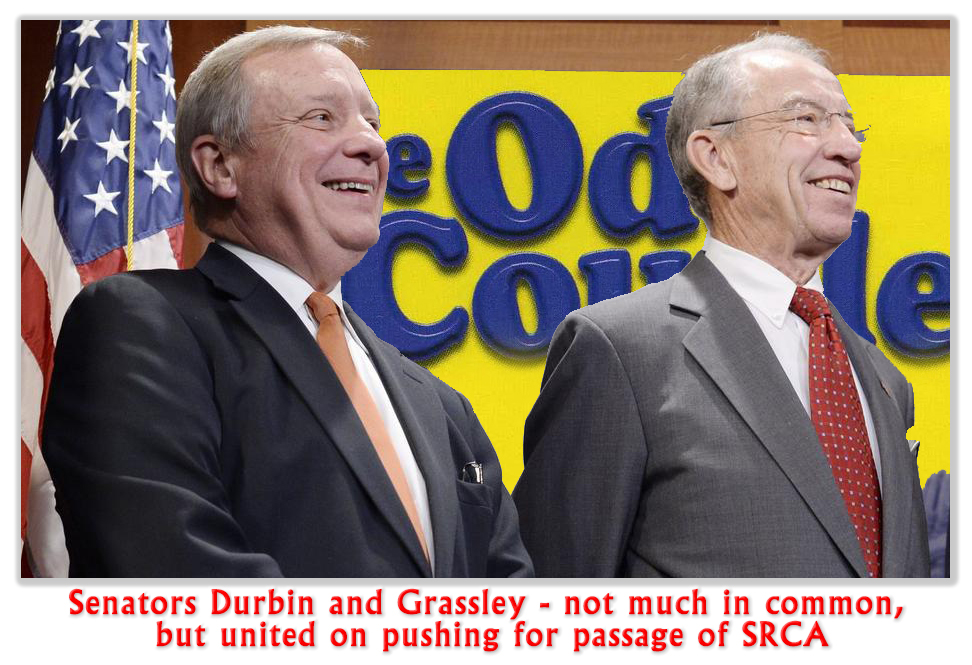
Sens. Charles Grassley (R-Iowa), chairman of the Senate Judiciary Committee, and Richard Durbin (D-Illinois), the No. 2 Senate Democrat, both want a broader criminal justice measure including the mandatory minimum sentencing reforms they previously tucked into the Sentencing Reform and Corrections Act, S.1917, which passed out of the Judiciary Committee last February. The SRCA, which picked up two more co-sponsors last week, is now sponsored by 14 Democrats and 13 Republicans. It slashes mandatory minimums for drug offenses, makes the Fair Sentencing Act retroactive for inmates with pre-2010 crack sentences, and brings relief to people with stacked 924(c) convictions.

sessions180322Despite White House opposition, spearheaded by Attorney General Jefferson Beauregard Sessions III, both senators say they’ve made a deal to not split prison reform from changes to sentencing guidelines. But The Hill predicted last weekend that combining sentencing reform with prison reform will “all but kill any chance of getting sentencing reform through the GOP-controlled Congress.

Grassley’s and Durbin’s approach is poison to both to Sessions and to Senate Majority Leader Mitch McConnell (R-Kentucky), who refused to bring SRCA to a vote in the last session of Congress despite sponsorship of 40” senators. And some of the bill’s most vocal opponents, Sens. Tom Cotton (R-Arkansas) and David Perdue (R-Georgia), are some of Trump’s closest allies on Capitol Hill.

Sens. John Cornyn (R-Texas) and Sheldon Whitehouse (D-Rhode Island) last week introduced a companion bill to the House’s FIRST STEP Act. S. 2795, a bill to provide for programs to help reduce the risk that prisoners will recidivate upon release from prison, represents an effort by some in the Senate to press forward with a narrower bill that would match FIRST STEP. Asked if Sens. Grassley’s and Durbin’s stance was realistic, Cornyn said, “Their opinion matters, but I wouldn’t say that’s the end of the discussion.” 

House Republicans already have made some changes to their prison reform bill in an attempt to win the support needed for it to pass that chamber, but the modifications did not placate Grassley or Durbin, whose support would likely be critical if any legislation is to reach the Senate floor.

In a show of strength, Sen. Cornyn and White House advisor and Trump son-in-law Jared Kushner were to tour FCI Seagoville in suburban Dallas last Friday, to tout FIRST STEP. Sen. Cornyn made it, but Kushner skipped out.

kushner180515Sen. Thom Tillis (R-North Carolina), while saying he’s open to either path forward on the issue, is skeptical that a prison reform bill alone would be able to get the 60 votes needed to ultimately clear the Senate. “It’s how we get the votes, and I’m not sure how you do [it with just that]. The way that that evolved was by talking about pairing the two,” he said, referring to both sentence reform and prison reform.

Sen. Grassley appears to be closing the door for now on negotiating with Cornyn. He said he and Durbin are pushing forward with their bill, adding that he’s delivered that message to Kushner several times. “[We’re going] to try to convince the White House that we’re right,” he said. “This is a wonderful opportunity for the president to have a bipartisan victory and to sign it, and that’s exactly what he needs for the midterm election.”

S. 2795: A bill to provide for programs to help reduce the risk that prisoners will recidivate upon release from prison, and for other purposes, Introduced May 7, 2018, by Sens. Cornyn and Whitehouse.

FreedomWorks, FreedomWorks Applauds Important “First Step” In Criminal Justice Reform (May 9, 2018)

The Hill, Trump-backed prison reforms face major obstacles in Senate (May 13, 2018)

Roll Call, Criminal justice overhaul efforts appear stuck (May 11, 2018)

Mother Jones, Jared Kushner’s Prison reform Bill Just got Slightly Less Bad (May 7, 2018)

– Thomas L. Root

LISAStatHeader2small

House Judiciary Committee Takes “FIRST STEP” Toward Prison Reform – Update for May 9, 2018

We post news and comment on federal criminal justice issues, focused primarily on trial and post-conviction matters, legislative initiatives, and sentencing issues. 

LISAStatHeader2small
JUDICIARY COMMITTEE SENDS FIRST STEP ACT FOR FULL HOUSE VOTE

firststep1800509In a surprise burst of bipartisan effort, the House Judiciary Committee this afternoon approved a new prison reform bill, H.R.  5682, being pushed by the White House.

The bill, called the “Formerly Incarcerated Reenter Society Transformed Safely Transitioning Every Person Act’’ or the ‘‘FIRST STEP Act,” offers more funding for prison programs in an attempt to reduce inmates’ likelihood to re-offend after they’ve been released.

The House Judiciary Committee approved the bill by a 25-5 vote, sending it to the House floor for a vote. The measure replaces the Prison Reform and Redemption Act, H.R. 3356, that had been set for markup two weeks ago. Reps. Doug Collins (R-Georgia) and Hakeem Jeffries (D-New York), co-sponsors of the PRRA, spent the last week negotiating after committee Democrats pushed back against a number of conservative provisions, which resulted in their introducing the new FIRST STEP Act.

education180509In the legislation now advancing to the House, lawmakers created more opportunities for prisoners to earn time credits by completing prison programs. Programs that may earn credit include working at UNICOR (Federal Prison Industries, Inc.) and adult education programs, as well as more traditional rehabilitation programs. Inmates participating the approved programs can earn 10 days of credit for every 30 days of classes, and while participating be given higher spending limits at the commissary, more phone and email time, and increased visits.

Priority for participation in recidivism reduction programs is to be given to medium-risk and high-risk prisoners, with access to productive activities given to minimum-risk and low-risk prisoners. Inmates may use credits earned in the programs to serve more time in halfway houses or on home confinement.

goodconduct180509The bill also clarifies current law, 18 USC 3624(b), to allow prisoners up to 54 days of credit for good behavior annually. The law was previously interpreted as only allowing prisoners to earn 47 days a year. A bipartisan amendment from was also approved to clarify that the legislative fix, which makes prisoners eligible for 54 days of good time instead of 47, applies to prisoners already serving sentences.

Two additional provisions of interest to inmates and their families are, first, a directive that the BOP designate people to institutions within 500 driving miles of their families, where other factor permit it, and second, that the BOP “shall, to the extent practicable, place prisoners with lower risk levels and lower needs on home confinement for the maximum amount of time permitted under this paragraph,” which is 10% of the inmates’ sentence up to a maximum of six months. There is also a provision requiring increased use and transparency for compassionate release.

Sens. John Cornyn (R-Texas) and Sheldon Whitehouse (D-Rhode Island) have a companion bill in the Senate, S. 1994, The CORRECTIONS Act. Rep. Collins said he’s confident there’s enough Democratic support to get the bill through the House and the Senate.

recividists160314In a weird twist, some liberal groups have already called for the bill’s defeat on the grounds that it does not go far enough in that sentencing reform is not included and too many inmates are excluded. “The FIRST STEP Act, as introduced, would exclude too many in people in federal prisons from receiving time credits for participating in the rehabilitative programs authorized by the bill,” according to a statement issued by People for the American Way. “The long list of exclusions in the bill sweep in, for example, those convicted of certain immigration offenses and drug offenses. Because immigration and drug offenses account for 53.3% of the total federal prison population, many people could be excluded from utilizing the time credits they earned after completing programming.”

The group did observe that the “good-time” fix from 47 days to 54 days “could immediately impact 4,000 individuals if made retroactive, however this number has not been verified. According to a BOP calculation done over a decade ago, approximately 4,000 people could be eligible for release within a year, not on the first day of implementation. While the “good time fix” is a much needed, positive reform, which should become law, this provision alone is not enough to overcome our overwhelming concerns with the core of the bill as outlined above.”

The Hill, White House-backed prison reform bill advances in House (May 9, 2018)

H.R. 5682, Formerly Incarcerated Reenter Society Transformed Safely Transitioning Every Person Act (approved by House Judiciary Committee, May 9, 2018)

S. 1994: The CORRECTIONS Act

People for the American Way, PFAW and AAMIA to Congress: Criminal Justice Reform Requires More Than the “FIRST STEP Act”
(May 9, 2018)

– Thomas L. Root
LISAStatHeader2small

10th Circuit Says Robbery is Still Violent – Update for Tuesday, May 8, 2018

We post news and comment on federal criminal justice issues, focused primarily on trial and post-conviction matters, legislative initiatives, and sentencing issues. 

LISAStatHeader2small
TENTH CIRCUIT SAYS ROBBERY IS A GUIDELINES VIOLENT CRIME

Ed McCranie pleaded guilty to federal bank robbery, which his presentence report suggested was a crime of violence under United States Sentencing Guidelines 4B1.2(a)(1), just like a prior federal bank robbery and Colorado aggravated robbery. The three convictions made Ed a Guidelines career offender under USSG 4B1.1(a). Ed complained at sentencing that none of his three robberies qualified as a crime of violence, but the district court rejected the argument, sentencing him to 175 months.

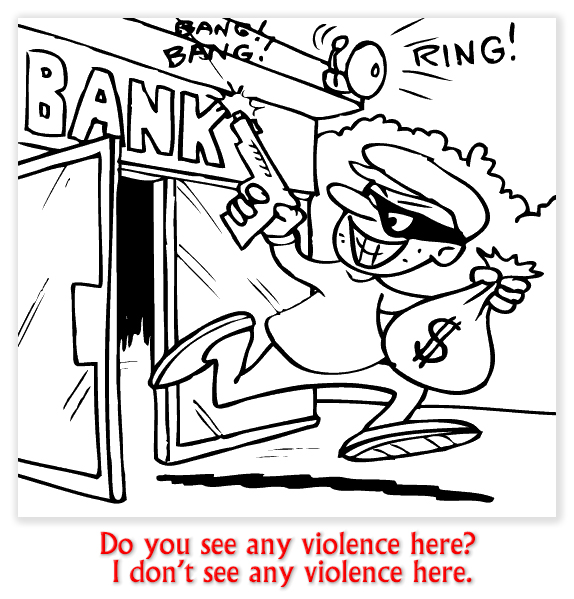
violence180508Last week, the 10th Circuit affirmed, holding that federal bank robbery, which is taking property by force, violence, or intimidation, qualifies categorically as a crime of violence. Ed argued that because robbery can be accomplished by threatening something other than physical force, such as releasing poison if the teller does not hand over the case, the crime is not a “crime of violence.” But the Supreme Court’s 2014 decision in United States v. Castleman knocked down that issue.

Still, Ed contended, robbery can be committed by intimidation, and some people can be intimidated by raising an eyebrow, without any real threat of physical force at all. If one robs by scaring some clerk who is scared of his own shadow, Ed argued, it does not rise to a crime of violence.

caspar180508Not so, the Circuit said. “We have defined intimidation… as an act by [the] defendant ‘reasonably calculated to put another in fear, or conduct and words calculated to create the impression that any resistance or defiance by the individual would be met by force’… This definition requires the objective threatened use of physical force.” Even the 10th Circuit pattern jury instructions say that to take ‘by means of intimidation’ is to say or do something in such a way that a person of ordinary sensibilities would be fearful of bodily harm’… And then, putting to rest any concerns of the too-timid teller, the instructions clarify that “a taking would not be by ‘means of intimidation’ if the fear, if any, resulted from the alleged victim’s own timidity rather than some intimidating conduct on the part of the defendant. The essence of the offense is the taking of money or property accompanied by intentional, intimidating behavior on the part of the defendant.”

Because intimidation requires an objectively reasonable fear of bodily harm, Tim’s conviction was upheld.

United States v. McCranie, Case No. 17-1058 (10th Cir. May 3, 2018)

– Thomas L. Root

LISAStatHeader2small

Congress, Media Force BOP to Back Down on Book Restriction – Update for May 7, 2018

We post news and comment on federal criminal justice issues, focused primarily on trial and post-conviction matters, legislative initiatives, and sentencing issues. 

LISAStatHeader2small
BOP REVERSES COURSE ON BOOK LIMITATIONS

Next to watching the FBI walk a Bureau of Prisons employee off the premises in handcuffs, there is nothing BOP management hates more than congressional heat. Last week provided a perfect illustration of that basic truth, as the BOP hastily reversed a controversial policy that had was making it harder and more expensive for inmates to receive books by banning direct delivery through the mail from publishers, bookstores and book clubs.

books180507The policy banned books from outside sources, including Amazon and Barnes & Noble. Instead, prisoners would have had to submit a request to purchase books through an ordering system run by the commissary in which they would pay list price, shipping and a 30% markup, and could buy hardcover books only, according to memos distributed in at least three BOP facilities. Under the new protocol, a book Amazon might sell for as little as $11.76, including shipping, could cost more than $26.00.

The book policy has been in effect at USP Atwater since last October, USP Victorville since February, and reportedly at USP Lee as well. But the issue only erupted publicly last month at House oversight hearings on the BOP, where Director Inch had his head handed to him by Congresswoman Karen Bass, who raised the issue of the policy being implemented at USP Coleman and lambasted the Director for adopting a policy that seemingly banned books.

We reported last month that Inch seemed nonplussed, saying he was unaware of the Coleman policy and would look into it. When he suggested Rep. Bass might misunderstand the policy, she shot back, “I hope you follow up with Coleman, because this does not seem to be a misperception, this seems to be a directive.”

At the time, we figured the Coleman warden’s new policy was a frolic that the Central Office might not know anything about, but the fact that the policy has been on a slow-walk rollout at joints in California, Virginia and Florida suggests that Director Inch’s denial of knowledge about the book restriction might be less than candid.

petition180507After the House hearings raised the book restriction issue, The Washington Post followed up, asking the BOP for the identity of the book vendor the BOP would use, the markup and the rationale for the restriction. The Central Office refused to say, but told the Post in an email last Thursday that the BOP had rescinded the memos and will review the policy to “ensure we strike the right balance between maintaining the safety and security of our institutions and inmate access to correspondence and reading materials.”

“You shouldn’t have to be rich to read,” complained Tara Libert, whose D.C.-based Free Minds Book Club has had reading material returned from two California prisons in recent months and has stopped shipping to two others because of the policy.

So the complaints went from inmates to families to congressional representatives to the media, demonstrating that if the issue is right, even the people who seem to have no power can end up making government accountable.

Washington Post, Federal prisons abruptly cancel policy that made it harder, costlier for inmates to get books (May 3, 2018)

In Justice Today, New Federal Prison Policies May Put Books and Email on Ice (Apr. 27, 2018)

– Thomas L. Root

LISAStatHeader2small

Supreme Court Taking Another Look at ACCA Predicates – Update for May 3, 2018

We post news and comment on federal criminal justice issues, focused primarily on trial and post-conviction matters, legislative initiatives, and sentencing issues. 

LISAStatHeader2small
IT’S DEJA VU ALL OVER AGAIN

deja171017It will seem like old times – James, Begay, Chambers, Sykes, Johnson, Mathis, and Beckles – as the Supreme Court has granted review to yet another pair of Armed Career Criminal Act cases last week. These companion cases focus on the question of whether burglary of a nonpermanent or mobile structure that is adapted or used for overnight accommodation can qualify as “burglary” under the ACCA. The cases will be decided together during the Supreme Court term beginning in October 2018.

At the same time, we’re watching a trio of cases that are awaiting a decision by SCOTUS on certiorari. The petitions for certiorari have been “relisted” eight times, an astounding number of deferrals by the Court. (A relist is when the Supreme Court schedules a case for a decision on certiorari at the weekly Friday justices’ conference, but then defers decision until the next conference, essentially “relisting” it on the next week’s conference list).

The three cases, Allen v. United States, Gates v. United States, and James v. United States, all ask whether under the Supreme Court’s opinions in United States v. BookerJohnson v. United States and Beckles v. United States – all of which depended heavily upon the distinction between advisory and mandatory sentencing schemes – the residual clause of the mandatory sentencing guidelines is unconstitutionally vague.

BettyWhiteACCA180503Ohio State University law professor Doug Berman, writing in his Sentencing Law and Policy blog last week, noted that the Stitt and Sims cases are being heard “because the government was seeking cert on these cases after losing in big Circuit rulings and because there is a split in the circuits.” Still, he admitted to “growing somewhat annoyed that issues related to the application of the Armed Career Criminal Act continued to be the focal point of so much SCOTUS activity… Many other issues that are so very consequential to so many more cases – e.g., the functioning of reasonableness review or the proper application of Graham and Miller — have been unable to get the Justices’ attention while nearly a dozen ACCA cases have been taken up by SCOTUS in the last decade.”

United States v. Stitt, Case No. 17-765 (cert. granted Apr. 23, 2018)

United States v. Sims, Case No. 17-766 (cert. granted Apr. 23, 2018)

Allen v. United States, Case No. 17-5864 (certiorari decision pending)

Gates v. United StatesCase No. 17-6262 (certiorari decision pending)

James v. United StatesCase No. 17-6769 (certiorari decision pending)

Sentencing Law and Policy, SCOTUS grants cert on yet another set of ACCA cases, this time to explore when burglary qualifies as “burglary” (Apr. 23, 2018)

SCOTUSBlog.com, Relist Watch (Apr. 27, 2018)

– Thomas L. Root

LISAStatHeader2small

If a Court Screws It Up Once, Must It Do So Twice? – Update for May 2, 2018

We post news and comment on federal criminal justice issues, focused primarily on trial and post-conviction matters, legislative initiatives, and sentencing issues. 

LISAStatHeader2small
ONE SWALLOW DOES NOT A SUMMER MAKE

swallow180502When Aristotle observed that sighting one returning swallow did not mean that summer was here, was talking about how a single event – often an aberration – does not constitute a trend. So it is in law.

Appeals courts are staffed with humans, and humans make mistakes. Eight years ago, the 6th Circuit held that an inmate whose was eligible for a sentence reduction under 18 U.S.C. 3582(c)(2) but whose judge decided not to grant some or all of the reduction could not appeal. In United States v. Bowers, the Circuit held that the appeal statute, 18 USC 3742, tightly limited its jurisdiction to entertain an appeal of the district court’s denial of a 3582(c)(2) sentence-reduction motion. It lacked jurisdiction to review a sentence reduction decision simply because the defendant thought it was unreasonable.

When Bill Reid asked his judge to apply the 2014 2-level drug reduction to his sentence, the district court refused, citing two disciplinary infractions Bill had gotten during his prison stint for possession of drugs and tobacco. The judge said the two disciplinary reports proved Bill had not “gained respect for the law.”

Bill appealed, argued the district court had not provided a “reasoned basis” for denial, and that it “misapplied the governing statutory criteria” to the facts of his case. He cited two cases the Circuit had decided after the 2010 Bowers decision in which it had considered the identical arguments.

oneswallow180502Yeah, the Circuit admitted last week, we did do that. But “those decisions are not faithful to Bowers. At their core, Reid’s arguments are challenges to the procedural and substantive reasonableness of the outcome of his Sec. 3582(c)(2) sentence-reduction proceeding… But Bowers explicitly held that we do not have jurisdiction under Sec. 3742(a)(1) to consider such arguments in appeals from the denial of sentence-reduction motions.”

“We are obliged,” the Court held, “to follow the explicit holding of Bowers, later cases notwithstanding… And pursuant to Bowers, we do not possess jurisdiction to entertain Reid’s Booker unreasonableness arguments.”

United States v. Reid, Case No. 17-5451 (6th Cir. Apr. 23, 2018)

– Thomas L. Root

LISAStatHeader2small

Thanks to Mathis, Chances Are It’s No Longer Violent – Update for May 1, 2018

We post news and comment on federal criminal justice issues, focused primarily on trial and post-conviction matters, legislative initiatives, and sentencing issues. 

LISAStatHeader2small
8TH CIRCUIT SAYS NORTH DAKOTA BURGLARY TOO BROAD FOR ACCA

Courts are still struggling over the application of Mathis v. United States, the 2016 case that changed the way state statutes are interpreted for imposing Armed Career Criminal Act sentences. Mathis says that in determining whether a statute can be divided into crimes that qualify for ACCA treatment and crimes that are too broad for ACCA treatment, you first read the plain text, then see whether the separate offenses have different punishments, then look at state court decisions in the issue, and then check out state jury instructions. If none of that works, chances are it may still not count for an ACCA punishment…

mathis180501That’s what the 8th Circuit ran into last week with defendant Jon Kinney. He had a prior North Dakota burglary conviction of a “building or occupied structure” that helped qualify him for an ACCA sentence. But the state statute provided that an occupied structure could include a vehicle, and vehicle burglary falls beyond the kind of generic burglary that counts against the ACCA.

The Circuit looked at the statute, state court decisions and jury instructions, but could not tell whether “building or occupied structure” described two elements or just two means of committing the crime. Frustrated, the court gave just a “peek” at the record of Jon’s prior conviction “for the sole and limited purpose of determining whether the listed items are elements of the offense.”

It turned out that each of Jon’s charges just accused him of burgling “a building or occupied structure.” The fact that his indictments listed both, the Court held, was “as clear an indication as any that each alternative is only a possible means of commission, not an element that the prosecutor must prove to a jury beyond a reasonable doubt.” Thus, the Circuit held, Jon’s prior North Dakota convictions can’t count as predicates for the ACCA.

United States v. Kinney, Case No. 16-3764 (8th Cir. Apr. 23, 2018)

– Thomas L. Root

LISAStatHeader2small

New Delay on Prison Reform Committee Vote May Jeopardize Passage – Update for April 30, 2018

We post news and comment on federal criminal justice issues, focused primarily on trial and post-conviction matters, legislative initiatives, and sentencing issues. 

LISAStatHeader2small
HOUSE MARKUP OF PRISON REFORM BILL DELAYED AGAIN

roadblock180430Disagreements over provisions in the Prison Reform and Redemption Act, H.R. 3356, backed by the White House, forced House Judiciary Chairman Robert Goodlatte (R-Virginia) to postpone markup of the bill previously scheduled for last Wednesday, and called into question the future of any type of criminal justice reform.

“We will consider the prison reform bill at the next mark-up of the Committee, which will occur the week of May 7th,” Goodlatte said. “I look forward to considering it then.”

The PRRA, co-sponsored by Reps. Doug Collins (R-Georgia.) and Hakeem Jeffries (D-New York), rewards inmates’ completion of programs like drug treatment, adult education classes and vocational training with additional halfway house and home confinement. Any sentencing reform – such as change in mandatory minimums and retroactivity of the Fair Sentencing Act – was left out because of White House and Justice Department pressure.

The Hill reported that House Judiciary Democrats are battling with some Committee Republicans over PRRA provisions that restrict the kinds of programs offered and the kinds of convictions that will be excluded from benefits. Multiple House sources, however, blamed the delay not on House negotiations but instead on a behind-the-scenes opposition campaign from two Senate heavyweights, one from each party.

SRCARIP180430Senate Judiciary Committee Chairman Chuck Grassley (R-Iowa) and Senate Minority Whip Dick Durbin (D-Illinois) reportedly told House Judiciary panel members to oppose the PRRA unless it adds the sentencing overhaul contained in the Sentencing Reform and Corrections Act, S.1917, which they co-sponsor and which was reported out of the Senate Judiciary Committee two months ago.

The Trump administration wants to see a prison-only bill, not the broader SRCA, but that’s not stopping Grassley and Durbin from what one Republican complained was meddling in the House debate. “Frankly, I respect the two senators, but they have enough problems in the Senate,” said Rep. Doug Collins (R-Georgia), one of the PRRA’s authors. “I wish they would actually focus on passing bills over there.”

The PRRA also has been criticized by civil and human rights groups, who have long focused their fight for criminal justice reform on measures that reduce mandatory minimum prison sentences. More than 60 police chiefs and prosecutors wrote to Congress and the White House last week, urging that the PRRA be amended to include mandatory minimums reform. The group, called Law Enforcement Leaders to Reduce Crime and Incarceration is concerned that the PRRA doesn’t address sentencing.

“Improving prison conditions and reentry services, on their own, will not adequately solve our high rates of incarceration and recidivism,” the letter says. “Legislation like the Prison Reform and Redemption Act (H.R.3356) and the CORRECTIONS Act (S. 1994) are useful efforts to improve the lives of those in prison. But such efforts should be coupled with efforts to reduce unnecessary incarceration.”

perfect170428Last Friday, leaders of faith-based groups met at the White House to voice their support for the PRRA. The Prison Fellowship, one of the participants, sees demands for sentencing reform as a needless distraction: “The delay in voting on the Prison Reform and Redemption Act in the House of Representatives is a disappointment to Prison Fellowship and the hundreds of thousands of prisoners and families we serve in our programs,” Craig DeRoche, Senior Vice President, Advocacy and Public Policy, said. “There is no disagreement about what is in the bill, the fight is over what has not been put in this legislation—and the people who pay the price for these delays are the men and women that are incarcerated today. Delaying, or even killing these important reforms disregards the hope, dignity, value and potential of the people incarcerated today and will only serve the practical outcome of making America less safe by continuing the current recidivism rate.”

Despite the delay, Rep. Jeffries said he’s confident of a bipartisan agreement soon, and that the bill will pass in May.

The Hill, House Judiciary delays markup of prison reform bill (Apr. 25, 2018)

Politico, Kushner-backed prison reform bill stumbles in House (Apr. 25, 2018)

– Thomas L. Root

LISAStatHeader2small