We post news and comment on federal criminal justice issues, focused primarily on trial and post-conviction matters, legislative initiatives, and sentencing issues.

WHAT WILL BE ADDED TO FIRST STEP IN THE WHITE HOUSE DEAL?
As we have reported, the Trump Administration is brokering a deal to amend the FIRST STEP Act to include some of the sentencing reform provisions of the Sentencing Reform and Corrections Act. The compromise, intended to appease SRCA co-sponsors Sen. Charles Grassley (R-Iowa) and Sen. Richard Durbin (D-Illinois), should clear the way for a Senate vote on FIRST STEP, and passage of some badly needed prison reform.
Not everything in SRCA will get dropped into the Senate version of the FIRST STEP Act. Nevertheless, what is proposed is significant to a lot of people.
• Reductions in some drug mandatory minimums, reducing penalty from life to 25 years for a third drug conviction, and from 20 to 15 years for a second drug conviction.
• Ending 18 USC 924(c) “stacking” charges. This provision would prohibit the doubling up of mandatory sentences for carrying a gun during drug or violent crime offenses. The way 924(c) is written now, a defendant who carries a gun while selling pot three days in a row commits three separate 924(c) offenses. The first one carries a consecutive 5 years, and the second and third each carry a consecutive 25 years, meaning the defendant gets 55 years plus the pot sale guidelines. The change in the law makes clear that the increased penalty for a second or third 924(c) offense applies only after conviction for the first one.
• Increase “safety valve” application. This provision would give judges more discretion in giving less than the mandatory minimum for certain low-level crimes, including people with Criminal History II in the safety valve provisions of 18 USC 3553(f).
• Retroactivity for the 2010 Fair Sentencing Act. This provision would make the FSA, which changed sentencing guidelines to treat offenses involving crack and powder cocaine more equally, retroactive to people sentenced before the law went into effect.
“Just the facts, FAMM.”
Last Friday, FAMM released an extended series of fact sheets reviewing which SRCA sentencing provisions are in play. The document, written as a memo to Congress members and staff, is entitled “Fact sheets explaining potential sentencing additions to FIRST STEP Act.” It explains in detail the provisions possibly being added to FIRST STEP, and describes cost savings and justice issues surrounding each.
Also last week, Marc Holden, general counsel to Koch Industries and point man for the Koch initiatives on criminal justice reform, wrote, “By supporting these smart-on-crime, soft-on-taxpayers reforms, President Trump is demonstrating exemplary leadership. If Congress is able to pass the FIRST STEP Act with these sentencing provisions included, it would give the president a lasting, landmark achievement on criminal justice reform that has eluded previous administrations.”
We post news and comment on federal criminal justice issues, focused primarily on trial and post-conviction matters, legislative initiatives, and sentencing issues.
DC CIRCUIT HAMMERS DOJ OVER FREEDOM OF INFORMATION ACT ARROGANCE
Who hasn’t had this happen? You file a Freedom of Information Act request seeking documents showing prosecutorial misconduct, only to wait many months for a two-page letter claiming that all of the requested material is exempt law-enforcement stuff. And it’s hard to appeal, because you cannot tell what records were not included, so you cannot argue that the withheld records were non-exempt.
That happened to Greg Bartko. After he was convicted in a case “beset by prosecutorial misfeasance,” as the DC Circuit put it, he filed multiple Freedom of Information Act requests with the Dept. of Justice Office of Professional Responsibility and other relevant agencies trying to get records of other times the Assistant U.S. Attorney assigned to his case had cut corners. OPR categorically refused to acknowledge the existence of, let alone disclose any, potentially relevant documents outside of Greg’s own case. And even with respect to Greg’s case, OPR held back a lot of material, asserting a sweeping exemption for law enforcement records under FOIAExemption 7(C) and providing a “Glomar” response that it could neither confirm or deny the records existed, because that would implicate law enforcement activities.
Last week, the DC Circuit slammed OPR’s reckless use of Exemption 7(C) and its arrogant “Glomar” claim (which exists to enable agencies to dodge making admissions about records for national security reasons). To qualify as law-enforcement records, the Circuit said, “the documents must arise out of investigations which focus directly on specifically alleged illegal acts which could, if proved, result in civil or criminal sanctions. Records documenting only government surveillance or oversight of the performance of duties of its employees do not qualify.
The Circuit held that an agency must establish a rational nexus between the investigation and one of the agency’s law enforcement duties, and a connection between an individual or incident and a violation of federal law. OPR does not do law enforcement, but instead internal DOJ discipline. Plus, one of OPR’s primary responsibilities is not to generate reports, but rather just to obtain reports from others that arise as a result of internal agency monitoring and review allegations of non-law violations by DOJ attorneys for internal disciplinary purposes. Thus, the Court said, OPR bears the burden of showing on a case-by-case basis that requested records were actually compiled for law-enforcement, rather than employment-supervision purposes.
In defense of its Glomar response, OPR offered only a bare-bones declaration that the records Greg requested consist of complaints or allegations of misconduct which, if they exist at all, would have been compiled as part of OPR’s investigations of DOJ attorneys “who are alleged to have committed specific acts of professional misconduct which, if proved, could result in civil or criminal penalties.” The Court said that “is not even in the ballpark.” OPR “cannot rely on a bare assertion to justify invocation of an exemption from disclosure.” A “near-verbatim recitation of the statutory standard is inadequate” to justify the use of an exemption.
Greg’s FOIA request was broadly worded to include a wide variety of actual or alleged violations by the AUSA of the U.S. Attorney’s Manual, the North Carolina Code of Professional Conduct, and other ethical and legal obligations. While violations of some of those standards could conceivably result in civil or criminal sanctions, the Court said, many of them would not and would bear only on internal disciplinary matters.
Bartko v. DOJ, Case No. 16-5333 (D.C.Cir., Aug. 3, 2018)
We post news and comment on federal criminal justice issues, focused primarily on trial and post-conviction matters, legislative initiatives, and sentencing issues.
WHITE HOUSE, SENATE CUTTING A DEAL ON AMENDING FIRST STEP
The FIRST STEP Act, which has stalled in the Senate because of opposition from top Republicans who want more sentencing relief than the bill offers, got a jump start in the last week, and, according to White House sources, may be set for a vote in the Senate before the end of the month.
Behind the scenes, the administration and legislators are hammering out an agreement that would add significant changes in the nation’s mandatory sentencing laws to the widely popular prison reform bill that passed the House earlier this year, the Washington Post said, crediting officials familiar with the discussions.
President Trump met with a number of state governors during his golf course vacation at Bedminster, New Jersey, last week, holding a “roundtable” that was intended to signal the important to the President of getting a Senate vote on FIRST STEP.
During Thursday’s meeting, Trump said the administration was working to “refine” the House-backed measure in the Senate. “I have to say, we have tremendous political support. It surprises me. I thought that when we started this journey about a year ago, I thought we would not have a lot of political support,” Trump said, flanked by state officials and top aides. “People I would least suspect are behind it, 100 percent.”
The deal being discussed would add four sentence reform measures from the Sentencing Reform and Corrections Act(legislation sponsored by Senate Judiciary Committee Chairman Charles Grassley (R-Iowa) and Sen. Richard J. Durbin (D-Illinois) and backed by a broad coalition of Senate Democrats and Republicans) to the House bill. Ohio State law professor Doug Berman said last week in his Sentencing Law and Policy blog that he believed the revised measure will breeze its way to passage in the Senate, with a vote of in favor of 80% or more.
“We are trying to get a Senate vote in the next two weeks,” an administration said. White House officials hope that Trump’s meeting with governors will spark action in the Senate and prompt leaders to put legislation on the summer calendar. Senate Majority Leader Mitch McConnell has kept the Senate in session.
“There can’t be any doubt that by having this as the only major event on the president’s schedule that he is laser focused on this,” said a Trump aide. “We think that with this momentum and with the coalition behind it, that this can actually happen.”
At the session with governors, Trump said, “Our first duty is to our citizens, including those who have taken the wrong path but are seeking redemption and a new beginning. That’s people that have been in prison, and they come out and they’re having a hard time… We’ve passed the FIRST STEP Act through the House, and we’re working very hard in the Senate to refine it and pass it into law. We think we’ll be successful in that regard. The bill expands vocational educational programs to eligible federal inmates so that more of them can learn a trade. And that’s what we’re doing. We’re teaching them trades. We’re teaching them different things that they can put into good use, and put into use to get jobs.”
ABC News reported last Thursday that “the Senate is now expected to move forward with a modified version of the House bill that will reduce the current mandatory life sentence for certain drug offenses from a life sentence to 25 years, prohibit the doubling of mandatory sentences for certain gun and drug offenses, broaden judicial discretion, and make retroactive the 2010 Fair Sentencing Act that narrowed the discrepancy in sentencing guidelines for crack versus powdered cocaine.”
Jon Ponder, an associate minister at a Las Vegas church who has two priors for robbery, was one of the ministers who met with the President at the White House in late July. Ponder, founder of HOPE for Prisoners, a program that helps more former inmates adjust to life after prison by providing financial advice, personal mentoring and connections to employers, said he believes Trump supports inmate re-entry programs as much as he does.
“I think that something would really have to be wrong with that man to sit down in that room and have the conversation with the (ministers) that he did, if he was not being sincere about this,” Ponder said. “I believe that he spoke from his heart. He shared in that room that he was very compassionate about this, and about the importance of people who are fighting for a second chance.”
We post news and comment on federal criminal justice issues, focused primarily on trial and post-conviction matters, legislative initiatives, and sentencing issues.
GOVERNMENT PLEA BREACH NOT PLAIN ERROR, BUT DEFENSE COUNSEL WAS PROBABLY INEFFECTIVE
A defendant is supposed to get what he reasonably believed he negotiated in a plea deal
Marquette Murray had a couple of problems, a federal drug conspiracy indictment and a couple of misdemeanors in D.C. Superior Court. His lawyer negotiated a favorable plea deal in which the government agreed Marquette was looking at Criminal History I and a sentencing range of 24-30 months.
After the deal was made, however, Marquette got sentenced in D.C. Superior Court before his federal sentencing. The presentence report used the misdemeanor convictions and made Marquette a Crim History II. His sentencing range rose to 27-33 months, and the government recommended a 33-month sentence.
On appeal with a different lawyer, Marquette claimed the government had breached the plea agreement, because in D.C., the government runs prosecutions in federal court and superior court. Because the government had the power, Marquette said, it should have delayed Superior Court sentencing so Marquette would have remained a Crim History I for federal sentencing purposes. To add insult to injury, the government demandedMarquette get 33 months, and thus breached its promise to recommend a within-range guidelines sentence.
What did in the government was that it agreed in the plea agreement that based on the information it knew, Marquette had a criminal history of I and a sentencing range of 24-30 months. Last week, the Court of Appeals agreed with Marquette that the government had welshed on the deal, but it denied Marquette relief… even while dangling a post-conviction carrot in front of him.
Sure, the Court ruled, the government breached the plea agreement. But because Marquette’s trial attorney did not object, the appeals court could only grant relief for FRCrimP 52(b) plain error. “And to find plain error,” the Court said, “it is not enough to base our reading on the parties’ ‘reasonable understanding’ and on ‘construing any ambiguities’ against the government. Rather, we must find that the breach was clear or obvious.”
While reasonable defendants could have understood the agreement the way Marquette did, the agreement did not expressly address whether the not-yet-entered pleas would affect his final criminal history category and Guidelines range, and the agreement does not expressly address the expected timing of those pleas. “In sum, we conclude that the government breached its plea agreement with appellant [Marquette]. But [Marquette] did not object to the breaches in the district court, and we therefore cannot provide him with relief because the breaches were not plain. Although his interpretation of the agreement’s ambiguous language is the best one, we cannot say that the breaches should “have been obvious to the trial court.”
However, the Court said in an unmistakable hint to Marquette, it seemed pretty clear his trial counsel was ineffective in not seeking a continuance in Superior Court and in not objecting to the government asking for more than 30 months.
And because “in most cases the Guidelines range will affect the sentence,” the prospect that effective performance would have put [Marquette’s] 33-month sentence above the Guidelines range is sufficient to establish a reasonable probability of prejudice.
The Court strongly implied that Marquette might get the deal he was entitled to on post-conviction review, and it hinted to Marquette that he should be sure to file a 2255 motion, which he will no doubt be doing soon.
We post news and comment on federal criminal justice issues, focused primarily on trial and post-conviction matters, legislative initiatives, and sentencing issues.
TRUMP BREAKING CRIMINAL JUSTICE REFORM LOGJAM?
President Trump told Republican senators last Wednesday that he’s open to a proposal on prison and sentencing reform that combines the FIRST STEP Act with provisions of the Sentencing Reform and Corrections Act of 2017, giving new life to criminal justice reform that had seemed hopelessly stalled on Capitol Hill.
The compromise presented to President Trump by Republican senators at a White House meeting on Wednesday would combine the FIRST STEP Act with four sentencing reform provisions that have bipartisan Senate backing, according to a source familiar with the meeting.
A senior White House official described the president as “positively inclined” toward the compromise proposal. The source said Trump told GOP senators to “do some work with your colleagues” and “let’s see where the Senate is andthen come back to me with it.”
The White House meeting with Republican senators included Mike Lee (Utah), Lindsey Graham (South Carolina), and Senate Judiciary Committee chairman Charles Grassley (Iowa).
Trump’s support is significant because the core group of Republicans and Democrats behind the Senate bill has insisted on including sentencing reform as part of any criminal justice legislation, but Senate Majority Leader Mitch McConnell (R-Kentucky) is not about to bring a bill to the floor if there is vocal opposition from either the White House or the Republican caucus. “The question is whether there [are] enough sentencing provisions in there to make those guys happy without turning off too many Republicans and making it too toxic for McConnell to put on the floor,” says Alex Gudich, deputy director of #Cut50, a criminal justice advocacy group.
The Hill reports that some of the bill backers now think there’s a possibility of moving the modified legislation through the Senate as soon as this month, although it’s more likely be delayed until the lame-duck session after the midterm elections, that starts in mid-November.
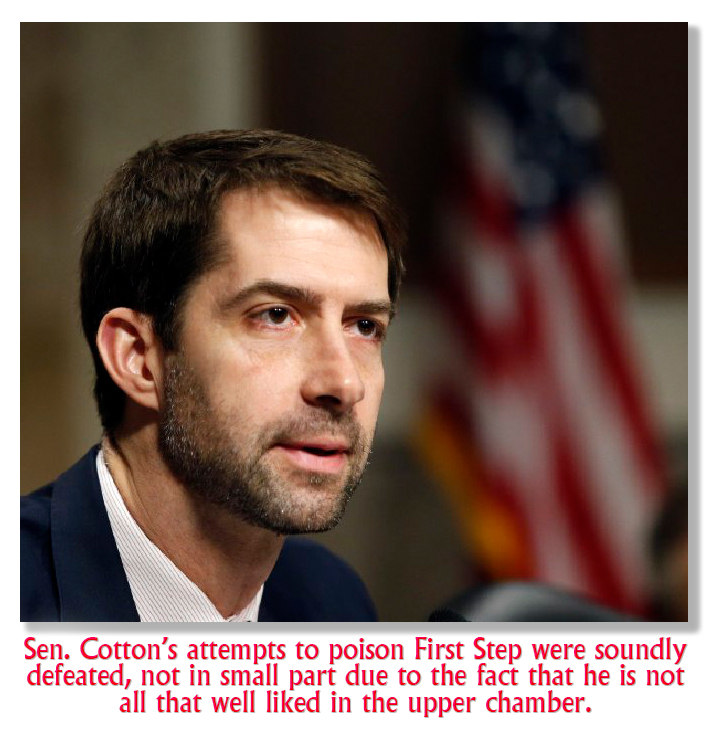
Conservatives such as Sen. Tom Cotton (R-Ark.) and Attorney General Jeff Sessions have opposed combining prison and sentencing reform. Cotton argued in a speech at the Hudson Institute earlier this year that “if anything, we have an under-incarceration problem.”
Meanwhile. the Washington Free Beaconpublished a leaked letter from the Dept of Justice to the White House outlining its concerns about the FIRST STEP Act. “In the Department’s view,” the letter says, “this legislation, if passed in its current form, would further and significantly erode our long-established truth-in-sentencing principles, create impossible administrative burdens, effectively reduce the sentences of thousands of violent felons, and endanger the safety of law-abiding citizens and law enforcement officers.”
The DOJ letter also tied the declining federal prison population to rising crime rates. “The number of federal inmates has declined more than 16% since 2013 and is at its lowest level since 2004,” the letter reads. “It is likely no coincidence that, at the same time, we are in the midst of the largest drug crisis in our nation’s history and recently experienced the two largest single-year increases in the national violent crime rate in a quarter of a century.”
Conservative groups supporting criminal justice reform pushed back against the DOJ letter. FreedomWorks rebutted the report, saying, “Simply put, correlation doesn’t equal causation.” And when reporters asked Grassley today about his former Senate colleague Sessions’ efforts to derail the criminal justice legislation, Grassley responded sharply, “With all that I have done to help Sessions, to keep the president from firing him, I think Sessions ought to stay out of it.”
Criminal justice reform groups have been bolstered by a poll released last week by Freedom Partners, a nonprofit group that funds conservative and libertarian causes, showing 70% of voters nationwide think the Senate should pass the FIRST STEP Act.
Ohio State University law prof Doug Berman said in his Sentencing Law and Policy blog this past weekend, “I am not counting any sentencing reform chickens before they hatch, but this description of the compromise combo FIRST STEP Act and SRCA would seem to make a lot of sense in light of various positions staked out on both sides of the aisle. And if Prez Trump signals support for such a reform package and is willing to make it a priority, I would now be inclined to predict this will get done this year. But because Prez Trump has never seemed a serious advocate for sentencing reform, and because his Attorney General likely dislikes all of this, and because the run-up and aftermath of an election can disrupt lots in DC, I am inclined to remain pessimistic about all of this until votes are being scheduled and taken.”
We post news and comment on federal criminal justice issues, focused primarily on trial and post-conviction matters, legislative initiatives, and sentencing issues.
3RD CIRCUIT HOLDS “ACTUAL INNOCENCE” EVIDENCE NEED NOT BE NEWLY DISCOVERED
The Supreme Court ruled in Schlup v. Delo that an actual innocence claim was an exception to habeas corpus “procedural default.” More recently, McQuiggin v. Perkins held that actual innocence excuses filing a habeas petition late. But courts of appeal have wrestled with whether the evidence of actual innocence has to be newly discovered, or just be evidence the jury never saw before.
Some of the people who say this really are...
The 3rd Circuit weighed in on the issue last week, joining the 1st, 2nd, 6th, 7th and 9th in holding that the evidence the petitioner relied on could be simply evidence the jury never saw before, even if it was evidence that the defendant knew about, but his lawyer never presented.
The 3rd said, “in a case where the underlying constitutional violation claimed is ineffective assistance of counsel premised on a failure to present evidence, a requirement that the new evidence be unknown to the defense at the time of trial would operate as a roadblock to the actual innocence gateway. To overcome this roadblock, we now hold that when a petitioner asserts ineffective assistance of counsel based on counsel’s failure to discover or present to the fact-finder the very exculpatory evidence that demonstrates his actual innocence, such evidence constitutes new evidence for purposes of the Schlup actual innocence gateway.”
We post news and comment on federal criminal justice issues, focused primarily on trial and post-conviction matters, legislative initiatives, and sentencing issues.
CLOCK RUNS WHILE PARTISANS FUME OVER FIRST STEP ACT
The Senate will be working through August while the House takes a break, because Senate Majority Leader Mitch McConnell (R-Kentucky) has a Supreme Court nomination, as well as a looming midterm election disaster, to address. The pressure remains on McConnell to bring the FIRST STEP Act to a vote as well.
The problem is that Senate Judiciary Committee Chairman Charles Grassley continues to back the Sentence Reform and Corrections Act of 2017, his pet bill, and refusing to back FIRST STEP unless the bill is amended to adopt some of the SRCA provisions.
Last week, Georgetown law professor Shon Hopwood (who is both a skilled litigator and a former BOP prisoner) blasted an opinion piece written by the president of progressive criminal justice reform group JustLeadershipUSA in which she called for opposition to FIRST STEP as dangerous and suggested that home confinement was as bad or worse than being locked up. Hopwood wrote,
Arguing against a bill that will move thousands of people from federal prisons to back home with their families because we can’t get Congress to release people outright, is about as shocking a proposition as any I’ve ever heard from a criminal justice reform organization dedicated to ending mass incarceration. JLUSA would have a hard time convincing anyone currently in federal prison of the position that somehow home confinement is worse than people remaining in prison… Although we are trying to create a political climate to eventually move to a system of full release good-time credits, that doesn’t mean we should deny current prisoners and their families this relief.
Some complain that FIRST STEP is far from perfect… so we should wait for the next bus.
Hopwood admits that the bill is far from perfect, but he writes that “First Step along with some sentencing additions is the best bill we can get now in the current political climate. If we don’t take First Step now, we will be waiting at least another two years for any possibility of federal prison reform. If the past thirty years is a guide, we are probably waiting much, much longer. Given the stakes, there should be an urgency on all sides to get this done.”
Meanwhile, director of the conservative Center for Urban Renewal and Education Star Parker complained that Senate Republicans ought to be rolling out the red carpet for FIRST STEP, especially because the White House is behind it. “Senate Majority Leader McConnell and Senator Grassley should see this as an opportunity for the Republican-controlled Congress to show it can act decisively on a major national problem,” she wrote. “Holding up prison reform to add on the complex issue of sentencing reform will result in what I said above: either nothing will happen or we’ll get one big unworkable bill.”
We post news and comment on federal criminal justice issues, focused primarily on trial and post-conviction matters, legislative initiatives, and sentencing issues.
“SEX OFFENDER” BRUSH PAINTS BROADLY, STIGMATIZES TOO MANY, REPORT SAYS
Some types of offenses are just too offensive. Today, it’s kiddie porn… tomorrow, it may be jaywalking. That’s why we have laws, to save us from the Flavor of the Day.
The stigma against sex offenders has created a huge population of people with skills to benefit humanity whose lives and mainstream contributions are seen as forfeit, according to a story in The Crime Report last week.
Rory Fleming, founder of a campaign research services firm for prosecutors, argued that people convicted of sex offenses are statistically unlikely to reoffend, and that “many prosecutors, police officers, corrections professionals, and criminal justice reformers are aware that it is nonsensical to irreparably stigmatize a broad swath of offenders…”
In fact, Fleming writes, the phrase “sex offender” is grossly overbroad, describing any person convicted under a statute requiring sex offender registration. “The registry includes everyone from the mentally ill, remorseful flasher to the sexually-motivated killer, as well as the older party in a high school sweetheart relationship to a dangerous child rapist. There are almost one million Americans on sex offender registries, including people convicted for relatively minor sex crimes as children.”
The extent of institutional bias, let alone the general public’s perceptions, against sex offenders was starkly illustrated in a report published last week in American Criminal Law Reporter. The authors unearthed a 2004-2009 California study of untreated sexually violent offenders showing that while 30% of released offenders were arrested for some offense, only 6.5% were arrested for another sex offense. The study suggested that the actual recidivism rate was much less that the 36% estimated by a personality test California administered to the offenders while they were locked up.
The authors detailed how the California Dept. of Mental Health, which commissioned the study in 2004, killed the study five years once officials learned of the recidivism data. The authors interviewed the psychologist who ran the study, who provided documentation. But when the authors filed a state FOIA request with the DMH for records of the study, the agency denied there had ever been a study, and stonewalled until the authors showed DMH documents obtained from the psychologist proving the study had taken place.
We post news and comment on federal criminal justice issues, focused primarily on trial and post-conviction matters, legislative initiatives, and sentencing issues.
HUGHES DECISION BEGINS WORKING FOR 3582(c)(2) INMATES
In a Rule 11(c)(1)(C), or “Type-C,” plea agreement, the defendant and Government agree on a particular sentence. The court may either accept the agreement, which requires it to impose that agreed-upon sentence, or reject the agreement in its entirety. What the court may not do is accept the agreement but deviate from the sentence. In standard, or Rule 11(c)(1)(A), plea agreements, the sentence may be recommended by the parties, but a determination of what sentence to impose is the prerogative of the court.
The U.S. Sentencing Commission has reduced the drug quantity tables three times since 2007. In each case, the Commission made the reduction retroactive under Guideline 1B1.10. This meant that a 2006 defendant whose offense level was set at a Level 36 for the quantity of marijuana involved in her offense, and sentenced within the corresponding sentencing range of 188-235 months, could have applied for a reduction of sentence under 18 USC 3582(c)(2) based on the new, lower range for the same quantity of marijuana adopted in 2007. She would have then had a range of 151-188 months. By 2015, the accumulated reductions would have set her range at 121-151 months. An initial sentence of 188 months may have dropped by a third to as low as 121 months.
Before Hughes, a defendant sentenced under a Rule 11(c)(1)(C) pies could not qualify for a reduction unless she could show that her sentence was “based on the Guidelines.” Proving that the Guidelines were the basis for a Type-C plea was a pretty tall order, because most of the time, the issue never arose. The sentence was pure negotiation, and the courts usually signed off without much comment.
In Hughes, the Supreme Court held that a sentence imposed pursuant to a Rule 11(c)(1)(C), or “Type-C” plea agreement, is typically based on the sentencing guideline range whether it says so or not because the district court almost always must first evaluate the stipulated sentence in light of the defendant’s sentencing guideline range. A sentence imposed pursuant to a Type–C agreement is based on the defendant’s Guidelines range so long as that range was part of the framework the district court relied on in imposing the sentence or accepting the agreement.
Tremell Armsted had a Type-C plea agreement, and was denied an 18 USC 3582(c)(2) sentence reduction by the 5th Circuit last year. He filed for Supreme Court review, and his petition was held pending Hughes. After that decision, the Supreme Court sent him back to the 5th Circuit.
The Circuit agreed that Tremell entered into a “Type- C” agreement “in which the parties agreed that the appropriate term of imprisonment was 180 months. At the sentencing hearing, the district court referred to the applicable guideline range that had been calculated by the probation officer and noted that it was lower than the stipulated sentence of 180 months. We conclude that Armstead’s sentence was ‘based on his guideline range because it was part of the framework the court relied upon in imposing his sentence.”
Tremell’s 3582(c)(2) motion was sent back to the district court for a decision on the merits.
We post news and comment on federal criminal justice issues, focused primarily on trial and post-conviction matters, legislative initiatives, and sentencing issues.
ARE POLITICS KILLING HOPES FOR PRISON REFORM?
Legislators and interest groups on both sides of the current Senate tussle over whether to pass the FIRST STEP Act or the Sentencing Reform and Corrections Act of 2015 continue to stake out their positions, and concern is rising that the political bickering may doom both bills.
Some complain that FIRST STEP is far from perfect… so we should wait for the next bus.
It has now been nearly two months since FIRST STEP passed the House by a huge margin and it has now been more than five months since the SRCA, sponsored by Sens. Charles Grassley (R-Iowa) and Richard Durbin (D-Illinois), passed the Senate Judiciary Committee by a significant margin.
Last week, two executives from the conservative reform group FreedomWorks complained in Washington Examiner that “the FIRST STEP Act hasn’t moved in the Senate. [The bill], led by Sens. John Cornyn, R-Texas, and Sheldon Whitehouse, D-R.I., has been referred to the Senate Judiciary Committee. Grassley has said that at least some SRCA-style sentencing reforms would have to be added to the FIRST STEP Act before it can move forward.”
Few in the Senate question the merits of FIRST STEP. An earlier version of the bill was passed by the Senate Judiciary Committee 15-2 in 2014. But politics could condemn any criminal justice reform. “Democrats,” the FreedomWorks piece said, “with their eyes on the party’s presidential nomination view criminal justice reform as a campaign issue. Selfishly killing the FIRST STEP Act for little more than political gain risks infecting criminal justice reform with the same toxicity that has plagued immigration reform proponents, not to mention that it also denies much-needed relief to communities, families, and individuals who have been severely affected by crime.”
The FreedomWorks officials said the next step must be to strike a deal in the Senate that will add modest sentencing reforms to make the legislation acceptable to Grassley without dividing the Republican conference. If there is any infighting among the Republicans, Senate Majority Leader Mitch McConnell will be unwilling to bring the bill to the floor for a vote. “It is a delicate balance to strike,” the FreedomWorks executives said, “but the Senate, which often refers to itself as the greatest deliberative body in the world, should be up for the challenge. On bipartisan legislation that has the backing of the White House, working out a deal on FIRST STEP should be a layup.”
These days, passage of any federal criminal justice reform seems to be more like a three-pointer from mid-court. Last week, Grassley and Sen. Orrin Hatch (R-Utah) doubled down on their SRCA position in an opinion piece in the Washington Examiner, urging passage of both mens rea reform and the SRCA:
Mens rea reform, in addition to sentencing and prison reform, is an essential part of the criminal justice reform constellation… We firmly believe that mens rea reform is an important piece of the broader criminal justice reform landscape. Together with the bipartisan Sentencing Reform and Corrections Act, which we both support, the Mens Rea Reform Act will improve fairness and clarity in our criminal justice system.
Grassley, current chairman of the Senate Judiciary Committee, and Hatch, a former chair of that Committee, are both legislators with more-than-average juice in the Senate. Grassley may be able to trade his current importance to the White House (as chair of Judiciary, he is key to getting Judge Brett Kavanaugh through the Supreme Court confirmation process) for Trump pressuring McConnell to bring SRCA to a vote. But although Washington is sweltering under the July sun and the end of the year seems far off, there are not that many legislative days left in the calendar year. Something needs to happen soon.
Meanwhile, the interest groups continue to check in, adding to the chaos. Last week, two police chiefs – one from the D.C. metro police force and the other, a former chief of New Orleans and Nashville – wrote in The Hill that “police and prosecutors need Congress to take meaningful action, like moving forward with a bipartisan solution hammered out by Grassley and Durbin. The Sentencing Reform and Corrections Act would shorten unnecessarily long sentences for low-level offenses, while also improving prison conditions and reentry services for men and women coming home from prison.”
Such public pressure does not much help to convince McConnell that scheduling either bill for a vote – likely, a showdown risking Republican fratricide – is a good idea.
Other criminal justice reformers are taking shots at FIRST STEP. DeAnna Hoskins, the president of JustLeadershipUSA, a progressive criminal justice reform group, blasted FIRST STEP last week, arguing, “The need and demand for reform are real. The FIRST STEP Act is not only a step backward; it invites a scary future. We need good proposals that address the structural racism baked into our justice system. We can pursue good proposals at all levels of government — proposals that are human-centered, values-driven, and that truly have an impact on decarcerating and decriminalizing communities across the country.”
She dismisses FIRST STEP’s process that lets inmate earn more halfway house and home confinement time. “For those released from prison on credit time, an electronic shackle awaits,” she writes, “branding people with a tool that tracks their every movement, expands the carceral state into our neighborhoods and significantly lowers the threshold for reincarceration.”
Our observation is that, lucky for her, Ms. Hoskins probably has never done federal time. Had she been a guest of the BOP, she would understand that just about every inmate in the system would gladly have the “carceral state” expanded into his or her home neighborhood by doing as much incarceration time at home – ankle bracelet and all – as possible. One inmate told us, “The best day I ever had locked up was worse than the worst day I ever spent at home.”
Ohio State University law professor Doug Berman, writing in his Sentencing Law and Policy blog last week, complained that Grassley and Durbin are hurting momentum. “At this point I am eager to hear any news about any movement in the Senate with respect to the FIRST STEP Act or the Sentencing Reform and Corrections Act… Prez Trump has suggested he will sign whatever bill gets delivered to his desk. But as the summer marches on, I am struggling to remain optimistic that the full Senate will get to vote on any of these reform proposals anytime soon.”
At the same time, Berman denounced Hoskins’ buzz-word policy nonsense. Her blather (although Prof. Berman is more polite in his terminology) is “disturbing hyperbole… Like the author here, I would like to see reform that goes beyond the FIRST STEP Act. But broader reforms have been stalled by leaders in DC who are likely to be in place at least until 2020 if not later. Hoping and waiting for something better leaves current prisoners and their families waiting and waiting and waiting… But rather than seeing a politic consensus for “transforming our criminal justice system,” I just see a lot of political division among advocates for reform that seems to be making achieving any reform that much harder.”