We post news and comment on federal criminal justice issues, focused primarily on trial and post-conviction matters, legislative initiatives, and sentencing issues.

BOP RETRENCHMENT ANNOUNCED
 The Federal Bureau of Prisons said yesterday that it will close at least six prisons, citing “extreme staffing challenges” and crumbling facilities (leaving something like 113 still running in the system).
The announcement represents the most ambitious plan yet to address both the staffing crisis and the need to clean up years of maintenance neglect. The New York Times calls the closure “the most expansive effort to shut down or consolidate federal prisons in response to funding shortages.” Ironically, BOP Director William K. Marshall III announced the plan three days short of the first anniversary of the signing of President Trump’s One Big Beautiful Bill Act last July 4th, which gave the BOP a $5 billion one-time infusion to add to staff and fix prisons that are falling apart.
The prisons being closed are low-security facilities FCI Beaumont Low (and adjacent minimum-security camp), FCI Big Spring, and FCI La Tuna (all in Texas); FCI Petersburg Low (Virginia); and the already-shuttered FCI Taft, in the California desert north of Los Angeles (closed almost seven years ago). Additionally, the BOP will decommission the minimum-security satellite camp at the Federal Medical Center in Lexington, Kentucky. The highest-population facility affected by the closure announcement is FCI Beaumont Low, with 1,651 inmates in the low-security prison and another 514 in the adjacent camp.
The Agency also said it would change FPC Duluth and FCI Morgantown (both minimum-security facilities) to low-security facilities.
Staff freed from duties at the closed facilities in Beaumont, Petersburg and Lexington will be transferred to other co-located facilities. Some from Big Spring and La Tuna – each at least 250 miles from the next-closest BOP facility – will lose their jobs.
According to an unidentified official at the Council of Prison Locals, which served as the BOP employees’ union until the BOP cut ties with it about a year ago, the union had not been aware of the plan to close the facilities until yesterday’s announcement.
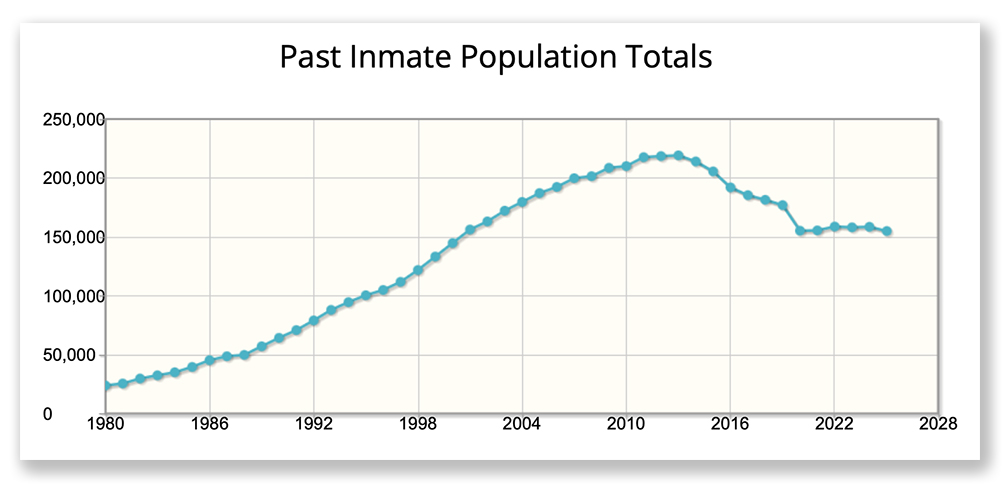
The BOP population swelled nearly tenfold between 1980 (about 25,000 prisoners) and over 219,000 in 2013. The Sentencing Reform Act of 1984, mandatory minimum sentencing laws, and the abolition of federal parole left the system severely overcrowded.

Due in large part to Attorney General Eric Holder’s Smart on Crime Initiative, a policy that reserved the harshest federal penalties for the most serious offenders while reducing the prosecution of some low-level, nonviolent drug cases and later to Trump’s First Step Act, the BOP population has fallen by 30 percent since then.
BOP inmates at the affected institutions only learned that they would be relocated soon to locations not disclosed to them. The closure of these facilities will require the transfer of nearly 4,000 inmates to institutions across the federal system.
Congress observed in the First Step Act that placing prisoners close to their families was not only humane but contributed to rehabilitation. Thus, 18 USC 3621(b) provides that the BOP
shall designate the place of the prisoner’s imprisonment, and shall, subject to bed availability, the prisoner’s security designation, the prisoner’s programmatic needs, the prisoner’s mental and medical health needs, any request made by the prisoner related to faith-based needs, recommendations of the sentencing court, and other security concerns of the Bureau of Prisons, place the prisoner in a facility as close as practicable to the prisoner’s primary residence, and to the extent practicable, in a facility within 500 driving miles of that residence…
Sadly, that provision has more holes than a Swiss cheese factory. Any minimally competent BOP facility designator can easily find an excuse – bed availability, population management, education or medical needs, and the undefined but expansive “other security concerns” – to place a Hawaiian in New Hampshire or a Floridian in California.
To top it off, § 3621(b) provides that “notwithstanding any other provision of law, a designation of a place of imprisonment under this subsection is not reviewable by any court.”
In other words, the provision is utterly toothless.
 Writing in Forbes, Walter Pavlo observes that “[d]ecades of correctional research have consistently shown that maintaining family connections is one of the strongest predictors of successful reentry and lower rates of recidivism.” Good luck with that. Pavlo notes that “[f]or thousands of inmates and their families, a prison closure is not just a change in address. It is a significant disruption to the stability they have worked to build while incarcerated.”
To be sure, Marshall has an unenviable task before him. The BOP has a potful of money for repairs over the next few years, but even that is insufficient for the more than $4 billion in maintenance needed. In announcing the closures, Marshall said, “We are a Bureau that acts. These actions are necessary to address longstanding infrastructure and staffing challenges while ensuring the Bureau remains focused on its core mission of operating safe, secure, and efficient correctional facilities. We will support our workforce throughout this transition and responsibly position the agency for the future.”
BOP, Federal Bureau of Prisons Announces Facility Closures and Operational Changes (July 1, 2026)
The New York Times, Bureau of Prisons Will Close Facilities Housing Thousands of Inmates (July 1, 2026)
Forbes, Bureau of Prisons Announces Multiple Facility Closings Citing Budget (July 1, 2026)
~ Thomas L. Root