Tag Archives: Marshall

Contraband and Lousy Food – Update for February 27, 2026

We post news and comment on federal criminal justice issues, focused primarily on trial and post-conviction matters, legislative initiatives, and sentencing issues.

A REMARKABLE ADMISSION… AND A WARNING

BOP Director William K. Marshall took to video last week to describe with uncommon candor the BOP’s losing battle with contraband in its facilities.

In a 5-minute video posted on the BOP website, Marshall said BOP staff is confronting a steady stream of drugs, weapons and drone drops, some of which is being introduced by corrupt BOP employees.

In the last 10 months, BOP staff have used Narcan in more than 500 apparent overdose incidents. Drugs found in facilities include fentanyl, methamphetamine, marijuana, liquid-soaked papers, Suboxone strips, amphetamines, mushrooms and vapes. In the same time period, Marshall noted, the BOP has intercepted 228 drone drops, seized nearly 17,000 cell phones, confiscated 4,300 weapons, recovered nearly 50 lbs. of methamphetamine, and stopped 231 visitors with contraband.

Notably, Marshall disclosed that the BOP has conducted contraband investigations involving 260 staff members. He recounted one case in Texas where a staff member was caught smuggling tobacco into a facility. 

It is both evidence of the severity of the problem and of Marshall’s willingness to recognize reality that he acknowledged that some of the contraband problem is staff-driven. (But then, in the past 10 months, Marshall has proven himself to be a very different director. He is the director who looked at a plate of expired dining hall food being served to an inmate during a facility visit last summer and asked a warden, “Would you eat that? If the answer is ‘no,’ then don’t serve it. Period. That’s` not just about food safety, that’s about human decency”).

As for the contraband problem, Marshall said, “These numbers represent real threats stopped by real people. But for every attempt we catch, others are still trying.” And he had a warning: “We are prosecuting anyone, whether a visitor, a staff member, or an inmate who attempts to introduce contraband into our facilities. This unified approach sends a clear message – criminal activity in or around federal prisons will not be tolerated, and those responsible will be held accountable.”

William Marshall, Growing Threat of Contraband in the Bureau of Prisons (February 17, 2026)


Forbes, “Would You Eat That? A Leadership Question at the Bureau of Prisons (February 11, 2026) 

~ Thomas L. Root

BOP To Close Terminal Island – Update for December 1, 2025

We post news and comment on federal criminal justice issues, focused primarily on trial and post-conviction matters, legislative initiatives, and sentencing issues.

TERMINAL ISLAND CLOSING AS BOP RAMPS UP INFRASTRUCTURE REPAIR

The Federal Bureau of Prisons is closing FCI Terminal Island – located near Long Beach, California, near Los Angeles – over concerns about crumbling infrastructure, according to an internal memo obtained last week by the Associated Press.

Director William K. Marshall III told BOP staff on Tuesday that the agency is suspending operations at Terminal Island, a low-security prison south of Los Angeles that currently houses 952 inmates. The decision to close the facility “is not easy, but is absolutely necessary,” Marshall wrote, calling it a matter of “safety, common sense, and doing what is right for the people who work and live inside that institution.”

Marshall said if the prison remains open, falling concrete in tunnels that deliver infrastructure could hurt workers or create a prison-wide emergency. “There is a very real risk that falling concrete could strike the steam lines,” he wrote. “If that happens, heat to the institution could be lost instantly, creating an emergency that could require the evacuation of nearly 1,000 inmates in a matter of hours. We are not going to wait for a crisis. We are not going to gamble with lives. And we are not going to expect people to work or live in conditions that we would never accept for ourselves.”

The 87-year-old Terminal Island facility is the latest prison to be targeted for closure as the BOP struggles with mounting staff vacancies, a $4 billion repair backlog, and an expanded mission to support President Trump’s immigration crackdown and to invest billions in a rebuilt Alcatraz prison.

In a statement to Government Executive, a BOP spokeswoman said efforts to protect staff and inmates at the facility will begin immediately. “A strategic and targeted approach will be used to relocate inmates currently housed at FCI Terminal Island to other locations across the agency,” she said. “Several placement options are being evaluated, with a priority on keeping individuals as close as possible to their anticipated release locations.”

BOP said decisions regarding what to do about the facility, including whether and how to repair it, will wait until a “further assessment” of the situation there. News of the planned evacuation came just days after the agency touted $2 billion in funding to address deferred maintenance priorities across the federal prison system from this year’s budget reconciliation law.

According to the Los Angeles Times, an assessment last year revealed that Terminal Island needs $110 million in repairs over the next 20 years, raising questions about whether the BOP will ever be in a position to move inmates back to the facility.

In late 2024, the BOP announced that seven other facilities would be shuttered. The decision to close one, FPC Duluth, was reversed, but the others have been decommissioned.

The report that Terminal Island will close came only a few days after BOP Deputy Director Joshua Smith released a video message to BOP staff reporting that $2 billion had become available for repair of BOP infrastructure. He said the BOP hasn’t

wasted a minute. We began with the simplest most commonsense step imaginable. We looked at how money was actually being spent, and what we found was jaw-dropping. Entire complexes that included two USP’s getting only $1.8 million, while a standalone USP somehow got $2 [million]. No rhyme, no reason, just the same old good old boy system deciding whose friends got taken care of.

Smith said that facilities, functions planning, construction, maintenance, and environmental energy – roughly 2000 positions within the institutions – will report to his office. “This isn’t bureaucracy for bureaucracy’s sake,” Smith said. “That’s how we get things done, centralized oversight, national prioritization, real accountability, and the kind of data-driven decision making that finally lets us attack the backlog instead of just talking about it.”

The infrastructure program will depend on training inmates in skilled trades and having them work on infrastructure repair in positions that pay on a scale with UNICOR.

Associated Press, Federal Bureau of Prisons says falling concrete is forcing it to close a prison near Los Angeles (November 25, 2025)

Government Executive, Bureau of Prisons to ‘suspend operations’ at California penitentiary (November 25, 2025)

KABC-TV, San Pedro prison to suspend operations amid concerns over falling concrete (November 25, 2025)

Los Angeles Times, Crumbling ceilings in underground tunnels force closure of Terminal Island prison (November 26, 2025)

BOP, A New Era For Facilities (November 22, 2025)

~ Thomas L. Root

A Short Rocket of BOP News – Update for July 24, 2025

We post news and comment on federal criminal justice issues, focused primarily on trial and post-conviction matters, legislative initiatives, and sentencing issues.

LAST WEEK AT THE BUREAU OF PRISONS

You’d think that the sole focus of the Federal Bureau of Prisons in the last week had been how to produce celebrity prisoner Ghislaine Maxwell for a Congressional deposition. But from Duluth to Alcatraz, there was a lot else going on as well. Here’s the short rocket…

Marshall Establishes FSA Task Force:   Bureau of Prisons Director William K. Marshall III announced the established of an FSA Task Force at the BOP’s Grand Prairie, Texas, Designation and Sentence Computation Center.

Marshall cited inmate “frustration that their paperwork for home confinement under the First Step Act (FSA) wasn’t being processed by staff despite Director Marshall’s directive to maximize the use of community placement. But at the same time, the staff told [Marshall] that the systems they rely on weren’t always showing the right dates… The majority of staff were doing their best with the information they had, but, unfortunately, they were taking the blame from inmates and families who thought they were dragging their feet. That wasn’t fair to them.”

The task force will identify prisoners in halfway houses who are eligible for home confinement; manually calculate home confinement dates that “stack[] both the FSA and Second Chance Act;” and ‘[r]eview eligible incarcerated individuals inside institutions for additional community placement opportunities.”

Writing in Forbes, Walter Pavlo said, “Having a person serve a portion of their sentence in the community is not something new and has been used for decades by the BOP. However, the Agency has been slow to move inmates after the [First Step Act] was codified… in January 2022. The initiative is part of Director Marshall’s broader strategy of “Leadership in Action,” which has included institutional walk-throughs, direct engagement with frontline staff, and timely operational changes based on what he hears.”

BOP, Director Marshall Launches FSA Task Force (July 14, 2025)

Forbes, Bureau of Prisons Launches First Step Act Task Force (July 14, 2025)

Alcatraz Moves Forward:  Never mind that the price tag has blown through $2 billion to renovate a prison closed for 60 years that only houses 325 prisoners and has no water supply. A visit to Alcatraz Island in San Francisco Bay last week by Attorney General Bondi, Dept of the Interior Secretary Doug Burgum, Marshall, and BOP Deputy Director Joshua J. Smith makes it clear that President Trump’s May musings on social media that he wanted to reopen Alcatraz as a federal prison to “house America’s most ruthless and violent offenders” and remove criminals “who came into our country illegally,” is going to happen.

A BOP press release underscores that reopening Alcatraz is pure symbolism, the fevered dream of President Trump: “Reopening Alcatraz isn’t just about a building, it’s about sending a message: crime doesn’t pay, and justice will be served. If feasible, Alcatraz will stand as a beacon of American resolve, where the most dangerous offenders face accountability. For the public, it’s a promise fulfilled—a stronger, safer America. And for President Trump, it’s a project that will make our nation proud.”

Alcatraz was closed as a maximum-security prison in 1963 after 29 years of operation, because it was too expensive to continue operating. Now managed by the National Park Service, the island is one of San Francisco’s most popular tourist destinations.

BOP, The Rebirth of Alcatraz (July 17, 2025)

NY Times, Trump’s Plan to Reopen Alcatraz Appears to Move Forward With Officials’ Visit (Jul 17)
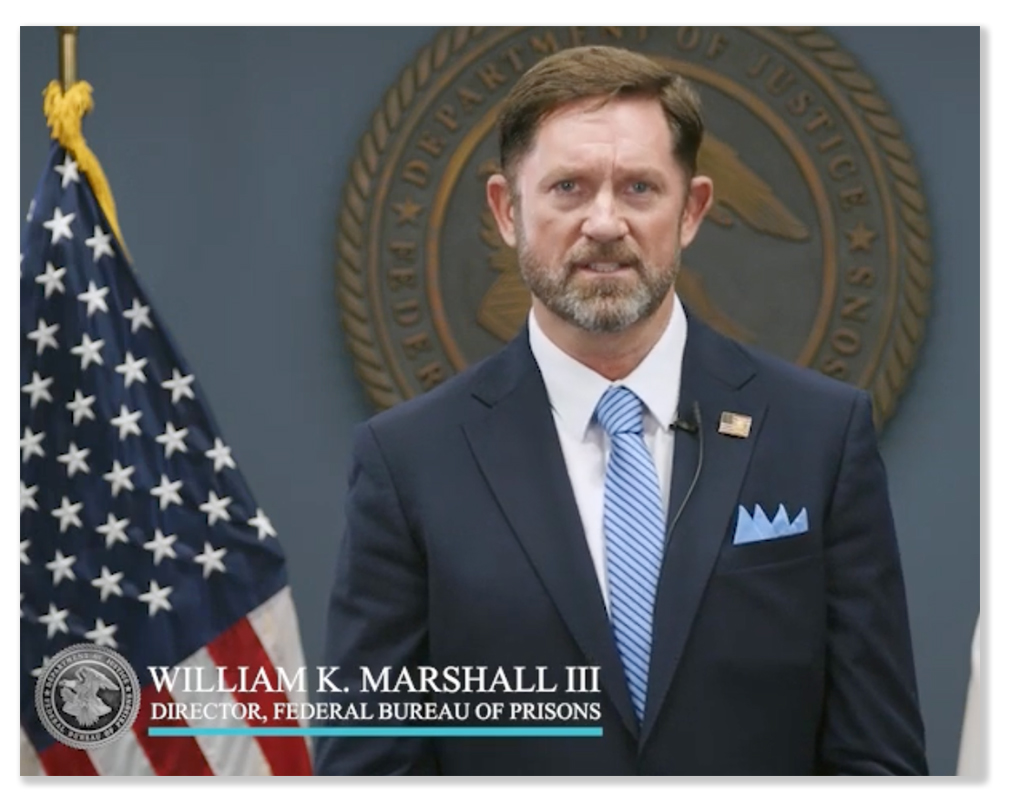
FPC Duluth to Remain Open: Seven months after the then-BOP Director Colette Peters listed FPC Duluth with six other facilities that would be closed because of “aging and dilapidated infrastructure,” new BOP boss William K. Marshall III announced last week after a site inspection that the minimum-security camp “will not be deactivated.”

Currently, there are only about 258 inmates remaining at the facility, but officials anticipate repopulating the camp to its rated capacity of about 800 prisoners. The camp is located on the grounds of the former Duluth Air Force Base.

Minnesota Public Radio, Duluth prison camp to remain open, reversing earlier decision to ‘deactivate’ the facility (July 16, 2025)

ICE Sending Immigrant Detainees to FDC Honolulu, Proposes Using Fort Dix: Under normal circumstances, scoring an all-expenses-paid trip to Hawaii would be a Wheel of Fortune moment.  But these are not normal circumstances.

It turns out that over 70 immigrant detainees, some from as far east as Florida, are being flown to imprisonment at the Federal Detention Center in Honolulu.

The Honolulu Civil Beat quoted one immigration lawyer as saying that a client “was taken into custody in Florida and went to two detention centers there before he was transferred to Louisiana, Arizona and two facilities in California before finally coming to Hawaiʻi.” Attorneys are complaining that the endless moves and distances make consultation with their clients almost impossible.

Homeland Security Secretary Tom Homan said over the weekend that 60,000 immigrants are currently in custody, with plans for 40,000 more.

Still, air conditioning in the Aloha State may be better than a tent in the South Jersey heat. Last week, Secretary of Defense Pete Hegseth approved the use of Joint Base McGuire-Dix-Lakehurst, where FCI Fort Dix is located, to confine immigrants. The Defense Department said detainees would be confined in “temporary soft-sided holding facilities,” suggesting for now that facilities at the aging FCI Fort Dix – located on base grounds – will not be used.

Honolulu Civil Beat, ICE Is Moving Immigrants Arrested On The Mainland To Honolulu (July 16, 2025)

Philadelphia Inquirer, Trump administration plans to hold immigration detainees on South Jersey military base (July 18, 2025)

~ Thomas L. Root

BOP’s ‘Big, Beautiful’ Budget – Update for July 17, 2025

We post news and comment on federal criminal justice issues, focused primarily on trial and post-conviction matters, legislative initiatives, and sentencing issues.

MONEY, THAT’S WHAT I WANT

Slate magazine published a piece a week ago complaining that “the Trump administration has thrown the lives of incarcerated people into chaos—especially the more than 150,000 people under the jurisdiction of the Federal Bureau of Prisons.”

Slate admitted that the BOP’s crisis has been “long-standing,” with issues ranging from crumbling infrastructure to sexual assault to severe staffing shortages. However, Slate argued, “incarcerated people and BOP experts say that in just a few short months, the Trump administration has exacerbated this crisis. He has implemented major pay cuts, issued confusing and short-sighted orders, directly targeted vulnerable incarcerated populations, and haphazardly slashed funding for crucial initiatives.”

The Slate article hit the streets only a day after Trump signed the Big Beautiful Bill Act (HR 1)  which passed Congress by the thinnest of margins. But it turns out that the bill may undercut any of the damage that Slate has laid at the President’s feet.

Last week, BOP Director William K. Marshall III issued a video message to staff in which he noted that HR1 “provides $3 billion in staffing support over several years… for hiring of new staff and the salary and benefits for current employees “as well as “”funding for training which will address a critical need of our employees.” The $3 billion will be spread over five years “which equates to approximately $600 million a year through Sep 30, 2029.”

The BBB also provides $2 billion “for the maintenance and repairs” of BOP facilities, which carry a price tag of almost $3 billion but a maintenance budget – before BBB – of about $150 million. Marshall said the $2 billion will be used to “tackle major repair projects that prioritize those that involve life safety security and operational agency. It is a major step forward in reducing the maintenance backlog and enhancing our facilities to meet the standards we expect in our own homes…”

The BBB’s $5 billion is a one-shot funding that will expire September 30, 2029. However, money to meaningfully address crumbling infrastructure and full staffing – which should lead to ending the frequent lockdowns and augmentation that disrupts programming – may benefit prisoners as much as it does staff.

Slate, A Surprise Target of Trump’s Cutbacks Is Devastating One Specific Population (July 5, 2025)

BOP, Director’s Message (July 11, 2025)

HR1, The Big Beautiful Bill Act (July 4, 2025)

Thomas L. Root

Less than Meets the Eye – Update for June 30, 2025

We post news and comment on federal criminal justice issues, focused primarily on trial and post-conviction matters, legislative initiatives, and sentencing issues.

A TRULY SHORT STACK

A week ago, I reported that BOP Director William K. Marshall III had announced the dawning of a new day in the use of First Step Act credits (FTCs) and the Second Chance Act. Among his several promises was that his new policy “ensures that FSA Earned Time Credits and SCA eligibility will be treated as cumulative and stackable, allowing qualified individuals to serve meaningful portions of their sentences in home confinement when appropriate.”

It turns out that the new memo doesn’t exactly say “cumulative and stackable”. Instead, it directs that “[i]n addition to FTCs for those individuals who have earned less than 365 days of FTCs, staff must also consider adding up to an additional 12 months of prerelease time under the SCA, based on the five-factor review.”

Under the heading “The Rules Are Clear,” a number of institutions last week issued guidance that doubled down on the memo. The “guidance” stated, “For individuals who have earned less than 365 days of FSA time credits towards supervised release, staff must also consider adding up to an additional 12 months of pre-release time under the SCA based on the five-factor review. The FSA Time Credit Worksheet for time under the SCA defaults to and will remain “zero” until your Unit Team inputs the pre-release time as determined based on the five-factor review. The number will range from zero to 12 months.”

Notwithstanding the heading, the only thing “clear” in all of this is the implication that, despite what the Director said, people who have more than 365 FTCs to be used toward prerelease custody will probably not be getting any SCA time whatsoever.

Practically speaking, no one with a sentence of under 46 months will earn any FTCs that go to prerelease custody. That’s because it is only mathematically possible to earn 365 days in a sentence of that length, after being adjusted for good time granted under 18 USC § 3624(b). All of the 46-monthers’ FTCs will be used up in cutting their sentences by 12 months. It will take a sentence of at least 74 months before a prisoner has accumulated more than 365 additional FTCs to be used toward more halfway house or home confinement. So the people with the most time – more than 74 months – being the ones most likely to benefit from the stacking, who will feel the impact of the non-stacking “stacking.”

Much of the problem arises from the tension between First Step and the SCA. Under the “five-factor review” (set out in 18 USC § 3621(b)), inmates are placed in halfway house not as a reward but rather because they need the prerelease custody time to give them “a reasonable opportunity to adjust to and prepare for the reentry.” 18 USC § 3624(c). First Step, on the other hand, treats halfway house/home confinement as a reward for earning FTCs. There’s nothing wrong with either approach, but the problem comes in mixing the two: despite all the fine talk about time being “cumulative and stackable,” the five-factor review applied to someone who is already entitled to 12 months in a halfway house as an incentive under the FSA is very unlikely to need any more than that amount of time there to have “a reasonable opportunity to adjust to and prepare for the reentry.”

The “five-factor review” will and probably should disqualify anyone with 12 months of prerelease custody under the FSA from any additional SCA prerelease time. If 12 months in a halfway house isn’t enough to prepare an inmate for release into the community, then (1) he or she probably is not rated as having a low chance of recidivism to begin with, and thus is ineligible to use any accumulated FTCs; and (2) will not make it in society once released.

I got email from an inmate last week denouncing the institutional guidance as “a very inmate-unfriendly interpretation of how FSA and SCA interact (despite the FSA saying time limits on SCA don’t apply and that FTCs should be in addition to other incentives).” But SCA halfway house was never meant to be an incentive, but rather was intended to be a tool for people who needed the transition time and services of a halfway house.

For now, the Director’s new policy suggests that we’ll see a lot more FSA prerelease time served on home confinement. That’s probably good for the BOP and prisoner alike. However, despite the “stackable and cumulative” talk, there is little reason to think that the “five-factor review” will result in stacked FSA and SCA prerelease custody time than it did before.

BOP, Bureau of Prisons Issues Directive to Fully Implement First Step Act and Second Chance Act (June 17, 2025)

BOP, Memorandum on Use of Home Confinement as a Release Option (June 17, 2025)

BOP, Home Confinement and Pre-Release Placement Updates (June 25, 2025)

– Thomas L. Root

More About the Cheese – Update for June 23, 2025

We post news and comment on federal criminal justice issues, focused primarily on trial and post-conviction matters, legislative initiatives, and sentencing issues.

THE DEVIL’S IN THE DETAILS

Last Friday, I wrote about the Federal Bureau of Prisons’ latest pronouncements on how it would implement the “awards” portion of the First Step Act time credits (FTCs) program.

You recall that federal prisoners may earn FTCs for successful completion of evidence-based recidivism reduction programs (EBRRs), classes and vocational programs and therapy shown to reduce their likelihood to again fall into crime after release.

By and large, the EBRR program is good stuff. The Attorney General’s report last June reported that recidivism among people who had completed recidivism assessment and programming was coming in substantially lower than even the rosy assessments made right after First Step passed. (Note: We should be seeing the AG’s June 2025 update any day now).

To entice inmates to earn FTCs, the First Step Act provided that the credits could reduce the sentence of an eligible prisoner by up to a year, and FTCs left after the sentence reduction could be used for more halfway house and home confinement. But the BOP has been all over the map as to how to implement the awards, leaving a lot of prisoners and their families feeling puzzled, frustrated or betrayed.

The other factor in play is the BOP’s authority under the Second Chance Act of 2007 to place an inmate in a halfway house for up to 12 months at the end of his or her term, with 10% of his or her sentence (up to six months) of the final term being served on home confinement.

Last week, I only had the BOP’s press release to work from, but over the weekend, I obtained a copy of the new memo – entitled “Use of Home Confinement As A Release Option.” The 4-page memorandum from BOP Director William K. Marshall III to wardens suggests a bold, new pro-release mindset at the BOP, but – as with everything in this world – the devil’s in the details.

The memo’s highlights:

• The BOP will treat its authorizations under the First Step Act and Second Chance Act as cumulative. BOP staff shall and apply those in sequence to maximize prerelease time in community custody, including home confinement.

• Halfway house “bed availability/capacity shall not be a barrier to home confinement when an individual is statutorily eligible and appropriate for such placement.”

• If a First Step Act or Second Chance Act eligible prisoner does not require the services of a halfway house, the inmate “shall be referred directly from an institution to home confinement.” Halfway house “placement should be prioritized for those in our custody with the most need for services available at a [halfway house].”

• Referrals shall proceed with the understanding that so long as prisoners meet First Step Act and Second Chance Act eligibility requirements, “they shall receive the forecasted credits and ordinarily should not experience delays in prerelease placement based on administrative timing, presumed [halfway house] capacity limits or placement constraints, or pending credit accrual.”

• Under the Second Chance Act, inmates may be placed in prerelease custody for a period of up to 12 months (halfway house) or 6 months or 10 pct of their sentence (home confinement), whichever is less. “The Second Chance Act Conditional Placement Date reflects the window under 18 USC § 3624(c) —up to 12 months (halfway house) or 6 month or 10% of the sentence (home confinement)—for which the individual is expected to qualify, subject to a five-factor review. “There is no restriction concerning how many FTCs may be applied toward home confinement. For individuals only eligible under the Second Chance Act, referrals must comply with 18 USC § 3624(c), including a five-factor review and documentation of eligibility based on sentence length (12 months [halfway house] or 6 month or 10% (home confinement), whichever is less).”

• For prisoners “who have earned less than 365 days of FTCs, staff must also consider adding up to an additional 12 months of prerelease time under the Second Chance Act, based on the five-factor review.”

• Home confinement candidates must be able to show a verified and stable home environment that supports monitoring, appropriate supervision, and safe community reentry and integration, and that they pose no public safety or placement disqualification. Employment history shall not be required. For individuals at or near working age, potential for employment may be considered positively, but is not mandatory.

Note what has not changed: Second Chance Act placement is still based on the BOP’s “five-factor” review, found in 18 USC § 3621(b):

(1) the resources of the halfway house;

(2) the “nature and circumstances of the offense;”

(3) the history and characteristics of the prisoner;

(4) any statement by the court that imposed the sentence about “the purposes for which the sentence to imprisonment was determined to be warranted; or recommending a type of penal or correctional facility as appropriate;” and

(5) any pertinent Sentencing Commission policy statement.

The memo and the “five factor” review contain enough wiggle room to enable the BOP to justify disqualifying Mother Teresa from halfway house or home confinement placement. Home confinement will be allowed for “qualified individuals,” but the memo directs that “placement decisions should prioritize public safety and the overall stability of the release plan.” Second Chance Act halfway house time is subject to review that is broad enough to let the BOP cut or take away halfway house on the basis of the crime or what it thinks of the prisoner.

Those persons who recall that in the late months of CARES Act home confinement placement, the BOP began asking inmates’ prosecutors for their views on sending a prisoner home, may have good cause question what may happen in the latest opaque review process.

BOP, Memorandum on Use of Home Confinement as a Release Option (June 17, 2025)

BOP, Bureau of Prisons Issues Directive to Fully Implement First Step Act and Second Chance Act (June 17, 2025)

– Thomas L. Root

A Pair and a Half of Shorts – Update for May 30, 2025

We post news and comment on federal criminal justice issues, focused primarily on trial and post-conviction matters, legislative initiatives, and sentencing issues.

Today, some shorts… just in time for warm summer weather.

shorts250530

SUMMER’S HERE – TIME FOR SOME SHORTS

Shocking News: BOP Healthcare Found Deficient – A report issued last week by the Dept of Justice Inspector General found that the BOP has failed to screen over a third of at-risk inmates for colorectal cancer (CRC). Between low screening offers and inmate refusals, less than half of average-risk inmates had a completed annual CRC screening.

healthbareminimum220603What’s more, out of a sample of 327 inmates, the IG found that around 10% had no documented follow-up after testing positive for CRC. Also, the Report found, the BOP lacked timeliness metrics for access to a colonoscopy for inmates with a positive CRC screening. The IG reported that “inmates in our sample waited an average of 8 months between a positive CRC screening and a colonoscopy.”

During the period covered by the Report, there were about 38,000 federal inmates who fell in the age range and “average risk” level for CRC. About 13,600 of them were not offered a screening, according to the Report.

BOP Director William K. Marshall III took time from being excited about a billion-dollar rebuild of Alcatraz (see below) to blame “longstanding staffing issues” for compromising efforts to screen inmates for colorectal cancer in certain facilities.

DOJ Inspector General, Evaluation of the Federal Bureau of Prisons’ Colorectal Cancer Screening Practices for Inmates and Its Clinical Follow-up on Screenings (Report 25-057, May 20, 2025)

Washington Post, Prisons bureau failed to screen inmates for colorectal cancer, watchdog says (May 20, 2025)

shorts250530

Sentencing Commission Releases 922(g) Data: About 7,500 people are convicted every year for 18 USC § 922(g) offenses, the US Sentencing Commission reported last week.

funwithnumbers170511The USSC said men accounted for 98% of all convictions, with 58% of them being black, 21% white and 17% Hispanic. The average age for defendants at conviction was 36 years old.

The defendants were overwhelmingly US citizens (95%). About 24% were Criminal History Category III and another 24% fell into Criminal History VI (the highest category).

USSC, Section 922(g) firearm offenses (May 22, 2025)

shorts250530

BOP Director Calls Rebuilding Alcatraz “Exciting Opportunity”: BOP Director William K. Marshall III, who has less than $200 million in his FY 2025 budget to make $3 billion in infrastructure repairs to existing prisons, told Fox News a week ago that his team is actively exploring the possibility of reopening Alcatraz, the 330-bed penitentiary on an island in San Francisco Bay.

excited250530Marshall called the project – a late-night idea President Trump hatched late on his inaptly-named “Truth Social” site a month ago – an “exciting opportunity” and one that aligns with the Trump administration’s law-and-order priorities.

Last week, KTVU-TV reported that estimates to make the repairs needed to reopen Alcatraz as a prison are close to $1 billion, plus another $40 million to $100 million a year in maintenance.

Corrections1, BOP director: Reopening Alcatraz is an ‘exciting opportunity’ (May 23, 2025)

KTVU, Bureau of Prisons director ‘excited’ about reopening Alcatraz as max-security prison (May 23, 2025)

– Thomas L. Root

They’re Just Inmates Once Again, Billy Says – Update for May 6, 2025

We post news and comment on federal criminal justice issues, focused primarily on trial and post-conviction matters, legislative initiatives, and sentencing issues.

LUCKY 13?

William K. Marshall III has been sworn in as the 13th BOP Director, the agency reported last week.

unlucky13250506The number ‘13’ is traditionally seen as unlucky. Superstition or not, Marshall will need a large dose of good fortune to right the BOP, let alone to avoid the fate of the prior three directors, who were fired or quit under pressure.

Putting first things first, Billy made the bold move of ordering that inmates no longer be called “Adults in Custody,” the kinder, gentler term ushered in by the last director, Colette Peters. Walter Pavlo reported on LinkedIn that one of Billy’ first last week was rolled out in an internal email telling staff that “effective immediately BOP will no longer adhere to Adult in Custody (AIC / AICs). Please ensure as of Monday, April 28, 2025, all BOP templates, memos, etc. reflect the usage of inmate(s).”

On his plate right after that may be a BOP corrections officer who was indicted last week in the Eastern District of Pennsylvania US District Court for allegedly sexually abusing an FDC Philadelphia adult-in-custody – oops, an inmate – by using force. The US Attorney’s Office said the inmate was injured during the incident, which occurred last July.

Ironically, last week the Senate passed the Prison Staff Safety Enhancement Act (S.307), sponsored by Sen Marsha Blackburn (R-TN) and Sen Jon Ossoff (D-GA), to address inmate sexual harassment and sexual assault of BOP staff. The bill, intended to build on the DOJ Inspector General’s 2023 report about inmate-on-staff sexual harassment, now goes to the House of Representatives.

The same bill passed the Senate late last year but died when Congress ended without the House acting on it.

The law that would provide additional protections to federal inmates, the Federal Prison Oversight Act, became law last summer, “but it hasn’t gone into practical effect yet, due in part to funding issues,” Washington Stand reported last week.

morale250225Marshall’s most immediate problem is perhaps the most insoluble. The BOP’s struggles with severe staffing shortages that are chronic and well documented, yet the Trump Dept of Government Efficiency just eliminated BOP employee retention bonuses, created in 2021 to keep prisons open. Trump’s Executive Order stripping BOP employees of collective bargaining rights, handed down a month ago, exacerbated the crisis, which is now “a self-fueling monster [with] low staffing levels cause mandatory overtime, stressful conditions, burnout, and, unsurprisingly, high rates of turnover,” the Hill said last week.

Billy has inherited a tinderbox. Pleasing his bosses while keeping it from igniting will require skill and more luck than his predecessors have had in the last seven years.

BOP, Deputy AG Blanche Swears in William K. Marshall III (April 28, 2025)

Cherry Hill Courier-Post, Cherry Hill corrections officer accused of sexual abuse at Federal Detention Center (May 2, 2025)

Prison Staff Safety Enhancement Act (S.307)

DOJ Inspector General, Evaluation of the Federal Bureau of Prisons’ Efforts to Address Sexual Harassment and Sexual Assault Committed by Inmates Toward Staff (Feb 23, 2023)

Federal Prison Oversight Act, PubL 118-71, 138 Stat 1492 (July 25, 2024)

Washington Stand, Trump’s First Step Act Was a Monumental Success. His New Administration Has a Chance to Build On It. (May 1, 2025)

The Hill, Prison understaffing: A crisis seen by few, felt by prisoners and prison employees (April 26, 2025)

– Thomas L. Root

New BOP Sheriff In Town – Update for April 18, 2025

We post news and comment on federal criminal justice issues, focused primarily on trial and post-conviction matters, legislative initiatives, and sentencing issues.

TRUMP APPOINTS NEW BOP DIRECTOR

lawandorder161219The Federal Bureau of Prisons has been rudderless since January 20th, when then-director Colette Peters was unceremoniously shown the door by the incoming Trump Administration. Last week, Trump announced that he was appointing William “Billy” Marshall III, commissioner of the West Virginia Division of Corrections and Rehabilitation, as the latest BOP Director.

Trump said on social media that “Billy is a Strong Advocate for LAW AND ORDER. He understands the struggles of our prisons better than anyone, and will help fix our broken Criminal Justice System. Congratulations Billy, you will inspire us all!”

Marshall, a Marshall University and the West Virginia State Police Academy graduate, served 25 years with WVSP before retiring in 2017. He then served as the Criminal Investigation Director for the state Dept of Military Affairs and Public Safety. He became head of the state prison system in 2023.

lawandorderb161219Walter Pavlo wrote in Forbes that Marshall is “someone who is going to be tough on crime. However, he is going to head an organization that is substantially larger than the approximately 6,000 state prisoners in West Virginia… There are federal prison compounds that hold more inmates than all of the state of West Virginia.” Nearly 9,000 federal prisoners are held in BOP facilities located in West Virginia.

“WV regional jails have come under scrutiny for squalid conditions, excessive use of force and record numbers of deaths,” the Los Angeles Times reported. “They were the target of several civil rights suits, including one filed in 2022 that alleged the jail had broken toilets infested with maggots, 70 people sharing a single shower, and people being forced to sleep on ‘cold, wet floors in the winter without heat’.”

Marshall accused inmates of “ma[king] up claims of inhumane treatment and [telling] relatives to spread them,” television station WCHS reported in 2023.

excessiveforce250418Lydia Milnes, an attorney who has sued the WV DCR several times, told the Times, “I’m concerned that he comes from a past where the culture is to use force to gain control as opposed to considering less violent alternatives. He has continued to foster a culture of using excessive force.”

A separate suit, which the corrections department settled in 2022, alleged widespread failures of the jails’ medical and mental health care.

Forbes, Trump Announces New Director of the Bureau of Prisons (April 11, 2025)

Los Angeles Times, Trump’s new director of federal prison system led a troubled state agency (April 12, 2025)

– Thomas L. Root