Tag Archives: DOJ inspector general

Shocking News – BOP Healthcare ‘Unacceptable’ – Update for September 15, 2025

We post news and comment on federal criminal justice issues, focused primarily on trial and post-conviction matters, legislative initiatives, and sentencing issues.

DOG BITES MAN

In journalism, a ‘dog bites man’ story is one that is completely unsurprising and unremarkable. Last week, in a perfect example of this genre, the Dept. of Justice Office of Inspector General reported that yet another Bureau of Prisons facility was providing grossly substandard healthcare to inmates.

On Wednesday, the OIG issued a report on its unannounced inspection of FDC SeaTac, the detention center located about a thousand yards south of SeaTac Airport between Seattle and Tacoma, Washington. The inspection was conducted under the OIG’s authority granted in the Federal Prison Oversight Act, which requires regular independent reviews of BOP facilities.

The inspection, which occurred last December, found only three out of the FDC’s nine nursing positions and one of two pharmacist positions were filled. “At the time of our inspection,” the Report said, “10 of 20 Health Services Department positions were vacant, including the Clinical Director position (which had been vacant for at least 18 months). Moreover, based on the BOP’s own staffing projection tool, the institution appears to require a doubling in the size of its Health Services Department—from an authorized level of 20 positions to 40 positions—to meet its healthcare needs.”

The report was the sixth issued by the OIG on unannounced inspections of BOP facilities, all of which were unstinting in their criticism of BOP healthcare. A report that yet another BOP facility was not meeting inmate medical needs was

Even the FDC SeaTac Health Services Department leadership called health services staffing a crisis. The short staffing meant that Health Services “had to prioritize the provision of emergency care to inmates and we identified extensive delays in care for both routine and serious health concerns. For example, we identified concerns with FDC SeaTac’s ability to provide medical care to inmates who submit medical care requests. We selected a sample of 29 medical requests that appeared to be among the most serious, including for respiratory distress and severe pain, and found that 62 percent (18 of 29) were never addressed by a healthcare provider. We also determined that FDC SeaTac was unable to provide timely outside medical appointments for inmates with conditions that could not be addressed at the institution.”

As of November 2024, SeaTac had a backlog of 480 blood draw orders more than 30 days past due, again due to staffing shortages. The Report said, “Health Services Department employees told us that without blood test results they could not appropriately monitor the health of inmates with chronic conditions, such as diabetes, or diagnose new illnesses. For example, more than half of diabetic inmates whose records we reviewed had not received necessary diabetic testing within recommended time frames.”

OIG staff also identified unsafe practices unrelated to staffing. Crushed pills were stored loosely in plastic bags. Exam tables were filthy. Hazardous medical waste bins overflowed. Expired medications were still in use and lab specimens were left unrefrigerated. Insects crawled through clinical areas, and staff food was stored alongside medical supplies.

Writing in Forbes, Walter Pavlo said, “The inspection paints a picture not just of underfunding but of dangerously neglected standards of care.”

Sen Patty Murray (D-WA) called the conditions at the detention center unacceptable. “Individuals in federal detention should not be forced to risk their lives because they can’t get urgent medical issues addressed,” she said in a prepared statement. “I’m reaching out to the Bureau of Prisons about this report—much more needs to be done to make sure people in federal custody can get the health care they need.”
Meanwhile, last Friday, DOJ announced more than 50 new measures aimed at reducing suicides among prisoners in federal custody. The announcement follows recommendations from a department-wide working group tasked with developing strategies to address suicide in prison and jail.

While federal facilities record a lower suicide rate compared to state prisons and local jails, officials said, DOJ must work to prevent every possible death. The new framework, outlined in the Report on Actions to Reduce the Risk of Suicide by Adults in Federal Custody and Advance a Culture of Safety, sets five objectives: expanding information sharing, improving access to mental health care, fostering healthier facility environments, reducing opportunities for self-harm, and forming policy through data-driven research.

Spokesman-Review, Federal inspection finds an inmate healthcare ‘crisis’ at SeaTac detention center amid health worker shortage (September 10, 2025)

DOJ Inspector General, Inspection of the Federal Bureau of Prisons’ Federal Detention Center SeaTac (September 10, 2025)

Federal Prison Oversight Act, Pub.L. 118-71, 138 Stat. 1492 (July 25, 2024).

Shore News Network, Justice Department launches sweeping reforms to curb suicides in federal custody (September 12, 2025)

Forbes, Troubling Findings At FDC SeaTac: A 2025 OIG Inspection Report (September 10, 2025)

~ Thomas L. Root

Horowitz Leaves DOJ Inspector General Post – Update for July 11, 2025

We post news and comment on federal criminal justice issues, focused primarily on trial and post-conviction matters, legislative initiatives, and sentencing issues.

BOP INMATES LOSE A CHAMPION

DOJ Inspector General Michael Horowitz, one of the only federal government inspectors general to survive President Trump’s January purge, has left his position to become IG of the Federal Reserve.

Bloomberg Law reports that Horowitz’s departure “has former officials and lawyers worried that an era of robust, independent oversight of law enforcement is ending at the worst possible moment.”

Horowitz’s successor will face a growing pile of complaints seeking probes into top DOJ officials and White House efforts to shrink the IG’s budget by 28%. As the DOJ’s largest agency by employees and the second largest by budget (next to the US Attorneys’ offices), the BOP has drawn substantial oversight from Horowitz. Well before the Federal Prison Oversight Act passed, mandating regular inspections of BOP facilities, Horowitz began sending teams to prisons for surprise audits. The IG’s office added detail and official gravitas to many of the complaints that inmates have lodged for years.

Some in the IG and whistleblower communities told Bloomberg Law that they hope Horowitz’s veteran deputy,  William M. Blier, takes over the iG office and maintains “the office’s reputation for bipartisan accountability.” Blier is running things for the time being, but some fear that a new appointee will be a puppet.

“Mr. Horowitz personified a public servant who followed the evidence wherever it led, regardless of political party,” said Tom Devine, legal director at the Government Accountability Project, which represents whistleblowers cooperating with the IG’s office. “He will be sorely missed because he will be the last credible official source of factfinding at the Department of Justice.”

Bloomberg Law, Veteran DOJ Watchdog’s Exit Spurs Fears of Lax Trump Oversight (June 27, 2025)

– Thomas L. Root

Inspector General Blasts BOP Use of Restraints – Update for July 8, 2025

We post news and comment on federal criminal justice issues, focused primarily on trial and post-conviction matters, legislative initiatives, and sentencing issues.

RESTRAINTS KILL, MAIM INMATES THROUGH IMPROPER USE, IG SAYS

The Dept of Justice Office of Inspector General reported in a memorandum last week that BOP policies governing the use of physical restraints on inmates are inadequate.

BOP policy allows the use of restraints to gain control of disruptive inmates, ranging from ambulatory restraints that allow limited freedom of movement to four-point restraints and waist chains that render prisoners immobile from the neck down. Policy dictates that restraints are to be used only as a last resort and never as a method of punishment.

A 2022 Marshall Project/NPR investigation uncovered restraint abuses at USP Thomson. “Specifically,” the report said, “many men reported being shackled in cuffs so tight they left scars, or being ‘four-pointed’ and chained by each limb to a bed for hours, far beyond what happens at other prisons and in violation of bureau policy and federal regulations.” A subsequent  Marshall Project/NPR investigation last December reported on dozens of similar restraint abuse allegations of prolonged shackling and abuse at USP Lee.

The IG said it had received “numerous allegations every year regarding abuse, mistreatment, or injury of inmates in connection with the use of restraints, including four-point restraints.”  Between August 2022 and August 2023, complaints about four-point restraints alone numbered in the “dozens.”

Multiple complaints alleged inmates “suffered nerve damage or other long-term injuries due to the prolonged use of restraints. For example, one inmate suffered long-term scarring and was provisionally diagnosed with carpal tunnel syndrome due to ongoing complaints of wrist numbness after being held in four-point restraints for over 3 days…” The IG said, “[A]nother inmate suffered severe injury requiring the amputation of part of the inmate’s limb after being held in a combination of ambulatory restraints and a restraint chair for over 2 days.”

“The inmate’s injury worsened to the point of needing hospitalization and amputation despite medical checks occurring at time intervals that complied with policy,” the memo stated. “The medical checks were completed by different medical staff who did not discuss the progression of the inmate’s injuries between shifts, and there were no photographs or video recordings to document that a medical check was actually performed and to show the progression of the inmate’s injuries.”

In another case, the IG said, a prisoner was “placed in a restraint chair with restraints on both wrists and both ankles for more than 2 days and then, less than 2 hours after being released from restraints, sprayed by BOP staff with pepper spray following an alleged altercation with a cellmate and placed back in the restraint chair for another approximately 5 hours until being discovered unresponsive.” The autopsy listed the cause of death as “Vaso-Occlusive Crisis due to Sickle Cell Disease Complicating Oleoresin Capsicum Use and Prolonged Restraint Following Altercation.”

The memo recommended improving guidelines and training on the use of restraints, strengthening reporting requirements, and requiring audio and video recording of health checks of inmates in restraints.

DOJ Inspector General, Notification of Concerns Regarding the Federal Bureau of Prisons’ Policies Pertaining to the Use of Restraints on Inmates (June 30, 2025)

The Marshall Project and NPR, How the Newest Federal Prison Became One of the Deadliest (May 31, 2022)


Thomas L. Root

The Doctor Won’t See You Now – Update for January 6, 2025

We post news and comment on federal criminal justice issues, focused primarily on trial and post-conviction matters, legislative initiatives, and sentencing issues.

INSPECTOR GENERAL REVIEW OF FMC DEVENS YIELDS ANOTHER ‘DOG BITES MAN’ MOMENT

IG230518The DOJ Office of Inspector General began making unannounced inspections of BOP facilities over a year ago, even before the Federal Prison Oversight Act – which requires the OIG to conduct periodic inspections of BOP facilities based on its assessment of the risks such prisons pose to inmates and staff – became law last summer. Last month, the OIG released a report on the its fifth such inspection, conducted last April.

For anyone who has experienced BOP healthcare, the report is a real “dog bites man” moment. That may explain how the December 11th report was issued to nearly universal yawns. Writing in Forbes last week, Walter Pavlo noted it in passing, or we would have missed it, too.

The report is harrowing and deserves a full reading.

Devens – located about 33 miles west northwest of Boston – is an administrative-security (houses all security levels of inmates) medical center for prisoners with serious medical or mental health conditions. The facility consists of a federal medical center and an adjacent minimum-security prison camp that provides inmate labor to the medical facility. Both facilities house male prisoners only.

The first prisons the OIG hit in its inspection program were regular prisons, FCI Waseca and FCI Tallahassee (both female facilities), and FCI Sheridan and FCI Lewisburg (male). This time, the OIG said, “We selected FMC Devens as the site of our fifth inspection to better understand and assess the conditions of confinement at [a federal medical facility].”

doctorhouseB250106We’ve all heard of Doctors Without Borders. The OIG found that the BOP’s variation is “Hospitals Without Doctors.” The report found it “particularly concerning” that Devens had only 76% of its Health Services Department positions filled and had only a single physician “to manage the care of the entire inmate population of approximately 941 inmates: 2 of the institution’s 6 physicians were on extended leave without pay, and 3 other physician positions were vacant.”

Having a Clinical Director would have provided a second physician, but the CD, “who leads the provision of preventive health services and provides standing orders for nurses,” retired two months after the inspection. As of October 5, 2024, the report said, “the position remained vacant… leaving FMC Devens without this critical medical role filled and only one physician at the institution to provide daily patient care.”

This is hardly surprising: a doctor at FMC Devens makes about $282,000 a year. A physician at a nearby hospital emergency department earns about $415,300. Physician assistants and nurse practitioners at FMC Devens earn between $72,000 and $124,000; the same practitioners at a nearby hospital earn an average salary of $141,000.

BOP Director Colette Peters told a Congressional subcommittee last summer that a CO quit Devens to go to work at a local grocery store for better pay.

Half of the pharmacy positions, about a quarter of nursing positions, and the Chief Dental Officer position were vacant. Only 61% of the Psychology Dept positions are filled. The OIG said, “We are concerned that the staffing crisis at FMC Devens has cascading effects on its ability to care for its inmates and limits the quality and quantity of medical services it can provide, including for inmates who were transferred there expressly for its specific medical programs.”

The report also identified “concerns related to the quality of healthcare provided to inmates,” lack of preventive healthcare screening, inappropriate placement of inmates in the Memory Disorder Unit (MDU), and inconsistent processes for requesting and accessing care.” The inspectors found that 57 outside medical appointments for inmates were yet to be scheduled and were on average 53 days overdue at the time of our inspection due to outside medical provider cancellations and a lack of COs to escort inmates to scheduled appointments.

medical told you I was sick221017The OIG found “inconsistencies regarding inmates’ access to medical care,” including routine screening for diabetes and cognitive impairment, and “an apparent inconsistency” in how Health Services determined what constituted a need for sick cal. The report drily observed that “[t]his inconsistency may limit an inmate’s ability to be seen and receive medication in a timely manner, which could negatively affect their overall health.

In 2021, FMC Devens got $150,000 in First Step money to build a LifeSkills Laboratory, a space designed for inmates with serious mental illnesses to practice routine skills. More than three years later, the lab had yet to be used for programming.  

Taking government money for a project and then not carrying through can get you convicted if you aren’t the government…

DOJ Inspector General, Inspection of the Federal Bureau of Prisons’ Federal Medical Center Devens (December 11, 2024)

Federal Prison Oversight Act, Pub. L. No. 118-71, 138 Stat. 1492 (2024) (primarily codified at 5 U.S.C. §  413[e] )

– Thomas L. Root

Faking Suicide To Get Healthcare And Other BOP Tales of Horror – Update for May 23, 2024

We post news and comment on federal criminal justice issues, focused primarily on trial and post-conviction matters, legislative initiatives, and sentencing issues.

FCI SHERIDAN IS POSTER CHILD FOR BOP DYSFUNCTION

IG230518The Department of Justice Inspector General released a report yesterday that found “serious operational deficiencies,” including “alarming staffing shortages” at the Bureau of Prisons facility in Sheridan, Oregon.

One might say that BOP dysfunction is trending.

FCI Sheridan, a medium-security men’s prison with an adjacent detention center and prison camp, was Inspector General Michael Horowitz’s third unannounced prison inspection since the IG began the program at FCI Waseca (a women’s facility) last May. That report was followed by last November’s findings on a surprise inspection at FCI Tallahassee, another women’s facility. Now, after inspecting two female facilities, the IG has focused on the other 92% of inmates, the men.

IG Horowitz is taking Jan and Dean to heart: Two girls for every boy.

The dominant theme of the Sheridan report is staffing shortages and the effect the problem has on healthcare. providing a glimpse into the depth of inmates’ frustrated enterprise:

For example, we found that, just prior to our inspection, an inmate feigned a suicide attempt in order to receive medical attention for an untreated ingrown hair that had become infected. When finally examined after the feigned suicide attempt, he required hospitalization for 5 days to treat the infection.

gottaso240523No doubt the prisoner was punished for his desperate caper, but only he got out of the hospital. The BOP is unlikely to have acknowledged that it shared any responsibility for turning the simple ingrown hair removal into a $50,000+ medical expense. The inmate was right: you gotta do what you gotta do, and that includes doing what it takes to get urgent healthcare from an overtaxed and uncaring bureaucracy.

The Sheridan findings are plenty harrowing, even without the illustration of the faked suicide attempt. The IG summarized them as:

Healthcare Worker Shortages: Because of short staffing in the Health Services Department, a backlog existed of 725 lab orders for blood draws or urine collection and 274 pending x-ray orders at the time of the inspection. “These backlogs cause medical conditions to go undiagnosed and leave providers unable to appropriately treat their patients,” the report said.

High Correctional Officer Vacancy Rate: A shortage of correctional officers meant that “inmates must routinely be confined to their cells during daytime hours and are therefore often unable to participate in programs and recreational activities.” What’s more, the shortage meant that “FCI Sheridan did not always have available Correctional Officers to escort inmates to external medical providers.”

Psychology Services and Education Department Staffing Shortages: “[S]erious shortages among drug treatment program employees prevented the institution from offering its Residential Drug Treatment Program (RDAP) to inmates… We also found long waitlists, some exceeding over 500 names, for other trauma-related mental health, anger management, and work skills classes.”

Sexual Misconduct Reporting: FCI Sheridan did not centrally track the number of all allegations of inmate-on-inmate sexual misconduct reported to employees. The failure “undermines the ability of… the BOP to collect data consistent with Prison Rape Elimination Act (PREA) standards that would allow them to assess and improve the effectiveness of sexual misconduct prevention efforts.”

understaffed220929

NPR reported that the staffing shortages “are among the biggest obstacles facing the federal prison system, according to this report, and contribute to other challenges at Sheridan and the more than 120 facilities like it.” Horowitz told NPR that “[i]t’s a problem that is at least 20 years in the making. It’s not going to get fixed overnight. But what these inspections show us how serious the problem has now become.” Horowitz said. “It is deeply concerning when you go to a facility like Sheridan and you hear from the staff, correctional officers, health care workers, educators, that they can’t do the jobs that they’re there to do and they want to do.”

After this third IG inspection, a trend is developing:

• Both the Tallahassee and the Sheridan inspections found “serious operational deficiencies” and “alarming” problems. At FCI Tallahassee, the alarming conditions were with the facility’s execrable food service. At Sheridan, staff shortages were “alarming.” The IG is able to be frugal, reusing the same descriptors for multiple prisons.

• All three inspections included the same disclaimer: “We did not make recommendations in this report because in our prior work we have recommended that the BOP address many of these issues at an enterprise level.” In other words, the IG was reporting on endemic BOP problems that exist throughout the system. The Sheridan report parrots the prior reports, conceding that “[m[ost of the significant issues we found at FCI Sheridan were consistent with findings the OIG has made in other recent BOP oversight work, which we have reported on publicly.”

Nothing new here, either folks.

• We’re starting to suss out the inspection tempo. The Waseca report was last May, the Tallahassee report was in November 2023, and Sheridan was this week. It looks like the IG is inspecting about two facilities a year. Certainly, there are resource considerations: it takes people to kick open the prison doors. Horowitz told a National Press Club audience last March that “[m]y 500 personnel [are] comprised mostly of auditors and law enforcement agents. We also have evaluators and inspectors. One of the things we’re doing now, by the way, is unannounced inspections of federal prisons, and those are much smaller groups compared to the auditors and the agents.”

• All three inspections found serious staffing problems, which is hardly news. The Waseca and Sheridan inspections found long delays in providing First Step Act and drug abuse programming to inmates, which the Sheridan report said resulted in inmates having “limited opportunities to prepare for successful reentry into our communities. “ All three reports found that shortages of Healthcare staff had “negatively affected healthcare treatment” (as the Tallahassee report put it). The Waseca findings were that “staff shortages in both FCI Waseca’s health services and psychology services departments… have caused delays in physical and mental health care treatment.”

• The IG reports all seem to come with some sexy news hook. Waseca’s was inmates living in basements and under leaky pipes. Tallahassee’s was moldy food and rat droppings in the chow hall. Sheridan’s was the feigned suicide attempt to get healthcare.

suicide240523“What we’ve seen over and over again, in our unannounced inspections of the Bureau of Prisons is the challenges they face in meeting their mission of making prisons safe and secure, and preparing inmates for reentry back into society,” Horowitz told NPR in an interview reported yesterday. “And this is another case where we’ve seen severe challenges that they face in fulfilling those missions.”

DOJ Inspector General, Inspection of the Federal Bureau of Prisons’ Federal Correctional Institution Sheridan (May 22, 2024)

NPR, Lack of staffing led to ‘deeply concerning’ conditions at federal prison in Oregon (May 22, 2024)

National Press Foundation, ‘The Truth Still Matters’: Justice Department Inspector General Highlights Non-Partisan Work (March 15, 2024)

– Thomas L. Root

The Phone Just Keeps On Ringing For the BOP – Update for March 26, 2024

We post news and comment on federal criminal justice issues, focused primarily on trial and post-conviction matters, legislative initiatives, and sentencing issues.

PHONE CALL MAY BE A SCAM… OR NOT

The Bureau of Prisons reissued a press release last week warning prisoners and their families of a phone scam in which callers identify themselves as BOP employees and demand money for halfway house or home confinement placement. The BOP stated that it “will not contact individuals to request personal information or money.”

money170419This scam, of course, would not fool federal inmates. They already know that getting the BOP to place people in halfway house or home confinement for the amount of time they’re entitled to for their FSA credits can’t be solved with mere bribes (which are illegal anyway and would just get prisoners more time).

More concerning is a scam in which callers claim to be US Probation Officers and demand personal information or money for halfway house or home confinement placement or relocation approval. Real USPO officers actually do call families from time to time, but usually just to make a home inspection appointment.

Phonescam240326Lesser-known phone frauds that may affect the BOP: Roll Call reported last week on the 38% haircut BOP took on its facilities budget in new appropriations bill. Last year, the BOP got $290 million repair and maintenance, but only $108 million came through regular appropriations. The other $182 million came through emergency funding.

Due to last summer’s Fiscal Responsibility Act, any call Director Peters gets from Congress promising emergency money this year is probably a scam. The paltry $179 million the BOP got “reflect[s] a thoughtful, serious approach to what can be achieved in a single given year… and then also given the overall environment of the Fiscal Responsibility Act,” Assistant Attorney General Jolene Lauria told Roll Call, trying to put a good spin on a repair budget that falls 96% short of the $3 billion needed to fix decaying infrastructure.

A phone call that would not be a scam: If a BOP warden gets a call from the front gate that a herd of inspectors from the Dept of Justice Office of Inspector General is demanding to be let in for an unannounced inspection, it’s probably the real thing.

IG230518Speaking at a National Press Foundation function recently, DOJ Inspector General Michael Horowitz said, “My 500 personnel [are] comprised mostly of auditors and law enforcement agents. We also have evaluators and inspectors. One of the things we’re doing now, by the way, is unannounced inspections of federal prisons, and those are much smaller groups compared to the auditors and the agents.”

Horowitz contrasted innocent mistakes found in some DOJ offices to recent BOP revelations: The problems the IG uncovered in other offices were “usually… one of the lawyers who didn’t quite understand rules, didn’t abide by the rules, played fast and loose with the rules and got in trouble… Wasn’t, you know, generally people stealing, people being bureaucratic. It was, you know, people trying to get things done right. And then on the other hand, go to the Federal Bureau of Prisons, which the current director is the 8th director in my 12 years there, right?”

Horowitz also said, “Whistleblowers are critical to who we are, what we do. We take their complaints seriously, we take retaliation against them particularly seriously. But whistleblowers are very important part of what we do.”

BOP, Phone Scams Impacting Adults in Custody (August 23, 2023, reissued last week)

Fiscal Responsibility Act, HR 3746 (June 3, 2023)

Roll Call, Congress cuts federal prison infrastructure funding (March 20, 2024)

Nationall Press Foundation, ‘The Truth Still Matters’: Justice Department Inspector General Highlights Non-Partisan Work (March 15, 2024)

– Thomas L. Root

An “AIC” Would Get More Prison Time For Doing What the BOP and ACA Did – Update for December 21, 2023

We post news and comment on federal criminal justice issues, focused primarily on trial and post-conviction matters, legislative initiatives, and sentencing issues.

INSPECTOR GENERAL UNMASKS BOP-ACA INSPECTION SCAM

Adults in Custody (that’s “prisoners” in normal-speak and so far, the new label is about all the progress BOP Director Colette Peters has made in 17 months at the helm) are fortunate that the institutions in which they’re housed are regularly audited by the American Correctional Association to ensure that they continue to meet that organization’s uncompromising high standards.

badcheck231221Of course. And the check’s in the mail, too…

A report issued by the Dept of Justice Inspector General last month found that instead of providing an independent evaluation of Federal Bureau of Prisons facilities, the ACA “instead relied on the prisons’ own internal reports during reaccreditation reviews.” In other words, as the DOJ put it, “it appears the BOP is, in effect, paying ACA to affirm the BOP’s own findings.”

The BOP awarded a $2.75 million contract to the ACA in 2018 to obtain accreditation and reaccreditation for BOP facilities. Five years into the agreement, the DOJ audit was intended to evaluate “the value the BOP receives through ACA accreditation for its prisons” and “how the BOP uses ACA’s accreditation to improve BOP standards for health, safety, and security of inmates and staff; and (3) the BOP’s contract administration and ACA’s performance and compliance with terms, conditions, laws, and regulations applicable to the contract.

nothingtosee230313The IG’s report found that “[a]lthough the contract requires ACA to perform its accreditation and reaccreditation in accordance with ACA’s policies, manuals, and procedures, current BOP and ACA officials… agreed that ACA would only perform independent reviews of BOP facilities as provided for in ACA policy during initial accreditation. For reaccreditation reviews, which was most of ACA’s work under the contract, the BOP and ACA agreed that ACA would rely on the BOP’s internal program review reports. As a result, it appears the BOP is, in effect, paying ACA to affirm the BOP’s own findings.”

The auditors also wrote they “did not identify instances where the BOP used ACA’s accreditation process to improve BOP standards for health, safety, and security of inmates and staff.” Of course not. If the BOP did a self-audit that the ACA signed off on, why bother to improve? Remember that only three months ago, NPR reported that the BOP claimed on its website that its medical centers were accredited by the Joint Commission, which accredits the vast majority of US hospitals, when in fact the certification had lapsed two years before.

NPR’s investigation – showing that federal prisoners die from treatable conditions that the BOP does not diagnose or treat in a timely way – was behind a call last week from Sens Richard Durbin (D-IL) and Charles Grassley (R-IA) for better BOP healthcare.

drquack191111“It is deeply upsetting that families are mourning the loss of their loved ones because they were not afforded the proper medical care they deserved while incarcerated,” Durbin, who is chairman of the Senate Judiciary Committee, told NPR. “BOP must immediately prioritize correcting the ineffective, harmful standards and procedures used to determine when an incarcerated person will be seen by medical professionals.”

Grassley, also a member of the Judiciary Committee, agreed. “BOP needs to be held responsible for this failure and take action to raise its standards.”

In response, a BOP spokesperson told NPR the Bureau “‘appreciates the Senators’ focus on this important issue’ and is committed to continue working with them on oversight.”

DOJ Office of Inspector General, Audit of the Federal Bureau of Prisons’ Contract Awarded to the American Correctional Association (November 16, 2023)

Lincoln, Nebraska, Journal-Star, Federal audit blasts nonprofit responsible for accrediting Nebraska’s prisons (December 10, 2023)

NPR, Lawmakers push for federal prison oversight after reports of inadequate medical care (December 12, 2023)

– Thomas L. Root

BOP Director Plays Chico Marx To House Subcommittee – Update for November 14, 2023

We post news and comment on federal criminal justice issues, focused primarily on trial and post-conviction matters, legislative initiatives, and sentencing issues.

WHO YOU GONNA BELIEVE, ME OR YOUR OWN EYES?


In testimony last week before a House Judiciary subcommittee, Bureau of Prisons director Colette Peters boasted that the agency has “modernized our mission, vision, core values, and strategic framework to formalize our commitment to transformative change… Our diverse and adept workforce champions a modern approach to corrections, where safety, humane environments, and effective reintegration are paramount.”

“[M]odernize[] our… strategic framework to formalize our commitment to transformative change?” Does the BOP use AI to generate bureaucratic mumbo-jumbo, or is this the combined output of a special Central Office committee on obfuscation? A more basic question: does that line even mean anything?

chico231114It apparently doesn’t mean much. A day after Director Peters delivered her bureaucratic buzz-word-laden report to the subcommittee, the Dept of Justice Office of Inspector General dropped a stunning rebuttal to that “safety, humane environments…” part of the Director’s word salad. The OIG’s findings on conditions of the women’s prison ar FCI Tallahassee, juxtaposed with Director Peters’ happytalk, reminded me of the classic Chico Marx line: “Who you gonna believe, me or your own eyes?”

Peters says “safe[]” and “humane.” The OIG report described its surprise inspection last May as “alarming.” 

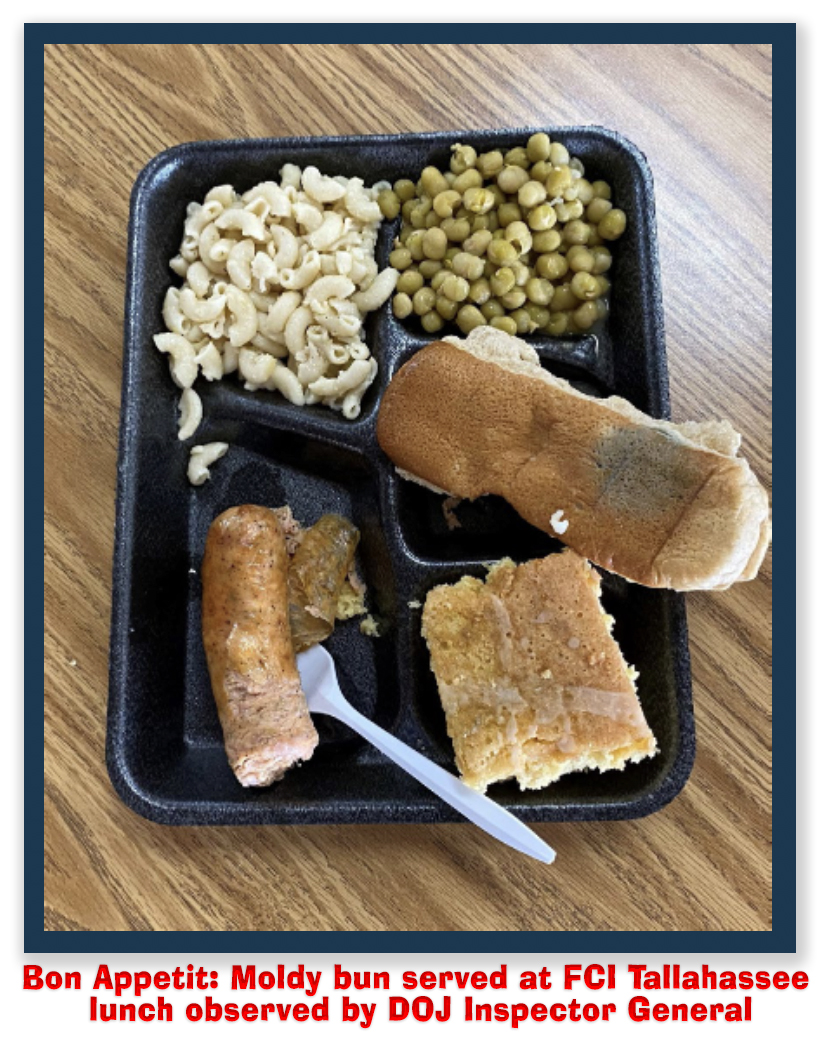
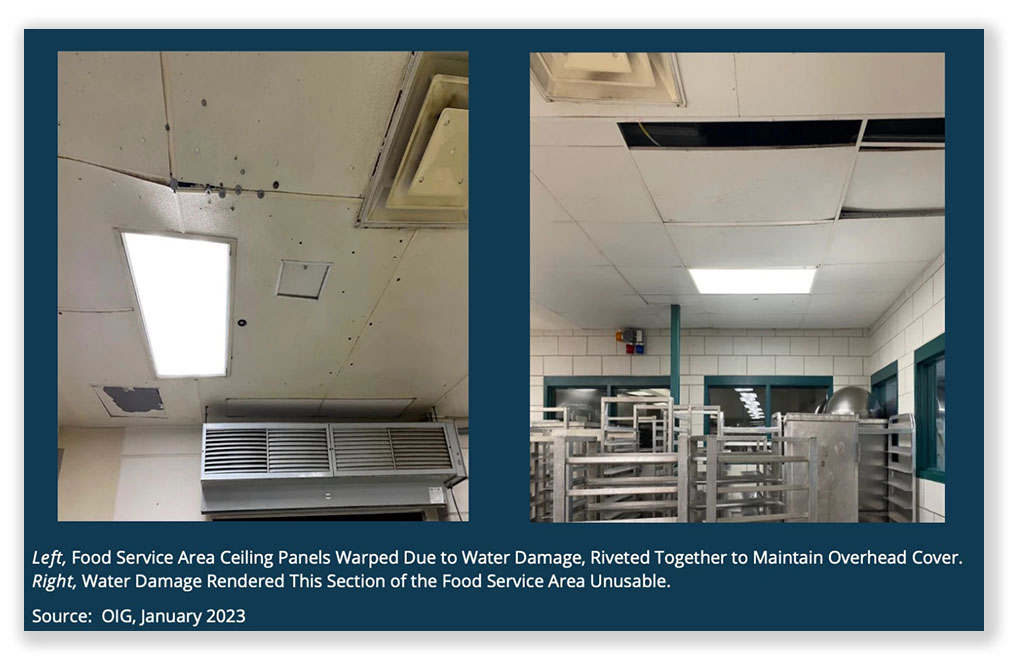
The inspection report identified “serious operational deficiencies,” with “the most concerning” being “the alarming conditions of its food service and storage operations.” The New York Times reported that the OIG inspectors only “expected to find serious problems endemic to other crumbling, understaffed facilities run by the Bureau of Prisons. What they encountered shocked them: Moldy bread on lunch trays, rotting vegetables, breakfast cereal and other foods crawling with insects or rodents, cracked or missing bathroom and ceiling tiles, mold and rot almost everywhere, roof leaks plugged with plastic bags, windows blocked with feminine hygiene products to keep out the rain, loose ventilation covers that created perfect hiding places for contraband and weapons.”

Tallahasseelunch231114AThe inspection report identified “serious operational deficiencies,” with “the most concerning” being “the alarming conditions of its food service and storage operations.” DOJ Inspector General Michael Horowitz said, “When we go to Tallahassee and we see windows leaking and ceilings leaking onto inmate living space, and we see female inmates having to use feminine hygiene products to keep the water from coming into their space, that’s something you should never have to deal with.”

In as much defense as she deserves after 15 months on the job, Peters did tell the Subcommittee the day before the OIG report was issued that the BOP’s unmet infrastructure needs are dire. She estimated that $2 billion was needed to clear the backlog of repairs and renovations identified as urgent. The Tallahassee Food Service Administrator position, responsible for food safety, had been vacant for two years. As it happened, FCI Tallahassee’s current Food Service Administrator’s first day on the job coincided with the first day of OIG’s inspection.

badexample231114In another embarrassment for the BOP, a federal judge last week ruled that the Alabama prison system, which has been sued by the DOJ for 8th Amendment violations, may inspect four federal prisons as part of its discovery in building its defense in the case. The State apparently intends to show that its prison conditions are no worse than those in the BOP. Alabama requested to inspect the FCC Coleman in Florida, FCI Yazoo City in Mississippi, and USP Atlanta.

House Subcommittee on Crime and Federal Government Surveillance, Oversight of the Bureau of Prisons (November 7, 2023)

New York Times, Justice Dept. Watchdog Describes Unsanitary Conditions at Florida Prison (November 8, 2023)

Dept of Justice Office of Inspector General, Inspection of the Federal Bureau of Prisons’ Federal Correctional Institution Tallahassee (November 8, 2023)

AL.com, Judge rules Alabama can inspect federal prisons to build defense in DOJ lawsuit (November 9, 2023)

– Thomas L. Root

Sort of like ‘Warden, a “60 Minutes” Crew Is At The Sallyport’ – Update for May 19, 2023

We post news and comment on federal criminal justice issues, focused primarily on trial and post-conviction matters, legislative initiatives, and sentencing issues.

DOJ INSPECTOR GENERAL PUBLISHES FIRST REPORT ON SURPRISE INSPECTION OF BOP FACILITY

Another continuing story: Last week, I reported that the Department of Justice Inspector General said the BOP is falling down and the BOP was in institutional stasis.

IG230518The IG said that because of operational deficiencies at USP Atlanta and MCC New York (which has since been closed), its investigators set out to “assess how critical issues at BOP institutions are identified, communicated to BOP Executive Staff, and remediated.”

When the BOP Executive Staff told the IG that management “had been largely aware of the long-standing operational issues at USP Atlanta and MCC New York and expressed confidence in the BOP’s existing mechanisms to communicate information about operational issues.”

Almost as if to say, You want a for instance’?, the IG last week also released a report on its unannounced inspection of the low-security women’s prison at FCI Waseca. The report, resulting from a surprise inspection, uncovered “many significant issues,” according to KSTP-TV, and is “the first unannounced inspection under the DOJ Office of the Inspector General’s new inspections program, which is expected to include inspections at other federal prisons across the country in the coming months.”

The inspection, which occurred in late winter, was performed by a team of nine making physical observations, interviewing staff and inmates, reviewing security camera footage and collecting records. It found that Waseca was operating with only two-thirds of its normal staff complement, and that augmentation was taking a toll on services and operations. “We… identified staff shortages in both FCI Waseca’s health services and psychology services departments which have caused delays in physical and mental health care treatment. Such delays can potentially result in more serious health issues for inmates, create further demands on health care staff and increase the costs of future treatments,” Inspector General Michael Horowitz said.

The IG found

• Significant staffing shortages have cascading effects on institution operations.
• Substantial concerns with numerous blind spots, poor night vision, poor zoom quality, and an insufficient number of cameras.
• Significant challenge limiting the amount of contraband in the institution, specifically drugs.
• Institution management and staff frustration with the amount of time it takes to close a staff misconduct investigation.
• Long inmate program participation wait lists.

waseca230519
The report also documents ‘serious facility issues’ affecting the conditions for inmates, such as pipes leaking next to prisoners’ beds and roof damage leading to unsanitary food services situations.

The IG’s “unannounced inspection” program should give the BOP Central Office – which has long accepted (if not tacitly approved) BOP facility “inspections” which were nothing more than ‘dog and pony’ shows – some sleepless nights.

DOJ, Inspection of the Federal Bureau of Prisons’ Federal Correctional Institution Waseca (May 10, 2023)

Bringmethenews.com, DOJ: Surprise inspection of Waseca women’s prison finds ‘significant issues’ (May 12, 2023)

KSTP, Surprise inspection of Waseca prison uncovers ‘many significant issues,’ DOJ says (May 10, 2023)

– Thomas L. Root

BOP Fiddles While Prisons Crumble – Update for May 12, 2023

We post news and comment on federal criminal justice issues, focused primarily on trial and post-conviction matters, legislative initiatives, and sentencing issues.

DOJ INSPECTOR GENERAL SAYS BOP FACILITIES ARE FALLING APART… AND NO ONE KNOWS WHAT TO DO

In a couple of reports issued last week that will surprise few, the Department of Justice Inspector General said the BOP is falling down, and management knows it but pretends otherwise.

nero230512In the first report, the IG said, “The BOP’s institutions are aging and deteriorating: all 123 of the BOP’s institutions require maintenance, with a large and growing list of unfunded modernization and repair needs, and three of these institutions are in such critical stages of disrepair that they are fully or partially closed.

The report found that the BOP chronically requests much less maintenance money from Congress than it needs. At the same time, Congress has set aside over $1 billion to build two new institutions, “but these funds remain largely unspent, the projects have been in the planning stages for over a decade, and the BOP’s requests each year that Congress cancel one of these projects and rescind the funds—made at the direction of the Department of Justice and the Office of Management and Budget—have not been acted on.”

The second report is more damning. Because of operational deficiencies at USP Atlanta and MCC New York (since closed), the IG set out to “assess how critical issues at BOP institutions are identified, communicated to BOP Executive Staff, and remediated.”

But the BOP Executive Staff told the IG “they had been largely aware of the long-standing operational issues at USP Atlanta and MCC New York and expressed confidence in the BOP’s existing mechanisms to communicate information about operational issues.” In light of the fact the staff knew all about the messes in New York and Atlanta but had done nothing about them, the IG “modified the scope of this review… to focus on [the] causes and the scope of the challenges, their effects on institutional operations, and the Executive Staff’s efforts to remedy them.”

dogandpony230512The IG found that BOP internal audits of facilities were not reliable because everyone knew when the audits were to happen and, predictably enough, put on a ‘dog-and-pony’ show for the inspectors. “Executive Staff members questioned whether the BOP’s overwhelmingly positive enterprise-wide audit ratings reflected actual institution conditions,” the report said. “Validating this concern, we found that the USP Atlanta internal audit conducted in January 2020 rated USP Atlanta’s inmate management efforts as Acceptable despite identifying numerous significant issues.”

Also, the report said, the BOP’s internal investigative staff has insufficient, resulting in a “substantial backlog of unresolved employee misconduct cases.” Not only does the BOP lack adequate staff the IG found, it doesn’t even know “whether the number of staff it represents as necessary to manage its institutions safely and effectively is accurate.”

Finally, the BOP’s “inability to address its aging infrastructure as a foundational, enterprise-wide challenge [limits] its ability to remedy institution operational issues.” In other words, the agency does not have a coherent maintenance plan, but rather just tries to fix problems when they get too serious, resulting in “increasing maintenance costs and, in the most extreme circumstances, having to shutter institutions and relocate inmates because needed maintenance and repairs have resulted in unsafe conditions.”

"Do you miss me yet?" No...
“Do you miss me yet?” No…

In a written response to a draft of this report, the unlamented former BOP Director Michael Carvajal said the challenges discussed in this report were “long-established” prior to his February 2020 appointment. He added that the executive staff “acknowledged and made attempts to address these issues in some fashion, although they may not have been corrected or completed for various reasons.” Conveniently omitting the fact that in his 30-year tenure with the BOP, he had been everything from a correctional officer to a lieutenant, a captain, a correctional services administrator, an associate warden, a warden, a regional director and Assistant Director in Washington, D.C., Carvajal whined that his appointment and two-year tenure coincided with the onset of COVID-19 and that “responding to the pandemic ‘required prioritization of resources behind life safety’.”

DOJ, The Federal Bureau of Prisons’ Efforts to Maintain and Construct Institutions, Rpt No 23-064 (May 3, 2023)

DOJ, Limited-Scope Review of the Federal Bureau of Prisons’ Strategies to Identify, Communicate, and Remedy Operational Issues, Rpt No 23-065 (May 4, 2023)

BOP, BOP Director Announces Plans to Retire (January 5, 2022)

– Thomas L. Root