Tag Archives: clemency

Biden Plans to Commute Some Drug Defendants, Vax BOP Staff – Update for September 14, 2021

We post news and comment on federal criminal justice issues, focused primarily on trial and post-conviction matters, legislative initiatives, and sentencing issues.

SO WHAT HAPPENS NOW?

The morning after President Biden announced an executive order that all federal employees would get the COVID vaccine, the Bureau of Prisons numbers were stubbornly high. The number of sick inmates was up 5% from a week ago, standing at 553 (the highest count since March 15). More ominously, the number of sick staff jumped 12% to 563, nearly equal to the number of sick inmates, and the highest since April 20. COVID is present at 112 of 122 institutions, and the death toll notched up to at least 267 inmates.

deadcovid210914What remains puzzling is the BOP’s testing. The agency said it tested 127 people last week, a very low number of tests for the number of inmate cases the BOP is reporting.

Meanwhile, the number of vaccinated inmates hit the 60% mark, while the staff percentage barely moved, from 53.39% to 53.62%.

The staff number should change. On Thursday, Biden signed an Executive Order that, among other things, “require[s] COVID-19 vaccination for all Federal employees, subject to such exceptions as required by law.” The exceptions are for medical and religious reasons only, and (I already received one email asking this) the Order does not exempt BOP employees. Biden ordered each Federal agency to implement a program to require COVID-19 vaccination for all Federal employees and directed the Safer Federal Workforce Task Force to issue guidance within 7 days of the date of this order on agency implementation of this requirement for all agencies covered by this order.

The BOP announced two more COVID-19 deaths, one on September 4th at FCI Bennettsville and another from last November at FCI Talladega. The Talladega death was of a 29-year old who had contracted COVID on August 5, 2020, but who was declared “recovered” 12 days later.

At the 43-minute mark of last Friday morning’s White House press briefing, Press Secretary Jen Psaki had an exchange with an unidentified reporter:

Q: Jen, I’m hearing that the Bureau of Prisons issued a memo today telling approximately about 1,000 drug offenders how to apply for clemency. Have you — do you have anything on that?

MS. PSAKI: I would certainly point you to the Department of Justice. I would say that the President has been clear about his openness to using clemency powers, but I don’t — I wouldn’t say that’s an assessment of decisions made — and certainly targeting those toward nonviolent drug offenders. But I’d point you to the Department of Justice for any further details.

The riddle was solved yesterday when POLITICO reported that the Biden administration has begun asking people on CARES Act home confinement inmates to “formally submit commutation applications, criminal justice reform advocates and one inmate herself tell POLITICO.”

clemencyjack161229“Those who have been asked for the applications fall into a specific category,’ POLITICO reported, “drug offenders released to home under the pandemic relief bill known as the CARES Act with four years or less on their sentences. Neither the White House nor the Department of Justice clarified how many individuals have been asked for commutation applications or whether it would be expanding the universe of those it reached out to beyond that subset. But it did confirm that the president was beginning to take action.”

Business Insider published a piece on Saturday noting that “the Biden administration is considering granting commutations to those under home confinement who have federal drug charges and have less than four years left in their sentences. If enacted, that decision would only affect about 2,000 out of the 4,000 people currently under home confinement. To those that don’t fit the criteria, the administration will force them back to federal prison. For these individuals, the decision could be devastating to the progress they’ve made since emerging from behind bars. Sending [inmates] back to prison and hampering [their] progress would have the opposite effect of what our justice system purports to achieve.”

White House, Executive Order on Requiring Coronavirus Disease 2019 Vaccination for Federal Employees (September 9, 2021)

BOP, Inmate Death at FCI Talladega (September 10, 2021)

White House, Press Briefing by Press Secretary Jen Psaki (September 10, 2021)

Politico, Biden starts clemency process for inmates released due to Covid conditions (September 13, 2021)

Business Insider, Thousands of people who were released from prison due to the pandemic are now thriving with their families. But if Biden doesn’t act now, they will be cruelly sent back. (September 11, 2021)

– Thomas L. Root

President Said to be Considering CARES Act Partial Clemency – Update for September 7, 2021

We post news and comment on federal criminal justice issues, focused primarily on trial and post-conviction matters, legislative initiatives, and sentencing issues.

BIDEN MAY (FINALLY) BE TAKING BABY STEPS ON CLEMENCY

The New York Times reported last week that President Biden is considering using his clemency powers – which he has not exercised in his first seven months in office – to commute the sentences of nonviolent drug offenders with fewer than four years left to serve. The contemplated intervention would not apply to those now in home confinement with longer sentences left, or those who committed other types of crimes, Biden administration sources told the Times.

The notion of clemency for some inmates is just one of several ideas being examined in the executive branch and Congress, the Times said. Others include a broader use of 18 USC § 3582(c)(1)(A)(i) “compassionate release” or 34 USC § 60541, the elderly offender home detention program, or even a law – such as the Safer Detention Act (S.312) – to allow some inmates to stay in home confinement after the pandemic.

The CARES Act permits inmates who are sent to home confinement under Section 12003(b) to remain at home until the pandemic public health emergency ends. The Times says, “That will not be soon: With the Delta variant spurring a surge in cases, the public health emergency is not expected to end before next year at the earliest.”

clemencyjack161229On August 10, Biden Press Secretary Jen Psaki said Biden was “exploring multiple avenues to provide relief to nonviolent drug offenders, including through the use of his clemency power.” The Times reported officials have confirmed that the Justice Department “will soon begin requesting clemency petitions for drug offenders who have less than four years left on their sentence, which will then be reviewed by its pardon office.” The officials said a focus on nonviolent drug offenders “dovetail[s] with Mr. Biden’s area of comfort on matters of criminal justice reform.”

Whether Biden is leaning toward commuting the sentences of drug offenders to home confinement, reducing sentence length to bring them down to the normal window 10%-or-six-month window for 18 USC 3624(c)(2) end-of-sentence home confinement, or some mix of the two, is not yet clear.

The Times reported that DOJ is still studying options that could keep non-drug offenders from being forced back into prison.

Meanwhile, criminal justice reform groups are keeping up pressure on the President. FAMM and the American Civil Liberties Union are mounting a six-figure ad campaign to pressure Biden to keep the CARES Act prisoners at home. The TV ads feature Juan Rodriguez, a federal prisoner sent home in July after doing eight of 14 years for a drug conviction. “I’m going to try to make the best out of every day I have out here,” Mr. Rodriguez says in the ad featuring him with his family and working a new job. “President Biden, please don’t separate me from my family.”

angel210907The ACLU has argued that fewer than 1% of prisoners put on home confinement had violated the terms of their release, and it was time for Biden to follow through on lowering the incarceration rate and size of the federal prison population that he campaigned on as a presidential candidate. So far, only five people sent home during the pandemic have been returned to prison for new criminal conduct.

USA Today has reported that over two dozen small business owners who have CARES Act home confinees are also asking Biden to grant clemency to prisoners. Some say losing employees to prison during a national labor shortage would not only be detrimental to their businesses, but would also keep their companies from growing.

Ohio State law professor Doug Berman complained in his Sentencing Law and Policy blog that when Biden was campaigning, he promised to “’take bold action to reduce our prison population’. But the federal prison population… has grown by over 4000 persons according to BOP numbers, from 151,646 total inmates on January 21, 2021, to 155,730 total inmates on August 26, 2021. To date, I cannot really think of any actions (let alone bold ones) that Prez Biden has taken to reduce the federal prison population. Talk of some clemency action is heartening, but just a start. And whatever clemency efforts are made, they should extend beyond just a limited group who are already home.”

The New York Times, White House Weighs Clemency to Keep Some Drug Offenders Confined at Home (August 30, 2021)

Washington Times, ACLU pressures Biden to keep convicts on home confinement out of prison due to pandemic (August 27, 2021)

USA Today, Businesses that hired inmates who were allowed to serve time at home during COVID push for clemency (August 26, 2021)

CBS News, Inmates on home confinement could be sent back to prison after the pandemic: “Why make us go back and do it again?” (September 3, 2021)

Sentencing Law and Policy, Prez Biden reportedly considering, for home confinement cohort, clemency only for “nonviolent drug offenders with less than four years” left on sentence (August 30, 2021)

– Thomas L. Root

Who Knows What Joe’s Thinking? – Update for August 17, 2021

We post news and comment on federal criminal justice issues, focused primarily on trial and post-conviction matters, legislative initiatives, and sentencing issues.

ADMINISTRATION HINTS AT DRUG CLEMENCY (MAYBE)

Biden Press Secretary Jen Psaki started hearts and tongues fluttering last week when she said the Administration was looking at clemency for federal drug offenders.

clemencypitch180716“The president is deeply committed to reducing incarceration and helping people successfully reenter society,” Psaki said in a press briefing. “And he said too many people are incarcerated — too many are black and brown — and he’s therefore exploring multiple avenues to provide relief to certain nonviolent drug offenders, including through the use of his clemency power.”

As a candidate, Biden said in 2019 that he wanted to release “everyone” in prison for marijuana, but Psaki has referred questions on whether he will do so to the Justice Department, saying last April it was “a legal question.”

The New York Post reported that “Psaki’s remark thrilled clemency advocates who have been pushing for Biden to commute prison sentences and issue pardons early in his term, which is uncommon for presidents. Clemency advocate Amy Povah said, “We are elated that President Biden has expressed an interest in using his executive clemency power with an emphasis upon drug cases.”

caresbear210104Meanwhile, other advocates feel frustrated that Biden has done nothing on a matter as small as addressing the status of people on CARES Act home confinement. Last Wednesday, Senators Richard Durbin (D-Illinois) and Cory Booker (D-New Jersey) wrote to President Biden, urging him to act on keeping CARES Act home confinees at home. They suggested, in part, that the Bureau of Prisons could “provide relief for certain individuals through prerelease home confinement, under 18 USC § 3624(c)(2), and the Elderly Home Detention Pilot Program, pursuant to 34 USC 6054l(g). For those who do not qualify for those provisions, BOP can recommend, and DOJ should support, compassionate release pursuant to 18 USC § 3582(c)(l)(A). Compassionate release is authorized whenever extraordinary and compelling reasons warrant a sentence reduction, and the once-in-a-century global pandemic that led to these home confinement placements certainly constitutes such an extraordinary and compelling circumstance.”

Reuters last week reported that the Justice Department had asked an Oregon federal judge on Tuesday to deny a bid by federal inmates to qualify for early release through First Step earned time credits. Prosecutors argued that no programs or activities completed by the inmates qualified for earned time credits.

Reuters said, “The rift could increase pressure on the Justice Department, which is under fire from civil rights advocates for its inaction to prevent BOP from sending thousands of federal inmates back to prison once the pandemic emergency is lifted.”

At issue is a provision from the 2018 First Step Act, which aims to ease harsh sentencing for non-violent offenders and reduce recidivism. The BOP may award 10 or 15 days’ credit for every 30 days of participation in recidivism-reduction or activities such as academic classes or certain prison jobs.

In a November 2020 proposed rule, the BOP defined a day of participation as eight hours and limited the menu of qualifying programs.

recid160321One issue is the BOP’s definition of a day of participation as 8 hours. “The math speaks for itself,” federal defenders wrote in a January 2021 letter to BOP. “It would take 219 weeks, or over 4 years to earn a full year of credit under the BOP’s proposed rule.”

In Tuesday’s case, the lead plaintiff has held prison jobs such as a painter and an HVAC worker and completed courses such as anger management, entrepreneurship, and a residential drug abuse program. But the government argued that none of those programs is on the BOP’s EBRR program list.

“If HVAC work doesn’t qualify, what kinds of jobs do?” asked Magistrate Judge John Acosta, noting the program’s goal of reducing recidivism and facilitating reintegration into society.

“The ones that are identified by the Bureau of Prisons,” AUSA Jared Hager replied, noting the inmates have “not shown entitlement to any credit.” The list of qualifying programs and activities will be updated by Attorney General Merrick Garland, he added.

Similar suits are on file in federal courts throughout the country.

Finally, JDSupra.com reported last week that Senate Majority Leader Chuck Schumer (D-New York) has partnered with Senate Finance Committee Chairman Ron Wyden (D-Oregon) and Sen Booker to draft comprehensive federal cannabis reform legislation, which the sponsors plan to introduce this fall.

marijuanahell190918The measure, called the Cannabis Administration and Opportunity Act (the CAOA), would – among other matters – would require the federal government to expunge any arrest or conviction for a non-violent federal cannabis offense, and allow any person serving a criminal justice sentence for a non-violent federal cannabis offense to move for sentence reduction. After the hearing, the court would be required to expunge each arrest, conviction, or adjudication for a non-violent federal cannabis offense.

The drafting of the bill is in its early stages. The sponsors are actively soliciting comments prior to CAOA’s introduction. Comments may be submitted through September 1, 2021, at Cannabis_Reform@finance.senate.gov.

New York Post, Biden ‘exploring’ clemency for federal drug crimes, Psaki says (August 11, 2021)

Letter from Senators Durbin and Booker to President Biden (August 12, 2021)

Reuters, U.S. Justice Dept clashes with inmates over credits to shave prison time (August 10, 2021)

JDSupra.com, US Senators Seeking Input on Comprehensive Federal Cannabis Reform Legislation (August 11, 2021)


– Thomas L. Root

Some Short Notes From the News – Update for July 15, 2021

We post news and comment on federal criminal justice issues, focused primarily on trial and post-conviction matters, legislative initiatives, and sentencing issues.

THE SHORT ROCKET

rocket190620
A couple of short takes from last week’s news (and one update to yesterday:

Pardon Me: The June 2021 Federal Sentencing Reporter was devoted entirely to the presidential pardon power. In one essay, the authors found that of President Trump’s 238 clemency grants, only 25 (11%) were recommended by the DOJ Pardon Attorney.

New York magazine reported last week that Trump’s 238 clemency grants was a 50-year low. While Biden has hinted he’ll started granting clemency next year (before the midterm elections), the magazine was skeptical:

“The appearance of being “soft on crime,” and the possibility that someone you free re-offends in some politically inopportune way, makes it hard for presidents to rationalize pardoning people or commuting sentences with any regularity… The effect is that clemency has become really unusual. And when something is unusual, each decision becomes freighted with dramatic significance and scrutinized to the nth degree.”

Meanwhile, law professors Rachel Barkow (New York University) and Mark Osler (University of St. Thomas School of Law) sounded the alarm this week that contrary to its campaign pledges, the Biden Administration is poised to resume the errors of the past.

Inexplicably, however, the Biden administration… wants to leave clemency under the control of the Justice Department. Doing so will undermine the administration’s stated hope of achieving criminal justice reform and reducing racial bias in the federal system….

In conversations with activists, the administration has, at most, expressed some desire to use the pardon power before the 2022 midterm elections. That tells us two things, both dispiriting: that this is a low priority for the president, and that the administration does not yet have a handle on how this all could work. That’s far too long for reforms that don’t need congressional approval and when there is a backlog of petitioners who have waited too long for justice.

Federal Sentencing Reporter, Vol 33, Issue 5, After Trump: The Future of the President’s Pardon Power

Lawfare, Trump and the Pardon Power (July 6, 2021)

New York Magazine, When Will Joe Biden Start Using His Clemency Powers? (July 5, 2021)

The New York Times, We Know How to Fix the Clemency Process. So Why Don’t We? (July 13, 2021)

DOJ Inspector General Calls Out BOP on Faith-Based Support: A report issued last week by the DOJ Office of Inspector General found that a 30% shortage in BOP chaplains as well as “a lack of faith diversity” among the chaplaincy staff “leaves some inmate faith groups significantly underrepresented,” causing “many institutions to rely on alternative religious services options, such as inmate-led services.”

religion191230

The IG said “One particular concern was the potential for an inmate to use a religious leadership role to engage in prohibited activities or as a method to obtain power and influence among the inmate population.” The report concluded that “in the absence of a fully staffed and diverse chaplaincy, BOP institutions are unable to adequately administer their religious programs, prompting many BOP institutions to turn to alternatives that pose enhanced risks, such as inmate-led services and reliance on minimally vetted volunteers.”

DOJ, Audit of the Federal Bureau of Prisons’ Management and Oversight of its Chaplaincy Services Program (July 7, 2021)

readup210715Read Up on EBRRs: The BOP has issued a Program Statement on how staff is to determine inmate programming needs. This is important, because – contrary to the rumor mill, so-called inmate.com – earned time credits (ETCs) are only awarded for completion of approved programs that address needs previously identified by BOP staff. The new program statement guides you on how to get needs identified that will lead to ETCs.

PS 5400.01, First Step Act Needs Assessment (June 25, 2021)

– Thomas L. Root

Biden to Ask Fox To Advise on Emptying Henhouse – Update for May 26, 2021

We post news and comment on federal criminal justice issues, focused primarily on trial and post-conviction matters, legislative initiatives, and sentencing issues.

GOOD AND BAD NEWS ON CLEMENCY

clemencypitch180716The New York Times reported last week that Biden Administration officials have begun evaluating clemency requests and have let activists know that President Biden may start issuing pardons or commutations.

That’s the good news. The bad news is that White House officials have indicated privately that it is working with the Department of Justice’s Office of the Pardon Attorney to process clemency requests with the intent of issuing some clemencies the president sign some before the 2022 midterm elections in. The White House has indicated that it will rely on the rigorous application vetting process overseen by the OPA, an office that most clemency advocates see as an impediment to clemency, not a facilitator.

henhouse180307Several pretty influential commentators, including NYU law prof and former Sentencing Commission member Rachel Barkow, have urged White House officials to consider moving the clemency process out of DOJ, “noting the paradox of entrusting an agency that led prosecutions with determining whether the targets of those prosecutions deserve mercy,” as The Times put it. But the Biden administration is not inclined to circumvent the OPA, according to the paper, instead following the approach adopted by President Barack Obama, who issued more than 1,900 clemency grants, mostly to people recommended by the DOJ and who had been serving drug trafficking sentences.

Biden’s team has hinted it is establishing a deliberate, systemic process geared toward identifying entire classes of people who deserve mercy. The approach could allow the president to make good on his campaign promise to use his authority to address racial equity. Given that 70% of federal prisoners are nonwhite, and 48% of all inmates are convicted of drug offenses, a focus on racial equity could have substantial impact.

pardon160321An April push by the National Council for Incarcerated and Formerly Incarcerated Women and Girls, called on Biden to grant pardons or to commute the sentences for 100 women during his first 100 days of office. Nothing came of it.

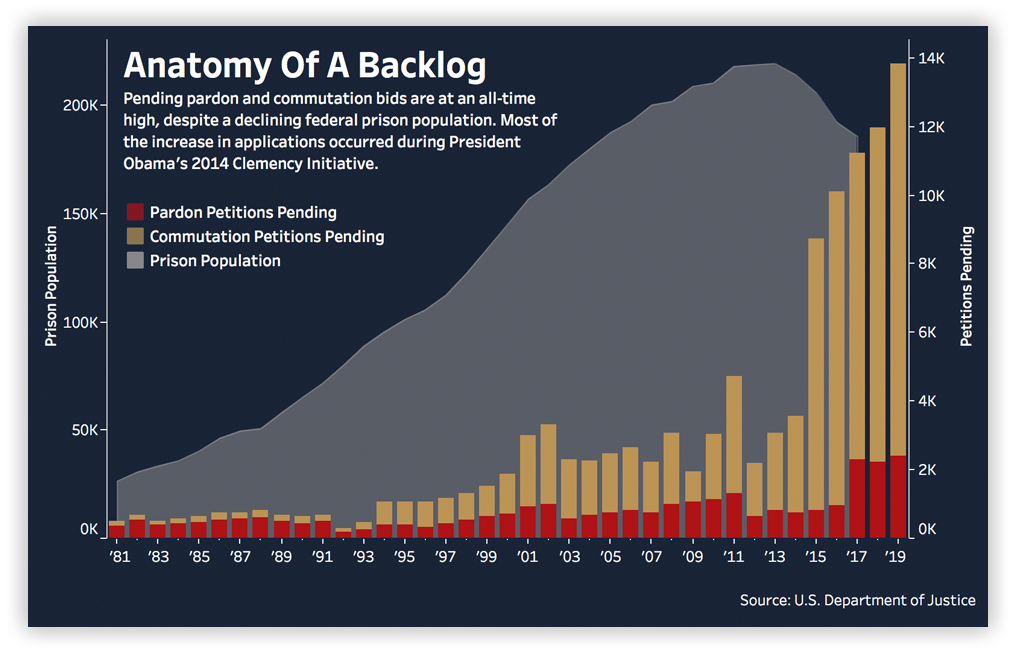
As of May 10, there were 3,211 pardon and 11,804 clemency petitions pending, according to DOJ statistics. Of those, 14 pardons and 461 clemency petitions were “closed without presidential action.”

New York Times, Biden Is Developing a Pardon Process With a Focus on Racial Justice (May 17)

US Sentencing Commission, Quick Facts – Offenders in Federal Prison (March 2021)

CNN, Advocates push for Biden to use his executive powers to grant clemency for hundreds of women in federal prisons (May 19)

DOJ, Clemency Statistics (May 23)

– Thomas L. Root

Can Clemency Save CARES Act Home Confinees? – Update for May 11, 2021

We post news and comment on federal criminal justice issues, focused primarily on trial and post-conviction matters, legislative initiatives, and sentencing issues.

RUMBLINGS OF FIXING CLEMENCY AND HOME CONFINEMENT

biden210511White House officials are signaling that President Biden is prepared to “flex his clemency powers” as officials wade through the 14,000+ clemency requests on file.

I reported last week on a Zoom call the White House held to discuss criminal justice reform with advocates and former inmates. While the White House did not signal any imminent moves, officials indicated that Biden will not hold off until later in his term to issue pardons or commutations, The Hill reported last week.

“It was clear that they are working on something,” Norris Henderson, founder and executive director of Voice of the Experienced, who participated in the call, told The Hill. “They are looking at that right now as an avenue to start doing things.”

Meanwhile, an opinion piece in USA Today suggested Biden grant clemency to people on CARES Act home confinement as a means of thwarting last January’s Dept of Justice opinion that those people would have to return to prison after the pandemic ends.

noplacelikehome200518The Hill reported Saturday that Biden and Attorney General Merrick Garland have been facing mounting calls to rescind the DOJ memo. a policy implemented in the final days of the Trump administration that would revoke home confinement for those inmates as soon as the government lifts its emergency declaration over the coronavirus.

Randilee Giamusso, a Federal Bureau of Prisons spokesperson, told The Hill that the Biden administration had recently expanded the eligibility for home confinement, the clearest admission yet the pressure from above is forcing a renewed emphasis on CARES Act home confinement. Giamusso noted that Biden has extended the national COVID emergency declaration and that the Dept of Health and Human Services expects the crisis to last through the end of 2021.

insincerity210511“The BOP is focused right now on expanding the criteria for home confinement and taking steps to ensure individualized review of more inmates who might be transferred,” Giamusso said.  

Of course it is. No one who has ever dealt with the BOP can fairly doubt its laser focus on its mission or the helpfulness and professional polish of its staff.

The Hill, Biden set to flex clemency powers (May 5, 2021)

USA Today, COVID-19 concerns sent thousands of inmates home. Give clemency to those who deserve it. (May 5, 2021)

The Hill, DOJ faces big decision on home confinement (May 9, 2021)

– Thomas L. Root

Great Clemency Idea Or Stupid Political Stunt? – Update for March 18, 2021

We post news and comment on federal criminal justice issues, focused primarily on trial and post-conviction matters, legislative initiatives, and sentencing issues.

WASHINGTON WEEK: SEEKING CLEMENCY FOR SOME LADIES
"I won!"
“I won!”

Congresswomen Cori Bush (D-Missouri) and Ayanna Pressley (D-Massachusetts) last Friday joined with the National Council for Incarcerated & Formerly Incarcerated Women and Girls’ initiative calling on President Joseph Biden to grant 100 women clemency in his first 100 days in office. Speaking at an event held outside the White House, Pressley told the President “to exercise his clemency authority,” adding he can grant clemency to the 100 women “by the stroke of a pen.”

Vox said several weeks ago that “advocates want Biden to act quickly” on clemency. “They point to epidemics of Covid-19 in jails and prisons, which could be eased if there were fewer people in those settings to spread the coronavirus. And they argue that acting too slowly would repeat the mistakes of Biden’s predecessors, who, if they moved on clemency at all, did so too late during their terms to do the long, hard work of broader reforms.”

clemencyjack161229Acting quickly on clemency is a great idea, but “100 women in 100 days” is nothing but a political stunt. The greatest danger in a proposal like this one is that if Biden knuckles under, 100 inmates get clemency, and then the Administration will check clemency off its “to-do” list, moving on to the next domestic issue. The problem with the clemency system – beyond the obvious, that 14,000 petitions are pending, many for years – is that the arbitrariness and bias of a system that relies on mercy from the very people who make their careers locking up defendants has a systemic infirmity that must be addressed. A political stunt that relies on an alliterative label – ‘100 in 100…’, like there’s something significant about the base-10 number system – simply detracts from the serious work to be done while delivering commonsense mercy in a scattershot and ineffective way.

The well-meaning people behind this have little idea of the effect of their Lafayette Park theatre on the inmates. I have had several emails this week from women inmates informing me that a list of 100 inmates was handed to the President in the Oval Office, and that he was ready to act. They wondered if they were on the list. Oh, if life only imitated rumor…

Why not simply distribute 151,703 scratch-off cards to the BOP population, with only 100 winners among them? That approach would make as much sense, while adding a bit of drama and excitement to the event.

crackpowder160606Last Tuesday, Representatives Hakeem Jeffries (D-New York), Bobby Scott (D-Virginia), Kelly Armstrong (R-North Dakota), and Don Bacon (R-Nebraska) introduced the Eliminating a Quantifiably Unjust Application of the Law (EQUAL) Act in the House. The bipartisan legislation would eliminate the federal crack and powder cocaine sentencing disparity and retroactively apply it to those already convicted or sentenced.

The measure is identical to the measure introduced in the Senate by Cory Booker (D-New Jersey) and Richard Durbin (D-Illinois) five weeks ago.

USA Today, ‘No justice in destroying lives’: Pressley, Bush call on Biden to grant clemency to 100 women in 100 days (March 12, 2021)

Vox, Biden’s secret weapon for criminal justice reform (March 1, 2021)

Atlanta Daily World, Congress Introduces Bill to Eliminate Sentencing Disparity Between Crack and Powder Cocaine (March 10, 2021)

– Thomas L. Root

Pardon Joe While He Works on Clemency – Update for February 16, 2021

We post news and comment on federal criminal justice issues, focused primarily on trial and post-conviction matters, legislative initiatives, and sentencing issues.

WHITE HOUSE BEGINS TO UNTANGLE CLEMENCY MESS

broken210216President Biden has inherited 14,000 unresolved clemency requests – petitions seeking a pardon (forgiveness of the offense) or commutation of sentence (reduction of sentence, usually to time served). Many of the clemency petitions date from the Obama era but a good number piled up in the last four years, during which time who you knew was more important that what you wrote in your petition.

Politico reported last week that the White House is seeking suggestions on how to reform the clemency system and deal with the backlog. But the White House so far has revealed little about its plans, leaving advocates concerned that Biden’s team lacks a comprehensive plan for dealing with the backlog.

Over 100 criminal justice reform groups are urging Biden to overhaul the process and start resolving cases right away. The ACLU launched an ad campaign last month to push him to grant clemency to 25,000 people and make good on his pledge to tackle criminal justice issues amid a national reckoning on racial injustice. “The danger,” law professor Mark Osler said, “is that they’ll replicate the mistake the past several administrations of never focusing on it until it’s too late and it’s a mess.”

While Biden didn’t campaign aggressively on the issue of clemency, the joint task force Biden and Sen. Bernie Sanders (D-Vermont) assembled last summer proposed a 60-person agency independent of the DOJ, composed of people with diverse backgrounds to review cases.

clemencypitch180716Rep. Steve Cohen (D-Tennessee), who chairs the House Judiciary subcommittee with jurisdiction over pardons, lobbied Obama and Trump to issue more pardons. He said he plans to do the same for Biden.

“There are… more and more people in jail, and a lot of those people have been there forever and they have been there for long draconian sentences,” Cohen said.

Ohio State University law prof Doug Berman counseled patience as the White House figures out a plan. But, he said, “taking a careful and deliberative process toward grander reform of the entire clemency process should not be an excuse for Prez Biden to hold back entirely on the use of his clemency pen…I am pretty confident that only a relatively little amount of time would be needed for members of the Biden team to identify at least a handful of compelling cases that could and should allow clemency grants” to be part of Biden’s first 100-day agenda.

Politico, Trump left behind a clemency mess. The clock’s ticking for Biden to solve it. (February 11, 2021)

Sentencing Law and Policy, How about some clemency grants from Prez Biden while his team works on grander clemency plans? (February 11, 2021)

– Thomas L. Root

After All of the Drama… Trump’s Clemency – Update for January 20, 2021

We post news and comment on federal criminal justice issues, focused primarily on trial and post-conviction matters, legislative initiatives, and sentencing issues.

TRUMP DOES SOMETHING RIGHT(?)

obtaining-clemencyAfter all of the angst since November about a flurry of pardons and commutations to be issued by President Donald John Trump (and you cannot imagine my relief at knowing I will never have to type those words again) – including speculation that he would pardon his family, all of his close friends, the Capitol rioters and even himself – Trump issued the final long-awaited clemency list in the wee hours on his last day in office (and you cannot imagine my relief at typing those words).

The media predictably fixated on the of handful of longtime allies and well-connected celebrities, including his former chief strategist, Steve Bannon, and onetime fundraiser Elliott Broidy, on the list. But that should not obscure the fact that, in virtually his last exercise of Presidential power, Trump pretty much got it right.

The White House released the list of 143 pardons and commutations at 12:50 a.m., as – according to the Wall Street Journal – Trump’s deliberations over who should receive clemency stretched late into the last full day of his term. Bannon, much like Schroedinger’s cat, flitted onto and off of the pardon list, but finally was included, short-circuiting his federal trial scheduled for May. A few rappers, politicos and Trump loyalists made the list, but the real story was that 90% of those getting pardons and commutations were rather ordinary people.

Only 18 of those on the list – 13% – were supported by the Dept of Justice Office of Pardon Attorney. The balance were by an array of political leaders, criminal justice reformers and other allies of the president.

On Tuesday, the president was still calling advisers to ask them how he should proceed on certain pardons and waffled repeatedly over whether to grant one to Mr. Bannon, a person familiar with the conversations said.

At various points on Tuesday, advisers believed Mr. Bannon—who was charged in connection to a scheme to siphon money from a crowdfunding campaign for a border wall—wouldn’t get one. The White House in a statement said Mr. Bannon “has been an important leader in the conservative movement and is known for his political acumen.”

Don’t take my word for it: here’s the list of those pardoned (their crimes forgiven) or had sentences commuted (imprisonment reduced or terminated, but the conviction remains):

White House List

trumpjohnson210120Trump has been widely criticized for using his clemency power to favor celebrities and political allies, including Michael Flynn, Paul Manafort, Roger Stone and former Maricopa County Sheriff Joe Arpaio. But he was praised for commuting the sentences of some prisoners serving long sentences for nonviolent drug offenses, like 63-year old Alice Johnson, who was doing life for a 1996 crack conspiracy. Her story (she was hardly the kingpin, but paid the price for not taking a deal) caught the attention of reality-TV star Kim Kardashian, who convinced Trump to commute her sentence. The move paid off for Trump: Johnson was a vocal supporter of the President after that (who could blame her), even speaking at the Republican convention last summer. Trump rewarded that by upgrading her commutation to a pardon. At the same time, Johnson advocated for clemency for people she knew in the system.

Before last week, Trump had pardoned or commuted the sentences of 44 people convicted of federal crimes —far fewer than any other president. To be sure, Trump isn’t the only president to pardon his friends and allies during his fpardon160321inal days in office. Former President Bill Clinton was criticized for including wealthy fugitive Marc Rich in his final batch of reprieves, after Rich’s wife donated generously to Clinton’s presidential library. An investigation later concluded that the pardon was sketchy but not quite illegal.

Experts argue that the erratic clemency process should be fundamentally reimagined, either by taking it out of the president’s hands altogether or at least by moving it out of the Department of Justice. This could speed up the review process and remove review from the people whose careers were made by convicting those seeking clemency. Advocates argues that clemency should be molded into a tool for redressing the harsh sentencing practices of the early Sentencing Guidelines days since 1989. The sentences, especially for drug offense, disproportionately sent minorities to prison for long stretches.

The New York Times reported that “advocates said they were hopeful that the Biden administration would be able to revamp the clemency process, and that the pardons approved by Mr. Trump would give the next administration some cover with conservatives in the future.”

The Biden administration said it would not comment on the Trump pardons.

The Wall Street Journal, Trump Issues 73 Pardons, Including to Ex-Aide Steve Bannon (January 20, 2021)

The New York Times, Trump’s final wave of pardons includes names pushed by criminal justice reform advocates (January 21, 2021)

The Marshall Project, Trump’s Pardons Show The Process Has Always Been Broken (January 19, 2021)

– Thomas L. Root

Final Hours for Trump Clemency… and Things Are Strange – Update for January 18, 2021

We post news and comment on federal criminal justice issues, focused primarily on trial and post-conviction matters, legislative initiatives, and sentencing issues.

THINGS ARE GETTING WEIRD

weird210118Secret commutations. A phony White House pardon website. Capitol Hill rioters complaining on TV the president sent them to the insurrection, so he owes them a pardon. A promise of hundreds of clemencies. A president wonder-ing whether he can pardon himself.

For weeks, federal inmates have hoped President Trump would grant clemency to thousands of them on his way out the door. But if things looked like they were going sideways before Jan 6, they have gotten downright screwy since then.

As of this morning, the Washington Post reported “Trump is preparing to pardon or commute the sentences of more than 100 people in his final hours in office, decisions that are expected to be announced Monday or Tuesday, according to two people familiar with the discussions, who spoke on the condition of anonymity to describe the plans.”

The Post said Trump “has been besieged by lobbyists and lawyers for well-heeled clients who are seeking to have their criminal convictions wiped from their records, as well as by advocates for criminal justice reform, who argue that their clients were wrongly convicted or were given unfair sentences and deserve to be freed from prison.” Trump’s clemency binge has been delayed by what the Post called increasing dysfunction stemming from the Capitol riot and impeachment, but he reportedly spent part of the weekend finalizing his list.

The President has always made a big deal of his clemencies, but last Tuesday, he quietly commuted the sentence of Fred Davis Clark, whose Ponzi theft of over $171 million got him a 480-month federal sentence two years ago. Fred’s docket said the 60-year old defendant had an out date beyond 2050, but the BOP released him last Tuesday. The White House has released no official statement on the clemency.

parler210118The White House did, however, release a statement declaring a pardon notice circulating on the right-wing website Parler to be fake. The phony post, which claimed to be from the Office of Pardon Attorney, said “POTUS is seriously considering PARDONING all of the patriots in the next week and a half. If you would like a pardon, please respond below.” It then asks for the rioter’s name, city and even “what crimes you think you need to be pardoned for,” asking for them by “Tuesday” so the President can get to work on them. (Some might suggest that the very notion of the President “working” should have been the tipoff that the post was a fraud).

Some of the people who thought that vandalizing the Capitol was great fun are apparently have second thoughts now that their selfies and tweets are leading to criminal charges. Jenna Ryan, a Texas real estate broker who was arrested for joining the attack on the Capitol, has pleaded with Trump to pardon her. After surrendering to the FBI on Friday, Ryan said: “We all deserve a pardon. I’m facing a prison sentence. I think I do not deserve that.” Ryan said she had been “displaying my patriotism,” adding, “I listen to my president who told me to go to the Capitol.”

The Dept of Justice issued a statement last weekend that “the information circulating on social media claiming to be from Acting Pardon Attorney Rosalind Sargent-Burns is inauthentic and should not be taken seriously.”

In private, the president has continued to pursue which pardons he can grant in his final days in office, calling advisers to ask for suggestions. The White House is expected to release dozens of pardons in the days before he leaves office, aides say. Aides say they don’t know if some of the most controversial pardons—including for Rudy Giuliani, for the president’s children, and for the president himself—will be among them.

The New York Times reported last night that “a lucrative market for pardons is coming to a head, with some of his allies collecting fees from wealthy felons or their associates to push the White House for clemency, according to documents and interviews with more than three dozen lobbyists and lawyers.” People reported to be selling services include former AUSA Brett Tolman, Trump’s personal lawyer John M. Dowd, and Guliani.

pardonsale210118Politico reported last Friday that former White House advisor Steve Bannon – facing a federal fraud trial in May – is on the pardon list. Politico’s White House source said “two additional batches of pardons are expected — one on Friday night and one Wednesday morning before President-elect Joe Biden is sworn into office.” Of course, Friday has come and gone, and the first of the promised clemency lists did not happen. Last Monday, ABC reported that after some of Trump’s lawyers told him that if he pardons himself, he could be more vulnerable to civil lawsuits. “The president is angry,” ABC reporter Jonathan Karl said. “He has not taken that well, and I am told that he is now saying that he doesn’t want to see pardons for anybody. So the attitude seems to be: ‘If I can’t get a pardon, then nobody else should get one, either.'”

Washington Post, Trump prepares to offer clemency to more than 100 people in his final hours in office (January 18, 2021)

Law360.com, Trump Commutes Ex-Cay Clubs CEO’s Ponzi Sentence (January 14, 2021)

DOJ, Statement on Misinformation on Social Media Regarding the Office of the Pardon Attorney (January 9, 2021)

The Guardian, ‘I’m facing a prison sentence’: US Capitol rioters plead with Trump for pardons (January 16, 2021)

New York Times, Prospect of Pardons in Final Days Fuels Market to Buy Access to Trump (January 17, 2021)

Wall Street Journal, Trump Spends Final Days Focused on GOP Defectors, Senate Defense (January 16, 2021)

Politico, Trump weighing a pardon for Steve Bannon (January 15, 2021)

The Week, Trump is reportedly so angry aides are warning him against a self-pardon, he’s put all pardons ‘on hold’ (January 12, 2021)

– Thomas L. Root