We post news and comment on federal criminal justice issues, focused primarily on trial and post-conviction matters, legislative initiatives, and sentencing issues.

DISTRICT COURT HOLDS COLORADO SEX REGISTRATION VIOLATES 8TH AMENDMENT
The registration systems for ex-inmates with sex offenses is state based. Congress decreed in the Sex Offender Registration and Notification Act (SORNA) that every state would have a system, and then imposed a federal requirement on people convicted of sex offenses that they must register under penalty of law.
The public loves state registration laws, because they like to identify and shame ex-offenders for crime committed years before, running them out of housing, hounding them out of jobs, and even trying to break up their families. Sounds like punishment? The Supreme Court said not, in Smith v. Doe, which in 2004 held that Alaska’s Sex Offender Registration Act (“SORA”) was not punitive.
For a decade since it was handed down, Smith v. Doe shut down constitutional challenges to state SORAs. In the last few years, however, federal courts have been willing to recognize that the landscape has changed.
A little more than a week ago, a Colorado district court recognized what anyone who has faced the burdens, obstacles, and dangers of life on the offenders registry already knows: the punitive impact of the state’s SORA far outweighs any value it might have in protecting the public. The district judge held that Colorado’s registration statute violates the 8th Amendment by imposing cruel and unusual punishment, and violates a registrant’s 14th Amendment procedural and substantive due process rights.
The Colorado court held that Smith v. Doe’s “words ring hollow that the state’s website does not provide the public with means to shame the offender when considering the evidence in this case.” The Supreme Court “did not foresee the development of private, commercial websites exploiting the information made available to them and the opportunities for ‘investigative journalism’ or “the ubiquitous influence of social media.”
The district court noted that Justice Kennedy, who wrote Smith v. Doe, said in last spring’s Packingham v. North Carolina decision that “the troubling fact that the law imposes severe restrictions on persons who already have served their sentence and are no longer subject to the supervision of the criminal justice system is… not an issue before the Court.” But it was in front of the Colorado district court, which said, “the evidence demonstrates that the very real restraints on Plaintiffs’ abilities to live, work, accompany their children to school, and otherwise freely live their lives are not simply a result of the crimes they committed, but of their placement on the registry and publication of their status…” Colorado’s SORA looks “far more like retribution for past offenses” than a public safety regulation, the Court said.
This decision joins similar court ruling in Alaska, Maine, Michigan, New Hampshire, Oklahoma, and Pennsylvania. Given the significance of SORNA and the state schemes, Supreme Court review within the next few years is probable.
We post news and comment on federal criminal justice issues, focused primarily on trial and post-conviction matters, legislative initiatives, and sentencing issues.
THE SEVEN PERCENT SOLUTION
When President Obama (remember him?) announced an initiative in 2014 to grant clemency to people serving unduly harsh sentences in the federal prison system, there was a land rush to apply. Ultimately, about 12% of the federal prison submitted applications seeking executive grace.
By the time the dust settled on the morning of The Donald’s inauguration, President O had granted 1,696 of the applications filed. This number, about 7% of all applicants, was dwarfed by the 7,881 applications left stranded when the Obamas fled the coming Trumpocalypse in a Marine helicopter.
Many of the inmates whose applications were denied complained that racism played a role, favoritism played a role, or simply that the clemency staff was throwing darts at a wall, and granting applications they happened to hit. Last Tuesday, the U.S. Sentencing Commission issued a report on the late great 2014 Clemency Initiative, and what it found suggests that the race-conspiracy people are wrong, but the dart-at-the-wall folks are spot-on.
Initially, the report – entitled “An Analysis of the Implementation of the 2014 Clemency Initiative” – does not especially settle the dark theories, espoused chiefly by white inmates, that President Obama was only interested in pardoning minority inmates. The Bureau of Justice Statistics reports that 53% of all drug inmates are black, and 57% are Hispanic. However, 71% of all clemency recipients were black, 19% were white, and 9% were Hispanic.
The fact that crack cocaine defendants have been 81% black, and that crack sentencing ranges have traditionally been stratospheric, thanks to the previous 100:1 ratio of crack to powder – may account for this. However, it would seem that the people with the most right to complain about being excluded from clemency would be Hispanics.
At the same time, the Report does substantiate the widely-held belief that the Clemency Initiative shut down any chances for commutation of sentences other than drug offenses. The real news, however, is that despite its criteria and processing standards and lofty rhetoric and self-congratulatory righteousness, the Clemency Initiative was as arbitrary as a Star Chamber proceeding.
At the outset, the Department of Justice announced six criteria for clemency. Initially, those were considered to be “processing” criteria, but later morphed into “eligibility” criteria. It turns out they could have been gumdrops or pixie dust, for all of the relevance they had to the process. The standards were that to qualify, a clemency applicant
• would have had to have gotten a lower sentence under txxxx h existing law; • must be a low-level, nonviolent offender; • must have served at least 10 years; • must not have a significant criminal history; • must have had good conduct in prison; and • must have no history of violence
Deputy Attorney General James Cole made it clear at the outset that “the initiative is open to candidates who meet six criteria” and that “a good number of inmates will not meet the six criteria.”
The Sentencing Commission Report contains good news and bad news. The good news (already known to a lot of people) is that DOJ was just kidding. It turns out that people didn’t have to ring all six bells after all: only 54 of the 1,696 people receiving a commutation met all of the six criteria. Only 5% of the winners met five of the criteria, 35% met four, 38% met three, 19% met two and 3% met only one. Two guys got clemency after going 0-6: they were career criminals, violent, had bad conduct, were high-level drug people and hadn’t yet done 10 years. Sweet for them.
It turns out that 62% commutation recipients had criminal history scores of 3 points or higher, 23% were assigned to the highest Criminal History Category, and 16% were career offenders. Thirty percent had serious misconduct while in prison, and 13% had violent misconduct in prison.
Now the bad news, which was also suspected (if not known) by many people. Examining all the announced Clemency Initiative factors together, the Sentencing Commission report estimated that 2,687 inmates met all six of the Clemency Initiative criteria, yet only 92 of the got clemency. “Therefore,” the Report drily states, “there were 2,595 offenders incarcerated when the Clemency Initiative was announced who appear to have met all the factors for clemency under the Initiative at the end of President Obama’s term in office but who did not obtain relief.”
“The Obama administration’s 2014 clemency initiative helped reduce sentences for thousands of federal defendants at many times an historic rate,” the Marshall Project gushed the other day, “but it still was not as efficient or as organized as it could have been, a new federal report concludes. So many more candidates met the requirements of clemency than were granted it.”
Let’s call it what it is. Despite the proclaimed “six criteria,” nearly 2,600 inmates who were perfect fits were ignored or denied while half of the clemency winners met only one-half or fewer of the standards. Obama Clemency was not a process: it was a crap shoot (unless, of course, you happened to be a trans-sexual darling of the left convicted of espionage against America).
“Not as efficient or organized?” The same could be said of a train wreck.
We post news and comment on federal criminal justice issues, focused primarily on trial and post-conviction matters, legislative initiatives, and sentencing issues.
We had a lot of short notes included in yesterday’s newsletter to federal inmates. We’re publishing those posts below.
The supervised release statute, 18 USC § 3583, provide that if a person on supervision violates, the court may send him or her back to prison for a specified term, and then impose more supervised release. The maximum terms of reimprisonment authorized by the statute for an supervised release violation of are limited based on the severity of the original crime of conviction, not the conduct that resulted in the revocation.
However, 18 USC § 3583(k) provides an exception. If the person subject to supervised release is a sex offender, and the conduct resulting in the revocation is a specified sex offense, the court is required to “revoke the term of supervised release and require the defendant to serve a term of imprisonment… [for] not less than 5 years.”
Last Thursday, the 10th Circuit ruled that 3583(k) violated Apprendi v. New Jersey and Alleyne v. United States, in that a mandatory prison sentence was increased based on a judge’s finding of fact instead of a jury finding beyond a reasonable doubt. The Court said § 3583(k) “strips the sentencing judge of discretion to impose punishment within the statutorily prescribed range, and… imposes heightened punishment on sex offenders expressly based, not on their original crimes of conviction, but on new conduct for which they have not been convicted by a jury beyond a reasonable doubt and for which they may be separately charged, convicted, and punished.
Inmates are notorious for filing badly-written Freedom of Information Act requests. It’s surprising however, to see a lawyer file a request as convoluted as the one attorney Steve Yagman sent to the CIA.
Steve asked for “records/information” on “the names and company/organization affiliations of any CIA employees, agents, operatives, contractors, mercenaries, and/or companies who are alleged to have engaged in torture of persons.” Specifically, he wanted the names and affiliations of those “as to whom President Obama stated that ‘we tortured some folks’ on August 1, 2014: that is, who are the individuals whom the word ‘we’ refers to?”
The CIA wrote Steve back, explaining correctly that FOIA does not require agencies to answer questions. The agency invited Steve to rewrite his request. Steve did not, but instead sued. The district court ruled Steve’s letter did not constitute a request for records, and thus that he had not exhausted administrative remedies. For that reason, the district court said, it lacked subject-matter jurisdiction to hear the case.
Last week, the 9th Circuit reversed. The Court ruled that because the goal of the FOIA was to provide government information to ordinary citizens, FOIA requests from citizens had to be construed liberally. Sure, Steve’s request was a hot mess, but the Court said Steve’s failure to reasonably describe the records he wanted went to the merits of his claim, and was not a jurisdictional issue.
The Circuit rejected the argument that the request had to reasonably describe the records sought to satisfy “exhaustion and exhaustion itself is jurisdictional,” the Circuit said, “we reject that argument as well. Significantly, FOIA does not expressly require exhaustion, much less label it jurisdictional, nor does FOIA include exhaustion in its jurisdiction-granting provision… Therefore, exhaustion cannot be considered a jurisdictional requirement.”
Yagman v. CIA, Case No. 15-55442 (9th Cir., Aug, 28, 2017)
CALIFORNIA PWITD OFFENSE NOT CATEGORICAL, BUT NOT DRUG FELONY, EITHER
The enhancements on the catch-all federal drug offense, 21 USC § 841(b), are tough: any prior state “felony drug offense” can double the mandatory minimum, or even pop it up to life. The term “felony drug offense” is defined in 21 USC § 802(44) as “an offense that is punishable by imprisonment for more than one year… that prohibits or restricts conduct relating to narcotic drugs, marihuana, anabolic steroids, or depressant or stimulant substances.”
Luis Ocampo-Estrada had a prior conviction under Cal. Health & Safety Code 11378, a drug trafficking offense. California law makes the particular illegal drug an element of the offense, and federal courts used the modified categorical approach to determine whether the crime fits within the “felony drug offense” definition.
The documents filed by the government showed that Luis had pled to an 11378 offense, but did not specify exactly what kind of drug was the basis for the conviction. The government has the burden to prove a prior conviction qualifies as a felony drug offense, but here offered only the abstract of judgment and the state-court minutes from the pronouncement of judgment, neither of which answered “the central question before us: whether Ocampo pleaded guilty to a controlled-substance element of § 11378, which is encompassed by the federal “felony drug offense” definition…”
The 8th Circuit last week ruled that the Wisconsin felony of battery of a law enforcement officer is categorically a crime of violence.
The defendant, Patrick Jones – who had been convicted of being a felon-in-possession of a firearm under 18 USC § 921(g) and the Armed Career Criminal Act, 18 USC 924(e) – argued that the Wisconsin statute’s definition of bodily harm includes “illness,” a person could be convicted under Wisconsin Statute 940.20(2) merely for attempting to give an officer a cold. But the Circuit found that Wisconsin cases provided “no realistic basis to conclude that courts would find such low-level conduct sufficient to support a conviction under the statute.” A theoretical possibility that a state may apply its statute to conduct falling short of violent force is not enough to disqualify a conviction; only a realistic probability will do.
The 8th said “The simple fact that the word “illness” is included in the definition of bodily harm is insufficient to render the statute overbroad.”
Meanwhile, 2,500 miles northwest of Minneapolis, the 9th Circuit sitting in Anchorage, Alaska, heard a case in which Dave Geozos – also sentenced under the ACCA – argued that his conviction for armed robbery in Florida was not a crime of violence. The Circuit agreed, holding first that the fact that a robbery is committed while carrying a gun does not make the offense any more violent, because the gun can remain concealed and unused. As for robbery, while it requires more force “than the force necessary to remove the property from the person. Rather, there must be resistance by the victim that is overcome by the physical force of the offender.” However, the amount of resistance can be minimal.
The 9th held that “neither robbery, armed robbery, nor use of a firearm in the commission of a felony under Florida law is categorically a ‘violent felony’. We recognize that this holding puts us at odds with the Eleventh Circuit, which has held, post-Johnson I, that both Florida robbery and (necessarily) armed robbery are ‘violent felonies’ under the force clause.”
The split could set up a Supreme Court review, if the government decides to push the issue. Meanwhile, prisoners with Florida robbery predicates may start figuring out how to get transferred to a joint in the 9th Circuit.
We post news and comment on federal criminal justice issues, focused primarily on trial and post-conviction matters, legislative initiatives, and sentencing issues.
LET’S GO ROUND US UP SOME POOR BLACK DEFENDANTS…”
We recall a counter-culture cartoon from the early 1970s criticizing big business getting into the environmental business: one fat cat telling another, “We get paid to make the mess. We get paid to clean it up. Business couldn’t be better.”
The old punch line comes to mind every time we read another “stash house” reverse-sting case. The story line is well known to everyone except, it would seem, the black guys in the poor part of town. An ATF undercover officer convinces some poor sap to rob a fantasy drug “stash house” that invariably is alleged to contain 10 kilos of drug or more. The unemployed “mark,” who has a felony record that makes getting a job problematic, doesn’t have two nickels to rub together. But he can perform simple math, and the math is 10 kilos of coke at $40,000 a key divided five ways equals a bigger pile of money than he’s ever seen before. So he recruits some other guys as desperate as he is, and they all gather with whatever guns they can find, in order to set off with the undercover guy to the target stash house.
There is no stash house, but there is a SWAT team ready to take them down.
The ATF manufactures the crime. The ATF performs the bust. Business couldn’t be better.
Notice we said “poor black guy.” That’s not a stereotype, but rather an acknowledgement of fact. In this case, acting on what appeared to be insider information from a drug courier, Askia Washington and his three co-conspirators planned to rob a Philadelphia “stash house” where they thought 10 kilos of cocaine were being stored for distribution. They discovered on the day of the robbery that the “stash house” was a trap set by ATF.
The cocaine did not exist, but the entirely fictitious 10 kilograms triggered a very real 20-year mandatory minimum for Askia, contributing to a total sentence of 264 months in prison — far more than even the statistics show that the defendants trapped in the reverse sting net are overwhelmingly black, so much so that some serious charges of discrimination have been raised against the practice.
From a defense perspective, it’s very hard to make a case for selective prosecution. The prevailing standard pretty much requires that you have the smoking gun in your hand in order to even win the right to engage in discovery to try to find the smoking gun. Exacerbating the problem is the obvious: you’re not arguing your client did not do what the indictment said he did, but rather arguing that how the government ensnared him is so contrary to fairness as to violate his right to due process of law.
The courts do not much like “stash house” cases, but they continue to hold their noses and uphold convictions. That happened earlier this week in Philadelphia, but the 86-page decision lightens the load for defendants attacking the “stash house” scheme and implies that the courts’ patience may be nearing an end.
The story is quotidian: Acting on what appeared to be insider information from a drug courier, Askia Washington and his three co-conspirators planned to rob a Philadelphia “stash house” where they thought 10 kilos of cocaine were being stored for distribution. They discovered on the day of the robbery that the “stash house” was a trap set by law enforcement. Their “courier” was an under ringleader of the conspiracy received.
His co-conspirators took pleas (getting sentences from 27 months to 180 months). Askia went to trial, beating an 18 USC 924(c) count but losing on the drug conspiracy and Hobbs Act counts. The jury found that the conspiracy involved at least 5 kilograms, and a very old drug possession conviction Askia had was used to increase the mandatory minimum sentence to 240 months.
Before trial, Askia tried to get government records to support his claim that Philadelphia-area “stash house” sting targets were selected by race, but the district court denied him on the ground that he could not show evidence of discriminatory effect and discriminatory intent, that is, evidence that similarly situated individuals of a difference race or classification were not prosecuted, arrested, or otherwise investigated.
This of course has the flavor of a dog chasing its tail. You need the evidence you’re trying to obtain in order to get permission to obtain it. But that has heretofore been the standard for getting the right to pursue a selective prosecution claim.
With considerable reluctance, the 3rd Circuit upheld Askia’s conviction and sentence, but not without a lot of misgiving:
In sum, we conclude that the 5 kilograms of cocaine charged in the indictment and found by the jury did not amount to an impermissible manipulation of sentencingfactors by the government. To the extent that the fictitious 10 kilogram quantity is relevant, we find too that Washington has shown neither improper manipulation nor prejudice. Nevertheless, we remind the government that we have expressed misgivings in the past about the wisdom and viability of reverse stash house stings. That this case fell on the safe side of the due process divide should not be taken to indicate that all such prosecutions will share the same fate. As one of our colleagues said in a prior case, “I do not find it impossible for the Government to exercise its discretion rationally to set up stash house reverse stings. But I share the concern that this practice, if not properly checked, eventually will find itself on the wrong side of the line.
The Circuit differentiated between “selective prosecution” claims and “selective enforcement” claims. “‘Prosecution’,” the 3rd said, “refers to the actions of prosecutors (in their capacity as prosecutors) and ‘enforcement’ to the actions of law enforcement and those affiliated with law-enforcement personnel.” The key distinction between prosecutors and law enforcement is that prosecutors are “protected by a powerful privilege or covered by a presumption of constitutional behavior”… while FBI and ATF agents “regularly testify in criminal cases” and have their credibility “relentlessly attacked by defense counsel.”
The Circuit held that in “stash house” cases, a district court may conduct a limited pretrial inquiry into the challenged law-enforcement practice on a proffer that shows some evidence of discriminatory effect, saying that “the proffer must contain reliable statistical evidence, or its equivalent, and may be based in part on patterns of prosecutorial decisions… even if the underlying challenge is to law enforcement decisions.”
Although Askia’s conviction remains in place, the Circuit remanded the case for the district court to permit the limited discovery. If evidence of selective enforcement was developed, the district court is free to dismiss the indictment.
The lone dissenting judge blasted Askia’s 265-month sentence:
Surely, sentences should bear some rational relationship to culpability. Otherwise, the entire enterprise of criminal sanctions is reduced to little more than an abstract matrix of numbers and grids. Yet, on this record, there is absolutely nothing to suggest that Washington would not have conspired to rob a stash house containing, for example, a kilogram less than the 5-kilogram mandatory trigger. No mandatory minimum would have “applied” had this trap been baited with the illusion of a stash house containing four kilograms (translating roughly to upwards of $160,000 in value based on the trial testimony)—thereby placing him beyond the reach of the perceived need to impose a 20-year statutory mandatory minimum sentence.
We post news and comment on federal criminal justice issues, focused primarily on trial and post-conviction matters, legislative initiatives, and sentencing issues.
HIDE AND SEEK
There is perhaps no more pernicious problem in federal criminal justice today (if not criminal justice in general) than the ubiquity of Brady violations.
“Brady,” of course, is derived from Brady v. Maryland, and is the rule that the government has the duty to turn over to the defendant all evidence known to it that may be exculpatory, including not just substantive evidence (like an interview with a busload of nuns who saw the defendant in church 20 miles from the scene of the crime at the time the offense was being committed) but also impeachment evidence (like a secret agreement with a government witness that he’ll be let out of jail if he testifies against the defendant). The nature of the Brady right may have never been explained better than by 7th Circuit Court of Appeals Judge Diane P. Wood, who opened today’s decision with this:
The Supreme Court’s decision in Brady v. Maryland, 373 U.S. 83 (1963), might seem a bit strange to someone who thought that the adversary system in criminal cases allows each side to adopt a “no holds barred” litigation stance. But that is not the way the Constitution structures criminal procedure. From the Fifth Amendment’s privilege against compulsory self-incrimination, to its double-jeopardy clause, to the rights conferred by the Sixth Amendment both to be informed of the nature and cause of the accusation and to be confronted with witnesses, to the due process right to be convicted only upon proof beyond a reasonable doubt, the system is replete with safeguards for an accused.
The obligation of the prosecution to turn over any favorable evidence to the defendant, first announced in Brady, is one aspect of the due process right.
Criticism of prosecutorial mischief when it comes to revealing exculpatory evidence has grown dramatically in the last few years. From the 3rd Circuit’s tome of Brady violations in Dennis v. Sec’y, DOC, to the 2nd Circuit upholding an $18 million award to a man convicted because of a Brady violation, to the Supreme Court’s wrestling with Brady in last June’s Turner v. United States decision, Brady violations have been hot.
In fact, a Brady issue from the State of Washington led to an unusual judicial squabble in the 9th Circuit when Judge Alex Kozinski blasted state officials for not disciplining errant prosecutors for what he saw as an egregious Brady violation, an aside that drew spirited disagreement from fellow jurists (and was later withdrawn by the Court).
The litany of Brady “hide and seek” abuses – where the government hides evidence and implicitly challenges the defense to find it – has been well chronicled elsewhere in popular media, professional publications and scholarly journals. The costs exacted by Bradyviolations on the integrity of the process, lives of wrongly-convicted defendants, and on wasted trials and retrials – all because of prosecutorial boneheads – are high. The latest judicial expense laid low by Brady is a long, expensive trial of two drug defendants in Chicago.
Antonio Walter and Kenneth Bell were tried for being heroin supplier kingpins managing an open-air drug mart at various street corners on Chicago’s west side. The case was far from airtight: It rested on evidence that Bell was inexplicably wealthy, on physical samples of heroin seized from organization members, and expert testimony by law enforcement about drug trafficking.
As described by Judge Wood, “conspicuously absent was any direct evidence tying either Walter or Bell to the alleged conspiracy. Because there were no controlled buys or recorded incriminating statements, the government’s case hinged on witness testimony. Seven witnesses identified Walter as a participant in the drug organization; five of them fingered Bell as the drug supplier. The problem was that these witnesses, unsurprisingly for this type of case, were hardly model citizens. Their knowledge of the defendants’ involvement in the organization stemmed from their own participation. All seven had been charged with or convicted of drug crimes, and six of them were testifying pursuant to agreements that held out the possibility of reduced sentences. As the defense was at pains to point out, personal involvement, lengthy criminal histories, and a desire to secure lenient treatment all raised major credibility concerns.”
One of the witnesses, a guy named Forrest, testified pursuant to a deal that cut his 30-year sentence by two thirds. He initially offered only lukewarm support for the government’s case. He said that he had seen Walter in the room while heroin was being prepared for sale, but he did not remember Walter’s actively participating. Bell, he said, was rarely present, and he did not recall how often Bell supplied heroin. Unsurprisingly, Forrest’s memory improved markedly after he spoke with the prosecution during a lunch break. After a sandwich and a briefing, Forrest suddenly recalled that Bell dropped off heroin to Walter around three times a month, and that cash from the day’s sales was usually handed over to Walter.
Another witness, Nesbitt, came near the end of the case. He was reticent on the stand, but in the hallway, he told an FBI agent that Forrest was still packaging and selling heroin on the same street corner, this time for a new supplier named “K-Mart.” This directly contradicted Forrest’s testimony that he had given up drug sales while on bond. The agent told the prosecutor what Nesbitt had said, but the prosecutor said nothing to the defense about Nesbitt’s revelations until months after the trial.
Pat Brady – Roy Rogers’ comical sidekick back in the 1950s – had nothing to do with Brady v. Maryland, which is deadly serious for many defendants.
To succeed on a Brady claim, a defendant has to show that some evidence was suppressed, that it was favorable to the defendant, and it was material to the defense. As is usually the case, everyone agreed the evidence was suppressed and it was favorable. The battle was over whether it was material.
Brady evidence is material if there is a reasonable probability that, had it been disclosed to the defense, the result of the proceeding would have been different. The government argued the evidence was not material because Forrest had already been pretty shown to be a scumbag, and anyway, the rest of its case was so strong that the new evidence would not have mattered.
The Circuit said that “the fact that Forrest is an admitted lifelong drug dealer with at least two controlled-substance convictions (to say nothing of his firearm convictions) does not undermine the incremental value of this impeachment evidence.” The evidence went to whether he was lying on the stand. The Court pointed out that Forrest’s claim that he had given up his drug-dealing ways “would enhance the witness’s credibility with the jury, if one thinks that jurors are more likely to trust a reformed criminal than an active one. Yet the implication is flipped if the redemption story turns out to be a lie.”
What’s more, the evidence cut to the heart of the case. Nesbitt’s comment revealed that Forrest was selling on behalf of a new supplier named “KMart.” If the jury thought that KMart had taken over this area, and if it further believed that there was room for only one supplier, it might have found that Bell could not have been that person. Nesbitt and Forrest had been selling on those corners before Bell’s arrival, and they continued to sell after Bell’s arrest. While the Court admitted “that is far from conclusive evidence pointing to Bell’s non-involvement… it could have been one piece of a puzzle.
The Circuit warned against employing a “but for” analysis. “We do not need to find, however, that “but for” the failure to disclose Nesbitt’s impeachment evidence, the defendants would not have been convicted. The standard is only whether there is a reasonable probability of a different outcome. We conclude that the evidence meets this standard.”
The Court observed that if the jury had learned of Forrest’s ongoing criminal conduct, “it might have doubted his testimony that he had ‘seen the light.’ Knowing that he was lying under oath about his using and dealing in drugs, the jury might reasonably have supposed that he was lying about the criminal activities of the defendants as well.” While the court conceded that the government still could have the defendants if the defense had been told of Nesbitt’s statement, it said “but the standard, once again, is only a ‘reasonable probability’ that disclosure would have changed the result of the proceeding.”
We post news and comment on federal criminal justice issues, focused primarily on trial and post-conviction matters, legislative initiatives, and sentencing issues.
KEEPING THE PROMISES YOU INTEND TO KEEP
George Stephanopoulos famously defended his former boss, President Bill Clinton, as a guy who had “kept all of the promises he intended to keep.” You could forgive inmates seeking a reduction of sentence under 18 USC 3582(c)(2) for feeling the same way about the Supreme Court.
Not that the Court should get all of the blame. Sec. 3582(c)(2) is one of those limited exceptions to the general rule that when a conviction is final, it is final. Congress designed the exception into the Sentencing Reform Act of 1984, providing that when the Sentencing Commission changed a sentencing guideline after a defendant’s conviction was final and specifically provided that the change should be retroactive to final convictions, an inmate could petition the court to apply the change. The district court could apply it if the effect would be to reduce the sentence, but even then the judge retained discretion whether to apply it or not.
Those are a lot of hoops through which a defendant must jump. Many have succeeded, inasmuch as the Sentencing Commission has reduced drug quantity guidelines three times since 2007. Of course, when prisoners asked for the reduction, they often threw in a lot of extraneous errors, omissions and complaints about their original sentencings that they wanted the judge to fix as well.
Judges resisted turning a very limited, pointed sentence reduction proceedings into a sentencing mulligan. The issue found its way to the Supreme Court in 2010. There, the Court ruled in Dillon v. United States that the 3582(c)(2) proceeding was a limited resentencing where no factual findings from the first sentencing could be revisited, no new developments could be addressed, and no additional wrongs – old or new – could be redressed. Instead, the district court took the record as it was, except for the new lower guideline, and sentenced according to the newly adjusted guideline range.
All right. Prisoners could live with that. The Supreme Court promised that there would no new fact-finding, but instead the 3582(c)(2) proceeding would run off the record that closed at conviction. Since the Dillon case, the Sentencing Commission made the 2014 2-level reduction in drug offenses retroactive, and almost 30,000 inmates followed the Dillon playbook and received reductions.
One of the people seeking the reduction – although not on the list of 30,000 successful inmates – was Raul Mercado-Moreno. Raul had been convicted of manufacturing and distributing methamphetamine, a lot of it. Exactly how much was the question. At the time, the guidelines’ top range of 38 was reserved for people whose cases involved more than 1.5 kilograms of meth. At Raul’s sentencing, the judge held that Raul had distributed more than 4.3 kilos. The number was not reached with a lot of precision, because it did not much matter: with the bottom of his range being 1.5 kilos and the top of the range being infinity, a rough number seemed good enough.
Rough or not, the 4.3 kilos was the record finding when Raul was sentenced, and he was confident it would continue to be the record finding for his 3582(c)(2) motion.
But the 2014 reduction in drug quantities changed the equation. Now, Offense Level 38 was reserved for more than 4.5 kilos of actual methamphetamine or more. The range of 1.5 to 4.5 was set at Level 36. Raul’s 4.3 kilos would put him within this lower range, and would yield a sentence reduction of at least 22 months.
Raul filed his petition for sentence reduction in front of a different district judge, because his first one had retired. Relying on the 4.3-kilogram quantity the district court had found at sentencing, Raul argued he was entitled to a new sentence of 188 months instead of the 210 he had been given.
“Not so fast!” the new judge said. That 4.3-kilo figure was a quick and dirty estimate of how much Raul had distributed. It never, the district court said, was intended to represent the amount Raul had distributed AND manufactured. When the manufactured meth was included, the court found, Raul’s quantity was way over 4.5 kilograms, which means his offense level stayed at Level 38, and he thus had nothing coming.
Raul appealed, arguing that the district court had found the weight of 4.3 kilos at sentencing, and that Dillon meant the new judge had to dance with girl who brung the old judge to the dance.
Monday, the 9th Circuit disagreed with Raul. A district court is bound by the facts it found at sentencing, the Circuit admitted, but only where those are complete. “In those cases where a sentencing court’s quantity finding is ambiguous or incomplete,” the appeals panel said, “a district court may need to identify the quantity attributable to the defendant with more precision to compare it against the revised drug quantity threshold under the relevant Guidelines amendment. The Supreme Court indicated that such fact-finding was permissible in Dillon.”
Here, the 9th said, the original fact-finding was incomplete because the district court found that Raul had distributed at least 4.3 kilograms without ever mentioning how much Raul might have manufactured. “Section 3582(c)(2)’s eligibility inquiry may require a district court to supplement the original sentencing court’s drug quantity findings to ‘determine the amended guideline range that would have been applicable’ to the defendant in light of a retroactive Guidelines amendment.”
It seems a lot like the courts are only keeping the part of Dillon’spromise they intended to keep. We would be more comfortable with the holding if it were the original judge ruling on the 3582(c)(2) motion. The original judge would presumably know what he had meant when he found the 4.3 kilo figure. It seems to us that the quantity of meth that Raul manufactured would be subsumed by the quantity he distributed. Clandestine labs don’t usually keep meth on the warehouse shelf. It’s sort of like McDonald’s: the sign in front does not count how many hamburgers were cooked. Rather, it counts the number served. So we think it’s a stretch to suggest there is a heretofore undeclared amount of meth that was made but not sold.
On the other hand, the district judge was fully empowered to look at the original 4.3 kilos found to be the amount distributed, and to conclude that that the defendant should not benefit from the sentence reduction, even if he were eligible for it. Thus, to a great extent, this is a case of “no harm, no foul.” But it is troubling that without notice or opportunity to be heard, a district court may declare a prior factual finding incomplete, and revise it upward.
We post news and comment on federal criminal justice issues, focused primarily on trial and post-conviction matters, legislative initiatives, and sentencing issues.
A TALE OF TWO GIRLFRIENDS
Jim and his girlfriend “Sweetie” had a brief fling a few years ago. The allure wore off for Sweetie pretty quickly. Now sick of Jim, she moved a thousand miles away.
Jim did not take rejection well. He began sending emails, texts and Facebook messages demanding that Sweetie apologize to him for breaking it off.
When she refused, Jim used social media to portray Sweetie as a stripper and prostitute, sending the lies to her new employer and generally spreading the meme to the four corners of the Internet. He told Sweetie and her family he would keep it up until she apologized. Sweetie found it pretty upsetting.
Jim was charged with interstate stalking, which he moved to dismiss on the grounds he had a 1st Amendment right to say whatever he wanted to. Problem is that the law is a bit more complex. It holds that “speech integral to criminal conduct” is not protected by the 1st Amendment.
The district court said Jim was committing extortion under 18 USC 875(d), making prosecution of him for interstate stalking permissible despite his asserted 1st Amendment right.
Jim argued that he was not extorting Sweetie, because extortion required that one person threaten to injure the reputation of another with the intent to extort a “thing of value” from that person. Jim said all he wanted was an apology, and, after all, what’s an apology worth, anyway?
Last week, the 8th Circuit upheld his conviction. The Court found that a “thing of value” includes intangibles. The focus, the Court said, is on whether the defendant thinks what is demanded is of value. Here, regardless of how much the apology might really have been worth, it was clearly a “thing of value” to Jim. Thus, he was extorting Sweetie, and his speck thus was integral to a crime.
Meanwhile, a couple hundred miles away from Jim and Sweetie, Rod had struck up an Internet friendship with a 17-year girl in another state. The young girlfriend, whom we’ll simply call “Honeybunch,” lived in an unhappy home environment and was aching to get out of there. Rod sent her money for a bus ticket to come to live with him several states away in Texas (where the romance, he conceded, would have included some “honey” from Honeybunch in the form of consensual and loving sex).
The plan fell apart before Honeybunch could even get as far as the state line. Honeybunch’s family found her missing, and panicked. When they found Rod’s phone number among things Honeybunch had left behind, they called him. Rod counseled the girl by phone to go back home, which she did.
That was not enough for the family, whose panic quickly turned to ire. They convinced the feds to prosecute Rod under the Mann Act, for knowingly transporting someone under 18 in interstate commerce “with intent that the individual engage in… sexual activity for which any person can be charged with a criminal offense.” The age of consent in Honeybunch’s home state was 18, but Rod argued that any sex would have occurred in Texas, where the age of consent was 17. Rod argued the 1st Amendment protected his communications with Honeybunch, because he did not urge her to do anything that would have been a crime where he proposed doing it.
Last week, the 8th Circuit denied Rod’s 2255 motion, too. Sure, it agreed, the age of consent in Texas is 17 years old. But it found another Texas statute that made it a crime to “employ, authorize, or induce a child younger than 18 years of age to engage in sexual conduct,” including “sexual contact, actual or simulated sexual intercourse.” Rod was right that Texas allowed him to have sex with a 17-year old, but Texas nevertheless made it a crime for him to say or do anything that might convince the 17-year old to have sex with him.
So in Texas, you can have sex with a 17-year old if you just lie there. But if you’re at all interested, you could end up with 10 years in federal prison. Charles Dickens was right: “‘If the law supposes that,’ said Mr. Bumble, squeezing his hat emphatically in both hands, ‘the law is a ass – a idiot’.”
11th CIRCUIT GOES ROGUE AGAIN, THIS TIME ON ‘VIOLENT FORCE’
Since the Supreme Court decided in the 2010 Curtis Johnson v. United States case that “force” meant “violent force—that is, force capable of causing physical pain or injury to another person,” circuits have been determining whether force was “violent” by asking whether it was likely to cause pain. Trust the 11th Circuit to upend that logical approach with a 67-page en banc decision holding that everyone is wrong: violent force only needs to be “capable” of causing physical pain. Degree of force no longer matters: only the effect does.
The ruling came last Friday in a reversal of an earlier 3-judge decision that Florida’s felony battery offense is categorically not a violent crime.
Five dissenting judges point out that Florida felony battery “criminalizes a mere touching that happens to cause great bodily harm… A mere touching is not violent—it does not involve a substantial degree of force. A tap on a jogger’s shoulder that happens to cause the jogger to suffer a concussion is still just a tap.” The dissenters complaint that “the Majority’s decision cannot be reconciled with Curtis Johnson… Johnson explain[s] over the course of several pages that “physical force” refers to a threshold degree of force. But the Majority, reading this lengthy analysis out of Curtis Johnson, creates a new test for “physical force” that disregards degree of force. Although the Supreme Court has cautioned against reading a statement from one of its opinions “in isolation” rather than “alongside” the rest of the opinion, the Majority does exactly that.”
We have written before about the Circuit split on whether a prisoner can use a 28 USC 2241 to challenge his or her guilt when there has been an intervening change in statute. Nine circuits say the saving clause of 28 USC 2255(e) permits it. Two, the 10th and 11th, do not.
A case challenging the 11th Circuit’s ban is awaiting grant of review by the Supreme Court, and some heavyweight legal talent is lining up to urge the issue on the high court. Meanwhile, the 3rd Circuit last week recognized the circuit split while reaffirming its commitment to maintaining 2241 as a safety valve.
Gary Bruce was involved in a rather ugly robbery/murder years ago in Tennessee. Among other crimes, he was convicted of witness tampering murder, for killing to “prevent the communication by any person to a law enforcement officer or judge of the United States of information relating to the commission or possible commission of a Federal offense.” Gary’s jury was not instructed at all about whether it had to find Gary thought the witnesses might communicate with a federal officer. At the time, the law said that “no state of mind need be proved with respect to the circumstance… that the law enforcement officer is an officer or employee of the Federal Government.”
Later, the Supreme Court held that the statute required that the jury find that it was “reasonably likely under the circumstances that (in the absence of the killing) at least one of the relevant communications would have been made to a federal officer.” This was a new rule of substantive law not dictated by precedent existing at the time Gary was convicted, that narrowed the scope of the statute.
The Court said it permitted a 2241 when two conditions are satisfied: First, a prisoner must assert a “claim of actual innocence’ on the theory that… an intervening Supreme Court decision” has changed the statutory case law in a way that applies retroactively in cases on collateral review. Second, the prisoner must have had no earlier opportunity to challenge the conviction with a 2255 since the intervening Supreme Court decision issued.
‘Actual innocence’ is a standard all circuits apply to 2241 motions…
Some other circuits allowing 2241s have stricter standards, requiring that prisoners show that circuit precedent foreclosed the issue at the time the 2255 was due. Here, Gary’s brother Bob was locked up in a different circuit that had such a rule. The 3rd noted the unfairness of the disparate treatment, noting that while Congress enacted Sec. 2255 to “alleviate the inefficiencies that attend 2241’s… rules, now those difficulties have returned, though in a new form. And so they will remain, at least until Congress or the Supreme Court speaks on the matter.”
We post news and comment on federal criminal justice issues, focused primarily on trial and post-conviction matters, legislative initiatives, and sentencing issues.
SEARCH ME
There are few events in life as unnerving as having a phalanx of gendarmes appear, search warrant in hand, to toss your house or office. Contrary to pop culture – where a couple of cops knock on the door with the warrant, look in a few drawers, find some evidence and leave – the execution of search warrants usually involves dozens of law enforcement personnel, takes hours to complete, and often involves you and your family watching helplessly while your home is trashed and your lives upended by scowling, officious cops.
And that’s on a good day. Many times these days, even for the most pedestrian of suspected offenses, searches include having guns pointed at your kids, being thrown to the floor, and being held, handcuffed on a couch, for hours on end.
The nightmare continues after the search, too. The property carted off is often irreplaceable and, at the same time, it may seem to the target to have no relationship to any possible criminal offense. Given the frequency these days of seizure of computers, cellphones and media storage devices, searches almost always mean loss of a trove of photos, emails, contacts and data we depend on for our businesses and daily lives.
Federal search warrants are governed by Rule 41 of the Federal Rules of Criminal Procedure, and may be issued only after a particularized affidavit is presented to a federal judge or magistrate, and he or she finds probable cause to believe evidence of a crime or contraband may be found on the premises to be searched.
Justin Smith suffered having his home and offices searched by federal authorities, seeking God knows what. Because God wasn’t talking, Justin demanded that the government produce a copy of the affidavit filed with the magistrate. Justin filed a motion pursuant to Rule 41, demanding a copy, but the district court ruled that it could remain sealed after the government complained that release could hinder whatever investigation it was pursuing.
Justin appealed.
Earlier this week, the 5th Circuit agreed that he had a right to access to the affidavit, and remanded the case to the district court. The Circuit observed that there exists a general common-law right to inspect and copy public records and documents, including judicial records and documents, and it extended the right – subject to qualification – to access to warrant materials, including affidavits, during a pre-indictment investigation.
In cases such as this one, the Court said, involving a request to unseal affidavits in support of pre-indictment search warrants, district courts should exercise their discretion by balancing the public’s right to access judicial documents against interests favoring nondisclosure. If the unsealing would threaten an ongoing investigation, the district court has discretion to redact the affidavit prior to its unsealing or even, where necessary, to leave the affidavit under seal. The same applies where unsealing such materials might endanger or discourage witnesses from providing evidence or testimony, or where the publication of the affidavit warrant could damage an unindicted target’s reputation.
“This is not to say,” the Circuit wrote, “that a district court must go to painstaking lengths to review pre-indictment warrant materials, detailing factual findings on each line of every affidavit. This Court is sensitive to the district court’s concern over the judicial resources that would have to be expended if that much detail were unilaterally required. As a result, the requisite degree of specificity will vary from case to case, but in most cases, a district court should at least articulate any reasons that would support sealing a judicial document or explain why it chose to seal a judicial document.”
The Circuit directed the district court to review Julian’s motion with the specificity that the right requires.
We post news and comment on federal criminal justice issues, focused primarily on trial and post-conviction matters, legislative initiatives, and sentencing issues.
CATCH-22
Those of us approaching social security age lament that the younger among us (and that’s getting to be just about everyone) no longer recalls Joseph Heller’s classic satirical novel about allied bomber pilots in World War II named Catch-22.
The expression “Catch-22” has since entered the lexicon, referring to a type of unsolvable logic puzzle sometimes called a double bind. According to the novel, people who were crazy were not obligated to fly missions, but anyone who applied to stop flying was showing a rational concern for his safety and was, therefore, sane and had to fly.
It’s not a perfect analogy, but the 4th Circuit came pretty close to defining a “Catch-22” on Monday. Thilo Brown had been sentenced as a career offender back in the bad old days, when the Guidelines were mandatory. He had been enhanced as a “career offender” for prior crimes of violence, among those being a prior state conviction for resisting arrest. After the Supreme Court held in Johnson v. United States that the residual clause of the Armed Career Criminal Act’s definition of a “crime of violence” was unconstitutionally vague, people who had been sentenced under the ACCAbecause of priors like Thilo’s won substantial sentence relief.
Thilo’s problem was that he wasn’t sentenced under the ACCA, despite the fact that the “career offender” Guidelines used the identical, word-for-word language defining a “crime of violence” that the Johnson court threw out of the ACCA. But he dutifully filed a post-conviction motion under 28 USC 2255 asking that his “career offender” status be vacated because of Johnson.
The government argued vociferously against Thilo, maintaining that the Guidelines are different that the ACCA, and that the same language that is unconstitutional in one is hunky dory in the other. The Supreme Court took up the question last spring in Beckles v. United States, and agreed that because the Guidelines merely recommended to the judge how to sentence offenders, if they were a little too vague, there’s no harm done.
But the Beckles Court was careful to explain that it was only deciding the case in front of it, in which the prisoner had been sentenced after the Guidelines became advisory in 2005. The Supreme Court said it was not considering whether the vague “crime of violence” language might violate a prisoner’s due process rights if used to sentence someone under the mandatory Guidelines.
So Thilo pursued his 2255 motion, arguing that Johnson is a new right recognized by the Supreme Court which does extend to mandatory Guidelines people like himself. This is an important argument, because Thilo’s 2255 motion fell within the time deadline set out in 28 USC 2255(f)(3) only if it was filed within a year of the right he was asserting being recognized by the Supreme Court, and being made retroactively applicable to cases on collateral review.
Everyone had high hopes for Brown. Countless other lower court cases were stayed awaiting the decision. In fact, a 6th Circuit decision last week cited the pending Brown decision as being the one to resolve the question that went unanswered in Beckles: is the “career offender” residual clause unconstitutional when applied to mandatory Guidelines offenders?
The 4th Circuit has now ruled, and it has dodged the issue slickly. The Circuit, in a 2-1 decision, held that Brown’s 2255 petition was untimely.
The panel said the right under which an inmate proceeds has to be a right recognized by the Supreme Court. This means, the Circuit said, that only the Supreme Court can recognize the right. There is no derivative authority. That is, a lower court cannot recognize a right it may believe is implicit in analogous holdings by the Supreme Court.
The Supreme Court recognized in Johnson that the residual clause of the Armed Career Criminal Act was unconstitutionally vague (a due process violation, because everyone has a 5th Amendment right to understand what conduct is or is not unlawful). However, this recognition does not mean that the right was recognized for “career offenders” sentenced under Guidelines using the same language.
The 4th noted that the Supreme Court said in Beckles that it was not deciding Johnson’s applicability to mandatory Guidelines career offender cases. This merely proved, according to the Brown court, that the Supremes had definitely not yet recognized the right being asserted by Thilo.
Here’s the Catch-22 with the 4th Circuit’s approach. First, accept that no one who has a career offender sentence under the mandatory Guidelines could have possibly been sentenced after 2004, because it would not have been final when United States v. Booker was issued in January 2005, and would have gotten the benefit of a resentencing.
If a “career offender” Guidelines sentence was final on December 31, 2004, a timely 28 USC 2255 motion had to be filed by December 31, 2005. But as of that time, the right to not be sentenced for vague residual-clause offenses was still more than nine years in the future. No 2255 raising the unconstitutionality of the residual clause had any realistic chance of success until the end of June 2015, when Johnson was handed down.
But if the Brown decision is right, in order for such a 2255 to be successful, it had to be timely under 2255(f)(3), because no other subsection would have made such a filing timely.
Except that it could not possibly be timely under (f)(3). The identical “residual clause” language found to be unconstitutional in Johnsoncould be tested under the advisory Guidelines, because at the time Johnson was decided, people were still being sentenced as career offenders under the Guidelines. Someone could test the language in a 2255 motion filed within a year of finality. But no one could test whether the language remained constitutional if applied to a mandatory Guidelines sentence, because no timely 2255 could be filed challenging its application to a sentence that necessarily had to have been imposed more than nine years before.
Thus, if the 4th Circuit is right in Brown, to assert a constitutional right just recently defined by the Supreme Court, a mandatory Guidelines prisoner would have to have filed the petition challenging it a decade ago, when the right did not exist and he or she would be laughed out of court.
It’s not quite a Catch-22, but it certainly carries the same level of arbitrariness and frustration.
The dissenting judge argued persuasively that the right recognized by the Supreme Court does not have to be the precise application being sought by the petitioner. Instead, alleging a rational and supportable extension of the newly-recognized to a similar fact situation is enough. Certainly, it is more efficient, and is reasonably calculated to do justice.
We post news and comment on federal criminal justice issues, focused primarily on trial and post-conviction matters, legislative initiatives, and sentencing issues.
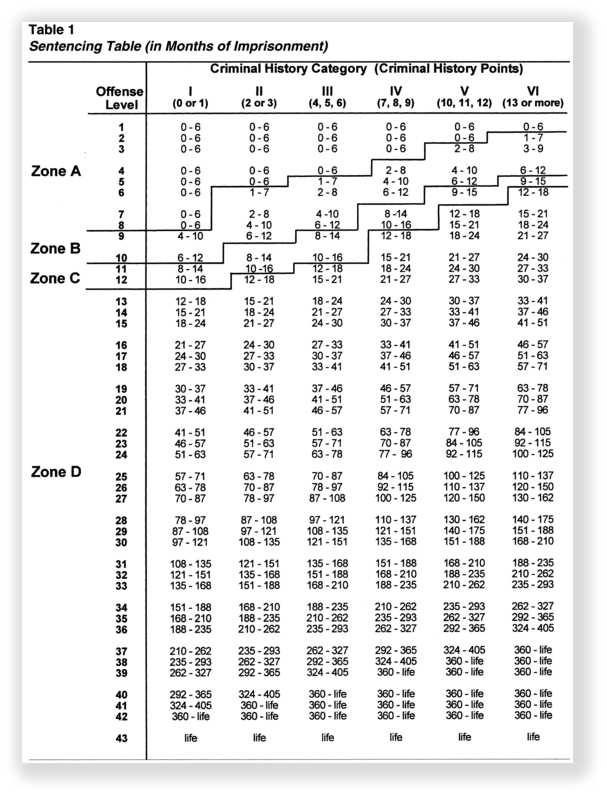
… AND BROUGHT FORTH A MOUSE
You recall the flurry of activity in July, as the nonprofit group Prisology encouraged people – inmates, families, friends and advocates – to sign on to comments encouraging the U.S. Sentencing Commission to consider a new Sentencing Table that reduced sentencing ranges across the board?
Prisology ended up delivering 62,236 online submissions and an additional 22,000-plus letters supporting its proposal. It delivered over 80,000. In fact, Brandon Sample, president of Prisology, reported to us by email at the end of July that he expected to exceed 90,000 submissions when all was said and done.
Brandon would probably agree with our take that getting the Sentencing Commission to address the Sentencing Table, which has not been amended for other than three minor tweaks in nearly 30 years, is a race that is more of a marathon than a sprint. Still, we thought the Commission might somehow acknowledge the widespread interest in promoting amendment of the Sentencing Table to the Commission’s listed priorities for the coming cycle.
The Sentencing Commission did not. Indeed, one wonders whether it read any of the comments it received. TL;DR, maybe? It’s pretty curious that a side-by-side comparison of the priorities it adopted for the coming amendment cycle shows that they are virtually word-for-word the priorities it originally proposed when it asked for public comment. As Aesop once put it, “The mountain labored mightily, and brought forth a mouse.”
To be sure, some of the priorities are promising. Its first goal is to “simplify the guidelines, while promoting proportionality and reducing sentencing disparities, and to account appropriately for the defendant’s role, culpability, and relevant conduct.”
Other priorities include revision of the “career offender” guidelines to “focus on offenders who have committed at least one ‘crime of violence,’ and to adopt a uniform definition of ‘crime of violence’ applicable to the guidelines and other recidivist statutory provisions.” The Commission also hopes to expand the “safety valve” at 18 U.S.C. 3553(f), and to get Congress to eliminate mandatory “stacking” of penalties under 18 U.S.C. 924(c). As well, the Commission wants to “promote effective reentry programs” and perhaps lower guideline ranges for “first offenders.”
All of this is good stuff, but for a couple of provisos. First, the 7-member Sentencing Commission currently only has four members. President Trump and his legal sidekick, Jefferson Beauregard Sessions III, will pick the other three (with one, U.S. District Judge Henry “Hang ‘em High” Hudson as the first choice, as we noted last week). The complexion of the Commission could change drastically in the next few months, and all of the touchy-feely business about actually making the Guidelines fairer and more reasonable could be torpedoed by a 7-member commission with three staunch law-and-order types.
Second, a lot of what the Commission wants to do – fixing mandatory minimums and expanding the safety valve, for example – will require Congressional action. We have seen how effective Congress can be: last year, the bipartisan sentencing reform legislation died, and this year’s version languishes in committee.
Finally, these priorities are not the same thing as amendments, or even proposed amendments. Something will have to happen to turn intent into action, and then action into retroactivity.
Meanwhile, Prisology finds itself on the beginning mile of a marathon. How it handles the campaign for a more rational sentencing table from here on out will give us an idea of what the organization is made of.