We post news and comment on federal criminal justice issues, focused primarily on trial and post-conviction matters, legislative initiatives, and sentencing issues.
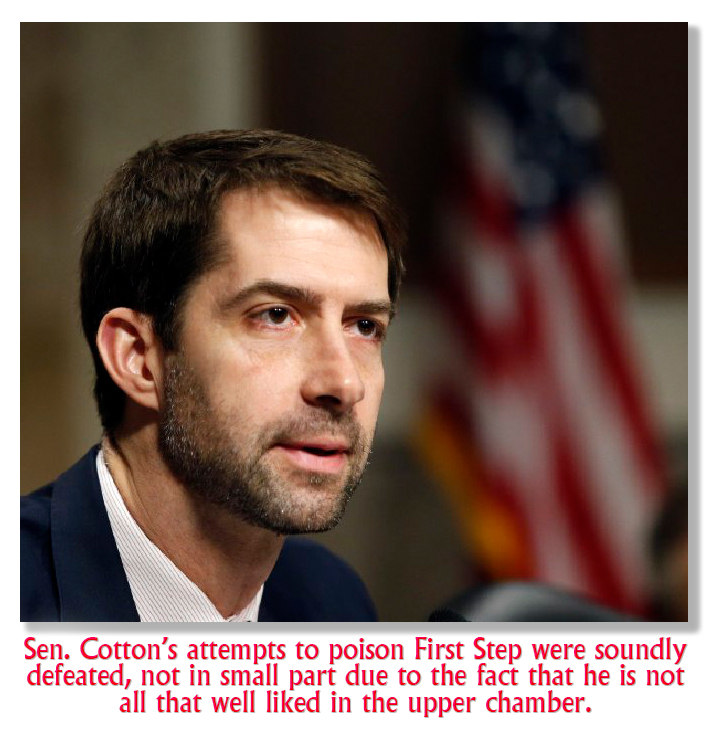
SENATE SHOOTS DOWN COTTON, ADOPTS CRUZ AMENDMENT, PASSES FIRST STEP
TheFirst Step Act, now renamed theCriminal Justice Reform Act, S.756, passed the Senate last night by a vote of 87 – 12, making adoption of federal criminal justice reform virtually a done deal.
A different version passed the House (H.R.5682) earlier this year, so all that remains is to have the House either pass the Senate version, or hold a quick conference committee to work out a compromise before the bill comes to President Trump for a signature. House Speaker Paul Ryan (R-Wisconsin) previously promised quick action on anything the Senate sent over on First Step.
Before passing the measure, the Senate shot down the “poison pill” amendment offered by Sens. Tom Cotton (R-Arkansas) and John Kennedy (R-Louisiana). That amendment would have disqualified anyone with a crime of violence (applying the very restrictive 18 USC 924(c) definition, which is of dubious constitutionality when applied in this setting) from using program credits for early release, required victim notification whenever anyone got early release, and required DOJ to track rearrests of people who got early release. The Senate broke the amendment into three pieces, all of which were defeated by close to 2-1 votes.
As well, the Senate rejected efforts by Sen. Cory Gardner (R-Colorado) to add legalization of marijuana to the measure.
At the same time, the Senate adopted two amendments, one from Sen. James Lankford (R-Oklahoma), which permits faith-based groups participate in providing the recidivism-reducing programs envisioned by the bill, and another by Sen. Ted Cruz (R-Texas), which added a few specific offenses to the list of offenses excluded from early release and stripped judges of the right to make people with more than four Guidelines criminal history points eligible for the “safety valve” under 18 USC 3553(f).
The Cotton-Kennedy amendment only needed a majority to pass, but none of the three sections even came close.
Trump last night issued a statement hailing the passage of the bill. “America is the greatest Country in the world and my job is to fight for ALL citizens, even those who have made mistakes,” Trump tweeted moments after the Senate vote. “This will keep our communities safer, and provide hope and a second chance, to those who earn it. In addition to everything else, billions of dollars will be saved. I look forward to signing this into law!”
We post news and comment on federal criminal justice issues, focused primarily on trial and post-conviction matters, legislative initiatives, and sentencing issues.
SENATE VOTES TO CLOSE DEBATE, SET FIRST STEP UP FOR A FINAL VOTE AS EARLY AS TODAY
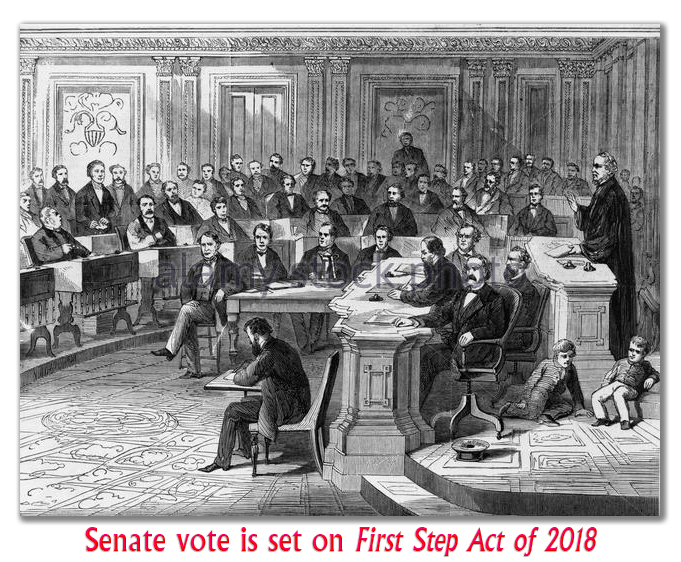
The First Step Act of 2018 (S.3747), cleared a major hurdle last night, with the Senate voting 82-12 to end debate on the bill and steer the legislation to a final vote, likely scheduled for today.
A different version passed the House earlier this year, so the House would have to pass the Senate version, or a conference committee would have to work out a compromise before the bill would come to President Trump for a signature.
Before a final Senate vote, the bill’s 35 sponsors will have to defeat so-called “legislative poison pills” that they say are designed to kill the compromise that has been carefully negotiated among Democrats, Republicans and the Trump administration. “There are a number of members with outstanding concerns that they feel are still unresolved… The Senate will be considering amendments before we vote on final passage later this week,” Senate Majority Leader Mitch McConnell (R-Kentucky) said ahead of the vote.
Look out, Sen. Cotton, here comes First Step…
Sens. Tom Cotton (R-Arkansas) and John Kennedy (R-Louisiana) will get a vote on their amendment that would bar people convicted of various offenses, including sex crimes and crimes of violence, from being able to qualify for shortened sentences, although they could still earn credits that would get them more halfway house, home confinement and in-prison privileges. The legislation already has a 50 or so exclusions, but Cotton and Kennedy want to add more crimes to the list. Sens. Patrick J. Toomey (R-Pennsylvania), Jon Kyl (R-Arizona) and John Barrasso (R-Wyoming) have endorsed Cotton and Kennedy’s effort, suggesting that they, too, are uncomfortable with the underlying bill.
The Cotton-Kennedy amendment would only need a majority to pass, so some Republicans will have to band with Democratic senators to kill it. And senators who wrote the bill say there are already a number of safeguards meant to prevent violent criminals from being prematurely released.
“From the standpoint that they aren’t specifically mentioned, the answer is, that’s true, they aren’t,” Senate Judiciary Committee Chairman Charles E. Grassley (R-Iowa) said. But “the reasons they aren’t is because we think that other parts of the law cover it and also the process that somebody has to go through to get a review of their sentence, the prosecutors gotta go through that as well.”
Sen. Dick Durbin (D-Illinois), who helped craft the deal along with Sens. Chuck Grassley (R-Iowa) and Mike Lee (R-Utah), warned that as currently drafted that he believes Cotton’s amendments are “poison pills” meant to undercut the legislation as a whole. “The amendments that he will propose tomorrow, the senator from Arkansas, have been opposed by groups across the board, left and right, conservative, progressive, Republican, Democrat, they all oppose his amendments. …If he goes with the amendments we’ve seen, we’re going to have to do our best to oppose him,” Durbin said.
Most if not all Democrat senators are expected to support First Step, although they emphasize that the bill alone is not enough. “It is a compromise of a compromise,” Sen. Kamala D. Harris (D-California) said in a statement yesterday announcing her support for the bill. “We ultimately need to make far greater reforms if we are to right the wrongs that exist in our criminal justice system.”
We post news and comment on federal criminal justice issues, focused primarily on trial and post-conviction matters, legislative initiatives, and sentencing issues.
FIRST STEP SENATE VOTES SET FOR TODAY AND WEDNESDAY
Senate Majority Leader Mitch McConnell (R-Kentucky) ended the Senate’s 4-day work last Thursday night by scheduled a procedural vote on the latest revision of the First Step Act of 2018 for 5:30 p.m. today. That vote, promised weeks ago, will be a crucial test of the bill’s backing, where supporters will need to put up 60 votes to advance the bill.
If the Monday vote is successful, the Senate leadership says First Step could be wrapped up Wednesday, after allowing opponents the opportunity to have yet amendments considered. “My impression is that people are not going to string this out unnecessarily for procedural reasons, as long as they get an opportunity to make their arguments and have a vote on their amendment,” said Senate Majority Whip John Cornyn (R-Texas), who announced his support for First Step this week.
Supporters say they have at least 70 votes for the measure, although cosponsors of the measure are officially at 35. Sen. Roy Blunt (R-Missouri), a member of Senate leadership, predicted that “slightly more than half” of the GOP conference and as many as 30 of the 51 GOP senators could back it.
As McConnell set the week’s votes last Thursday, Sen. Mike Lee (R-Utah) sought to make last-minute changes in First Step that would reflect a compromise the bill’s supporters had reached with Sen. Ted Cruz (R-Texas). Cruz endorsed the bill because it was supposed to bar many violent criminals from earning early release, but the version that was presented on Wednesday (which is available online) did not include all of the exclusions Cruz had been promised. Lee tried to get McConnell to change them, according to multiple people familiar with the matter, but McConnell wanted to give his divided caucus at least 24 hours to review the new just-released text. The bill‘s chief critic, Sen. Tom Cotton (R-Arkansas), joined in a private meeting with McConnell, Lee and Cornyn on the Senate floor Thursday afternoon, during which Lee argued that the changes should be made to increase the bill‘s conservative support.
To get any amendments into the bill, the legislation must be amended on the Senate floor. Cruz’s endorsement was critical to moving the bill forward, and he has repeatedly touted that the legislation would no longer allow the early release of violent criminals.
McConnell will allow only a little time and very few amendments to First Step before the Wednesday vote. After the Senate begins debating the bill, it will ultimately take 60 votes to pass it. And an amendment, however, will require just 50 votes in the narrowly divided Senate. Cotton and Sen. John Kennedy (R-La.) are expected to offer an amendment to add new exclusions to the list of inmates not allowed to get program credits. Because amendments need only a simple majority, some Republicans will have to vote against them to keep the provisions from being added to the legislation. One senator predicted that many Democrats would probably defect from the legislation if the Cotton amendment passed.
Still, First Step will pass as long as it survives an uncertain amendment process. Most Senate Democrats support it, a significant bloc of Republicans is expected to back it, and President Donald Trump is expected to sign it if it passes the Senate and House ahead of the Dec. 21 partial government shutdown deadline.
The biggest immediate impact of First Step would be felt by nearly 2,600 federal prisoners convicted of crack offenses before 2010. That’s the year the Fair Sentencing Act reduced the disparity in punishment between crack cocaine and the powdered form of the drug. First Step would make the reform retroactive.
All federal inmates will benefit from an increase in good time from 47 days a year to 54 days a year, retroactive to the beginning of each inmate’s sentence. The change is estimated to result in 4,000 extra prisoners being released in the next year, some immediately.
If it passes the Senate, the House and Senate will have to reconcile their different versions of First Step and then approve the reconciled version, all before Dec. 21. Rep. Steny Hoyer, D-Maryland, the House minority whip, told reporters last week, “I presume… we will be able to approve it next week. I’m hopeful that it can move that quickly.” The New York Times said House Speaker Paul Ryan (R-Wisconsin) has pledged swift action before the House leaves town for the year-end holidays.
We post news and comment on federal criminal justice issues, focused primarily on trial and post-conviction matters, legislative initiatives, and sentencing issues.
FIRST STEP GETTING WATERED DOWN AS IT APPROACHES THE FINISH LINE
We now have some idea of what had to be given away to convince House Majority Leader Mitch McConnell (R-Kentucky) to agree to schedule a vote on the FIRST STEP Act, perhaps as soon as tomorrow. The Senate released the text of the revised FIRST STEP Act (S.3649) this afternoon.
McConnell cited “improvements to the legislation that have been secured by several members” in his surrender speech last Tuesday, in which he agreed to bring the bill to the floor for debate and a vote. Whether these changes actually count as improvements depends on your perspective, but they were crucial to gaining the support of Sen. Ted Cruz (R-Texas) and a few other Republican senators who were initially opposed to the bill, which according to The New York Times “seemed to be the clincher” in moving McConnell off the fence.
The votes of Cruz and the others were hardly needed to pass FIRST STEP, which already had the support of Democrats, most Republicans, the president, and several law enforcement groups that are ordinarily leery of sentencing reform. The bill, which may get a Senate vote as soon as today, is expected to pass by a margin of more than 2 to 1. But McConnell “wanted every conceivable guarantee that the criminal justice measure would not blow up on him politically,” The Times said. The cost of reassuring McConnell was further dilution of a bill that was already pretty weak tea, the result of compromises on top of compromises.
Here are some of the additional concessions that were necessary to get McConnell to honor his promise of a vote:
• The bill now excludes all 924(c) firearm offenders from earning time credits.
• The bill now excludes fentanyl and heroin traffickers who are leaders/organizers from earning time credits.
• The bill now limits early release from prison to supervised release by specifying that only low and minimum risk offenders are eligible and specifying that the maximum amount of time off a sentence is 12 months. Also specifies that if a prisoner violates a condition of his or her prerelease custody, and the violation is nontechnical in nature, the Director of the Bureau of Prisons shall revoke the prisoner’s prerelease custody.
• The bill removed first time 18 USC 2252A(a) porn download offenders from earning time credits.
• The bill specifically excludes additional offenses from receiving earned time credits, including smuggling aliens into the U.S. with records of aggravated felonies, importing aliens for prostitution, drug-related robberies involving assault with dangerous weapon, carjacking resulting in serious bodily injury, threatening to murder a congressman, senator or government official, assault of a spouse or intimate partner or dating partner resulting in substantial bodily injury, assault of a law enforcement officer with a deadly weapon, arson, possessing contraband in prison, rioting in prison, gang-related felonies, escape, and failure to register as a sex offender.
So is there any good news? Well, the 54 days a year good time is still in the bill, still applies to everyone, and still is retroactive. No one has messed with the Fair Sentencing Act retroactivity, or the changes in the compassionate release or elderly offender home detention program. And Politico is asking in headlines, “Is Tom Cotton’s winning streak about to end?”
At Reason magazine, Jacob Sullum said today, “On the whole, the FIRST STEP Act still represents a significant improvement. But the changes are quite modest in the context of a federal system that imprisons more than 180,000 people and state systems that hold another 2 million. The difficulty of passing these incremental reforms, which took years notwithstanding broad bipartisan support, does not bode well for further progress anytime soon.”
There remains the possibility that after the Senate passes the bill, some of the good stuff will get put back into the bill by the joint conference committee. The irony is that if FIRST STEP gets back what has been given away to get the bill to the floor, the overwhelming support for the bill in the Senate guarantees that changes – even if McConnell, Cruz and Cotton do not like them – will sail through.
We post news and comment on federal criminal justice issues, focused primarily on trial and post-conviction matters, legislative initiatives, and sentencing issues.
MCCONNELL TO BRING FIRST STEP TO A VOTE
Senate Majority Leader Mitch McConnell (R-Kentucky) folded yesterday, announcing during a floor speech that the Senate will vote this month on the FIRST STEP Act, S.3649.
McConnell said the Senate will take up the legislation, written by Senate Judiciary Committee Chairman Charles E. Grassley (R-Iowa), Sen. Richard J. Durbin (D-Illinois) and several other Democratic and GOP senators, despite the controversial nature of the bill within the Senate Republican ranks. The bill could be debated as early as the end of this week.
Proponents of the bill believe the changes could receive as many as 85 votes in the Senate. House Speaker Paul Ryan (R-Wisconsin), who also privately pressured McConnell to take up the bill, has pledged swift action before the House leaves town for the year-end holidays.
The decision to put the bill to a vote comes “at the request of the president and following improvements to the legislation” secured by several senators, McConnell said.
At this time, no one knows what FIRST STEP’s sponsors had to give away, but Sen. Ted Cruz (R-Texas) said last Friday that he was supporting the measure now because it would be amended to prevent those convicted of crimes of violence from benefitting from earning earlier release for completing programs that reduce recidivism.
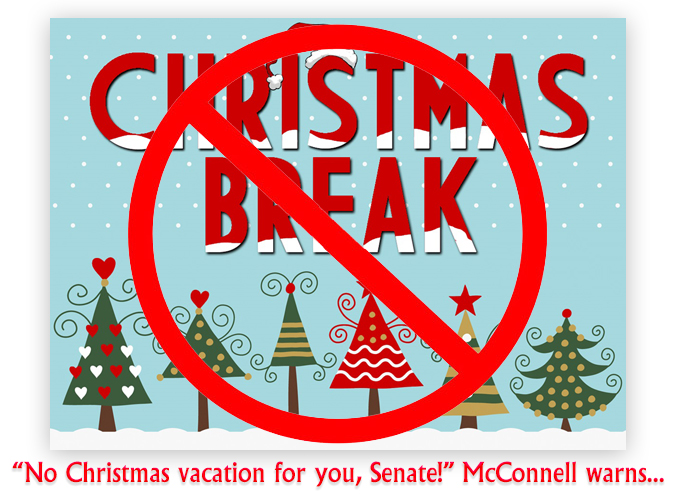
McConnell warned that because of the decision to add the criminal justice bill to the Senate agenda, “members should now be prepared to work between Christmas and New Year’s.” He urged senators to “work together or prepare for a very, very long month.” On the Senate’s to-do list is passing a farm bill, averting a partial government shutdown and clearing the deck of judicial and executive branch nominations.
The legislation has the strong support of Trump and his adviser and son-in-law Jared Kushner. Responding to McConnell’s announcement, Trump’s daughter Ivanka tweeted, “It’s official . . . the #FIRSTStepAct is headed to the floor for a vote. This historic legislation will reform our prison system and lift millions of Americans!”
We post news and comment on federal criminal justice issues, focused primarily on trial and post-conviction matters, legislative initiatives, and sentencing issues.
SUPREME COURT BROADENS ACCA BURGLARY IN EARLY LUMP-OF-COAL DECISION
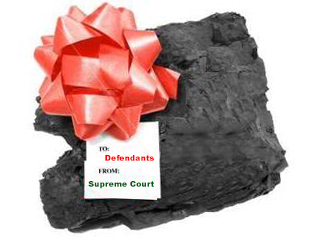
The Supreme Court yesterday issued an unexpectedly-early decision in United States v. Stitt, delivering a lump of coal to the stockings of people still hoping to to convince a court that their state burglary prior conviction should not count as a “prior” under the Armed Career Criminal Act. In a unanimous decision, the Court held in a Justice Breyer opinion that burglary of a structure or vehicle that has been adapted or is customarily used for overnight accommodation counts as a “generic burglary” in the ACCA’s“enumerated offenses” clause.
First, a review: Under the ACCA, a defendant convicted of being a felon in possession of a firearm under 18 USC 922(g)(1) receives an enhanced sentence. The basic 922(g)(1) conviction carries a zero to ten-year sentence. But if the ACCA applies, the sentence starts at 15 years and goes to a maximum of life.
A defendant qualifies for an ACCA sentence if he or she has three prior convictions for a serious drug offense or a crime of violence. The Stitt opinion concerned the ACCA’s crime-of-violence definition. A crime of violence is either (1) one of four listed crimes, burglary, arson, extortion or use of explosives, or (2) a crime which requires the use of force or threat of force against another. The first clause is known as the “enumerated offense” clause, which the second is called the “elements clause.”
In deciding whether an offense qualifies as one of the enumerated offenses – burglary, extortion, arson or use of explosives – under the “violent felony” definition in the ACCA, the “categorical approach” first adopted in the 1990 decision Taylor v. United States requires courts to evaluate a prior conviction by reference to the elements of the offense instead of the defendant’s actual conduct. A prior state burglary conviction does not qualify as a generic burglary under the ACCA where the elements of the offense are “broader than those of generic burglary,” as explained in Mathis v. United States.
The Supreme Court has defined the elements of a generic burglary as “an unlawful or unprivileged entry into, or remaining in, a building or other structure, with intent to commit a crime. Under that definition, breaking into a car, a boat, an RV or even a mobile home often was not considered a burglary because it was not a “building or other structure.”
Yesterday’s decision changed all of that. In a consolidated case covering two defendants from two separate states, Arkansas and Tennessee, the Supreme Court expanded that previous definition, saying in effect that burglarizing anywhere that is used for overnight lodging falls within the ACCA’s generic burglary definition. The Court said Congress intended that the burglary definition reflect “the generic sense” in which the term ‘burglary’ was used in the criminal codes of most States when the ACCA was passed.
At that time, a majority of state burglary statutes covered vehicles adapted or customarily used for lodging. Also, Congress viewed burglary as an inherently dangerous crime that “creates the possibility of a violent confrontation” between the burglar and an occupant. An offender who breaks into a mobile home, an RV, a tent, or another structure or vehicle “adapted or customarily used for lodging creates a similar or greater risk of violent confrontation.”
The Court said it did not matter if the vehicle or structure was only used for lodging part of the time, meaning that conceivably, breaking into new RVs on the dealer’s lot would still count toward an ACCA sentence.
One of the two defendants, Jason Sims complained that Arkansas’ statute remained too broad, because it also covers burglary of “a vehicle… [w]here any person lives.” He said since homeless people sometimes sleep in cars, this means that breaking into any car would fall under the ACCA definition. The Supreme Court said the question of whether the statute would be applied that way needed to be decided by a lower court, and remanded Jason’s case to a lower court to decide the merits of the claim.
We post news and comment on federal criminal justice issues, focused primarily on trial and post-conviction matters, legislative initiatives, and sentencing issues.
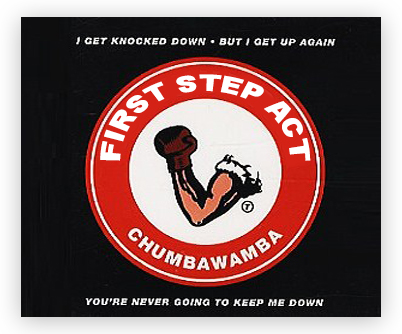
FIRST STEP GETS KNOCKED DOWN, BUT IT GETS UP AGAIN, CAN MCCONNELL EVER KEEP IT DOWN?
The lyrics from “Tubthumping,” Chumbawamba’s 1997 hit, describe the FIRST STEP Act’s week. The bill got knocked down early in the week by inaction and demagoguery, to the point that pundits were writing the bill’s obituary last Thursday. But the prison and sentencing reform act stumbled back up again on Friday, with three surprisingly positive developments.
FIRST STEP is still far from being passed, but the pressure (for a change) is on Senate Majority Leader Mitch McConnell (R-Kentucky) instead of on the bill’s supporters. Sen. John Thune (R-South Dakota) seemed to signal that McConnell may yield to pressure. On Face the Nation yesterday, Sen. Thune said of FIRST STEP, “There are timing issues associated with it but there – at the moment at least there are still some substantive issues that are being resolved. I think if they get that worked out, if they can attract the support of more Republican Senators, there – there’s still an opportunity I think for that to be finished this year, but if not obviously it – it will be taken up again next year-”
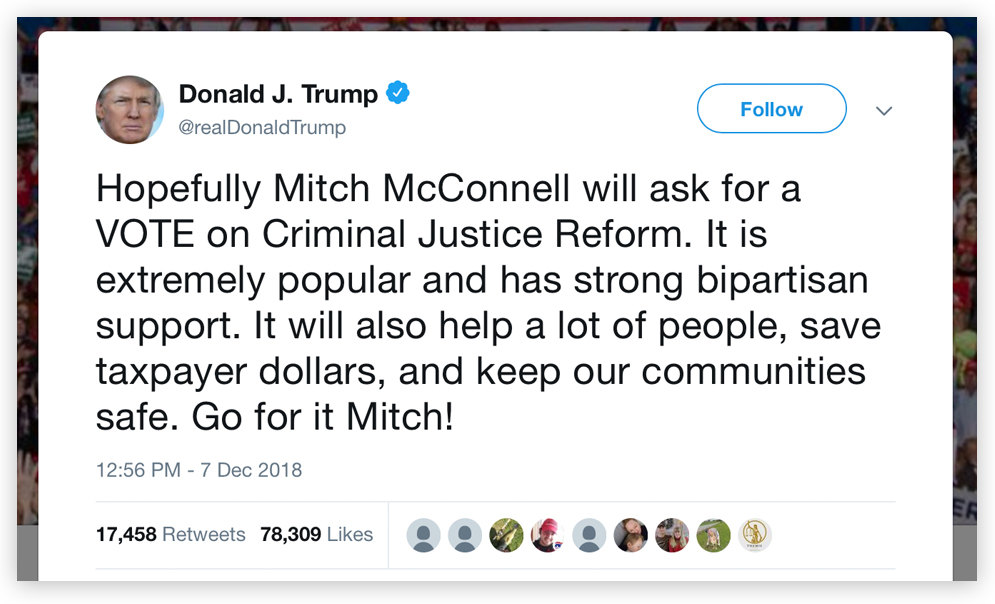
The big news of the week came late on Friday, when President Trump decided to check back in on the bill, and pressured McConnell to bring FIRST STEP to a vote during the crowded lame duck session. After going mostly silent on the bill for several weeks, Trump singled McConnell out on Friday on his Twitter feed:
Trump’s public demands do not guarantee McConnell will bring the bill to a vote. He has told Trump several times that the Senate calendar is too cluttered in December to take up a bill that divides Republicans. As late as Thursday, McConnell had not mentioned the bill at either of two GOP senator meeting, and he has reportedly told senators there’s almost no window to take up the bill this year, according to multiple GOP sources.
One McConnell adviser said the senator does not intend to have a vote on the legislation because he does not have enough time and is more focused on other things — like funding the government and confirming judges. “He doesn’t like the bill,” the Washington Post reported Republican donor Doug Deason, a key White House ally, said of McConnell’s view of FIRST STEP. “He’s a Jeff Sessions-style, lock-them-up-and-throw-away-the-key kind of guy.”
White House officials say McConnell doesn’t want a vote unless the overwhelming majority of Republicans will vote for it — although both Senate Judiciary Committee Chairman Charles Grassley (R-Iowa) and Sen. Mike Lee (R-Utah) said that 28 or 30 GOP senators support the bill. There are 51 Senate Republicans, and nearly all of the 49 Senate Democrats are expected to back it.
McConnell complained at a Wall Street Journal event last week that such a bill requires a week or ten days to consider, while there are only two weeks left before the planned holiday recess and budget bills that must be passed. FIRST STEP advocates argue that it would only take a few days, with a cloture vote capping debate at 30 hours. McConnell acknowledged support on both sides of the aisle but called the legislation “extremely divisive inside the Senate Republican conference,” with more members undecided or opposed than in favor.
“That’s his calling card, protecting his conference,” said Kevin Ring, president of FAMM. The Atlantic suggested yesterday that while past majority leaders like Lyndon Johnson might have strong-armed their members, McConnell waits for near-unanimity among Senate Republicans. “I think he’s not just looking for 60 votes,” said Brett Tolman, a former U.S. Attorney in Utah who also worked as a GOP Senate staffer and now advocates for criminal-justice reform. “He’s looking for a majority of Republicans.”
But it’s not a bad thing.
Earlier in the week, FIRST STEP opponents Sen. Tom Cotton (R-Arkansas), John Kennedy (R-Louisiana) and Ted Cruz (R-Texas) seemed to be on a roll, denouncing FIRST STEP as giving immediate release to sexual predators, drug kingpins and gun-toting gangbangers. But Friday, just before Trump’s renewed support, Sen. Cruz flipped, issuing a press release pledging support:
“I have long supported criminal justice reform. I believe in reducing mandatory minimum sentences for non-violent drug offenders, and providing greater opportunities for offenders to be rehabilitated. At the same time, I do not believe we should be granting early release to violent offenders.
“That is why I drafted an amendment that would exclude violent offenders from being released early. I’m happy to report that, after working closely with the White House and the sponsors of this bill, they have decided to accept my amendment. This new version of the bill resolves my concerns, and is one that I wholeheartedly support and cosponsor.”
Also, last Friday a leading FIRST STEP opponent announced his support of key planks of the legislation. Larry Leiser, president of the National Association of Assistant U.S. Attorneys, told the Washington Examiner he supports in principle three of four major sentencing reforms included in FIRST STEP.
The possible turning of the tide seems to have little effect on McConnell’s reluctance to hold a vote. He has angered some GOP senators and created an unusual rift with Sen. Grassley, a longtime McConnell ally. Grassley has spent years building a coalition around FIRST STEP and is pushing hard for a vote this year. “We’ve done what needs to be done,” Grassley said about the overwhelming support for the bill. “So what’s holding it up?”
On Friday, Sen. Lindsey Graham (R-South Carolina) intervened, talking directly to President Trump about attaching the criminal justice legislation to the must-pass year-end spending bill, which is already tangled in a separate fight over funds for the border wall with Mexico. “Just talked with President,” Graham tweeted. “He strongly believes criminal justice reform bill must pass now. He also indicated he supports putting criminal justice reform bill on year-end spending bill which must include MORE wall funding.”
The spending bill will need approval by Dec. 21 to avoid a funding lapse days before Christmas.
On Thursday, Sen. Lee said there were 28 hard “yes” Republican votes plus 49 Democrats for the bill. “It’s rock-solid,” he said. But Sen. John Cornyn (R-Texas), the Senate Republican whip, said more Republicans needed to be convinced. “Right now we have a majority of the Republican conference either undecided or no,” he told reporters. He also continued to call for some changes to the bill.
Despite Sen. Lee’s assurance that he has 49 Democrat votes in favor of FIRST STEP, The Hill reported Wednesday Democrats who are mulling 2020 presidential bids have split over whether to support FIRST STEP. The decision to support or oppose the bill is a significant policy decision for 2020 Democrat candidates.
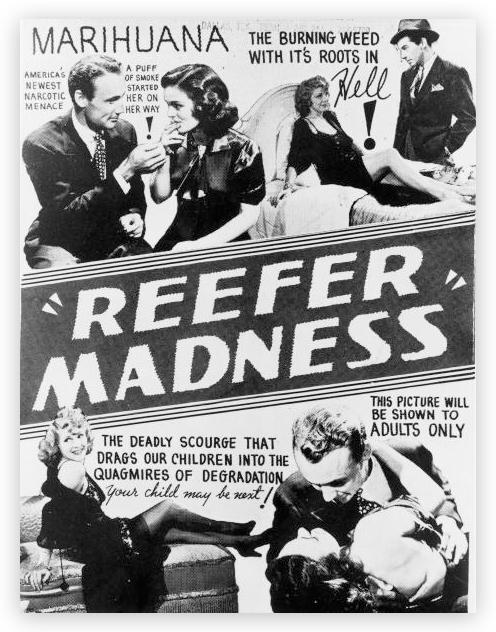
Among Republican senators, Sen. Rand Paul (R-Kentucky) told CNN that there’s a generational divide within the party on the issue. “I think there are people who were teenagers in 1937 watching ‘Reefer Madness’ and they’re still concerned that Reefer Madness is going to take over and everybody is going to become zombies, hacking and killing everyone if they smoke pot,” said Sen. Paul, a FIRST STEP supporter. “And then there are a couple of generations after 1937 of people who don’t see it with the same degree of evil.”
We post news and comment on federal criminal justice issues, focused primarily on trial and post-conviction matters, legislative initiatives, and sentencing issues.
INDICTMENT “PILING ON” VIOLATES DOUBLE JEOPARDY
Pablo Chilaca was convicted of four counts of possessing child pornography in violation of 18 USC 2252(a)(4)(B). He got four concurrent 66-month prison terms. Chilaca appealed, arguing that his four counts of conviction were multiplicitous.
An indictment is not multiplicitous merely because it charges more than one violation of the same statute based on related conduct; instead, a defendant can be convicted of multiple violations of the same statute if the conduct underlying each violation involves a separate and distinct act. However, where a single act or transaction is alleged to have resulted in multiple violations of the same statutory provision, the proper inquiry involves the determination of what Congress has made “the allowable unit of prosecution.”
Last week, the 9th Circuit held that under 18 USC 2252(a)(4)(B), which makes it a crime to knowingly possess one or more matters containing any visual depiction of child pornography, simultaneous possession of different matters containing offending images at a single time and place constitutes a single violation. The panel held that the four counts charging the defendant with possession of child-pornography images on separate hard drives found at the same time and in the same place were multiplicitous and constituted double jeopardy.
The panel held the error was not harmless, but that because the record clearly shows that evidence presented at trial would have been the same regardless of the number of counts charged, no new trial was warranted. The panel remanded with instructions to vacate three of the four counts of convictions and to resentence the defendant on the remaining count.
We post news and comment on federal criminal justice issues, focused primarily on trial and post-conviction matters, legislative initiatives, and sentencing issues.
SUPREME COURT HEARS TWO CONSEQUENTIAL CASES
The Supreme Court heard oral arguments last week on forfeiture and whether someone screwed up in leaving a big chunk of Oklahoma as Indian Country.
Tyson Timbs, an Indiana man who lost his 2012 Land Rover after he pleaded guilty to drug charges. The state argued that it could seize the car because it had been used to transport drugs, but Tyson countered that requiring him to forfeit the $42,000 car – which he had bought with inheritance money – would violate the 8th Amendment’s ban on excessive fines, because the value of the vehicle was nearly four times the maximum fine that could have been imposed. The question before Court in Timbs v. Indiana was simply whether the 8th Amendment’s prohibition of excessive fines applies to the states at all.
The justices appeared to agree that it does. However, there is wide disagreement on what kind of forfeiture is excessive. Federal defendants can hope for the Court to define when forfeiture is too much, but observers think that the justices are likely to say that excessive fines clause applies to the states, but not much more.
Carpenter v. Murphy asked whether a large part of eastern Oklahoma, including where Patrick Murphy is alleged to have committed murder and the entire City of Tulsa, still lies within the borders of a reservation granted to the Creek Nation when it was forcibly relocated to the Oklahoma Territory in the early 19th century. If so, then Oklahoma had no jurisdiction to try Murphy: The Major Crimes Act would give exclusive jurisdiction over that murder to federal authorities, because Murphy is a Native American. The formal procedures that Congress followed when it organized the state of Oklahoma did not explicitly terminate the reservation on which the crime occurred. Because the Supreme Court’s earlier cases have emphasized the importance of statutory language explicitly terminating a reservation, the lower court concluded that the reservation remains in place.
The case is important to a number of federal defendants, whose prior convictions could be wiped out, affecting not only ACCAconvictions and 21 USC 851 drug enhancements, but Guidelines criminal histories as well.
The Court is clearly grappling with the law that plainly makes eastern Oklahoma Indian Country versus the wholesale dislocation that upholding the Tenth Circuit would cause. Yesterday afternoon, the Court took the unusual step of calling for additional briefing on two questions that suggest it is looking for a creative way to decider the case. The first is whether some statute out there may authorize Oklahoma prosecutions “irrespective of the area’s reservation status.” If Oklahoma has such authority, then the criminal-law disruption from recognizing the reservations as still existing would be substantially less.
The second question is whether there “are circumstances” in which land that still qualifies as Indian Country might nevertheless not be “Indian country as set forth in 18 USC 1151(a).” If so, the Major Crimes Act would not divest Oklahoma of the authority it has exercised through the years to prosecute offenses committed by Native Americans.
We post news and comment on federal criminal justice issues, focused primarily on trial and post-conviction matters, legislative initiatives, and sentencing issues.
STATE TIME MAY NOT BE BETTER… BUT IT IS SHORTER
Federal inmates (and especially their families) often complain that the prisoner would be better off with a state conviction, because he or she would have gotten a shorter sentence? True? Or just a federal inmate myth?
The Bureau of Justice Statistics released a report last Wednesday reporting on how much time offenders serve in state prisons, and it is illuminating.
The average time served by state prisoners released in 2016, from initial admission to initial release, was 2.6 years. By comparison, in 2016, federal prisoners served an average of 3.6 years.
All of those who thought they would have been better off killing someone than, say, looking at child porn or selling drugs, now have some hard numbers to back up their beef: defendants sentenced for murder or non-negligent manslaughter served an average of 180 months in state prison before their initial release. This means that if a federal inmate has more than 206 months – like the guy who contacted us the other day with a 360-month sentence for a marijuana conspiracy – he or she should have just shot that meth customer instead of dealing to him.


 A different version passed the House (H.R.5682) earlier this year, so all that remains is to have the House either pass the Senate version, or hold a quick conference committee to work out a compromise before the bill comes to President Trump for a signature. House Speaker Paul Ryan (R-Wisconsin) previously promised quick action on anything the Senate sent over on First Step.
 At the same time, the Senate adopted two amendments, one from Sen. James Lankford (R-Oklahoma), which permits faith-based groups participate in providing the recidivism-reducing programs envisioned by the bill, and another by Sen. Ted Cruz (R-Texas), which added a few specific offenses to the list of offenses excluded from early release and stripped judges of the right to make people with more than four Guidelines criminal history points eligible for the “safety valve” under 18 USC 3553(f).