All posts by lisa-legalinfo

Dimaya Redux at the Supreme Court? – Update for January 7, 2019

We post news and comment on federal criminal justice issues, focused primarily on trial and post-conviction matters, legislative initiatives, and sentencing issues.

SUPREME COURT GRANTS CERTIORARI TO 924(C) CASE

After the Supreme Court decision last spring in Sessions v. Dimaya, a lot of people doing time for using a gun during a crime of violence had hoped to attack their 18 USC 924(c) convictions by arguing the underlying crime was not violent.

gunb160201Section 924(c) outlaws using, carrying, or possessing a firearm in connection with a drug offense or “crime of violence.” “Crime of violence” is defined in subsection (c)(3)(B) to be a crime in which force is used or threatened against the person or property of another (the “elements clause”) or any a felony “that by its nature, involves a substantial risk that physical force against the person or property of another may be used in the course of committing the offense,” known as the residual clause.

In Johnson v. United States and, later, in Dimaya, the Supreme Court invalidated similar residual clauses as violating due process because of vagueness.

After Dimaya, the courts of appeal entertained a spate of cases arguing that if 18 USC 16(b) (the residual clause found unconstitutional in Dimaya) was invalid, so was the identically-worded clause in § 924(c)(3)(B). Last September, the 5th Circuit became the first appellate court to decide the matter, holding in United States v. Davis that it would use the same “categorical approach” approved by the Supreme Court in Johnson and Dimaya when applying § 924(c)(3)(B) to the underlying offense. Doing so, the Court said, there was no doubt that 924(c)(3)(B) was unconstitutional.

A number of other circuits have differed with the 5th since then. Most recently, the 2nd ruled in United States v. Barrett and the 11th held in Ovalles v. United States that § 924(c)(3)(B) survives Johnson and Dimaya. Those circuits agree that, first, 18 USC 924(c) is a criminal offense that requires a determination of guilt beyond a reasonable doubt of the underlying offense by a jury in the same proceeding. For that reason, the categorical approach – which requires a reviewing court to ‘imagine’ an “idealized ordinary case of the crime” and which would render the 924(c) residual clause unconstitutional – need not be employed. Instead, those circuits used a conduct-based approach, looking at how the defendant actually committed the underlying crime instead of employing some “least violent hypothetical.” See “Circuits Busy Shutting Down 924(C) Dimaya Claims,” Newsletter, Oct. 8, 2018.

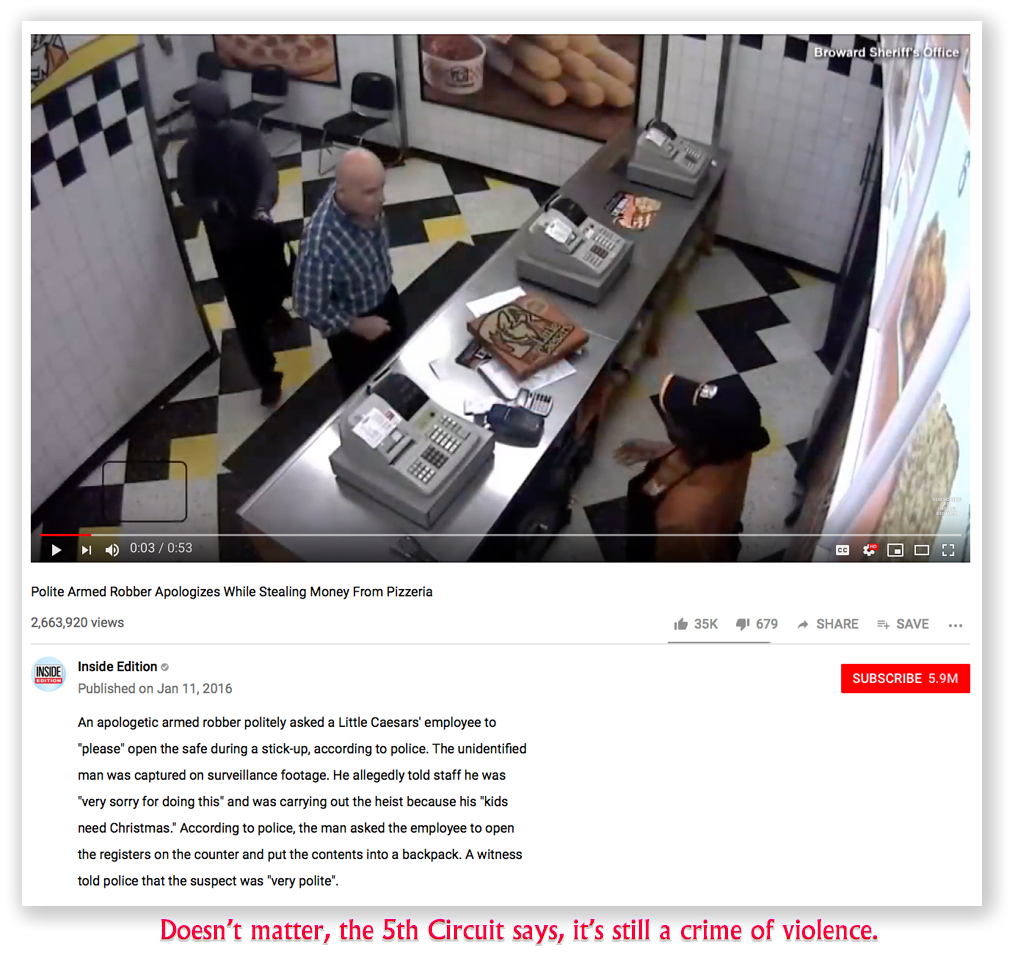
scotus161130Naturally, the government prefers the approach favored by every court except the 5th Circuit. Last Friday, the Supreme Court granted the government’s petition for certiorari to challenge the 5th Circuit’s use of the categorical approach in Davis. In that case, the 5th held the defendants’ 924(c) conviction could not stand, because it was based on conspiracy to commit a Hobbs Act robbery. A conspiracy itself does not use force or threat of force, the Circuit reasoned, so it only could be a crime of violence under 924(c)’s residual clause. Because that clause was identical to the crime of violence residual clause declared unconstitutional in Dimaya, the 5th Circuit held conspiracy to commit a crime of violence could not constitutionally support a 924(c) conviction under the residual clause in that statute, either.

It is possible there will be a decision by June, but it is more likely the case will not be argued until the fall.

United States v. Davis, Case No. 18-431 (certiorari granted Jan. 4, 2018)

– Thomas L. Root

Court’s Still In During Shutdown – Update for January 4, 2019

We post news and comment on federal criminal justice issues, focused primarily on trial and post-conviction matters, legislative initiatives, and sentencing issues.

FEDERAL COURTS: BUSINESS AS USUAL (FOR NOW)

Despite President Trump’s partial government shutdown that began almost two weeks ago, the federal courts remain open and will continue operations for about three weeks, at least through January 11, by using court fee balances and other funds on hand.

38700Most proceedings and deadlines will occur as scheduled. In cases where an attorney from an Executive Branch agency is not working because of the shutdown, hearing and filing dates may be rescheduled. As of late last week, federal courts across the country started hitting pause on many cases at the request of the Dept. of Justice, which was arguing in cut-and-paste pleadings that the shutdown restricts government lawyers from performing their usual duties.

If the federal courts burn through their resources, they would then operate under the terms of the Anti-Deficiency Act, which allows work to continue during a lapse in appropriations if it is necessary to support the exercise of Article III judicial powers. Each court and federal defender’s office would determine the staffing resources necessary to support such work.

Meanwhile, the DOJ has cited its own 13-page contingency plan for continuation during the shutdown. The agency says that “criminal litigation will continue without interruption as an activity essential to the safety of human life and the protection of property,” but “civil litigation will be curtailed or postponed to the extent that this can be done without compromising to a significant degree the safety of human life or the protection of property… The Department will limit its civil litigation staffing to the minimum level needed to comply with the court’s order and to protect life and property. Receipt of summonses, pleadings and motions by mail may be delayed.”

Not all is bliss, however. Several Bureau of Prisons employees (who are considered essential) have sued the government for requiring them to show up for work without being paid at the appointed time. Apparently, the notion that when your employer stops paying you, you find another job – an idea well known in the private sector, where performance, merit, advancement and compensation are generally tightly-connected concepts –  has not occurred to these government employees. 

Administrative Office of US Courts, Judiciary Operating During Shutdown (Dec. 22, 2018)

DOJ, FY 2019 Contingency Plan (Sept. 11, 2018)

The Washington Post, ‘Nothing short of inhumane’: Union sues Trump administration over shutdown (Jan. 2, 2019)

– Thomas L. Root

Reading First Step A Little More Carefully – Update for January 3, 2019

We post news and comment on federal criminal justice issues, focused primarily on trial and post-conviction matters, legislative initiatives, and sentencing issues.

SOME EASTER EGGS – NOT ALL GOOD – IN THE FIRST STEP BILL

software_easter_eggIn computer software and media, an Easter egg is an intentional inside joke, hidden message or image, or secret feature of a work. It is usually found in a computer program or video game.

The First Step Act text raced through the Senate and House, and was signed by the President, in four days. It was difficult to be sure that the available version of the Act – and there had been at least three even before the Senate passed a fourth on Dec. 18 – was the latest.

The final version has a few tweaks, previously unnoticed revisions and poorly-drafted parts that were finally noticed last week. Some are confusing, a few are interesting, but others are  rather ugly.

The good: It has always been gospel for people seeking reductions in sentence under 18 USC 3582(c)(2) because of the changed drug tables that Guidelines career offenders and people with 851 enhancements were blocked from the benefits of the reductions. Guidelines career offenders have their offense levels set on a scale of 12 up to 3, depending on the statutory maximum sentence of the underlying offense. A change in drug quantity Guidelines did not affect the stat maximum, so career offenders’ offense levels did not change.

retro160110The retroactivity of the Fair Sentencing Act – part of First Step – changes the statutory maximum. It used to be that 5 grams of crack got you 5 to 40 years. Now, anything under 28 grams is 0-20 years. More than 50 grams got you 10-life; now 50 grams is 5-40, and 10-life only starts after 280 grams. The effect for a lot of guys, who were convicted of “at least 5 grams” or “at least 50 grams,” is to drop the statutory maximums, and therefore reduce their career offender ranges from 37 to 34 or 34 to 32.

Because the retroactivity of the Fair Sentencing Act requires that a court “impose a reduced sentence as if… the Fair Sentencing Act of 2010… [was] in effect at the time the covered offense was committed,” it appears that Guidelines career offenders with the right numbers in their indictments may be entitled to lower sentences, as well as the straight USSG 2D1.1 crack guidelines people.

The same stepdown from 21 USC 841(b)(1)(A) to (b)(1)(B), and from (b)(1)(B) to (b)(1)(C) may well let people with 851 enhancements get lower sentences as well.

narrow190103That’s a great gift. But not so great is language in First Step Sec. 102(b)(2) that suggests that the extra seven days a year does not have to be applied by BOP until late July 2019, when the Attorney General is required to have a risk assessment program adopted. The interpretation of the subsection is capable of being interpreted to applying only to earned-time credits, but the BOP has a history of interpreting statutory language to the inmates’ detriment (see the 2010 Supreme Court Barber v. Thomas decision).

Perhaps even worse is the apparent squishiness of the Elderly Offender Home Detention program. People who think the EOHD is a brand new bauble are mistaken: First Step is not writing on a clean slate.

The definition of “elderly offender,” unchanged (except for dropping the age requirement to 60), has been around since 2008 in The Second Chance Act. Second Chance authorized an EOHD pilot program of two years’ duration, run at a single institution. The terms are set out at 34 USC 60541(g), and should be reviewed by any inmate interested in the program.

The parts of the definition of an “eligible elderly offender” which were not changed by First Step give the BOP a lot of discretion. For example, if the BOP does not “determine that release to home detention… will result in a substantial net reduction of costs to the Federal Government,” the prisoner would be deemed ineligible. 34 USC 60541(g)(5)(A)(vi). This could exclude some people at the younger end of the age range who are especially skilled at a UNICOR job or some other maintenance position valued by the particular institution.

ripper190103Likewise, to be eligible, an offender must be “determined by the Bureau of Prisons to be at no substantial risk of engaging in criminal conduct or of endangering any person or the public if released to home detention.” 34 USC 60541(g)(5)(A)(vii). This criterion makes perfect sense in a perfect world: who wants Jack D. Ripper to return to the house next door?  But in the real world, this provision grants the BOP virtually unbridled discretion. If it predicts that a drug defendant has a substantial risk of peddling some more pot, or a fraudster will likely run a three-card monte game from his front porch, what judge would ever rule otherwise? What the subsection really says is that the BOP can send who its lower-level staff want to send and deny those who staff want to deny.

 Parenthetically, I witnessed the operation of the 2-year pilot program, run at FCI Elkton in Lisbon, Ohio. In one memorable denial, a 79-year old man, 10 years into a 15-year marijuana sentence – who had had multiple strokes, suffered from heart disease and hearing loss, and had gone through multiple chemotherapy treatments for unrelated cancer, was denied the pilot EOHD program because of violence in his criminal history. It seemed that in 1949, as a hot-blooded youth, he had robbed a corner grocery store.

“You’re a danger,” the Elkton case manager told the minimum-security septuagenarian, “based on your robbery conviction” more than a half-century before. And that was that.

The BOP did not release a guiding program statement for the Elkton EOHD experiment, just a one-page release for prisoners. One can only hope for more detail, more consistency, and more common sense from the full-blown EOHD.

Enrolled Bill, First Step Act of 2018 (Dec. 21)

BOP, Elderly Offender Home Detention Pilot Program (Feb. 5, 2009)

– Thomas L. Root

Inmate Celebs Jump on First Step Act – Update for January 2, 2019

We post news and comment on federal criminal justice issues, focused primarily on trial and post-conviction matters, legislative initiatives, and sentencing issues.

IT’S WHO YOU KNOW…

A few connected people did not let the ink dry on President Trump’s signature before deploying their lawyers to make hay out of the First Step Act’s modification to the compassionate release provisions of 18 USC § 3582(c)(1).

whoknows190102On the last Friday of 2018, a federal judge reduced former Birmingham, Alabama, mayor Larry Langford’s sentence for corruption to time served, a day after Ebony magazine reported that he was near death and being denied release. He had served a little more than half of a 15-year sentence for bribery and corruption, but the family and friends in Congress were able to convince the U.S. Attorney and BOP to move for his compassionate release.

U.S. District Court Judge Scott Coogler ordered that Langford “shall be released from the custody of the Federal Bureau of Prisons as soon as his medical condition permits, the release plan is implemented, and travel arrangements can be made.”

iknowyou190102Meanwhile, lawyers for Annette Bongiorno, Bernie Madoff’s former secretary, raced into court a day after First Step became law to ask her judge to order the BOP to send her to home confinement on March 19, the day on which she will have served two-thirds of her sentence. Not content to have the BOP process her Elderly Offender Home Detention program request (probably a wise idea), her lawyers want Judge Laura Taylor Swain – who is already on record favoring Bongiorno’s home confinement – to tell the BOP to get it done.

The government has not yet weighed in on Bongiorno’s request, which was picked up in the national media as soon as it was filed (no doubt because the defendant’s lawyers made sure of the publicity.)

The Birmingham News, Larry Langford will be freed after sentence reduction (Dec. 28)

ABC News, Bernie Madoff’s secretary wants to use new Trump law to get out of jail early (Dec. 25)

United States v. Bongiorno, Case No. 10-cr-228, Letter Motion (Dec. 22)

– Thomas L. Root

A Week After Christmas, First Step Is No Longer So New and Shiny – Update for December 31, 2018

We post news and comment on federal criminal justice issues, focused primarily on trial and post-conviction matters, legislative initiatives, and sentencing issues.

IMPATIENCE, DISAPPOINTMENT IS SETTING IN ON FIRST STEP

President Trump shortened thousands of sentences by signing the First Step Act of 2018, S.756, four days before Christmas. But 10 days later, inmates and frustrated families say they are afraid the gift be may lost somewhere in the bureaucracy.

lousygift181231Silence from the BOP is creating concern that foot-dragging will slow sentence reductions. The new law gives inmates an extra seven days good time for each year of their sentence, but it’s unclear when the BOP will make the calculations. Advocates estimate that 4,000 federal prisoners will be released almost immediately under the good-time expansion.

LISA called the BOP’s Designation and Sentence Computation Center in Grand Prairie, Texas, on Dec. 27. DSCC is responsible for making all BOP sentence computation changes. A BOP spokesman said DSCC is still awaiting Dept. of Justice guidance, which he does not expect to receive for two or three weeks. “Until we get direction on what to do,” he said, “nothing is going to happen.”

bureaucracy180122“We are currently reviewing the new legislation to determine implementation guidance for BOP,” said DOJ spokesman Wyn Hornbuckle. More than 80% of DOJ’s workforce is working through the government shutdown, which began hours after Trump signed the First Step Act. But three-fourths of those people are law enforcement agents, and are unlikely to be busy writing directives for implementation of the law.

“Some families have loved ones who they know would be home tomorrow,” said Kevin Ring, FAMM president, told the Washington Examiner. “People are very concerned about when this is going to get done. Congress has passed this. It’s in effect.”

“We want to be prepared and know what’s going on,” said Steve Henderson, whose brother is serving federal time for a drug case. “When you have an infraction in prison, when they take the time away from you, they calculate it immediately… the next day it is gone,” Henderson said. But now, when “you have people across the country who are supposed to be home, all of a sudden DSCC isn’t answering their phones.”

For some, judging from many of the hundreds of First Step questions LISA received in the last week, the uncertainty is creating real questions about adjustment in the dates they are to go to halfway house. Others, including many already in halfway houses, calculate that they are now past their release dates, yet have no answers from BOP on getting out. At least one inmate, a resident of a Chicago halfway house, filed a pro se 28 USC 2241 motion last week in the U.S. District Court for the Northern District of Illinois, and has a hearing set for later this week.

why181231Angela Stanton King, an ex-inmate who is now a reform advocate, complained to the Examiner, “These are people at the holidays jumping up and down because the bill passed, and then they’re like, ‘Now what are we waiting for?'”

Meanwhile, other media outlets are noting that the lack of retroactivity in all but one of First Step’s sentencing reforms is disappointing. In one of many compromises made by criminal justice reform advocates to win conservative support, changes in so-called 851 enhancements and several other provisions were not made retroactive.

“I’m human and I would have loved to have benefited from the bill, but unfortunately I don’t,” one inmate doing life under 18 USC 3559 told the Guardian from federal prison in Lexington, Kentucky. “I don’t necessarily feel left behind, I just feel [lawmakers] don’t understand what goes on with the… actual humans that their choices and politics affect.”

bitter181231“I absolutely think that this one is going to be catalytic towards other decarceration campaigns on the local and state level,” said Glenn Martin, an ex-inmate reformer who helped bring dozens of groups together to support First Step. Nevertheless, the lack of retroactivity on a majority of the sentencing reforms was “a tough pill to swallow.”

“It’s one of the concessions that hurts the most,” said Martin. “It’s about fairness, and yet there’s this group of people who continue to be harmed because of the lack of retroactivity.”

Washington Examiner, Prisoners due for release under First Step Act stuck in limbo (Dec. 28)

The Guardian, Current inmates feel left behind by Trump’s criminal justice reform bill (Dec. 22)

– Thomas L. Root

You’ve Got Questions, We’ve Got Blank Stares – Update for December 27, 2018

We post news and comment on federal criminal justice issues, focused primarily on trial and post-conviction matters, legislative initiatives, and sentencing issues.

QUESTIONS ANYONE?

questions181227Yesterday, we presented a précis on the First Step Act. It didn’t help much. We have logged over 600 emails asking questions about the effect of the First Step Act on the sentences of existing inmates, and they continue to pour in.

Did we not make everything pellucidly clear?

Apparently not. Here are the most popular questions and our answers:

•   What sentencing changes are retroactive?

Only people with pre-Fair Sentencing Act crack sentences get retroactive relief. There is no retroactive relief for 18 USC 924(c) stacking, for denial of safety valve, or for 851 sentencing enhancements.

That is not to say that these changes will not come, just like the Fair Sentencing Act – which conservatives would not vote for if it was retroactive – finally became retroactive eight years later. But for now, the people with 924(c) stacked sentences, 851 life and 20-year sentences, and non-safety valve sentences are out of luck.

•   How about the seven days extra good time? Is it retroactive?

Yes.

•   When will I get the seven days extra good time?

This question is on everyone’s lips. The change in federal inmates’ sentence computation will be performed by the Bureau of Prisons’ Designation and Sentence Computation Center in Grand Prairie, Texas. It should not be difficult to do, and it is hardly as though BOP did not know this was coming. However, the BOP is a bureaucracy, and no one in a bureaucracy is going to be daring or self-starting enough to throw the switch just because some blow-dried President in Washington, D.C., makes something binding federal law.

As of last Friday afternoon, DSCC said it was waiting for guidance from the Dept. of Justice. Inasmuch as Monday and Tuesday were federal holidays, we doubt anything was forthcoming on those days. Whether DSCC is even staffed, due to the partial government shutdown, is not clear.

Yet, the BOP faces liability for holding people past their release dates, and as of last Friday, nearly everyone’s release date changed. We talked to DSCC today, and we were told that it still awaits direction from DOJ, and does not expect that for two to three weeks. No one appears to be in a hurry there.

That’s the long answer. The short answer is that we don’t know.

creditsign181227•   How about programs I have already completed? Are credits retroactive?

No, the credits are not. However, a change in 18 USC 3621(h) provides that “beginning on the date of enactment of this subsection, the Bureau of Prisons may begin to expand any evidence-based recidivism reduction programs and productive activities that exist at a prison as of such date, and may offer to prisoners who successfully participate in such programs and activities the incentives and rewards described in subchapter D.” We cautiously interpret this to mean that the BOP can start giving credits for programs successfully completed at any time after last Friday. This does not require the BOP to do so, but it is out there.

•   Are all 924(c) offenses ineligible for earned-time credit?

The Act excludes from earned time credits any offense of conviction under “924(c), relating to unlawful possession or use of a firearm during and in relation to any crime of violence or drug trafficking crime.” We read this to exclude all 924(c)s, whether for a crime of violence or for drugs.

•   If you have a 2-level enhancement to your drug conviction for a gun, are you excluded?

No, only a statutory 924(c) conviction excludes you.

miracle181227•   When is First Step effective?

Unless a law says otherwise, it is effective when the president signs it. But do not expect miracles. For the earned time credits, the Attorney General has seven months (until late July 2019) to develop the risk assessment system. The BOP then has 180 days to apply the risk assessment system to everyone and identify the programs that it believes will reduce recidivism (by late January 2020). The BOP then has two years (by January 2022) to fully ramp up the system.

During the initial two years of the program, the First Step Act anticipates, there will be more people wanting programs than there will be program space. The BOP is to put people nearest the end of their sentences in the programs first.

The Elderly Home Detention Program has never had a BOP program statement that implemented it, because it was limited in time and location. The BOP will have to develop procedures to process and judge applications. Nothing prevents someone from applying right away – and we recommend using 34 USC 60541(g)(5)(A) as a guide – but do not expect speedy processing.

Our take about compassionate release, however, is that Congress intends that it be implemented immediately. What is more, the BOP has procedures for dealing with compassionate release applications. While its history of doing so is not especially honorable, there is no need for delay while the BOP spools up a program statement on how to process them.

Nothing else in First Step should require any time for implementation. New or renewed requests for home confinement instead of halfway house, transfers to closer-to-home locations and the extra seven days should be immediate. How quickly the BOP updates sentences to account for the extra seven days is anyone’s guess, but a lot of people with short time will need that done immediately. (See answer above)

•   How do you file for a reduction in a crack sentence because of FSA retroactivity?

You file a motion under 18 USC 3582(c)(2). You should check with the federal public defender in the district in which you were sentenced. Many court ordered the FPD to represent people eligible under 3582(c)(2).

•   Are Guidelines 4B1.1. career offenders excluded from anything under First Step?

No. If you are excluded, it is because of a statute you were convinced of violating.

•   If I was convicted of a crime of violence or a sex offense in my past, does that exclude me from getting earned time credits?

No. Only your current offense will exclude you.

• Who is excluded?

We’ll cover that tomorrow.

now181227•   How soon can people start receiving credits?

Credits could start to accrue as early as the end of July 2019. The Act anticipates that it could take up to two years for the program to completely spool up, and preference will be given to the people who are short time first. This could mean that people with longer dates will not start getting earned time credits right away.

However, there had been discussion that BOP could be expansive in its interpretation of what constituted programs that lessened recidivism, and it could even include UNICOR employment and adult education classes.

•    Did your 21 USC 851 10-year sentence drop to 5 years?

No. Drug sentence enhanced by an 851 notice due to prior drug or state convictions changed, but only natural life (fell to 25 years to life), and 20 years (fell to 15 years to life). Nothing beyond that. And the change is not retroactive.

•   If you are excluded from getting earned time credits, how much halfway house/home confinement will you get?

The Second Chance Act still applies, and theoretically, you are entitled to up to 12 months of halfway house. The BOP has been very stingy with halfway house in the last year and a half, however, and no one knows what the BOP will do.

•   For EOHD, do you serve two-thirds of your sentence or two-thirds of the time between you start and you get good-time release?

If you got 180 months, for example, you serve 120 months. If you get EOHD, you will be on home confinement for 33 months. At 1053 months, you are released on good-time release.

•   If you get 12 months off for RDAP, can you get another 12 months off for earned time credits?

Theoretically, the one does not affect the other. But the BOP has the option to credit you with more halfway house or a shorter sentence, and no one knows how the BOP will decide to apply the earned time credits. No one in Congress discussed this, or, to our knowledge, even thought about it. Some things, like Donald Rumsfeld liked to say, are unknown unknowns.

S.756, First Step Act, passed into law Dec. 21, 2018

– Thomas L. Root

Trump Signs First Step Act… So What Happens Now? – Update for December 26, 2018

We post news and comment on federal criminal justice issues, focused primarily on trial and post-conviction matters, legislative initiatives, and sentencing issues.

FIRST STEP ACT – BOTH MORE AND LESS THAN MEETS THE EYE

I tried to take a few days to travel to the East Coast for Christmas with the granddaughters. But my inbox did not take any time off, with over 300 emails from inmates wondering what the First Step Act President Trump signed last Friday, would do for them.

I will try to cover what it includes in its 148-odd pages for people who have already been sentenced.

•   SENTENCING LAW CHANGES

firststepB180814First Step made some important sentencing law changes, which unfortunately are not very useful to the already-sentenced. From now on, no one can be convicted of a subsequent 924(c) gun offense carrying a 25-year penalty unless he or she has already been convicted of the first one. The government can still stack up 924(c) offenses in an indictment, but each one would only carry the 5-year, 7-year or 10-year penalty.

First Step also reduces the so-called 851 enhancement because of prior drug convictions penalty from life to 25 years and from 20 years down to 15 years. But where 851 enhancements used to be for drug offenses only, the provision slips in “serious violent felony” as a prior that will count, too.

First Step expands the “safety valve” for drug offenders. It used to be that the defendant could not have more than one Guidelines criminal history point. Now, a defendant can have up to four points, with some limitations.

Finally, the 2010 Fair Sentencing Act changed how crack cocaine was compared to powder cocaine from a 100:1 ratio down to an 18:1 ratio. This eased harsh sentencing for a lot of people whose prison terms were driven by crack cocaine amounts in their cases. But it was not retroactive, leaving a lot of people sentenced before August 2010 with a lot of time under a sentencing structure that had been judged to be unfair. The First Step Act fixed that, extending the Fair Sentencing Act to those people.

•   GOOD TIME CHANGES

When Congress wrote good time into law 30 years ago, it did a sloppy job. It awarded a maximum of 54 days a year, but the provision was so poorly written that it could mean that if you served 319 days, you got 54 days of good time to make up one year, or that you had to serve 365 days, after which you got 54 days. The difference in how you interpreted it amounted to seven more days a year.

Unsurprisingly, the BOP chose to read it the way that shorted everyone the seven days, and the Supreme Court upheld the agency’s right to interpret a messy statute the way it wanted to. The First Step corrects this, so that Congressional intent is clear. Congress always meant “do 319, get 54 more.” Now the BOP has no more wiggle room.

•  EARNED TIME FOR PROGRAMMING

The heart of First Step is recidivism programming. Congress does not want you to come back to prison. The idea is that every prisoner should be assessed to determine how likely he or she is to commit a new crime after release. There will be four categories, minimum, low, medium and high. After the risk assessment is done, the BOP will offer programs that have been shown to reduce recidivism. If prisoners successfully complete the programs, they will be rewarded with credits that the BOP will use to offer more halfway house or even shorten the length of the prisoner’s sentence, 10 days for every 30 days of programming or – when you reach the minimum-risk level – 15 days.

Warning: minimum risk is not the same as minimum security, and high risk is not the same as high security. It is entirely possible that your risk level will have nothing to do with your security/custody level.

Not the right halfway house - but you could get drunk here, which is what it may take to believe that BOP will implement FIRST STEP's transitional housing mandates.
Not the right halfway house – but you could get drunk here, which is what it may take to believe that BOP will implement FIRST STEP’s transitional housing mandates.

Will you get a shorter sentence or more halfway house? It is totally within the BOP’s discretion. You cannot get more than 12 months of time off your sentence, leaving extra earned-time credits for increased halfway house, on which there is no cap. No one knows whether the BOP will prefer halfway house over shorter sentences, but sending you to supervised release is much cheaper for the BOP than sending you to more halfway house. I suspect the BOP will go for cheap.

To satisfy politicians who wanted to look tough on crime to the folks at home, the bill has 63 categories of offenses of conviction that do not qualify for any earned time for programming. The fact that it does not make sense to keep these prisoners from completing programs that would do them and society a lot of good does not matter. What matters is how the senator or congressman looks at re-election time.

•   ELDERLY OFFENDERS

The Second Chance Act of 2007 authorized the BOP to conduct a two-year pilot program to send elderly offenders to home confinement. The program was limited to one prison (we believe the BOP used Elkton), and it only would send home someone who was 65 or over, was non-violent, had served at least 10 years, and had served at least 75% of his sentence (no women at Elkton, so it was all “he”). The limitations are at 34 USC 60541(g)(5)(A) and are worth reading.

With limitations like these, it is little wonder that only a handful of people ever qualified. The First Step Act readopts and expands the elderly offender home detention program. First, EOHD applies to all prisons, not just a single one. Second, the eligible prisoner just has to be 60 years old or older, and originally was intended to have to have served just two-thirds of the sentence.

A very peculiar twist is this: the legislation had always abolished the 10-year minimum service of sentence requirement, but somehow, in the final version passed by the Senate, that sentence was quietly dropped. Usually, when provisions were wrested from the bill, it was because Sen. Ted Cruz, Sen. Tom Cotton, or some other troglodyte legislator noisily opposed it. I am trying to find out whether the omission was a scrivener’s error or intentional. But if the 10-year limitation remains, all but a handful of nonviolent elderly offenders will ever qualify for the relief.

The original program pretty much left decisions to BOP discretion, including determining “that release to home detention under this section will result in a substantial net reduction of costs to the Federal Government” and that the prisoner is “at no substantial risk of engaging in criminal conduct or of endangering any person or the public if released to home detention.” All of that remains in the law, and applies to EOHD.

Back in 2009, when the pilot program was running, prisoners were told to contact their unit teams to determine whether they were eligible. There was no appeal except through the administrative remedy process. That does not appear to have changed.

•   COMPASSIONATE RELEASE

compassion160124Both the Sentencing Commission and Congress have been up in arms over the BOP’s dismal record in granting compassionate release under 18 USC 3582(c)(1)(A)(ii). Wait times for BOP action took months, the BOP higher-ups seemed to arbitrarily decide that dying prisoners were not terminally ill, and more people died waiting for a decision on compassionate release than received it. And if the BOP refused to file a compassionate release request with the sentencing court, there was nothing anyone could do about it.

The First Step Act rewrites compassionate release, both giving and taking away. Anyone with a crime or violence or sex offense is now excluded, but if the inmate is not dying right away, but requires nursing home-quality care, he or she is now eligible. The BOP is directed to act within deadlines on deciding cases, directed to notify families immediately about terminal diagnoses and about their rights to file a compassionate release. Most important, perhaps, compassionate release applicants can file their own requests with the court if the BOP refuses to do so.

•   HOME CONFINEMENT

Everyone knows that home confinement is dirt cheap for the BOP, but that getting it from the BOP instead of halfway house is like pulling teeth. The First Step Act directs that the BOP “to the extent practicable, place prisoners with lower risk levels and lower needs on home confinement for the maximum amount of time permitted under this paragraph.’’

It is a fine sentiment, but the way the provision is written, it is more a suggestion than a mandate. Still, it may give the BOP some cover from the agency’s fear of bad press that may come from sending someone to home confinement, only to have them run amok.

•   500 MILES…

First Step gives the same guidance, but a little more forcefully, to the placement of inmates. Of special interest to those reading this newsletter, the BOP is directed, “subject to consideration of the factors described in the preceding sentence [bed space, programming needs, security and medical needs] and the prisoner’s preference for staying at his or her current facility or being transferred, transfer prisoners to facilities that are closer to the prisoner’s primary residence even if the prisoner is already in a facility within 500 driving miles of that residence.”

This is a nice provision, helpful to a lot of prisoners who cannot get a transfer because they are 495 air miles from home, but there is a suitable prison 10 miles from the family. The only downside to this provision is that it specifies that you have no judicial remedy if the BOP wrongfully refuses transfer.

•  OTHER STUFF

The Senate print of the bill runs 148 pages, so there is a lot that is not covered here. Pregnant prisoners will no longer be shackled, and women will be provided certain healthcare products without charge, products that the men have no need for. The bill also provides for a lot of evaluation of the programming portions of First Step, meaning that if the attack on recidivism does not work, the legislation could go away someday (although that would require Congress to act, and we have all seen how long that can take).

Tomorrow, I’ll try to take some of the hundreds of questions I’ve been getting on the bill.

S.756, First Step Act, passed into law Dec. 21, 2018

– Thomas L. Root

Find Your Pen, Mr. President – Update for December 21, 2018

We post news and comment on federal criminal justice issues, focused primarily on trial and post-conviction matters, legislative initiatives, and sentencing issues.

HOUSE OF REPRESENTATIVES OKS FIRST STEP

The House on Thursday approved S.756, with the final name of the First Step Act (no capital letters anymore) and sent it to President Trump’s desk.

firststepB180814The long-awaited and frequently-declaraed-dead legislation overwhelmingly passed the House by a vote of 358-36 after the Senate passed it 87-12 on Tuesday.

Trump has already endorsed the legislation, and he is expected to sign it into law in the next few days.

If you want a copy of the Act as approved, you can find all 149 pages  here.

– Thomas L. Root

First Step Passes Senate Without Cotton’s Killer Amendment – Update for December 19, 2018

We post news and comment on federal criminal justice issues, focused primarily on trial and post-conviction matters, legislative initiatives, and sentencing issues.

SENATE SHOOTS DOWN COTTON, ADOPTS CRUZ AMENDMENT, PASSES FIRST STEP

The First Step Act, now renamed the Criminal Justice Reform Act, S.756, passed the Senate last night by a vote of 87 – 12, making adoption of federal criminal justice reform virtually a done deal.

firststep1800509A different version passed the House (H.R.5682) earlier this year, so all that remains is to have the House either pass the Senate version, or hold a quick conference committee to work out a compromise before the bill comes to President Trump for a signature. House Speaker Paul Ryan (R-Wisconsin) previously promised quick action on anything the Senate sent over on First Step.

Before passing the measure, the Senate shot down the “poison pill” amendment offered by Sens. Tom Cotton (R-Arkansas) and John Kennedy (R-Louisiana). That amendment would have disqualified anyone with a crime of violence (applying the very restrictive 18 USC 924(c) definition, which is of dubious constitutionality when applied in this setting) from using program credits for early release, required victim notification whenever anyone got early release, and required DOJ to track rearrests of people who got early release. The Senate broke the amendment into three pieces, all of which were defeated by close to 2-1 votes.

As well, the Senate rejected efforts by Sen. Cory Gardner (R-Colorado) to add legalization of marijuana to the measure.

cotton181219At the same time, the Senate adopted two amendments, one from Sen. James Lankford (R-Oklahoma), which permits faith-based groups participate in providing the recidivism-reducing programs envisioned by the bill, and another by Sen. Ted Cruz (R-Texas), which added a few specific offenses to the list of offenses excluded from early release  and stripped judges of the right to make people with more than four Guidelines criminal history points eligible for the “safety valve” under 18 USC 3553(f).

The Cotton-Kennedy amendment only needed a majority to pass, but none of the three sections even came close.

Trump last night issued a statement hailing the passage of the bill. “America is the greatest Country in the world and my job is to fight for ALL citizens, even those who have made mistakes,” Trump tweeted moments after the Senate vote. “This will keep our communities safer, and provide hope and a second chance, to those who earn it. In addition to everything else, billions of dollars will be saved. I look forward to signing this into law!”

New York Times, Senate Passes Bipartisan Criminal Justice Bill (Dec. 19)

Fox News, Senate passes criminal justice reform bill, sends to House (Dec. 18)

– Thomas L. Root


First Step May Pass Today, But Amendment Battle Looms – Update for December 18, 2018

We post news and comment on federal criminal justice issues, focused primarily on trial and post-conviction matters, legislative initiatives, and sentencing issues.

SENATE VOTES TO CLOSE DEBATE, SET FIRST STEP UP FOR A FINAL VOTE AS EARLY AS TODAY

firststepB180814The First Step Act of 2018 (S.3747), cleared a major hurdle last night, with the Senate voting 82-12 to end debate on the bill and steer the legislation to a final vote, likely scheduled for today.

Procedurally, the bill has been amended into another pending bill, formerly known as the Save Our Seas Act of 2018, S. 756. The bill is now being called the Senate Criminal Justice Reform Act.

A different version passed the House earlier this year, so the House would have to pass the Senate version, or a conference committee would have to work out a compromise before the bill would come to President Trump for a signature.

Before a final Senate vote, the bill’s 35 sponsors will have to defeat so-called “legislative poison pills” that they say are designed to kill the compromise that has been carefully negotiated among Democrats, Republicans and the Trump administration. “There are a number of members with outstanding concerns that they feel are still unresolved… The Senate will be considering amendments before we vote on final passage later this week,” Senate Majority Leader Mitch McConnell (R-Kentucky) said ahead of the vote.

Look out, Sen. Cotton, here comes First Step...
Look out, Sen. Cotton, here comes First Step…

Sens. Tom Cotton (R-Arkansas) and John Kennedy (R-Louisiana) will get a vote on their amendment that would bar people convicted of various offenses, including sex crimes and crimes of violence, from being able to qualify for shortened sentences, although they could still earn credits that would get them more halfway house, home confinement and in-prison privileges. The legislation already has a 50 or so exclusions, but Cotton and Kennedy want to add more crimes to the list. Sens. Patrick J. Toomey (R-Pennsylvania), Jon Kyl (R-Arizona) and John Barrasso (R-Wyoming) have endorsed Cotton and Kennedy’s effort, suggesting that they, too, are uncomfortable with the underlying bill.

The Cotton-Kennedy amendment would only need a majority to pass, so some Republicans will have to band with Democratic senators to kill it. And senators who wrote the bill say there are already a number of safeguards meant to prevent violent criminals from being prematurely released.

“From the standpoint that they aren’t specifically mentioned, the answer is, that’s true, they aren’t,” Senate Judiciary Committee Chairman Charles E. Grassley (R-Iowa) said. But “the reasons they aren’t is because we think that other parts of the law cover it and also the process that somebody has to go through to get a review of their sentence, the prosecutors gotta go through that as well.”

poison pillSen. Dick Durbin (D-Illinois), who helped craft the deal along with Sens. Chuck Grassley (R-Iowa) and Mike Lee (R-Utah), warned that as currently drafted that he believes Cotton’s amendments are “poison pills” meant to undercut the legislation as a whole. “The amendments that he will propose tomorrow, the senator from Arkansas, have been opposed by groups across the board, left and right, conservative, progressive, Republican, Democrat, they all oppose his amendments. …If he goes with the amendments we’ve seen, we’re going to have to do our best to oppose him,” Durbin said. 

Most if not all Democrat senators are expected to support First Step, although they emphasize that the bill alone is not enough. “It is a compromise of a compromise,” Sen. Kamala D. Harris (D-California) said in a statement yesterday announcing her support for the bill. “We ultimately need to make far greater reforms if we are to right the wrongs that exist in our criminal justice system.” 

Washington Post, Criminal justice bill clears hurdle in the Senate on strong bipartisan vote (Dec. 17)

The Hill, Senate votes to end debate on criminal justice reform bill (Dec. 17)

– Thomas L. Root

LISAStatHeader2small