
We post news and comment on federal criminal justice issues, focused primarily on trial and post-conviction matters, legislative initiatives, and sentencing issues.

SINGING FROM THE SAME SHEET OF MUSIC
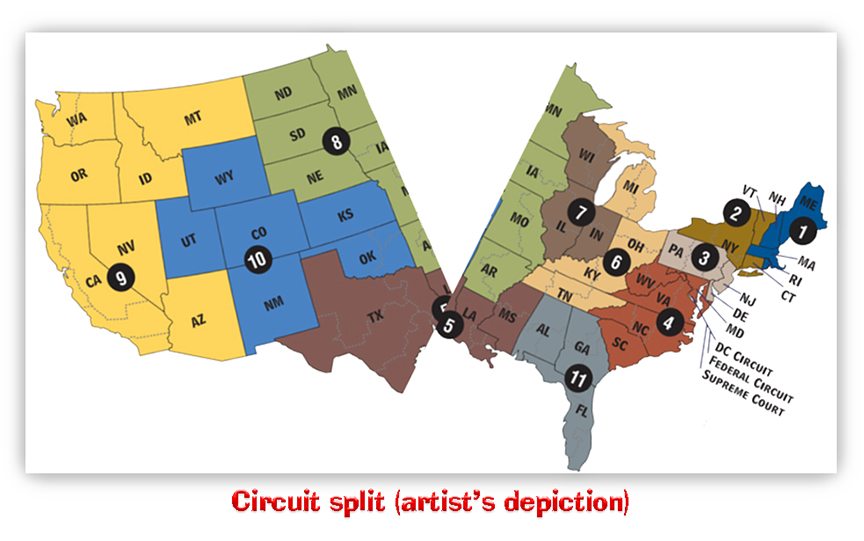 Everyone knows that a decision by one circuit’s court of appeals does not bind other circuits. In fact, differences among the circuits – known as a “circuit split” – is one way issues get to the Supreme Court. Still, the decision of one circuit may influence another circuit that has not yet addressed the issue. For this reason, decisions of other circuits are referred to as “persuasive authority.”
But how persuasive? In a Southern California Law Review article being published soon, Georgetown University Law Center professor Amy Griffin questioned how much deference circuit judges give “peer circuit precedent” – that is, decisions by circuit judges in other circuits – despite not being bound by it.
Professor Griffin analyzed roughly 800 cases across federal appeals courts in 2022 and 2023 in addressing issues of first impression in that circuit. She tracked whether existing sister circuit precedent existed and whether the deciding court agreed with it or not. When only one prior circuit had ruled on a first-impression issue, the new, deciding circuit agreed with that peer precedent 84% of the time. But once two circuits ruled the same way, agreement jumped to 97%. And once three or more circuits were in agreement, the new court agreed essentially 100% of the time.
 The lesson, Professor Griffin observed, is that the first circuit to decide a question had an outsized impact on how future courts decided the issue and its long-term resolution across the country. The results also raise questions about “percolation,” the Supreme Court’s practice of allowing multiple lower courts to develop reasoning on an issue before it takes it up. “One of my takeaways is that what some people might be thinking is happening as percolation is not really happening if they are just very quickly falling in line,” Griffin told the National Law Journal.
Professor Griffin also found variation in how often respective circuits’ first-impression rulings were later followed by other appeals courts. The 10th Circuit was followed most often, 75% of the time.
The circuit with the lowest “win rate” was the 2nd. Out of 41 times the Second Circuit appeared on either side of a split, the later, considering court chose the 2nd Circuit’s position 49% of the time, Prof Griffin found.
National Law Journal, Appellate Judges Put a Lot of Weight on Sister Circuit Precedent, Study Finds (April 20, 2026)
~ Thomas L. Root