Tag Archives: oyer

A “Totally Decimated” DOJ Pardon Office Sidelined by “Corrupt” Clemency Process – Update for March 2, 2026

We post news and comment on federal criminal justice issues, focused primarily on trial and post-conviction matters, legislative initiatives, and sentencing issues.

PARDON OUR MESS AT THE OFFICE OF PARDON ATTORNEY

The Dept of Justice Office of Pardon Attorney has always been rather opaque. Last week, we got a glimpse of President Trump’s OPA, and what we saw was not good.

Under the Constitution, the President holds unreviewable clemency power. However, since 1789, various government offices have provided the President with administrative support for the exercise of executive clemency. In 1865, a DOJ office was formally delegated the responsibility of assisting the President in vetting clemency petitions. It became the “Office of Pardon Attorney” in 1894. Historically, presidents have relied on OPA’s pardon review process to rely on the pardon attorney process before making pardons, but they are not required to do so.

OPA used to apply five standards for someone to be considered for clemency, including conduct since conviction, seriousness of the offense, acceptance of responsibility for the crime, the extent of punishment already suffered (especially collateral consequences), and references from other people who could attest to the applicant’s good character and rehabilitation.

Not anymore. A troubling New York magazine article last week detailed the mess that OPA has become, and the implications for federal prisoners without rich parents or powerful friends.

Elizabeth Oyer, who headed OPA when Trump came into office, was the first former public defender to serve as Pardon Attorney. Her staff of 45 was responsible for reviewing the cases of thousands of offenders to determine who was worthy of clemency. But within hours of President Trump taking office, “she was cut out of the process, which was rerouted from the top down.” Oyer told New York that she began learning about Trump clemency grants “when they popped up in the news.”
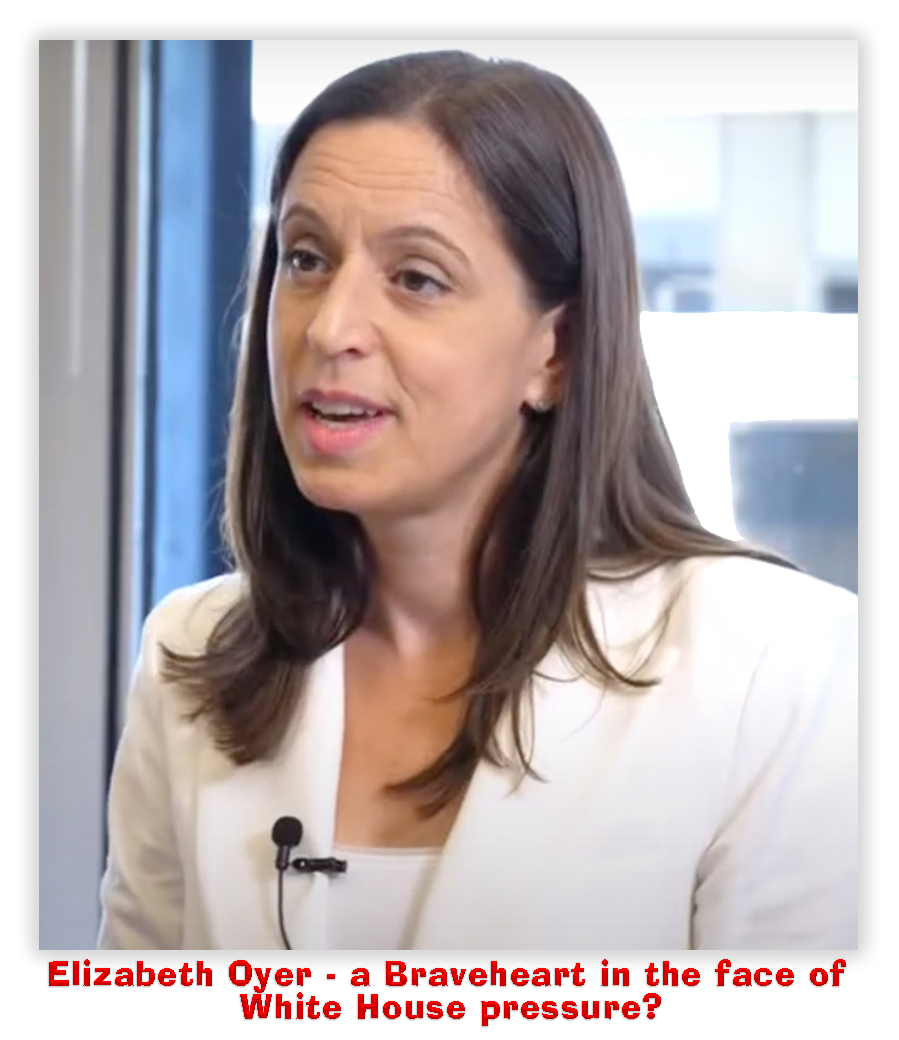
Oyer was fired last March when she refused to agree that actor and friend of Trump Mel Gibson should have his gun rights restored. Gibson was disqualified under 18 USC § 922(g)(9) because of a misdemeanor conviction for violence against his ex-girlfriend and the mother of his 1-year-old daughter at the time.  New York described Oyer’s firing as “a death knell for the office, according to some former staffers.”

“The office has been totally decimated,” an ex-staffer was quoted as saying. The office is down from 45 to about 15 employees. Many took buyouts when Elon Musk’s DOGE offered them last April. “Others,” New York said, “quit rather than stick around in an office where their work was being ignored.” (DOJ, of course, denies that OPA has been sidelined).

Two people appear to be in charge. Alice Marie Johnson, the “pardon czar” Trump appointed a year ago – a former federal prisoner serving life for a cocaine trafficking conspiracy before Trump commuted her sentence in 2018 (and later upgraded her to a full pardon) – works out of the White House. “Some ex-staffers hoped Johnson would maintain the office’s mission-based work…” one former OPA employee said. “But I don’t know that she has a staff,” says another former employee.

The official head of OPA is Edward Martin, named Pardon Attorney as a consolation prize after he was found to be too controversial to pass the Senate appointment process to be US Attorney for Washington, D.C. New York reported that Martin is uninterested in the Pardon Attorney position and apparently appears at the office about once a week.  “He’s just not there that much,” the staffer said.

The best way to obtain clemency in the current environment is to pay big in order to go around OPA. Lobbying for clemency is big business. Billionaire Changpeng Zhao, who violated money-laundering prevention statutes at his crypto exchange, Binance, was pardoned last fall, about a month after hiring the lobbying firm of Donald Trump Jr.’s friend Ches McDowell. The cost for a month’s lobbying? $450,000. (It helped that Binance was also a major backer of the Trump family’s cryptocurrency stablecoin). Nursing-home magnate Joseph Schwartz paid conservative lobbyists nearly $1 million last April to lobby for a pardon on tax-fraud charges; by November, Schwartz was free.

“Attorneys close to Trump are now seeking fatter fees,” New York reported. “Rudy Giuliani was reportedly shopping around a $2 million price last year. One former pardon-office lawyer… said they were hearing lobbyists go as high as $5 million to work their connections in the White House.”
Last Tuesday, in his State of the Union address, Trump asked that Congress “pass tough legislation to ensure that violent and dangerous repeat offenders are put behind bars and importantly, that they stay there.” Trump is not a friend of federal inmates who have neither connections nor a lot of money. Yet I hear weekly from prisoners believing that Trump is about to grant a large number of commutations to federal prisoners.

Not likely. All that is certain is that OPA has been broken and made irrelevant by the White House. “It’s heartbreaking,” one attorney who left OPA shortly after Oyer was fired told New York. “It’s not that they’re doing it differently that makes it heartbreaking. It’s that it’s corrupt.”

New York magazine, Trump’s Pardon Office Is ‘Totally Decimated’ The team has been virtually replaced by highly paid lobbyists and friends of the president. (February 27, 2026)

Politico, Trump showcases gruesome stories throughout the night (February 24, 2026)

~ Thomas L. Root

A Year of Presidential Clemencies Bring Little Hope for Federal Prisoners- Update for December 29, 2025

We post news and comment on federal criminal justice issues, focused primarily on trial and post-conviction matters, legislative initiatives, and sentencing issues.

CLEMENCY YEAR IN REVIEW

The conservative Washington Examiner last week reviewed President Trump’s unprecedented first-year clemency record of more than 1,600 people. The report was not favorable.

The lesson from over 11 months of Trump’s pardons and commutations is clear: if you don’t have rich parents, a MAGA flag and hat, or a means of enriching the Trump family, your odds of clemency rival those of winning the Powerball.

“On his first day back in office, Trump issued sweeping pardons for those tied to the Jan. 6 attack on the U.S. Capitol,” the Examiner wrote. “In November, he also moved preemptively to pardon several political allies, including Rudy Giuliani, former chief of staff Mark Meadows, and attorneys Sidney Powell and John Eastman, even though none were facing federal criminal charges at the time.”

The Examiner then listed Trump’s five most controversial clemency actions. Top of its list was the clemency for drug black market operator Ross Ulbricht last February, whom Trump promised to pardon when he pitched the Libertarian Party convention in 2024 for political support. Trump paid off within a month of taking office.

Second on the list was the pardon of Changpeng Zhao, founder of Binance, the world’s largest cryptocurrency exchange. Zhao was sentenced to four months in prison in April 2024 after pleading guilty to money laundering. Zhao and Binance have been key supporters of the Trump family’s crypto enterprises.

Third was former congressman George Santos, a serial liar sentenced in April to seven years in federal prison after pleading guilty to fraud and identity theft. Santos served about four months in a camp before being pardoned. The Examiner also cited this month’s pardon of former Honduran president Juan Orlando Hernandez, who had been serving a 45-year sentence at USP Hazelton for a massive drug trafficking operation that moved more than 400 tons of cocaine into the United States. Reports at the time suggested Trump sought to influence the Honduran presidential election, going on at the time.

For the final pardon on its “top five” list the Examiner noted this month’s pardon of Rep Henry Cuellar (D-TX), charged but not yet convicted of bribery and money laundering. In a Truth Social post, Trump said he never spoke to Cuellar or anyone in his family, but he felt good about “fighting for a family that was tormented by very sick and deranged people – They were treated sooo BADLY!” Of course, Cuellar is a Democrat, which makes it unlikely that a Biden Administration Dept of Justice would have targeted him unfairly.

Ironically, Trump responded in fury a few days after the pardon, as Cuellar filed to run again as a Democrat rather than turning Republican out of “loyalty” to the President.

The Washington Post reported that at least 20 people who have received clemency from Trump so far this year were also forgiven of restitution totaling tens of millions of dollars. For some, restitution was more onerous than the sentence. Paul Walczak, a health care executive convicted of willfully failing to pay over $4 million in taxes withheld from his employees and willfully failing to file individual tax returns, was sentenced in April to 18 months in prison. He was pardoned before serving a day, wiping out his $4 million restitution obligation to the IRS.

The common thread connecting almost all of Trump’s clemencies is that the beneficiaries had committed offenses with political import, had money ties to Trump or were supporters of the President.  The Jan 6 rioters fell into the first category. Walczak’s pardon came after his mother had raised millions of dollars for Trump’s campaigns and was involved in an effort to sabotage President Biden’s 2020 campaign by publicizing the addiction diary of his daughter Ashley, an episode that The New York Times said “drew law enforcement scrutiny.”

Trevor Milton, convicted of lying to investors to pump the stock of his company, electric vehicle maker Nikola, was sentenced to four years in prison and over $600 million  In discussing the pardon, which left investors high and dry, In describing his decision to pardon Milton, Trump said, “And they say the thing that he did wrong was he was one of the first people that supported a gentleman named Donald Trump for president. He supported Trump. He liked Trump.”

The transactional nature of Trump’s presidency was brought home a few weeks ago in an unusual quid pro quo raised in a video last week by former Pardon Attorney Elizabeth Oyer. You may recall that the Obama Administration brought a sprawling fraud case against FIFA and over 30 other defendants. The remnants of that case are now in front of the Supreme Court in petitions for certiorari brought by two defendants.

Earlier this month, world soccer organization FIFA announced a new “peace prize” that would be bestowed on a recipient who has taken “exceptional and extraordinary actions for peace and by doing so have united people across the world.” The inaugural FIFA “Peace Prize,” unsurprisingly, was awarded to President Trump on December 5.

Four days later, the DOJ filed a F.R.Crim.P. 48 motion to dismiss the indictment “in the interests of justice.”   In a Facebook post, Oyer reported that the dismissal came over the objection of the line prosecutor who had obtained the convictions.  She said, “This is a huge deal because it could also unravel dozens of other convictions of soccer officials and sports executives. It could also mean that the government has to return hundreds of millions of dollars in penalties paid by these people. It’s also a big deal because it’s an example of corruption at work. In Trump’s America, justice can be bought: all it takes is a shiny object or a large check.”

Washington Examiner, Trump’s five most controversial pardons of 2025 (December 25, 2025)

Washington Post, Trump’s pardons wipe out payments to defrauded victims (December 19, 2025)

New York Times, Trump Pardoned Tax Cheat After Mother Attended $1 Million Dinner (May 27, 2025)

CNN, What is the FIFA Peace Prize and why did Donald Trump win? (December 5, 2025)

Facebook, Days after FIFA gave him a medal, Trump’s DOJ started dismantling a major corruption prosecution (December 22, 2025)

~ Thomas L. Root

Cash Registers Ringing for Presidential Clemency… Just Not For Uncle Sam – Update for May 5, 2025

We post news and comment on federal criminal justice issues, focused primarily on trial and post-conviction matters, legislative initiatives, and sentencing issues.

PARDONS: CRIME AND DRAMA

theatremasks250505Former Dept of Justice Pardon Attorney Elizabeth Oyer last week claimed on social media that President Trump’s pardons of white-collar defendants have cost Americans $1 billion.

Oyer totaled the money that the pardoned people owed or might owe in restitution and fines. Some pardon recipients had not yet been sentenced, leading her to estimate the restitution that might be imposed. The pardoned people who had already begun paying restitution can now seek reimbursement from the government.

Oyer, who has been outspoken against the Trump administration since she was fired in March over her opposition to a DOJ decision to restore actor Mel Gibson’s gun rights, said “that the $1 billion figure highlights the unusually high number of Republican allies convicted of fraud and pardoned by Trump before they served their sentences.” She called that “a significant break from the traditional and often protracted pardon application process,” the Washington Post reported.

“It’s unprecedented for a president to grant pardons that have the effect of wiping out so much debt owed by people who have committed frauds,” Oyer said. “They do not meet Justice Department standards for recommending a pardon.”

Law360 reported last week that the spate of White House pardons is resulting in white-collar defendants being solicited by scammers who promise to influence White House connections to secure pardons and commutations in exchange for big fees.

clemencyjack161229The clemency pitches call for payments of hundreds of thousands or millions, “prey on the desperation of people serving or facing prison time,” some experts say. “Historically, seeking a pardon was seen as a low-percentage effort, something that would be very difficult to pursue as part of the defense strategy, except in the most obvious circumstances,” Joe Whitley, chair of law firm Womble Bond Dickinson’s white collar defense practice, told Law360.

One clemency pitch that a “consultant” recently sent to a bank fraud defendant called for payment of $155,000 a month for six months, along with an additional $1 million “success fee” once clemency was granted. The consultant claimed to have access to Trump at his Mar-a-Lago resort, according to the defendant’s lawyer. The defendant was also pitched a different clemency service for $3 million, including a $2.5 million success fee, for “advocacy with the Trump administration for a pardon and/or case dismissal,” Law360 said.

“Unfortunately, a lot of what’s going on and a lot of the decisions being made are setting up corruption — it’s making this all dependent on having access to people in power and charging money for that access,” one big law firm partner told Law360.

money240822A white collar sentencing consultant was quoted as saying that a typical clemency package costs about $40,000 to $50,000. Law firms might charge up to $200,000 for clemency work.

“Selling a guaranteed pardon because of a perceived relationship is a problem,” the consultant told Law360. “In my opinion, it’s gross negligence to say, ‘I can get the president of the United States to grant this clemency on your behalf’.”

Washington Post, Fired DOJ attorney says on TikTok that Trump pardons cost U.S. $1 billion (May 1, 2025)

Law360, Pardon Me? Why Offers To Secure Clemency Might Be A Scam (April 24, 2025)

– Thomas L. Root

Pardon Attorney Becomes Gun Victim – Update for March 11, 2025

We post news and comment on federal criminal justice issues, focused primarily on trial and post-conviction matters, legislative initiatives, and sentencing issues.

GOODBYE, LIZ… WE HARDLY KNEW YE

oyer250311Notoriously apolitical and dedicated Dept of Justice Pardon Attorney Elizabeth G. Oyer was abruptly fired and frog-marched out of the DOJ building by security last Friday morning. Her crime?  According to this morning’s New York Times, Oyer refused to recommend restoration of gun rights to actor Mel Gibson, who is disqualified from possessing a lethal weapon due to a 2011 misdemeanor conviction for battering his girlfriend.

Under 18 USC § 922(g)(8), a conviction for a misdemeanor crime of domestic violence disqualifies a person from possessing a firearm or ammunition that has traveled in interstate commerce. While it is possible for a person disqualified under § 922(g) – which lists multiple categories of people not allowed to have guns – to possess a firearm that was manufactured in the same state in which the person lives, the courts have long held that no commercial ammunition is made entirely of components produced in a single state.

In 2011, Gibson pleaded no contest in Los Angeles Superior Court to a charge of misdemeanor battery stemming from a January 2010 fight he had with Oksana Grigorieva, his ex-girlfriend and the mother of his then 1-year-old daughter. Gibson was sentenced to 36 months of informal probation, community service, a year of domestic violence counseling, and $570 in fines. In an incident which must have had a fascinating backstory, prosecutors also agreed not to charge Grigorieva with extortion, citing insufficient evidence. Gibson had alleged that she tried to extort money from by leaking multiple recordings of him purportedly yelling at her.

Oyer said through a spokesperson yesterday that about two weeks ago, she was assigned to a working group to restore gun rights to people convicted of crimes. The group was headed by Paul Perkins of the deputy attorney general’s office and James McHenry, the acting attorney general, two sources familiar with the effort told NBC.

As The New York Times described it, “It was an unusual assignment for the office of the pardon attorney, which typically handles requests for clemency and tries to focus on people who cannot hire well-connected lawyers to plead their cases to the White House, where the president has vast power to grant pardons in federal cases. Mr. Trump has a history of making pardon decisions without substantial input from the pardon attorney, but in this case Justice Department leaders planned to make the decision about gun rights on their own.”

gibsongun250311NBC News reported today that the working group was “instructed to find a way to restore gun rights to entire classes of previously convicted people. Because ATF is technically prohibited from processing such requests, the plan was to give the authority to the pardon attorney and for there to be a semi-automated process. That was in stark contrast to how the pardon office normally works, which is by evaluating each application case by case and making recommendations.”

A list of about 95 people made the initial list, but that was cut to about nine. Oyer prepared a draft memorandum for the group, but after she submitted the draft, she was asked to add Gibson’s name to the list and was given a letter that Gibson’s attorney had sent asking DOJ to restore his gun rights.

She refused to do so, explaining that she lacked enough information about the 2011 conviction to make a recommendation. However, she soon got a phone call from the deputy attorney general’s office asking whether her position on Gibson was flexible. When she said it was not, NBC said, Oyer was told that “Mel Gibson is a friend of the president and that should be justification enough.”

On Friday morning, NBC said, Oyer submitted a second draft memo that summarized the information she had available on Gibson – including not just the 2011 conviction but also reports of Gibson’s 2006 drunken anti-semitic tirade to LA cops – and made no any recommendation to the attorney general

Shortly after that, she was handed her termination notice and marched out.

Oyerfiring250311“This is dangerous. This isn’t political — this is a safety issue,” Oyer told The New York Times. In a statement to NBC, Oyer described a climate of fear within the DOJ. “Unfortunately, experienced professionals throughout the Department are afraid to voice their opinions because dissent is being punished,” she was quoted as saying. “Decisions are being made based on relationships and loyalty, not based on facts or expertise or sound analysis, which is very alarming given that what is at stake is our public safety.”

The Times said that Oyer’s account of the gun debate over Gibson and others was confirmed by two other people familiar with the events, who spoke on the condition of anonymity because they feared retaliation.

A Justice Department official familiar with the matter told NBC News and The Times that Oyer’s firing was not related to the Gibson case. “The Mel Gibson decision did not play a role in termination decision,” said the official, who spoke on the condition of anonymity. “The paperwork was done before the Mel Gibson email went out.”

However, NBC reported that a second senior Justice Department official, who was not authorized to speak publicly, said Oyer’s ouster “is part of a very concerning set of personnel moves across the federal government and at DOJ” in which officials who might act as checks on abuses of power were being fired.

“I don’t know how much of what happened to Liz was a failure to toe the line about a specific thing,” the DOJ official is quoted as saying. “But, systematically, the political leadership of this administration is doing their best to take away the institutional guardrails.”

Oyer was appointed by President Joe Biden. She was a breath of fresh air in the Pardon Office backwater, spearheading sessions at federal prisons where she spoke to inmates about the pardon process and dismissing a stack of very old and stale clemency petitions to try to reset the process. All too often, both Biden and (in the last six weeks) Trump appeared on more than one occasion to ignore her role in the pardon process when it suited them.

As for the gun rights restoration push, NBC reported that while a system has not yet been set up to review gun rights restoration applications, “there have been talks to have the attorney general immediately begin restoring rights to a pre-set list of people in the meantime, two law enforcement officials familiar with the matter said.”

New York Times, Justice Dept. Official Says She Was Fired After Opposing Restoring Mel Gibson’s Gun Rights (March 11, 2025)

NBC News, DOJ official says she was fired after opposing the restoration of Mel Gibson’s gun rights (March 11, 2025)

– Thomas L. Root