Shakeup at State Department May Rid Senate of Sentencing Reform Foe – Update for December 4, 2017

We post news and comment on federal criminal justice issues, focused primarily on trial and post-conviction matters, legislative initiatives, and sentencing issues.

LISAStatHeader2small
IT’S AN ILL WIND…

illwind171204A 500-year old proverb holds that it’s an ill wind that blows no one any good. In other words, even a lousy turn of events may benefit someone.

The story broke last Thursday that President Trump is considering dumping Secretary of State Rex Tillerson and replacing him with CIA Director Mike Pompeo. There is a lot of media hand-wringing over the plan to remove Tillerson, who has been a much better Secretary of State than the pundits predicted, but for our purposes the silver lining is that moving Pompeo to the State Department would create a vacancy at the CIA. Government officials familiar with White House thinking said the CIA slot could be filled by Sen. Tom Cotton (R-Arkansas), one of the President’s staunchest Congressional foreign policy defenders and a criminal justice hardliner.

cotton171204Those who remember the sentencing reform debate last year may appreciate Reason.com’s explanation that Sen. Cotton “has a nasty record of taking any number of authoritarian, anti-liberty positions. Getting him out of the Senate could arguably be an improvement in terms of lawmaking. He has been a supporter of harsh mandatory minimum federal sentencing for drug crimes and has stood in the way of reforms of the criminal justice system… Cotton has been no friend of freedom as a senator.”

It may even be too much of a good thing. Sen. Cotton has been so in tune with the President’s authoritarian urges that some Administration officials told the New York Times last week that there is concern that he’s more valuable to Trump in the Senate. If Sen. Cotton leaves the Senate to head the CIA, Arkansas Gov. Asa Hutchinson, a Republican, would name a replacement to serve until next fall. Hutchinson has not been terribly thrilled with the way Trump has been handling himself as president, and may not nominate someone as reliably right-wing as Sen. Cotton.

badge171204Sentence reform has not made much progress this year while Congress has been focused on health care and tax reform. But as Sen. Mike Lee (R-Utah) noted a month ago, the Sentencing Reform and Corrections Act could receive 70 votes in the Senate if it ever comes to a vote.  Ohio State University law professor Doug Berman wrote in his Sentencing Law and Policy blog last Friday that “I think Senator Cotton is one big reason the Sentencing Reform and Corrections Act seems unlikely to get a vote in the Senate in the near future.  But if Senator Cotton becomes CIA Director Cotton, maybe these political dynamics change for the better for those eager to see sentencing reform enacted in Congress.”

Real Clear Politics, Trump weighs plan to replace Tillerson with CIA’s Pompeo (Nov. 30, 2017)

New York Times, White House plans Tillerson ouster from State Dept., to be replaced by Pompeo (Nov. 30, 2017)

Reason, CIA Director Tom Cotton: A Disaster for foreign policy or a boon for better lawmaking? (Nov. 30, 2017)

Sentencing Law and Policy, Does federal statutory sentencing reform become a bit more likely if Senator Tom Cotton were to become CIA Director? (Nov. 30, 2017)

– Thomas L. Root 

LISAStatHeader2small

Keep Those Marks… uh, Inmates Stirred Up – Update for December 1, 2017

We post news and comment on federal criminal justice issues, focused primarily on trial and post-conviction matters, legislative initiatives, and sentencing issues.

LISAStatHeader2small
WE ARE CURIOUS AS TO WHY THEY’RE CURIOUS

In the post-conviction world, a number of legal and paralegal purveyors offer inmates assistance (for a fee, of course) in filing habeas corpus petitions, motions to reduce sentences, and other appropriate (and sometimes, not-so-appropriate) means of cutting prison time. We don’t have trouble with shameless commerce: we provide some of those services, too, and we don’t do it for free.

Nevertheless, prisoners are an extraordinarily vulnerable class of consumers. The desire for freedom is a fairly powerful urge, and many inmates are less-than-educated in the ways of the criminal justice system. Anyone mongering hope finds it fairly easy to shake money out of the families of inmates wanting to get out early.

puzzled171201For that reason, people offering post-conviction help to inmates should have a strong moral compass as well as a sense of caution when it comes to suggesting that a change in the law/ regulations/guidelines/ whatever is about to make everything better. Which brings us to today’s puzzler:

Another outfit which shall remain nameless (we’ll call it “XYZ Paralegal”) sent out a inmate-targeted email last week that included this observation about the U.S. Sentencing Commission:

“We were also curious why November 6 came and went without the new First Offender proposal being published in the Federal Register, which must be done to start the clock for making it effective for potential sentence reduction.”

This comment left us curious, too, curious as to what part of the Sentencing Commission’s rulemaking process the folks at XYZ don’t get. Remember that the so-called first-offender proposal is a contemplated change in the criminal history section of the Guidelines that would award extra credit to first-time people who had no prior criminal history. Currently, the best criminal history category – Criminal History I – is reserved for people with zero or one criminal history point. But someone can fall into Crim History I with a prior misdemeanor conviction, or even a sheaf of prior felonies if they are somewhere more than 15 years old. The first-offender proposal would award extra credit, in the form of a reduction in Guidelines score, for virgins, people with utterly clean records.

virgin171201The Sentencing Commission released an 85-page package of proposed amendments, which included the first-offender proposal, last August, setting a public comment period that ended Oct. 10, and a reply comment period ending Nov. 6. In the proposal, the USSC asked for suggestions on a couple of alternatives: first, should the benefit be a one-level reduction or two-? Second, should the credit go to anyone with a zero criminal history score (which would benefit people who had convictions that were too old to be counted) or should it be reserved only for the purest of the pure, people with no prior convictions inter lifetimes?

So what would have made the XYZ people think that (1) all of the comments and reply comments would be digested as of midnight on November 6, and (2) the Commission would have adopted a first-offender proposal from the various options it floated, and (3) the adopted proposal would already be in the Federal Register. At minimum, this supposition exhibits a faith in the efficiency of government that anyone who’s ever dealt with Uncle Sam has long since lost.

The USSC has never suggested that the amendment proposals it released last August were intended to be adopted at any time before November 1 of this year. Indeed, anyone who is familiar with how the USSC has run the annual amendment cycle for the past 30 years knows how it works. The Commission plans to assemble a final package of amendments for adoption in April 2018. By law, those amendments will only become effective after a 6-month review period by Congress, or November 1, 2018.

There is an alternative explanation for the XYZ folks’ email. They note that XYZ is “continu[ing] to review the cases of people who appear to be eligible for relief under that proposal.” This may be why they are implying that an amendment not slated for effectiveness (if ever) for almost a year is on the cusp of being announced.

Inmates having their cases reviewed for “eligibility” under the first-offender proposal (and their families, who are paying the bill) should be forewarned: (1) No one yet knows whether there will even be a first-offender proposal; (2) If one is ever adopted, no one yet knows what the requirements will be for a Guidelines reduction, or whether the reduction will be 1-level or 2-level; and (3) Most important, the first-offender proposal will not apply to people who are already sentenced as of the day it goes into effect, unless the USSC has a separate proceeding to decide whether the first-offender proposal will be retroactive.

stars171201If all the stars align and if the first-offender proposal is adopted, and if it applies to an inmate’s case, and if it is retroactive, we never-theless expect that no one already convicted would be eligible to seek relief before about March or April of 2019 (based on what happened in the 2-level drug quantity reductions in 2007, 2011 and 2014). That is a guess, but it is one that – unlike suggesting that relief is just around the corner and you had better get your case reviewed now – makes sense.

U.S. Sentencing Commission, Proposed Amendments to the Sentencing Guidelines, 82 FR 40651 (Aug. 24, 2017)

– Thomas L. Root

LISAStatHeader2small

Licensed by the Government of the United Nations… – Update for November 30, 2017

We post news and comment on federal criminal justice issues, focused primarily on trial and post-conviction matters, legislative initiatives, and sentencing issues.

LISAStatHeader2small
LICENSED TO MAKE A LIVING

In 1950, only one out of 20 jobs in America required a license. Today, the number has swollen to one out of four. Unsurprisingly, most of those licenses are denied to anyone with a criminal record.

spangler1711309Remember Carl Spackler, the demented assistant greens-keeper in Caddyshack, muttering about how he was “licensed by the Government of the United Nations, to kill gophers?” “Gopher shooter” is still not a licensed occupation (although possession of the sniper rifle Carl tried to use to kill the varmint could be problematic for a person with a criminal record). However, in a detailed study just released by the free market-leaning Institute of Justice, 102 other lower-income occupations were subject to licensing in many states.

The study ranked states according to the number of occupations (like tree trimmer, hair weaver, crane operator or bartender) subject to license, and how tough getting the licenses can be. Louisiana, Washington and California license the most; Vermont, Wyoming, Montana and South Dakota the least.

When it comes to the burdens states impose on would-be workers, however, Hawaii tops the list, requiring an average of almost 988 days in education and experience, more than $430 in fees, almost two exams, and grade and age requirements for the 63 occupations it licenses. Nevada is not far behind, with California, Arizona and Florida rounding out the top five.

dogirish171130The Report specifically noted the burden over-licensing places on people with criminal records. Noting that about “one in three adults has a prior arrest or conviction on their record,” criminal record prohibitions in licensing “likely affects a sizable share of the workforce.” The Report said, “Limiting employment opportunities not only hurts those with criminal records, it also puts communities at risk by making it tempting for former offenders to fall back into crime.5 Indeed, research has found a relationship between higher rates of recidivism and heavy licensing burdens… Between 1997 and 2007, recidivism rates grew by more than 9% in states with the heaviest licensing burdens and shrank by 2.5% in states with the lowest licensing burdens.”

Institute for Justice, License to Work: A National Study of Burdens from Occupational Licensing (Nov. 14, 2017)

– Thomas L. Root

LISAStatHeader2small

Unringing the Bell – Update for November 29, 2017

We post news and comment on federal criminal justice issues, focused primarily on trial and post-conviction matters, legislative initiatives, and sentencing issues.

LISAStatHeader2small
IGNORING A BIG WHITE BEAR

whitebear171129Everyone’s favorite author Leo Tolstoy recounted that as a boy, he was inducted into a childhood secret pact called the “Ant Brothers.One of the initiation rites was to stand in the corner and not think about a big white bear.

So how do you not think about the bear? In a decision handed down several weeks ago, the 4th Circuit provide no helpful pointers on how to do it, but nonetheless mandates that it must be done.

Next to claims of ineffective assistance of counsel, a Brady v. Maryland claim is probably the most common one raised in post-conviction motions. To make a successful Brady claim, a prisoner has to show that the evidence at issue favorable to him either because it is exculpatory or because it impeaches a government witness; that the evidence was suppressed by the government, either willfully or inadvertently; and the prisoner suffered prejudice because the evidence was material.

Evidence is material if a petitioner can show that there is a reasonable probability that the result of the trial would have been different if the suppressed documents had been disclosed to the defense.

guilty170417Tony Juniper asked a federal court to grant him a writ of habeas corpus because Virginia prosecutors withheld evidence that undercut the State’s timeline used to convict him of murder, as well as evidence that would have discredited one of the State’s key witnesses. The district court agreed that the evidence had been withheld, that it indeed gave Tony defenses he never had without the evidence and it undercut the trustworthiness of a star State witness. The problem, the district court said, was that other evidence that it thought proved Tony’s guilt was not affected by the Brady material.

In a surprising (and we think welcome) decision, the 4th Circuit reversed, holding that first, the district court failed to “apply the proper legal standard in determining whether Petitioner alleged or established sufficient facts regarding materiality to warrant an evidentiary hearing.” In assessing a Brady claim, a court must construe facts in a light most favorable to the petitioner, and “draw all reasonable inferences in his favor.”

slept171129Second, the district court failed to properly account for the impeachment value of the withheld evidence. In determining whether there is a “reasonable probability” that the result of the trial would have been different, a court must consider “the aggregate effect that the withheld evidence would have had if it had been disclosed,” by adding to the weight of the evidence on the defense side… all of the undisclosed exculpatory evidence” and subtracting from “the weight of the evidence on the prosecution’s side… the force and effect of all the undisclosed impeachment evidence.” This meant the court had to assume that what the witness who would have been discredited said would have been ignored by a skeptical jury.

Finally, the district court cannot make credibility determinations based on a written record alone. In Tony’s case, the judge refused to credit Brady evidence that someone who looked like the murder victim had been seen much later than when Tony could have possibly killed her. The district court reasoned that crediting these statements would require accepting them “over the word of people who claim to have seen the petitioner either at or leaving the crime scene” before 12:44 p.m.

The 4th Circuit complained that “in determining whether a petitioner is entitled to relief… based on undisclosed exculpatory evidence, credibility should be assessed on the basis of an in-court hearing where the judge can see and hear the witnesses.” The district court decided who the jury would have believed without hearing the witnesses on the stand.

This case is a fascinating and detailed instruction manual as to how a district court must analyze a Brady claim. Without thinking about the bear.

Juniper v. Zook, Case No. 13-7 (4th Cir. Nov. 16, 2017)

– Thomas L. Root

LISAStatHeader2small

Turkeys 3, Prisoners 0 – Update for November 28, 2017

We post news and comment on federal criminal justice issues, focused primarily on trial and post-conviction matters, legislative initiatives, and sentencing issues.

LISAStatHeader2small
GOOD NEWS AND BAD NEWS ON PRESIDENTIAL PARDONS

presidential_pardon_thanksgiving_tile_coasterThe good news from the Trump White House is that the President has issued 1.5 times more pardons in his first 10 months in office as did either President Obama or President George W. Bush. The bad news is that the pardons only number three, all of the recipients were turkeys of one type of plumage or another, and none of the  pardons suggests the President will be very interested in further clemency.

arpaio171128The first act came in late August, when Trump pardoned primo turkey Maricopa County, Arizona, Sheriff Joe Arpaio – already well known for his harsh treatment of inmates – after he was convicted of contempt of court for ignoring federal court orders against harassing Hispanics. Prisoners applying for executive clemency are advised by the Justice Department that a show of contrition really helps, but that’s not necessarily a condition if you’re the good Sheriff.

A week ago today, President Trump pardoned two more turkeys, both more the Meleagris gallopavo kind, in the annual pre-Thanksgiving pardoning ritual that has been around for 30, 50 or 140 years, depending on the historian you believe.

Ohio State University law professor Doug Berman noted that Obama, Bush and Clinton “all started their presidencies with two full years in which they failed to use their historic clemency powers in any way. But Prez Trump is unlike his predecessors in so many ways, and his use of the pardon power is yet another example.” After the pardons of Phoenix-area Sheriff Joe Arpaio and the turkeys named Wishbone and Drumstick last week, Prof. Berman wonders about the next acts of clemency: “who knows?”

pardon171128But Trump himself has in the past as well as last Tuesday implied a lack of enthusiasm for the kinds of clemency Obama pursued. After announcing that Wishbone and Drumstick will join the two turkeys Obama pardoned last year, “Tater” and “Tot,” Trump joked that he is not allowed to reverse Obama’s turkey pardons.

“As many of you know,” Trump said, “I have been very active in overturning a number of executive actions by my predecessor. However I have been informed by the White House Counsel’s office that Tater and Tot’s pardons cannot under any circumstances be revoked. Tater and Tot, you can rest easy.”

Maybe the birds can shake their tailfeathers for joy, but the people most interested in clemency can fairly read into Trump’s statement a decided lack of interest in the Obama-era clemency.

Sentencing Law and Policy, Hasn’t Prez Trump has already pardoned a turkey before this week’s traditional ceremony? (Nov. 20, 2017)

Business Insider, Trump pardons ‘Drumstick’ the turkey and jokes about overturning Obama’s turkey pardons (Nov. 21, 2017)

– Thomas L. Root

LISAStatHeader2small

Taking the “Justice” Out of DOJ – One Position at a Time – Update for November 27, 2017

We post news and comment on federal criminal justice issues, focused primarily on trial and post-conviction matters, legislative initiatives, and sentencing issues.

LISAStatHeader2small
DOJ’S NOT JUST INCONSISTENT, IT’S GUTLESS AS WELL
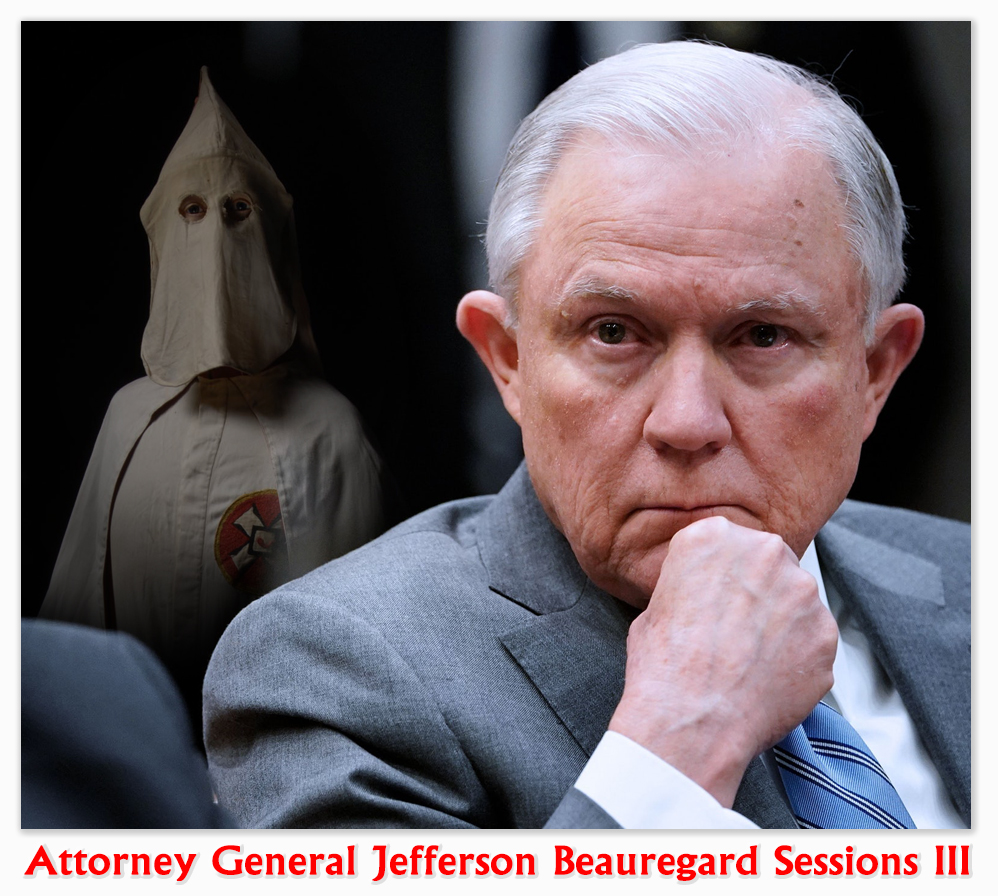
Attorney General Jefferson Beauregard Sessions III
     Attorney General Jefferson Beauregard Sessions III in a seriously retouched photo.

Anyone who wonders where Attorney General Jefferson Beauregard Sessions III will take the Dept. of Justice has to look no further than a brief filed last month in McCarthan v. Collins.

Late last July, we wrote about McCarthan, which deals with when and under what terms an inmate may use a 28 USC 2241 motion. Recall that every inmate gets to file one motion under  28 USC 2255, but only one: filing a second 2255 motion requires prior approval of a court of appeals, which is granted only in unusual circumstances.

One such circumstance is a new Supreme Court ruling changing a constitutional rule and made retroactive. The 2015 Johnson decision, that declared part of the Armed Career Criminal Act unconstitutional, is the most recent example of such a case.

But sometimes changes in the law are not based on the constitution, like a 1995 Supreme Court decision holding that the lower courts had been misinterpreting 18 USC 924(c) – which punishes using a gun in a crime of violence or drug offense – and locking up people to whom the statute did not apply. The decision was purely one of statutory interpretation, with no constitutional dimension at all. Because of that,  people who had already filed a 2255 motion were prohibited from filing another one, because the nonconstitutional change in the law did not qualify them for a second 2255.

For that kind of problem, 2255 has a “saving clause” at 28 USC 2255(e), which provides that a prisoner may use the other form of federal habeas corpus – a petition under 28 USC 2241 – if it “appears that the remedy by [2255] motion is inadequate or in-effective to test the legality of his detention.”

Some of the people who say this really are...
Some of the people who say this really are…

For the past 20 years, prisoners have been allowed to use 2241 to challenge convictions that suddenly became non-convictions because statutes had been reinterpreted in such a way that the inmates were no longer guilty of a crime. And what could make more sense? If a guy has been locked up for a decade, and he already used up and lost his 2255 motion nine years before, does that make it fair to keep him in prison another 10 years for something that’s no longer a crime?

Many years ago, Dan McCarthan walked away from a halfway house, a mistake that caught him an escape charge. At the time Dan was convicted of a felon-in-possession gun charge, all escapes were deemed to be violent, and that got him 15 years under the ACCA. But then, in 2009, the Supreme Court held escape was not a violent crime. Because the decision was based on interpreting the statute and not the constitution, it did not entitle Dan to file a second 2255, so he filed a 2241.

The district court threw out Dan’s 2241, but a three-judge panel on the 11th Circuit held he was entitled to seek review using that petition. Then, the Circuit decided to rehear Dan’s case en banc, and told the parties to brief the question of whether the 2241 was even usable in this kind of case.

Meme171127The Circuit – by a 7-4 vote last March, with six different opinions totaling more than 150 pages – held that an initial Section 2255 motion is an adequate and effective remedy to “test” a sentence, even when circuit precedent forecloses the movant’s claim at the time of the motion. After all, the Circuit said, a movant could have asked the court of appeals to overrule its precedent, sought Supreme Court review, or both. The en banc decision asserted the saving clause in Section 2255(e) is concerned only with ensuring that a person in custody has a “theoretical opportunity” to pursue a claim, even if, at the time of the initial 2255 motion, the claim was virtually certain to fail in the face of adverse precedent. In other words, you have to raise arguments even when the court has already said the arguments are futile.

Prior to the 11th Circuits’s decision in Dan’s case, only the 10th Circuit took such a draconian view of the saving clause. But now, the circuit split is 9-2, and thousands of federal inmates are shut out of relief.

Dan filed a petition for writ of certiorari with the Supreme Court last summer, asking the Court to resolve the circuit split by ruling that the 2255 savings clause was intended to throw a lifeline to someone who never had a reasonable chance because circuit precedent foreclosed his argument. He argued that “the conflict on the question presented cries out for the Court’s intervention. The arguments on both sides of the conflict are well developed, with the benefit of numerous opinions across nearly every regional circuit over the last two decades. There is little room for the law to develop further… This case satisfies all of the criteria for the Court’s review, and the petition for a writ of certiorari should therefore be granted.”

This is where the plot thickens. For the last 16 years, the Justice Department had taken the same view held by Dan and 9 out of 12 circuits. DOJ even said so in at least 11 separate Supreme Court filings. But that was then. This is now, and now, the AG wants to have it both ways.

DOJ told the Supreme Court that it no longer believed that federal prisoners serving longer prison terms than the law allowed were entitled to challenge their sentences in court, because they could have raised the issue themselves years before (when their chance of prevailing was theoretical at best and located somewhere between slim and none). 

curtain171127That change of position alone is duplicitous, but the next part is downright gutless. Given the fact of a substantial circuit split, you might be forgiven for thinking that DOJ would suggest the Supreme Court should take this case to settle the issue. But instead, Sessions’ department doesn’t want the Supremes to touch it, even though the DOJ brief acknowledges that the legal question is significant and that its new position could condemn inmates to serve out unlawful sentences.

Last week, The New York Times observed that “it is one thing for a new administration to switch sides in a legal dispute. That is merely unusual. It is another to urge the Supreme Court to deny review in a case that would test whether the government’s new position is correct.”

Dan’s petition is scheduled to be considered at the Supreme Court’s conference on Friday, December 1.  It could be decided then or get relisted for one or more subsequent conferences.

New York Times, Serving Extra Years in Prison, and the Courthouse Doors Are Closed (Nov. 20, 2017)

– Thomas L. Root

LISAStatHeader2small

(Winnie the) Pooh on You, Warden! – Update for November 22, 2017

We post news and comment on federal criminal justice issues, focused primarily on trial and post-conviction matters, legislative initiatives, and sentencing issues.

LISAStatHeader2small
GREAT MOMENTS IN THE ANNALS OF INMATE LITIGATION

From the We Couldn’t Make This Stuff Up Department:

bear171122Remember the Pastafarians? Now comes Chris Grief, who says keeping stuffed animals in his cell is necessary for his religious practices. He sued under the Religious Freedom Restoration Act, claiming that he “engages in meditation as part of his quest to achieve spiritual enlightenment…” and he believes that “everything has a spiritual essence to it.” He told the district court he “has a strong spiritual connection with the spiritual essence of stuffed animals…” and that in order “to meditate on enlightenment he must do so with the presence of at least two stuffed animals.”

Yeah, he really said that.

sacrilege171122You will find it as incredible as we did that the institution did not bother respond to his heartfelt request to “receive and possess two stuffed animals.” Just as unbelievably, the district court heartlessly threw out Chris’s RFRA complaint, holding that his “belief that stuffed animals are necessary for his religious practice falls within the category of beliefs that are ‘so bizarre, so clearly nonreligious in motivation, as not to be entitled to protection’.”

Fortunately for Chris, the 2nd Circuit put a start to such hobnailed intolerance. Last week, it reinstated Chris’s lawsuit.

weird171122It was not enough, the appellate court ruled, for the district judge to find Chris’s attachment to his teddy bear “bizarre.” Of course it is, but that’s not the point of the RFRA. Rather, the Circuit said, “whether a professed belief is entitled to free exercise protection under our precedents requires a determination by the ‘factfinder’ regarding ‘whether the beliefs professed are, in the claimant’s own scheme of things, religious’.”

The district court will therefore have to determine whether Chris’s veneration of stuffed toys is sincere, no matter how weird it may seem.

Grief v. Quay, Warden, Case No. 16-1651 (2nd Cir., Nov. 13, 2017)

– Thomas L. Root

LISAStatHeader2small

Shut My Mouth! – Update for November 21, 2017

We post news and comment on federal criminal justice issues, focused primarily on trial and post-conviction matters, legislative initiatives, and sentencing issues.

LISAStatHeader2small
THE NIGHT THE LIGHTS WENT OUT IN TEXAS

A federal prison in Texas, like a lot of joints around the country, suffers from frequent power outages. Derrick Brunson (who has since been released) filed an administrative remedy request with prison administrators, expressing his concern over security due to the lights going out all the time and asking that something be done about.

work171121Derrick’s counselor quickly responded to his filing. She complained that he was “just putting more work on her desk.” In response to Derrick’s filing, she wrote him up for threatening her, filing a disciplinary report  known in federal prison parlance as a “shot.”  Derrick was promptly thrown into the SHU – the “Special Housing Unit” – for three weeks while awaiting a hearing in front of a Disciplinary Hearing Officer.

In due course, he was found guilty of the “shot” and was given 7 days in disciplinary segregation and a loss of some good time credits he had previously earned.

shutmouth171121After his 28 days in the SHU, Derrick appealed the finding of guilt, and his appeal fell on the desk of cooler heads. The DHO’s finding was reversed, and the “shot” was expunged. After that, Derrick – who justifiably felt that he had been punished for exercising his 1st Amendment rights in a completely reasonable way – brought a Bivens action against prison staff for a retaliation conspiracy against him for speaking out.

The district court dismissed Derrick’s complaint, holding that his conspiracy claim was “conclusory” and his seven days in seg was too insignificant an injury, “de minimis” as the courts like to say.

shu171121Last week, the 5th Circuit reversed.  The appellate court held the district judge should not have ignored the 21 days Derrick spent in the hole waiting for a hearing. “Taking the 21 days in the SHU and the seven days of disciplinary segregation together,” the Court said, “the alleged retaliatory act lasted at least 28 days, which is certainly… not de minimis.

The 5th found it significant that the shot was later expunged, because that suggested the counselor “lacked any basis for initiating the charge.”  And Derrick’s conspiracy claim was not “conclusory,” the Court said. He alleged that while he was in the SHU, the Captain told him, “You didn’t think I know the lights are an issue? You are not going to make threats.”  A lieutenant then said, “Thanks for telling us how to do our jobs, you want to tell us how to do our jobs things go downhill for you.” 

tapemouth161230When Derrick pointed out that the incident report did not state a violation, the Captain responded, “Well, when I talk to the DHO we’ll see if he can articulate” one. The DHO subsequently changed the charged offense from “threatening” to “refusal to obey an order.” 

The Circuit held that “these facts suffice to state “an agreement to commit an illegal act which resulted in the plaintiff’s injury.”

Brunson v. Nichols, Case No. 14-31350 (5th Cir. Nov. 15, 2017)

– Thomas L. Root

LISAStatHeader2small

Reeling in Some ‘Desperate Targets’ – Update for November 20, 2017

We post news and comment on federal criminal justice issues, focused primarily on trial and post-conviction matters, legislative initiatives, and sentencing issues.

LISAStatHeader2small


7TH CIRCUIT UPHOLDS ANOTHER STASH HOUSE STING, BUT WITH SCATHING CONDEMNATION OF GOVERNMENT

You know the story by now. After prison, Tracy Conley was getting his life together. He had a job, a car, and a girlfriend. He was regaining his footing one step at a time.

stash171120At least he was, until a series of unfortunate events. Tracy got to work one day to find the machine he operated was down. His employer sent him home. He started to drive back to his girlfriend’s house, but in a second stroke of bad luck, was running out of gas. He stopped at a gas station, and saw two friends, from whom he tried to borrow a few bucks for some fuel.

The friends convinced him to come to a meeting instead, where a guy named Myreon pitched them all on robbing a drug stash house stuffed with cocaine. Of course, there was no stash house and no 50 kilos of powder. Instead, the whole scheme was orchestrated by the ATF.

Tracy and the others were thus ensnared in what the 7th Circuit called “a now familiar government set up in which a government actor, pretending to be a criminal, presents the defendant with an opportunity to be part of a robbery of an illegal drug stash house. The stash house is fictional, of course, and so the government decides which and what quantity of drugs it will have (in this case, fifty kilograms of cocaine) and how high or low the barriers to the crime will be (in this case it was allegedly protected only by two armed and one unarmed guards). Tracy took the bait and ended up with a sentence of 180 months’ imprisonment on drug distribution and weapons charges.”

The Circuit upheld Tracy’s conviction and sentence (which was way below his Guidelines range), but had to pinch its collective nose shut to do so. Reviewing the district court’s unhappiness with the case and widespread judicial criticism of stash house “stings,” the 7th said:

The district court’s discomfort with this case echoes a substantial body of criticism of similar stash house cases both from this circuit and others. Beginning many years ago, we criticized these cases as “tawdry,” noting in particular how these operations are “directed at unsophisticated, and perhaps desperate defendants” like Tracy who easily take the all-too-tempting bait put out for them by the government.

stash171031In this case, Tracy may have been starting down a straighter path, after a life filled with many poor choices. He was gainfully employed, had obtained his GED, enrolled in some college courses, and had skills in electronics and marketing. But he was also an ‘unsophisticated and desperate’ target, so down on his luck that he did not have even enough money to get home from work on the day he was approached by his co-conspirators… Like the district court, we ‘question the wisdom and purpose of expending the level of law enforcement resources and judicial time and effort in this prosecution’. But the resources have been expended and the district court conducted an exceptionally thorough post-trial review and ‘after much consideration, time, reflection and review of the parties’ arguments and the trial record’ properly denied the motion for acquittal or new trial on all charges.

United States v. Conley, Case No.15-3442 (7th Cir. 2017)

– Thomas L. Root

LISAStatHeader2small

Dog Bites Man – Federal Sentencing Said to Be Racially Tinged – Update for November 16, 2017

We post news and comment on federal criminal justice issues, focused primarily on trial and post-conviction matters, legislative initiatives, and sentencing issues.

LISAStatHeader2small
WE’RE SHOCKED! SENTENCING COMMISSION STUDY FINDINGS FEDERAL SENTENCING IS UNFAIR

blackprisoner171116While this hardly comes as much of a comfort to you if you’re already serving one, a United States Sentencing Commission report issued last week found that, statistically speaking, your sentence is longer if you’re black than if you’re white, or if you’re a male instead of a female.

The report compares sentences handed down to similarly situated people between October 2011 and September 2016. Its key findings are

• black males continue to catch sentences that are 19% longer than those imposed on white males. The average black male sentence of about 92 months in 2007 has fallen to about 75 months, mostly because of changes in crack cocaine sentencing ranges, while white male sentences have risen slightly from 58 to 64 months. But when the data are adjusted for the effect of the Fair Sentencing Act, the gap between black and white sentences is unchanged since 2007.

• sentence departures and variances given for reasons other than assistance to the government are the principal culprits. During the period, black males were 21% less likely than whites to get a downward departure or variance, and when they did get one, their sentences were still 17% longer on the average. When the courts sentenced within the sentencing range, black male sentences were still 8% longer than those of whites.

• violence did account for any of the demographic differences in sentencing. Violent black male sentences were on average 20% longer than violent white male sentences.

• females received shorter sentences than males during the period, unchanged from every year since 2003. White and Hispanic women received 26% shorter sentences than males, and black women got 21% shorter sentences. These rates suggest while there is a racial sentencing disparity for women, its smaller than for men.

• non-citizens got longer sentences than similarly situated citizens, but education didn’t make a difference.

guy171116The 2003 PROTECT Act (which defendants generally disliked) drove the racial disparity down to 6%, but after United States v. Booker – which made the Guidelines advisory – the difference between black and white male sentences increased by 10%. The pronounced disparity between white and non-white offenders may be partially attributable to the lack of a strict, rational sentencing scheme. When judges use their discretion, implicit racial and gender biases may show.

US Sentencing Commission, Demographic Differences in Sentencing: An Update to the 2012 Booker Report (Nov. 13, 2017)

– Thomas L. Root

LISAStatHeader2small