We post news and comment on federal criminal justice issues, focused primarily on trial and post-conviction matters, legislative initiatives, and sentencing issues.

THE NUMBERS GAME
Several interesting stats were released at year end, starting with the annual report on Federal courts. Chief Justice Roberts of the U.S. Supreme Court reported on New Year’s Eve (just before he and the Mrs. left for a party, no doubt) that 6,300 petitions seeking Supreme Court review were filed last year, with 62 cases being decided, meaning that a petition for writ of certiorari has about a 1% chance be being heard.
In the Courts of Appeal, the workload fell substantially, with new filings in 2017 dropping 16% from the year before. In district courts, new civil actions fell 8%, while criminal cases were unchanged. Slightly more than 22% of district courts’ workload was criminal. About 135,000 people were under post-conviction supervision, about 2% fewer than a year before. Around 87% of those were on supervised release after doing prison time, a 1% decrease from the year before.
Meanwhile, the Pew Charitable Trust – which keeps track of these things – reported that 8.11% of voting-age Americans were convicted felons, up from 3.03% in 1981. In Georgia, 15% of the adult population was a felon in 2010, up from 4% in 1980. The rate was above 10% in Florida, Indiana, Louisiana and Texas.
And a fairly sobering stat: Nearly 60% of formerly incarcerated people are unemployed a year after their release. Those who do find employment are paid an average of 40% less than those without a criminal record. This contributes to a vicious circle, as the ability to get and keep a job is one of the greatest factors in determining successful re-entry. One study in Florida found that helping inmates receive a vocational certificate reduced recidivism by 17 percent.
We post news and comment on federal criminal justice issues, focused primarily on trial and post-conviction matters, legislative initiatives, and sentencing issues.
USSC SETS “POSSIBLE VOTE” ON GUIDELINE AMENDMENTS
The U.S. Sentencing Commission has scheduled a public meeting for Friday, January 19, 2018 at 10:30 a.m. The agenda includes no substantive items other than a report from the chair and what the USSC terms a “possible vote to publish proposed guideline amendments and issues for comment.”
The “possible vote” could be to finalize a package of proposed amendments for public comment prior to recommending the package to Congress by May 1. Once sent to Congress, the amendments would become effective November 1, 2018, unless Congress blocked them.
Of primary interest to many inmates is the “first offender” proposal, which would give people who lack any prior criminal history points a reduction of 1 to 2 levels. The idea, which the USSC floated a year ago, has not yet been firmed up as to who would qualify for the reduction and how great the reduction might be. If the measure becomes an amendment to the Guidelines, it would not be retroactive to already-sentenced inmates unless the USSC decides in a separate proceeding to do so.
The possibility that a “first offender” proposal may be adopted and may someday be retroactive has already spawned a cottage industry of the usual “hopemongers” trying to sell inmates “analyses” of their cases, to determine whether they would be eligible for a sentence reduction under 18 USC 3582(c)(2). Inasmuch as the Sentencing Commission does not itself know to whom the “first offender” proposal will fit, or whether it will ever apply to people already convicted, there would seem to be a little alchemy (or perhaps old-time snake oil) involved.
The USSC meeting will be streamed live over the Internet.
We post news and comment on federal criminal justice issues, focused primarily on trial and post-conviction matters, legislative initiatives, and sentencing issues.
IF ERROR WAS NOT PLAIN, WAS COUNSEL STILL INEFFECTIVE?
It has happened often enough before: A Circuit decision was plainly against a sentencing position the defendant wanted to take, and so counsel did not fight the issue. Then, after the defendant’s conviction is final, the law changes. Was counsel ineffective for not raising the issue?
Jolol Carthorne was sentenced as a Guidelines career offender in part because he had a Virginia prior for assaulting a police officer. Circuit precedent at the time held the crime to be a crime of violence, and his lawyer did not fight it, despite the fact that Virginia law held that the slightest touching was enough for conviction.
On appeal, Jolol argued that the assault should not count for career offender status. The problem, of course, was that Jolol did not raise the issue at sentencing, so he could only win the issue if the district court committed plain error. The Circuit agreed that his assault on the cop was not a crime of violence, but said that because its prior decisions (all of which had since discredited by Johnson and Mathis and other Supreme Court cases) were binding on the district court when Jolol was sentenced, the sentencing error was not FRCrimP 52(b) “plain error.” Jolol had noting coming.
Jolol then filed a 2255 motion complaining that his lawyer should have argued that a Virginia conviction for assaulting a cop was no longer a crime of violence. His lawyer admitted he was not even aware of the analysis required by the recent Supreme Court cases application offenses, such as Johnson v. United States, Mathis v. United States, and Descamps v. United States, for purposes of the career offender enhancement. But the district court said that since there was no plain error in sentencing Jolol as a career offender, there was no ineffective assistance of counsel standard in not raising it.
On the Thursday before Christmas, the 4th Circuit ruled for Jolol. It said that the plain error standard and ineffective assistance of counsel are not the same thing. “The ineffective assistance inquiry focuses on a factor that is not considered in a plain error analysis, namely, the objective reasonableness of counsel’s performance. In addition, plain error review requires that there be settled precedent before a defendant may be granted relief, while the ineffective assistance standard may require that counsel raise material issues even in the absence of decisive precedent… Claims of ineffective assistance are evaluated in light of the available authority at the time of counsel’s allegedly deficient performance. But the plain error inquiry applies precedential authority existing at the time of appellate review.”
Defense counsel must demonstrate a basic level of competence regarding the proper legal analysis governing each stage of a case. Therefore, he or she may be constitutionally required to object when there is relevant authority strongly suggesting that a sentencing enhancement is not proper. The Circuit said that was the case here, where newer cases made clear that Virginia assault and battery did not categorically present serious risks of physical injury. Defense counsel should have known to make the argument, even though the district court probably would have rejected it because of circuit precedent.
We post news and comment on federal criminal justice issues, focused primarily on trial and post-conviction matters, legislative initiatives, and sentencing issues.
PLEA AGREEMENT OFFERS NOTHING, STILL OK
Jose Rivera-Cruz agreed to plead guilty to being a felon in possession of a gun. He signed a plea agreement in which the government (1) did not agree to reduce or dismiss any of charges, (2) reserved the right to argue for a statutory-maximum sentence, and (3) did not stipulate to a criminal history category of offense level. The plea agreement did permit Jose to argue for a 96-month sentence (a right he had with or without a plea agreement), and let the government argue for a statutory-maximum 120-month sentence (the most sentence Jose could get by law). However, the government did agree to recommend that Jose receive a 3-level acceptance of responsibility.
After getting hammered with the full 120 months by the district judge, Jose argued on appeal that he should be allowed to get out of the plea agreement due to lack of consideration. Under basic contract law, both parties must give and receive consideration. If there is no consideration, the contract is not enforceable. Jose argued that just as Oz never did give nothing to the Tin Man that he didn’t already have, Jose got absolutely nothing under the plea agreement that he could not have gotten by pleading to the indictment without a plea agreement.
Last week, the 1st Circuit disagreed. The appellate court held the plea agreement provided Jose with “at least three separate benefits, each of which independently constituted sufficient consideration.” First, the government agreed to move for the third acceptance-of-responsibility point under USSG 3E1.1(a), something it did not have to do because Jose refused to plead guilty until the eve of trial. The Circuit said the fact the 3-level reduction did not help him at sentencing made no difference: “the government’s voluntary agreement to submit the same three-point reduction, rather than a two-point reduction, certainly gave Rivera-Cruz a better ‘chance at less’ in front of the district court.”
Second, the government agreed not to seek a 4-point obliterated-serial-number enhancement under USSC 2K2.1(b)(4)(B). The Presentence Report included the enhancement anyway, and Jose complained the government did not fight it, but the Court said the AUSA had no “affirmative obligation… to object to the enhancement at sentencing. In any case, the government’s voluntary agreement not to include the… enhancement in the plea agreement improved Rivera-Cruz’s chances of obtaining a more lenient sentence, and accordingly constituted sufficient consideration for his plea.”
Finally, the government agreed not to seek a 15-year mandatory minimum Armed Career Criminal Act sentence. Jose argued on appeal that the promise was meaningless, because he never would have qualified for an ACCA sentence. The 1st Circuit said that did not matter: “the government was under no obligation to drop its pursuit of an ACCA sentence. Its decision to do so in the plea agreement… provided Rivera-Cruz with a ‘chance at less’ during sentencing,” whether that chance was meaningful or not.
We post news and comment on federal criminal justice issues, focused primarily on trial and post-conviction matters, legislative initiatives, and sentencing issues.
IF YOUR LAWYER SAYS HE SCREWED UP, THAT’S GOOD ENOUGH
Barely an adult, Frank Hernandez committed a couple of horrific murders. The jury heard about how he was drunk during the crimes, but never heard about his severe mental illness with “psychiatric illness of psychotic proportions,” including schizophrenia, bipolar disorder, seizure disorder, and depression, in addition to an “extraordinary degree of chemical dependency.” What’s more, they never heard about his childhood with a succession of depraved parents and foster parents, which one expert later described as “a daily hell.”
Frank brought a state habeas corpus claim, claiming his lawyer was ineffective for not arguing “diminished capacity,” which was a valid state defense to murder. Usually when lawyers are accused of being ineffective, they try to justify their sloth as being some kind of strategy. To his credit, Frank’s lawyer did not. Instead, he admitted that he would have investigated and advanced the diminished capacity defense based on mental impairment had he realized that he could have done so.
Game, set, match, right? Wrong. The state argued that the lawyer’s “subjective state of mind is irrelevant” as long as the state can conjure up some hypothetical reason why a reasonable defense attorney might have not raised the diminished capacity issue. After Frank brought a federal court action under 28 USC § 2254 and lost, he appealed to the 9th Circuit.
Last week, the Circuit slapped down the prosecutor, saying what might have been did not matter as long as the record showed what really was.
“Where counsel has provided the reason for his conduct, and we have no reason to doubt the validity of that explanation, the relevant inquiry is whether the stated reason was objectively unreasonable,” the Circuit said. “Courts are not to indulge ‘post hoc rationalization’ for counsel’s decision-making that contradicts the available evidence of counsel’s actions.” Only where the defense counsel’s conduct is not explained in the record or the explanation contradicts the record, should a district court “entertain the range of possible reasons counsel may have had for proceeding as he did.”
Because “an attorney’s ignorance of a point of law that is fundamental to his case combined with his failure to perform basic research on that point is a quintessential example of unreasonable performance under Strickland,” the Court said, defense counsel’s omission was ineffective assistance.
We post news and comment on federal criminal justice issues, focused primarily on trial and post-conviction matters, legislative initiatives, and sentencing issues.
WILL 2018 BE THE YEAR FOR SENTENCING REFORM?
Some commentators are predicting that 2018 will be a breakout year for criminal justice reform.
“We remain focused on comprehensive reform of the criminal justice system,” Mark Holden, senior vice president and general counsel at Koch Industries, told the paper. “It remains to be seen what Congress will be amenable to doing. However, both Speaker [Paul] Ryan and Senators Cornyn, Grassley, Lee and [Illinois Sen. Dick] Durbin have shown that they hope to pursue reforms in the coming year.” Holden and Koch Industries have been prime movers behind sentencing reform for several years. “Given the seemingly strong support for prison reform and re-entry reform,” he said, “this may be a starting point for criminal justice reform in 2018 which will hopefully lead to other reforms as well,” he said.
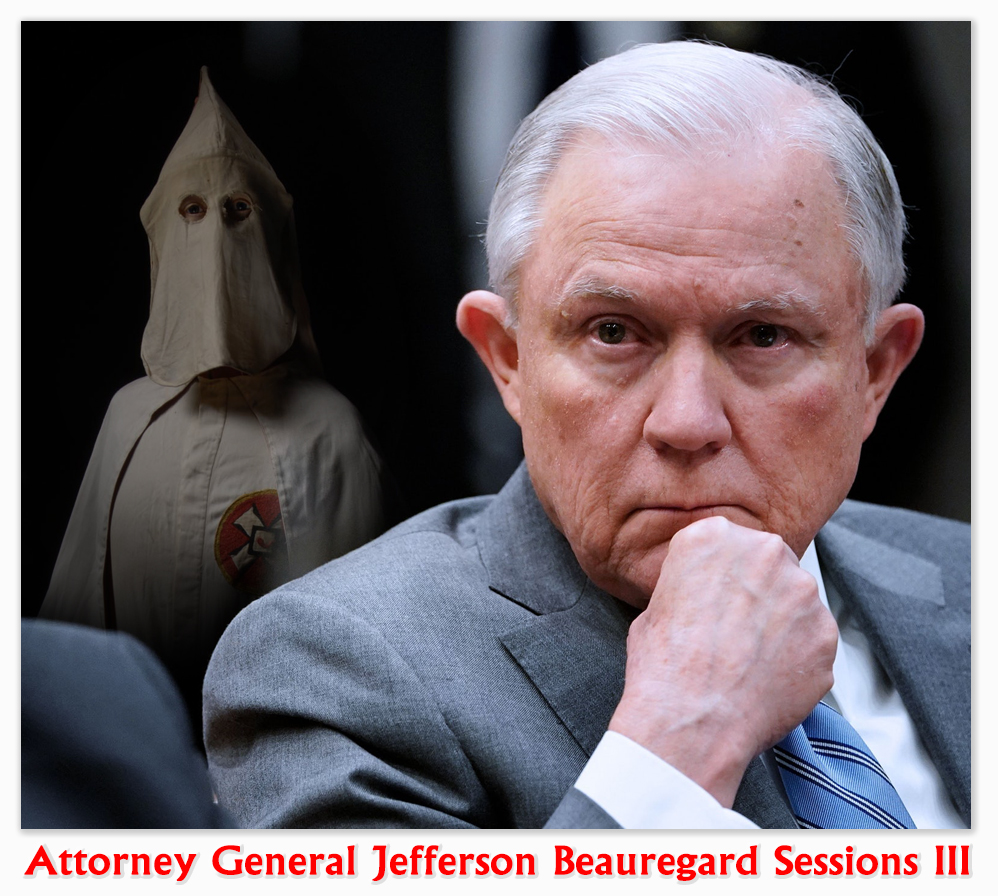
Attorney General Jefferson Beauregard Sessions III
Rep. Collins’ bill would require Attorney General Jefferson Beauregard Sessions III to develop a risk and needs assessment system for criminals, while giving them incentives to lower their risk of recidivism. “Last year we saw both sides of the aisle and both ends of Pennsylvania Avenue hone in on prison reform as a way to strengthen the justice system,” the Examiner quoted Collins as saying. “In 2018, I think we’re going to see even more lawmakers come together to push forward where we have consensus, and the Prison Reform and Redemption Act captures a big part of those shared priorities at the federal level.”
Holden and Collins both were part of a bipartisan roundtable meeting on federal prison reform at the White House in September, convened by President Trump’s son-in-law, Jared Kushner.
Not everyone is hopeful. Kara Gotsch, manager of the Sentencing Project’s federal advocacy work, said she sees the chances for sentencing reform as slight, and expressed concern over changes being made at the Dept. of Justice. “Areas to watch are how Sessions’ harsher charging and sentencing policies take effect now that more Trump-appointed U.S. attorneys are being installed,” she said. On the other hand, “the U.S. Sentencing Commission is poised to issue new guideline amendments related to alternatives to incarceration which would expand eligibility for federal dependents to receive a non-incarceration sentence.”
Also on the horizon is a Sentencing Commission proposal floated last year to adopt a “first offender” provision that would reduce the Guidelines score of people with no prior offenses. The Commission has not adopted the proposal yet, and has not yet settled on whether the reduction would be one level or two, and whether to qualify, a first offender would just need a criminal history score of zero, or whether he or she would need a prior record that was absolutely clean. Likewise, the Commission has not hinted whether a first offender proposal would be retroactive. Nevertheless, the possibility of a beneficial Guidelines change makes 2018 look more promising than the prior year.
Looming over sentencing reform, however, is the opioid crisis. Republican senators such as Rob Portman from Ohio and Democrats like Elizabeth Warren from Massachusetts are making the case that opioid addiction should not be criminalized. The Washington Spectatorsaid last week that “before in our nation’s history had we seen such a vocal and powerful bipartisan push among politicians to make sure that drug addiction, at least addiction to some drugs, is treated like the public health crisis it always was… Even when the Republican attempt to overhaul Obamacare failed this summer, bipartisan calls to protect opioid addicts didn’t die out. Again, this is a good thing as it suggests that even in the Trump White House, there might remain the possibility of at least some criminal justice reform. But protecting some is hardly protecting all, or even most, of the people who suffer the consequences of criminalizing addiction in this country. Indeed, those very same politicians who continue to clamor for a different approach to opioid addiction are now insisting that we must start “beefing up other tough-on-crime laws” for everyone else.”
Ever cautious and thoughtful, Ohio State University law professor Doug Berman expressed skepticism in his review at his Sentencing Law and Policyblog: “As is my general tendency, I am hopeful but not optimistic about the prospects for federal statutory sentencing reform during a pivotal election year. If other possible ‘easier’ legislative priorities get completed (or falter), I could see at least some modest reforms making it through the legislative process. But inertia can be a potent political and practical force in this setting, especially in an election year, so I am not holding my breath.”
We post news and comment on federal criminal justice issues, focused primarily on trial and post-conviction matters, legislative initiatives, and sentencing issues.
WHO’S IN CHARGE HERE?
Maurice Collins knew that his cocaine distribution enterprise was a people business. If you don’t keep the customer satisfied, what kind of future do you have? So when a customer needed some powder while Maurice was out of town, he called Bob Palmer, another dealer he knew who owed him a favor, and got him to pick up and deliver an ounce of cocaine to the customer.
Sadly, the customer was an informant. When Maurice, who was otherwise eligible for the safety valve, went for sentencing, the district court found he was a supervisor because he got the other dealer to do his bidding. The 2-level enhancement under USSG 3B1.1(c) for being a manager killed Maurice’s shot at a safety valve sentence.
Christmas came early for Maurice when the 7th Circuit held that calling in a favor was different from being a manager. The appellate court said, “it was a legal error to apply Sec. 3B1.1 to the incident here. There was no organization or hierarchy, and there was just this one occasion involving Palmer, apparently as an equal rather than a subordinate, without Collins exercising control or authority over him.”
Because application of the 2-level enhancement disqualified Maurice from safety valve treatment, the district court’s error was not harmless. Maurice was remanded for resentencing.
We post news and comment on federal criminal justice issues, focused primarily on trial and post-conviction matters, legislative initiatives, and sentencing issues.
GIVING THE POOR GOVERNMENT LAWYER A BOOST
Most of us imagine that litigation is a gladiatorial sport, one where the judge keeps it honest but otherwise leaves the parties to rise or fall by their wits, knowledge and preparation.
Lady Justice, after all, is blind to how the scales of justice tip.
Leonard Oliver got convicted of drug offenses along about seven years ago. Afterwards he filed a post-conviction motion under 28 USC 2255. When the court ruled against him in 2015, he apparently concluded that he probably should have appealed his conviction from four years before. So he filed a notice of appeal, attempting to do so.
The only problem with Len’s cart-before-the-horse approach to criminal litigation is that the Federal Rule of Appellate Procedure allow a criminal defendant 14 days to file a notice of appeal. Len was a little late, about three years and eight months late. Lucky for Len, the Supreme Court ruled earlier this year that a late-filed notice of appeal does not deprive the appeals court of subject-matter jurisdiction. Even luckier for Len, the government fought his appeal on the merits, never, for some inexplicable reason, objecting to the grossly late filing. Perhaps the luckiest break for Len, a party’s failure to timely object to timeliness forfeits its right to do so.
Lucky, lucky, lucky Len. Well, not so fast. Last week, the 4th Circuit last week held that just because the government overlooked the untimeliness does not mean the court has to. The Circuit invoked the inherent authority that all federal courts possess “to protect their proceedings and judgments in the course of discharging their traditional responsibilities.”
It is unsurprising that the Court found that in cases of prisoner civil litigation, where “complaints… are more likely to be “frivolous, malicious, or repetitive,” the courts could raise nonjurisdictional defenses where the government forgets to do so. Likewise, the 4th said, “a federal habeas court may also consider a statute-of-limitations defense sua sponte because [such] petitions implicate considerations of comity, federalism, and judicial efficiency to a degree not present in ordinary civil actions.”
Extrapolating, the Circuit said that “like meritless complaints and untimely habeas petitions, late-filed criminal appeals can implicate significant judicial interests. Most notably, they disrupt the finality of criminal judgments.” This is good reason, the Court said, to throw out a late-filed notice of appeal even where the government – because of forgetfulness or for strategic reasons – decides not to.
Say what? If the Court figures the defendant’s case could have been thrown out if the government had only thought to ask that it be, the Court can effectively take over the government’s case. And if the prisoner, who usually is acting as his own attorney and is litigating on a slightly smaller budget that the $2.074 billion allocated to U.S. Attorneys, needs a boost? Maybe he misses advancing a motion or argument that would carry the day for him. Will the judge step in with a useful suggestion?
Don’t bet the farm on it, Lucky Len. Federal courts seem much more willing to correct one party’s oversights when the party is the government and prisoners are on the other side. Do the math: a prisoner’s case ends up with two prosecutors, one defendant… and no impartial judge.
We post news and comment on federal criminal justice issues, focused primarily on trial and post-conviction matters, legislative initiatives, and sentencing issues.
AND YOU WONDER WHY…
Oliver Cromwell threw out the Rump Parliament with criticism that seems altogether contemporary, given the diatribes that come from the Right against the Left and the Left against the Right. But we tend to be single-issue voters, so our interest is not so much pro-Trump or anti-Trump as it is pro-common sense on sentencing reform.
A few weeks ago, we reported that Rex Tillerson might get dumped as Secretary of State, a matter of little importance to most of us except that the shuffling that might occur as a result would move Sen. Tom Cotton (R-Arkansas) to the CIA.
For those of you who yawned at our report on Potomoc machinations, the following report may explain our enthusiasm for moving Sen. Cotton as far from a vote on sentencing reform as he can get. Legislation that would update and overhaul the nation’s juvenile justice system has stalled over a single Republican senator’s concern over whether youths should be locked up for low-level status offenses. The bills, already passed in the House and Senate (and now in conference committee to smooth out differences), have come to a screeching halt because of one senator – Tom Cotton.
Sen. Cotton likes seeing children thrown into kiddie jail, and he has thus long opposed measures that would keep youthful offenders from being locked up for violating piddling offenses like curfew and school attendance. In fact, he was able to see that the Senate version of the Juvenile Justice Delinquency and Prevention Actdid not soften laws that jailed minors for insignificant offenses. But the House version phases out all incarceration for such “status offenses” — including judicial orders — over the next three years.
Now, Sen. Cotton has refused to let the very bipartisan bill go to conference without a guarantee that the status offenses provision is a dead issue. “We have to get around Cotton, who won’t move,” said Marcy Mistrett, chief executive officer of the Campaign for Youth Justice, which supports the House bill. “He’s been very clear on that.”
Staffers for Reps. Jason Lewis (R-Minnesota) and Virginia Foxx (R-North Carolina) have been working to resolve Sen. Cotton’s concerns, a GOP House aide said.
Rep. Lewis and co-sponsor Rep. Bobby Scott (D-Virginia), “are encouraging the Senate to move quickly to conference so that we can iron out the small differences between the two bills, and get the president a bill with vital reforms to the juvenile justice system.”
That, in a nutshell, is why Sen. Cotton, who was opposed to the Sentence Reform and Corrections Act of 2015 a year ago, is so toxic to the chances of sentencing reform in the next few months. New York Times columnist and curmudgeonly conservative William Safire once was criticized for calling President Nixon a pimple on the ass of progress. He apologized, admitting that his description was wrong. “I should have said ‘boil’,” he ruefully admitted.
We post news and comment on federal criminal justice issues, focused primarily on trial and post-conviction matters, legislative initiatives, and sentencing issues.
JUDGE’S HAMMERING OF ILLEGAL REENTRY DEFENDANT TOO MUCH FOR THE 2ND CIRCUIT
Latchman Singh, a native of the South American paradise of Guyana, lived in the United States for 39 years before a stealing-the-mail beef got him deported. His American wife and daughter stayed here, so of course he returned illegally to be with them. What dutiful father and husband would not?
He got caught and thrown out. He came back again, and this time was convicted of illegal reentry, with a Guidelines range of 15-21 months.
So far, it does not sound like a very exciting case: the defense, the probation officer and the government all thought Latchman should get something within his Guidelines sentencing range. But Judge Katherine Forrest, who was appointed by Obama but acts a lot like Trump, mistook Latchman for Al Capone. She varied upward on his sentence to 60 months, the maximum she could give him under the law.
Among other vexations, the Judge thought Latchman’s heartfelt letter to her that, among other things, explained that some of his 20-year old minor theft convictions resulted from “Bad Friend and Company who I follow,” showed he had not accepted responsibility. She fumed that “the kinds of crimes he is engaged in relate to a variety of conduct which is harmful, and it is harmful to members of the public. The public shouldn’t be exposed to it. It’s repeated and it’s repeated so often and so brazenly that I do not have any hope. I have no expectation, frankly, that it could stop.”
And conservatives complained Obama’s judges were too soft? Apparently, Judge Forrest – who, despite her Obama-esque credentials, has been described by legal commentators as “stinking rich” – lacks sufficient empathy for an illegal immigrant scrambling to support his pathetic little family in their pathetic little apartment. Whatever the roots of her rant, Judge Forrest’s Scrooge imitation was too much even for the 2nd Circuit, which reversed the sentence last week. As the Court of Appeals put it, “even if Singh’s sentence does not shock the conscience, it at the very least stirs the conscience.” It might even stir Judge Forrest’s privileged conscience (if she has one).
The appellate panel observed that nationally, upward variances in illegal reentry cases only happened 1% of the time, and Latchman’s criminal history – which Judge Forrest found to be extreme – was only a Category II, while the average illegal reentry defendant was a Category III. Latchman had eight prior convictions, but four of them were over 20 years old, and three of the eight were so minor he got neither jail nor probation.
Not only was the upward variance to four times his Guidelines minimum not substantively reasonable, the 2nd Circuit said, but the district judge’s handling of the acceptance of responsibility factor was not procedurally reasonable. The panel cautioned that a judge should not confuse “statements in mitigation with a failure to accept responsibility.” Latchman admitted he had committed wrongdoing, but explained he was influenced by a bad crowd and did foolish things. He said he came back to the USA because he was robbed and beaten in Guyana because of his Indian subcontinent heritage. “A defendant’s acceptance of responsibility and his assertion of mitigating circumstances,” the Circuit said, “are not necessarily inconsistent or incompatible.” While the district judge said she was giving Latchman acceptance-of-responsibility credit under the Guidelines, she pretty clearly took it away in her comments on the upward variance.
The Circuit did not assign the case to a new judge, pointedly saying, “we are confident that on remand the experienced and capable district judge will conduct a full resentencing, in compliance with all procedural requirements, and impose a sentence that is fair, reasonable, and sufficient but not longer than necessary to meet the goals of justice.”