We post news and comment on federal criminal justice issues, focused primarily on trial and post-conviction matters, legislative initiatives, and sentencing issues.

HERE’S SOME CANDY, LITTLE GIRL…
In the universe of criminal offenses, there is no category more reviled than that of sex offender. It’s a broad category – covering every crime from looking at kiddie porn downloaded from the Internet to statutory rape to horrific physical abuse of a baby – but the “sex offender” label is enough for most people to generate loathing and repugnance not just at the offense but at the offender.
 And no offense is easier for a politician to demagogue. I know of prisoners – adults who are first-time offenders – serving 50-year sentences for child porn crimes that involved no physical contact whatsoever. Say what you want, in a system where the average federal sentence for murder is about 25 years, the time meted out in the federal system for child sex offenses redefines “Draconian,” suggesting that defendants would do better murdering their victims than sexually abusing them. (Neither is a good idea, but the inversion between the average sentence for taking a life and for producing a disgusting video is puzzling).
Every few months, I will have some inmate serving a horrific sentence for child porn ask when Congress is going to do something to reduce his (or occasionally, her) sentence. My answer’s always the same: no legislator ever lost an election by being too hard on kiddie porn. I know of about 538 elected people on Capitol Hill who would swim drunk and naked in the Tidal Basin with the “Argentine Firecracker” before signing on to a bill that injected any sense into sex offender sentences.
For such offenders, the punishment never ends. Thomas Sanderson knows that. Come every October, Sanderson and his family have always set up large, elaborate Halloween displays involving decorations, sound effects, and fog machines. You know the type: 15-foot skeletons, big blow-up ornaments, orange lights… the works. As a district court judge described it, the Halloween Sandersons regularly were “throwing large parties, hosting a bonfire, handing out candy to children outside, decorating [their] residence, and keeping… lights on.”
 In 2006, Tom was convicted of sodomy with a 16-year-old female friend of the family. Section 566.010 of the Missouri Revised Statutes defines sodomy as “deviant sexual misconduct.” What is “deviant sexual misconduct” in Missouri is quite broad, including virtually any offense where penetration does not occur, even just getting “handsy” with the crotch of the victim. Not to discount the mental trauma that such conduct may inflict on the victim, but being convicted of sodomy in Missouri is something much less than its Biblical definition.
No matter. Tom was labeled a sex offender who was required to register annually with the authorities. Plus, while he was locked up, Missouri passed the so-called Halloween Statute in 2008 (Mo. Rev. Stat. § 589.426)
The statute restricts registered sex offenders from participating in Halloween, requiring them on October 31st to
(1) Avoid all Halloween-related contact with children;
(2) Remain inside his or her residence between the hours of 5 p.m. and 10:30 p.m. unless required to be elsewhere for just cause, including but not limited to employment or medical emergencies;
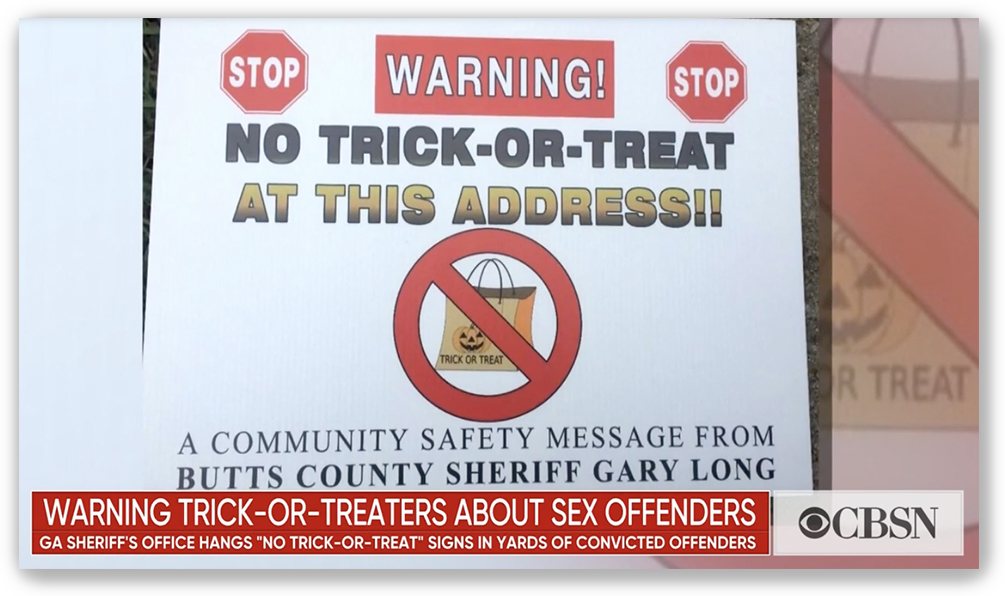
(3) Post a sign at his or her residence stating, “No candy or treats at this residence;” and
(4) Leave all outside lights off during the evening hours after 5 p.m.
When Tom was released, he asked the local police whether he was required to comply with the Halloween statute, given that he had been convicted well before the law was enacted. The police assured him that he had been “grandfathered in” and thus could continue participating in Halloween festivities (which, as we shall see, is a great cautionary tale illustrating why you should never accept legal advice from a cop).
 For the next 14 years, Tom’s Halloween displays didn’t just continue, they grew more extravagant with each year. But in 2022, although Tom had never been accused of any further sexual misconduct, some neighborhood Karen complained that Tim was having innocent fun by participating in Halloween. Consequently, Tom was arrested, charged, and convicted for violating the Halloween statute (a crime for which he got probation).
Tom brought a facial challenge to the Halloween statute under the 1st Amendment, specifically arguing that subsection 3 — the sign mandate — unconstitutionally compelled speech from all Missouri registered sex offenders. After a bench trial, the district court found the sign mandate unconstitutional and entered a permanent injunction preventing the State from enforcing it anywhere in Missouri.
Missouri appealed.
Last week, the 8th Circuit Court of Appeals agreed that the sign requirement cannot survive the “strict scrutiny” required by constitutional law and thus violates the 1st Amendment.
The government can restrict private speech – and even force people to say things they don’t want to (“compelled speech”) – when it can establish a compelling state interest in preventing the harm that the restriction addresses and that the restriction is narrowly tailored to address that harm. Here, the Circuit ruled that
the sign mandate is not merely incidental to conduct: it explicitly requires registrants to post a sign bearing a specific message. True, the other three provisions of the Halloween statute regulate a registrant’s conduct. But the sign mandate requires only speech (the posting of a sign with the government’s message), not any other related conduct. In fact, it requires verbatim speech… Because the sign mandate (1) explicitly requires registrants to speak the government’s message in the form of a sign at their residence, and (2) dictates specifically what that sign must say, it compels speech.
 Missouri argued that the sign requirement served a compelling state interest by making it easier for police officers to “be able to ensure that there is compliancy” without getting out of their cruisers, thus making enforcement of the Halloween statute more efficient, and providing “an extra layer of protection for children.” However, Missouri conceded that there was no requirement that the sign be put in front of the house instead of the rear (or even posted in the resident’s kitchen) and even if the sign were on a Post-It note, it would be in “compliancy” if it had the right wording. (Making up words is not a state felony, but it should be – a topic for another time).
The 8th held that while Missouri argued it had a compelling interest by demonstrating that Halloween presented unique risks for “grooming” children that could lead to future abuse, it “could not provide any evidence for the claim that signs provide any additional protection beyond the other restrictions imposed on registrants in the Halloween statute. There was no evidence to support the idea that children would be at risk if there was no sign, so long as the registrant complied with the remaining provisions of the statute (i.e., remaining inside the residence, not giving candy to or otherwise engaging with children, and leaving lights off). In other words, nothing in the record indicates that a child knocking on a door that no one opens presents a risk to that child.”
What was more, the Circuit ruled, while
[w]e agree with the State that narrow tailoring does not require “perfect” tailoring. Here, however, there is insufficient evidence to support the State’s assertion that the sign mandate is the least restrictive means of achieving its goals. The record does not support the claim that, despite the remaining provisions of the Halloween statute, the sign mandate is necessary to further the government’s compelling interest in protecting children on Halloween. Accordingly, the sign mandate burdens more speech than necessary and fails strict scrutiny.
 Missouri, in true “smear the defendant” fashion, tried to offer testimony from the victim, then 16 years old but now in her 30s, and from its expert – who had never met Tom – about Tom’s “dangerousness.” One can fairly ask whether the 20 years that passed since Tom’s offense and Halloween 2024 didn’t suggest that maybe he was rehabilitated (especially since he had celebrated Halloween in his usual overblown fashion for 14 years without any suggestion of sexual misconduct).
The 8th, however, said that Tom’s record didn’t matter: “[E]ven if the evidence had been admitted, it would not have affected the verdict. That is because any evidence of Sanderson’s dangerousness—either from [the 2006 victim] or from the State’s expert, who never met or conducted an evaluation of Sanderson—would have supported only the compelling interest prong of the legal analysis. But, as discussed, the sign mandate failed strict scrutiny on the second prong: whether it was narrowly tailored. Nothing about the unique risks posed by Sanderson—or any other registrant for that matter—would have overcome the sign mandate’s tailoring deficiency.”
Sanderson v. Hanaway, Case Nos. 24-3120, 24-3204, 2026 U.S. App. LEXIS 3, at *11-12 (8th Cir. Jan. 2, 2026)
~ Thomas L. Root