Tag Archives: minor role

A New November… Same Old Laws – Update for November 3, 2025

We post news and comment on federal criminal justice issues, focused primarily on trial and post-conviction matters, legislative initiatives, and sentencing issues.

NOVEMBER 1ST IS HERE… SO WHAT?

Quick quiz: What new laws benefitting inmates became effective on November 1st?

If you said ‘none,’ you win. Any other guess means you lose. If you said the ‘65% law went into effect,’ go to the back of the class.

In a few weeks, I will have been writing this newsletter every week for 10 years. And for the past 10 years, I have been waging a lonely campaign to stamp out the never-ending myth that Congress just passed (or is about to pass) a law that says that some or all federal offenders will only have to serve 65% of their sentences.

So I again repeat myself. There is NO 65% bill, 65% law or 65% anything. There is NO proposal to cut federal sentences so that everyone will only serve 65% of his or her time. There is NO bill, law, NO directive from Trump, and NO anything else that will give inmates extra time off because things were so bad during COVID.

Nothing. Nada. Zilch. Bupkis.

The genesis of the pernicious 65% rumor is a longing for the bad old days of parole, where federal prisoners served between one-third and two-thirds of their sentences. People seem to think that if parole – abolished in the Sentencing Reform Act of 1985 – only came back, that means that prisoners would only serve two-thirds of their current Sentencing Guidelines sentences. But back then, there were no Guidelines sentences. Courts would just hand out statutory sentences of 5 years, 10 years, 20 years, or whatever. The U.S. Parole Commission would then apply its own guidelines to determine where – between one-third and two-thirds of that time – you’d actually be locked up.

So that meant on a sentence with a statutory range of zero to five years, the court would usually give you five years. You would serve between 20 months and 40 months, but you wouldn’t know how long you’d serve until you finally had your parole hearing (in front of a board of non-judges who were notoriously pro-prosecution).

The Sentencing Guidelines moved that analysis to the front of the sentencing process and applied standards that were much more detailed and subject to due process protections.  The parole hearing process was opaque and – while it could be challenged with a 28 USC § 2241 habeas petition – was nearly bulletproof. I have seen both systems, and for all of its shortcomings, the Sentencing Guidelines are better for prisoners by an order of magnitude.

The 65% rumor gained legs because the late Rep. Sheila Jackson-Lee (D-TX) introduced a bill in every Congress since 2003 (except for the 116th in 2019) to increase 18 USC § 3624(b) good time from 15% to 35% for nonviolent offenders. None of those bills ever collected a single co-sponsor, had a committee hearing, or came up for a vote.

Congresswoman Jackson Lee died in June 2024 of pancreatic cancer. Her last effort at a 65%-type law was the Federal Prison Bureau Nonviolent Offender Relief Act of 2023 (H.R. 54), which called for nonviolent offenders who were at least 45 years old and had zero criminal history points and no incident reports to serve only 50% of their sentences. This bill, like her prior efforts, failed.

There is NO legislation pending in Congress – a legislative body unable to even keep the government open – that provides any sentencing relief for federal prisoners. I predict that there is no stomach in this Republican-controlled Congress to entertain any such legislation. If there were, President Trump – who has been pushing the trope that America is overrun with crime – is unlikely to sign it.
However, the 2025 Guidelines amendments did become effective on November 1st. The most significant is that for the first time in 37 years, departures have been eliminated (except for substantial assistance to the government, its own category with three decades of precedent on its frequent application). Another, a new drug amendment, expands the use of the mitigating role adjustment and caps the drug quantity table for such people at a maximum of 32. Another change encourages courts to impose supervised release only on people needing such structure and asks courts to terminate such supervised release early.

The supervised release change will benefit anyone subject to current or future supervised release. None of the other changes, however, is retroactive.

US Sentencing Commission, Amendments in Brief (October 31, 2025)

~ Thomas L. Root

Some Helpful Guidelines Amendment Guidance – Update for September 25, 2025

We post news and comment on federal criminal justice issues, focused primarily on trial and post-conviction matters, legislative initiatives, and sentencing issues.

GUIDELINES ‘EXPLAINER’

Lebedin Kofman, a New York criminal law firm has published an online explanation of the Guidelines amendments that will take effect in less than 40 days. These changes – as we have repeated often – are not retroactive to anyone already in prison.

Still, knowing what those changes are may benefit people seeking compassionate release, other 18 USC § 3582(c) sentence reductions, or other resentencings.  Here are some highlights:

Departures: The most dramatic change eliminates the departure system that’s been in place for 37 years. LK says, “This isn’t just moving the furniture around; it’s tearing down the walls and rebuilding the house.”

There will still be departures for substantial assistance (USSG § 5K1.1) and early disposition programs (for aliens agreeing to quick deportation). However, the Guidelines system now will depend on calculating the base offense level and any adjustments, and then considering variances up or down under 18 USC § 3553(a), including the nature and circumstances of the offense and the defendant’s  history and characteristics. LK notes, “This requires more individualized presentations of mitigation evidence, which can actually work in your favor if your attorney knows how to leverage it properly.”

Drug offenses: For drug offenses, the amended Guidelines will focus on a defendant’s actual role in the offense rather than just the drug quantities involved. The Guidelines will now cap the drug quantity table at offense level 32 for defendants who receive mitigating role reductions under USSG § 3B1.2.

What’s more, new Guidelines commentary clarifies that § 3B1.2(a) minor reductions are “generally warranted” for defendants whose primary function was among the lowest levels of drug trafficking, including couriers, errand runners, message takers, lookouts, and defendants performing other low-level functions, such as distributing user-level quantities for little compensation or being motivated by intimate relationships or fear rather than profit.

LK said, “This is a game-changer for many defendants who previously got hammered with sentences based on drug quantities they had no real control over.”

Lebedin Kofmin, Federal Sentencing Reform: Major Changes Every Defendant Should Understand (September 10, 2025)

~ Thomas L. Root

Opacity, Thy Name Is Sentencing Commission – Update for April 15, 2025

We post news and comment on federal criminal justice issues, focused primarily on trial and post-conviction matters, legislative initiatives, and sentencing issues.

SENTENCING COMMISSION ADOPTS AMENDMENTS BUT DROPS METH GUIDELINE CHANGE

meth240618The bad news first: At last Friday’s U.S. Sentencing Commission meeting, the Commission did not vote on – in fact, did not even mention – the amendment it studied last summer and proposed in January to change the existing 2-level Guidelines enhancement for high methamphetamine purity levels. This means that there will be no change in the meth guidelines until November 2026 at the earliest (and maybe not even then).

What the Commission did do: The USSC is amending Guideline § 2D1.1 to cap the drug tables at Level 32 if the defendant had a mitigating role in the offense (that is, received a role reduction under USSG § 3B1.2 for a minor or minimal role). More critically, the Commission – concerned that courts have applied the § 3B1.2 role reduction too sparingly over the years – is adding commentary directing that a § 3B1.2(a) reduction is generally warranted

if the defendant’s primary function in the offense was plainly among the lowest level of drug trafficking functions, such as serving as a courier, running errands, sending or receiving phone calls or messages, or acting as a lookout… A § 3B1.2(b) reduction is generally warranted if the defendant’s primary function in the offense was performing another low-level trafficking function, such as distributing controlled substances in user-level quantities for little or no monetary compensation or with a primary motivation other than profit (such as being motivated by an intimate or family relationship, or by threats or fear to commit the offense).

This is a welcome change. Sentencing courts have been surprisingly stingy over the years in applying minor role reductions. The Commission is saying that the drug guidelines should focus more on role in the offense and less on drug quantity (a metric that prosecutors have found is easy to manipulate).

supervisedrelease180713The other significant change for the people already sentenced is to supervised release. The Commission is urging courts to apply supervised release where needed rather than reflexively, guidance which would dramatically reduce the number of defendants to whose cases it is added to the end of a sentence.

The supervised release change would adopt an individualized approach to decisions on early termination of supervised release, making getting off supervision after a year much easier for defendants. The proposed changes resolve the Circuit split on whether a releasee must show extraordinary reasons supporting termination, instead directing a court to perform an “individualized assessment of the need for ongoing supervision” and ending supervision if it determines that “termination is warranted by the conduct of the defendant and in the interest of justice.”

In determining a defendant’s criminal history, prior convictions are counted as different offenses even if sentenced at the same time if they were separated by an “intervening arrest.” The 3rd, 6th, 9th, and 11th Circuits have held that a citation or summons following a traffic stop does not qualify as an intervening arrest. In the 7th Circuit, however, if a defendant is arrested for selling crack on the street corner on Tuesday, makes bail Tuesday night, gets a speeding ticket on Wednesday, and is arrested again for selling crack on Thursday, those two arrests have added six criminal history points to the defendant’s Guidelines calculations for what in most other Circuits would be scored as a 3-point criminal history, essentially part of a continuing offense. The 7th says that a traffic stop is enough to trigger the “intervening arrest” standard.

The Commission has proposed an amendment holding that a traffic stop, followed by the issuance of a summons, is not an arrest for criminal history purposes.

Robber160229Under USSG § 2B3.1(b)(4)(B), an enhancement in a robbery sentence is called for if a victim is physically restrained. The Commission proposes amending the enhancement to provide that the psychological coercion of possessing a firearm alone is not enough. Instead, the increase will apply only where “any person’s freedom of movement was restricted through physical contact or confinement, such as being tied, bound, or locked up, to facilitate the commission of the offense or to facilitate escape.”

No decision was made on the retroactivity of any of the changes, but the Commission proposes study and comment on whether to make the drug minimal role, criminal history, and physical restraint amendments retroactive. That decision will be made this summer.

So what’s my beef about opacity? Jonathan Wroblewski described it well in an incisive Sentencing Matters Substack:

In this 40th anniversary year of the Sentencing Reform Act (SRA), and 20th anniversary year of the Supreme Court’s decision in Booker, the Commission said it would be reflecting on the core goals of the Sentencing Reform Act, the progress that has been made towards meeting them, and what actions might be taken now, and in the future, to further them. It sounded like a big deal… The published proposals made clear that the Commission was seriously considering making fundamental change to the guidelines system…

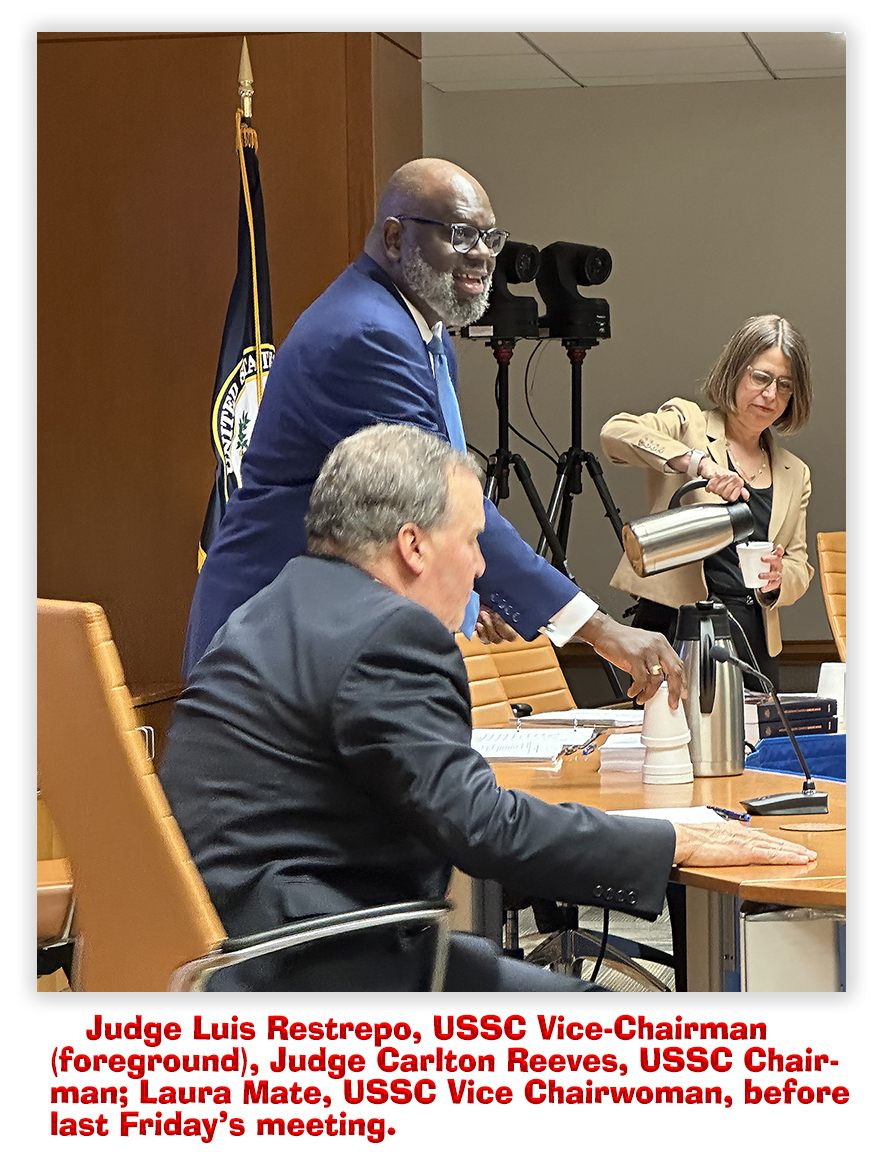
USSC250415With expectations high, last Friday, the Commission’s amendment year came to an end with a rather short and quite opaque public meeting, unbecoming given the importance of the issues at stake and the process leading up to it. There were votes on amendment proposals for sure, but almost no explanation from commissioners for the consequential choices they were making. It turned out to be quite a disappointment.

First, there was no discussion of the Commission’s thinking and how it arrived at its decisions. The Commission spent two and half days in deliberations behind closed doors, and then in a public meeting of less than a half hour, explained nothing of how those deliberations resulted in the actions taken and not taken. Judges, practitioners, Members of Congress, advocates, inmates, family members, and academics spent countless hours developing and submitting written comments to the Commission, and there was virtually no explanation of how those comments were considered. Second, the Commission in the end did not even address the categorical approach. No matter how many times the Commission places the issue on its priorities – and it has over and again for over a decade – it just can’t seem to find a fix. And again, no explanation.

Third, the Commission did not address the unwarranted disparities in methamphetamine sentencing identified by numerous commentors. This seemed especially perplexing given Judge Reeves’ own detailed decision in United States v. Robinson, holding that the methamphetamine purity enhancement had ceased to have any meaning. And again, no explanation. Fourth, the Commission made no fundamental reform to the drug guideline or to Step One of any other guideline. It did take steps to ensure that drug offenders who play a mitigating role are not over-punished. But the Commission has tried this before – numerous times, in fact – and it is far from clear that the steps taken will make a significant difference in drug sentencing policy.

I seldom quote at such length from another work, but Mr. Wroblewski’s Substack is worthy of it, and in fact is worthy of a full read by anyone affected by the Sentencing Commission’s work.

U.S. Sentencing Commission, Amendments to the Sentencing Guidelines (Preliminary) (April 11, 2025)

WHNT, U.S. Sentencing Commission approves revisions to federal sentencing guidelines (April 11, 2025)

Jonathan Wroblewski, Sentencing Matters Substack (April 14, 2025)

– Thomas L. Root

5th Circuit Finds Sentencing Commission Mitigating-Role Amendment to be ‘Clarifying’ – Update for May 25, 2017

We post news and comment on federal criminal justice issues, focused primarily on trial and post-conviction matters, legislative initiatives, and sentencing issues.

LISAStatHeader2small
 I’M ONLY THE PIANO PLAYER

whore170525When a cop stopped Frank Sanchez-Villarreal in Texas., he found six kilos of coke and a gun. Frank admitted that he had been hired by someone he only knew as “Chaparro” to deliver the cocaine to someone he did not know, for which he would be paid $1,000.00. He said the guy who hired him had given him the gun for protection.

At sentencing, Frank’s lawyer argued that he should get a 2-level mitigating-role adjustment under the sentencing Guidelines for having played a lesser part in the drug trafficking than the average conspirator. He argued that Frank was just a “standard ‘mule’” who had been ordered to transport drugs without knowing the end location or coordinating the drug trafficking. If the conspiracy had been a whorehouse, his lawyer argued, Frank was only the piano player.

The district judge reluctantly concluded that Frank’s conduct did not warrant the USSG Sec. 3B1.2 mitigating-role adjustment. She said she “probably had some disagreement with the guidelines,” but while Frank “may be not the person gaining the most financially from this, but – but he is – I’m hesitating to use the word “critical,” but I’ll go ahead and use the word “critical.” He is critical to the operation as far as moving the drugs, and – and also, especially here, where by his own admission this was the second time he’d done this – and in that regard I do consider that, his admission – he’s –he’s entrusted, obviously to get this work done.”

mule170525While Frank’s appeal was pending, the Sentencing Commission adopted Amendment 794, and changed the commentary to 3B1.2. The changed commentary makes it clear that the standards for a minor-role adjustment are not as stringent as a number of courts had said they are. In particular, the Commission added this:

The fact that a defendant performs an essential or indispensable role in the criminal activity is not determinative. Such a defendant may receive an adjustment under this guideline if he or she is substantially less culpable than the average participant in the criminal activity.

The Commission said it made the change because courts had been denying mitigating-role adjustments solely because defendants were “integral” or “indispensable” to the criminal activity. The Commission explained that such a standard was inconsistent with the primary issue of relative culpability. The Amendment Commission was intended to address a circuit split as to what an “average participant” might be.

This week, the 5th Circuit agreed with Frank that he should be considered for the 2-level reduction. In so doing, the Circuit held it could consider Amendment 794, even though it was “not effective at the time of the commission of the offense or at the time of sentencing” because it was intended only to clarify, rather than effect substantive changes.

Bit170525The 5th joined three other circuits agreed with the parties that Amendment 794 is a clarifying amendment. In determining whether a Guidelines amendment is clarifying or substantive, a court looks (1) whether the Commission declared the amendment to be clarifying; (2) whether the amendment is intended to address a circuit split (which generally indicates that the amendment is substantive, not clarifying); (3) whether the amendment was made retroactively applicable by the Commission; and (4) whether the amendment alters the language of the commentary rather than the language of the Guideline itself (which may suggest that it is clarifying). Because Amendment 794 altered the text of the commentary but not the guideline itself, and because the change was to better reflect the Commission’s intent and provide “additional guidance to sentencing courts,” Amendment 794 was clarifying.

The Circuit concluded the district judge erred in her application of Sec. 3B1.2 “by giving conclusive weight to the finding that Sanchez-Villarreal’s role was ‘critical’.” After that conclusion, the district court did not consider whether, despite playing a critical role, Frank was “substantially less culpable than the average participant in the criminal activity.” Because his culpability is the central issue in a 3B1.2 reduction, Frank was entitled to resentencing where that issue would be resolved.

United States v. Sanchez-Villarreal, Case No. 15-41303 (5th Cir., May 23, 2017)

– Thomas L. Root

LISAStatHeader2small