We post news and comment on federal criminal justice issues, focused primarily on trial and post-conviction matters, legislative initiatives, and sentencing issues.

REST IN PEACE, FRED BARDELL
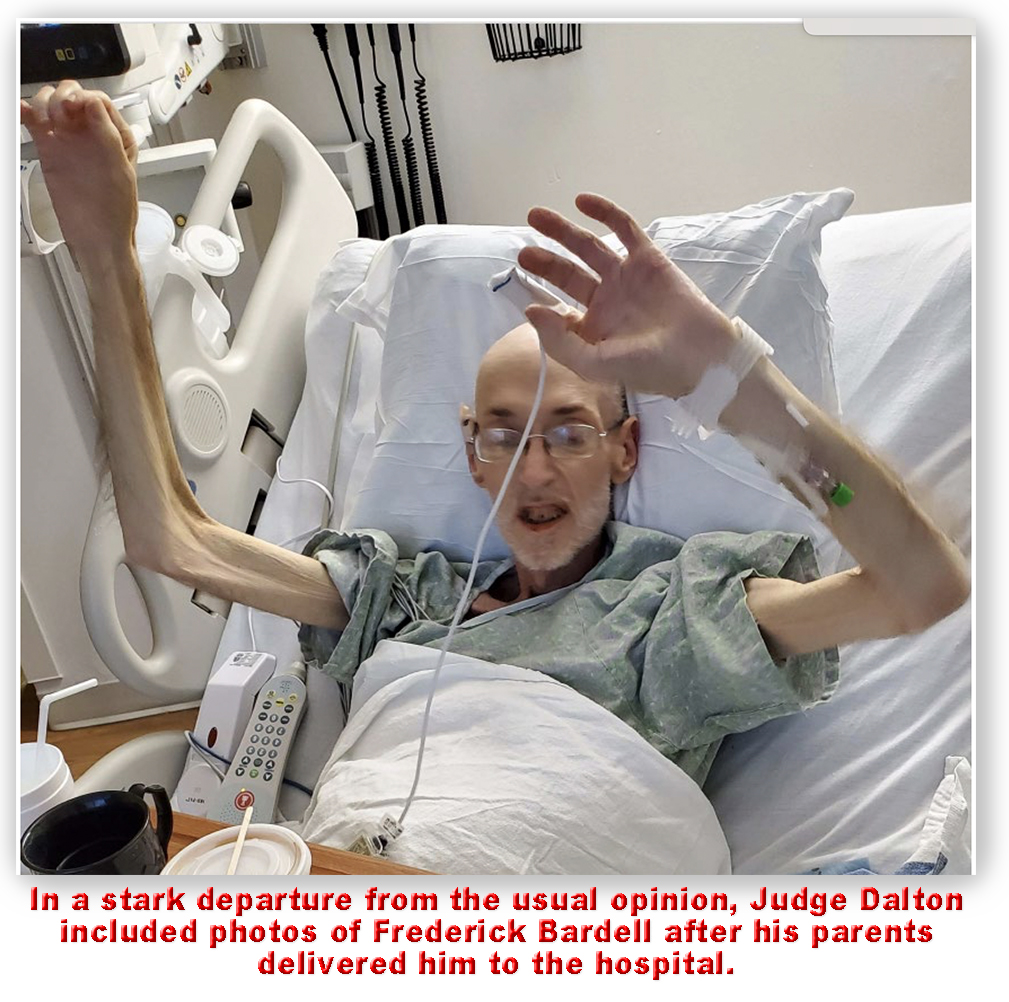 Do you remember Frederick Bardell?
You should not forget him.
Mr. Bardell was a BOP prisoner whose medical and release mistreatment by the Federal Bureau of Prisons were acts, as described by U.S. District Court Judge Roy Dalton (Middle District of Florida) in an October 2022 Order, “indifferent to… human dignity.”
Fred was housed at FCI Seagoville when he developed an intestinal mass that turned into metastatic colon cancer. Although a BOP medical expert determined that Fred “ha[d] a high likelihood” of having colon cancer “with likely metastasis to the liver,” the BOP did nothing.
An outside specialist said later that if Fred had gotten prompt treatment when the mass was first found, he would have had a 71% chance of recovery. But prompt treatment is simply not how BOP healthcare rolls.
As LISA reported at the time, Fred’s first compassionate release motion (filed under 18 USC § 3582(c)(1)(A)) was denied after the BOP falsely assured the court that Fred could receive adequate care in custody. Judge Dalton later wrote, “As we now know, it was not true that Mr. Bardell could receive adequate care in custody. And, regrettably, his condition was indeed terminal.”
Fred’s second compassionate release motion filed three months later – supported by an affidavit from an oncologist that Fred was likely dying of cancer – was granted. The Court ordered him released as soon as the Probation Office and Fred’s attorney worked out a release plan.
The BOP didn’t wait for a release plan. After forcing Fred’s parents to pay $500 for an airline ticket, the BOP dumped Fred – who by then was “skin and bones, wheelchair dependent, and bladder and bowel incontinent” – on the airport curb without even a wheelchair. Only with the aid of strangers was Fred able to get on the plane, change planes in Atlanta, and arrive, his clothes soaked with blood and feces, in Jacksonville. His parents took him straight to a hospital, where he died nine days later.
Judge Dalton was outraged, holding the Seagoville warden in contempt, not for the negligent medical care but for the heartless way the prison dumped Fred at the airport:
The BOP as an institution and Warden Zook as an individual should be deeply ashamed of the circumstances surrounding the last stages of Mr. Bardell’s incarceration and indeed his life. No individual who is incarcerated by order of the Court should be stripped of his right to simple human dignity as a consequence.
The judge found that the BOP’s actions were “inconsistent with the moral values of a civilized society and unworthy of the Department of Justice of the United States of America.”
 A special master appointed by Judge Dalton confirmed that prison officials allowed an incarcerated man to waste away from highly treatable cancer and misrepresented key facts about his health care to a court. After that, the judge referred the matter to the DOJ Office of the Inspector General.
Last week, the Inspector General concluded that “serious failures by multiple levels of staff” at Seagoville led to Fred’s death from colon cancer. The OIG “identified job performance and management failures at multiple levels within FCI Seagoville, from line staff through the Warden. We also identified problems with the BOP’s medical care of inmates, handling of compassionate release requests due to medical circumstances, and handling of compassionate release orders.”
The OIG found that severe understaffing led to six months of delays in scheduling a colonoscopy for Fred, despite symptoms, tests, and scans showing that he likely had advanced colon cancer. As his condition worsened, staff denied his requests for a compassionate release without fully reviewing his medical records and then misrepresented the adequacy of treatment he was receiving to a federal judge. And when that judge finally ordered Bardell’s release, no fewer than nine BOP officials and employees failed to read the court’s order and thus violated the Judge’s directive to wait until a release plan had been approved. The Report said, “The hastiness of the BOP’s handling of Bardell’s release was extremely concerning because the BOP did not take measures to ensure his safe and compassionate transport in light of his medical condition.”
The OIG also said that “the BOP’s handling of Bardell’s request for a reduction in sentence [RIS] was deficient, and the government’s related representations to the Court that there was ‘no indication’ that Bardell could not ‘receive adequate care in custody’ were inconsistent with what we learned during the course of our investigation and review.”
The canard that a compassionate release is unnecessary because there is ‘no indication’ that an inmate cannot ‘receive adequate care in custody’ is one common to government oppositions to medical-condition compassionate release RIS requests. The OIG tears the fig leaf from these representations. In Fred’s case, the Inspector General’s report found,
that the government’s inaccurate representations were the result of the government’s reliance on the BOP’s RIS decision, which we found to be based on a seriously deficient process within the BOP, and [Assistant United States Attorney Emily C. L.] Chang’s honest, although nonexpert, understanding of the limited records provided by the BOP. While we believe that it would have been prudent for Chang to consult with BOP medical professionals, other BOP employees, or other medical experts to better understand the BOP medical records, Bardell’s medical condition, and the BOP’s ability to care for him, we noted that Department procedures in place at the time did not require her to speak with such individuals.

Those familiar with litigation involving BOP conduct are all too aware of the government’s unquestioning reliance on the Bureau’s ipse dixit pronouncements. Whether the OIG’s implicit doubt that doing so is appropriate will change anything is probably unlikely.
DOJ OIG, Investigation and Review of the Federal Bureau of Prisons’ Conditions of Confinement and Medical Treatment of Frederick Mervin Bardell and Related Representations to the Court, Upon Referral by Senior U.S. District Judge Roy B. Dalton, Jr. (January 6, 2026)
Reason, Inspector General Report Finds Serious Failures Led to an Inmate Wasting Away From Treatable Cancer (January 6, 2026)
New York Times, Judge Holds Prison Officials in Contempt for Treatment of Terminally Ill Inmate (October 13, 2022)
LISA, BOP Mistreatment of Inmate Dying of Cancer Sparks Outrage (October 17, 2002)
~ Thomas L. Root