We post news and comment on federal criminal justice issues, focused primarily on trial and post-conviction matters, legislative initiatives, and sentencing issues.

SUPREME COURT REFUSES TO WADE INTO 2241 DEBATE
Last Monday’s Supreme Court orders list carried good news for people waiting on a certiorari decision on the 4th Circuit’s United States v. Wheeler case. But for those who would like to see the 2255(e) debate put to bed, the day brought nothing but bad news.
 Everyone convicted of a federal crime has the right to petition for a writ of habeas corpus, a procedure intended to protect defendants from denial of their constitutional rights. Traditional habeas corpus is governed by a statute, 28 USC § 2241. However, Congress has directed federal defendants seeking to challenge their convictions or sentences to a special habeas corpus statute, 28 USC § 2255, which spells out what kind of showing must be made in order to obtain relief, and when and how that showing is permitted. To prevent abuse of the 2255 procedure, the law prevents any defendant from filing more than one such motion except under the most restricted of circumstances.
But not all circumstances can be foreseen. For that reason, Congress included 28 USC § 2255(e), which provides that a federal defendant may use the classic route, 28 USC § 2241, when it “appears that the remedy by [2255] motion is inadequate or ineffective to test the legality of his detention.” This subsection has become known as the “savings clause.”
 A number of years ago, Gerald Wheeler was convicted of federal drug trafficking and gun charges. His drug and gun possession sentences were increased dramatically because he had a prior North Carolina drug felony.
Except, due to a unique sentencing law on North Carolina’s books at the time, Gerry’s state drug conviction really was not a felony, because the maximum sentence he could have gotten was undera year. The 4th Circuit had gotten that wrong in hundreds of cases, but finally set it right in 2011 with United States v. Simmons, which held that hundreds of state convictions like Gerry’s really weren’t felonies after all. But Simmons came too late for Gerry, whose 2255 motion had already been heard and denied. Believing that the “safety clause” was intended for this kind of situation, Gerry filed a traditional § 2241 habeas corpus petition. Up to this point, the “savings clause” had been held to apply only where a change in statutory interpretation (like Simmons) resulted in the petitioner being actually innocent of a criminal offense. Gerry was not claiming that. Instead, he said he was actually innocent of the sentence, not of the underlying conviction. The district court said that kind of actual innocence didn’t count, and denied Gerry’s motion.
In a big victory for defendants, the 4th Circuit reversed, holding for the first time that the § 2255(e) savings clause could be invoked if at the time a defendant was sentenced, precedent made the sentence legal, but after the prisoner’s appeal and § 2255 motion, the settled substantive law changed and was held to be retroactive.
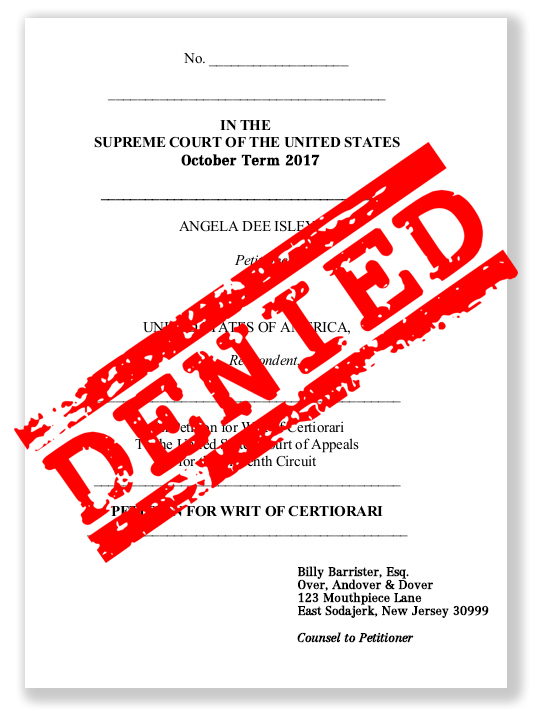
The government did not much like the 4th Circuit’s decision, and thus petitioned the Supreme Court to review Wheeler. Typically, SCOTUS takes government requests for certiorari very seriously, but last Monday the Court refused the government’s request.
 Wheeler is at last final, which is great news for people who happen to be locked up in prisons located in the 4th Circuit. If you are in other circuits, your prospects may be dimmer. If you’re housed in the 10th or 11th Circuit – neither of which believes that the § 2255(e) “savings clause” has any meaning whatsoever – you are just plain out of luck.
The not-so-great news: Three other requests for review of the “safety clause” were also denied last week, Lewis v. English, Delancy v. Pastrana, and Dusenbery v. Holt. Lewis (10th Cir.) and Delancy (11th Cir.) argued that those Circuits are wrong, and a prisoner should be allowed to file a § 2241 petition to raise arguments that were foreclosed by binding circuit precedent at the time of his or her original § 2255 motion, but that are meritorious in light of a subsequent decision overturning that precedent. Dusenbery (3rd Cir.) argued that a § 2241 petition filed under the 2255(e) savings clause should be able to raise actual innocence of sentence (like Wheeler successfully did) as well as innocence of conviction.
All of the petitions were relisted (reconsidered by the Justices) multiple times before being denied. The website SCOTUSBlog noted of the Wheeler denial that “it’s somewhat unexpected for the court to reject a government petition on an obviously recurring issue. But the government in Wheeler and the petitioner in Lewis each claimed that their case was the only good vehicle, and apparently they succeeded in persuading the court that all the vehicles were bad.”
The Supreme Court looks for a case with facts and arguments that make it well suited for a decision that will sweep broadly. It apparently decided that none of the four met that standard. The issue will continue to arise, and I think the Court will eventually take it up. But for now, people needing the relief that only a § 2241 petition can provide will be victims of geography.
United States v. Wheeler, Case No. 18-420 (cert. denied Mar 18)
Lewis v. English, Case No. 18-292 (cert. denied Mar 18)
Delancy v. Pastrana, Case No. 18-5772 (cert. denied Mar 18)
Dusenbery v. Holt, Case No. 18-5781 (cert. denied Mar 18)
SCOTUSBlog.com, Relist Watch (Mar. 20)
– Thomas L. Root