Tag Archives: GAO

Shocking News from GAO! BOP Has Messed Up FSA Placement! Who’d Have Guessed? – Update for February 17, 2026

We post news and comment on federal criminal justice issues, focused primarily on trial and post-conviction matters, legislative initiatives, and sentencing issues.

GAO PAINTS PICTURE OF DEADBEAT BOP’S CHAOTIC HALFWAY HOUSE MANAGEMENT

The Government Accountability Office painted a bleak picture of the Bureau of Prisons’ halfway house placement program, a chaos of mismanagement that deprives inmates of First Step Act credits they have earned and halfway house operators of payments they are owed.

The 7-year-old First Step Act encourages federal prisoners to complete programs proven to reduce recidivism by promising them earned time credits that can shorten sentences and extend their time in prerelease custody in Residential Reentry Centers or RRCs (which we know as halfway houses) and on home confinement. Writing in Forbes last week, Walter Pavlo said, “Lawmakers understood what correctional professionals have long known. The last months of a sentence should focus on reconnecting people to jobs, housing, and families, not warehousing them in prison.”

Reality, however, is muted. The GAO reports that not only has the BOP not consistently moved eligible inmates into halfway houses on time, but often, the BOP does not even know how many people are eligible for and entitled to placement.

The Report said that “BOP officials said they do not know because the dates individuals are eligible to transfer are not readily available… GAO found that BOP did not apply all the earned time toward placement in RRCs and home confinement for 21,190 of 29,934 individuals reviewed, for reasons such as insufficient RRC capacity and court orders. However, the full scale of this issue is unknown due to the lack of readily available data on eligibility dates.”

The problem has been due in part to limited capacity in BOP-contracted halfway house and home confinement spaces, BOP officials told GAO. However, the Report stated, “BOP does not know the full extent of this shortage because it has not comprehensively assessed its capacity and related budgetary needs. Without these assessments, BOP cannot ensure it has enough space for incarcerated individuals to transfer on time. BOP could also miss opportunities to increase revenues and decrease costs to the federal government.”

As of September 30, 2024, the BOP was using 91% of its contracted halfway house beds and 121% of its contracted home confinement space. A full 38% of halfway houses were at or above 95% capacity, and 62% were at or above the 95% capacity for halfway house slots. In fairness to the BOP, since William K. Marshall III assumed the Director’s slot, the agency has prioritized home confinement through the alternative Federal Location Monitoring program, managed by the US Probation Office instead of halfway house staff.

GAO also found that the BOP has been a deadbeat on a scale that would get a defendant on supervised release sent back to prison. From 2022 through March 2025, the Bureau “made roughly 65,000 late payments to contractors, including to RRCs,” according to the Report. “As a result, the agency paid $12.5 million in interest penalties as part of $2.8 billion in payments to contractors. In addition, GAO found that BOP paid RRCs late about 70% of the time, from fiscal years 2023 through 2024.”

It should be unsurprising that halfway houses would be less than enthusiastic about working with the BOP to expand their businesses: the Report said that as a result of late payments, halfway houses “face hardships due to the late payments — needing private loans to pay staff. One halfway house representative said late payments have made some halfway houses reluctant to bid for new BOP contracts, which can further complicate BOP’s plans to expand capacity.”

Pavlo wrote, “The BOP understands that it has a problem and after years of not addressing it now realize that the solution is going to take time.” A BOP spokesman said, “[T]he Bureau has actively posted Requests for Information… in more than 20 locations nationwide to expand RRC and home confinement services… With respect to home confinement, the Bureau is transferring individuals as quickly as possible once they reach their Home Confinement Eligibility Date and meet all statutory and public safety criteria. We are committed to ensuring individuals are not held longer than necessary when they are appropriate for home confinement placement.”

Government Accountability Office, Bureau of Prisons: Actions Needed Better Achieve Financial and Other Benefits of Moving Individuals to Halfway Houses on Time (February 11, 2026)

Forbes, GAO Critical of Bureau of Prisons Use of Halfway Houses (February 12, 2026)

~ Thomas L. Root
GAO Finds BOP Employee Misconduct Process Flawed – Update for October 7, 2025

We post news and comment on federal criminal justice issues, focused primarily on trial and post-conviction matters, legislative initiatives, and sentencing issues.

JUSTICE DELAYED’: BOP MISCONDUCT RESOLUTION SYSTEM FLAWED, GAO SAYS


The Government Accountability Office, a congressional agency, issued a report last week criticizing the Federal Bureau of Prisons’ backlog of over 12,000 unresolved employee misconduct complaints.

The BOP received 15,000 employee misconduct allegations last year alone, with beefs ranging from unexcused absences to inmate abuse. The most frequent allegations involved charges of unprofessional conduct or failure to follow policies. Other common allegations claimed employees were absent without leave or failing to follow a supervisor’s instructions. These kinds of accusations have increased during the last 10 years.

Criminal misconduct made up about 14% of allegations lodged in the last decade, allegations of physical and sexual abuse such as those at FCI Dublin, which have resulted in seven convictions so far. But, as of last February, the BOP had more than 12,000 employee misconduct cases awaiting investigation or discipline.

The GAO report noted that the BOP had hired more investigators and taken other steps to reduce the number of open cases. However, the Report found, the BOP “continues to miss its own goals for reducing the backlog of cases and doesn’t have a plan for meeting those goals.”

Bureau officials told GAO that the longer a misconduct case drags on, the more difficult it is to hold employees accountable. As time passes, the employee who is the subject of the complaint “may not remember the details of the incident when investigators question them. Or the employee might leave the bureau before being disciplined.” About 37% of the 12,153 cases open as of February 2025, had been unresolved for three years or longer.

The Report also found that while the BOP collects data on employee misconduct and compares the information from year to year, it doesn’t track misconduct trends across longer periods. “This means the Bureau is missing opportunities to identify trends and address them,” the GAO said.  Also, while the BOP trains employees to prevent misconduct, it doesn’t use their feedback to evaluate the training’s effectiveness.

The BOP was once again on the GAO’s High Risk List for 2025 because of crumbling facilities and threats to prison safety posed by understaffing (which, last week’s Report notes, “can exacerbate employee misconduct. To ensure that incarcerated people are treated humanely and keep its facilities secure, the bureau needs to address these issues and improve its approach to holding employees accountable.”

The Wall Street Journal last week argued that the BOP’s decertification of the 30,000-member employees’ union will help with misconduct allegations. The Journal said, “One of the strongest arguments against prison-guard unions is their role in shielding abusive officers from discipline. In some cases, the unions have ‘frustrated and undermined accountability,’ David Fathi, director of the American Civil Liberties Union National Prison Project, has said.”

After the FCI Dublin sexual abuse scandal, both prisoners and staff said union interference delayed corrective action. Seven of eight corrections officers charged with sex abuse crimes pled guilty or were convicted by juries, according to news reports. At the trial of the eighth officer, the local union president testified that the union abhorred “dirty officers” but claimed the defendant – Darnell “Dirty Dick” Smith, who was charged with 15 sex crimes against women inmates – was accused in retaliation by prison managers for speaking up about their alleged misconduct.

At USP Thomson in 2022, union resistance thwarted a new warden’s plan to fire violent officers. In January 2023, the union called for the warden to be canned for failing “to address the rampant sexual assault and misconduct of employees by inmates.” Some correctional officers tried to persuade inmates to assault the warden.

One BOP inmate told The Marshall Project earlier this year: “On a day-to-day basis, the union is a threat to the well-being of most inmates. It’s what guarantees that the officer who beats you will get away with it.”

Writing in Forbes last week, Walter Pavlo said, “Employee misconduct in federal prisons has consequences that ripple far beyond the individuals directly involved. For incarcerated people, misconduct can lead to harm, abuse, and violations of their basic rights. For staff, it can create a work environment where trust erodes and morale declines. The BOP has consistently ranked last in employee satisfaction, and the recent demise of their union has, for the moment, been troubling for many frontline staff. For the institution as a whole, unresolved allegations undermine legitimacy and weaken public confidence in the system. Legal and financial risks also rise, as cases of abuse or negligence can result in costly lawsuits and federal scrutiny.”

GAO, Bureau of Prisons: Strategic Approach Needed to Prevent and Address Employee Misconduct (GAO-25-107339, September 29, 2025)

Wall Street Journal, Trump Fires the Prison-Guard Union (October 4, 2025)

Forbes, Study Critical Of Bureau Of Prisons Investigating Misconduct (October 1, 2025)

GAO, High-Risk Series: Heightened Attention Could Save Billions More and Improve Government Efficiency and Effectiveness (GAO-25-107743, February 25, 2025)

KTVU-TV, Former FCI Dublin officer charged with sex abuse provides witness list (September 10, 2025)

~ Thomas L. Root

There Once Was an Inmate Who Lived in a SHU – Update for February 12, 2024

We post news and comment on federal criminal justice issues, focused primarily on trial and post-conviction matters, legislative initiatives, and sentencing issues.

GAO EXCORIATES BOP FOR INEFFECTIVE AND POORLY MANAGED SPECIAL HOUSING UNITS

The Federal Bureau of Prisons says restrictive housing – that is, Special Housing Units (SHUs) – is not an effective deterrent for bad behavior and can even increase future misconduct. So guess who still keeps 12,000 of its “persons in custody” locked up 23 hours a day in SHUs around the country?

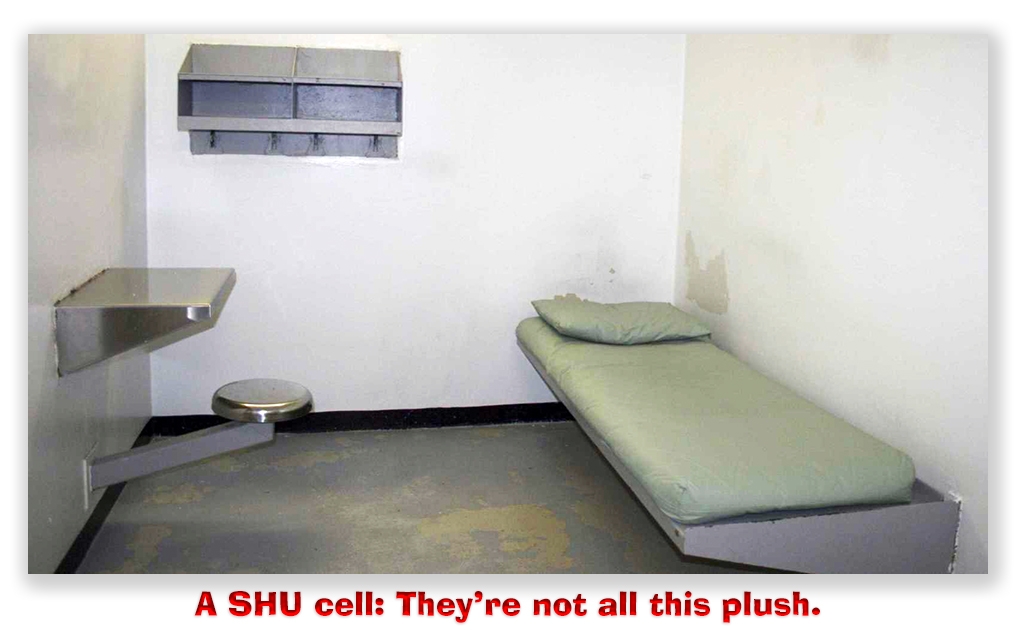
shucell240212A Government Accountability Office report wondered that last week, complaining that “while the BOP was previously called out for the practice of SHU placement of prisoners, little has changed.” The GAO criticized the BOP for its “slow progress toward taking action on longstanding recommendations, partly because the Bureau hasn’t established roles or time frames for doing so.” In fact, how the BOP monitors and evaluates all of its programs is such a problem that the GAO added the agency to the GAO’s High-Risk List annual update issued last April. It’s unlikely to be dropped from the 2024 list, due out in two months.

A SHU is a “housing unit” in name only, a warren of individual cells – some of the barred like old-time jails but more modern ones with solid metal doors with a small port through which food can be passed. The SHU residents – sometimes two to a cell, sometimes only one, are locked down 23 hours a day according to policy and removed from the cells only when handcuffed. A “recreation area” is usually a larger cage, sometimes with a basketball hoop, where often only the sky is visible. Inmates get a shower three times a week. There are no TVs, often no radios, scant reading material, and absolutely nothing to do.

“The management of federal prisons, including the use of restrictive housing, requires immediate attention,” the GAO found. “This issue is so pressing that, in 2023, Addressing these issues will enhance the Bureau’s approach to improving and ultimately reducing its use of restrictive housing.”

The BOP’s problems with its management of SHUs are nothing new. A Dept of Justice study a year ago criticized the BOP’s failure to reduce the number of SHU inmates. In a year, nothing improved.

dungeon180627Writing in Forbes last week, Walter Pavlo said, “The primary purpose of SHU is for disciplinary reasons. Disciplinary segregation is a punitive housing status imposed as a sanction for violating a disciplinary rule… However, SHU has been used for those under investigation for a disciplinary violation, protective custody (fear of being assaulted by fellow prisoners), pending transfer to another institution, or to protect a prisoner at the end of their disciplinary confinement term to prevent them from being assaulted on returning to general population.”

During the pandemic, prisoners testing positive for COVID were often isolated in the SHU, a practice that court-appointed expert Homer Venters, M.D., observed that locking COVID inmates in the SHU “runs counter to CDC guidelines on making COVID-19 responses in detention settings non-punitive” and resulted in prisoners with COVID symptoms to hide those from staff in order to avoid the SHU.”

“Some prisoners can be in SHU for months with little communication with the outside world and hardly a recreation outside of the cell in which they are confined,” Pavlo wrote. “While prisoners may be in SHU for these administrative reasons, it certainly feels like punishment.”

shit240212The GAO recounted that SHU inmates had complained that they felt hungry “because meal portions were insufficient or were smaller than the meals provided in general population.” Others reported that recreation time was much less frequent than policy dictated. “One individual,” the GAO reported, “said that facility staff kept a toilet ‘full of excrement’ in one of the SHU cells to use as a punishment and then directed an orderly to clean it before a visit from the regional director.”

Senate Majority Whip Richard Durbin (D-IL), chairman of the Judiciary Committee, said the GAO report “shows a troubling trajectory for the number of federal prisoners in restrictive housing” and expressed concern that the “BOP has not fully implemented 54 of the 87 recommendations from two prior studies on improving restrictive housing practices.” One of those studies was commissioned at BOP’s own request in 2014, meaning that some of the unmet recommendations are a decade old. Other recommendations are from a 2016 DOJ report that, among other things, recommended that the BOP ensure people with serious mental illness conditions were not put in restrictive housing.

BOP Director Colette Peters responded to GAO’s report by asserting that the BOP knows restrictive housing is not an effective deterrent and can increase future recidivism. Pavlo reported that Peters said the BOP plans to reduce the use of disciplinary segregation – part of a new rule proposed in the Feb 1 Federal Register – and will conduct unspecified “other studies… to address the issues brought forward by GAO.”

GAO, Federal Prisons Haven’t Addressed Longstanding Concerns About Overuse of Solitary Confinement (February 6, 2024)

GAO, High-Risk Series: Efforts Made to Achieve Progress Need to Be Maintained and Expanded to Fully Address All Areas (April 20, 2023)

Dept of Justice, Department of Justice Efforts to Ensure that Restrictive Housing in Federal Detention Facilities is Used Rarely, Applied Fairly, and Subject to Reasonable Constraints (February 2023)

Homer Venters, M.D., COVID-19 Inspection of BOP Lompoc by Dr. Homer Venters, Dkt. NO. 101-1 (filed in Case No 2:20-cv-04450, CD Cal (September 25, 2020)

GAO, Bureau of Prisons: Additional Actions Needed to Improve Restrictive Housing Practices (February 6, 2024)

Forbes, GAO Releases Report On Federal Prisons’ Use Of Restrictive Housing (February 6, 2024)

Senate Committee on the Judiciary, Durbin Statement on GAO Report on BOP’s Continued Failure to Eliminate Overuse of Solitary Confinement (February 6, 2024)

– Thomas L. Root

“Code Blue” At BOP, GAO Says – Update for April 28, 2023

We post news and comment on federal criminal justice issues, focused primarily on trial and post-conviction matters, legislative initiatives, and sentencing issues.

GAO PUTS BOP ON CRITICAL LIST

The Government Accountability Office last week added the BOP to its “high risk” list of “government operations with vulnerabilities to fraud, waste, abuse, and mismanagement, or in need of transformation.”

criticalcondition230428Federal prisons were the only program added to the 2023 list, which is updated every two years. The GAO has seen “good progress in certain areas due to congressional and executive branch actions, but there are still serious, very consequential problems that need to be addressed,” GAO head Gene Dodaro recently told the Senate Homeland Security and Governmental Affairs Committee. “We’re adding management of the Bureau of Prisons, there’s been problems with staffing, which has led to some concerns about inmate and staff safety and also their efforts to evaluate programs that are intended to help deal with the recidivism issue.”

GAO first identified BOP management as an “emerging high-risk issue” in March 2021. Since then, GAO reports, the BOP has addressed 22 GAO recommendations, leaving 28 recommendations still on the table. What’s more, Charles Johnson, managing director of GAO’s homeland security and justice team, told Congress the BOP’s staffing level remains down 15%.

Speaking of management failings, the Associated Press reported last week that an inmate whose death sentence was commuted in 2019 remains housed on death row at USP Terre Haute.

deathrow230428Four years later, AP reported, the BOP has not moved him to a less restrictive unit. Asked about the prisoner’s continued placement on death row, a Dept of Justice official told AP that “the Bureau of Prisons is considering [the inmate’s] designation determination.”  At least the BOP is taking the time to carefully consider whether someone without a death sentence should be housed somewhere other than death row.

AP said that the case “illustrates chronic bureaucracy in the prisons system and the difficulties in getting anyone off death row.”

“How can I not get this guy off death row?” federal defender Monica Foster said in a recent interview. “Well, I did get him off death row. But why can’t I physically get him off death row?”

Meanwhile, after a recent disturbance at FCI Miami, a BOP low-security facility, Miami TV station WTVJ reported, “multiple sources from inside the facility [said] that more than 100 weapons were found…” A prison security expert told the station, “Discovering a hundred weapons in a search following something like this would signal the administration. It would signal me, if I were the administrator, to look into my search processes.”

The station said that a 2019 Occupational Safety and Health Administration report likewise recommended that the BOP “increase number of searches for weapons, cellphones and contraband.”

cellphones230428Last week, the BOP fired a shot across the bow at illegal cellphones, as ubiquitous in prisons as spring flowers in the garden. The U.S. Attorney for the Eastern District of North Carolina said that six inmates housed at three different facilities at the FCC Butner complex have been criminally charged with possession of contraband cell phones.

If convicted, each inmate faces up to an extra year of prison for possessing a cellphone and disqualification for First Step Act credits and the 365 days sentence credit for eligible programming participation.

U.S. Attorney Michael Easley said, “By indicting these six inmates at FCC Butner, we hope to send a clear message to the inmate population that the possession of cellphones will never be tolerated at FCC Butner.”

Govt Executive, Management of the Federal Prisons System Is Added to GAO’s High-Risk List (April 20, 2023)

GAO, Efforts Made to Achieve Progress Need to Be Maintained and Expanded to Fully Address All Areas (April 20, 2023)

AP, Inmate stuck on US death row despite vacated death sentence (April 16, 2023)

WTVJ, Video Shows Disturbance That Led to Lockdown at Federal Correctional Institution in Miami (April 21, 2023)

DOJ, Six Federal Inmates Indicted for Contraband Cell Phones (April 20, 2023)

– Thomas L. Root