We post news and comment on federal criminal justice issues, focused primarily on trial and post-conviction matters, legislative initiatives, and sentencing issues.
BUT I REPEAT MYSELF…
A 149-page report issued Tuesday by the U.S. Sentencing Commission offers a fascinating, data-filled glimpse into recidivism by federal drug offenders.
 First, our criticism: the data are drawn from 10,000+ federal drug offenders who were either released or placed on probation during 2005. While a study on recidivism necessarily has to watch a cohort of people over a period of years, a lot has happened since 2005 that may change the accuracy of some of the findings.
For example, the study showed that among the 2005 releasees, methamphetamine offenses constituted just under 17% of all offenses. By 2015, about 31% of all drug offenders were methheads. The other concern is that all of the releasees would have been sentenced before United States v. Booker, and thus had mandatory Guidelines sentences. That leaves unanswered the question whether non-mandatory Guidelines sentences have a different influence on drug offender recidivism than did the old regime of mandatory Guidelines sentences.
 But our concerns do not materially lessen the benefit that the Report’s wealth of data confers on the sentencing debate. The overall finding is sobering: over an 8-year period, one half of the 2005 group of federal drug trafficking were rearrested for a new crime or a violation of supervised release conditions.
Some other findings:
• Crack cocaine offenders had the highest rate (61%) of recidivism of any drug type, while powder cocaine offenders had the lowest rate (44%);
• The median time from release to the first recidivism event was 25 months;
• Nearly one-fourth (24%) of recidivist drug trafficking offenders had assault as their most serious new charge, followed by drug trafficking and public order offenses at about 15% apiece;
• A drug trafficking offender’s criminal history was closely associated with the likelihood of recidivism, from a recidivism rate of 35% for offenders with no prior criminal history, to 77% for offenders in the highest criminal history. Interestingly, the Guidelines “career offenders” – whom policy dictates are supposed to represent the hardest-core offenders – had a recidivism rate of 63%, lower than three of the six other criminal history ranges;
• A federal drug trafficking offender’s age at time of release was closely associated with likelihood of recidivism. Drug trafficking offenders released prior to age 21 had the highest recidivism rate at 65%, while drug trafficking offenders over 60 years old at the time of release apparently retired, with a recidivism rate of only 16.5%;
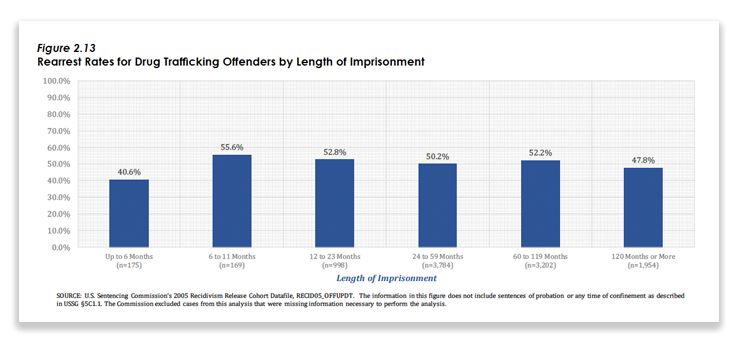
• There is little apparent association between the length of imprisonment and recidivism for drug trafficking offenders overall, a finding that supports other studies suggesting that no prison sentence over 5 years has any greater deterrent effect than a 5-year term. However, once criminal history is accounted for, length of imprisonment is associated with lower rates of recidivism (probably because of the older age of the prisoner when released).
• Federal drug trafficking offenders had a substantially lower recidivism rate compared to state drug offenders released around the same time. Over 76% of state drug offenders released from prison were rearrested within five years, compared to 42% of federal drug trafficking offenders released over the same five-year period.
The Report includes chapters breaking down the numbers according to the types of drugs in the offenders’ cases.
 There’s plenty of data in the Report for everyone. While only being released two days as of this writing, the Report is already being used by one inmate going back for resentencing and another 60+-year old offender on supervised release who wants the court to end his supervision early.
United States Sentencing Commission, Recidivism Among Federal Drug Trafficking Offenders (February 21, 2017)
– Thomas L. Root